1
Prepared by:
Arbab Younas
&
Qurat-ul-Ain
Working in Groups and Interper
sonal Skills.
Submitted to:
Sir Zaheer Ahmad
Assistant Professor
Minhaj University
Lahore
2
INTERPERSONAL SKILLS
3
Interpersonal skills
 Necessary for relating and working
with others
 Effective communication skills –
listening and expressing
 Ability to give and receive feedback
 Being able to work well in teams or
groups
4
Benefits
 Personal relationships
 Professional relationships
 Employment related skill
 Team or group work in college
 Learn about other perspective
s
 Share work load
Interpersonal skills include:
1. Communication skills: Following communication skills are included in
interpersonal skills:
a. Verbal Communication: what we say and how we say it;
b. Non-Verbal Communication: what we communicate without
words, for example through body language, or tone of voice; and
c. Listening Skills: how to interpret both the verbal and non-verbal
messages sent by others.
5
6
Interpersonal skills include:
2. Emotional Intelligence being able to understand and manage
your own and others’ emotions.
3. Working in Groups being able to work with others in groups and te
ams, both formal and informal.
4. Negotiation, Persuasion and Influencing skills working with others
to find a mutually agreeable outcome. This may be considered a s
ubset of communication, but it is often treated separately.
Interpersonal skills include:
5. Conflict resolution and mediation: working with
others to resolve interpersonal conflict and
disagreements in a positive way, which again may
be considered a subset of communication.
6. Problem solving and decision-making: working
with others to identify, define and solve problems,
which includes making decisions about the best
course of action.
7
8
Working with Others
Working in Groups.
9
Group work is a common situation, both at home and
at work, giving you plenty of opportunities to work on
the skills. It may be helpful to understand more about
group dynamics and ways of working, as these can aff
ect how both you and others behave. Conventionally a
cademics, communication, and management theorists
use the terms: group, group-working, group-interactio
n, group structure, etc. to refer to the dynamics of
people working together towards a common cause.
Working in Groups includes:
10
1. People who can identify with each other.
2.Sharing ideas, beliefs, and experiences of common areas.
3.People who frequently and regularly engage with each
other, agreeing on a purpose and working together on shared
tasks
4. People who recognize themselves and are recognized by
others as part of a group.
11
Benefits of learning in groups
 Experience, skills or knowledge of others
 Support, encouragement, responsibility
 Share work
 Increase understanding
 Differing perspectives
 Others?
12
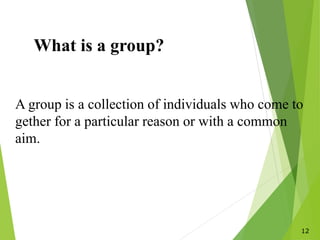
What is a group?
A group is a collection of individuals who come to
gether for a particular reason or with a common
aim.
13
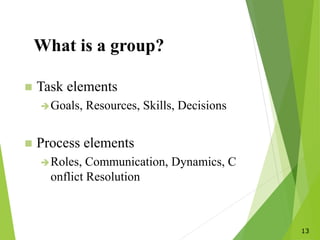
What is a group?
 Task elements
Goals, Resources, Skills, Decisions
 Process elements
Roles, Communication, Dynamics, C
onflict Resolution
14
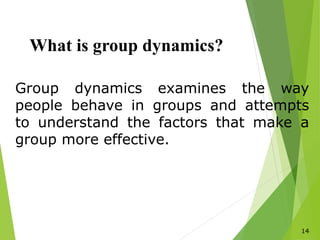
What is group dynamics?
Group dynamics examines the way
people behave in groups and attempts
to understand the factors that make a
group more effective.
15
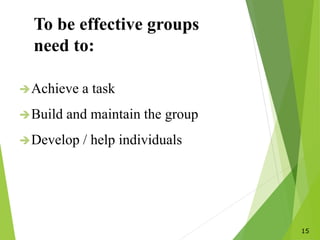
To be effective groups
need to:
Achieve a task
Build and maintain the group
Develop / help individuals
16
Effective groups:
Clear, relevant goals
Open communication
Cooperation
Members responsible for own behavior
Processes for decisions established
Problems confronted openly
Conflict resolved constructively
17
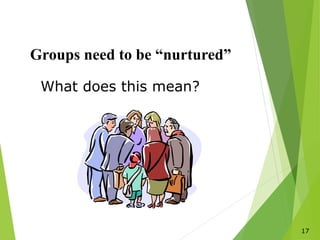
Groups need to be “nurtured”
What does this mean?
Characteristics of Working in
Groups:
Following traits are related to working in groups which are linked
with Interpersonal skills:
1. Sharpness drives work forward and get things done, has a clear
idea of the desired direction of travel.
2. Implementation related to getting things done, looking for ways
to turn talk into action and generate practical activity.
18
Characteristics of Working in Groups:
3. Completion focuses on completing tasks and tidying up all the loose ends.
4. Coordination manages the group dynamics, often in a leadership role.
5. Team Work intends to help the team to work effectively by supporting
personal relationships.
6. Resource Investigation gathers external resources and information to help
the team.
19
Characteristics of Working in Groups:
7. Planning generates ideas and creative solutions.
8. Monitoring and Evaluation related to good at critically assessing ideas
and proposals, and at making decisions.
9. Technical Specialization brings expert knowledge to the group, not
always necessary to effective functioning.
10.Cohesiveness is, in part, the measure of the success of the group.
20
Conclusion:
People with strong interpersonal skills tend to be able
to work well with other people, including in teams or
groups, formally and informally. They communicate
effectively with others, whether family, friends,
colleagues, customers or clients. They also have better
relationships at home and at work.
21
Reference:
Syed, S. Z., Abiodullah, M., & Yousaf, A. (2014). Assessing emotional
intelligence and interpersonal skills of university students as predictors of
employability. In 21st Century Academic Forum Conference at Harvard–
2014 Official Conference Proceedings (pp. 243-255).
Lopes, D. C., Gerolamo, M. C., Del Prette, Z. A. P., Musetti, M. A., & Del
Prette, A. L. M. I. R. (2015). Social skills: A key factor for engineering
students to develop interpersonal skills. International Journal of
Engineering Education, 31(1), 405-413.
Klein, C., DeRouin, R. E., & Salas, E. (2006). Uncovering workplace
interpersonal skills: a review, framework, and research agenda.
Interpersonal Skills Module 22

Presentation on Working in groups and Interpersonal Skills Final for Presenting.pptx

  • 1.
    1 Prepared by: Arbab Younas & Qurat-ul-Ain Workingin Groups and Interper sonal Skills. Submitted to: Sir Zaheer Ahmad Assistant Professor Minhaj University Lahore
  • 2.
  • 3.
    3 Interpersonal skills  Necessaryfor relating and working with others  Effective communication skills – listening and expressing  Ability to give and receive feedback  Being able to work well in teams or groups
  • 4.
    4 Benefits  Personal relationships Professional relationships  Employment related skill  Team or group work in college  Learn about other perspective s  Share work load
  • 5.
    Interpersonal skills include: 1.Communication skills: Following communication skills are included in interpersonal skills: a. Verbal Communication: what we say and how we say it; b. Non-Verbal Communication: what we communicate without words, for example through body language, or tone of voice; and c. Listening Skills: how to interpret both the verbal and non-verbal messages sent by others. 5
  • 6.
    6 Interpersonal skills include: 2.Emotional Intelligence being able to understand and manage your own and others’ emotions. 3. Working in Groups being able to work with others in groups and te ams, both formal and informal. 4. Negotiation, Persuasion and Influencing skills working with others to find a mutually agreeable outcome. This may be considered a s ubset of communication, but it is often treated separately.
  • 7.
    Interpersonal skills include: 5.Conflict resolution and mediation: working with others to resolve interpersonal conflict and disagreements in a positive way, which again may be considered a subset of communication. 6. Problem solving and decision-making: working with others to identify, define and solve problems, which includes making decisions about the best course of action. 7
  • 8.
  • 9.
    Working in Groups. 9 Groupwork is a common situation, both at home and at work, giving you plenty of opportunities to work on the skills. It may be helpful to understand more about group dynamics and ways of working, as these can aff ect how both you and others behave. Conventionally a cademics, communication, and management theorists use the terms: group, group-working, group-interactio n, group structure, etc. to refer to the dynamics of people working together towards a common cause.
  • 10.
    Working in Groupsincludes: 10 1. People who can identify with each other. 2.Sharing ideas, beliefs, and experiences of common areas. 3.People who frequently and regularly engage with each other, agreeing on a purpose and working together on shared tasks 4. People who recognize themselves and are recognized by others as part of a group.
  • 11.
    11 Benefits of learningin groups  Experience, skills or knowledge of others  Support, encouragement, responsibility  Share work  Increase understanding  Differing perspectives  Others?
  • 12.
    12 What is agroup? A group is a collection of individuals who come to gether for a particular reason or with a common aim.
  • 13.
    13 What is agroup?  Task elements Goals, Resources, Skills, Decisions  Process elements Roles, Communication, Dynamics, C onflict Resolution
  • 14.
    14 What is groupdynamics? Group dynamics examines the way people behave in groups and attempts to understand the factors that make a group more effective.
  • 15.
    15 To be effectivegroups need to: Achieve a task Build and maintain the group Develop / help individuals
  • 16.
    16 Effective groups: Clear, relevantgoals Open communication Cooperation Members responsible for own behavior Processes for decisions established Problems confronted openly Conflict resolved constructively
  • 17.
    17 Groups need tobe “nurtured” What does this mean?
  • 18.
    Characteristics of Workingin Groups: Following traits are related to working in groups which are linked with Interpersonal skills: 1. Sharpness drives work forward and get things done, has a clear idea of the desired direction of travel. 2. Implementation related to getting things done, looking for ways to turn talk into action and generate practical activity. 18
  • 19.
    Characteristics of Workingin Groups: 3. Completion focuses on completing tasks and tidying up all the loose ends. 4. Coordination manages the group dynamics, often in a leadership role. 5. Team Work intends to help the team to work effectively by supporting personal relationships. 6. Resource Investigation gathers external resources and information to help the team. 19
  • 20.
    Characteristics of Workingin Groups: 7. Planning generates ideas and creative solutions. 8. Monitoring and Evaluation related to good at critically assessing ideas and proposals, and at making decisions. 9. Technical Specialization brings expert knowledge to the group, not always necessary to effective functioning. 10.Cohesiveness is, in part, the measure of the success of the group. 20
  • 21.
    Conclusion: People with stronginterpersonal skills tend to be able to work well with other people, including in teams or groups, formally and informally. They communicate effectively with others, whether family, friends, colleagues, customers or clients. They also have better relationships at home and at work. 21
  • 22.
    Reference: Syed, S. Z.,Abiodullah, M., & Yousaf, A. (2014). Assessing emotional intelligence and interpersonal skills of university students as predictors of employability. In 21st Century Academic Forum Conference at Harvard– 2014 Official Conference Proceedings (pp. 243-255). Lopes, D. C., Gerolamo, M. C., Del Prette, Z. A. P., Musetti, M. A., & Del Prette, A. L. M. I. R. (2015). Social skills: A key factor for engineering students to develop interpersonal skills. International Journal of Engineering Education, 31(1), 405-413. Klein, C., DeRouin, R. E., & Salas, E. (2006). Uncovering workplace interpersonal skills: a review, framework, and research agenda. Interpersonal Skills Module 22

Editor's Notes