Welcome to
My Presentation on
Soil Solidification,
Soil Acidification,
Soil Alkalization,
Soil Pollution
Course Name: “Environmental Geochemistry”
Course Code: ESE-2203
Presented To:
Professor Dr. Ashraf Ali Seddique (sir)
Dept. of “Environmental Science & Engineering”
Jatiya Kabi Kazi Nazrul Islam University.
Presented By:
Mozakkir Azad
ID : 20103429
2nd year, 2nd semester
Dept. of Environmental Science & Engineering
Jatiya Kabi Kazi Nazrul Islam University.
01
SOIL
SOLIDIFICATION
SOIL
ACIDIFICATION
SOIL
ALKALIZATION
02
03
04
05
06
EFFECTS OF SOIL
SOLIDIFICATION SOIL POLLUTION
IMPORTANCE OF SOIL
TO THE BIOSPHERE
Contents
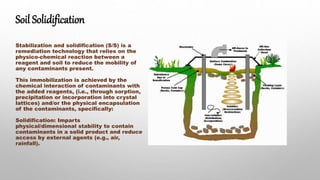
Stabilization and solidification (S/S) is a
remediation technology that relies on the
physico-chemical reaction between a
reagent and soil to reduce the mobility of
any contaminants present.
This immobilization is achieved by the
chemical interaction of contaminants with
the added reagents, (i.e., through sorption,
precipitation or incorporation into crystal
lattices) and/or the physical encapsulation
of the contaminants, specifically:
Solidification: Imparts
physical/dimensional stability to contain
contaminants in a solid product and reduce
access by external agents (e.g., air,
rainfall).
Soil Solidification
Advantages:
Short treatment time scale (compared to piles, monitored natural
attenuation MNA)
Can remediate a very wide range of contaminants or a mix of
contaminants
Environment Agency-approved methodology
In-situ or ex-situ applicable
Potential structural or geotechnical improvement in soils
Limitations:
Site-specific requires laboratory and pilot scale testing of contaminated
soils
Residual long-term liability, i.e., contaminant mass remains
Inhibitory substances (oils, free-phase solvents, etc) can limit success
Long-term performance can be difficult to demonstrate to stakeholders
Advantages and Limitations of Soil Solidification
EXCESSIVELY ACIDIC SOILS MAY LEAD TO A DRAMATIC DECLINE IN CROP AND PASTURE
PRODUCTION BECAUSE THE PH OF THE SOIL CHANGES THE AVAILABILITY OF SOIL
NUTRIENTS.
ACIDIC SOILS MAY HAVE SOME OR ALL OF THE FOLLOWING PROBLEMS:
* HELPFUL SOIL MICRO-ORGANISMS MAY BE PREVENTED FROM RECYCLING NUTRIENTS
(E.G. NITROGEN SUPPLY MAY BE REDUCED)
* PHOSPHORUS IN THE SOIL MAY BECOME LESS AVAILABLE TO PLANTS
* DEFICIENCIES OF CALCIUM, MAGNESIUM AND MOLYBDENUM MAY OCCUR
* THE ABILITY OF PLANTS TO USE SUBSOIL MOISTURE MAY BE LIMITED
* ALUMINUM, WHICH IS TOXIC TO PLANTS AND MICRO-ORGANISMS, MAY BE RELEASED
FROM THE SOIL
* LEVELS OF MANGANESE MAY REACH TOXIC LEVELS
* UPTAKE BY CROPS AND PASTURES OF THE HEAVY METAL CONTAMINANT, CADMIUM,
MAY INCREASE.
Effects of Soil Solidification
Soil acidification is a process where the soil pH decreases
over time. This process is accelerated by agricultural
production and can affect both the surface soil and
subsoil.
Some contributing factors to soil acidification include:
•the application of high levels of ammonium-based
nitrogen fertilisers to naturally acidic soils
•leaching of nitrate nitrogen, originally applied as
ammonium-based fertilisers
•harvesting plant materials (plant material is alkaline so
when it is removed the soil is more acidic than if the plant
material had been returned to the soil).
Soil Acidification
EFFECTS & SOLUTION OF SOILACIDIFICATION
Excessively acidic soils may lead to a dramatic decline in crop and pasture
production because the pH of the soil changes the availability of soil
nutrients.
Acidic soils may have some or all of the following problems:
• helpful soil micro-organisms may be prevented from recycling nutrients
(e.g. nitrogen supply may be reduced)
• phosphorus in the soil may become less available to plants
• deficiencies of calcium, magnesium and molybdenum may occur
• the ability of plants to use subsoil moisture may be limited
• aluminium, which is toxic to plants and micro-organisms, may be released
from the soil
• levels of manganese may reach toxic levels
• uptake by crops and pastures of the heavy metal contaminant, cadmium,
may increase.
There are a number of ways to minimise the soil acidification process,
including:
• the use of less acidifying farming practices—considered when soils show
signs of acidification
• applications of agricultural lime—applied to counter the acidification
SOIL ALKALIZATION
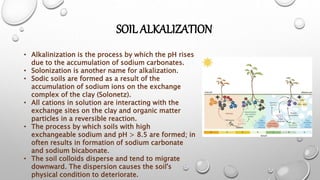
• Alkalinization is the process by which the pH rises
due to the accumulation of sodium carbonates.
• Solonization is another name for alkalization.
• Sodic soils are formed as a result of the
accumulation of sodium ions on the exchange
complex of the clay (Solonetz).
• All cations in solution are interacting with the
exchange sites on the clay and organic matter
particles in a reversible reaction.
• The process by which soils with high
exchangeable sodium and pH > 8.5 are formed; in
often results in formation of sodium carbonate
and sodium bicabonate.
• The soil colloids disperse and tend to migrate
downward. The dispersion causes the soil's
physical condition to deteriorate.
EFFECTS ANDSOLUTIONS FOR SOIL ALKALIZATION
Effects:
Alkaline soils are difficult to take into
agricultural production. Due to the low
infiltration capacity, rain water stagnates on
the soil easily and, in dry periods, cultivation is
hardly possible without copious irrigated water
and good drainage. Agriculture is limited to
crops tolerant to surface waterlogging and the
productivity is lower.
Solutions:
• Apply fertilizer for alkaline soil, such as
ammonium sulfate, to help increase soil pH
and the nutrients in the soil but avoid
fertilizers that only contain phosphorous.
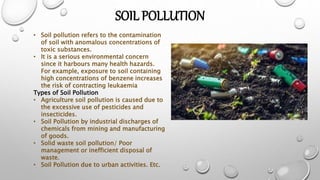
SOIL POLLUTION
• Soil pollution refers to the contamination
of soil with anomalous concentrations of
toxic substances.
• It is a serious environmental concern
since it harbours many health hazards.
For example, exposure to soil containing
high concentrations of benzene increases
the risk of contracting leukaemia
Types of Soil ​Pollution
• Agriculture soil pollution is caused due to
the excessive use of pesticides and
insecticides.
• Soil Pollution by industrial discharges of
chemicals from mining and manufacturing
of goods.
• Solid waste soil pollution/ Poor
management or inefficient disposal of
waste.
• Soil Pollution due to urban activities. Etc.
MAINCAUSES OF SOILPOLLUTION
• Corrosion of underground storage tanks.
• Application of pesticides and fertilizers.
• Mining
• Oil and fuel dumping
• Disposal of coal ash
• Leaching from landfills
• Direct discharge of industrial wastes to the soil
• Drainage of contaminated surface water into
the soil
EFFECTS OF SOILPOLLUTION
• Effects of Soil Pollution on Human Health The contamination of soil has a major
consequence on human health. Living, working, or playing in contaminated soil can
lead to respiratory diseases, skin diseases, and other health problems. Diseases caused
by soil pollution include Irritation of the skin and the eyes, Headaches, nausea,
vomiting, Coughing, pain in the chest, and wheezing.
• Effects on Plants In such a short period of time, plants are unable to adapt to the soil
change chemistry. Fungi and bacteria found in the soil that bind them together start to
decline, which creates an additional problem in soil erosion. Regular use of chemical
fertilizers, inorganic fertilizers, pesticides will decrease the fertility of the soil and alter
the structure of soil.
• Effects on the Ecosystem The soil is an important habitat for different types of
microorganisms, birds, and insects. Thus, change in the chemistry of soil can
negatively impact the lives of living organisms and can result in the gradual death of
many organisms.
SOLUTION TO SOIL POLLUTION
• Reduction of Acid Rain Sulfur dioxide
emissions can cause acid rain and forest
destruction.
• Reduce Waste Consider the amount of
needlessly generated waste.
• Improve Agriculture.
• Wetland Restoration Help restore polluted
wetlands.
• Reduction of Human Impact Finally, simply
reduce your negative impact on the
environment.
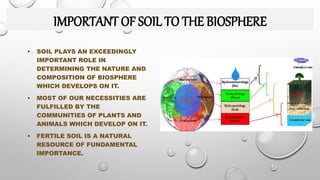
IMPORTANT OF SOIL TO THE BIOSPHERE
• SOIL PLAYS AN EXCEEDINGLY
IMPORTANT ROLE IN
DETERMINING THE NATURE AND
COMPOSITION OF BIOSPHERE
WHICH DEVELOPS ON IT.
• MOST OF OUR NECESSITIES ARE
FULFILLED BY THE
COMMUNITIES OF PLANTS AND
ANIMALS WHICH DEVELOP ON IT.
• FERTILE SOIL IS A NATURAL
RESOURCE OF FUNDAMENTAL
IMPORTANCE.
Learning part
SOIL CONTAMINATION, SOIL POLLUTION, OR LAND
POLLUTION AS A PART OF LAND DEGRADATION IS CAUSED BY
THE PRESENCE OF XENOBIOTIC CHEMICALS OR OTHER
ALTERATION IN THE NATURAL SOIL ENVIRONMENT. IT IS
TYPICALLY CAUSED BY INDUSTRIAL ACTIVITY,
AGRICULTURAL CHEMICALS OR IMPROPER DISPOSAL OF
WASTE.
THANK YOU

Presentation On - Soil Pollution, Soil Solidification, Soil Acidification, Soil Alkalization

  • 1.
    Welcome to My Presentationon Soil Solidification, Soil Acidification, Soil Alkalization, Soil Pollution
  • 2.
    Course Name: “EnvironmentalGeochemistry” Course Code: ESE-2203 Presented To: Professor Dr. Ashraf Ali Seddique (sir) Dept. of “Environmental Science & Engineering” Jatiya Kabi Kazi Nazrul Islam University. Presented By: Mozakkir Azad ID : 20103429 2nd year, 2nd semester Dept. of Environmental Science & Engineering Jatiya Kabi Kazi Nazrul Islam University.
  • 3.
  • 4.
    Stabilization and solidification(S/S) is a remediation technology that relies on the physico-chemical reaction between a reagent and soil to reduce the mobility of any contaminants present. This immobilization is achieved by the chemical interaction of contaminants with the added reagents, (i.e., through sorption, precipitation or incorporation into crystal lattices) and/or the physical encapsulation of the contaminants, specifically: Solidification: Imparts physical/dimensional stability to contain contaminants in a solid product and reduce access by external agents (e.g., air, rainfall). Soil Solidification
  • 5.
    Advantages: Short treatment timescale (compared to piles, monitored natural attenuation MNA) Can remediate a very wide range of contaminants or a mix of contaminants Environment Agency-approved methodology In-situ or ex-situ applicable Potential structural or geotechnical improvement in soils Limitations: Site-specific requires laboratory and pilot scale testing of contaminated soils Residual long-term liability, i.e., contaminant mass remains Inhibitory substances (oils, free-phase solvents, etc) can limit success Long-term performance can be difficult to demonstrate to stakeholders Advantages and Limitations of Soil Solidification
  • 6.
    EXCESSIVELY ACIDIC SOILSMAY LEAD TO A DRAMATIC DECLINE IN CROP AND PASTURE PRODUCTION BECAUSE THE PH OF THE SOIL CHANGES THE AVAILABILITY OF SOIL NUTRIENTS. ACIDIC SOILS MAY HAVE SOME OR ALL OF THE FOLLOWING PROBLEMS: * HELPFUL SOIL MICRO-ORGANISMS MAY BE PREVENTED FROM RECYCLING NUTRIENTS (E.G. NITROGEN SUPPLY MAY BE REDUCED) * PHOSPHORUS IN THE SOIL MAY BECOME LESS AVAILABLE TO PLANTS * DEFICIENCIES OF CALCIUM, MAGNESIUM AND MOLYBDENUM MAY OCCUR * THE ABILITY OF PLANTS TO USE SUBSOIL MOISTURE MAY BE LIMITED * ALUMINUM, WHICH IS TOXIC TO PLANTS AND MICRO-ORGANISMS, MAY BE RELEASED FROM THE SOIL * LEVELS OF MANGANESE MAY REACH TOXIC LEVELS * UPTAKE BY CROPS AND PASTURES OF THE HEAVY METAL CONTAMINANT, CADMIUM, MAY INCREASE. Effects of Soil Solidification
  • 7.
    Soil acidification isa process where the soil pH decreases over time. This process is accelerated by agricultural production and can affect both the surface soil and subsoil. Some contributing factors to soil acidification include: •the application of high levels of ammonium-based nitrogen fertilisers to naturally acidic soils •leaching of nitrate nitrogen, originally applied as ammonium-based fertilisers •harvesting plant materials (plant material is alkaline so when it is removed the soil is more acidic than if the plant material had been returned to the soil). Soil Acidification
  • 8.
    EFFECTS & SOLUTIONOF SOILACIDIFICATION Excessively acidic soils may lead to a dramatic decline in crop and pasture production because the pH of the soil changes the availability of soil nutrients. Acidic soils may have some or all of the following problems: • helpful soil micro-organisms may be prevented from recycling nutrients (e.g. nitrogen supply may be reduced) • phosphorus in the soil may become less available to plants • deficiencies of calcium, magnesium and molybdenum may occur • the ability of plants to use subsoil moisture may be limited • aluminium, which is toxic to plants and micro-organisms, may be released from the soil • levels of manganese may reach toxic levels • uptake by crops and pastures of the heavy metal contaminant, cadmium, may increase. There are a number of ways to minimise the soil acidification process, including: • the use of less acidifying farming practices—considered when soils show signs of acidification • applications of agricultural lime—applied to counter the acidification
  • 9.
    SOIL ALKALIZATION • Alkalinizationis the process by which the pH rises due to the accumulation of sodium carbonates. • Solonization is another name for alkalization. • Sodic soils are formed as a result of the accumulation of sodium ions on the exchange complex of the clay (Solonetz). • All cations in solution are interacting with the exchange sites on the clay and organic matter particles in a reversible reaction. • The process by which soils with high exchangeable sodium and pH > 8.5 are formed; in often results in formation of sodium carbonate and sodium bicabonate. • The soil colloids disperse and tend to migrate downward. The dispersion causes the soil's physical condition to deteriorate.
  • 10.
    EFFECTS ANDSOLUTIONS FORSOIL ALKALIZATION Effects: Alkaline soils are difficult to take into agricultural production. Due to the low infiltration capacity, rain water stagnates on the soil easily and, in dry periods, cultivation is hardly possible without copious irrigated water and good drainage. Agriculture is limited to crops tolerant to surface waterlogging and the productivity is lower. Solutions: • Apply fertilizer for alkaline soil, such as ammonium sulfate, to help increase soil pH and the nutrients in the soil but avoid fertilizers that only contain phosphorous.
  • 11.
    SOIL POLLUTION • Soilpollution refers to the contamination of soil with anomalous concentrations of toxic substances. • It is a serious environmental concern since it harbours many health hazards. For example, exposure to soil containing high concentrations of benzene increases the risk of contracting leukaemia Types of Soil ​Pollution • Agriculture soil pollution is caused due to the excessive use of pesticides and insecticides. • Soil Pollution by industrial discharges of chemicals from mining and manufacturing of goods. • Solid waste soil pollution/ Poor management or inefficient disposal of waste. • Soil Pollution due to urban activities. Etc.
  • 12.
    MAINCAUSES OF SOILPOLLUTION •Corrosion of underground storage tanks. • Application of pesticides and fertilizers. • Mining • Oil and fuel dumping • Disposal of coal ash • Leaching from landfills • Direct discharge of industrial wastes to the soil • Drainage of contaminated surface water into the soil
  • 13.
    EFFECTS OF SOILPOLLUTION •Effects of Soil Pollution on Human Health The contamination of soil has a major consequence on human health. Living, working, or playing in contaminated soil can lead to respiratory diseases, skin diseases, and other health problems. Diseases caused by soil pollution include Irritation of the skin and the eyes, Headaches, nausea, vomiting, Coughing, pain in the chest, and wheezing. • Effects on Plants In such a short period of time, plants are unable to adapt to the soil change chemistry. Fungi and bacteria found in the soil that bind them together start to decline, which creates an additional problem in soil erosion. Regular use of chemical fertilizers, inorganic fertilizers, pesticides will decrease the fertility of the soil and alter the structure of soil. • Effects on the Ecosystem The soil is an important habitat for different types of microorganisms, birds, and insects. Thus, change in the chemistry of soil can negatively impact the lives of living organisms and can result in the gradual death of many organisms.
  • 14.
    SOLUTION TO SOILPOLLUTION • Reduction of Acid Rain Sulfur dioxide emissions can cause acid rain and forest destruction. • Reduce Waste Consider the amount of needlessly generated waste. • Improve Agriculture. • Wetland Restoration Help restore polluted wetlands. • Reduction of Human Impact Finally, simply reduce your negative impact on the environment.
  • 15.
    IMPORTANT OF SOILTO THE BIOSPHERE • SOIL PLAYS AN EXCEEDINGLY IMPORTANT ROLE IN DETERMINING THE NATURE AND COMPOSITION OF BIOSPHERE WHICH DEVELOPS ON IT. • MOST OF OUR NECESSITIES ARE FULFILLED BY THE COMMUNITIES OF PLANTS AND ANIMALS WHICH DEVELOP ON IT. • FERTILE SOIL IS A NATURAL RESOURCE OF FUNDAMENTAL IMPORTANCE.
  • 16.
    Learning part SOIL CONTAMINATION,SOIL POLLUTION, OR LAND POLLUTION AS A PART OF LAND DEGRADATION IS CAUSED BY THE PRESENCE OF XENOBIOTIC CHEMICALS OR OTHER ALTERATION IN THE NATURAL SOIL ENVIRONMENT. IT IS TYPICALLY CAUSED BY INDUSTRIAL ACTIVITY, AGRICULTURAL CHEMICALS OR IMPROPER DISPOSAL OF WASTE.
  • 18.