Group members
•SHUBHAM SHUKLA
•SHAIKH SHANAULLA
•RAHUL VERMA
•ALOK RANJAN
•KRISHNA SAH
•NIKHIL SINGH
SETH VISHAMBHAR NATH INSTITUTE OF
ENGINEERING AND TECHNOLO0GY
SAFEDABAD BARABANKI.
A PROJECT REPORT ON RIGID
PAVEMENT CONSTRUCTION
GUIDED BY
MR. VIKAS SINGH (SIR)
INTRODUCTION
2
Development of a country depends on the connectivity
of various places with adequate road network.
important mode of
railways have not
Roads constitute the most
communication in areas where
developed much.
India has one of the largest road networks in the world
(over 3 million km at present).For the purpose of
management and administration, roads in India are
divided into the following five categories:
3
•
•
•
•
•
National Highways (NH)
State Highways (SH)
Major District Roads (MDR)
Other District Roads (ODR)
Village Roads (VR)
WHAT IS ROAD ?
4
Road is an open, generally public way for the passage
of vehicles, people, and animals.
Finish with a hard smooth surface (pavement) helped
make them durable and able to withstand traffic and
the environment.
Roads have a life expectancy of between 20 - 30 years.
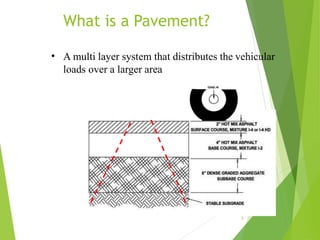
What is a Pavement?
5
• A multi layer system that distributes the vehicular
loads over a larger area
What is a Pavement?
6
•
OR
Highway pavement is a structure consisting of
superimposed layers of selected and processed
materials whose primary function is to distribute
the applied vehicle load to the sub grade.
OR
• It can also be defined as “structure which
separates the tyres of vehicles from the under
lying foundation.”
•
•
Pavement is the upper part of roadway, airport or
parking area structure
It includes all layers resting on the original ground
Functions of the Pavement
7
•
•
•
•
•
•
Reduce and distribute the traffic loading so as not to
damage the subgrade.
Provide vehicle access between two points under all-
weather conditions.
Provide safe, smooth and comfortable ride to road
users without undue delays and excessive wear & tear.
Meet environmental and aesthetics requirement.
Limited noise and air pollution.
Reasonable economy.
Requirements of pavement
structure
8
•
•
•
•
•
Sufficient thickness to spread loading to a pressure
intensity tolerable by subgade.
Sufficiently strong to carry imposed stress due to
traffic load.
Sufficient thickness to prevent the effect of frost
susceptible subgrade.
Pavement material should be impervious to
penetration of surface water which could weaken
subgrade and subsequently pavement.
Pavement surface should be skid resistant.
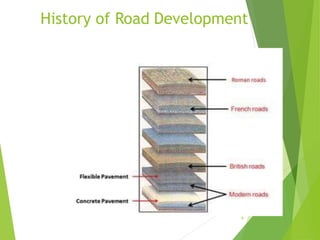
History of Road Development
9
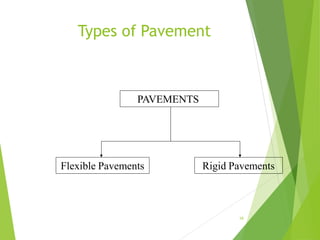
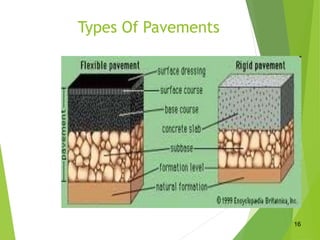
Types of Pavement
10
Flexible Pavements
PAVEMENTS
Rigid Pavements
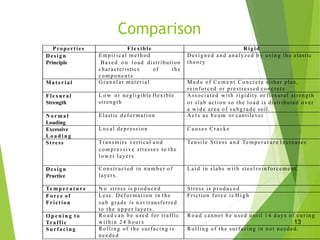
Comparison
Properties Flexible Rigid
Design
Principle
Empirical me t h o d
Ba sed o n load distribution
characteristics of the
component s
Designed and analyzed b y using the elastic
theory
Material Granular material M a d e of C e m e n t Concrete either plan,
reinforced or prestressed concrete
Flexural
Strength
L o w or negligible flexible
strength
Associated with rigidity or flexural strength
or slab action so the load is distributed over
a wide area of subgrade soil.
N o r ma l
Loading
Elastic deformation Acts as b e a m or cantilever
Excessive
L o a d i n g
Local depression Causes Cracks
Stress Transmits vertical and
compressive stresses to the
lower layers
Tensile Stress and Temperature Increases
Design
Practice
Constructed in n u mb e r of
layers.
Laid in slabs with steel reinforcement.
Te mp e r a t u re N o stress is produced Stress is produced
F o rc e of
Friction
Less. Deformation in the
sub grade is not transferred
to the upper layers.
Friction force is H i g h
O p e n i n g to
Traffic
R o a d can be used for traffic
within 2 4 hours
R o a d cannot be used until 1 4 days of curing
13
Surfacing Rolling of the surfacing is
needed
Rolling of the surfacing in not needed.
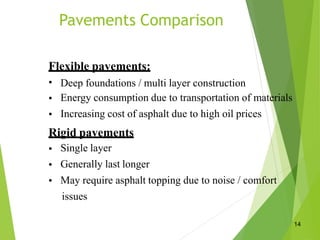
14
Pavements Comparison
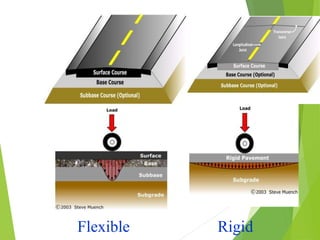
Flexible pavements:
•
•
•
Deep foundations / multi layer construction
Energy consumption due to transportation of materials
Increasing cost of asphalt due to high oil prices
Rigid pavements
•
•
•
Single layer
Generally last longer
May require asphalt topping due to noise / comfort
issues
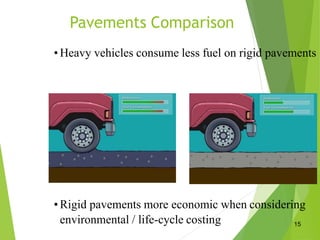
15
Pavements Comparison
• Heavy vehicles consume less fuel on rigid pavements
• Rigid pavements more economic when considering
environmental / life-cycle costing
Types Of Pavements
16
Flexible Rigid
16
RIGID PAVEMENT
17
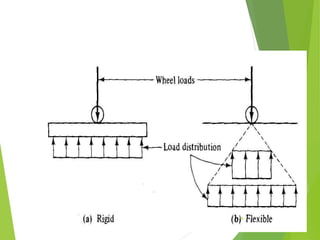
Rigid pavements are those, which contain sufficient
beam strength to be able to bridge over the localized
sub-grade failures and areas of in adequate support.
OR
Load is transmitted through beam action of slab in rigid
pavements.
OR
Rigid pavements are those, which reduces the stress
concentration and distributes the reduced stresses
uniformly to the area under the slab.
RIGID PAVEMENT
18
Deflection is very small hence the name rigid
pavement.
The high flexural strength is predominant and the
subgrade strength does not have much importance as
in case of flexible pavement.
usually finite slab with joints.
continously slab can be provided without jointed.
RIGID PAVEMENT
19
Rigid pavements, though costly in initial investment, are
cheap in long run because of low maintenance costs, The cost
of construction of single lane rigid pavement varies from 35
to 50 lakhs per km in plain area,
•Rigid pavement have deformation in the sub grade is not
transferred to subsequent layers.
•Design is based on flexural strength or slab action,Have high
flexural strength.
•No such phenomenon of grain to grain load transfer exists
•Have low repairing cost but completion cost is high
•Life span is more as compare to flexible (Low Maintenance
Cost)
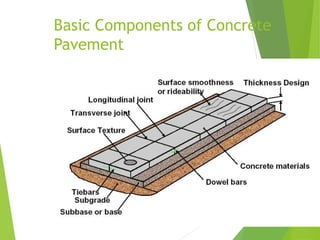
Basic Components of Concrete
Pavement
20
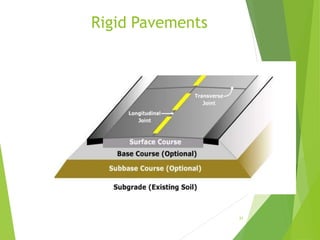
Rigid Pavements
21
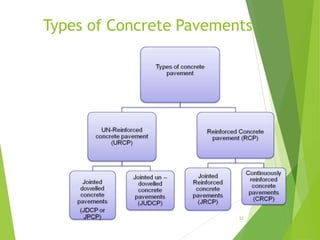
Types of Concrete Pavements
22
Un Reinforced Concrete Pavements
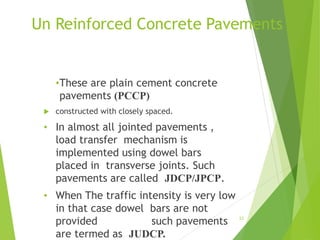
•These are plain cement concrete
pavements (PCCP)
 constructed with closely spaced.
• In almost all jointed pavements ,
load transfer mechanism is
implemented using dowel bars
placed in transverse joints. Such
pavements are called JDCP/JPCP.
• When The traffic intensity is very low
in that case dowel bars are not
provided such pavements
are termed as JUDCP.
23
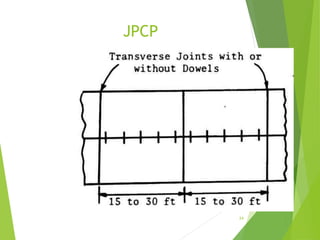
JPCP
24

PRESENTATION ON RIGID PAVEMExNT.pptx for

  • 1.
    Group members •SHUBHAM SHUKLA •SHAIKHSHANAULLA •RAHUL VERMA •ALOK RANJAN •KRISHNA SAH •NIKHIL SINGH SETH VISHAMBHAR NATH INSTITUTE OF ENGINEERING AND TECHNOLO0GY SAFEDABAD BARABANKI. A PROJECT REPORT ON RIGID PAVEMENT CONSTRUCTION GUIDED BY MR. VIKAS SINGH (SIR)
  • 2.
    INTRODUCTION 2 Development of acountry depends on the connectivity of various places with adequate road network. important mode of railways have not Roads constitute the most communication in areas where developed much.
  • 3.
    India has oneof the largest road networks in the world (over 3 million km at present).For the purpose of management and administration, roads in India are divided into the following five categories: 3 • • • • • National Highways (NH) State Highways (SH) Major District Roads (MDR) Other District Roads (ODR) Village Roads (VR)
  • 4.
    WHAT IS ROAD? 4 Road is an open, generally public way for the passage of vehicles, people, and animals. Finish with a hard smooth surface (pavement) helped make them durable and able to withstand traffic and the environment. Roads have a life expectancy of between 20 - 30 years.
  • 5.
    What is aPavement? 5 • A multi layer system that distributes the vehicular loads over a larger area
  • 6.
    What is aPavement? 6 • OR Highway pavement is a structure consisting of superimposed layers of selected and processed materials whose primary function is to distribute the applied vehicle load to the sub grade. OR • It can also be defined as “structure which separates the tyres of vehicles from the under lying foundation.” • • Pavement is the upper part of roadway, airport or parking area structure It includes all layers resting on the original ground
  • 7.
    Functions of thePavement 7 • • • • • • Reduce and distribute the traffic loading so as not to damage the subgrade. Provide vehicle access between two points under all- weather conditions. Provide safe, smooth and comfortable ride to road users without undue delays and excessive wear & tear. Meet environmental and aesthetics requirement. Limited noise and air pollution. Reasonable economy.
  • 8.
    Requirements of pavement structure 8 • • • • • Sufficientthickness to spread loading to a pressure intensity tolerable by subgade. Sufficiently strong to carry imposed stress due to traffic load. Sufficient thickness to prevent the effect of frost susceptible subgrade. Pavement material should be impervious to penetration of surface water which could weaken subgrade and subsequently pavement. Pavement surface should be skid resistant.
  • 9.
    History of RoadDevelopment 9
  • 10.
    Types of Pavement 10 FlexiblePavements PAVEMENTS Rigid Pavements
  • 11.
    Comparison Properties Flexible Rigid Design Principle Empiricalme t h o d Ba sed o n load distribution characteristics of the component s Designed and analyzed b y using the elastic theory Material Granular material M a d e of C e m e n t Concrete either plan, reinforced or prestressed concrete Flexural Strength L o w or negligible flexible strength Associated with rigidity or flexural strength or slab action so the load is distributed over a wide area of subgrade soil. N o r ma l Loading Elastic deformation Acts as b e a m or cantilever Excessive L o a d i n g Local depression Causes Cracks Stress Transmits vertical and compressive stresses to the lower layers Tensile Stress and Temperature Increases Design Practice Constructed in n u mb e r of layers. Laid in slabs with steel reinforcement. Te mp e r a t u re N o stress is produced Stress is produced F o rc e of Friction Less. Deformation in the sub grade is not transferred to the upper layers. Friction force is H i g h O p e n i n g to Traffic R o a d can be used for traffic within 2 4 hours R o a d cannot be used until 1 4 days of curing 13 Surfacing Rolling of the surfacing is needed Rolling of the surfacing in not needed.
  • 12.
    14 Pavements Comparison Flexible pavements: • • • Deepfoundations / multi layer construction Energy consumption due to transportation of materials Increasing cost of asphalt due to high oil prices Rigid pavements • • • Single layer Generally last longer May require asphalt topping due to noise / comfort issues
  • 13.
    15 Pavements Comparison • Heavyvehicles consume less fuel on rigid pavements • Rigid pavements more economic when considering environmental / life-cycle costing
  • 14.
  • 15.
  • 16.
  • 17.
    RIGID PAVEMENT 17 Rigid pavementsare those, which contain sufficient beam strength to be able to bridge over the localized sub-grade failures and areas of in adequate support. OR Load is transmitted through beam action of slab in rigid pavements. OR Rigid pavements are those, which reduces the stress concentration and distributes the reduced stresses uniformly to the area under the slab.
  • 18.
    RIGID PAVEMENT 18 Deflection isvery small hence the name rigid pavement. The high flexural strength is predominant and the subgrade strength does not have much importance as in case of flexible pavement. usually finite slab with joints. continously slab can be provided without jointed.
  • 19.
    RIGID PAVEMENT 19 Rigid pavements,though costly in initial investment, are cheap in long run because of low maintenance costs, The cost of construction of single lane rigid pavement varies from 35 to 50 lakhs per km in plain area, •Rigid pavement have deformation in the sub grade is not transferred to subsequent layers. •Design is based on flexural strength or slab action,Have high flexural strength. •No such phenomenon of grain to grain load transfer exists •Have low repairing cost but completion cost is high •Life span is more as compare to flexible (Low Maintenance Cost)
  • 20.
    Basic Components ofConcrete Pavement 20
  • 21.
  • 22.
    Types of ConcretePavements 22
  • 23.
    Un Reinforced ConcretePavements •These are plain cement concrete pavements (PCCP)  constructed with closely spaced. • In almost all jointed pavements , load transfer mechanism is implemented using dowel bars placed in transverse joints. Such pavements are called JDCP/JPCP. • When The traffic intensity is very low in that case dowel bars are not provided such pavements are termed as JUDCP. 23
  • 24.