INNOVATION & CULTURAL INDUSTRIES:
LETS TALK ABOUT INNOVATION IN THE MOVIE INDUSTRY
FEDERICO SALTALAMACCHIA
SUZE VAN DER MARKT
EUGENIO STELLA
WHAT IS INNOVATION?
According to Handke there are two concepts which define innovation:
• The first concept refers to procedures: According to Dosi (1988), “innovation concerns the
search for, and the discovery, experimentation, development, imitation, and adoption of new
products, new production processes and new organisational set ups”.
• The second concept refers to the outcomes of such procedures. Edquist (1997) defines
innovation simply as “new creations of economic significance of either a tangible or
intangible nature”.
Handke. C. 2010. The Creative Destruction of Copyright - Innovation in the Record Industry and Digital
Copying, p.194), p.194
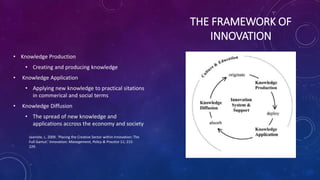
THE FRAMEWORK OF
INNOVATION
• Knowledge Production
• Creating and producing knowledge
• Knowledge Application
• Applying new knowledge to practical sitations
in commerical and social terms
• Knowledge Diffusion
• The spread of new knowledge and
applications accross the economy and society
Jaaniste, L. 2009. ‘Placing the Creative Sector within Innovation: The
Full Gamut.’ Innovation: Management, Policy & Practice 11; 215-
229.
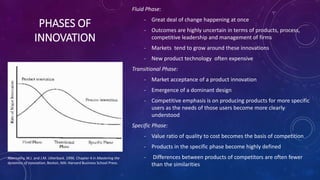
PHASES OF
INNOVATION
Fluid Phase:
- Great deal of change happening at once
- Outcomes are highly uncertain in terms of products, process,
competitive leadership and management of firms
- Markets tend to grow around these innovations
- New product technology often expensive
Transitional Phase:
- Market acceptance of a product innovation
- Emergence of a dominant design
- Competitive emphasis is on producing products for more specific
users as the needs of those users become more clearly
understood
Specific Phase:
- Value ratio of quality to cost becomes the basis of competition
- Products in the specific phase become highly defined
- Differences between products of competitors are often fewer
than the similarities
Abernathy, W.J. and J.M. Utterback. 1996. Chapter 4 in Mastering the
dynamics of innovation, Boston, MA: Harvard Business School Press.
TYPES OF INNOVATION
(PAY CLOSE ATTENTION!)
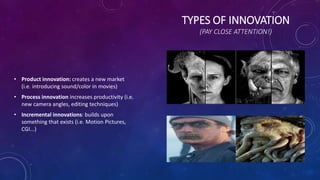
• Product innovation: creates a new market
(i.e. introducing sound/color in movies)
• Process innovation increases productivity (i.e.
new camera angles, editing techniques)
• Incremental innovations: builds upon
something that exists (i.e. Motion Pictures,
CGI...)
TYPES OF INNOVATION PT. 2
(PAY CLOSE ATTENTION!)
• Radical innovations: solutions to established
infrastructure, devalue of older knowledge, technology
and goods (i.e. Amazon Prime, Hulu, Netflix)
• In the cultural sector:
• Content creation
(i.e. a new film)
• Humdrum innovation : traditional technological
innovation
(i.e. streaming, Blu-Ray, Digital Filmmaking)
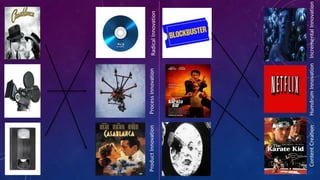
RadicalInnovationProcessInnovationProductInnovation
HumdrumInnovationIncrementalInnovationContentCreation
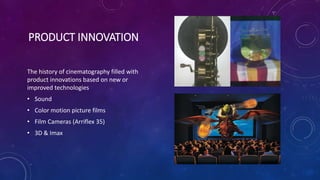
PRODUCT INNOVATION
The history of cinematography filled with
product innovations based on new or
improved technologies
• Sound
• Color motion picture films
• Film Cameras (Arriflex 35)
• 3D & Imax
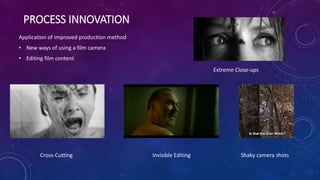
PROCESS INNOVATION
Application of improved production method
• New ways of using a film camera
• Editing film content
Invisible Editing Shaky camera shotsCross-Cutting
Extreme Close-ups
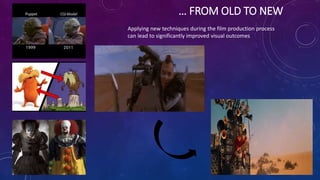
… FROM OLD TO NEW
Applying new techniques during the film production process
can lead to significantly improved visual outcomes
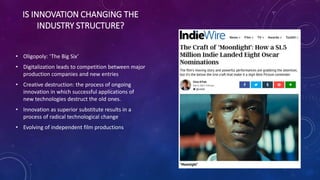
IS INNOVATION CHANGING THE
INDUSTRY STRUCTURE?
• Oligopoly: ‘The Big Six’
• Digitalization leads to competition between major
production companies and new entries
• Creative destruction: the process of ongoing
innovation in which successful applications of
new technologies destruct the old ones.
• Innovation as superior substitute results in a
process of radical technological change
• Evolving of independent film productions
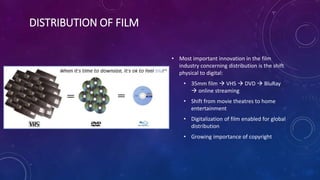
DISTRIBUTION OF FILM
• Most important innovation in the film
industry concerning distribution is the shift
physical to digital:
• 35mm film  VHS  DVD  BluRay
 online streaming
• Shift from movie theatres to home
entertainment
• Digitalization of film enabled for global
distribution
• Growing importance of copyright
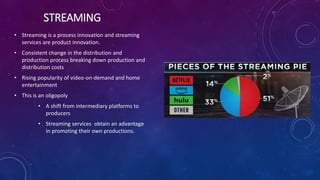
STREAMING
• Streaming is a process innovation and streaming
services are product innovation.
• Consistent change in the distribution and
production process breaking down production and
distribution costs
• Rising popularity of video-on-demand and home
entertainment
• This is an oligopoly
• A shift from intermediary platforms to
producers
• Streaming services obtain an advantage
in promoting their own productions.
DISADVANTAGES OF
STREAMING
• Controversial side = downloading processes
decreasing, but the practice of illegal streaming is still
very diffused
• Why? Lack of regulations and the easy access to
illegal alternatives
• Limitation of product supplied in legal
streaming platform due to license issues
may lead to illegal alternatives
• Limiting factor of illegal consumptions due
to the lack of quality in illegal streaming
product
FACTORS & EFFECTS
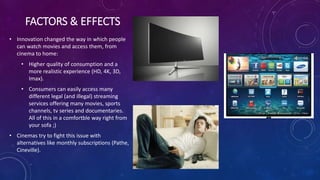
• Innovation changed the way in which people
can watch movies and access them, from
cinema to home:
• Higher quality of consumption and a
more realistic experience (HD, 4K, 3D,
Imax).
• Consumers can easily access many
different legal (and illegal) streaming
services offering many movies, sports
channels, tv series and documentaries.
All of this in a comfortble way right from
your sofa ;)
• Cinemas try to fight this issue with
alternatives like monthly subscriptions (Pathe,
Cineville).
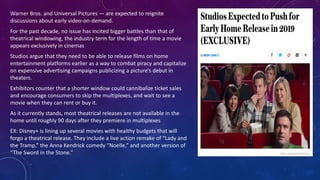
Warner Bros. and Universal Pictures — are expected to reignite
discussions about early video-on-demand.
For the past decade, no issue has incited bigger battles than that of
theatrical windowing, the industry term for the length of time a movie
appears exclusively in cinemas
Studios argue that they need to be able to release films on home
entertainment platforms earlier as a way to combat piracy and capitalize
on expensive advertising campaigns publicizing a picture’s debut in
theaters.
Exhibitors counter that a shorter window could cannibalize ticket sales
and encourage consumers to skip the multiplexes, and wait to see a
movie when they can rent or buy it.
As it currently stands, most theatrical releases are not available in the
home until roughly 90 days after they premiere in multiplexes
EX: Disney+ is lining up several movies with healthy budgets that will
forgo a theatrical release. They include a live action remake of “Lady and
the Tramp,” the Anna Kendrick comedy “Noelle,” and another version of
“The Sword in the Stone.”

Presentation on Innovation

  • 1.
    INNOVATION & CULTURALINDUSTRIES: LETS TALK ABOUT INNOVATION IN THE MOVIE INDUSTRY FEDERICO SALTALAMACCHIA SUZE VAN DER MARKT EUGENIO STELLA
  • 2.
    WHAT IS INNOVATION? Accordingto Handke there are two concepts which define innovation: • The first concept refers to procedures: According to Dosi (1988), “innovation concerns the search for, and the discovery, experimentation, development, imitation, and adoption of new products, new production processes and new organisational set ups”. • The second concept refers to the outcomes of such procedures. Edquist (1997) defines innovation simply as “new creations of economic significance of either a tangible or intangible nature”. Handke. C. 2010. The Creative Destruction of Copyright - Innovation in the Record Industry and Digital Copying, p.194), p.194
  • 3.
    THE FRAMEWORK OF INNOVATION •Knowledge Production • Creating and producing knowledge • Knowledge Application • Applying new knowledge to practical sitations in commerical and social terms • Knowledge Diffusion • The spread of new knowledge and applications accross the economy and society Jaaniste, L. 2009. ‘Placing the Creative Sector within Innovation: The Full Gamut.’ Innovation: Management, Policy & Practice 11; 215- 229.
  • 4.
    PHASES OF INNOVATION Fluid Phase: -Great deal of change happening at once - Outcomes are highly uncertain in terms of products, process, competitive leadership and management of firms - Markets tend to grow around these innovations - New product technology often expensive Transitional Phase: - Market acceptance of a product innovation - Emergence of a dominant design - Competitive emphasis is on producing products for more specific users as the needs of those users become more clearly understood Specific Phase: - Value ratio of quality to cost becomes the basis of competition - Products in the specific phase become highly defined - Differences between products of competitors are often fewer than the similarities Abernathy, W.J. and J.M. Utterback. 1996. Chapter 4 in Mastering the dynamics of innovation, Boston, MA: Harvard Business School Press.
  • 5.
    TYPES OF INNOVATION (PAYCLOSE ATTENTION!) • Product innovation: creates a new market (i.e. introducing sound/color in movies) • Process innovation increases productivity (i.e. new camera angles, editing techniques) • Incremental innovations: builds upon something that exists (i.e. Motion Pictures, CGI...)
  • 6.
    TYPES OF INNOVATIONPT. 2 (PAY CLOSE ATTENTION!) • Radical innovations: solutions to established infrastructure, devalue of older knowledge, technology and goods (i.e. Amazon Prime, Hulu, Netflix) • In the cultural sector: • Content creation (i.e. a new film) • Humdrum innovation : traditional technological innovation (i.e. streaming, Blu-Ray, Digital Filmmaking)
  • 8.
  • 10.
    PRODUCT INNOVATION The historyof cinematography filled with product innovations based on new or improved technologies • Sound • Color motion picture films • Film Cameras (Arriflex 35) • 3D & Imax
  • 11.
    PROCESS INNOVATION Application ofimproved production method • New ways of using a film camera • Editing film content Invisible Editing Shaky camera shotsCross-Cutting Extreme Close-ups
  • 12.
    … FROM OLDTO NEW Applying new techniques during the film production process can lead to significantly improved visual outcomes
  • 13.
    IS INNOVATION CHANGINGTHE INDUSTRY STRUCTURE? • Oligopoly: ‘The Big Six’ • Digitalization leads to competition between major production companies and new entries • Creative destruction: the process of ongoing innovation in which successful applications of new technologies destruct the old ones. • Innovation as superior substitute results in a process of radical technological change • Evolving of independent film productions
  • 15.
    DISTRIBUTION OF FILM •Most important innovation in the film industry concerning distribution is the shift physical to digital: • 35mm film  VHS  DVD  BluRay  online streaming • Shift from movie theatres to home entertainment • Digitalization of film enabled for global distribution • Growing importance of copyright
  • 16.
    STREAMING • Streaming isa process innovation and streaming services are product innovation. • Consistent change in the distribution and production process breaking down production and distribution costs • Rising popularity of video-on-demand and home entertainment • This is an oligopoly • A shift from intermediary platforms to producers • Streaming services obtain an advantage in promoting their own productions.
  • 17.
    DISADVANTAGES OF STREAMING • Controversialside = downloading processes decreasing, but the practice of illegal streaming is still very diffused • Why? Lack of regulations and the easy access to illegal alternatives • Limitation of product supplied in legal streaming platform due to license issues may lead to illegal alternatives • Limiting factor of illegal consumptions due to the lack of quality in illegal streaming product
  • 19.
    FACTORS & EFFECTS •Innovation changed the way in which people can watch movies and access them, from cinema to home: • Higher quality of consumption and a more realistic experience (HD, 4K, 3D, Imax). • Consumers can easily access many different legal (and illegal) streaming services offering many movies, sports channels, tv series and documentaries. All of this in a comfortble way right from your sofa ;) • Cinemas try to fight this issue with alternatives like monthly subscriptions (Pathe, Cineville).
  • 21.
    Warner Bros. andUniversal Pictures — are expected to reignite discussions about early video-on-demand. For the past decade, no issue has incited bigger battles than that of theatrical windowing, the industry term for the length of time a movie appears exclusively in cinemas Studios argue that they need to be able to release films on home entertainment platforms earlier as a way to combat piracy and capitalize on expensive advertising campaigns publicizing a picture’s debut in theaters. Exhibitors counter that a shorter window could cannibalize ticket sales and encourage consumers to skip the multiplexes, and wait to see a movie when they can rent or buy it. As it currently stands, most theatrical releases are not available in the home until roughly 90 days after they premiere in multiplexes EX: Disney+ is lining up several movies with healthy budgets that will forgo a theatrical release. They include a live action remake of “Lady and the Tramp,” the Anna Kendrick comedy “Noelle,” and another version of “The Sword in the Stone.”