1
MIS, Chapter 8
©2011 Course Technology, a part of Cengage Learning
E-COMMERCE
CHAPTER 8
Hossein BIDGOLI
MIS
2
MIS, Chapter 8
©2011 Course Technology, a part of Cengage Learning
Chapter 8 E-Commerce
LO1 Define e-commerce and describe its advantages,
disadvantages, and business models.
LO2 Explain the major categories of e-commerce.
LO3 Describe the business-to-consumer e-commerce
cycle.
LO4 Summarize the major models of business-to-
business e-commerce.
LO5 Describe mobile- and voice-based e-commerce.
l e a r n i n g o u t c o m e s
3
MIS, Chapter 8
©2011 Course Technology, a part of Cengage Learning
LO6 Explain two supporting technologies for e-
commerce.
l e a r n i n g o u t c o m e s (cont’d.)
Chapter 8 E-Commerce
4
MIS, Chapter 8
©2011 Course Technology, a part of Cengage Learning
Chapter 8 E-Commerce
Defining E-Commerce
• E-business
– Activities a company performs for selling and
buying products and services, using computers
and communication technologies
• E-commerce
– Buying and selling goods and services over the
Internet
– Builds on traditional commerce by adding the
flexibility that networks offer and the availability of
the Internet
5
MIS, Chapter 8
©2011 Course Technology, a part of Cengage Learning
Chapter 8 E-Commerce
Defining E-Commerce (cont’d.)
• Business applications that use the Internet:
– Buying and selling products and services
– Collaborating with other companies
– Communicating with business partners
– Gathering business intelligence on customers and
competitors
– Providing customer service
– Making software updates and patches available
– Offering vendor support
– Publishing and disseminating information
6
MIS, Chapter 8
©2011 Course Technology, a part of Cengage Learning
Chapter 8 E-Commerce
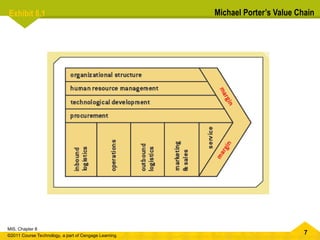
The Value Chain and E-Commerce
• Value chain
– Michael Porter
– 1985
– Series of activities designed to meet business
needs by adding value (or cost) in each phase of
the process
• Supporting activities:
– Organizational infrastructure, human resource
management, technological development, and
procurement
7
MIS, Chapter 8
©2011 Course Technology, a part of Cengage Learning
Exhibit 8.1 Michael Porter’s Value Chain
8
MIS, Chapter 8
©2011 Course Technology, a part of Cengage Learning
Chapter 8 E-Commerce
The Value Chain and E-Commerce (cont’d.)
• Primary activities:
– Inbound logistics
– Operations
– Outbound logistics
– Marketing and sales
– Service
• The Internet
– Increases the speed and accuracy of communication
between suppliers, distributors, and customers
– Low cost means companies of any size can participate
in value chain integration
9
MIS, Chapter 8
©2011 Course Technology, a part of Cengage Learning
Chapter 8 E-Commerce
E-Commerce versus Traditional Commerce
• Internet and telecommunication technologies
play major role
• No physical store
• Click-and-brick e-commerce
– Mix of traditional and e-commerce
10
MIS, Chapter 8
©2011 Course Technology, a part of Cengage Learning
Chapter 8 E-Commerce
Twitter Helps Businesses to Find Customers
• Twitter can be used by businesses as a promotional
tool and as a way to find sales leads
• Boloco, a burrito restaurant chain, posted a photo of a
coupon on Twitter and invited customers to bring in
any image of the coupon -- a photocopy, a printout, or
even an image on a mobile phone -- to get the discount
• The promotion was a big success, given that 900
customers redeemed the coupon (including by bringing
their mobile phones) as opposed to the usual 350
11
MIS, Chapter 8
©2011 Course Technology, a part of Cengage Learning
Chapter 8 E-Commerce
Advantages and Disadvantages of E-Commerce
• Advantages:
– Better relationships with suppliers, customers,
business partners
– Price transparency
– Round the clock and globe operations
– More information on potential customers
– Increasing customer involvement
– Improving customer service
– Increasing flexibility and ease of shopping
12
MIS, Chapter 8
©2011 Course Technology, a part of Cengage Learning
Chapter 8 E-Commerce
Advantages and Disadvantages of E-Commerce
(cont’d.)
– Increasing the number of customers
– Increasing opportunities for collaboration with
business partners
– Increasing return on investment because
inventory needs are reduced
– Offering personalized services and product
customization
– Reducing administrative and transaction costs
13
MIS, Chapter 8
©2011 Course Technology, a part of Cengage Learning
Chapter 8 E-Commerce
Advantages and Disadvantages of E-Commerce
(cont’d.)
• Disadvantages:
– Bandwidth capacity problems
– Security issues
– Accessibility
– Acceptance
14
MIS, Chapter 8
©2011 Course Technology, a part of Cengage Learning
Chapter 8 E-Commerce
E-Commerce Business Models
• E-commerce companies focus their operations
in different parts of the value chain
• Types:
– Merchant
– Brokerage
– Advertising
– Mixed
– Informediary
– Subscription
15
MIS, Chapter 8
©2011 Course Technology, a part of Cengage Learning
Major Categories of E-Commerce
Exhibit 8.3 Business-to-Consumer E-Commerce
Business-to-Consumer E-Commerce
16
MIS, Chapter 8
©2011 Course Technology, a part of Cengage Learning
Chapter 8 E-Commerce
Business-to-Consumer E-Commerce (cont’d.)
• Companies sell directly to consumers
• Examples:
– Amazon.com
– Barnesandnoble.com
– Onsale.com
• Types:
– Pure-play
– Brick and mortar stores with virtual storefronts
17
MIS, Chapter 8
©2011 Course Technology, a part of Cengage Learning
Chapter 8 E-Commerce
Business-to-Business E-Commerce
• Involves electronic transactions between
businesses
• Electronic data interchange (EDI) and electronic
funds transfer (EFT)
• Fastest growing segment of e-commerce
• Uses:
– Purchase orders, invoices, inventory status, shipping
logistics, business contracts, and other operations
• Example:
– Walmart
18
MIS, Chapter 8
©2011 Course Technology, a part of Cengage Learning
Chapter 8 E-Commerce
Consumer-to-Consumer E-Commerce
• Involves business transactions between users
• Online classified ads:
– Craigslist.org
• Online auction sites:
– eBay.com
19
MIS, Chapter 8
©2011 Course Technology, a part of Cengage Learning
Chapter 8 E-Commerce
Consumer-to-Business E-Commerce
• Involves people selling products or services to
businesses
• Example:
– Creating online surveys
• Search for sellers of a product and services
– Priceline.com
20
MIS, Chapter 8
©2011 Course Technology, a part of Cengage Learning
Chapter 8 E-Commerce
Government and Nonbusiness E-Commerce
• E-government applications
• Categories:
– Government-to-citizen (G2C)
– Government-to-business (G2B)
– Government-to-government (G2G)
– Government-to-employee (G2E)
21
MIS, Chapter 8
©2011 Course Technology, a part of Cengage Learning
Chapter 8 E-Commerce
Government and Nonbusiness E-Commerce (cont’d.)
• Nonbusiness organizations:
– Universities
– Nonprofits
– Political and social organizations
22
MIS, Chapter 8
©2011 Course Technology, a part of Cengage Learning
Chapter 8 E-Commerce
Organizational or Intrabusiness E-Commerce
• Involves e-commerce activities that take place
inside an organization
• Can include:
– Exchange of goods, services, or information
among employees
– Conducting training programs and offering human
resource services
• Supporting activities in Porter’s value chain
23
MIS, Chapter 8
©2011 Course Technology, a part of Cengage Learning
Chapter 8 E-Commerce
A B2C E-Commerce Cycle
• Major activities:
– Information sharing
– Ordering
– Payment
– Fulfillment
– Service and support
24
MIS, Chapter 8
©2011 Course Technology, a part of Cengage Learning
Exhibit 8.3 Major Activities in B2C E-Commerce
25
MIS, Chapter 8
©2011 Course Technology, a part of Cengage Learning
Chapter 8 E-Commerce
B2B E-Commerce: A Second Look
• B2Bs use these additional technologies
extensively:
– Intranets
– Extranets
– Virtual private networks
– Electronic data interchange (EDI)
– Electronic funds transfer (EFT)
• Lowers production costs and improves
accuracy
– By eliminating many labor-intensive tasks
26
MIS, Chapter 8
©2011 Course Technology, a part of Cengage Learning
Chapter 8 E-Commerce
Major Models of B2B E-Commerce
• Three major types of B2B e-commerce
models, based on who controls the
marketplace:
– Seller
– Buyer
– Intermediary (third-party)
• Fourth model called trading partner
agreements
27
MIS, Chapter 8
©2011 Course Technology, a part of Cengage Learning
Chapter 8 E-Commerce
Seller-Side Marketplace
• Most popular B2B model
• Sellers who cater to specialized markets come
together to create a common marketplace for
buyers
• E-procurement
– Enables employees in an organization to order and
receive supplies and services directly from suppliers
– Can also automate some buying and selling activities
• Major vendors of e-commerce and B2B solutions
include I2 Technologies, IBM, Oracle, and SAP
28
MIS, Chapter 8
©2011 Course Technology, a part of Cengage Learning
Chapter 8 E-Commerce
E-Procurement at Schlumberger
• Schlumberger
– Oil field services provider
• E-procurement system for order processing
– Has reduced the cost per order by streamlining
paperwork
– Replaced a centralized electronic data interchange
(EDI) procurement system
– Easy-to-use interface
29
MIS, Chapter 8
©2011 Course Technology, a part of Cengage Learning
Chapter 8 E-Commerce
Buyer-Side Marketplace
• Buyer, or a group of buyers, opens an
electronic marketplace
– Invites sellers to bid on announced products or
requests for quotation (RFQs)
• Buyers can:
– Manage the procurement process more efficiently
– Lower administrative costs
– Implement uniform pricing
• Large corporations, such as General Electric or
Boeing
30
MIS, Chapter 8
©2011 Course Technology, a part of Cengage Learning
Chapter 8 E-Commerce
Third-Party Exchange Marketplace
• Controlled by a third party
• Marketplace generates revenue from the fees
charged for matching buyers and sellers
• Usually active in vertical or horizontal
market
• Offers suppliers a direct channel of
communication to buyers through online
storefronts
31
MIS, Chapter 8
©2011 Course Technology, a part of Cengage Learning
Chapter 8 E-Commerce
Worldbid.com: A Third-Party Exchange Marketplace
• International marketplace
• Designed to help small to mid-sized
companies buy and sell products or services
domestically or internationally
• Provides:
– Trade leads
– Request for proposals for private and government
organizations worldwide
32
MIS, Chapter 8
©2011 Course Technology, a part of Cengage Learning
Chapter 8 E-Commerce
Trading Partner Agreements
• Automate negotiating processes and enforce
contracts between participating businesses
• Business partners can send and receive bids,
contracts, and other information needed
when offering and purchasing products and
services
• Enables customers to submit electronic
documents via the Internet that previously
required hard copies with signatures
– Using XML
33
MIS, Chapter 8
©2011 Course Technology, a part of Cengage Learning
Chapter 8 E-Commerce
Mobile and Voice-Based E-Commerce
• Mobile commerce (m-commerce)
– Based on Wireless Application Protocol (WAP)
– Using handheld devices, such as smart phones or PDAs,
to conduct business transactions
• Supporting technologies:
– Wireless wide-area networks and 3G networks
– Short-range wireless communication technologies
• Examples:
– iPhone apps
– Internet Explorer Mobile
– Google mobile
34
MIS, Chapter 8
©2011 Course Technology, a part of Cengage Learning
Chapter 8 E-Commerce
Mobile and Voice-Based E-Commerce (cont’d.)
• Voice-based e-commerce
– Rely on voice recognition and text-to-speech
technologies
– Can conduct business using e-wallets
– Security features
• Call recognition, voice recognition, fixed
shipping address
35
MIS, Chapter 8
©2011 Course Technology, a part of Cengage Learning
Chapter 8 E-Commerce
E-Commerce Supporting Technologies
• Electronic payment systems
• Web marketing
• Search engine optimization
36
MIS, Chapter 8
©2011 Course Technology, a part of Cengage Learning
Chapter 8 E-Commerce
Electronic Payment Systems
• Electronic payment
– Money or scrip that is exchanged only
electronically
• Payment cards:
– Credit, debit, charge, and smart cards
• Smart cards
– Credit card sized
– Contain an embedded microprocessor chip storing
important financial and personal information
37
MIS, Chapter 8
©2011 Course Technology, a part of Cengage Learning
Chapter 8 E-Commerce
Electronic Payment Systems (cont’d.)
• Other types of payments:
– E-cash
– E-check
– E-wallets
– PayPal
– Micropayments
38
MIS, Chapter 8
©2011 Course Technology, a part of Cengage Learning
Chapter 8 E-Commerce
Web Marketing
• Uses the Web and its supporting technologies
to promote goods and services
• Terms:
– Ad impression
– Banner ads
– Click
– Cost per thousand (CPM)
– Cost per click (CPC)
– Click-through rate (CTR)
– Cookie
39
MIS, Chapter 8
©2011 Course Technology, a part of Cengage Learning
Chapter 8 E-Commerce
Web Marketing (cont’d.)
– Hit
– Meta tag
– Page view (PV)
– Pop-up ads
– Pop-under ads
– Splash screen
– Spot leasing
40
MIS, Chapter 8
©2011 Course Technology, a part of Cengage Learning
Chapter 8 E-Commerce
Search Engine Optimization
• Method for improving the volume or quality
of traffic to a Web site
• Some companies offer SEO service
– Editing a site’s contents and HTML code to increase
its relevance to specific keywords
• Recommendations for optimizing a Web site:
– Keywords
– Page title
– Inbound links
41
MIS, Chapter 8
©2011 Course Technology, a part of Cengage Learning
Chapter 8 E-Commerce
Summary
• Michael Porter’s value chain, compared e-
commerce with traditional commerce
• Major e-commerce business models
• Main categories of e-commerce
• B2C e-commerce business cycle
• B2B e-commerce business models
• Mobile and voice e-commerce
• Supporting technologies

Presentation on Electronic Commerce - Basics

  • 1.
    1 MIS, Chapter 8 ©2011Course Technology, a part of Cengage Learning E-COMMERCE CHAPTER 8 Hossein BIDGOLI MIS
  • 2.
    2 MIS, Chapter 8 ©2011Course Technology, a part of Cengage Learning Chapter 8 E-Commerce LO1 Define e-commerce and describe its advantages, disadvantages, and business models. LO2 Explain the major categories of e-commerce. LO3 Describe the business-to-consumer e-commerce cycle. LO4 Summarize the major models of business-to- business e-commerce. LO5 Describe mobile- and voice-based e-commerce. l e a r n i n g o u t c o m e s
  • 3.
    3 MIS, Chapter 8 ©2011Course Technology, a part of Cengage Learning LO6 Explain two supporting technologies for e- commerce. l e a r n i n g o u t c o m e s (cont’d.) Chapter 8 E-Commerce
  • 4.
    4 MIS, Chapter 8 ©2011Course Technology, a part of Cengage Learning Chapter 8 E-Commerce Defining E-Commerce • E-business – Activities a company performs for selling and buying products and services, using computers and communication technologies • E-commerce – Buying and selling goods and services over the Internet – Builds on traditional commerce by adding the flexibility that networks offer and the availability of the Internet
  • 5.
    5 MIS, Chapter 8 ©2011Course Technology, a part of Cengage Learning Chapter 8 E-Commerce Defining E-Commerce (cont’d.) • Business applications that use the Internet: – Buying and selling products and services – Collaborating with other companies – Communicating with business partners – Gathering business intelligence on customers and competitors – Providing customer service – Making software updates and patches available – Offering vendor support – Publishing and disseminating information
  • 6.
    6 MIS, Chapter 8 ©2011Course Technology, a part of Cengage Learning Chapter 8 E-Commerce The Value Chain and E-Commerce • Value chain – Michael Porter – 1985 – Series of activities designed to meet business needs by adding value (or cost) in each phase of the process • Supporting activities: – Organizational infrastructure, human resource management, technological development, and procurement
  • 7.
    7 MIS, Chapter 8 ©2011Course Technology, a part of Cengage Learning Exhibit 8.1 Michael Porter’s Value Chain
  • 8.
    8 MIS, Chapter 8 ©2011Course Technology, a part of Cengage Learning Chapter 8 E-Commerce The Value Chain and E-Commerce (cont’d.) • Primary activities: – Inbound logistics – Operations – Outbound logistics – Marketing and sales – Service • The Internet – Increases the speed and accuracy of communication between suppliers, distributors, and customers – Low cost means companies of any size can participate in value chain integration
  • 9.
    9 MIS, Chapter 8 ©2011Course Technology, a part of Cengage Learning Chapter 8 E-Commerce E-Commerce versus Traditional Commerce • Internet and telecommunication technologies play major role • No physical store • Click-and-brick e-commerce – Mix of traditional and e-commerce
  • 10.
    10 MIS, Chapter 8 ©2011Course Technology, a part of Cengage Learning Chapter 8 E-Commerce Twitter Helps Businesses to Find Customers • Twitter can be used by businesses as a promotional tool and as a way to find sales leads • Boloco, a burrito restaurant chain, posted a photo of a coupon on Twitter and invited customers to bring in any image of the coupon -- a photocopy, a printout, or even an image on a mobile phone -- to get the discount • The promotion was a big success, given that 900 customers redeemed the coupon (including by bringing their mobile phones) as opposed to the usual 350
  • 11.
    11 MIS, Chapter 8 ©2011Course Technology, a part of Cengage Learning Chapter 8 E-Commerce Advantages and Disadvantages of E-Commerce • Advantages: – Better relationships with suppliers, customers, business partners – Price transparency – Round the clock and globe operations – More information on potential customers – Increasing customer involvement – Improving customer service – Increasing flexibility and ease of shopping
  • 12.
    12 MIS, Chapter 8 ©2011Course Technology, a part of Cengage Learning Chapter 8 E-Commerce Advantages and Disadvantages of E-Commerce (cont’d.) – Increasing the number of customers – Increasing opportunities for collaboration with business partners – Increasing return on investment because inventory needs are reduced – Offering personalized services and product customization – Reducing administrative and transaction costs
  • 13.
    13 MIS, Chapter 8 ©2011Course Technology, a part of Cengage Learning Chapter 8 E-Commerce Advantages and Disadvantages of E-Commerce (cont’d.) • Disadvantages: – Bandwidth capacity problems – Security issues – Accessibility – Acceptance
  • 14.
    14 MIS, Chapter 8 ©2011Course Technology, a part of Cengage Learning Chapter 8 E-Commerce E-Commerce Business Models • E-commerce companies focus their operations in different parts of the value chain • Types: – Merchant – Brokerage – Advertising – Mixed – Informediary – Subscription
  • 15.
    15 MIS, Chapter 8 ©2011Course Technology, a part of Cengage Learning Major Categories of E-Commerce Exhibit 8.3 Business-to-Consumer E-Commerce Business-to-Consumer E-Commerce
  • 16.
    16 MIS, Chapter 8 ©2011Course Technology, a part of Cengage Learning Chapter 8 E-Commerce Business-to-Consumer E-Commerce (cont’d.) • Companies sell directly to consumers • Examples: – Amazon.com – Barnesandnoble.com – Onsale.com • Types: – Pure-play – Brick and mortar stores with virtual storefronts
  • 17.
    17 MIS, Chapter 8 ©2011Course Technology, a part of Cengage Learning Chapter 8 E-Commerce Business-to-Business E-Commerce • Involves electronic transactions between businesses • Electronic data interchange (EDI) and electronic funds transfer (EFT) • Fastest growing segment of e-commerce • Uses: – Purchase orders, invoices, inventory status, shipping logistics, business contracts, and other operations • Example: – Walmart
  • 18.
    18 MIS, Chapter 8 ©2011Course Technology, a part of Cengage Learning Chapter 8 E-Commerce Consumer-to-Consumer E-Commerce • Involves business transactions between users • Online classified ads: – Craigslist.org • Online auction sites: – eBay.com
  • 19.
    19 MIS, Chapter 8 ©2011Course Technology, a part of Cengage Learning Chapter 8 E-Commerce Consumer-to-Business E-Commerce • Involves people selling products or services to businesses • Example: – Creating online surveys • Search for sellers of a product and services – Priceline.com
  • 20.
    20 MIS, Chapter 8 ©2011Course Technology, a part of Cengage Learning Chapter 8 E-Commerce Government and Nonbusiness E-Commerce • E-government applications • Categories: – Government-to-citizen (G2C) – Government-to-business (G2B) – Government-to-government (G2G) – Government-to-employee (G2E)
  • 21.
    21 MIS, Chapter 8 ©2011Course Technology, a part of Cengage Learning Chapter 8 E-Commerce Government and Nonbusiness E-Commerce (cont’d.) • Nonbusiness organizations: – Universities – Nonprofits – Political and social organizations
  • 22.
    22 MIS, Chapter 8 ©2011Course Technology, a part of Cengage Learning Chapter 8 E-Commerce Organizational or Intrabusiness E-Commerce • Involves e-commerce activities that take place inside an organization • Can include: – Exchange of goods, services, or information among employees – Conducting training programs and offering human resource services • Supporting activities in Porter’s value chain
  • 23.
    23 MIS, Chapter 8 ©2011Course Technology, a part of Cengage Learning Chapter 8 E-Commerce A B2C E-Commerce Cycle • Major activities: – Information sharing – Ordering – Payment – Fulfillment – Service and support
  • 24.
    24 MIS, Chapter 8 ©2011Course Technology, a part of Cengage Learning Exhibit 8.3 Major Activities in B2C E-Commerce
  • 25.
    25 MIS, Chapter 8 ©2011Course Technology, a part of Cengage Learning Chapter 8 E-Commerce B2B E-Commerce: A Second Look • B2Bs use these additional technologies extensively: – Intranets – Extranets – Virtual private networks – Electronic data interchange (EDI) – Electronic funds transfer (EFT) • Lowers production costs and improves accuracy – By eliminating many labor-intensive tasks
  • 26.
    26 MIS, Chapter 8 ©2011Course Technology, a part of Cengage Learning Chapter 8 E-Commerce Major Models of B2B E-Commerce • Three major types of B2B e-commerce models, based on who controls the marketplace: – Seller – Buyer – Intermediary (third-party) • Fourth model called trading partner agreements
  • 27.
    27 MIS, Chapter 8 ©2011Course Technology, a part of Cengage Learning Chapter 8 E-Commerce Seller-Side Marketplace • Most popular B2B model • Sellers who cater to specialized markets come together to create a common marketplace for buyers • E-procurement – Enables employees in an organization to order and receive supplies and services directly from suppliers – Can also automate some buying and selling activities • Major vendors of e-commerce and B2B solutions include I2 Technologies, IBM, Oracle, and SAP
  • 28.
    28 MIS, Chapter 8 ©2011Course Technology, a part of Cengage Learning Chapter 8 E-Commerce E-Procurement at Schlumberger • Schlumberger – Oil field services provider • E-procurement system for order processing – Has reduced the cost per order by streamlining paperwork – Replaced a centralized electronic data interchange (EDI) procurement system – Easy-to-use interface
  • 29.
    29 MIS, Chapter 8 ©2011Course Technology, a part of Cengage Learning Chapter 8 E-Commerce Buyer-Side Marketplace • Buyer, or a group of buyers, opens an electronic marketplace – Invites sellers to bid on announced products or requests for quotation (RFQs) • Buyers can: – Manage the procurement process more efficiently – Lower administrative costs – Implement uniform pricing • Large corporations, such as General Electric or Boeing
  • 30.
    30 MIS, Chapter 8 ©2011Course Technology, a part of Cengage Learning Chapter 8 E-Commerce Third-Party Exchange Marketplace • Controlled by a third party • Marketplace generates revenue from the fees charged for matching buyers and sellers • Usually active in vertical or horizontal market • Offers suppliers a direct channel of communication to buyers through online storefronts
  • 31.
    31 MIS, Chapter 8 ©2011Course Technology, a part of Cengage Learning Chapter 8 E-Commerce Worldbid.com: A Third-Party Exchange Marketplace • International marketplace • Designed to help small to mid-sized companies buy and sell products or services domestically or internationally • Provides: – Trade leads – Request for proposals for private and government organizations worldwide
  • 32.
    32 MIS, Chapter 8 ©2011Course Technology, a part of Cengage Learning Chapter 8 E-Commerce Trading Partner Agreements • Automate negotiating processes and enforce contracts between participating businesses • Business partners can send and receive bids, contracts, and other information needed when offering and purchasing products and services • Enables customers to submit electronic documents via the Internet that previously required hard copies with signatures – Using XML
  • 33.
    33 MIS, Chapter 8 ©2011Course Technology, a part of Cengage Learning Chapter 8 E-Commerce Mobile and Voice-Based E-Commerce • Mobile commerce (m-commerce) – Based on Wireless Application Protocol (WAP) – Using handheld devices, such as smart phones or PDAs, to conduct business transactions • Supporting technologies: – Wireless wide-area networks and 3G networks – Short-range wireless communication technologies • Examples: – iPhone apps – Internet Explorer Mobile – Google mobile
  • 34.
    34 MIS, Chapter 8 ©2011Course Technology, a part of Cengage Learning Chapter 8 E-Commerce Mobile and Voice-Based E-Commerce (cont’d.) • Voice-based e-commerce – Rely on voice recognition and text-to-speech technologies – Can conduct business using e-wallets – Security features • Call recognition, voice recognition, fixed shipping address
  • 35.
    35 MIS, Chapter 8 ©2011Course Technology, a part of Cengage Learning Chapter 8 E-Commerce E-Commerce Supporting Technologies • Electronic payment systems • Web marketing • Search engine optimization
  • 36.
    36 MIS, Chapter 8 ©2011Course Technology, a part of Cengage Learning Chapter 8 E-Commerce Electronic Payment Systems • Electronic payment – Money or scrip that is exchanged only electronically • Payment cards: – Credit, debit, charge, and smart cards • Smart cards – Credit card sized – Contain an embedded microprocessor chip storing important financial and personal information
  • 37.
    37 MIS, Chapter 8 ©2011Course Technology, a part of Cengage Learning Chapter 8 E-Commerce Electronic Payment Systems (cont’d.) • Other types of payments: – E-cash – E-check – E-wallets – PayPal – Micropayments
  • 38.
    38 MIS, Chapter 8 ©2011Course Technology, a part of Cengage Learning Chapter 8 E-Commerce Web Marketing • Uses the Web and its supporting technologies to promote goods and services • Terms: – Ad impression – Banner ads – Click – Cost per thousand (CPM) – Cost per click (CPC) – Click-through rate (CTR) – Cookie
  • 39.
    39 MIS, Chapter 8 ©2011Course Technology, a part of Cengage Learning Chapter 8 E-Commerce Web Marketing (cont’d.) – Hit – Meta tag – Page view (PV) – Pop-up ads – Pop-under ads – Splash screen – Spot leasing
  • 40.
    40 MIS, Chapter 8 ©2011Course Technology, a part of Cengage Learning Chapter 8 E-Commerce Search Engine Optimization • Method for improving the volume or quality of traffic to a Web site • Some companies offer SEO service – Editing a site’s contents and HTML code to increase its relevance to specific keywords • Recommendations for optimizing a Web site: – Keywords – Page title – Inbound links
  • 41.
    41 MIS, Chapter 8 ©2011Course Technology, a part of Cengage Learning Chapter 8 E-Commerce Summary • Michael Porter’s value chain, compared e- commerce with traditional commerce • Major e-commerce business models • Main categories of e-commerce • B2C e-commerce business cycle • B2B e-commerce business models • Mobile and voice e-commerce • Supporting technologies