presentation of emotional detection system with ai.pptx
1.
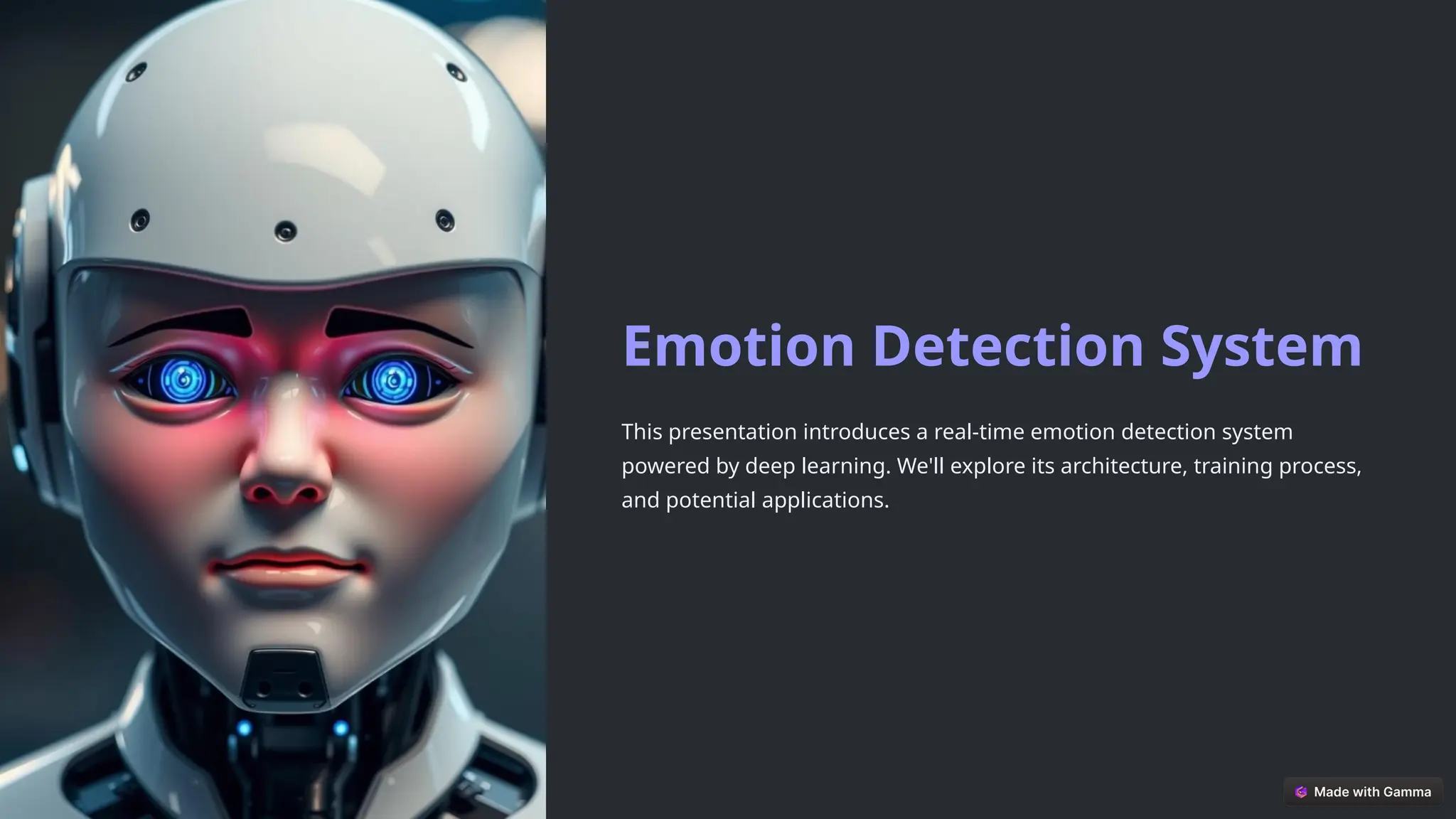
Emotion Detection System
Thispresentation introduces a real-time emotion detection system
powered by deep learning. We'll explore its architecture, training process,
and potential applications.
2.
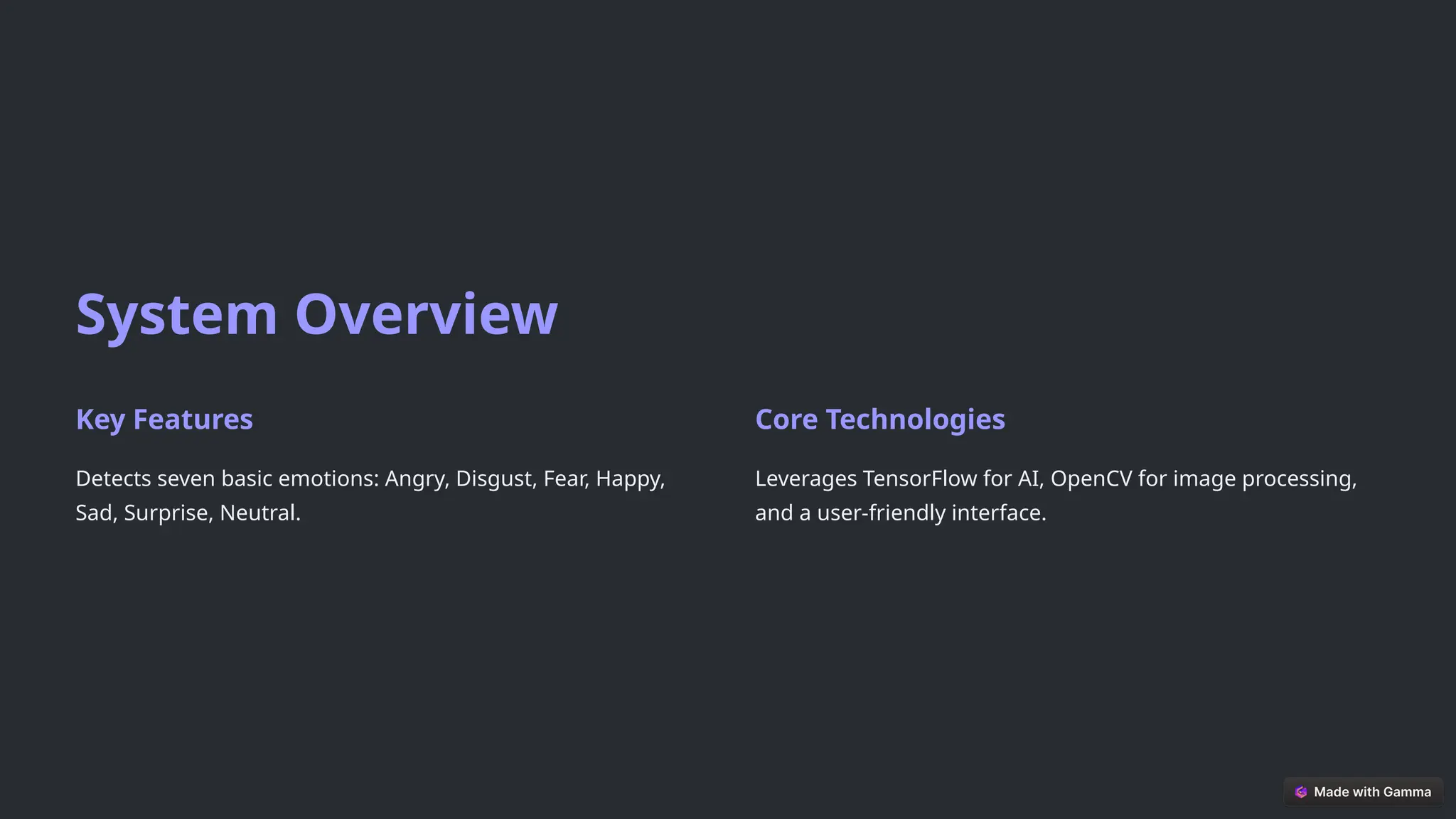
System Overview
Key Features
Detectsseven basic emotions: Angry, Disgust, Fear, Happy,
Sad, Surprise, Neutral.
Core Technologies
Leverages TensorFlow for AI, OpenCV for image processing,
and a user-friendly interface.
3.
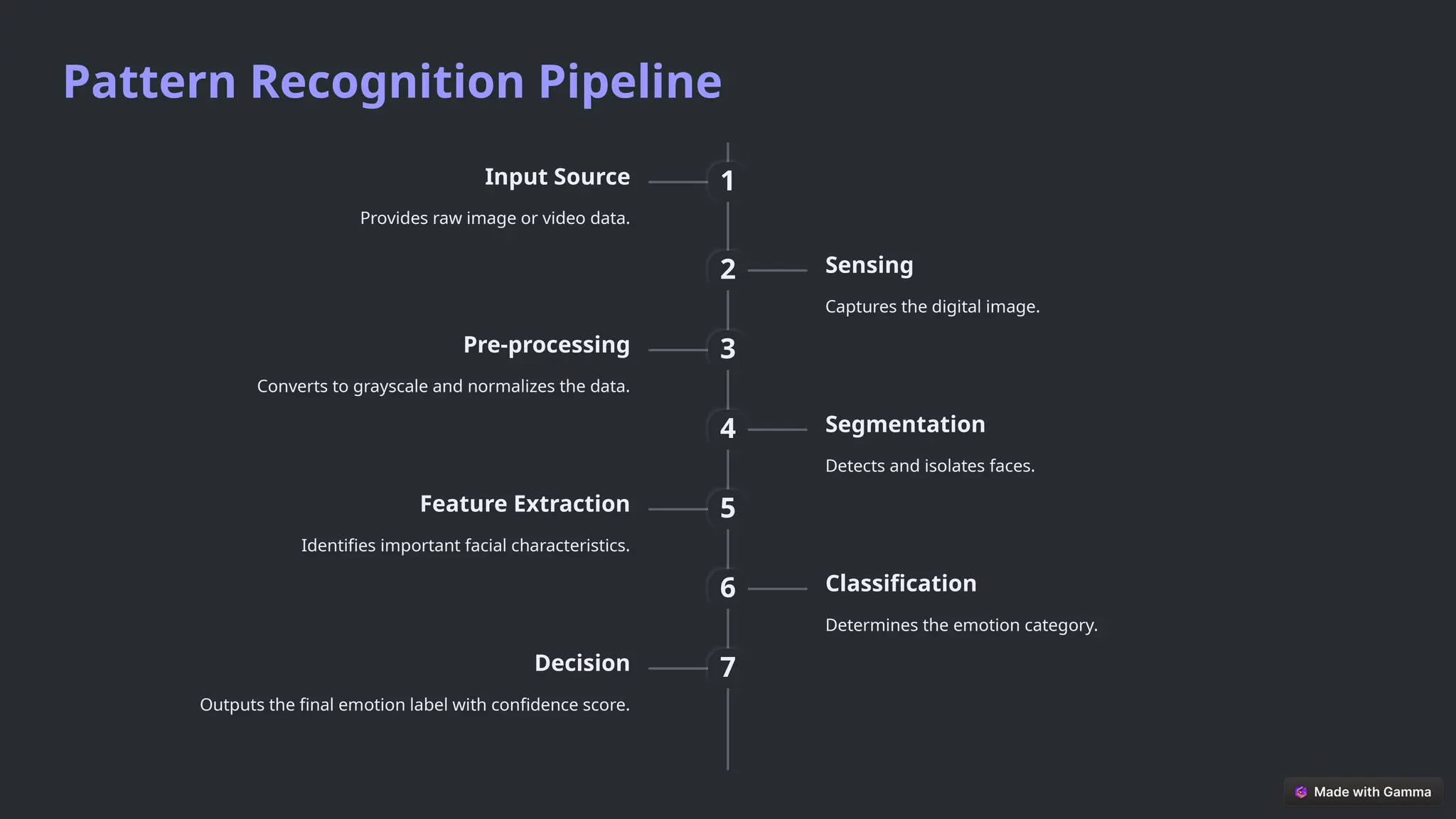
Pattern Recognition Pipeline
1
InputSource
Provides raw image or video data.
2 Sensing
Captures the digital image.
3
Pre-processing
Converts to grayscale and normalizes the data.
4 Segmentation
Detects and isolates faces.
5
Feature Extraction
Identifies important facial characteristics.
6 Classification
Determines the emotion category.
7
Decision
Outputs the final emotion label with confidence score.
4.
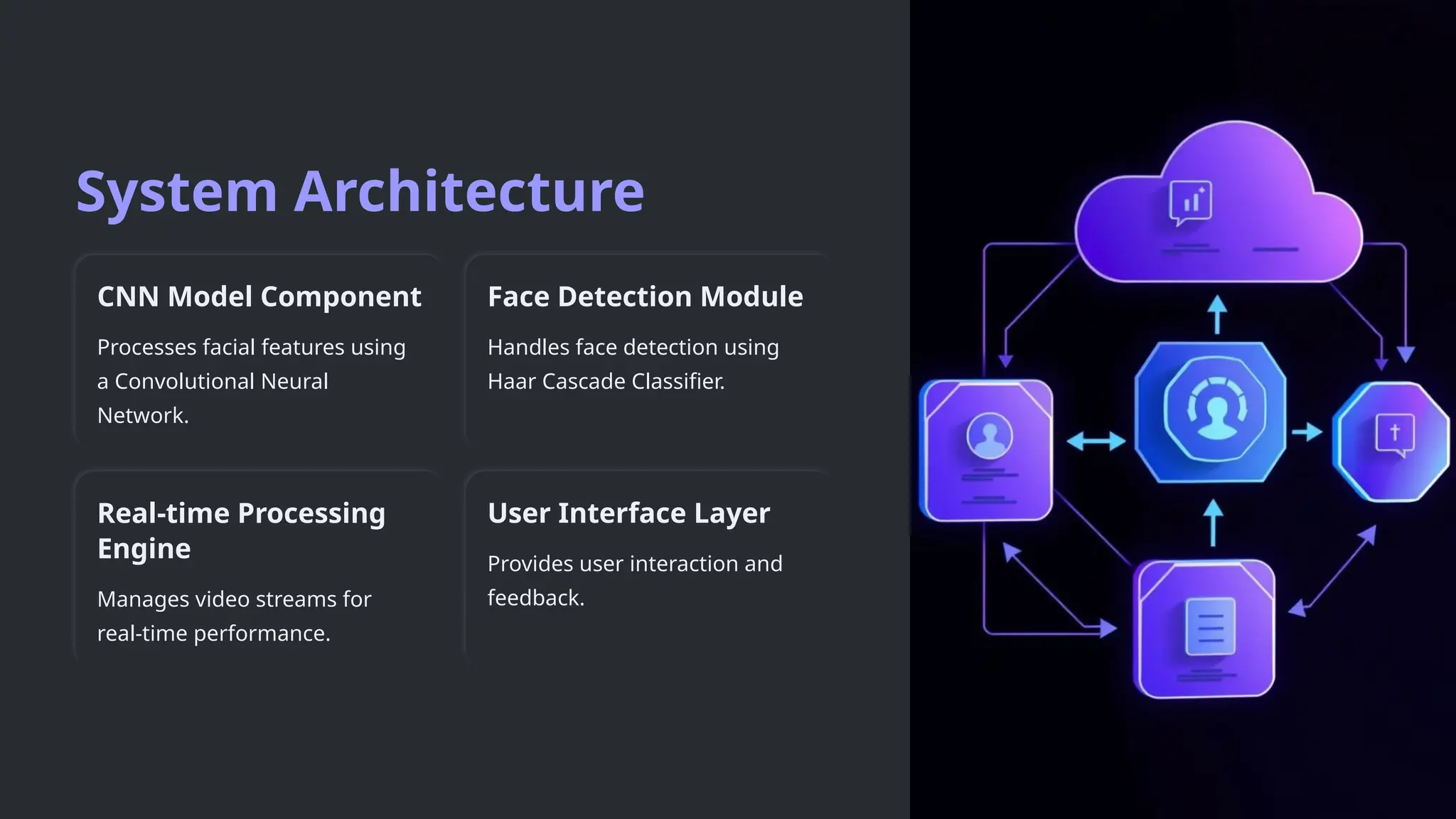
System Architecture
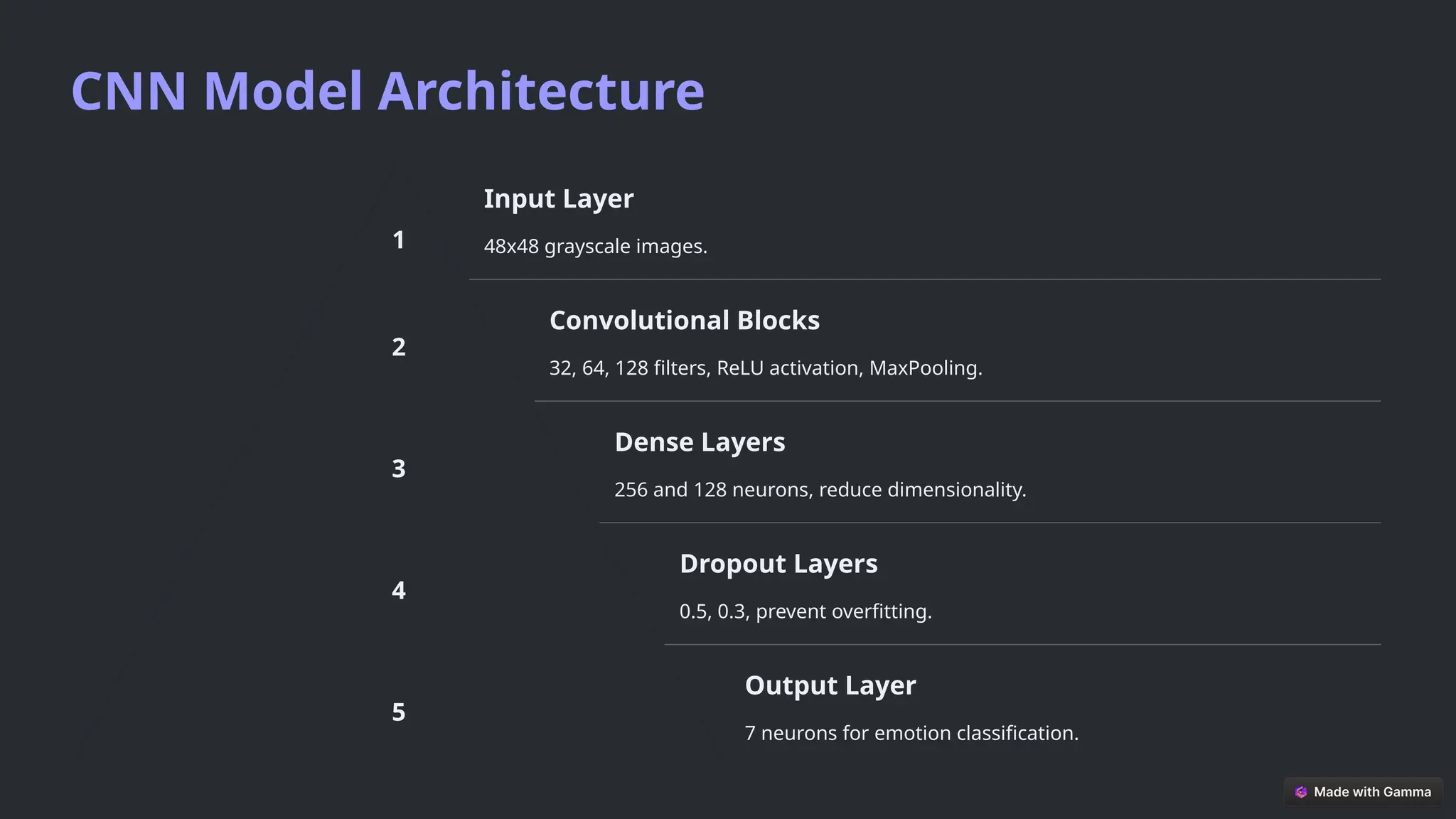
CNN ModelComponent
Processes facial features using
a Convolutional Neural
Network.
Face Detection Module
Handles face detection using
Haar Cascade Classifier.
Real-time Processing
Engine
Manages video streams for
real-time performance.
User Interface Layer
Provides user interaction and
feedback.
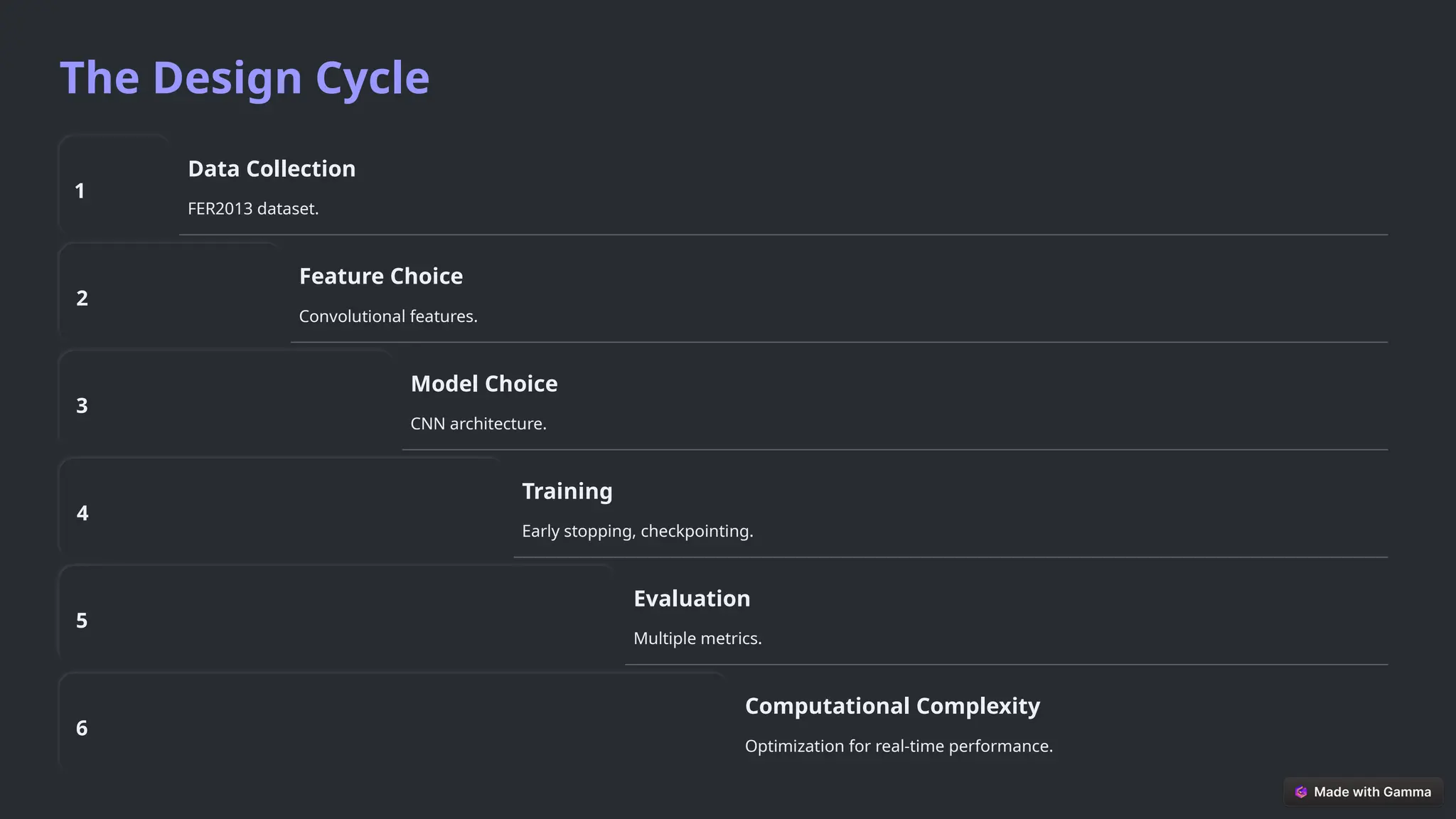
The Design Cycle
1
DataCollection
FER2013 dataset.
2
Feature Choice
Convolutional features.
3
Model Choice
CNN architecture.
4
Training
Early stopping, checkpointing.
5
Evaluation
Multiple metrics.
6
Computational Complexity
Optimization for real-time performance.
7.
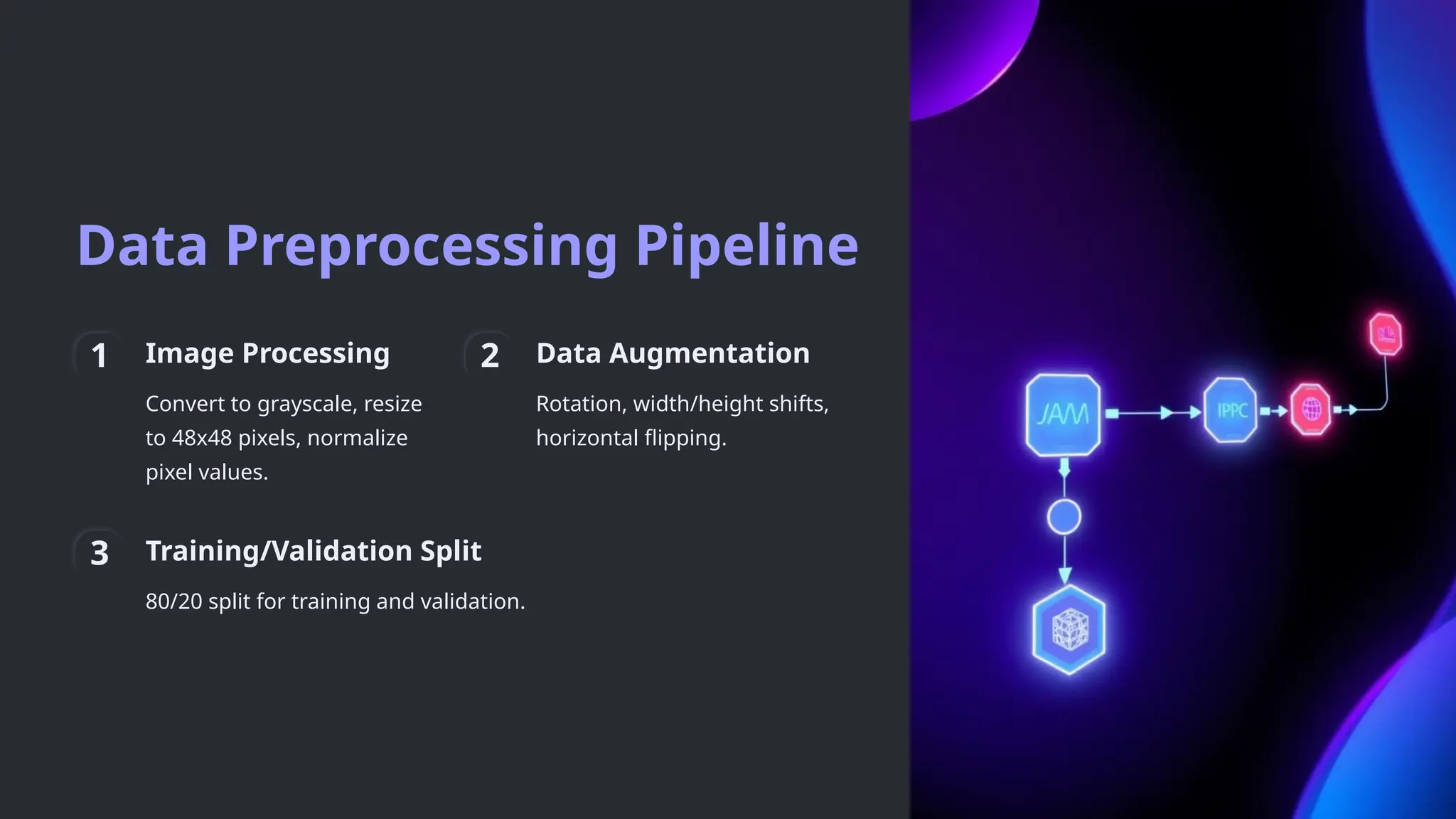
Data Preprocessing Pipeline
1Image Processing
Convert to grayscale, resize
to 48x48 pixels, normalize
pixel values.
2 Data Augmentation
Rotation, width/height shifts,
horizontal flipping.
3 Training/Validation Split
80/20 split for training and validation.
8.
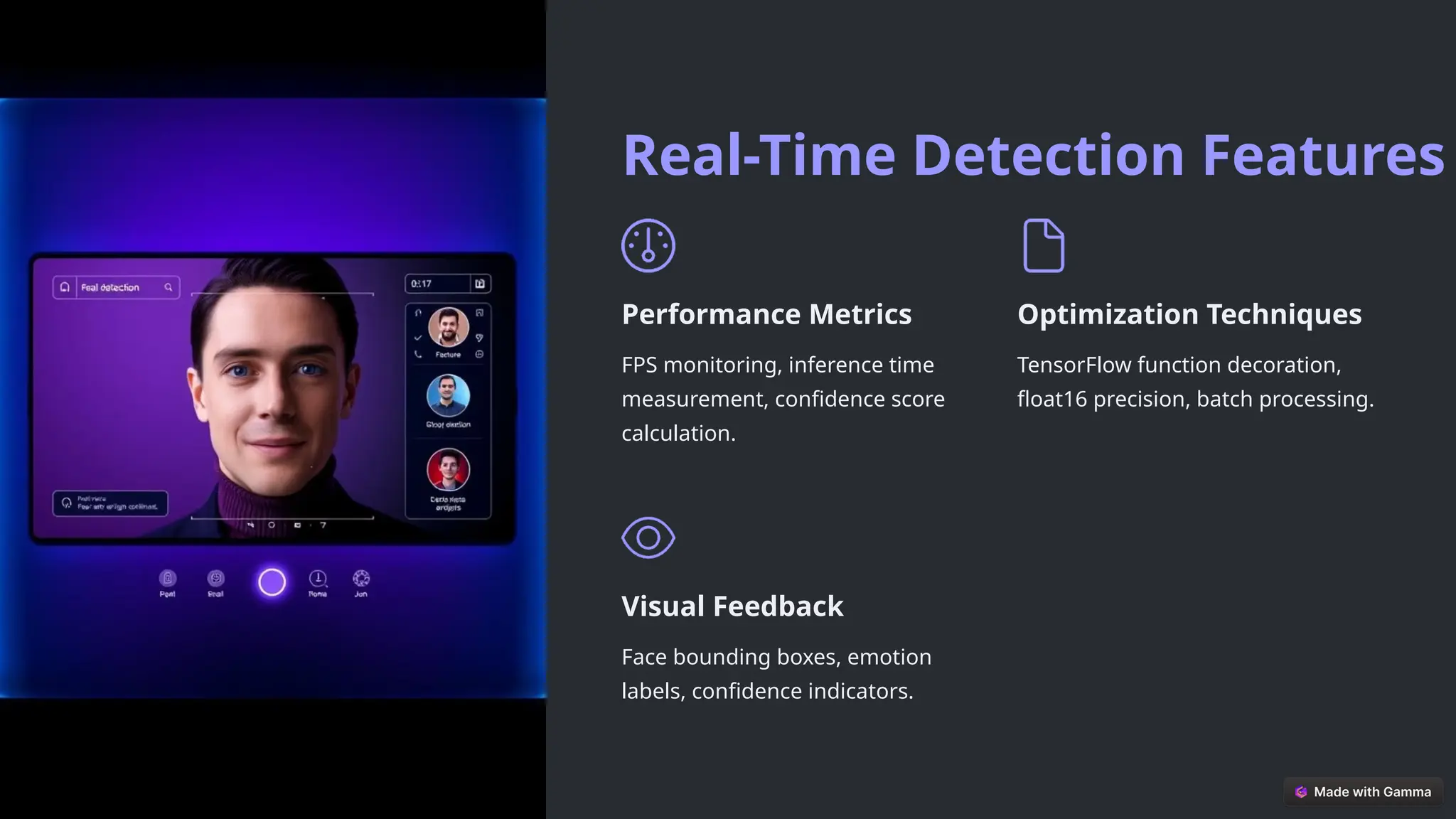
Real-Time Detection Features
PerformanceMetrics
FPS monitoring, inference time
measurement, confidence score
calculation.
Optimization Techniques
TensorFlow function decoration,
float16 precision, batch processing.
Visual Feedback
Face bounding boxes, emotion
labels, confidence indicators.
9.
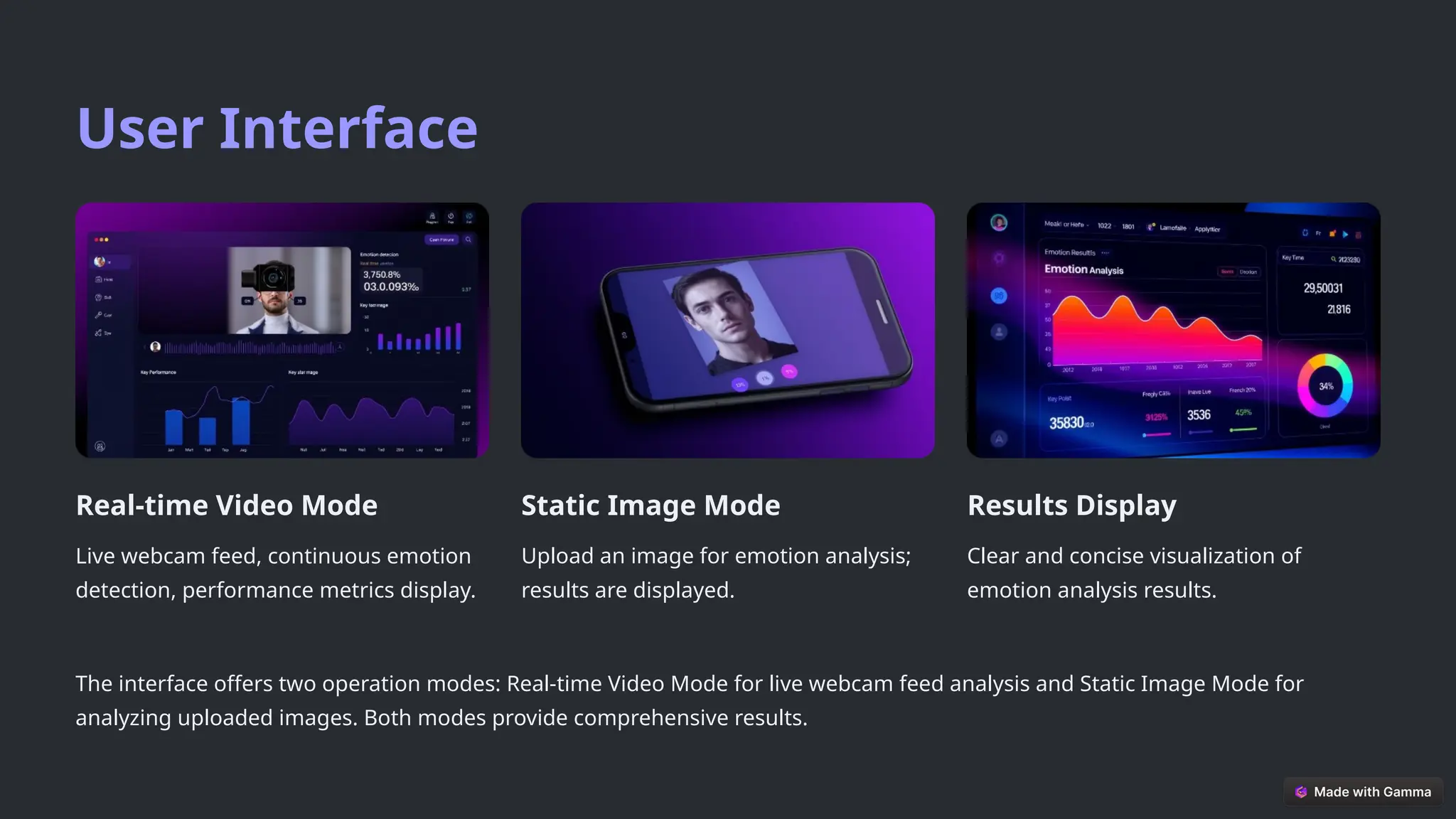
User Interface
Real-time VideoMode
Live webcam feed, continuous emotion
detection, performance metrics display.
Static Image Mode
Upload an image for emotion analysis;
results are displayed.
Results Display
Clear and concise visualization of
emotion analysis results.
The interface offers two operation modes: Real-time Video Mode for live webcam feed analysis and Static Image Mode for
analyzing uploaded images. Both modes provide comprehensive results.
10.
Model Training andEvaluation
Training Parameters
Early stopping with 30-epoch patience, model checkpointing for best performance, TensorBoard monitoring.
Evaluation Metrics
Accuracy, precision, recall, confusion matrix analysis.
Performance Results
The model demonstrates robust performance in recognizing facial emotions.
11.
Future Improvements
Technical Enhancements
•Multi-face detection capability
• Temporal emotion tracking
• Transfer learning implementation
• Mobile deployment
• Edge device optimization
Application Domains
• Human-Computer Interaction
• Market Research
• Mental Health Monitoring
• Educational Technology
Development Roadmap
The roadmap outlines a phased
approach for incorporating these
improvements and expanding the
application of emotion detection
technology.
12.
Team Members
• YoussefMohamed Mohamed Abdelmaksod
• Abdullah Mohamed Abdelgawad
• Moamen Ayman Gad
• Abdelrahman Ahmed Saad
• Abdelrahman Abozied
• Mona Alhussieny
13.
Thanks !
We appreciateyour time and interest. Feel free to reach out for any further
questions or discussions.