INTRODUCTION
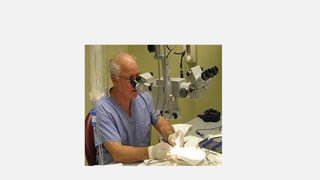
• Microsurgery isa precise type of surgical operation in which
tools such as loupes and microscopes are used when
performing surgical procedures.
• In the latter half of the 18th century, advances in optical lens
technology led to the development of magnifying instruments
such as loupes.
• Stationary microscopes were introduced in clinical settings in
the 19th century.
3.
• . Inthe latter half of the 19th century, highly specific organ
transplantation research involving large numbers of laboratory
animals was conducted to enable the transition from concept
to reality.
• However, it was necessary to introduce excellent microsurgery
technologies, especially for the creation of small animal models
that were similar to humans.
5.
EVOLUTION
• The useof this technology expanded into the following medical
fields: ear, nose and throat (ENT), plastic surgery,
ophthalmology and neurosurgery.
• Concurrently, a ground-breaking type of surgical treatment
was introduced.
• Specifically, organ transplantation therapy was introduced with
the aim of saving lives by transplanting new organs into
patients who had experienced lethal organ failure
6.
• . Inthe latter half of the 19th century, highly specific organ
transplantation research involving large numbers of laboratory
animals was conducted to enable the transition from concept
to reality.
• However, it was necessary to introduce excellent microsurgery
technologies, especially for the creation of small animal models
that were similar to humans.
• Currently, revolutionary progress in the field of medical optical
instruments is ongoing, and surgical techniques are beginning
to incorporate robotic technology
• Microsurgery witha conventional optical microscope provides a
limited field of view and imposes serious strain on surgeons
during long operations.
• Accordingly, an ophthalmological surgical technique known as
“heads-up surgery” was recently developed; here, the field of
view is displayed on a screen via a high-resolution camera.
• This method is now being applied to various types of
microsurgeries with long operating times that formerly
required the use of a magnifying glass
9.
• Heads-up surgerycould be implemented in an even greater
range of operations.
• Additionally, many microsurgeries could implement heads-up
surgery with a three-dimensional (3D) video camera.
• Currently available higher-performance CCD cameras and
imaging technologies will enable new options for advanced
microsurgery.
10.
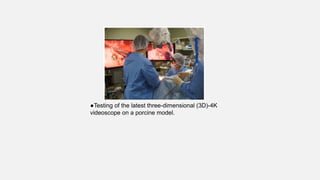
●Testing of thelatest three-dimensional (3D)-4K
videoscope on a porcine model.
• Today, manysurgical procedures are performed
arthroscopically.
• Surgical techniques are often practiced using dummies,
cadavers and live pigs
• In recent years, the development of robot-assisted surgery has
led to an eminent revolution in surgical operations.
• In the field of microsurgery, the world’s first super-
microsurgery operation was performed using Microsure, or
“robot hands,” at Maastricht University Medical Center+ in
2017
13.
• However, robotsmay experience difficulties when interacting
with uncertain environments.
• Optical technology, while enhancing the scope of a surgeon’s
eyesight, decreases the haptic sensation in the surgeon’s
hands.
• In microsurgery, the haptic sensation from extremely thin
suture threads is nearly undetectable, and expert surgeons
tend to recoup this lack of haptic sensation from microscopic
images.
• Similar to microscopes and other engineering supports for
eyes, surgical robots have been developed to support hands.
Nevertheless, these robots cannot yet transmit haptic
information
14.
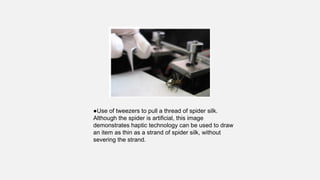
●Use of tweezersto pull a thread of spider silk.
Although the spider is artificial, this image
demonstrates haptic technology can be used to draw
an item as thin as a strand of spider silk, without
severing the strand.
15.
RECENT ADVANCEMENTS INROBOT
ASSISTED MICROSURGERY
• Bilateral control, an engineering methodology used to transmit
haptic sensation, has been developed via senseless technology.
• With this method, haptics can be controlled mutually between
the “Master,” which is operated by a human, and the “Slave,”
which directly manages surgical sites.
• Bilateral control enables us to operate a robot with haptic
sense feedback. The robots can act “softly” via the bilateral
control system, despite being composed of steel or aluminum.
A surgical robot is one promising application of this technology.







![ONFH[AVN HIP] -TRIPLE REGIME -A NOVAL SURGICAL CONCEPT .pptx](https://cdn.slidesharecdn.com/ss_thumbnails/onfhavnhip2026koaconcalicutdrgokuldevdrmashraf-260210064517-213ec005-thumbnail.jpg?width=640&height=640&fit=bounds)


![CTEV [ clubfoot] DR ARUN LAL ,DR MOHAMED ASHRAF travancore medical college k...](https://cdn.slidesharecdn.com/ss_thumbnails/ctevclubfootdrarunlaldrmohamedashraftravancoremedicalcollegekollamkeralaindia-260208063247-18fc466c-thumbnail.jpg?width=640&height=640&fit=bounds)

