IMPACTS OF CLIMATE CHANGE
ON COCOA YIELD PRODUCTION
USING FORECAST MODELS
BY:
WILLIAM AGYAKWAH
SUPERVISOR:
PASCALINE CHEMAIYO
JULY, 2014
1
OUTLINE
 INTRODUCTION
 OBJECTIVE
 JUSTIFICATION
 LITERATURE REVIEW
 METHODOLOGY
 STUDY AREAS
 RESULTS AND DISCUSSION
 CONCLUSION AND RECOMMENDATION
 REFERENCES
2
INTRODUCTION
 What is climate change?
 Cocoa as a tropical crop is specific in its climatic and
soil requirement
 Climatic parameters related to cocoa yield production
 Other factors which affect cocoa yield
 Cocoa production serves as source of livelihood for
most inhabitants of Ghana
3
 The main objective of this study is to determine the impacts of
climate change on cocoa yield production using forecast models.
SPECIFIC OBJECTIVES
 To find associations among rainfall, temperature and sunshine
with cocoa production
 Investigate the impacts of climate change on cocoa yields
 Assess the socio-economic implications of climate change on
cocoa yields
 How to mitigate or adapt to impacts of climate change on cocoa
yields
OBJECTIVE
4
JUSTIFICATION
 The world production of cocoa beans has experienced
irregular pattern due to heavy dependence on weather
in production
 What are the effects of climate change on cocoa
production?
 What coping strategies can be adopted by cocoa
farmers in sustaining crop failure and cocoa yield
loses?
5
LITERATURE REVIEW
 Cocoa is highly vulnerable to drought and the pattern
of cropping of cocoa is related to rainfall distribution.
(Anim-Kwapong, G. J. and Frimpong, E. B. (2005).
 Cocoa as a tropical crop can only be profitably grown
under temperatures varying between 30-32oC mean
maximum and 18-21oC mean minimum and absolute
minimum of 10oC (Wood and Lass 1985).
6
LITERATURE REVIEW CONT.
 Black pod disease is closely related to weather and
climate. It is more prevalent in damp situations and is
most destructive in years when the short dry period
from July to August is very wet (Anim-Kwapong and
Frimpong 2003).
 Low light intensities suppress flower production; with
light levels less than 1800 hours per year, have
considerable depressing effect on production
(Asomaning et al 1971)
7
METHODOLOGY
 General Circulation Models (GCM) in conjunction with
Simple Climate Models (SCM) method
 Multiple Regression Analysis
 Questionnaire Approach Method (Tobit Model for
analysis)
 These models were to find possible relationship among
climate parameters and cocoa production
 Models were used to predict the impact of climate
change on cocoa yield production 8
9
STUDY AREAS
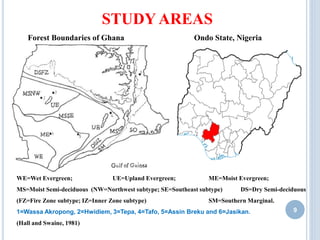
Forest Boundaries of Ghana Ondo State, Nigeria
WE=Wet Evergreen; UE=Upland Evergreen; ME=Moist Evergreen;
MS=Moist Semi-deciduous (NW=Northwest subtype; SE=Southeast subtype) DS=Dry Semi-deciduous
(FZ=Fire Zone subtype; IZ=Inner Zone subtype) SM=Southern Marginal.
1=Wassa Akropong, 2=Hwidiem, 3=Tepa, 4=Tafo, 5=Assin Breku and 6=Jasikan.
(Hall and Swaine, 1981)
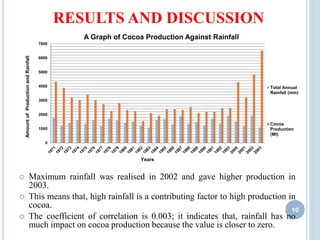
 Maximum rainfall was realised in 2002 and gave higher production in
2003.
 This means that, high rainfall is a contributing factor to high production in
cocoa.
 The coefficient of correlation is 0.003; it indicates that, rainfall has no
much impact on cocoa production because the value is closer to zero.
10
0
1000
2000
3000
4000
5000
6000
7000
AmountofProductionandRainfall
Years
A Graph of Cocoa Production Against Rainfall
Total Annual
Rainfall (mm)
Cocoa
Production
(Mt)
RESULTS AND DISCUSSION
RESULTS AND DISCUSSION CONT.
11
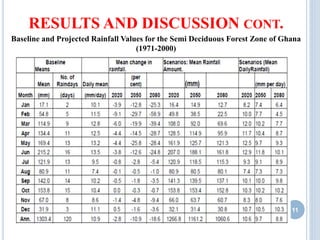
Baseline and Projected Rainfall Values for the Semi Deciduous Forest Zone of Ghana
(1971-2000)
RESULTS AND DISCUSSION CONT.
12
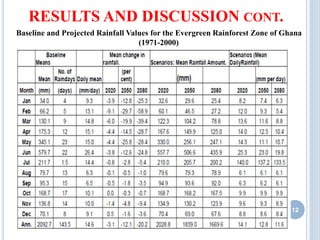
Baseline and Projected Rainfall Values for the Evergreen Rainforest Zone of Ghana
(1971-2000)
CONCLUSION
13
 The Climate Change (temperature and rainfall) scenarios for the semi-
deciduous forest will decline by -2.8%, -10.9% and -18.6% in year 2020, 2050
and 2080 respectively
 In the evergreen rainforest zone, mean annual rainfall will also decline by -
3.1%, -12.1% and -20.2% in year 2020, 2050 and 2080 respectively
 Mean annual temperature changes will rise by 0.8oc, 2.5oc and 5.4oc in year
2020, 2050 and 2080 respectively in the semi deciduous forest
 Mean annual temperature changes will rise by 0.6oc , 2.0oc and 3.9oc in year
2020, 2050 and 2080 respectively in the evergreen rainforest zone
 60% of the variation in dry Cocoa beans produced could be explained by the
combination of the preceding year’s total annual rainfall, total rainfall in the two
driest months and total sunshine duration. (Y= 2447 - 1.41 (X1) + 32.4 (X2) +
0.66(X3) )
RECOMMENDATIONS
 Drought management policy through information systems
 Policies to promote the establishment of irrigation systems in
farms through the provision of infrastructure, education and
training.
 Policies to encourage tree planting and maintenance of shade on
cocoa.
 Farmers should be trained on techniques of spraying against
diseases and how to process the produce for sale.
 Researching into making new breeds of cocoa that can adapt to
climate change for high productivity 14
REFERENCES
 Anim-Kwapong, G. J. and Frimpong, E. B. (2005). Vulnerability of Agriculture
to Climate Change – impact of climate on Cocoa production. Cocoa Research
Institute, New Tafo Akim, Ghana.
 A.S. Oyekale , M.B. Bolaji and O.W. Olowa ,(2009). The Effects of Climate
Change on Cocoa Production and Vulnerability Assessment in
Nigeria. Agricultural Journal, 4: 77-85.
 Brew, K. M. (1991). Relationship between yield, rainfall and total sunshine
hours. Rep. Cocoa Res. Inst. Ghana. 1988/89, p30-32. Charter, C. F. (1947).
Cocoa soils: good and bad (Mimeo). West Africa Cocoa Research Institute, Tafo,
Ghana.
 Skidmore, C. L. (1929). Indications of existing correlation between rainfall and
the number of pods harvested at Aburi and Asuansi. Department of Agriculture
Gold Coast Bulletin, 1928, p.114-120. 15
THANK YOU
MAY GOD BLESS
YOU
16

Presentation -GAMFC (2014)

  • 1.
    IMPACTS OF CLIMATECHANGE ON COCOA YIELD PRODUCTION USING FORECAST MODELS BY: WILLIAM AGYAKWAH SUPERVISOR: PASCALINE CHEMAIYO JULY, 2014 1
  • 2.
    OUTLINE  INTRODUCTION  OBJECTIVE JUSTIFICATION  LITERATURE REVIEW  METHODOLOGY  STUDY AREAS  RESULTS AND DISCUSSION  CONCLUSION AND RECOMMENDATION  REFERENCES 2
  • 3.
    INTRODUCTION  What isclimate change?  Cocoa as a tropical crop is specific in its climatic and soil requirement  Climatic parameters related to cocoa yield production  Other factors which affect cocoa yield  Cocoa production serves as source of livelihood for most inhabitants of Ghana 3
  • 4.
     The mainobjective of this study is to determine the impacts of climate change on cocoa yield production using forecast models. SPECIFIC OBJECTIVES  To find associations among rainfall, temperature and sunshine with cocoa production  Investigate the impacts of climate change on cocoa yields  Assess the socio-economic implications of climate change on cocoa yields  How to mitigate or adapt to impacts of climate change on cocoa yields OBJECTIVE 4
  • 5.
    JUSTIFICATION  The worldproduction of cocoa beans has experienced irregular pattern due to heavy dependence on weather in production  What are the effects of climate change on cocoa production?  What coping strategies can be adopted by cocoa farmers in sustaining crop failure and cocoa yield loses? 5
  • 6.
    LITERATURE REVIEW  Cocoais highly vulnerable to drought and the pattern of cropping of cocoa is related to rainfall distribution. (Anim-Kwapong, G. J. and Frimpong, E. B. (2005).  Cocoa as a tropical crop can only be profitably grown under temperatures varying between 30-32oC mean maximum and 18-21oC mean minimum and absolute minimum of 10oC (Wood and Lass 1985). 6
  • 7.
    LITERATURE REVIEW CONT. Black pod disease is closely related to weather and climate. It is more prevalent in damp situations and is most destructive in years when the short dry period from July to August is very wet (Anim-Kwapong and Frimpong 2003).  Low light intensities suppress flower production; with light levels less than 1800 hours per year, have considerable depressing effect on production (Asomaning et al 1971) 7
  • 8.
    METHODOLOGY  General CirculationModels (GCM) in conjunction with Simple Climate Models (SCM) method  Multiple Regression Analysis  Questionnaire Approach Method (Tobit Model for analysis)  These models were to find possible relationship among climate parameters and cocoa production  Models were used to predict the impact of climate change on cocoa yield production 8
  • 9.
    9 STUDY AREAS Forest Boundariesof Ghana Ondo State, Nigeria WE=Wet Evergreen; UE=Upland Evergreen; ME=Moist Evergreen; MS=Moist Semi-deciduous (NW=Northwest subtype; SE=Southeast subtype) DS=Dry Semi-deciduous (FZ=Fire Zone subtype; IZ=Inner Zone subtype) SM=Southern Marginal. 1=Wassa Akropong, 2=Hwidiem, 3=Tepa, 4=Tafo, 5=Assin Breku and 6=Jasikan. (Hall and Swaine, 1981)
  • 10.
     Maximum rainfallwas realised in 2002 and gave higher production in 2003.  This means that, high rainfall is a contributing factor to high production in cocoa.  The coefficient of correlation is 0.003; it indicates that, rainfall has no much impact on cocoa production because the value is closer to zero. 10 0 1000 2000 3000 4000 5000 6000 7000 AmountofProductionandRainfall Years A Graph of Cocoa Production Against Rainfall Total Annual Rainfall (mm) Cocoa Production (Mt) RESULTS AND DISCUSSION
  • 11.
    RESULTS AND DISCUSSIONCONT. 11 Baseline and Projected Rainfall Values for the Semi Deciduous Forest Zone of Ghana (1971-2000)
  • 12.
    RESULTS AND DISCUSSIONCONT. 12 Baseline and Projected Rainfall Values for the Evergreen Rainforest Zone of Ghana (1971-2000)
  • 13.
    CONCLUSION 13  The ClimateChange (temperature and rainfall) scenarios for the semi- deciduous forest will decline by -2.8%, -10.9% and -18.6% in year 2020, 2050 and 2080 respectively  In the evergreen rainforest zone, mean annual rainfall will also decline by - 3.1%, -12.1% and -20.2% in year 2020, 2050 and 2080 respectively  Mean annual temperature changes will rise by 0.8oc, 2.5oc and 5.4oc in year 2020, 2050 and 2080 respectively in the semi deciduous forest  Mean annual temperature changes will rise by 0.6oc , 2.0oc and 3.9oc in year 2020, 2050 and 2080 respectively in the evergreen rainforest zone  60% of the variation in dry Cocoa beans produced could be explained by the combination of the preceding year’s total annual rainfall, total rainfall in the two driest months and total sunshine duration. (Y= 2447 - 1.41 (X1) + 32.4 (X2) + 0.66(X3) )
  • 14.
    RECOMMENDATIONS  Drought managementpolicy through information systems  Policies to promote the establishment of irrigation systems in farms through the provision of infrastructure, education and training.  Policies to encourage tree planting and maintenance of shade on cocoa.  Farmers should be trained on techniques of spraying against diseases and how to process the produce for sale.  Researching into making new breeds of cocoa that can adapt to climate change for high productivity 14
  • 15.
    REFERENCES  Anim-Kwapong, G.J. and Frimpong, E. B. (2005). Vulnerability of Agriculture to Climate Change – impact of climate on Cocoa production. Cocoa Research Institute, New Tafo Akim, Ghana.  A.S. Oyekale , M.B. Bolaji and O.W. Olowa ,(2009). The Effects of Climate Change on Cocoa Production and Vulnerability Assessment in Nigeria. Agricultural Journal, 4: 77-85.  Brew, K. M. (1991). Relationship between yield, rainfall and total sunshine hours. Rep. Cocoa Res. Inst. Ghana. 1988/89, p30-32. Charter, C. F. (1947). Cocoa soils: good and bad (Mimeo). West Africa Cocoa Research Institute, Tafo, Ghana.  Skidmore, C. L. (1929). Indications of existing correlation between rainfall and the number of pods harvested at Aburi and Asuansi. Department of Agriculture Gold Coast Bulletin, 1928, p.114-120. 15
  • 16.
    THANK YOU MAY GODBLESS YOU 16