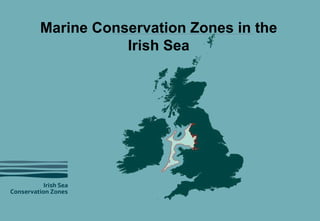
Marine Conservation Zones in the Irish Sea
A team of 7 people. Based at Envirolink Northwest in Warrington. A new project to support the development of Marine Conservation Zones in the Irish Sea region. Who are Irish Sea Conservation Zones?
Why Are We Here? Help secure a healthy and productive future for the coast and waters of the Irish Sea.
EC Habitats & Birds Directives Based on scientific  and  socio-economic factors Marine & Coastal Access Bill Wildlife & Countryside Act MCZs SPAs SACs SSSIs MPA Network 2012 A New Type of MPA for England & Wales Based on scientific grounds Ramsar Convention on Wetlands of International Importance
What is a Marine Conservation Zone (MCZ)? Protects  nationally important marine wildlife, habitats, geology and geomorphology. May take socio-economic factors into account.  Stakeholders will be actively involved in deciding the location of MCZs.
The MCZ Project The Project has been set-up by Defra, JNCC and Natural England. It will be delivered by 4 regional projects: Irish Sea Conservation Zones Finding Sanctuary (south-west England) Balanced Seas (south-east England) Net Gain (North Sea)
Irish Sea Conservation Zones
Project Delivery ISCZ Project 2009 2011 Natural England & JNCC advise on suitability of network Recommendation for regional MCZ network submitted. Formal consultation 2012 MCZs designated
Support sea users. Hire an independent facilitator Meet  National ecological guidance . Impact Assessment It is  not  our role to decide where MCZs will be or how they will be managed. What is our role?
Who are the Stakeholders? ©Dave Willis
1. Informing users in the area about the project.   2. Creating a group who can voice the opinion of sea users & interest groups using the Irish Sea. 4. Supporting feedback from the Group to the communities it represents. 3. Hosting a number of workshops to establish a set of site specific recommendations for MCZs in the Irish Sea. 5. Ensuring MCZs meet national ecological guidance and gaining consensus from all interested parties. 6. Submission of a set of recommendations to JNCC and Natural England Provision of Data to Support Decisions Delivering the Project
County Workshops Attended by 145 stakeholders throughout the northwest
The Regional Stakeholder Group Decide the location, size and shape of MCZs Decide the conservation objectives  Contribute to an impact assessment
Local MCZ Groups Review and comment  Provide feedback - local issues and concerns. Could not make recommendations on the location of MCZs.
Information collection & understanding local knowledge We need to understand which areas of sea are important to stakeholders. - Minimise impacts - More widely supported - More likely to be successful Provision of Data to  Support Decisions
Fishing Value Restricted Netting Areas
Participatory Mapping Commercial Fishers Charter Boat Operators Anglers Wildlife Enthusiasts Scuba Divers Leisure Boating One to One Participatory Mapping - Questionnaire Activity and local knowledge presented to Regional Stakeholder Group Liaison Officers ISCZ Team
Project Delivery ISCZ Project 2009 2011 Natural England & JNCC advise on suitability of network Recommendation for regional MCZ network submitted. Formal consultation 2012 MCZs designated
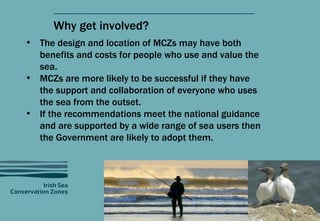
Why get involved? The design and location of MCZs may have both benefits and costs for people who use and value the sea.  MCZs are more likely to be successful if they have the support and collaboration of everyone who uses the sea from the outset.  If the recommendations meet the national guidance and are supported by a wide range of sea users then the Government are likely to adopt them.
Thank you! © Dave Willis Emily Hardman 07891 842 282 Kieran Bell 07515 167 297 Website:   www.irishseaconservation.org.uk

Presentation For Nwnwsfc December 09

  • 1.
    Marine Conservation Zonesin the Irish Sea
  • 2.
    A team of7 people. Based at Envirolink Northwest in Warrington. A new project to support the development of Marine Conservation Zones in the Irish Sea region. Who are Irish Sea Conservation Zones?
  • 3.
    Why Are WeHere? Help secure a healthy and productive future for the coast and waters of the Irish Sea.
  • 4.
    EC Habitats &Birds Directives Based on scientific and socio-economic factors Marine & Coastal Access Bill Wildlife & Countryside Act MCZs SPAs SACs SSSIs MPA Network 2012 A New Type of MPA for England & Wales Based on scientific grounds Ramsar Convention on Wetlands of International Importance
  • 5.
    What is aMarine Conservation Zone (MCZ)? Protects nationally important marine wildlife, habitats, geology and geomorphology. May take socio-economic factors into account. Stakeholders will be actively involved in deciding the location of MCZs.
  • 6.
    The MCZ ProjectThe Project has been set-up by Defra, JNCC and Natural England. It will be delivered by 4 regional projects: Irish Sea Conservation Zones Finding Sanctuary (south-west England) Balanced Seas (south-east England) Net Gain (North Sea)
  • 7.
  • 8.
    Project Delivery ISCZProject 2009 2011 Natural England & JNCC advise on suitability of network Recommendation for regional MCZ network submitted. Formal consultation 2012 MCZs designated
  • 9.
    Support sea users.Hire an independent facilitator Meet National ecological guidance . Impact Assessment It is not our role to decide where MCZs will be or how they will be managed. What is our role?
  • 10.
    Who are theStakeholders? ©Dave Willis
  • 11.
    1. Informing usersin the area about the project. 2. Creating a group who can voice the opinion of sea users & interest groups using the Irish Sea. 4. Supporting feedback from the Group to the communities it represents. 3. Hosting a number of workshops to establish a set of site specific recommendations for MCZs in the Irish Sea. 5. Ensuring MCZs meet national ecological guidance and gaining consensus from all interested parties. 6. Submission of a set of recommendations to JNCC and Natural England Provision of Data to Support Decisions Delivering the Project
  • 12.
    County Workshops Attendedby 145 stakeholders throughout the northwest
  • 13.
    The Regional StakeholderGroup Decide the location, size and shape of MCZs Decide the conservation objectives Contribute to an impact assessment
  • 14.
    Local MCZ GroupsReview and comment Provide feedback - local issues and concerns. Could not make recommendations on the location of MCZs.
  • 15.
    Information collection &understanding local knowledge We need to understand which areas of sea are important to stakeholders. - Minimise impacts - More widely supported - More likely to be successful Provision of Data to Support Decisions
  • 16.
  • 17.
    Participatory Mapping CommercialFishers Charter Boat Operators Anglers Wildlife Enthusiasts Scuba Divers Leisure Boating One to One Participatory Mapping - Questionnaire Activity and local knowledge presented to Regional Stakeholder Group Liaison Officers ISCZ Team
  • 18.
    Project Delivery ISCZProject 2009 2011 Natural England & JNCC advise on suitability of network Recommendation for regional MCZ network submitted. Formal consultation 2012 MCZs designated
  • 19.
    Why get involved?The design and location of MCZs may have both benefits and costs for people who use and value the sea. MCZs are more likely to be successful if they have the support and collaboration of everyone who uses the sea from the outset. If the recommendations meet the national guidance and are supported by a wide range of sea users then the Government are likely to adopt them.
  • 20.
    Thank you! ©Dave Willis Emily Hardman 07891 842 282 Kieran Bell 07515 167 297 Website: www.irishseaconservation.org.uk

Editor's Notes

  • #13 It will comprise representatives from regional, national and international sectors. Responsible for providing MCZ recommendations to Natural England and JNCC by June 2011 including: - Recommended MCZ sites. - conservation objectives for sites (which will inform the level and nature of protection necessary for their constituent features); - A draft Impact Assessment for the regional MCZ options. Representatives will act as a point of contact for 2-way communication between ISCZ and their sector.
  • #14 It will comprise representatives from regional, national and international sectors. Responsible for providing MCZ recommendations to Natural England and JNCC by June 2011 including: - Recommended MCZ sites. - conservation objectives for sites (which will inform the level and nature of protection necessary for their constituent features); - A draft Impact Assessment for the regional MCZ options. Representatives will act as a point of contact for 2-way communication between ISCZ and their sector.
  • #15 Could be based on existing partnerships (e.g. Morecambe Bay Partnership) or new groups may be set up.
  • #18 The 4 projects have come up with a questionnaire to help document your activities AND knowledge. Presented to the Regional Stakeholder Group who will be able to consider this information when recommending sites for MCZs.