A European Perspective: Challenges,
Opportunities and the Future of
Coastal & Estuary Management
Rhona Fairgrieve,
29 September 2015
Coastal Challenges
Coastal regions among the most populated & productive
• 40% of EU citizens live in coastal areas
• High economic, ecologic, social & cultural value
• Increasing competition for maritime and coastal space
• Increasing pressures on coastal/marine resources
Specific problems
• Inefficient/unbalanced use of space
• Conflicting claims on space
• Non-optimal use of economic potential
• Degradation of coastal/marine ecosystems
(8% of coastal habitats and 11% of coastal species in favourable conditions)
A brief history lesson
Year
1992
1993/4
2002
Mid
‘00s
Late
‘00s
Key developments
• House of Commons Select Committee on Coastal
Zone Protection & Planning
• Estuaries & Firths Initiatives set up around UK –
local Coastal Partnerships established
• EU ICZM Recommendation on Integrated Coastal
Zone Management – National Strategies
• Marine planning emerging – Irish Sea Pilot Project
• Thoughts about marine & coastal strategies
• Marine legislation:
– UK: M&CA Act (‘09) and M(S) Act (‘10)
– NL: Spatial plan for NL EEZ
– Mediterranean EU MS: ICZM Protocol to Barcelona Conv.
Also:
• 2000 – Water Framework Directive
• 2007 – Marine Strategy Framework
Directive
Early 2010s
• Economic disruption
• Pursuit of ‘Blue Growth’ agenda within
Integrated Maritime Policy
• Some EU MS pursuing marine planning to
accommodate national drivers
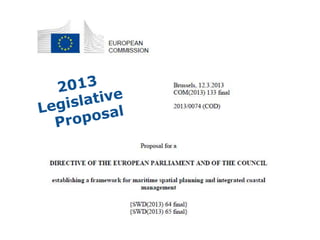
• Consideration of / consultation on a Directive
• “Do we need a MSP/ICM Directive?”
• Preliminary proposals developed 2011/12
– First time ever that 2 DGs worked on 1 Directive
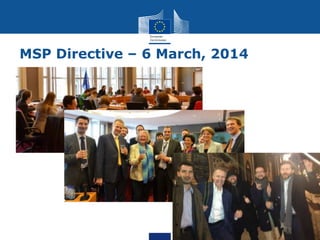
MSP Directive – 6 March, 2014
Directive 2014/89/EU
 Establishes the framework for
Maritime Spatial Planning (MSP)
aimed at promoting the sustainable
growth of maritime economies, the
sustainable development of marine
areas and the sustainable use of
marine resources.
Positives
 Sustainable growth, sustainable development & sustainable use
 “Land-sea interactions” to be taken into account
 References to "coastal regions" retained
 MSFD, WFD & INSPIRE – links to legislation across the acquis
 Ecosystem-based approach to be applied
 Coherence between formal & informal processes (incl. ICM)
 Spatial & temporal distribution of activities = planning
 Nature & species conservation to be planned for
 Strategic Environmental Assessment – Recital 24
 Cross-border cooperation, sea-basins & RSCs recognised
 Timetabling: by 31 March 2021.
Disappointments
 No inclusion of Integrated Coastal Management in its own
right
 "Coastal waters" only included in relation to maritime
planning, not in its own right (and at discretion of MS)
 Deletion of "coastal zones“ from primary scope of Directive
 Lots of "shall aim to contribute to…", "as appropriate", etc.
 Procedural in nature, not operational
 No Implementing Acts
 No timetable for MS to submit reports on implementation
 Strategic Environmental Assessment – only in a Recital
Challenges
• Coasts & estuaries CAN be included in marine
plans – but at MS’ discretion
• LSI means different things to different people –
sensitive subject on which to gain consensus
• Resources – human, financial, data, legislative
provision, etc.
• Timescales – transposition by Sept. 2016; creation
of marine planning authorities and delivery of
MSPs by 31 March 2021
• Integration across policy areas – WFD, MSFD, etc.
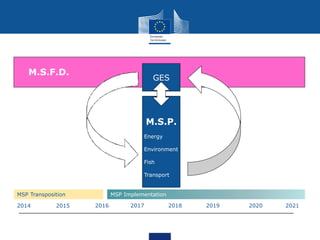
2014 2015 2021
MSP Transposition
2016 2017 2018 2019 2020
MSP Implementation
M.S.P.
Energy
Environment
Fish
Transport
GES
M.S.F.D.
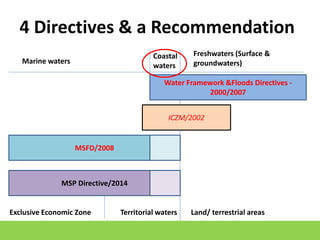
4 Directives & a Recommendation
Land/ terrestrial areas
Coastal
waters
Marine waters
Territorial watersExclusive Economic Zone
MSP Directive/2014
MSFD/2008
Water Framework &Floods Directives -
2000/2007
Freshwaters (Surface &
groundwaters)
ICZM/2002
Opportunities
• “Land/sea interactions”- facilitate understanding
of what it might mean in context of MSP
• ICZM Protocol & earlier ICM work – not wasted!
• Different regimes & requirements:
– UK model: new marine regime to complement T&CP
– Baltics: extension of terrestrial planning to 200nm
• Other EU-sponsored programmes in coastal
areas: ARCH, MARMONI, PAP/RAC, Atlantic
Strategy
• SIMCelt - Transboundary, cross-border MSP?
Areas of joint interest
MSFD
MSPWFD
More efficient & sustainable
management of marine
resources
• Ecosystem based approach
• "Land/sea interactions"
• Sound data for decision
making
• Data exchange &
management
• Engagement of
stakeholders & public
participation
• Cross-border cooperation
[ICM]
The future for coasts & estuaries
• Humans will still live in coastal areas, not at sea
• Estuaries have substantial infrastructure
investment that isn’t easily moved
• You can’t do marine planning without
considering what happens at coastal margins
• However: beware…
– Stakeholder fatigue
– Decline in/lack of resources and interest
– Mismatch in human/policy/politics timescales
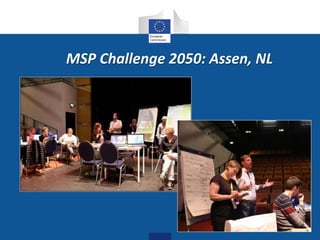
MSP Challenge 2050: Assen, NL
• ICM -> MSP: complementary, not in conflict
• Exchange of knowledge, support & data
• Local, national & international applications
We’ve come a long way in 20+ years…
marijana.mance@ec.europa.eu
DG ENV, Marine & Water Industry Unit
Rhona Fairgrieve
rhona.fairgrieve@gov.scot
+44 (0)131 244 2284

2015 01 - rhona fairgrieve

  • 1.
    A European Perspective:Challenges, Opportunities and the Future of Coastal & Estuary Management Rhona Fairgrieve, 29 September 2015
  • 2.
    Coastal Challenges Coastal regionsamong the most populated & productive • 40% of EU citizens live in coastal areas • High economic, ecologic, social & cultural value • Increasing competition for maritime and coastal space • Increasing pressures on coastal/marine resources Specific problems • Inefficient/unbalanced use of space • Conflicting claims on space • Non-optimal use of economic potential • Degradation of coastal/marine ecosystems (8% of coastal habitats and 11% of coastal species in favourable conditions)
  • 3.
    A brief historylesson Year 1992 1993/4 2002 Mid ‘00s Late ‘00s Key developments • House of Commons Select Committee on Coastal Zone Protection & Planning • Estuaries & Firths Initiatives set up around UK – local Coastal Partnerships established • EU ICZM Recommendation on Integrated Coastal Zone Management – National Strategies • Marine planning emerging – Irish Sea Pilot Project • Thoughts about marine & coastal strategies • Marine legislation: – UK: M&CA Act (‘09) and M(S) Act (‘10) – NL: Spatial plan for NL EEZ – Mediterranean EU MS: ICZM Protocol to Barcelona Conv. Also: • 2000 – Water Framework Directive • 2007 – Marine Strategy Framework Directive
  • 4.
    Early 2010s • Economicdisruption • Pursuit of ‘Blue Growth’ agenda within Integrated Maritime Policy • Some EU MS pursuing marine planning to accommodate national drivers • Consideration of / consultation on a Directive • “Do we need a MSP/ICM Directive?” • Preliminary proposals developed 2011/12 – First time ever that 2 DGs worked on 1 Directive
  • 7.
    MSP Directive –6 March, 2014
  • 8.
    Directive 2014/89/EU  Establishesthe framework for Maritime Spatial Planning (MSP) aimed at promoting the sustainable growth of maritime economies, the sustainable development of marine areas and the sustainable use of marine resources.
  • 9.
    Positives  Sustainable growth,sustainable development & sustainable use  “Land-sea interactions” to be taken into account  References to "coastal regions" retained  MSFD, WFD & INSPIRE – links to legislation across the acquis  Ecosystem-based approach to be applied  Coherence between formal & informal processes (incl. ICM)  Spatial & temporal distribution of activities = planning  Nature & species conservation to be planned for  Strategic Environmental Assessment – Recital 24  Cross-border cooperation, sea-basins & RSCs recognised  Timetabling: by 31 March 2021.
  • 10.
    Disappointments  No inclusionof Integrated Coastal Management in its own right  "Coastal waters" only included in relation to maritime planning, not in its own right (and at discretion of MS)  Deletion of "coastal zones“ from primary scope of Directive  Lots of "shall aim to contribute to…", "as appropriate", etc.  Procedural in nature, not operational  No Implementing Acts  No timetable for MS to submit reports on implementation  Strategic Environmental Assessment – only in a Recital
  • 11.
    Challenges • Coasts &estuaries CAN be included in marine plans – but at MS’ discretion • LSI means different things to different people – sensitive subject on which to gain consensus • Resources – human, financial, data, legislative provision, etc. • Timescales – transposition by Sept. 2016; creation of marine planning authorities and delivery of MSPs by 31 March 2021 • Integration across policy areas – WFD, MSFD, etc.
  • 12.
    2014 2015 2021 MSPTransposition 2016 2017 2018 2019 2020 MSP Implementation M.S.P. Energy Environment Fish Transport GES M.S.F.D.
  • 13.
    4 Directives &a Recommendation Land/ terrestrial areas Coastal waters Marine waters Territorial watersExclusive Economic Zone MSP Directive/2014 MSFD/2008 Water Framework &Floods Directives - 2000/2007 Freshwaters (Surface & groundwaters) ICZM/2002
  • 14.
    Opportunities • “Land/sea interactions”-facilitate understanding of what it might mean in context of MSP • ICZM Protocol & earlier ICM work – not wasted! • Different regimes & requirements: – UK model: new marine regime to complement T&CP – Baltics: extension of terrestrial planning to 200nm • Other EU-sponsored programmes in coastal areas: ARCH, MARMONI, PAP/RAC, Atlantic Strategy • SIMCelt - Transboundary, cross-border MSP?
  • 15.
    Areas of jointinterest MSFD MSPWFD More efficient & sustainable management of marine resources • Ecosystem based approach • "Land/sea interactions" • Sound data for decision making • Data exchange & management • Engagement of stakeholders & public participation • Cross-border cooperation [ICM]
  • 16.
    The future forcoasts & estuaries • Humans will still live in coastal areas, not at sea • Estuaries have substantial infrastructure investment that isn’t easily moved • You can’t do marine planning without considering what happens at coastal margins • However: beware… – Stakeholder fatigue – Decline in/lack of resources and interest – Mismatch in human/policy/politics timescales
  • 17.
  • 18.
    • ICM ->MSP: complementary, not in conflict • Exchange of knowledge, support & data • Local, national & international applications We’ve come a long way in 20+ years…
  • 19.
  • 20.

Editor's Notes

  • #3 Coastal areas also extremely vulnerable to climate change impacts. Risks include: Increased frequency of floods, storms, droughts, heat waves Sea level rise, erosion, salt water intrusion to groundwater 13 million of people are threatened with displacement if sea level rises by 1 metre Coastal erosion is the main driver of observed losses of biodiversity