Society as aGroup of
People Sharing a
Common Culture
2.
Anthropology and SociologyIn sociology, society
assumes primacy as the central concept, whereas
culture assumes a secondary role. In contrast,
anthropology prioritizes culture as the primary focus,
followed by society.
3.
Individuals Society comprises
Interconnectedby enduring relationships
and interactions, encompassing the origin,
existence, and interplay of various groups
or institutions within the community
(Giddens, 2009).
Culture embodies a collective way
of life, incorporating symbols.
languages, values, and norms
(Geertz, 1973). Anthropologists
often define culture as a
collection of acquired behaviors
and beliefs that distinguish a
particular group of individuals
(Kroeber & Kluckhohn, 1952).
Anthropology
Sociology
4.
Society and Cultureas a complex Whole
Edward B. Tylor defined culture as a complex whole
that includes knowledge, beliefs. customs, and habits
acquired by individuals as members of society. This
definition emphasizes the intricate relationship
between society and culture, suggesting that they
are interdependent entities. Society provides the
framework for culture to develop, while culture
shapes the norms and behaviors of society's
members. As society changes, cultural practices and
beliefs also evolve to reflect these shifts.
5.
Concept of Culture
Cultureencompasses beliefs, values, norms, customs,
and symbols that shape our identities, perceptions, and
interactions. Cultural differences manifest in
communication styles, etiquette, and rituals.
Anthropologists define culture as shared beliefs, values,
norms, customs, practices, and symbols learned and
transmitted within a group or society.
6.
Types of culture
Culturecan be categorized into material and non-material
components. Material culture refers to physical objects and
artifacts that are created and used by a society, while non-
material culture encompasses beliefs, values, norms, and
symbols that shape the way people think and behave.
Understanding the interplay between these two aspects of
culture is essential for gaining insight into the complexities
of human societies.
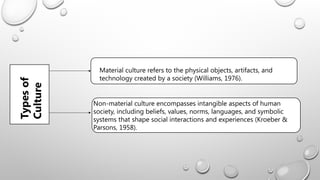
7.
Types
of
Culture
Material culture refersto the physical objects, artifacts, and
technology created by a society (Williams, 1976).
Non-material culture encompasses intangible aspects of human
society, including beliefs, values, norms, languages, and symbolic
systems that shape social interactions and experiences (Kroeber &
Parsons, 1958).
8.
Characteristics of Culture
Cultureencompasses a wide range of characteristics that
define a group of people. These characteristics include
language, beliefs, customs, traditions, and values.
Understanding these aspects of culture is essential for
building relationships and fostering mutual understanding
between individuals from different backgrounds. By
recognizing and respecting the unique characteristics of
each culture, we can promote diversity and create a more
inclusive society.
9.
Preservation efforts
Efforts topreserve cultural heritage require a multi-faceted
approach that addresses both tangible and intangible
aspects of heritage. While tangible heritage may benefit
from conservation practices and infrastructure
development, intangible heritage preservation often
involves community-based initiatives, documentation, and
education (Smith & Akagawa, 2009). Governments,
international organizations, and local communities play
crucial roles in safeguarding cultural heritage through
legislation, conservation projects, and public awareness





![Characteristics of Culture by Mark Elnar [Recovered].pptx](https://cdn.slidesharecdn.com/ss_thumbnails/characteristicsofculturebymarkelnarrecovered-221119033902-bfd01293-thumbnail.jpg?width=640&height=640&fit=bounds)


