Stop the Line + Stop Feature Development
Lean practices for Software Product Development
Juan Gutiérrez Plaza              |           Gabor Gunyho        |   Régis Déau
Senior Manager, Agile Practices               Improvement Coach       Manager, Testing Practices

21-Oct-2011


Protecting the irreplaceable | f-secure.com
F-Secure – the company
• Founded in 1988,
  listed on NASDAQ OMX
  Helsinki
• Market cap ca 350 m€,
  annual revenue ca 130 m€
  (2010)
• Headquartered in Helsinki, 18
  country offices, presence in
  more than 100 countries
• 812 people, 300+ in R&D,
  5 R&D offices in 4 countries
  (2010)


2   21-Oct-2011   © F-Secure Public
Products and Services


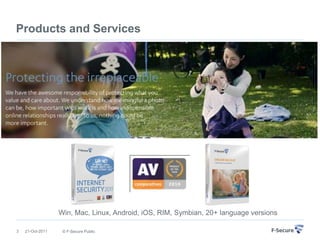
                  Win, Mac, Linux, Android, iOS, RIM, Symbian, 20+ language versions

3   21-Oct-2011    © F-Secure Public
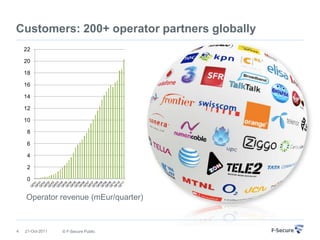
Customers: 200+ operator partners globally
    22

    20

    18

    16

    14

    12

    10

     8

     6

     4

     2

     0


    Operator revenue (mEur/quarter)


4   21-Oct-2011   © F-Secure Public
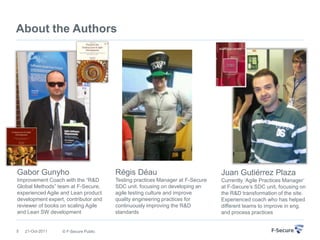
About the Authors


Gabor Gunyho                          Régis Déau                              Juan Gutiérrez Plaza
Improvement Coach with the “R&D       Testing practices Manager at F-Secure   Currently „Agile Practices Manager‟
Global Methods” team at F-Secure,     SDC unit, focusing on developing an     at F-Secure‟s SDC unit, focusing on
experienced Agile and Lean product    agile testing culture and improve       the R&D transformation of the site.
development expert, contributor and   quality engineering practices for       Experienced coach who has helped
reviewer of books on scaling Agile    continuously improving the R&D          different teams to improve in eng.
and Lean SW development               standards                               and process practices


5   21-Oct-2011   © F-Secure Public
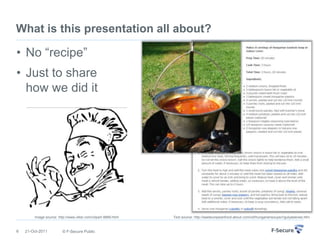
What is this presentation all about?

• No “recipe”
• Just to share
  how we did it


        Image source: http://www.clker.com/clipart-9889.html   Text source: http://easteuropeanfood.about.com/od/hungariansoups/r/gulyasleves.htm


6   21-Oct-2011          © F-Secure Public
The Project


7   21-Oct-2011   © F-Secure Public
Project setup

• About 12 teams (around 100 people)
    •    Mostly in Helsinki, some in Kuala Lumpur, later also one in Poland
    •    Mostly feature teams
    •    Fairly mature in basic Scrum[1] and Agile engineering practices
    •    Some experience in multi-team projects[2][3] but not on this scale
• Major new product, significant changes in
    • Business model
    • Architecture
    • Longer-Term Planning[4][5], including new backlog tooling
• Goal
    • Upgrading the demo platform every sprint


8   21-Oct-2011   © F-Secure Public
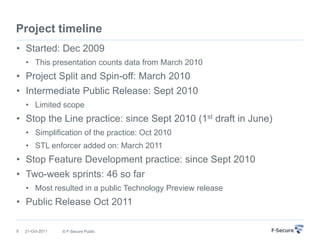
Project timeline
• Started: Dec 2009
    • This presentation counts data from March 2010
• Project Split and Spin-off: March 2010
• Intermediate Public Release: Sept 2010
    • Limited scope
• Stop the Line practice: since Sept 2010 (1st draft in June)
    • Simplification of the practice: Oct 2010
    • STL enforcer added on: March 2011
• Stop Feature Development practice: since Sept 2010
• Two-week sprints: 46 so far
    • Most resulted in a public Technology Preview release
• Public Release Oct 2011

9   21-Oct-2011   © F-Secure Public
Stop the Line


10   21-Oct-2011   © F-Secure Public
What is it?
A practice coming from Lean that is originated from the
Toyota Production System (TPS) [6]


                               Stop-the-Line
                   Work is stopped if an abnormality is found.
                   Work continues only when problem is fixed.


11   21-Oct-2011   © F-Secure Public
What is it? – The Line
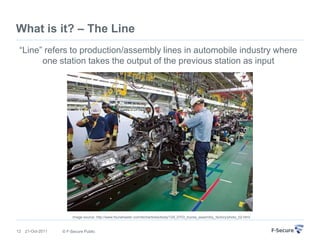
 “Line” refers to production/assembly lines in automobile industry where
       one station takes the output of the previous station as input


                        Image source: http://www.fourwheeler.com/techarticles/body/129_0703_toyota_assembly_factory/photo_02.html


12   21-Oct-2011   © F-Secure Public
What is it? - Stopping
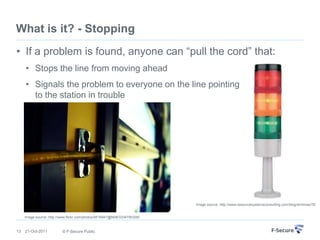
• If a problem is found, anyone can “pull the cord” that:
     • Stops the line from moving ahead
     • Signals the problem to everyone on the line pointing
       to the station in trouble


                                                                          Image source: http://www.resourcesystemsconsulting.com/blog/archives/78


     Image source: http://www.flickr.com/photos/9516941@N08/3334795306/


13   21-Oct-2011          © F-Secure Public
Why it happened? How to avoid it?

• To get all the benefits of the Stop the Line practice, a root
  cause analysis is done to find what caused the problem
• To avoid the same problem to happen again in the future,
  fix the root cause too


14   21-Oct-2011   © F-Secure Public
Why to use it?

• Focus on quality at all times
• Identify recurrent (systemic) problems so they are solved
  once and for all
• Avoid burying problems deep in the product where it‟s
  more difficult to fix it, potentially adding more problems on
  top of identified ones
• Everybody is aware of the problem so anyone who can
  help, can contribute to fixing it


15   21-Oct-2011   © F-Secure Public
… and for us in SW. Development? (1/3)

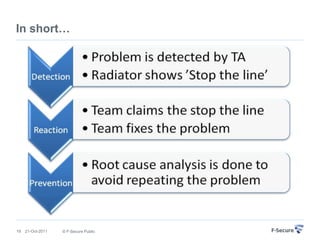
• Detection
     • A Stop-the-Line is raised when
         • A build is failing (e.g. it doesn't compile or pass unit testing)
         • Automated smoke tests fail for 2 or more consecutive times
         • A problem prevents manual testing to be performed


16   21-Oct-2011   © F-Secure Public
… and for us in SW. Development? (2/3)

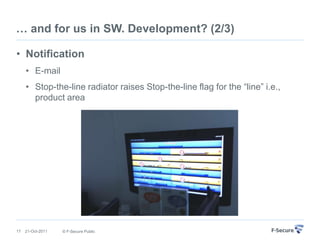
• Notification
     • E-mail
     • Stop-the-line radiator raises Stop-the-line flag for the “line” i.e.,
       product area


17   21-Oct-2011   © F-Secure Public
… and for us in SW. Development? (3/3)
• Fixing
     • A team or person claims the issue using the claim functionality in
       radiator (since March „10) and then starts investigating it
     • Same or other team or person starts fixing the problem
     • Issues not claimed before next day are handled in the daily Scrum
       of Scrums and picked by teams
     • Team works on stop-the-line as high priority item until it is handled
     • When radiator no longer declares stop-the-line, team is freed from
       this responsibility
• Prevention
     • Team worked on the stop-the-line case conducts a root cause
       analysis for selected cases and records findings then sends note to
       project mailing list

18   21-Oct-2011   © F-Secure Public
In short…


19   21-Oct-2011   © F-Secure Public
In short…

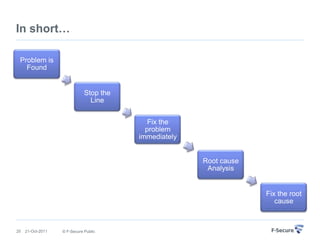
 Problem is
   Found


                              Stop the
                                Line


                                            Fix the
                                           problem
                                         immediately


                                                       Root cause
                                                        Analysis


                                                                    Fix the root
                                                                       cause


20   21-Oct-2011   © F-Secure Public
The First Implementation Fix

• Rule #1 when the STL is on then do not commit new feature
  development code to the module that has the STL, only commit bug
  fixes
• Unfortunately not everyone was careful enough to follow this rule
  systematically so some non-related commits were done whilst STL
  events
• To prevent the human mistakes an automated tool was introduced to
  enforce the rule #1, the “STL enforcer”
     • Hook was added in the repository that checks if the commit is done
       during a STL event, and if so, commits non-related with the fix, are
       rejected
     • Introduced in the middle of the project (March 2010)


21   21-Oct-2011   © F-Secure Public
Bug Handling &
Stop Feature Development


22   21-Oct-2011   © F-Secure Public
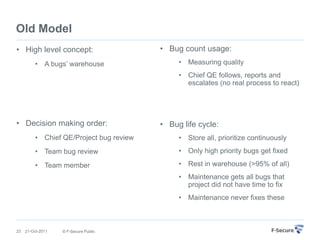
Old Model
• High level concept:                    • Bug count usage:
         • A bugs‟ warehouse                  • Measuring quality
                                              • Chief QE follows, reports and
                                                escalates (no real process to react)


• Decision making order:                 • Bug life cycle:
         • Chief QE/Project bug review        • Store all, prioritize continuously
         • Team bug review                    • Only high priority bugs get fixed

         • Team member                        • Rest in warehouse (>95% of all)
                                              • Maintenance gets all bugs that
                                                project did not have time to fix
                                              • Maintenance never fixes these


23   21-Oct-2011   © F-Secure Public
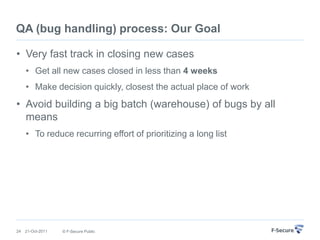
QA (bug handling) process: Our Goal

• Very fast track in closing new cases
     • Get all new cases closed in less than 4 weeks
     • Make decision quickly, closest the actual place of work
• Avoid building a big batch (warehouse) of bugs by all
  means
     • To reduce recurring effort of prioritizing a long list


24   21-Oct-2011   © F-Secure Public
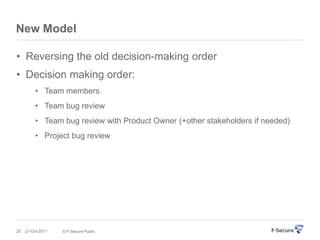
New Model

• Reversing the old decision-making order
• Decision making order:
          • Team members
          • Team bug review
          • Team bug review with Product Owner (+other stakeholders if needed)
          • Project bug review


25   21-Oct-2011   © F-Secure Public
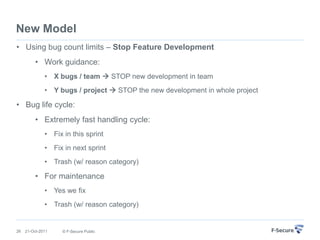
New Model
• Using bug count limits – Stop Feature Development
          • Work guidance:
              • X bugs / team  STOP new development in team
              • Y bugs / project  STOP the new development in whole project

• Bug life cycle:
          • Extremely fast handling cycle:
              • Fix in this sprint
              • Fix in next sprint
              • Trash (w/ reason category)

          • For maintenance
              • Yes we fix
              • Trash (w/ reason category)


26   21-Oct-2011    © F-Secure Public
Stop Feature Development (SFD)
• What is it, then?
     • An enhancement for STL
     • Line is stopped not only when tests are not passing but when the number
       of non-critical bugs go over a threshold:
          • Per team
          • Per project

• Why?
     • Care for quality even more
     • Prioritize bug fixing over new features
• When?
     • >10 cases / team. Stop Feature Development for the team
     • >100 cases / project. Stop Feature Development for the whole project

27   21-Oct-2011   © F-Secure Public
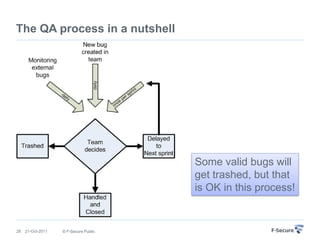
The QA process in a nutshell


                                       Some valid bugs will
                                       get trashed, but that
                                       is OK in this process!


28   21-Oct-2011   © F-Secure Public
The QA process in a nutshell


• Bug is created: Choose the correct product area and prioritize the bug with
  your best guess.
• Decision: A team decides whether the bug is fixed in this sprint, next sprint
  or trashed.
• Fix and test: A team fixes and tests their fix.
• Closing: All new bugs are closed in less than 4 weeks.


• Inside the teams:
     • Bugs not tracked if…
          • The bug is fixed and tested by the team within the sprint
          • The bug does not cross sprint or team boundaries


29   21-Oct-2011   © F-Secure Public
30   21-Oct-2011   © F-Secure Public
Statistics


31   21-Oct-2011   © F-Secure Public
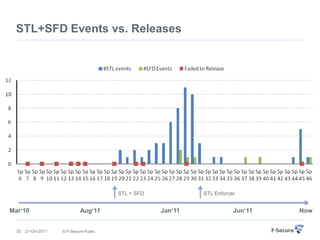
STL+SFD Events vs. Releases


                                         STL + SFD            STL Enforcer


Mar‘10                        Aug‘11                 Jan‘11              Jun‘11   Now


  32   21-Oct-2011   © F-Secure Public
Sprint 29 – STL Root Cause Analysis Findings
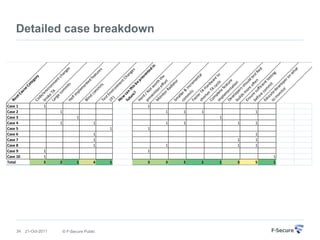
• 11 STL cases was tracked for Sprint 29
• Frequent root cause categories:
          1. Blind commits (or insufficiently tested commits)
          2. Code/environment changes broke Test Automations
          3. Large commits

• Actions that can prevent similar case in future:
          1. Ensure sufficient testing before commit, commit to branch if needed
          2. Monitor the radiator for smoke test results after commit (delay the commit to
             next day if you plan to leave office soon)
          3. Developers should test final builds manually more often
          4. Make smaller and incremental commits


33   21-Oct-2011   © F-Secure Public
Total
                                                    Ro


                    Case 9
                    Case 8
                    Case 7
                    Case 6
                    Case 5
                    Case 4
                    Case 3
                    Case 2
                    Case 1
                                                       ot


                    Case 10


34
                                                          C   au
                                                                 s  eC
                                                                         at
                                                                           eg
                                                                             or
                                                    Co                         y
                                                        de


                    3
                    1
                    1
                                                1


21-Oct-2011
                                                    br / e n
                                                       ok v i r
                                                            e           o
                                                    La TA nm
                                                        rg                      en
                                                            e                       tc


                    2
                                    1
                                            1
                                                               co                      ha
                                                                    m
                                                                      m                   ng
                                                                                              es
                                                    Ha                    its
                                                         lf
                                                            im


                    1
                                        1
                                                                  pl
                                                                     em
                                                    Bl                    en
                                                       in                      te
                                                           d                      d
                                                                                    fe


© F-Secure Public
                    4
                            1
                            1
                            1
                                    1
                                                               co
                                                                   m                   at
                                                                      m                   ur
                                                                                             es
                                                                         its
                                                    Te
                                                        st
                                                             E


                    1
                                1
                                                    (IT nv
                                                        ) ir o
                                                                        nm
                                                    Ho                         en
                                                         w                        tC
                                                    fu        ca                     ha
                                                       tu th       n                     ng
                                                            re is                            es
                                                                ?             be
                                                    Ha                            pr
                                                         rd                          ev
                                                                                        en


                    3
                        1
                                1
                                                1


                                                    pr / N                                  te
                                                       e v ot                                  d
                                                                                                      Detailed case breakdown


                                                            en w
                                                                            o                    in
                                                    M tion rth
                                                       on                          t
                    3                                        ito effo he
                            1
                                    1
                                            1


                                                                  rR            rt
                                                                      ad
                                                                           iat
                                                    Sm                          or
                                                          al
                    2
                                    1
                                            1


                                                    co ler &
                                                        m
                                                            m inc
                                                                i           re
                                                    Fa ts                       m
                                                        st                         en
                                                            er                        ta
                                                                                        l
                    1
                                            1


                                                    sh TA
                                                        or            Ha
                                                            te
                                                                n rd
                                                    Co              T w
                                                        m A cy are
                                                            p
                    1
                                        1


                                                    im let cle to
                                                        pl e f
                                                            em ea
                                                    De en ture
                                                         ve tat
                                                                            i
                    3
                            1
                            1
                                    1


                                                    bu lope on
                                                        ild rs
                                                              s m sh
                                                    En              o ou
                                                        su re o ld t
                                                             r                fte es
                    5
                            1
                            1
                            1
                                    1
                                            1


                                                    be e s                       n t Re
                                                        fo uff
                                                            re ici                             d
                                                    Ed com ent
                                                        uc              m tes
                                                             a               it tin
                                                    to te
                    1
                    1


                                                        m de                              g
                                                            on ve
                                                                  ito lop
                                                                      r          er
                                                                                     on
                                                                                          w
                                                                                            ha
                                                                                               t
Conclusions


35   21-Oct-2011   © F-Secure Public
Conclusions
• Overall quality of the product improved
• Number of STL events decreased by time
     • STL enforcer helped to avoid some mistakes
• Not releasing every two weeks BECAME AN EXCEPTION and not a rule
• New bug handling process helped on focusing on important bugs
• SFD keeps the level of open bugs in a manageable number
• After a settle down period, these practices changed the mindset of the people
  to be more quality focus


• Next step:
     • STL and SFD are “brakes” to avoid accidents, now we are learning how to
       drive at high speed safely (avoid making so many bugs)


36   21-Oct-2011   © F-Secure Public
Questions?


37   21-Oct-2011   © F-Secure Public
Acknowledgements

The authors would like to thank the whole project team and the whole R&D
organization of F-Secure and its management for making this presentation
possible and support the data collection and publishing
We‟d like to thank especially
     • Petri Kuikka
     • Risto Kumpulainen
     • Pekka Kiviniemi
     • Ferrix Hovi
for their contribution in the bug handling process, Continuous Integration and
Test Automation system and radiator design and implementation and data
visualization


38   21-Oct-2011   © F-Secure Public
Working at F-Secure - Keeping it fun!
• Coding Dojos
• Team building events
• Friday evening b**rs
• ‟Hamburger‟ nights
• Sports club: Football, squash, badminton…
• Trainings and book club
• Silent and… Musical hours ;-)
• Low hierarchy, small teams
• Innovation day and demo once per month
• Large and small company benefits


39   21-Oct-2011   © F-Secure Public
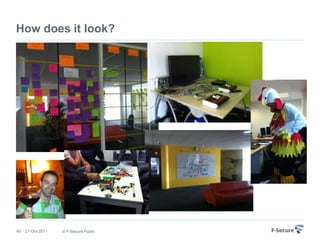
How does it look?


40   21-Oct-2011   © F-Secure Public
Wanna work for F-Secure?
     Would you like to work as…
          • C++, JavaScript and Python developer?
          • Quality Engineer?
          • Scrum Master?
          • Product Owner?
     We are looking for GOOD PEOPLE!
                               If you want to move to Bordeaux, LET ME KNOW!


     If you are more interested in Helsinki, Oulu, San José or Kuala Lumpur,
         check the position opens at:
                   http://www.f-secure.com/en_EMEA-Corp/careers/open-positions/


41   21-Oct-2011      © F-Secure Public
References
[1] Schwaber, K., Beedle, M.: “Agile Software Development with Scrum”, Prentice Hall (2001)

[2] Larman, C., Vodde, B.: “Scaling Lean & Agile Development: Thinking and Organizational Tools for
     Large-Scale Scrum”, Addison-Wesley Professional (2008)

[3] Larman, C., Vodde, B.: “Practices for Scaling Lean & Agile Development: Large, Multisite, and
     Offshore Product Development with Large-Scale Scrum”, Addison-Wesley Professional (2010)

[4] Leffingwell, D.: “Scaling Software Agility: Best Practices for Large Enterprises”, Addison-Wesley
     Professional (2007)

[5] Leffingwell, D.: “Agile Software Requirements: Lean Requirements Practices for Teams, Programs,
     and the Enterprise”, Addison-Wesley Professional (2011)

[6] Womack, J.P., Jones, D.T., Roos, D.: The machine that changed the world (1990, 2007)

[7] Poppendieck, M., Poppendieck, T.: “Implementing Lean Software Development: from Concept to
     Cash”, Addison-Wesley (2007)


42   21-Oct-2011   © F-Secure Public
Contact Information
juan.gutierrez@f-secure.com
                                                             http://creativecommons.org/licenses/by-nd/3.0/
gabor.gunyho@f-secure.com
regis.deau@f-secure.com


The authors did their best to attribute the authors of texts and images, and to recognize any copyrights, see more
details of copyrights, license terms and conditions for each source under the reference link provided. If you think
that anything in this material should be changed, added or removed, please contact the authors at the addresses
above


43   21-Oct-2011   © F-Secure Public
Stop the line & Stop Feature Development practices

Stop the line & Stop Feature Development practices

  • 1.
    Stop the Line+ Stop Feature Development Lean practices for Software Product Development Juan Gutiérrez Plaza | Gabor Gunyho | Régis Déau Senior Manager, Agile Practices Improvement Coach Manager, Testing Practices 21-Oct-2011 Protecting the irreplaceable | f-secure.com
  • 2.
    F-Secure – thecompany • Founded in 1988, listed on NASDAQ OMX Helsinki • Market cap ca 350 m€, annual revenue ca 130 m€ (2010) • Headquartered in Helsinki, 18 country offices, presence in more than 100 countries • 812 people, 300+ in R&D, 5 R&D offices in 4 countries (2010) 2 21-Oct-2011 © F-Secure Public
  • 3.
    Products and Services Win, Mac, Linux, Android, iOS, RIM, Symbian, 20+ language versions 3 21-Oct-2011 © F-Secure Public
  • 4.
    Customers: 200+ operatorpartners globally 22 20 18 16 14 12 10 8 6 4 2 0 Operator revenue (mEur/quarter) 4 21-Oct-2011 © F-Secure Public
  • 5.
    About the Authors GaborGunyho Régis Déau Juan Gutiérrez Plaza Improvement Coach with the “R&D Testing practices Manager at F-Secure Currently „Agile Practices Manager‟ Global Methods” team at F-Secure, SDC unit, focusing on developing an at F-Secure‟s SDC unit, focusing on experienced Agile and Lean product agile testing culture and improve the R&D transformation of the site. development expert, contributor and quality engineering practices for Experienced coach who has helped reviewer of books on scaling Agile continuously improving the R&D different teams to improve in eng. and Lean SW development standards and process practices 5 21-Oct-2011 © F-Secure Public
  • 6.
    What is thispresentation all about? • No “recipe” • Just to share how we did it Image source: http://www.clker.com/clipart-9889.html Text source: http://easteuropeanfood.about.com/od/hungariansoups/r/gulyasleves.htm 6 21-Oct-2011 © F-Secure Public
  • 7.
    The Project 7 21-Oct-2011 © F-Secure Public
  • 8.
    Project setup • About12 teams (around 100 people) • Mostly in Helsinki, some in Kuala Lumpur, later also one in Poland • Mostly feature teams • Fairly mature in basic Scrum[1] and Agile engineering practices • Some experience in multi-team projects[2][3] but not on this scale • Major new product, significant changes in • Business model • Architecture • Longer-Term Planning[4][5], including new backlog tooling • Goal • Upgrading the demo platform every sprint 8 21-Oct-2011 © F-Secure Public
  • 9.
    Project timeline • Started:Dec 2009 • This presentation counts data from March 2010 • Project Split and Spin-off: March 2010 • Intermediate Public Release: Sept 2010 • Limited scope • Stop the Line practice: since Sept 2010 (1st draft in June) • Simplification of the practice: Oct 2010 • STL enforcer added on: March 2011 • Stop Feature Development practice: since Sept 2010 • Two-week sprints: 46 so far • Most resulted in a public Technology Preview release • Public Release Oct 2011 9 21-Oct-2011 © F-Secure Public
  • 10.
    Stop the Line 10 21-Oct-2011 © F-Secure Public
  • 11.
    What is it? Apractice coming from Lean that is originated from the Toyota Production System (TPS) [6] Stop-the-Line Work is stopped if an abnormality is found. Work continues only when problem is fixed. 11 21-Oct-2011 © F-Secure Public
  • 12.
    What is it?– The Line “Line” refers to production/assembly lines in automobile industry where one station takes the output of the previous station as input Image source: http://www.fourwheeler.com/techarticles/body/129_0703_toyota_assembly_factory/photo_02.html 12 21-Oct-2011 © F-Secure Public
  • 13.
    What is it?- Stopping • If a problem is found, anyone can “pull the cord” that: • Stops the line from moving ahead • Signals the problem to everyone on the line pointing to the station in trouble Image source: http://www.resourcesystemsconsulting.com/blog/archives/78 Image source: http://www.flickr.com/photos/9516941@N08/3334795306/ 13 21-Oct-2011 © F-Secure Public
  • 14.
    Why it happened?How to avoid it? • To get all the benefits of the Stop the Line practice, a root cause analysis is done to find what caused the problem • To avoid the same problem to happen again in the future, fix the root cause too 14 21-Oct-2011 © F-Secure Public
  • 15.
    Why to useit? • Focus on quality at all times • Identify recurrent (systemic) problems so they are solved once and for all • Avoid burying problems deep in the product where it‟s more difficult to fix it, potentially adding more problems on top of identified ones • Everybody is aware of the problem so anyone who can help, can contribute to fixing it 15 21-Oct-2011 © F-Secure Public
  • 16.
    … and forus in SW. Development? (1/3) • Detection • A Stop-the-Line is raised when • A build is failing (e.g. it doesn't compile or pass unit testing) • Automated smoke tests fail for 2 or more consecutive times • A problem prevents manual testing to be performed 16 21-Oct-2011 © F-Secure Public
  • 17.
    … and forus in SW. Development? (2/3) • Notification • E-mail • Stop-the-line radiator raises Stop-the-line flag for the “line” i.e., product area 17 21-Oct-2011 © F-Secure Public
  • 18.
    … and forus in SW. Development? (3/3) • Fixing • A team or person claims the issue using the claim functionality in radiator (since March „10) and then starts investigating it • Same or other team or person starts fixing the problem • Issues not claimed before next day are handled in the daily Scrum of Scrums and picked by teams • Team works on stop-the-line as high priority item until it is handled • When radiator no longer declares stop-the-line, team is freed from this responsibility • Prevention • Team worked on the stop-the-line case conducts a root cause analysis for selected cases and records findings then sends note to project mailing list 18 21-Oct-2011 © F-Secure Public
  • 19.
    In short… 19 21-Oct-2011 © F-Secure Public
  • 20.
    In short… Problemis Found Stop the Line Fix the problem immediately Root cause Analysis Fix the root cause 20 21-Oct-2011 © F-Secure Public
  • 21.
    The First ImplementationFix • Rule #1 when the STL is on then do not commit new feature development code to the module that has the STL, only commit bug fixes • Unfortunately not everyone was careful enough to follow this rule systematically so some non-related commits were done whilst STL events • To prevent the human mistakes an automated tool was introduced to enforce the rule #1, the “STL enforcer” • Hook was added in the repository that checks if the commit is done during a STL event, and if so, commits non-related with the fix, are rejected • Introduced in the middle of the project (March 2010) 21 21-Oct-2011 © F-Secure Public
  • 22.
    Bug Handling & StopFeature Development 22 21-Oct-2011 © F-Secure Public
  • 23.
    Old Model • Highlevel concept: • Bug count usage: • A bugs‟ warehouse • Measuring quality • Chief QE follows, reports and escalates (no real process to react) • Decision making order: • Bug life cycle: • Chief QE/Project bug review • Store all, prioritize continuously • Team bug review • Only high priority bugs get fixed • Team member • Rest in warehouse (>95% of all) • Maintenance gets all bugs that project did not have time to fix • Maintenance never fixes these 23 21-Oct-2011 © F-Secure Public
  • 24.
    QA (bug handling)process: Our Goal • Very fast track in closing new cases • Get all new cases closed in less than 4 weeks • Make decision quickly, closest the actual place of work • Avoid building a big batch (warehouse) of bugs by all means • To reduce recurring effort of prioritizing a long list 24 21-Oct-2011 © F-Secure Public
  • 25.
    New Model • Reversingthe old decision-making order • Decision making order: • Team members • Team bug review • Team bug review with Product Owner (+other stakeholders if needed) • Project bug review 25 21-Oct-2011 © F-Secure Public
  • 26.
    New Model • Usingbug count limits – Stop Feature Development • Work guidance: • X bugs / team  STOP new development in team • Y bugs / project  STOP the new development in whole project • Bug life cycle: • Extremely fast handling cycle: • Fix in this sprint • Fix in next sprint • Trash (w/ reason category) • For maintenance • Yes we fix • Trash (w/ reason category) 26 21-Oct-2011 © F-Secure Public
  • 27.
    Stop Feature Development(SFD) • What is it, then? • An enhancement for STL • Line is stopped not only when tests are not passing but when the number of non-critical bugs go over a threshold: • Per team • Per project • Why? • Care for quality even more • Prioritize bug fixing over new features • When? • >10 cases / team. Stop Feature Development for the team • >100 cases / project. Stop Feature Development for the whole project 27 21-Oct-2011 © F-Secure Public
  • 28.
    The QA processin a nutshell Some valid bugs will get trashed, but that is OK in this process! 28 21-Oct-2011 © F-Secure Public
  • 29.
    The QA processin a nutshell • Bug is created: Choose the correct product area and prioritize the bug with your best guess. • Decision: A team decides whether the bug is fixed in this sprint, next sprint or trashed. • Fix and test: A team fixes and tests their fix. • Closing: All new bugs are closed in less than 4 weeks. • Inside the teams: • Bugs not tracked if… • The bug is fixed and tested by the team within the sprint • The bug does not cross sprint or team boundaries 29 21-Oct-2011 © F-Secure Public
  • 30.
    30 21-Oct-2011 © F-Secure Public
  • 31.
    Statistics 31 21-Oct-2011 © F-Secure Public
  • 32.
    STL+SFD Events vs.Releases STL + SFD STL Enforcer Mar‘10 Aug‘11 Jan‘11 Jun‘11 Now 32 21-Oct-2011 © F-Secure Public
  • 33.
    Sprint 29 –STL Root Cause Analysis Findings • 11 STL cases was tracked for Sprint 29 • Frequent root cause categories: 1. Blind commits (or insufficiently tested commits) 2. Code/environment changes broke Test Automations 3. Large commits • Actions that can prevent similar case in future: 1. Ensure sufficient testing before commit, commit to branch if needed 2. Monitor the radiator for smoke test results after commit (delay the commit to next day if you plan to leave office soon) 3. Developers should test final builds manually more often 4. Make smaller and incremental commits 33 21-Oct-2011 © F-Secure Public
  • 34.
    Total Ro Case 9 Case 8 Case 7 Case 6 Case 5 Case 4 Case 3 Case 2 Case 1 ot Case 10 34 C au s eC at eg or Co y de 3 1 1 1 21-Oct-2011 br / e n ok v i r e o La TA nm rg en e tc 2 1 1 co ha m m ng es Ha its lf im 1 1 pl em Bl en in te d d fe © F-Secure Public 4 1 1 1 1 co m at m ur es its Te st E 1 1 (IT nv ) ir o nm Ho en w tC fu ca ha tu th n ng re is es ? be Ha pr rd ev en 3 1 1 1 pr / N te e v ot d Detailed case breakdown en w o in M tion rth on t 3 ito effo he 1 1 1 rR rt ad iat Sm or al 2 1 1 co ler & m m inc i re Fa ts m st en er ta l 1 1 sh TA or Ha te n rd Co T w m A cy are p 1 1 im let cle to pl e f em ea De en ture ve tat i 3 1 1 1 bu lope on ild rs s m sh En o ou su re o ld t r fte es 5 1 1 1 1 1 be e s n t Re fo uff re ici d Ed com ent uc m tes a it tin to te 1 1 m de g on ve ito lop r er on w ha t
  • 35.
    Conclusions 35 21-Oct-2011 © F-Secure Public
  • 36.
    Conclusions • Overall qualityof the product improved • Number of STL events decreased by time • STL enforcer helped to avoid some mistakes • Not releasing every two weeks BECAME AN EXCEPTION and not a rule • New bug handling process helped on focusing on important bugs • SFD keeps the level of open bugs in a manageable number • After a settle down period, these practices changed the mindset of the people to be more quality focus • Next step: • STL and SFD are “brakes” to avoid accidents, now we are learning how to drive at high speed safely (avoid making so many bugs) 36 21-Oct-2011 © F-Secure Public
  • 37.
    Questions? 37 21-Oct-2011 © F-Secure Public
  • 38.
    Acknowledgements The authors wouldlike to thank the whole project team and the whole R&D organization of F-Secure and its management for making this presentation possible and support the data collection and publishing We‟d like to thank especially • Petri Kuikka • Risto Kumpulainen • Pekka Kiviniemi • Ferrix Hovi for their contribution in the bug handling process, Continuous Integration and Test Automation system and radiator design and implementation and data visualization 38 21-Oct-2011 © F-Secure Public
  • 39.
    Working at F-Secure- Keeping it fun! • Coding Dojos • Team building events • Friday evening b**rs • ‟Hamburger‟ nights • Sports club: Football, squash, badminton… • Trainings and book club • Silent and… Musical hours ;-) • Low hierarchy, small teams • Innovation day and demo once per month • Large and small company benefits 39 21-Oct-2011 © F-Secure Public
  • 40.
    How does itlook? 40 21-Oct-2011 © F-Secure Public
  • 41.
    Wanna work forF-Secure? Would you like to work as… • C++, JavaScript and Python developer? • Quality Engineer? • Scrum Master? • Product Owner? We are looking for GOOD PEOPLE! If you want to move to Bordeaux, LET ME KNOW! If you are more interested in Helsinki, Oulu, San José or Kuala Lumpur, check the position opens at: http://www.f-secure.com/en_EMEA-Corp/careers/open-positions/ 41 21-Oct-2011 © F-Secure Public
  • 42.
    References [1] Schwaber, K.,Beedle, M.: “Agile Software Development with Scrum”, Prentice Hall (2001) [2] Larman, C., Vodde, B.: “Scaling Lean & Agile Development: Thinking and Organizational Tools for Large-Scale Scrum”, Addison-Wesley Professional (2008) [3] Larman, C., Vodde, B.: “Practices for Scaling Lean & Agile Development: Large, Multisite, and Offshore Product Development with Large-Scale Scrum”, Addison-Wesley Professional (2010) [4] Leffingwell, D.: “Scaling Software Agility: Best Practices for Large Enterprises”, Addison-Wesley Professional (2007) [5] Leffingwell, D.: “Agile Software Requirements: Lean Requirements Practices for Teams, Programs, and the Enterprise”, Addison-Wesley Professional (2011) [6] Womack, J.P., Jones, D.T., Roos, D.: The machine that changed the world (1990, 2007) [7] Poppendieck, M., Poppendieck, T.: “Implementing Lean Software Development: from Concept to Cash”, Addison-Wesley (2007) 42 21-Oct-2011 © F-Secure Public
  • 43.
    Contact Information juan.gutierrez@f-secure.com http://creativecommons.org/licenses/by-nd/3.0/ gabor.gunyho@f-secure.com regis.deau@f-secure.com The authors did their best to attribute the authors of texts and images, and to recognize any copyrights, see more details of copyrights, license terms and conditions for each source under the reference link provided. If you think that anything in this material should be changed, added or removed, please contact the authors at the addresses above 43 21-Oct-2011 © F-Secure Public