

Presentation books
 you shouldn’t miss
Here’s a list of great
reads, any of which can
      have a garanteed
   impact on your next
    presentation effort.

         These are the
presentation books you
        shouldn’t miss!
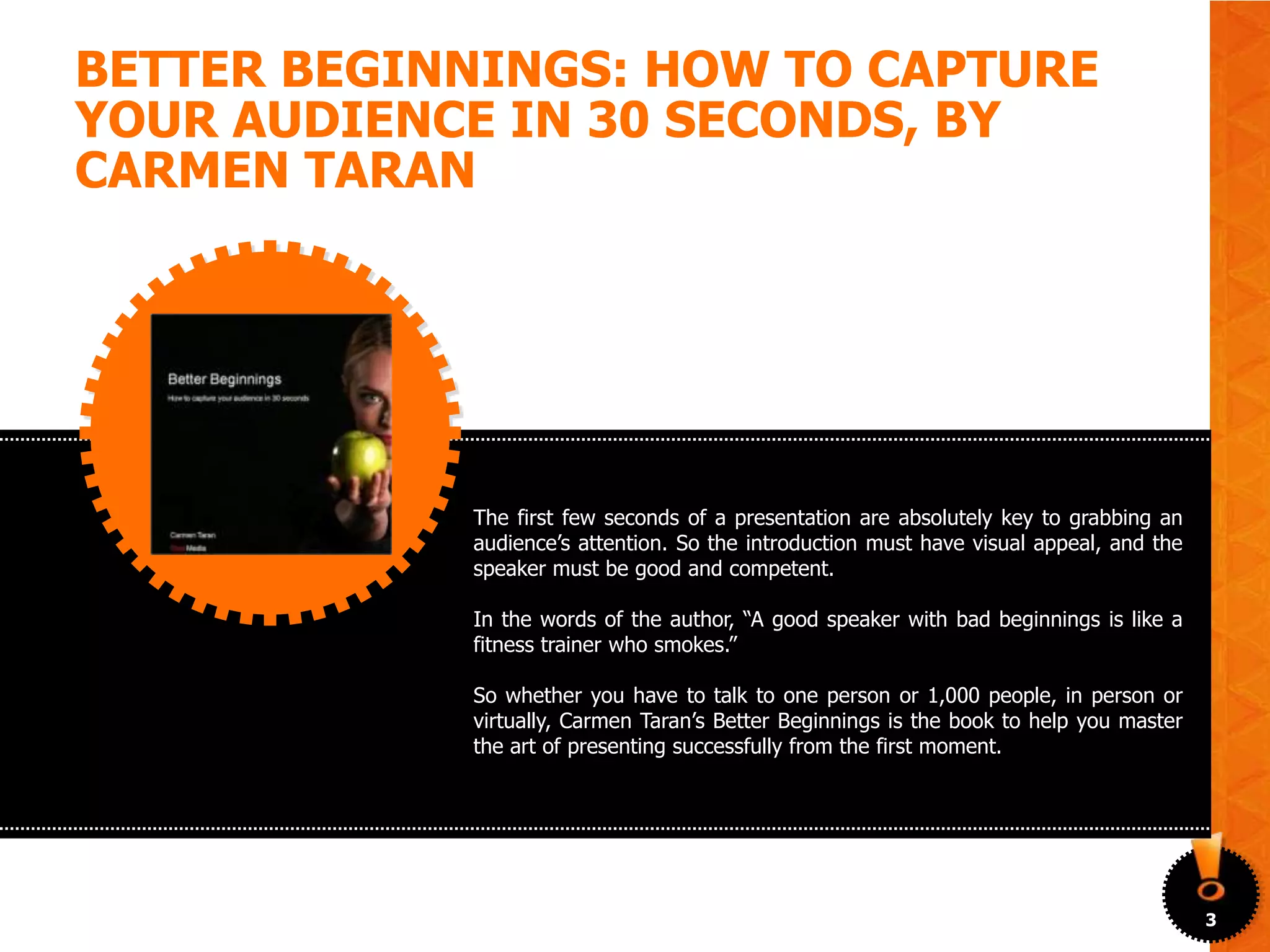
BETTER BEGINNINGS: HOW TO CAPTURE
YOUR AUDIENCE IN 30 SECONDS, BY
CARMEN TARAN


            The first few seconds of a presentation are absolutely key to grabbing an
            audience’s attention. So the introduction must have visual appeal, and the
            speaker must be good and competent.

            In the words of the author, “A good speaker with bad beginnings is like a
            fitness trainer who smokes.”

            So whether you have to talk to one person or 1,000 people, in person or
            virtually, Carmen Taran’s Better Beginnings is the book to help you master
            the art of presenting successfully from the first moment.


                                                                                         3
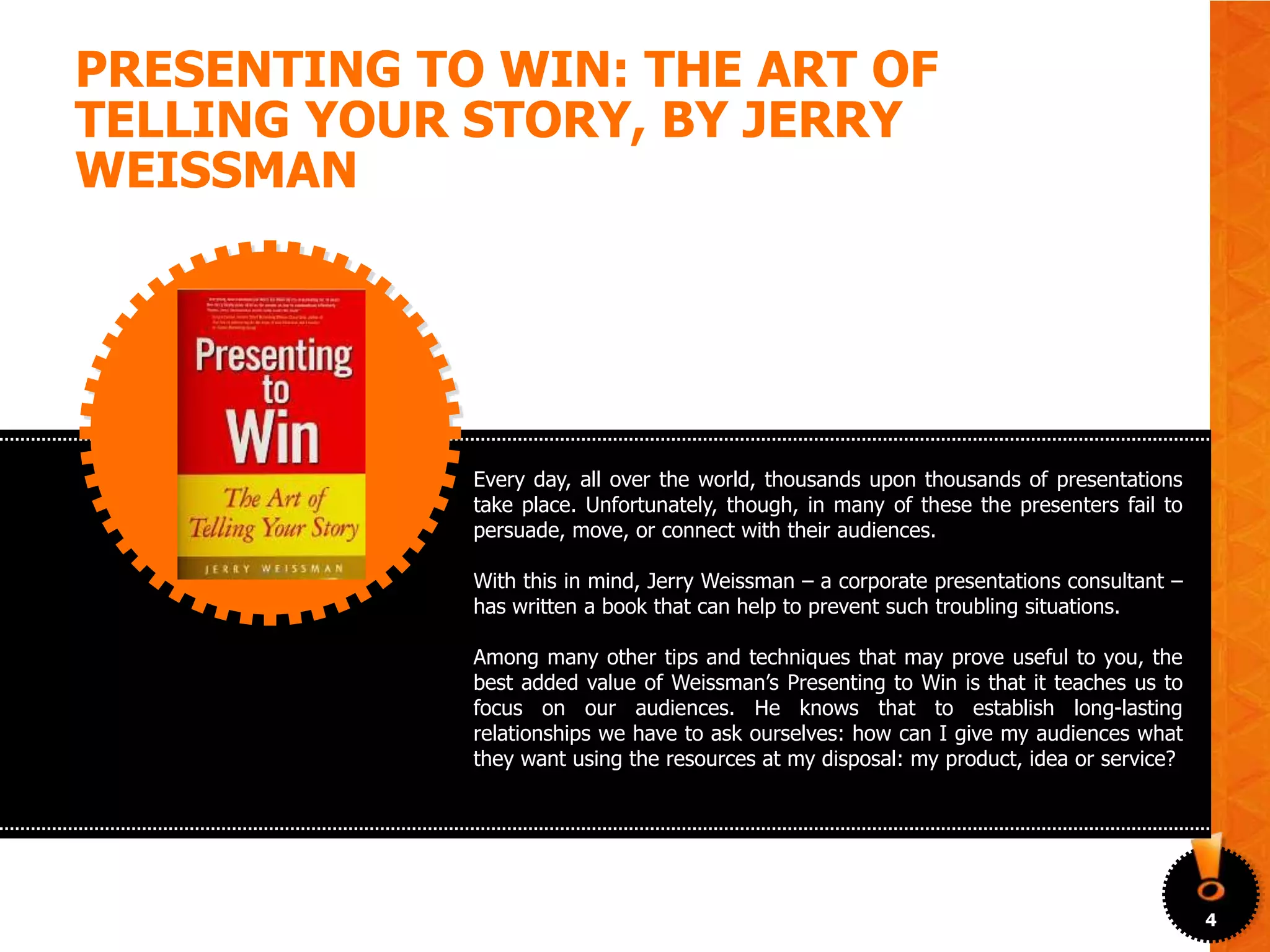
PRESENTING TO WIN: THE ART OF
TELLING YOUR STORY, BY JERRY
WEISSMAN


             Every day, all over the world, thousands upon thousands of presentations
             take place. Unfortunately, though, in many of these the presenters fail to
             persuade, move, or connect with their audiences.

             With this in mind, Jerry Weissman – a corporate presentations consultant –
             has written a book that can help to prevent such troubling situations.

             Among many other tips and techniques that may prove useful to you, the
             best added value of Weissman’s Presenting to Win is that it teaches us to
             focus on our audiences. He knows that to establish long-lasting
             relationships we have to ask ourselves: how can I give my audiences what
             they want using the resources at my disposal: my product, idea or service?


                                                                                          4
RESONATE AND SLIDE:OLOGY, BY NANCY
DUARTE


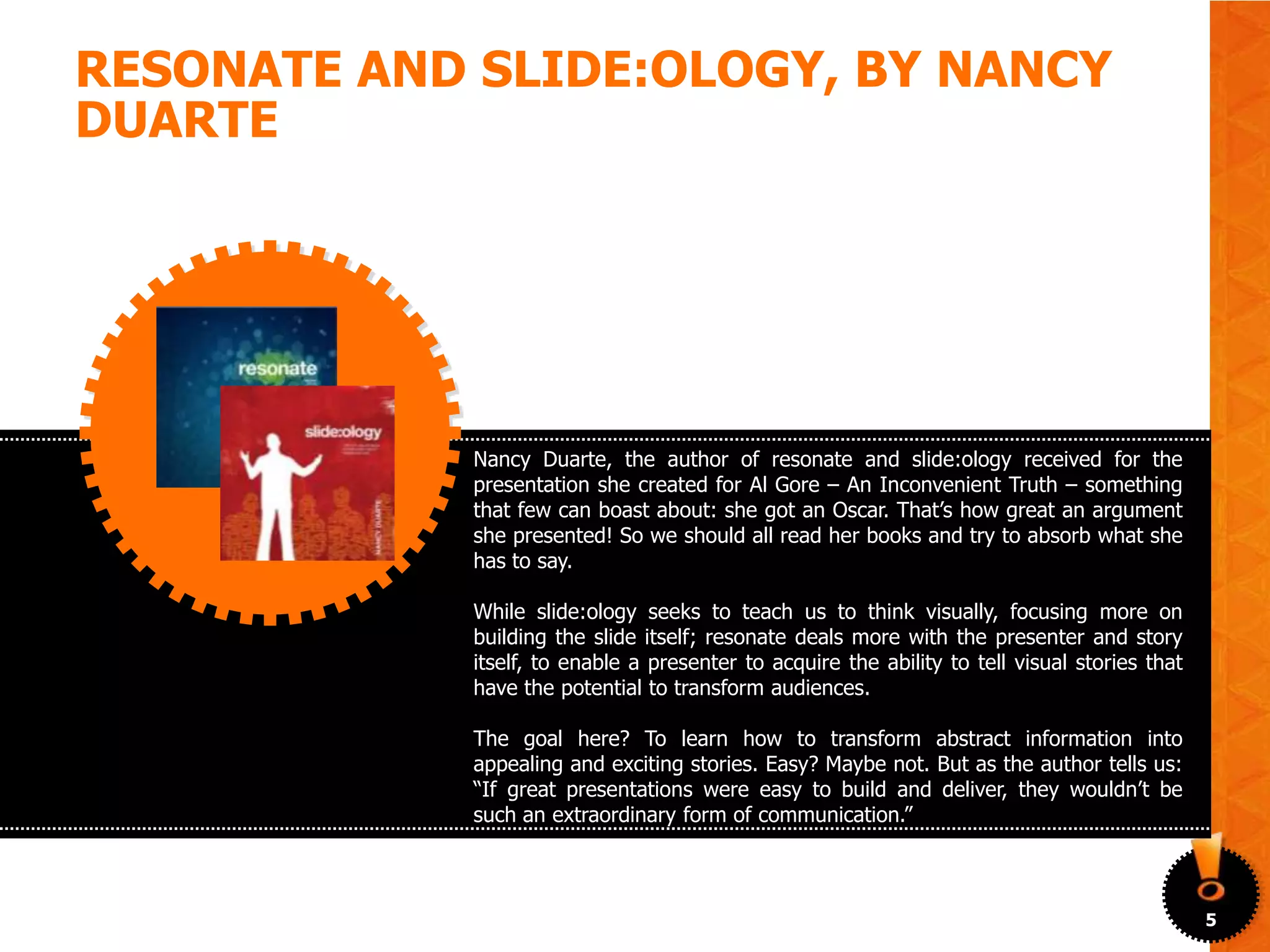
             Nancy Duarte, the author of resonate and slide:ology received for the
             presentation she created for Al Gore – An Inconvenient Truth – something
             that few can boast about: she got an Oscar. That’s how great an argument
             she presented! So we should all read her books and try to absorb what she
             has to say.

             While slide:ology seeks to teach us to think visually, focusing more on
             building the slide itself; resonate deals more with the presenter and story
             itself, to enable a presenter to acquire the ability to tell visual stories that
             have the potential to transform audiences.

             The goal here? To learn how to transform abstract information into
             appealing and exciting stories. Easy? Maybe not. But as the author tells us:
             “If great presentations were easy to build and deliver, they wouldn’t be
             such an extraordinary form of communication.”


                                                                                                5
THE PRESENTATION SECRETS OF STEVE
JOBS: HOW TO BE INSANELY GREAT IN
FRONT OF ANY AUDIENCE, BY CARMINE
GALLO


             It’s inevitable. When it comes to books about presentations, anything on
             the Steve Jobs approach is one that must be looked at.

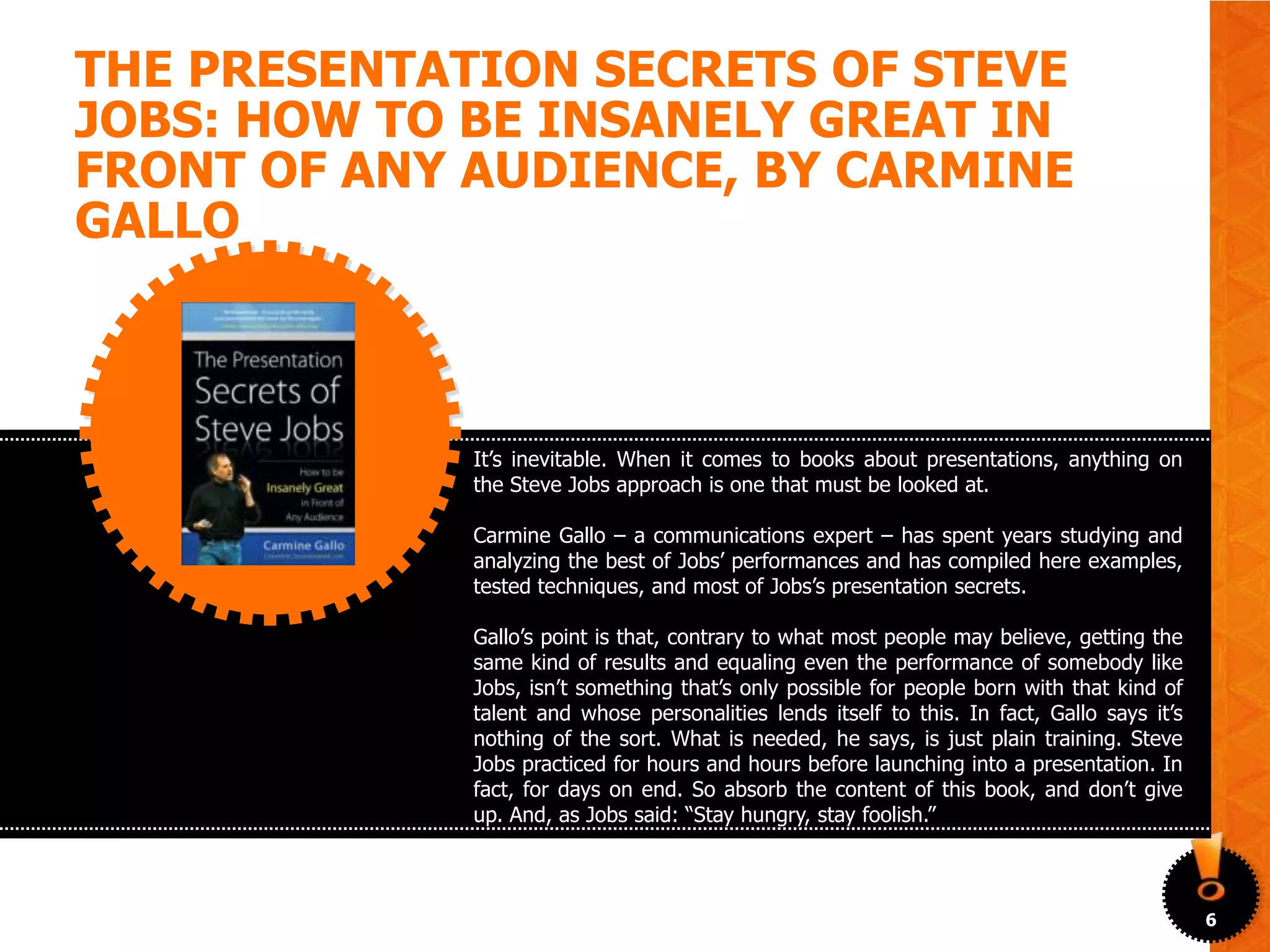
             Carmine Gallo – a communications expert – has spent years studying and
             analyzing the best of Jobs’ performances and has compiled here examples,
             tested techniques, and most of Jobs’s presentation secrets.

             Gallo’s point is that, contrary to what most people may believe, getting the
             same kind of results and equaling even the performance of somebody like
             Jobs, isn’t something that’s only possible for people born with that kind of
             talent and whose personalities lends itself to this. In fact, Gallo says it’s
             nothing of the sort. What is needed, he says, is just plain training. Steve
             Jobs practiced for hours and hours before launching into a presentation. In
             fact, for days on end. So absorb the content of this book, and don’t give
             up. And, as Jobs said: “Stay hungry, stay foolish.”


                                                                                             6
PRESENTATIONZEN SIMPLE IDEAS ON
PRESENTATION DESIGN AND DELIVERY, BY
GARR REYNOLDS


             Science tells us that when we transmit information orally, 72 hours later
             people will remember only about 10% of what we said. But if we talk and
             use a related visual cue, an image, the percentage increases to 65%.
             Apparently, the brain interprets each letter we’re reading as if it were an
             image. If this is the case, imagine what happens to the brain when it’s
             faced with slides filled with text, text and more text: it literally suffocates!

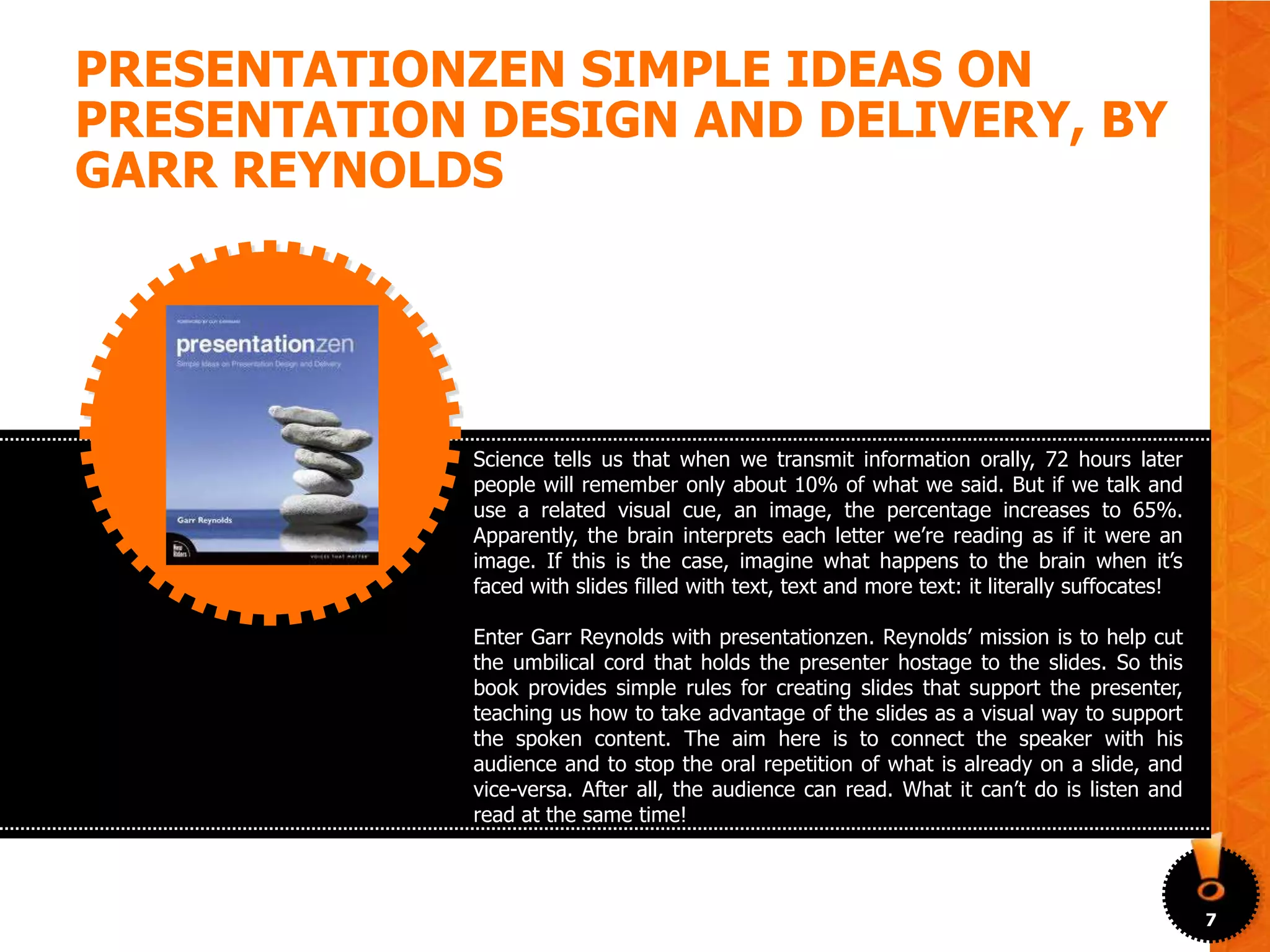
             Enter Garr Reynolds with presentationzen. Reynolds’ mission is to help cut
             the umbilical cord that holds the presenter hostage to the slides. So this
             book provides simple rules for creating slides that support the presenter,
             teaching us how to take advantage of the slides as a visual way to support
             the spoken content. The aim here is to connect the speaker with his
             audience and to stop the oral repetition of what is already on a slide, and
             vice-versa. After all, the audience can read. What it can’t do is listen and
             read at the same time!


                                                                                                7
STORY: SUBSTANCE, STRUCTURE, STYLE
AND THE PRINCIPLES OF SCREENWRITING,
BY ROBERT MCKEE


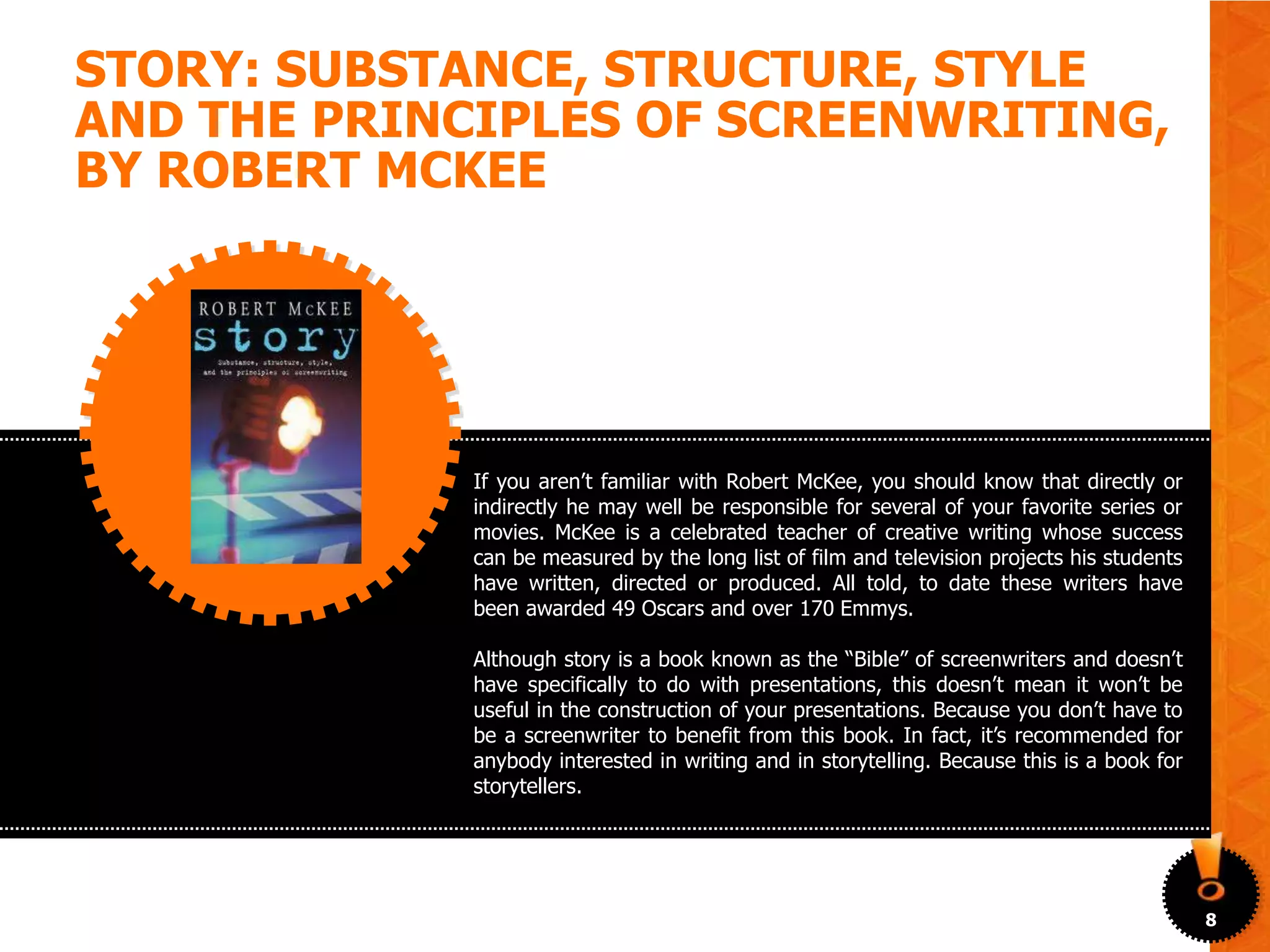
             If you aren’t familiar with Robert McKee, you should know that directly or
             indirectly he may well be responsible for several of your favorite series or
             movies. McKee is a celebrated teacher of creative writing whose success
             can be measured by the long list of film and television projects his students
             have written, directed or produced. All told, to date these writers have
             been awarded 49 Oscars and over 170 Emmys.

             Although story is a book known as the “Bible” of screenwriters and doesn’t
             have specifically to do with presentations, this doesn’t mean it won’t be
             useful in the construction of your presentations. Because you don’t have to
             be a screenwriter to benefit from this book. In fact, it’s recommended for
             anybody interested in writing and in storytelling. Because this is a book for
             storytellers.


                                                                                             8
STORY: SUBSTANCE, STRUCTURE, STYLE
AND THE PRINCIPLES OF SCREENWRITING,
BY ROBERT MCKEE


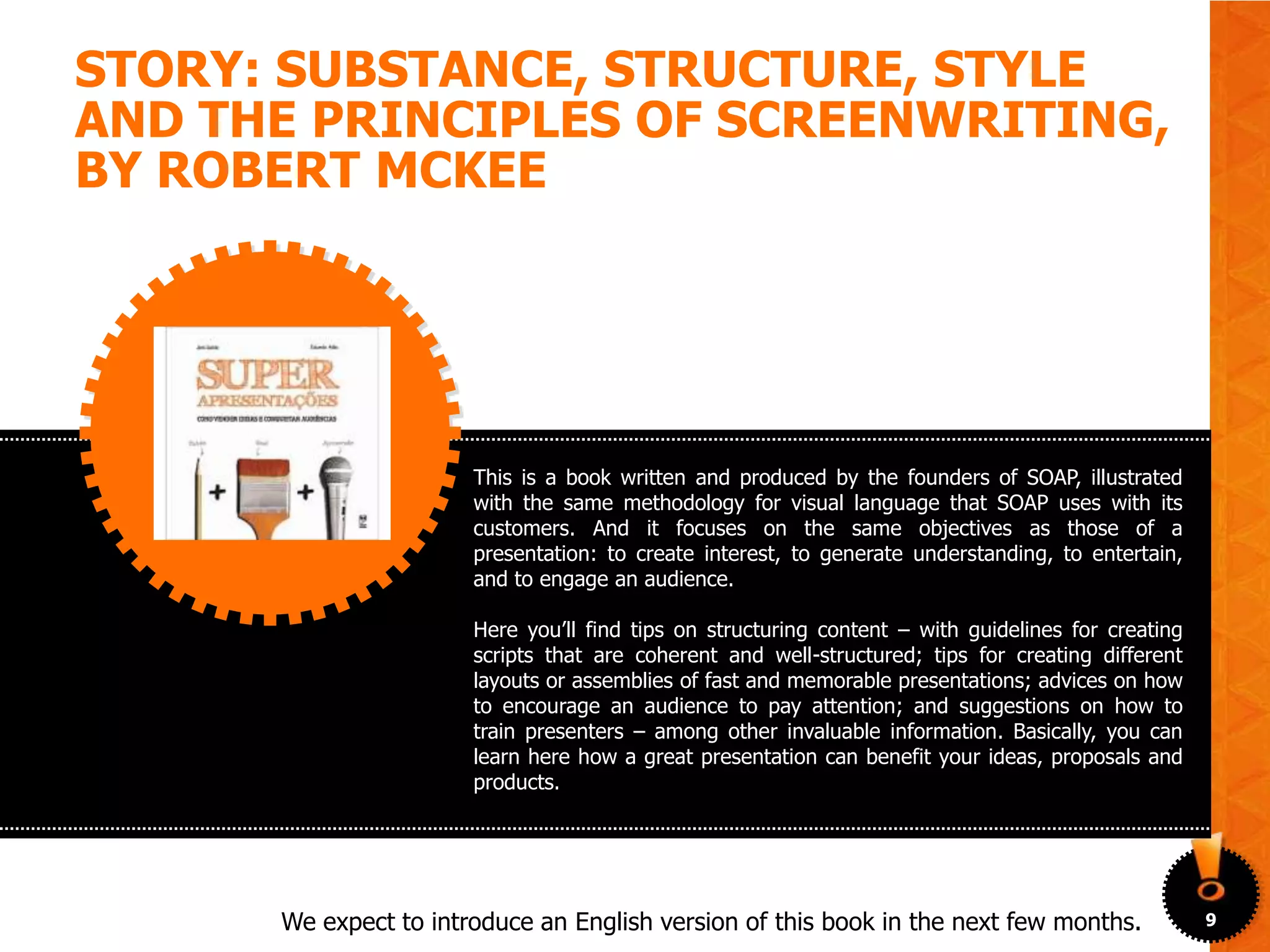
                       This is a book written and produced by the founders of SOAP, illustrated
                       with the same methodology for visual language that SOAP uses with its
                       customers. And it focuses on the same objectives as those of a
                       presentation: to create interest, to generate understanding, to entertain,
                       and to engage an audience.

                       Here you’ll find tips on structuring content – with guidelines for creating
                       scripts that are coherent and well-structured; tips for creating different
                       layouts or assemblies of fast and memorable presentations; advices on how
                       to encourage an audience to pay attention; and suggestions on how to
                       train presenters – among other invaluable information. Basically, you can
                       learn here how a great presentation can benefit your ideas, proposals and
                       products.


      We expect to introduce an English version of this book in the next few months.                 9
DO YOU NEED A STATE
OF THE ART
PRESENTATION?
                      Send us an e-mail with
                      your project to:
                      contact@soappresentations.com


                                                      10
Presentation books you shouldn’t miss by SOAP

Presentation books you shouldn’t miss by SOAP

  • 1.
    Presentation books youshouldn’t miss
  • 2.
    Here’s a listof great reads, any of which can have a garanteed impact on your next presentation effort. These are the presentation books you shouldn’t miss!
  • 3.
    BETTER BEGINNINGS: HOWTO CAPTURE YOUR AUDIENCE IN 30 SECONDS, BY CARMEN TARAN The first few seconds of a presentation are absolutely key to grabbing an audience’s attention. So the introduction must have visual appeal, and the speaker must be good and competent. In the words of the author, “A good speaker with bad beginnings is like a fitness trainer who smokes.” So whether you have to talk to one person or 1,000 people, in person or virtually, Carmen Taran’s Better Beginnings is the book to help you master the art of presenting successfully from the first moment. 3
  • 4.
    PRESENTING TO WIN:THE ART OF TELLING YOUR STORY, BY JERRY WEISSMAN Every day, all over the world, thousands upon thousands of presentations take place. Unfortunately, though, in many of these the presenters fail to persuade, move, or connect with their audiences. With this in mind, Jerry Weissman – a corporate presentations consultant – has written a book that can help to prevent such troubling situations. Among many other tips and techniques that may prove useful to you, the best added value of Weissman’s Presenting to Win is that it teaches us to focus on our audiences. He knows that to establish long-lasting relationships we have to ask ourselves: how can I give my audiences what they want using the resources at my disposal: my product, idea or service? 4
  • 5.
    RESONATE AND SLIDE:OLOGY,BY NANCY DUARTE Nancy Duarte, the author of resonate and slide:ology received for the presentation she created for Al Gore – An Inconvenient Truth – something that few can boast about: she got an Oscar. That’s how great an argument she presented! So we should all read her books and try to absorb what she has to say. While slide:ology seeks to teach us to think visually, focusing more on building the slide itself; resonate deals more with the presenter and story itself, to enable a presenter to acquire the ability to tell visual stories that have the potential to transform audiences. The goal here? To learn how to transform abstract information into appealing and exciting stories. Easy? Maybe not. But as the author tells us: “If great presentations were easy to build and deliver, they wouldn’t be such an extraordinary form of communication.” 5
  • 6.
    THE PRESENTATION SECRETSOF STEVE JOBS: HOW TO BE INSANELY GREAT IN FRONT OF ANY AUDIENCE, BY CARMINE GALLO It’s inevitable. When it comes to books about presentations, anything on the Steve Jobs approach is one that must be looked at. Carmine Gallo – a communications expert – has spent years studying and analyzing the best of Jobs’ performances and has compiled here examples, tested techniques, and most of Jobs’s presentation secrets. Gallo’s point is that, contrary to what most people may believe, getting the same kind of results and equaling even the performance of somebody like Jobs, isn’t something that’s only possible for people born with that kind of talent and whose personalities lends itself to this. In fact, Gallo says it’s nothing of the sort. What is needed, he says, is just plain training. Steve Jobs practiced for hours and hours before launching into a presentation. In fact, for days on end. So absorb the content of this book, and don’t give up. And, as Jobs said: “Stay hungry, stay foolish.” 6
  • 7.
    PRESENTATIONZEN SIMPLE IDEASON PRESENTATION DESIGN AND DELIVERY, BY GARR REYNOLDS Science tells us that when we transmit information orally, 72 hours later people will remember only about 10% of what we said. But if we talk and use a related visual cue, an image, the percentage increases to 65%. Apparently, the brain interprets each letter we’re reading as if it were an image. If this is the case, imagine what happens to the brain when it’s faced with slides filled with text, text and more text: it literally suffocates! Enter Garr Reynolds with presentationzen. Reynolds’ mission is to help cut the umbilical cord that holds the presenter hostage to the slides. So this book provides simple rules for creating slides that support the presenter, teaching us how to take advantage of the slides as a visual way to support the spoken content. The aim here is to connect the speaker with his audience and to stop the oral repetition of what is already on a slide, and vice-versa. After all, the audience can read. What it can’t do is listen and read at the same time! 7
  • 8.
    STORY: SUBSTANCE, STRUCTURE,STYLE AND THE PRINCIPLES OF SCREENWRITING, BY ROBERT MCKEE If you aren’t familiar with Robert McKee, you should know that directly or indirectly he may well be responsible for several of your favorite series or movies. McKee is a celebrated teacher of creative writing whose success can be measured by the long list of film and television projects his students have written, directed or produced. All told, to date these writers have been awarded 49 Oscars and over 170 Emmys. Although story is a book known as the “Bible” of screenwriters and doesn’t have specifically to do with presentations, this doesn’t mean it won’t be useful in the construction of your presentations. Because you don’t have to be a screenwriter to benefit from this book. In fact, it’s recommended for anybody interested in writing and in storytelling. Because this is a book for storytellers. 8
  • 9.
    STORY: SUBSTANCE, STRUCTURE,STYLE AND THE PRINCIPLES OF SCREENWRITING, BY ROBERT MCKEE This is a book written and produced by the founders of SOAP, illustrated with the same methodology for visual language that SOAP uses with its customers. And it focuses on the same objectives as those of a presentation: to create interest, to generate understanding, to entertain, and to engage an audience. Here you’ll find tips on structuring content – with guidelines for creating scripts that are coherent and well-structured; tips for creating different layouts or assemblies of fast and memorable presentations; advices on how to encourage an audience to pay attention; and suggestions on how to train presenters – among other invaluable information. Basically, you can learn here how a great presentation can benefit your ideas, proposals and products. We expect to introduce an English version of this book in the next few months. 9
  • 10.
    DO YOU NEEDA STATE OF THE ART PRESENTATION? Send us an e-mail with your project to: contact@soappresentations.com 10