INTRODUCTION
OBJECTIVE : Designing a complete air conditioning system
LOCATION : Bangi, Selangor
FLOOR SELECTION
METHODOLOGY
-Cooling load estimation table
-Rectangular duct chart
-Round duct chart
-Air Condition Load Estimation table (Eg . Table 1 – Table 13)
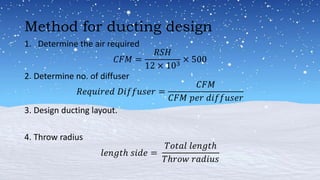
Method for ducting design
1. Determine the air required
𝐶𝐹𝑀 =
𝑅𝑆𝐻
12 × 103
× 500
2. Determine no. of diffuser
𝑅𝑒𝑞𝑢𝑖𝑟𝑒𝑑 𝐷𝑖𝑓𝑓𝑢𝑠𝑒𝑟 =
𝐶𝐹𝑀
𝐶𝐹𝑀 𝑝𝑒𝑟 𝑑𝑖𝑓𝑓𝑢𝑠𝑒𝑟
3. Design ducting layout.
4. Throw radius
𝑙𝑒𝑛𝑔𝑡ℎ 𝑠𝑖𝑑𝑒 =
𝑇𝑜𝑡𝑎𝑙 𝑙𝑒𝑛𝑔𝑡ℎ
𝑇ℎ𝑟𝑜𝑤 𝑟𝑎𝑑𝑖𝑢𝑠
SECTION CFM hr FPM Φ of duct Side of
rectangular
5. Determine of ducting sizes using table below
Procedure
1. Choose the design and the location.
2. Calculate cooling load using cooling load estimation table.
3. Choose suitable air condition system.
4. Calculate ducting system.
5. Design ducting system.
Assumption of design requirement
1. Ceiling = 12ft
2. Maximum operation – 24hours
3. Room condition – 75F, 55%RH, 72gr/lb
4. Outside air – 92F, 60%RH, 136gr/lb
5. Total of people – 25
6. Sun movement – east to west
Result and design
Sample for cooling load table
DUCTING SYSTEM
DETERMINE CFM
𝐶𝐹𝑀 =
𝑅𝑆𝐻
1.09 𝑥 𝑇
=
134888
1.09 𝑥 17
= 7279.5 ≈ 7500 𝐶𝐹𝑀
DETERMINE NUMBER OF DIFFUSER
𝑅𝑒𝑞𝑢𝑖𝑟𝑒𝑑 𝑑𝑖𝑓𝑓𝑢𝑠𝑒𝑟 =
𝐶𝐹𝑀
𝐶𝐹𝑀 𝑝𝑒𝑟 𝑑𝑖𝑓𝑓𝑢𝑠𝑒𝑟
=
7500
937.5
= 8
DETERMINE LENGTH AND WIDE SIDE
𝐿𝑒𝑛𝑔𝑡ℎ 𝑠𝑖𝑑𝑒 =
𝐿𝑒𝑛𝑔𝑡ℎ
𝑁𝑜 𝑜𝑓 𝑇ℎ𝑟𝑜𝑤 𝑟𝑎𝑑𝑖𝑢𝑠
𝑊𝑖𝑑𝑒 𝑠𝑖𝑑𝑒 =
𝑊𝑖𝑑𝑒
𝑁𝑜 𝑜𝑓 𝑇ℎ𝑟𝑜𝑤 𝑟𝑎𝑑𝑖𝑢𝑠
=
70
8
=
40
4
= 8.75 ft = 10 ft
DUCTING LAYOUT
EQUAL FRACTION METHOD
Total Rsh and cooling load
• RSH = 134888 Btu/hr
• Grand Total heat (GTH) = 200768
Proposing air conditioning system
• We choose UATN SERIES UATN210CGY1X.
Product specification
• Horsepower = 21 hp
• Type – non inverter
• Refrigerant – r410A
• Rated cooling – 213btu/hr
• Rated power comsumption – 16900W
• CFM = 7600
• Dimension - 1,650 x 2,410 x 2,030 (mm)
• Weight – 930kg
Justification
Why choose this system?
• Bigger building
• Energy Efficient
• Maintenance wise
• To conserve space
Discussion
• From the result above we can determine the type of conditioning
system for a choosen building.
• We can indentified the cooling load needed for a floor or a building.
• Grand total heat is significant factor in determined in air conditioning
system.
Conclusion
As a conclusion, the larger cooling load the more complicated our
conditioning system and much more efficient air conditioning system to
be used.
We are able to design and complete our objective which is to design a
system based of calculation of cooling load.
Other than that ducting system dimension can be determined and
designing the ducting system.

Presentation air-conditioning requirment

  • 1.
    INTRODUCTION OBJECTIVE : Designinga complete air conditioning system LOCATION : Bangi, Selangor
  • 2.
  • 3.
    METHODOLOGY -Cooling load estimationtable -Rectangular duct chart -Round duct chart -Air Condition Load Estimation table (Eg . Table 1 – Table 13)
  • 6.
    Method for ductingdesign 1. Determine the air required 𝐶𝐹𝑀 = 𝑅𝑆𝐻 12 × 103 × 500 2. Determine no. of diffuser 𝑅𝑒𝑞𝑢𝑖𝑟𝑒𝑑 𝐷𝑖𝑓𝑓𝑢𝑠𝑒𝑟 = 𝐶𝐹𝑀 𝐶𝐹𝑀 𝑝𝑒𝑟 𝑑𝑖𝑓𝑓𝑢𝑠𝑒𝑟 3. Design ducting layout. 4. Throw radius 𝑙𝑒𝑛𝑔𝑡ℎ 𝑠𝑖𝑑𝑒 = 𝑇𝑜𝑡𝑎𝑙 𝑙𝑒𝑛𝑔𝑡ℎ 𝑇ℎ𝑟𝑜𝑤 𝑟𝑎𝑑𝑖𝑢𝑠
  • 7.
    SECTION CFM hrFPM Φ of duct Side of rectangular 5. Determine of ducting sizes using table below
  • 10.
    Procedure 1. Choose thedesign and the location. 2. Calculate cooling load using cooling load estimation table. 3. Choose suitable air condition system. 4. Calculate ducting system. 5. Design ducting system.
  • 11.
    Assumption of designrequirement 1. Ceiling = 12ft 2. Maximum operation – 24hours 3. Room condition – 75F, 55%RH, 72gr/lb 4. Outside air – 92F, 60%RH, 136gr/lb 5. Total of people – 25 6. Sun movement – east to west
  • 12.
    Result and design Samplefor cooling load table
  • 15.
    DUCTING SYSTEM DETERMINE CFM 𝐶𝐹𝑀= 𝑅𝑆𝐻 1.09 𝑥 𝑇 = 134888 1.09 𝑥 17 = 7279.5 ≈ 7500 𝐶𝐹𝑀
  • 16.
    DETERMINE NUMBER OFDIFFUSER 𝑅𝑒𝑞𝑢𝑖𝑟𝑒𝑑 𝑑𝑖𝑓𝑓𝑢𝑠𝑒𝑟 = 𝐶𝐹𝑀 𝐶𝐹𝑀 𝑝𝑒𝑟 𝑑𝑖𝑓𝑓𝑢𝑠𝑒𝑟 = 7500 937.5 = 8
  • 17.
    DETERMINE LENGTH ANDWIDE SIDE 𝐿𝑒𝑛𝑔𝑡ℎ 𝑠𝑖𝑑𝑒 = 𝐿𝑒𝑛𝑔𝑡ℎ 𝑁𝑜 𝑜𝑓 𝑇ℎ𝑟𝑜𝑤 𝑟𝑎𝑑𝑖𝑢𝑠 𝑊𝑖𝑑𝑒 𝑠𝑖𝑑𝑒 = 𝑊𝑖𝑑𝑒 𝑁𝑜 𝑜𝑓 𝑇ℎ𝑟𝑜𝑤 𝑟𝑎𝑑𝑖𝑢𝑠 = 70 8 = 40 4 = 8.75 ft = 10 ft
  • 18.
  • 19.
  • 20.
    Total Rsh andcooling load • RSH = 134888 Btu/hr • Grand Total heat (GTH) = 200768
  • 21.
    Proposing air conditioningsystem • We choose UATN SERIES UATN210CGY1X.
  • 22.
    Product specification • Horsepower= 21 hp • Type – non inverter • Refrigerant – r410A • Rated cooling – 213btu/hr • Rated power comsumption – 16900W • CFM = 7600 • Dimension - 1,650 x 2,410 x 2,030 (mm) • Weight – 930kg
  • 23.
    Justification Why choose thissystem? • Bigger building • Energy Efficient • Maintenance wise • To conserve space
  • 24.
    Discussion • From theresult above we can determine the type of conditioning system for a choosen building. • We can indentified the cooling load needed for a floor or a building. • Grand total heat is significant factor in determined in air conditioning system.
  • 25.
    Conclusion As a conclusion,the larger cooling load the more complicated our conditioning system and much more efficient air conditioning system to be used. We are able to design and complete our objective which is to design a system based of calculation of cooling load. Other than that ducting system dimension can be determined and designing the ducting system.