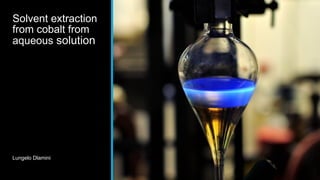
Solvent extraction
from cobalt from
aqueous solution
Lungelo Dlamini
Introduction
• Metals of value are extracted from minerals through hydrometallurgy, the use of aqueous solutions for
the recovery of metals from ores (Habashi, F. 1999)
• Aqueous solution of a salt of the metal of interest is prepared. Multiple metals dissolve in the aqueous
solution, it is then called a pregnant leach solution
• Downstream processing of the pregnant leach solution is required to recover the metal of interest e.g.,
solvent extraction, ion exchange etc.
• In this practical, cobalt (II) was removed from a pregnant leach solution of cobalt sulphate using solvent
extraction as a separation method
• Solvent extraction is a process by which compounds are separated based on their relative solubilities
• The component from aqueous liquid mixture is selectively removed by dissolving it in organic phase
2
Introduction
• The pregnant leach solution (aqueous phase) is mixed with extractant (organic
phase) preferably phosphinic acid(2,4,4-trimethyl pentyl) also known as Cyanex
272
• This allows aqueous species and extractant to form organometallic complexes
that are soluble in organic phase
• The selected organic phase should not be miscible with the aqueous phase, this
would allow the two phases to separate by gravity
• The order of their phases whether a particular liquid is on top or on the bottom,
is determined by its density.
• Typically, aqueous phase has higher density than organic phase.
3
Introduction
• Objectives:
• To perform solvent extraction in stages to asses the effectiveness of
separation of cobalt ions from the aqueous phase
• To establish the relevance of stage processing in solvent extraction
4
Literature review
• Typical processes that are used to treat leach solutions include ion exchange,
precipitation, solvent extraction etc.
• This practical considers solvent extraction as leach treatment
• It has been proven that phosphinic acid (Cyanex 272) is a better separation
agent for cobalt than phosphonic acid (PC-88A) and phosphoric acid
(DEHPA) (Sarangi et al., 1999b; Devi et al., 1998)
5
Methodology
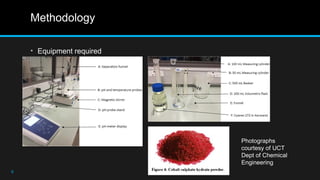
• Equipment required
6
Photographs
courtesy of UCT
Dept of Chemical
Engineering
Methodology
Chemicals required
• Cobalt sulphate hydrate (CoSO4·7H2O) powder
• O.3M Sodium hydroxide (NaOH)
• 0.6M Hydrochloric acid
• Organic phase which contains 15 vol% Cyanex 272 diluted in kerosene
7
Methodology
Preparation of pregnant leach solution
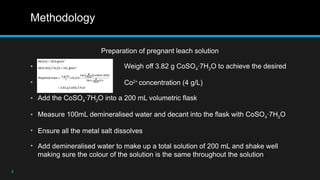
• Weigh off 3.82 g CoSO4·7H2O to achieve the desired
• Co2+
concentration (4 g/L)
• Add the CoSO4·7H2O into a 200 mL volumetric flask
• Measure 100mL demineralised water and decant into the flask with CoSO4·7H2O
• Ensure all the metal salt dissolves
• Add demineralised water to make up a total solution of 200 mL and shake well
making sure the colour of the solution is the same throughout the solution
8
Methodology
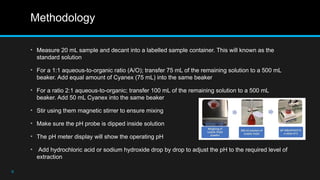
• Measure 20 mL sample and decant into a labelled sample container. This will known as the
standard solution
• For a 1:1 aqueous-to-organic ratio (A/O); transfer 75 mL of the remaining solution to a 500 mL
beaker. Add equal amount of Cyanex (75 mL) into the same beaker
• For a ratio 2:1 aqueous-to-organic; transfer 100 mL of the remaining solution to a 500 mL
beaker. Add 50 mL Cyanex into the same beaker
• Stir using them magnetic stirrer to ensure mixing
• Make sure the pH probe is dipped inside solution
• The pH meter display will show the operating pH
• Add hydrochloric acid or sodium hydroxide drop by drop to adjust the pH to the required level of
extraction
9
Methodology
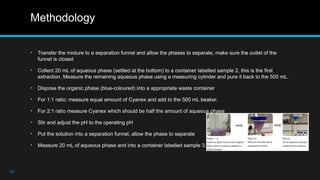
• Transfer the mixture to a separation funnel and allow the phases to separate, make sure the outlet of the
funnel is closed
• Collect 20 mL of aqueous phase (settled at the bottom) to a container labelled sample 2, this is the first
extraction. Measure the remaining aqueous phase using a measuring cylinder and pure it back to the 500 mL.
• Dispose the organic phase (blue-coloured) into a appropriate waste container
• For 1:1 ratio; measure equal amount of Cyanex and add to the 500 mL beaker,
• For 2:1 ratio measure Cyanex which should be half the amount of aqueous phase
• Stir and adjust the pH to the operating pH
• Put the solution into a separation funnel, allow the phase to separate
• Measure 20 mL of aqueous phase and into a container labelled sample 3.
10
Results and Analysis
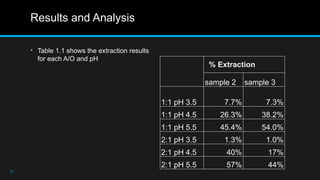
• Table 1.1 shows the extraction results
for each A/O and pH
11
% Extraction
sample 2 sample 3
1:1 pH 3.5 7.7% 7.3%
1:1 pH 4.5 26.3% 38.2%
1:1 pH 5.5 45.4% 54.0%
2:1 pH 3.5 1.3% 1.0%
2:1 pH 4.5 40% 17%
2:1 pH 5.5 57% 44%
Conclusion
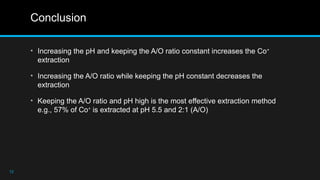
• Increasing the pH and keeping the A/O ratio constant increases the Co+
extraction
• Increasing the A/O ratio while keeping the pH constant decreases the
extraction
• Keeping the A/O ratio and pH high is the most effective extraction method
e.g., 57% of Co+
is extracted at pH 5.5 and 2:1 (A/O)
12
Recommendations
• Allow the magnetic stirrer to mix the solutions for some time before putting in
the pH probe and controlling the pH. This is because the pH meter could
display the required pH e.g pH 3.5 but the solutions haven’t mixed thoroughly
• Increase the speed of the magnetic stirrer to increase the mixing efficiency
• To increase the extraction in the separating funnel, wait a little longer to
make sure that the two phases separate “perfectly” before transferring the 20
mL i.e., there is no blue color (organic phase) in the aqueous phase
13
References
• Solvent extraction in hydrometallurgy, Flett, D.S. (2005)
• Habashi, F. (1999) Textbook of Hydrometallurgy, Métallurgie Extractive
Québec, Québec, Canada
• Ritcey, G.M. and Ashbrook, A.W. (1979) Solvent extraction: principles and
applications to process metallurgy, Elsevier Science, Amsterdam,
Netherlands
14

Presentation about organic phase and aqueous phase separation

  • 1.
    Solvent extraction from cobaltfrom aqueous solution Lungelo Dlamini
  • 2.
    Introduction • Metals ofvalue are extracted from minerals through hydrometallurgy, the use of aqueous solutions for the recovery of metals from ores (Habashi, F. 1999) • Aqueous solution of a salt of the metal of interest is prepared. Multiple metals dissolve in the aqueous solution, it is then called a pregnant leach solution • Downstream processing of the pregnant leach solution is required to recover the metal of interest e.g., solvent extraction, ion exchange etc. • In this practical, cobalt (II) was removed from a pregnant leach solution of cobalt sulphate using solvent extraction as a separation method • Solvent extraction is a process by which compounds are separated based on their relative solubilities • The component from aqueous liquid mixture is selectively removed by dissolving it in organic phase 2
  • 3.
    Introduction • The pregnantleach solution (aqueous phase) is mixed with extractant (organic phase) preferably phosphinic acid(2,4,4-trimethyl pentyl) also known as Cyanex 272 • This allows aqueous species and extractant to form organometallic complexes that are soluble in organic phase • The selected organic phase should not be miscible with the aqueous phase, this would allow the two phases to separate by gravity • The order of their phases whether a particular liquid is on top or on the bottom, is determined by its density. • Typically, aqueous phase has higher density than organic phase. 3
  • 4.
    Introduction • Objectives: • Toperform solvent extraction in stages to asses the effectiveness of separation of cobalt ions from the aqueous phase • To establish the relevance of stage processing in solvent extraction 4
  • 5.
    Literature review • Typicalprocesses that are used to treat leach solutions include ion exchange, precipitation, solvent extraction etc. • This practical considers solvent extraction as leach treatment • It has been proven that phosphinic acid (Cyanex 272) is a better separation agent for cobalt than phosphonic acid (PC-88A) and phosphoric acid (DEHPA) (Sarangi et al., 1999b; Devi et al., 1998) 5
  • 6.
  • 7.
    Methodology Chemicals required • Cobaltsulphate hydrate (CoSO4·7H2O) powder • O.3M Sodium hydroxide (NaOH) • 0.6M Hydrochloric acid • Organic phase which contains 15 vol% Cyanex 272 diluted in kerosene 7
  • 8.
    Methodology Preparation of pregnantleach solution • Weigh off 3.82 g CoSO4·7H2O to achieve the desired • Co2+ concentration (4 g/L) • Add the CoSO4·7H2O into a 200 mL volumetric flask • Measure 100mL demineralised water and decant into the flask with CoSO4·7H2O • Ensure all the metal salt dissolves • Add demineralised water to make up a total solution of 200 mL and shake well making sure the colour of the solution is the same throughout the solution 8
  • 9.
    Methodology • Measure 20mL sample and decant into a labelled sample container. This will known as the standard solution • For a 1:1 aqueous-to-organic ratio (A/O); transfer 75 mL of the remaining solution to a 500 mL beaker. Add equal amount of Cyanex (75 mL) into the same beaker • For a ratio 2:1 aqueous-to-organic; transfer 100 mL of the remaining solution to a 500 mL beaker. Add 50 mL Cyanex into the same beaker • Stir using them magnetic stirrer to ensure mixing • Make sure the pH probe is dipped inside solution • The pH meter display will show the operating pH • Add hydrochloric acid or sodium hydroxide drop by drop to adjust the pH to the required level of extraction 9
  • 10.
    Methodology • Transfer themixture to a separation funnel and allow the phases to separate, make sure the outlet of the funnel is closed • Collect 20 mL of aqueous phase (settled at the bottom) to a container labelled sample 2, this is the first extraction. Measure the remaining aqueous phase using a measuring cylinder and pure it back to the 500 mL. • Dispose the organic phase (blue-coloured) into a appropriate waste container • For 1:1 ratio; measure equal amount of Cyanex and add to the 500 mL beaker, • For 2:1 ratio measure Cyanex which should be half the amount of aqueous phase • Stir and adjust the pH to the operating pH • Put the solution into a separation funnel, allow the phase to separate • Measure 20 mL of aqueous phase and into a container labelled sample 3. 10
  • 11.
    Results and Analysis •Table 1.1 shows the extraction results for each A/O and pH 11 % Extraction sample 2 sample 3 1:1 pH 3.5 7.7% 7.3% 1:1 pH 4.5 26.3% 38.2% 1:1 pH 5.5 45.4% 54.0% 2:1 pH 3.5 1.3% 1.0% 2:1 pH 4.5 40% 17% 2:1 pH 5.5 57% 44%
  • 12.
    Conclusion • Increasing thepH and keeping the A/O ratio constant increases the Co+ extraction • Increasing the A/O ratio while keeping the pH constant decreases the extraction • Keeping the A/O ratio and pH high is the most effective extraction method e.g., 57% of Co+ is extracted at pH 5.5 and 2:1 (A/O) 12
  • 13.
    Recommendations • Allow themagnetic stirrer to mix the solutions for some time before putting in the pH probe and controlling the pH. This is because the pH meter could display the required pH e.g pH 3.5 but the solutions haven’t mixed thoroughly • Increase the speed of the magnetic stirrer to increase the mixing efficiency • To increase the extraction in the separating funnel, wait a little longer to make sure that the two phases separate “perfectly” before transferring the 20 mL i.e., there is no blue color (organic phase) in the aqueous phase 13
  • 14.
    References • Solvent extractionin hydrometallurgy, Flett, D.S. (2005) • Habashi, F. (1999) Textbook of Hydrometallurgy, Métallurgie Extractive Québec, Québec, Canada • Ritcey, G.M. and Ashbrook, A.W. (1979) Solvent extraction: principles and applications to process metallurgy, Elsevier Science, Amsterdam, Netherlands 14

Editor's Notes

  • #2 This is the question that your experiment answers
  • #5 Summarize your research in three to five points.
  • #11 Establish hypothesis before you begin the experiment. This should be your best educated guess based on your research.