1,4-Dioxane Degradation
Gene Analysis
Keith Sanders
Introduction
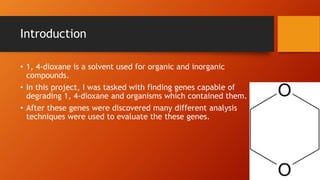
• 1, 4-dioxane is a solvent used for organic and inorganic
compounds.
• In this project, I was tasked with finding genes capable of
degrading 1, 4-dioxane and organisms which contained them.
• After these genes were discovered many different analysis
techniques were used to evaluate the these genes.
Purpose
• Exposure to this chemical can lead to headaches, and irritation of
the throat, lungs, and eyes.
• 1, 4-dioxane can also be absorbed through the skin causing mild to
severe skin irritation.
• 1, 4-dioxane is also suspected to be a carcinogen.
• Typically, exposure to this chemical is was limited to an
occupational hazard, However substances of these chemicals have
been found in ground and surface water.
Introduction
• This project aims to find genes, and the organisms they belong to
which can degrade 1, 4-dioxane.
• True degradation means that the organism can use the chemical as
a source of carbon.
• Possible outcomes include finding either many different organisms
which can degrade the compound, or finding a select group of
highly related organisms with this gene.
Materials: Data Gathering Phase
• During this phase of the project, data and sequences were
gathered.
• Databases:
• NCBI Pubmed was used to gain articles for the literary review.
• NCBI Databases like the gene, protein, and nucleotide were used
to gather sequence data.
• Programs like BLAST were used to search for multiple sequences
using a particular sequence target.
Materials: Sequence Analysis
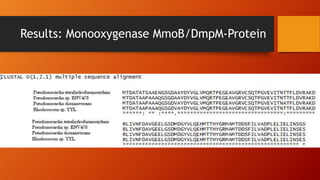
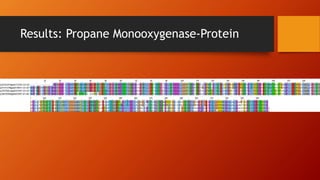
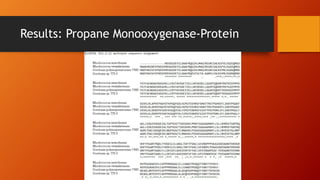
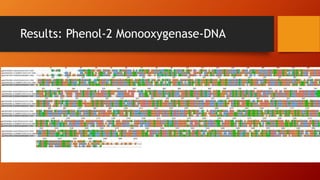
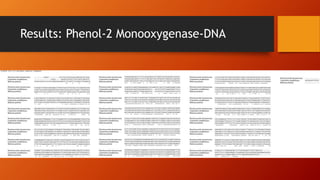
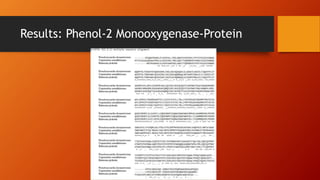
• The program Clustal Omega was used create multiple sequence
alignments (MSA).
• From these MSA’s many different data elements could be
obtained, all using Clustal Omega
• The Phylips programs were used which contained multiple analysis
programs.
• Gene/Protein consensus logos were created using GENIO/logo
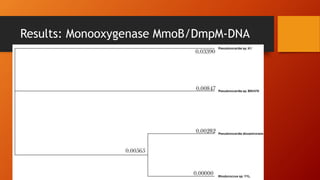
• The phylogeny tree was created using TreeView
Methods: Gene Search
• Using the results from my literary review I gained genes and
organisms of interest.
• Using BLAST, I was able to search databases for Protein(BLASTp)
and DNA(BLASTn) sequences.
• When using BLASTn, I set the search to exclude models and
uncultured samples using the megablast algorithm. The database
used to search was the nucleotide collection database.
• When using BLASTp, I set the search to exclude models and
uncultured samples. The algorithm set to DELTA-BLAST and was
searched by the Uni/Swiss-prot database.
Methods: Multiple Sequence Alignment
• The tool used to create the MSAs was Clustal Omega.
• This program has the ability to use create sequences from DNA
nucleotides and protein sequences.
• All parameters kept at default.
• The results of the MSA were saved for further examination.
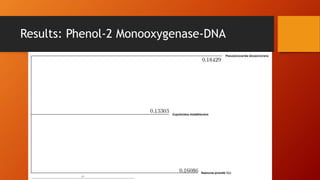
Methods: Phylogeny Tree Creation
• Clustal Omega created MSA and Phylips tree file which can be used
in further programs.
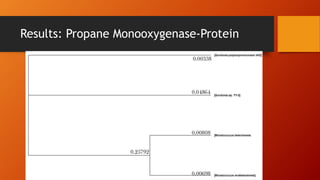
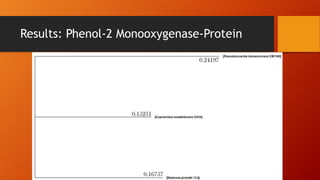
• The phylogeny tree was created using the TreeView Program.
TreeView created the tree from sequences using an Average
Distance % Identity.
Results
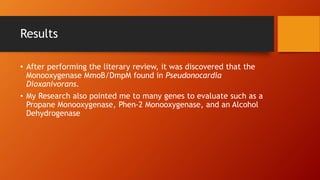
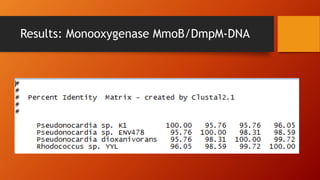
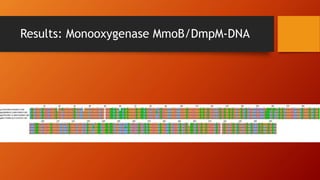
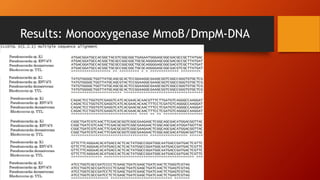
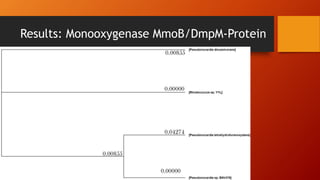
• After performing the literary review, it was discovered that the
Monooxygenase MmoB/DmpM found in Pseudonocardia
Dioxanivorans.
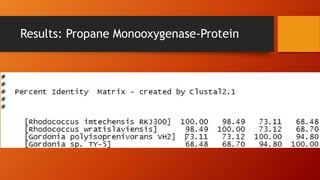
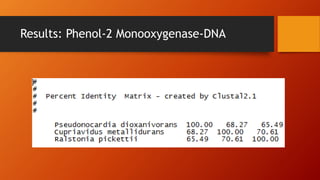
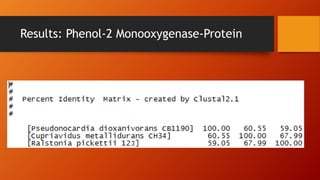
• My Research also pointed me to many genes to evaluate such as a
Propane Monooxygenase, Phen-2 Monooxygenase, and an Alcohol
Dehydrogenase
Result Visuals: Monooxygenase MmoB/DmpM
Results: Monooxygenase MmoB/DmpM-DNA
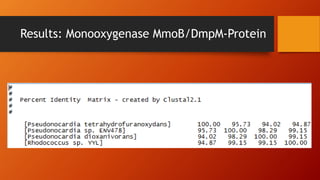
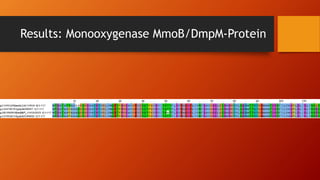
Results: Monooxygenase MmoB/DmpM-Protein
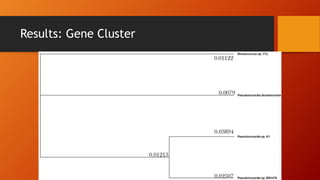
Results Visuals: Gene Cluster
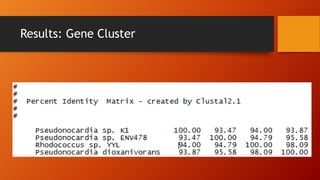
Results: Gene Cluster
Results Visuals: Propane Monooxygenase
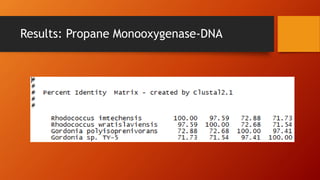
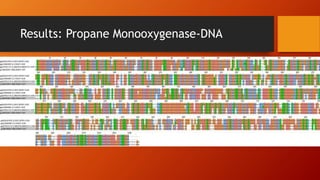
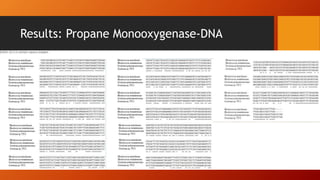
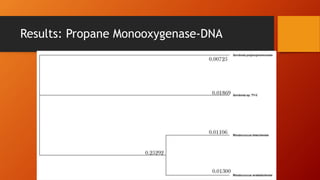
Results: Propane Monooxygenase-DNA
Results: Propane Monooxygenase-Protein
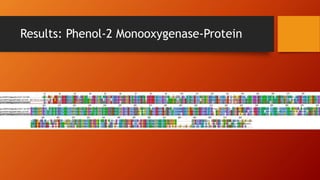
Results Visuals: Phenol-2 Monooxygenase
Results: Phenol-2 Monooxygenase-DNA
Results: Phenol-2 Monooxygenase-Protein
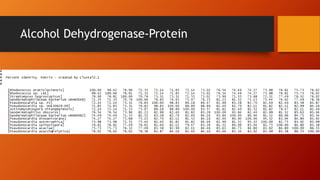
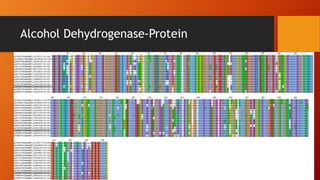
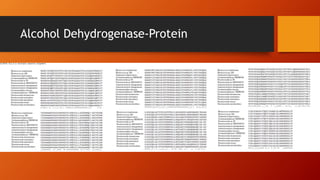
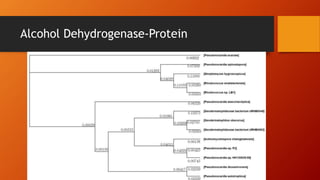
Results Visuals: Alcohol Dehydrogenase
Alcohol Dehydrogenase-Protein
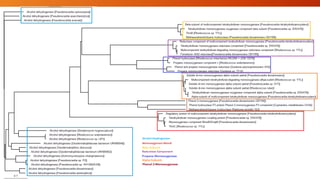
Complete Phylogeny Tree
Conclusion
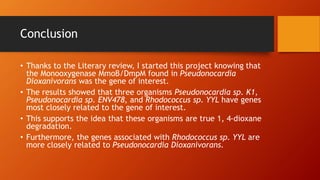
• Thanks to the Literary review, I started this project knowing that
the Monooxygenase MmoB/DmpM found in Pseudonocardia
Dioxanivorans was the gene of interest.
• The results showed that three organisms Pseudonocardia sp. K1,
Pseudonocardia sp. ENV478, and Rhodococcus sp. YYL have genes
most closely related to the gene of interest.
• This supports the idea that these organisms are true 1, 4-dioxane
degradation.
• Furthermore, the genes associated with Rhodococcus sp. YYL are
more closely related to Pseudonocardia Dioxanivorans.
Conclusion
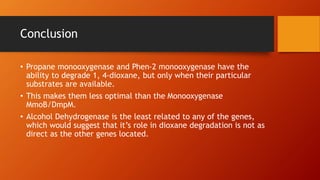
• Propane monooxygenase and Phen-2 monooxygenase have the
ability to degrade 1, 4-dioxane, but only when their particular
substrates are available.
• This makes them less optimal than the Monooxygenase
MmoB/DmpM.
• Alcohol Dehydrogenase is the least related to any of the genes,
which would suggest that it’s role in dioxane degradation is not as
direct as the other genes located.

Presentation