SUBMITTED TO:MR. ADNAN SADDIQUE
SUBMITTED BY : ROLL # M56
ROLL# M86
ROLL# M81
ROLL# M83
GENES of Leader
High Efforts
High desire to achieve
High energy level
Show intuitive
Persistent in decisions
Roles of Leader
•Create vision
•Build Team
•Allocate tasks
•Develop People
•Motivate Followers
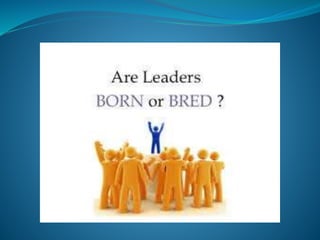
I think the answer is both. Leaders are born and bred, in a
combination of nurture building on nature. There does appear to be
some sort of raw material that contributes to leadership, which leads
to quite different capabilities and outcomes as education is added.
Leaders
Interpersonal Effectiveness
Interpersonal effectiveness is the capability of an individual to do this, influence
others, competently.
Leadership is a direct function of three elements of interpersonal effectiveness
Awareness
Ability
Commitment
Awareness is a state of consciousness.
It is the ability to recognize yourself, others, events and
situations in real time.
It is the ability to assess the impact of actions on
situations and others, and be critically self-reflective.
It is a development process that is a function of
experience, communication, self discovery and feedback.
Awareness
Ability to learn and understand technical issues is the basis of our
careers.
Ability to lead is a function of influence:
Ability to communicate
Ability to resolve conflicts
Ability to solve problems and make decisions
As a member of a team, we influence others in a collaborative effort to
find better ideas or solve problems.
Ability
Commitment
For leaders, the “one thing” that leads to maturity is the fully aware
recognition that one’s decisions make a difference, both positively and
negatively, in the lives of others, and that any attempt to solve a
problem might have a decided negative impact on some, while helping
others.
In no-win scenarios, one must still make a hard decision.
Movie example – Untouchables
Moment of truth for Elliott Ness
Jimmy O’Neil asks
“What are you prepared to do?”
Ness replies
“Anything I have to do to make this thing right.”
O’Neil says
“Everyone knows where the problems are, but no one is willing to do
anything. You said you would do anything you had to, to make it
right. Now, I’m willing to help you. You made the commitment.”
Leadership skills
•Communications
•Motivation
•Stress Management
•Team Building
•Change Management
Types of LeaderShip
Chrismatic Leadership:
Individuals are born with traits that make them charismatic.
Charismatic leaders are likely to be extraverted, self-confident,and
achievement oriented.
Transformational Leadership:
Transformational leaders inspire followers to transcend their self-
interests for the good of the organization and can have an extraordinary
effect on their followers.
Presentation
Presentation
Presentation
Presentation
Presentation
Presentation
Presentation
Presentation
Presentation
Presentation
Presentation
Presentation
Presentation
Presentation
Presentation
Presentation
Presentation
Presentation
Presentation
Presentation
Presentation
Presentation
Presentation
Presentation
Presentation

Presentation

  • 1.
    SUBMITTED TO:MR. ADNANSADDIQUE SUBMITTED BY : ROLL # M56 ROLL# M86 ROLL# M81 ROLL# M83
  • 4.
    GENES of Leader HighEfforts High desire to achieve High energy level Show intuitive Persistent in decisions
  • 5.
    Roles of Leader •Createvision •Build Team •Allocate tasks •Develop People •Motivate Followers
  • 10.
    I think theanswer is both. Leaders are born and bred, in a combination of nurture building on nature. There does appear to be some sort of raw material that contributes to leadership, which leads to quite different capabilities and outcomes as education is added. Leaders
  • 11.
    Interpersonal Effectiveness Interpersonal effectivenessis the capability of an individual to do this, influence others, competently. Leadership is a direct function of three elements of interpersonal effectiveness Awareness Ability Commitment
  • 12.
    Awareness is astate of consciousness. It is the ability to recognize yourself, others, events and situations in real time. It is the ability to assess the impact of actions on situations and others, and be critically self-reflective. It is a development process that is a function of experience, communication, self discovery and feedback. Awareness Ability to learn and understand technical issues is the basis of our careers. Ability to lead is a function of influence: Ability to communicate Ability to resolve conflicts Ability to solve problems and make decisions As a member of a team, we influence others in a collaborative effort to find better ideas or solve problems. Ability
  • 13.
    Commitment For leaders, the“one thing” that leads to maturity is the fully aware recognition that one’s decisions make a difference, both positively and negatively, in the lives of others, and that any attempt to solve a problem might have a decided negative impact on some, while helping others. In no-win scenarios, one must still make a hard decision. Movie example – Untouchables Moment of truth for Elliott Ness Jimmy O’Neil asks “What are you prepared to do?” Ness replies “Anything I have to do to make this thing right.” O’Neil says “Everyone knows where the problems are, but no one is willing to do anything. You said you would do anything you had to, to make it right. Now, I’m willing to help you. You made the commitment.”
  • 14.
  • 15.
    Types of LeaderShip ChrismaticLeadership: Individuals are born with traits that make them charismatic. Charismatic leaders are likely to be extraverted, self-confident,and achievement oriented. Transformational Leadership: Transformational leaders inspire followers to transcend their self- interests for the good of the organization and can have an extraordinary effect on their followers.