Dense Optical Flow Based
Emotion Recognition
By Anthony Lowhur (under Professor Chuah)
Outline of talk
• Motivation
• Limitations of existing methods
• Overview of our Dense Optical Flow-Based ER
(DOF-ER) approach
• Experimental Evaluation
Why emotion recognition?
• Need more effective human-computer interaction
methods in more intelligent systems
• Video Games which depend on users’ emotions
• Educational packages which depend on users’ emotions
• Healthcare applications for treating patients with PTSD or
depressions.
• Counseling and therapy applications that would help one
to optimize psychologicalogical treatment in patients
• Musical applications to autonomously play the right music
for the user at a certain moment.
Limitation of Existing Methods
• Still image emotion classifiers suffers from
weaknesses such as bad lighting, the subject’s
unique appearance, and unique facial expression.
• Other classifiers assume the presence of a fully
frontal face location with previous knowledge of
global facial landmark location.
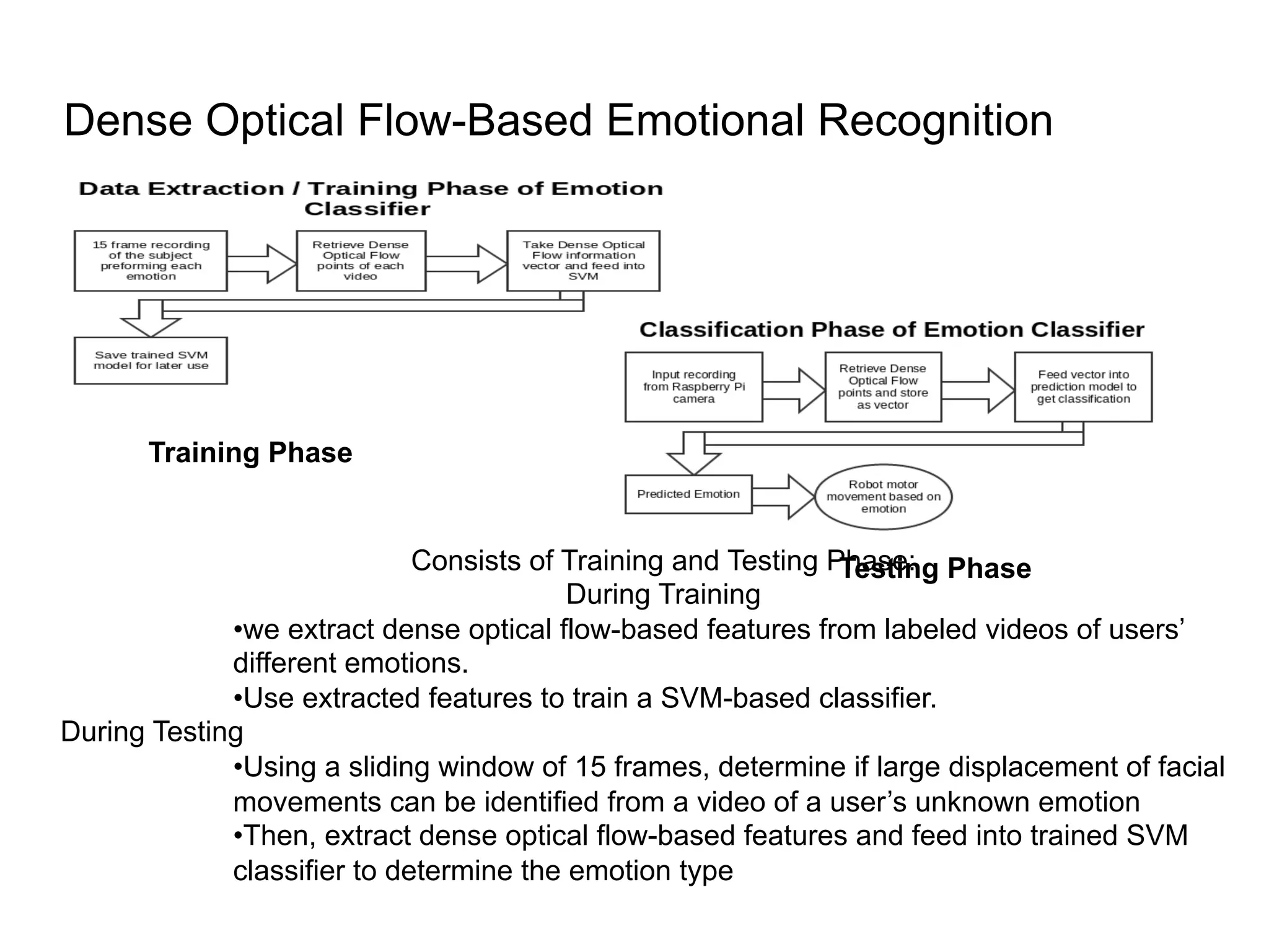
Dense Optical Flow-Based Emotional Recognition
Consists of Training and Testing Phase:
During Training
• we extract dense optical flow-based features from labeled videos of users’
different emotions.
• Use extracted features to train a SVM-based classifier.
During Testing
• Using a sliding window of 15 frames, determine if large displacement of facial
movements can be identified from a video of a user’s unknown emotion
• Then, extract dense optical flow-based features and feed into trained SVM
classifier to determine the emotion type
Training Phase
Testing Phase
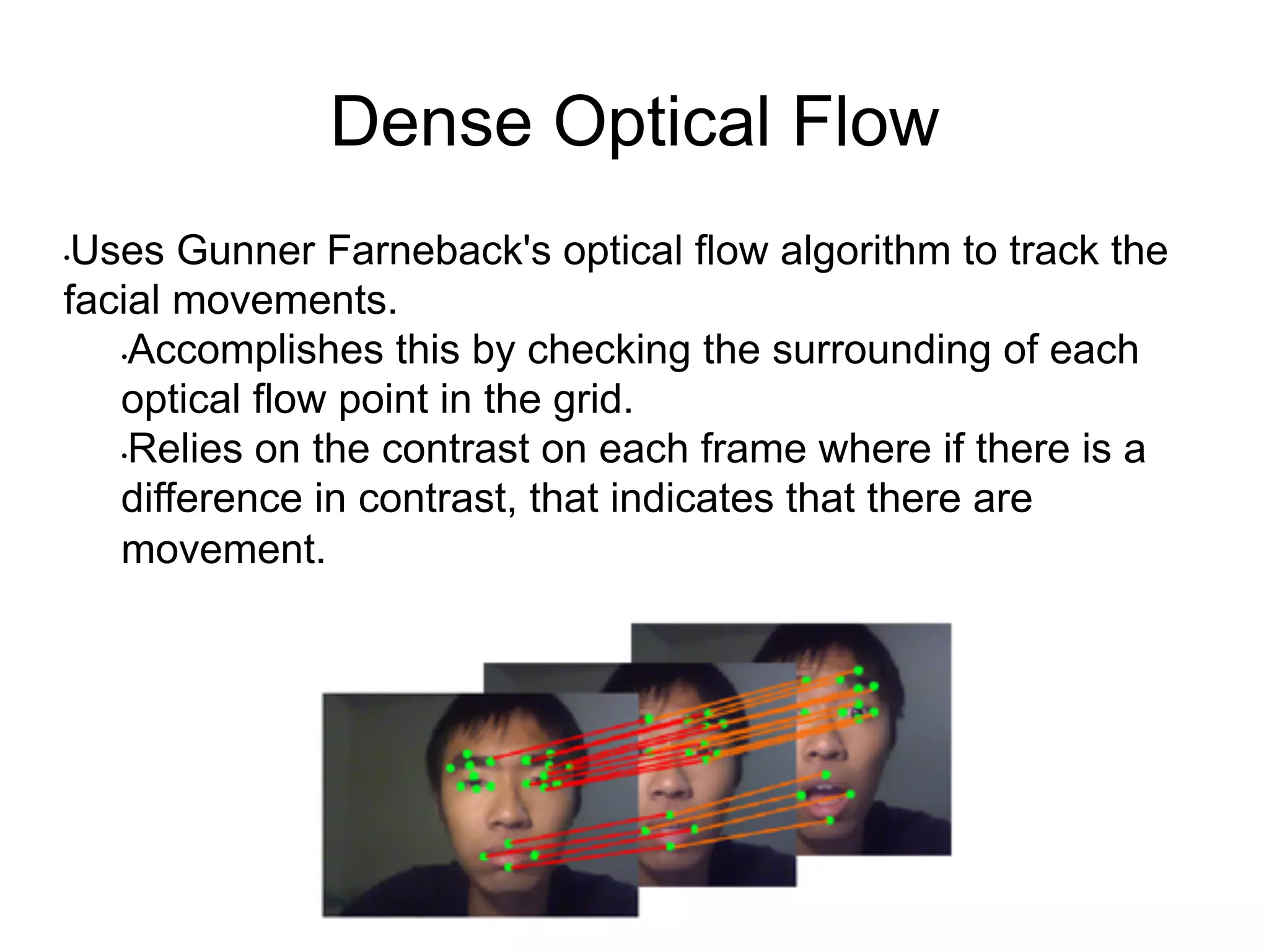
Dense Optical Flow
• Uses Gunner Farneback's optical flow algorithm to track the
facial movements.
• Accomplishes this by checking the surrounding of each
optical flow point in the grid.
• Relies on the contrast on each frame where if there is a
difference in contrast, that indicates that there are
movement.
Advantages of our approach
• Analyzing facial movements in videos as oppose to still
images.
• This method is less vulnerable to numerous factors such
as lighting and different appearance of each people
• Our approach makes it easier to classify emotions since
people generally have similar facial movements and
expression patterns for each emotion
Details of Evaluation Experiment
l We collected facial data from all of our subjects
l Perform dense optical flow analysis on the
images
l Train the emotion classifier with SVM with the
optical flow point data
l Predict someone’s emotion by recording them
and analyzing dense optical flow movement.
Data Collection
l Asked 6 volunteers to allow us to take pictures of them
with four posed emotions.
l Produced own dataset of 372 videos of expressing each
emotion from 6 different people.
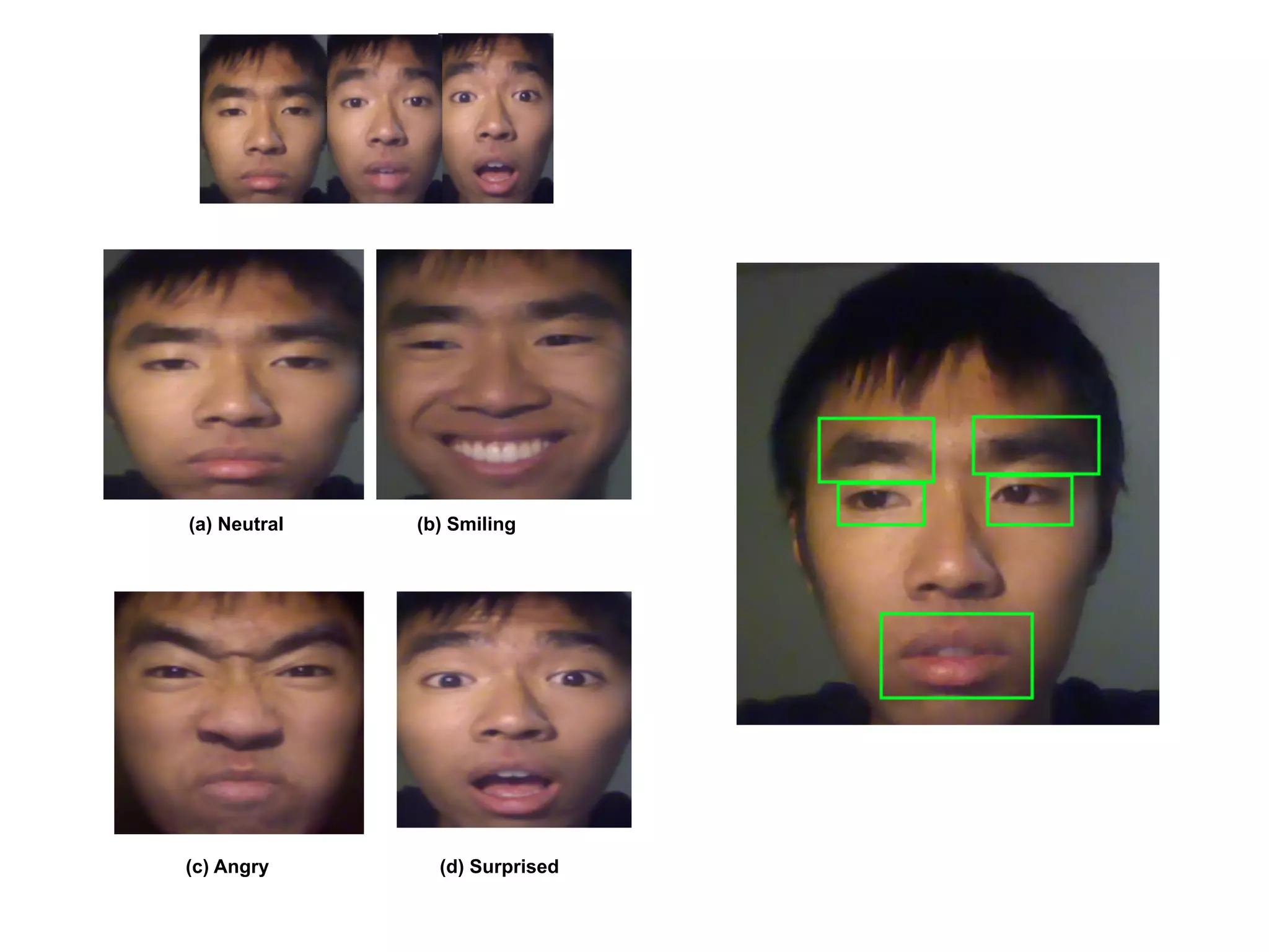
l Emotion labels are neutral, happy, surprised, and angry
l More emotions can be easily added by adding more
video samples
l Data was diverse enough so that each emotion had
different facial movements.
Evaluation Results
• Successfully recognized the emotions of a large
majority of the test subjects.
• With a large and diverse dataset, the classifier
achieved an accuracy range of 82-90% with
cross-validation.
• The confusion matrix tells us that the classifier
has a tendency to over guess neutral due to small
facial movements in other emotions. However
sensitive mode overcomes this.
(a) Neutral (b) Smiling
(c) Angry (d) Surprised
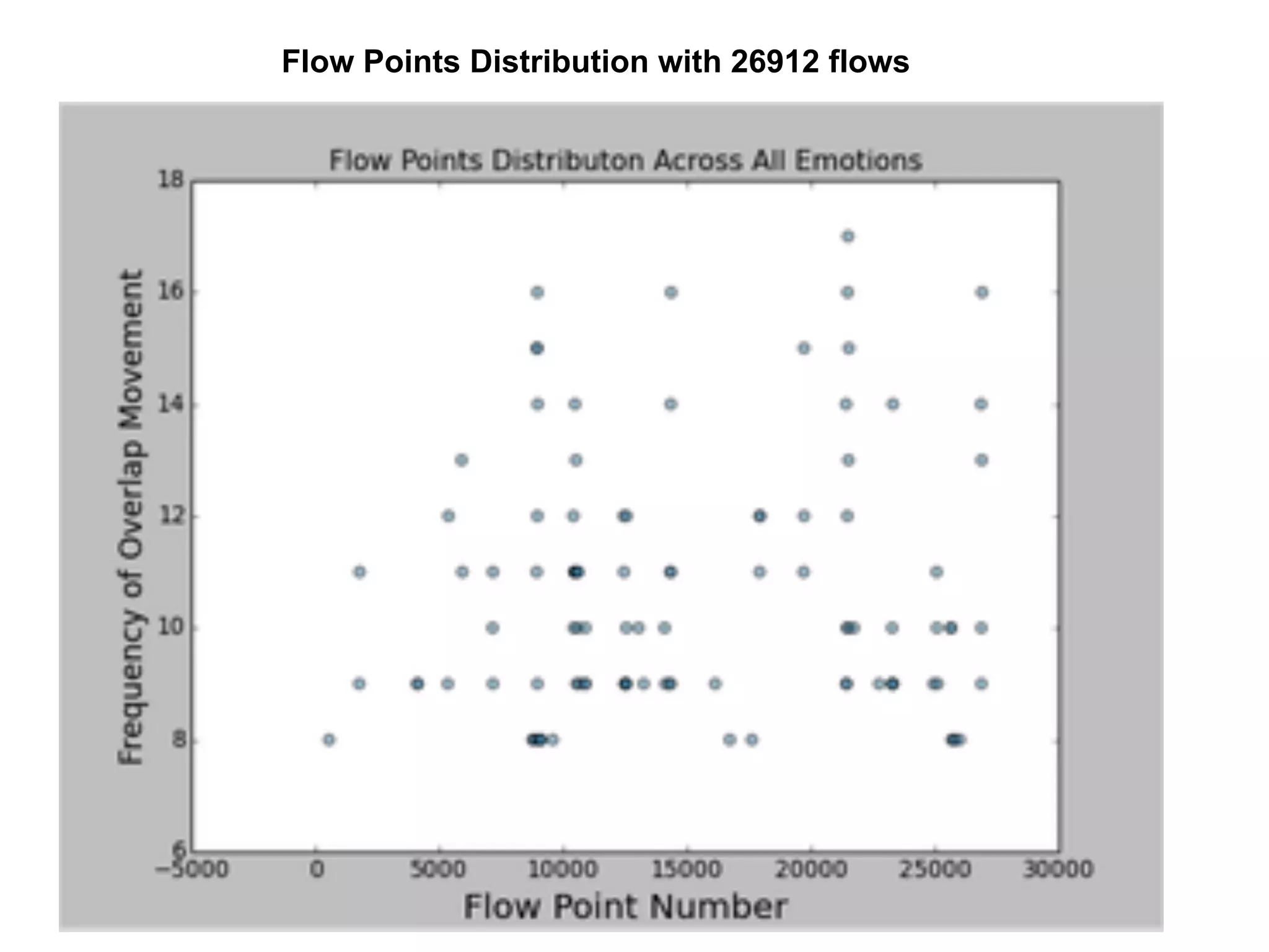
Amount of flow points
l We tested to see how our normal 26,912 optical
flow point emotion classifier compares to one with
10,000 optical flow points.
l The one with 26,912 flow points seemed to have
better performance with an accuracy of 81.75%
compared to the other classifier's 74.375%
l 
Flow Points Distribution with 26912 flows
Generic vs Per-User Classifier
• Also evaluate differences between a per-user and
generic classifier
• Per-user classifier can achieve an accuracy in the
range of 81-87% compared to the 81.25% with
generic classifier.
l 
Future Work
• Investigate if using a combination of different
classifiers with each classifier focusing on facial
movements in a particular region e.g. eyebrows or
mouth) gives higher accuracy.
• Investigate the robustness of our scheme when a
user’s facial expression is captured at different
distance from the camera e.g. near or far views,
front or side view of a user’s face.
Video of emotion classifier
https://www.youtube.com/watch?v=PM_k_zACWLE
Packages used
l OpenCV Python
l Computer Vision tasks such as haar cascade and
dense optical flow
l Scikit-Learn
l Machine Learning tasks such as Support Vector
Machines
l Numpy, matplotlib, etc
l Work with matrices and analyze data
l LibSVM (will add more info once I used it)
Acknowledgement
l We would like to thank all of our subjects who
allowed us to take emotion video samples from
them.

presentation

  • 1.
    Dense Optical FlowBased Emotion Recognition By Anthony Lowhur (under Professor Chuah)
  • 2.
    Outline of talk • Motivation • Limitationsof existing methods • Overview of our Dense Optical Flow-Based ER (DOF-ER) approach • Experimental Evaluation
  • 3.
    Why emotion recognition? • Needmore effective human-computer interaction methods in more intelligent systems • Video Games which depend on users’ emotions • Educational packages which depend on users’ emotions • Healthcare applications for treating patients with PTSD or depressions. • Counseling and therapy applications that would help one to optimize psychologicalogical treatment in patients • Musical applications to autonomously play the right music for the user at a certain moment.
  • 4.
    Limitation of ExistingMethods • Still image emotion classifiers suffers from weaknesses such as bad lighting, the subject’s unique appearance, and unique facial expression. • Other classifiers assume the presence of a fully frontal face location with previous knowledge of global facial landmark location.
  • 5.
    Dense Optical Flow-BasedEmotional Recognition Consists of Training and Testing Phase: During Training • we extract dense optical flow-based features from labeled videos of users’ different emotions. • Use extracted features to train a SVM-based classifier. During Testing • Using a sliding window of 15 frames, determine if large displacement of facial movements can be identified from a video of a user’s unknown emotion • Then, extract dense optical flow-based features and feed into trained SVM classifier to determine the emotion type Training Phase Testing Phase
  • 6.
    Dense Optical Flow • UsesGunner Farneback's optical flow algorithm to track the facial movements. • Accomplishes this by checking the surrounding of each optical flow point in the grid. • Relies on the contrast on each frame where if there is a difference in contrast, that indicates that there are movement.
  • 7.
    Advantages of ourapproach • Analyzing facial movements in videos as oppose to still images. • This method is less vulnerable to numerous factors such as lighting and different appearance of each people • Our approach makes it easier to classify emotions since people generally have similar facial movements and expression patterns for each emotion
  • 8.
    Details of EvaluationExperiment l We collected facial data from all of our subjects l Perform dense optical flow analysis on the images l Train the emotion classifier with SVM with the optical flow point data l Predict someone’s emotion by recording them and analyzing dense optical flow movement.
  • 9.
    Data Collection l Asked 6volunteers to allow us to take pictures of them with four posed emotions. l Produced own dataset of 372 videos of expressing each emotion from 6 different people. l Emotion labels are neutral, happy, surprised, and angry l More emotions can be easily added by adding more video samples l Data was diverse enough so that each emotion had different facial movements.
  • 10.
    Evaluation Results • Successfully recognizedthe emotions of a large majority of the test subjects. • With a large and diverse dataset, the classifier achieved an accuracy range of 82-90% with cross-validation. • The confusion matrix tells us that the classifier has a tendency to over guess neutral due to small facial movements in other emotions. However sensitive mode overcomes this.
  • 11.
    (a) Neutral (b)Smiling (c) Angry (d) Surprised
  • 12.
    Amount of flowpoints l We tested to see how our normal 26,912 optical flow point emotion classifier compares to one with 10,000 optical flow points. l The one with 26,912 flow points seemed to have better performance with an accuracy of 81.75% compared to the other classifier's 74.375% l 
  • 13.
    Flow Points Distributionwith 26912 flows
  • 14.
    Generic vs Per-UserClassifier • Also evaluate differences between a per-user and generic classifier • Per-user classifier can achieve an accuracy in the range of 81-87% compared to the 81.25% with generic classifier. l 
  • 15.
    Future Work • Investigate ifusing a combination of different classifiers with each classifier focusing on facial movements in a particular region e.g. eyebrows or mouth) gives higher accuracy. • Investigate the robustness of our scheme when a user’s facial expression is captured at different distance from the camera e.g. near or far views, front or side view of a user’s face.
  • 16.
    Video of emotionclassifier https://www.youtube.com/watch?v=PM_k_zACWLE
  • 17.
    Packages used l OpenCV Python l ComputerVision tasks such as haar cascade and dense optical flow l Scikit-Learn l Machine Learning tasks such as Support Vector Machines l Numpy, matplotlib, etc l Work with matrices and analyze data l LibSVM (will add more info once I used it)
  • 18.
    Acknowledgement l We would liketo thank all of our subjects who allowed us to take emotion video samples from them.