Filmmakers continued
Tom Davenport
TOM DAVENPORT (FOLKSTREAMS PROJECT DIRECTOR) is an
independent filmmaker and film distributor living in
Delaplane, Virginia. He was graduated from Yale University.
He began work in film with documentary filmmakers Richard
Leacock and Don Pennebacker in New York and made his first
independent film in 1969 on the Chinese martial art of T'ai
Chi. In 1970 he returned home to rural Virginia and started an
independent film company (www.davenportfilms.com) with
his wife, co-producer and designer, Mimi Davenport. They are
best known for a series of live action American adaptations of
traditional folktales in series called "From the Brothers
Grimm". The last film in that series Willa: An American Snow
White is their first feature length film and the winner of the
Andrew Carnegie Award from the American Library Association
for "Best Children's Film of 1998.”
Tom Davenport
 develops the creative potential for young viewers
 empowers people feeling manipulated by the media
 has American settings from the 17th century to present day
 shows patience, cunning and courage overcome poverty,
prejudice and hardship during wars, famine and depression
 has characters survive with pride and a sense of won dignity
 gives viewers a sense of hope in the face of poverty,
degradation and violence
 Shows hope for a better future
 brings in a sense of history and oppression
 has American tales about conflict with a matrilineal heritage
 have historical authenticity
 shows young women can assert themselves
Willa, An American Snow White
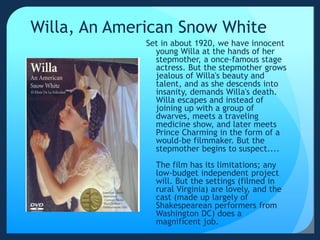
Set in about 1920, we have innocent
young Willa at the hands of her
stepmother, a once-famous stage
actress. But the stepmother grows
jealous of Willa's beauty and
talent, and as she descends into
insanity, demands Willa's death.
Willa escapes and instead of
joining up with a group of
dwarves, meets a traveling
medicine show, and later meets
Prince Charming in the form of a
would-be filmmaker. But the
stepmother begins to suspect....
The film has its limitations; any
low-budget independent project
will. But the settings (filmed in
rural Virginia) are lovely, and the
cast (made up largely of
Shakespearean performers from
Washington DC) does a
magnificent job.
Shelley Duvall
 Faerie Tale Theatre (also known as Shelley Duvall's
Faerie Tale Theatre) is a multi-award winning live-
action children's television anthology series retelling
popular fairy tales. Shelley Duvall serves as narrator,
host and executive producer of the program, and
occasionally stars in episodes.
Zipes on Duvall’s Fairy Tale Theater
Duvall
 just re-created classical tales using big-name stars,
not really innovative or truly for kids
 represents everything as predictable and boring
 emphasizes that performances of the actors make the
films; actors seem to have little conviction in roles or
over-dramatize. The films seem to be created for the
purpose of amusing the actors and giving them a
chance to show off
 have an over-emphasis on glitzy sets and costumes
 includes language that is American slang
 has sexual innuendos
 has no clear educational or philosophical policy
Bruno Bettleheim in The Uses of Enchantment
 Children can learn about solutions to their own predicaments
and predicaments in society.
 Fairytales carry important messages to the unconscious.
 Children become familiar with the struggles going on in their
own unconscious minds (sibling rivalries, oedipal dilemmas,
separation anxiety)
 Children learn to confront dilemmas instead of shying away
from them.
 They identify with success (victorious heroes).
 The tales build character (even the lowliest can succeed)
 They reinforce the fears that the parents reject or overlook,
believing that will alleviate the dilemmas.
More Bettleheim
Children can benefit from reading about small vulnerable children
who suffer from adults’ tyranny and survive.
Savage monsters and brutal punishments appeal to children who
feel helpless and small. They can become the powerful
monsters/witches themselves. They can administer the
punishments in their minds themselves.
Folktales create scenarios in which the heroes and heroines are
drawn to what is forbidden to them (lust, greed, riches,
gluttony) similar to the way in which children are drawn to the
forbidden.
The death of a parent is one of the most agonizing fears of small
children. Folktales help children to imagine a situation in which
they can survive such a loss.
The abused child in the folktale may represent the child who feels
neglected and misunderstood by parents and sibling in real life.
The ultimate success of the child represents the conviction of
the child that he can become a recognized hero who deserves a
better fate.
Vladimir Propp’s Common Folktale elements
One family member leaves home. (death or departure of younger or
older people)
The hero or heroine is forbidden to do some action and the hero or
heroine violates a forbidden order.
The victim submits to deception and unwittingly helps the enemy. A
preliminary misfortune is caused by a deceitful agreement.
The villain causes harm or injury to a member of the family. Can be
a threat.
One family member either lacks something or desires to have
something (lack of wealth or means of existence common)
The hero or heroine leaves home.
The hero or heroine acquires a magical agent. (Acquisition of a helper
or a gift.)
The hero or heroine is transferred, delivered, or led to the whereabouts
of an object or a designated place.
The villain is defeated.
The hero or heroine returns.
A false hero or heroine presents unfounded claims.
A difficult task is proposed to the hero or heroine.
The hero or heroine is recognized and the false hero/ heroine is
exposed.
The hero or heroine is given a new appearance.
The villain is punished. (The villain can also be pardoned.)
The hero or heroine is married and ascends to the throne.
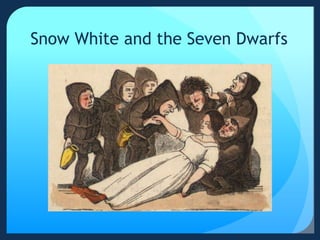
Snow White and the Seven Dwarfs
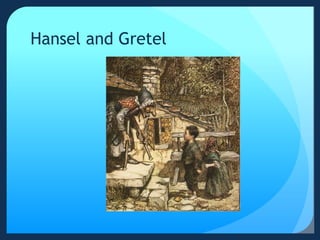
Hansel and Gretel
In groups, analyze the characters according to
Themes, Propp’s and Bettleheim’s theories
 "Hansel and Gretel" 149-152
 “Little Red Riding Hood” 23-24
 "Rapunzel" 378 - 380
 "The Magic Orange Tree" 353 - 356
 The Mother of the Waters 356 - 358
 The Water of Life 380 – 382
 Vasilissa the Fair 359 – 362
 “Jack and the Beanstalk” 394-397
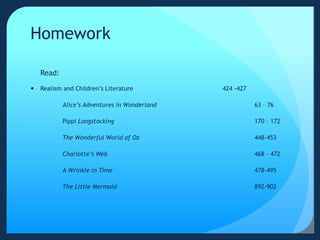
Homework
Read:
 Realism and Children’s Literature 424 -427
Alice’s Adventures in Wonderland 63 – 76
Pippi Longstocking 170 – 172
The Wonderful World of Oz 448-453
Charlotte’s Web 468 – 472
A Wrinkle in Time 478-495
The Little Mermaid 892-902

Presentation 5

  • 1.
  • 2.
    Tom Davenport TOM DAVENPORT(FOLKSTREAMS PROJECT DIRECTOR) is an independent filmmaker and film distributor living in Delaplane, Virginia. He was graduated from Yale University. He began work in film with documentary filmmakers Richard Leacock and Don Pennebacker in New York and made his first independent film in 1969 on the Chinese martial art of T'ai Chi. In 1970 he returned home to rural Virginia and started an independent film company (www.davenportfilms.com) with his wife, co-producer and designer, Mimi Davenport. They are best known for a series of live action American adaptations of traditional folktales in series called "From the Brothers Grimm". The last film in that series Willa: An American Snow White is their first feature length film and the winner of the Andrew Carnegie Award from the American Library Association for "Best Children's Film of 1998.”
  • 3.
    Tom Davenport  developsthe creative potential for young viewers  empowers people feeling manipulated by the media  has American settings from the 17th century to present day  shows patience, cunning and courage overcome poverty, prejudice and hardship during wars, famine and depression  has characters survive with pride and a sense of won dignity  gives viewers a sense of hope in the face of poverty, degradation and violence  Shows hope for a better future  brings in a sense of history and oppression  has American tales about conflict with a matrilineal heritage  have historical authenticity  shows young women can assert themselves
  • 4.
    Willa, An AmericanSnow White Set in about 1920, we have innocent young Willa at the hands of her stepmother, a once-famous stage actress. But the stepmother grows jealous of Willa's beauty and talent, and as she descends into insanity, demands Willa's death. Willa escapes and instead of joining up with a group of dwarves, meets a traveling medicine show, and later meets Prince Charming in the form of a would-be filmmaker. But the stepmother begins to suspect.... The film has its limitations; any low-budget independent project will. But the settings (filmed in rural Virginia) are lovely, and the cast (made up largely of Shakespearean performers from Washington DC) does a magnificent job.
  • 5.
    Shelley Duvall  FaerieTale Theatre (also known as Shelley Duvall's Faerie Tale Theatre) is a multi-award winning live- action children's television anthology series retelling popular fairy tales. Shelley Duvall serves as narrator, host and executive producer of the program, and occasionally stars in episodes.
  • 6.
    Zipes on Duvall’sFairy Tale Theater Duvall  just re-created classical tales using big-name stars, not really innovative or truly for kids  represents everything as predictable and boring  emphasizes that performances of the actors make the films; actors seem to have little conviction in roles or over-dramatize. The films seem to be created for the purpose of amusing the actors and giving them a chance to show off  have an over-emphasis on glitzy sets and costumes  includes language that is American slang  has sexual innuendos  has no clear educational or philosophical policy
  • 7.
    Bruno Bettleheim inThe Uses of Enchantment  Children can learn about solutions to their own predicaments and predicaments in society.  Fairytales carry important messages to the unconscious.  Children become familiar with the struggles going on in their own unconscious minds (sibling rivalries, oedipal dilemmas, separation anxiety)  Children learn to confront dilemmas instead of shying away from them.  They identify with success (victorious heroes).  The tales build character (even the lowliest can succeed)  They reinforce the fears that the parents reject or overlook, believing that will alleviate the dilemmas.
  • 8.
    More Bettleheim Children canbenefit from reading about small vulnerable children who suffer from adults’ tyranny and survive. Savage monsters and brutal punishments appeal to children who feel helpless and small. They can become the powerful monsters/witches themselves. They can administer the punishments in their minds themselves. Folktales create scenarios in which the heroes and heroines are drawn to what is forbidden to them (lust, greed, riches, gluttony) similar to the way in which children are drawn to the forbidden. The death of a parent is one of the most agonizing fears of small children. Folktales help children to imagine a situation in which they can survive such a loss. The abused child in the folktale may represent the child who feels neglected and misunderstood by parents and sibling in real life. The ultimate success of the child represents the conviction of the child that he can become a recognized hero who deserves a better fate.
  • 9.
    Vladimir Propp’s CommonFolktale elements One family member leaves home. (death or departure of younger or older people) The hero or heroine is forbidden to do some action and the hero or heroine violates a forbidden order. The victim submits to deception and unwittingly helps the enemy. A preliminary misfortune is caused by a deceitful agreement. The villain causes harm or injury to a member of the family. Can be a threat. One family member either lacks something or desires to have something (lack of wealth or means of existence common) The hero or heroine leaves home.
  • 10.
    The hero orheroine acquires a magical agent. (Acquisition of a helper or a gift.) The hero or heroine is transferred, delivered, or led to the whereabouts of an object or a designated place. The villain is defeated. The hero or heroine returns. A false hero or heroine presents unfounded claims. A difficult task is proposed to the hero or heroine. The hero or heroine is recognized and the false hero/ heroine is exposed. The hero or heroine is given a new appearance. The villain is punished. (The villain can also be pardoned.) The hero or heroine is married and ascends to the throne.
  • 11.
    Snow White andthe Seven Dwarfs
  • 12.
  • 13.
    In groups, analyzethe characters according to Themes, Propp’s and Bettleheim’s theories  "Hansel and Gretel" 149-152  “Little Red Riding Hood” 23-24  "Rapunzel" 378 - 380  "The Magic Orange Tree" 353 - 356  The Mother of the Waters 356 - 358  The Water of Life 380 – 382  Vasilissa the Fair 359 – 362  “Jack and the Beanstalk” 394-397
  • 14.
    Homework Read:  Realism andChildren’s Literature 424 -427 Alice’s Adventures in Wonderland 63 – 76 Pippi Longstocking 170 – 172 The Wonderful World of Oz 448-453 Charlotte’s Web 468 – 472 A Wrinkle in Time 478-495 The Little Mermaid 892-902