Information warfare
in the Internet.
Exposing and countering
pro-Kremlin disinformation
in the CEEC
Case study: Moldova
Kiev, Ucraine
24 February 2017The project is co-financed
by the International Visegrad Fund
Sources of influence and,
frequently, sources of Russian
propaganda in Moldova, are:
- President of Republic of Moldova;
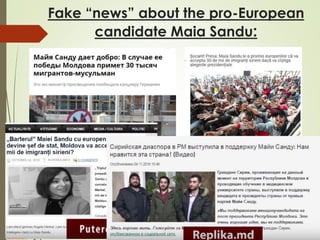
Fake “news” about the pro-European
candidate Maia Sandu:
Sources of influence and,
frequently, sources of Russian
propaganda in Moldova, are:
- President of Republic of Moldova;
- Several mass-media institutions from Russian Federation which
are re-transmitted or re-broadcast in Moldova;
- Several new media institutions and socializing networks;
- Communication sources of some political parties and NGOs,
supported or financed from Russia;
- Other pro-Russian interest groups.
- Orthodox Church (Metropolitan Church of Moldova,
subordinated to the Russian Patriarch);
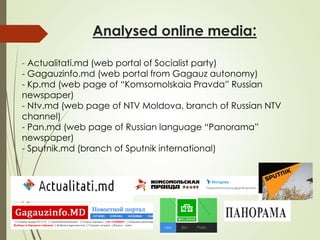
Analysed online media:
- Actualitati.md (web portal of Socialist party)
- Gagauzinfo.md (web portal from Gagauz autonomy)
- Kp.md (web page of “Komsomolskaia Pravda” Russian
newspaper)
- Ntv.md (web page of NTV Moldova, branch of Russian NTV
channel)
- Pan.md (web page of Russian language “Panorama”
newspaper)
- Sputnik.md (branch of Sputnik international)
Inoculated ideas:
"Europe soon to dissolve“
"Chisinau Government is ruled from outside,
being unable to decide by itself“
"NATO prepares a nuclear war against Russia,
and Moldova could turn into this war",
"Moldova is likely to repeat Ukraine’s fate if the
country’s leadership not re-orients to Russia ",
"Moldova’s adherence to EU is impossible, and
the Association Agreement is against the
country’s interests".
The main manipulation
techniques used in the articles:
- distortion, speculation and misinterpretation of facts,
denaturation of reality (ex.: ”the government of Romania is
no more able to make independent decisions”);
- promotion of the conspiracy theory (“conspiracy of the
West, the US and NATO against Moldova”), the assaults to
country’s sovereignty “as happened in Ukraine and
Romania”;
- artificial opposition of values and holidays of Eastern /
Russian with the Western / European;
- presentation of opinions only of those experts who are in
favour of a specific viewpoint regarding the topic discussed;
- use of pejorative language elements to discredit and insult
opponents (ex.: “those who believe in European integration
of Moldova are naive and idiots”);
- premeditated categorization of protagonists in ”good” and
”bad”.
False and distorted ideas:
“Only the naive and the idiots agree with the
utopian idea of Moldova’s European
integration”;
“The US and EU Commissioners and
ambassadors promote homosexual
demonstrations”;
“Moldova will be great together with Russia, or
will not be at all!”;
”Moldova is a puppet-country, a pawn in the
game of the US and the EU against Russia”;
“NATO will transform Moldova into a dominion”;
“Russia is consistent in its fight against terrorism,
unlike the US”...
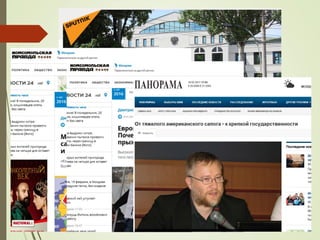
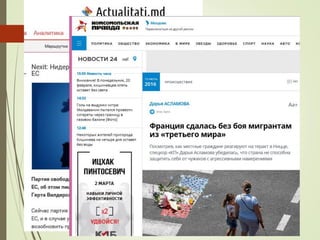
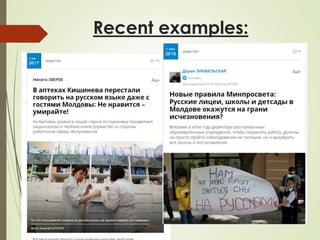
Recent examples:
Thank you
for your attention!

Presentation 24.02.2017 moldova

  • 1.
    Information warfare in theInternet. Exposing and countering pro-Kremlin disinformation in the CEEC Case study: Moldova Kiev, Ucraine 24 February 2017The project is co-financed by the International Visegrad Fund
  • 2.
    Sources of influenceand, frequently, sources of Russian propaganda in Moldova, are: - President of Republic of Moldova;
  • 3.
    Fake “news” aboutthe pro-European candidate Maia Sandu:
  • 4.
    Sources of influenceand, frequently, sources of Russian propaganda in Moldova, are: - President of Republic of Moldova; - Several mass-media institutions from Russian Federation which are re-transmitted or re-broadcast in Moldova; - Several new media institutions and socializing networks; - Communication sources of some political parties and NGOs, supported or financed from Russia; - Other pro-Russian interest groups. - Orthodox Church (Metropolitan Church of Moldova, subordinated to the Russian Patriarch);
  • 5.
    Analysed online media: -Actualitati.md (web portal of Socialist party) - Gagauzinfo.md (web portal from Gagauz autonomy) - Kp.md (web page of “Komsomolskaia Pravda” Russian newspaper) - Ntv.md (web page of NTV Moldova, branch of Russian NTV channel) - Pan.md (web page of Russian language “Panorama” newspaper) - Sputnik.md (branch of Sputnik international)
  • 6.
    Inoculated ideas: "Europe soonto dissolve“ "Chisinau Government is ruled from outside, being unable to decide by itself“ "NATO prepares a nuclear war against Russia, and Moldova could turn into this war", "Moldova is likely to repeat Ukraine’s fate if the country’s leadership not re-orients to Russia ", "Moldova’s adherence to EU is impossible, and the Association Agreement is against the country’s interests".
  • 9.
    The main manipulation techniquesused in the articles: - distortion, speculation and misinterpretation of facts, denaturation of reality (ex.: ”the government of Romania is no more able to make independent decisions”); - promotion of the conspiracy theory (“conspiracy of the West, the US and NATO against Moldova”), the assaults to country’s sovereignty “as happened in Ukraine and Romania”; - artificial opposition of values and holidays of Eastern / Russian with the Western / European; - presentation of opinions only of those experts who are in favour of a specific viewpoint regarding the topic discussed; - use of pejorative language elements to discredit and insult opponents (ex.: “those who believe in European integration of Moldova are naive and idiots”); - premeditated categorization of protagonists in ”good” and ”bad”.
  • 10.
    False and distortedideas: “Only the naive and the idiots agree with the utopian idea of Moldova’s European integration”; “The US and EU Commissioners and ambassadors promote homosexual demonstrations”; “Moldova will be great together with Russia, or will not be at all!”; ”Moldova is a puppet-country, a pawn in the game of the US and the EU against Russia”; “NATO will transform Moldova into a dominion”; “Russia is consistent in its fight against terrorism, unlike the US”...
  • 11.
  • 12.