Cloud Computing & DCIM
by: Shekhar Dasgupta, Founder
GreenField Software Private Limited


                                      1
Definitions
Cloud Computing: Gartner defines it as a style of computing in which scalable
   & elastic IT-enabled capabilities are delivered using Internet technologies.


Scalability and elasticity are not the same thing. Scalability lets you plan in
   advance and adapt your IT systems accordingly, whereas Elasticity
   provides you the resources to handle emergencies.


DCIM is a system that collects and manages information about a datacenter’s
assets, resource use and operational status. This information is then analyzed
and delivered in ways that help managers meet business objectives, service
goals and optimize the datacenter’s performance.
- Andrew Donoghue (Analyst, Eco-Efficient IT), 451 Research


                                                                                  2
Cloud Computing – Why do we need it?

More and more companies are moving to a cloud infrastructure
  because of the massive potential for cost savings and easy
  manageability.


The National Institute of Standards and Technology (NIST) defines cloud
   computing as “a model for enabling convenient, on-demand network
   access to a shared pool of configurable computing resources (e.g.,
   networks, servers, storage, applications, and services) that can be rapidly
   provisioned and released with minimal management effort or service
   provider interaction”.


                                                                                 3
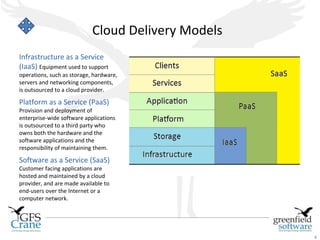
Cloud Delivery Models
Infrastructure as a Service
(IaaS) Equipment used to support
operations, such as storage, hardware,
servers and networking components,
is outsourced to a cloud provider.

Platform as a Service (PaaS)
Provision and deployment of
enterprise-wide software applications
is outsourced to a third party who
owns both the hardware and the
software applications and the
responsibility of maintaining them.

Software as a Service (SaaS)
Customer facing applications are
hosted and maintained by a cloud
provider, and are made available to
end-users over the Internet or a
computer network.


                                                    4
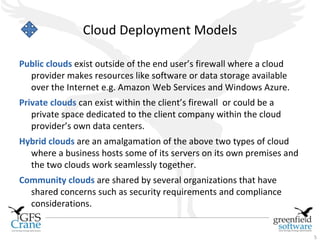
Cloud Deployment Models

Public clouds exist outside of the end user’s firewall where a cloud
  provider makes resources like software or data storage available
  over the Internet e.g. Amazon Web Services and Windows Azure.
Private clouds can exist within the client’s firewall or could be a
   private space dedicated to the client company within the cloud
   provider’s own data centers.
Hybrid clouds are an amalgamation of the above two types of cloud
  where a business hosts some of its servers on its own premises and
  the two clouds work seamlessly together.
Community clouds are shared by several organizations that have
  shared concerns such as security requirements and compliance
  considerations.


                                                                       5
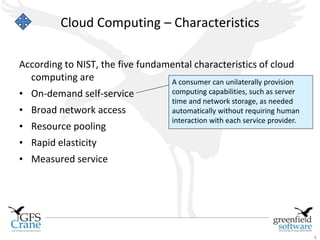
Cloud Computing – Characteristics

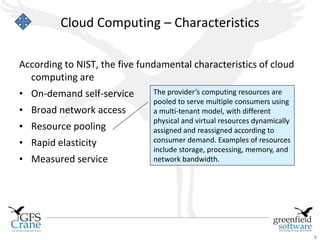
According to NIST, the five fundamental characteristics of cloud
  computing are                   A consumer can unilaterally provision
• On-demand self-service               computing capabilities, such as server
                                       time and network storage, as needed
• Broad network access                 automatically without requiring human
                                       interaction with each service provider.
• Resource pooling
• Rapid elasticity
• Measured service


                                                                                 6
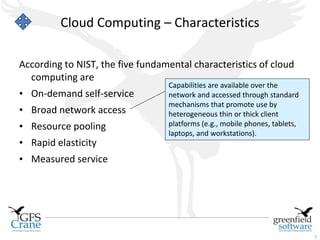
Cloud Computing – Characteristics

According to NIST, the five fundamental characteristics of cloud
  computing are
                                  Capabilities are available over the
• On-demand self-service          network and accessed through standard
                                  mechanisms that promote use by
• Broad network access            heterogeneous thin or thick client
• Resource pooling                platforms (e.g., mobile phones, tablets,
                                  laptops, and workstations).
• Rapid elasticity
• Measured service


                                                                             7
Cloud Computing – Characteristics

According to NIST, the five fundamental characteristics of cloud
  computing are
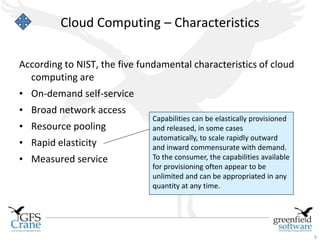
• On-demand self-service       The provider’s computing resources are
                               pooled to serve multiple consumers using
• Broad network access         a multi-tenant model, with different
                               physical and virtual resources dynamically
• Resource pooling             assigned and reassigned according to
• Rapid elasticity             consumer demand. Examples of resources
                               include storage, processing, memory, and
• Measured service             network bandwidth.


                                                                            8
Cloud Computing – Characteristics

According to NIST, the five fundamental characteristics of cloud
  computing are
• On-demand self-service
• Broad network access
                               Capabilities can be elastically provisioned
• Resource pooling             and released, in some cases
                               automatically, to scale rapidly outward
• Rapid elasticity             and inward commensurate with demand.
• Measured service             To the consumer, the capabilities available
                               for provisioning often appear to be
                               unlimited and can be appropriated in any
                               quantity at any time.


                                                                             9
Cloud Computing – Characteristics

According to NIST, the five fundamental characteristics of cloud
  computing are
• On-demand self-service
• Broad network access
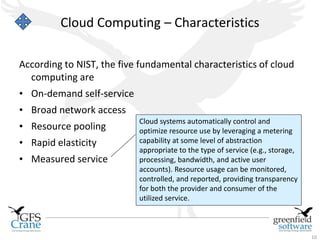
                           Cloud systems automatically control and
• Resource pooling         optimize resource use by leveraging a metering
• Rapid elasticity         capability at some level of abstraction
                           appropriate to the type of service (e.g., storage,
• Measured service         processing, bandwidth, and active user
                           accounts). Resource usage can be monitored,
                           controlled, and reported, providing transparency
                           for both the provider and consumer of the
                           utilized service.


                                                                                10
Elasticity – The Main Attraction of Cloud

The PROBLEM - Over-provisioning
Traditional on-site data centers are designed to handle peaks in demand. Typically
   only 15% of this capacity is used during other times resulting in unused capacity
   and inefficient use of costly resources. In most cases, businesses cannot afford to
   do away with over-provisioning altogether and the total cost of ownership (TOC)
   of the data center is very high.


The SOLUTION - Elasticity
Shifting some or all of their data and applications to the cloud gives businesses the
    ability to handle sudden, unanticipated and extraordinary loads. Cloud providers
    have the extra capacity to handle these peaks in usage and users only pay for what
    they use and the total spending on IT goes down.


                                                                                         11
How is it done?

Orchestration refers to combining
   multiple and distinct automated
   tasks into a single workflow and
   provides centralized                  The Data Centric Framework
   management across systems and           Management (DMF)
   networks including multiple             approach to cloud orchestration
   devices, applications, solutions        aims to maintain a conceptually
   and entire data centers.                centralized data repository of all
It even takes care of the financial        the resources being managed
    aspect of managing your IT             including computational, storage
    infrastructure including, billing,     and network devices.
    metering and power
    consumption.


                                                                                12
Where does DCIM comes in?

Data Center Infrastructure                DCIM could act as a cloud agent or
  Management (DCIM)                          cloud brokering software to
                                             allow businesses to provision
DCIM gives businesses a unified and          “elastic” resources across cloud
   enhanced management interface             providers and to make optimal
   across multiple data centers              choices for deriving the least Cost
   whether on-site or on the cloud.          of Application Delivery.
It assists with load balancing and on-
    demand provisioning of both
    physical and virtual resources        The Next Gen DCIM will be the Cloud
    and provides for broad platform          platform to enable Massive
    compatibility across your entire IT      Scalability & High Availability
    infrastructure.                          WITHOUT OVER-PROVISIONING.


                                                                                   13
Questions?


    GreenField Software is pioneering the Next Gen DCIM for Tomorrow’s
                        Software Defined Data Centers

Email: sales@greenfieldsoft.com
Visit us on the web at www.greenfieldsoft.com


                                                                         14

Cloud Computing & DCIM

  • 1.
    Cloud Computing &DCIM by: Shekhar Dasgupta, Founder GreenField Software Private Limited 1
  • 2.
    Definitions Cloud Computing: Gartnerdefines it as a style of computing in which scalable & elastic IT-enabled capabilities are delivered using Internet technologies. Scalability and elasticity are not the same thing. Scalability lets you plan in advance and adapt your IT systems accordingly, whereas Elasticity provides you the resources to handle emergencies. DCIM is a system that collects and manages information about a datacenter’s assets, resource use and operational status. This information is then analyzed and delivered in ways that help managers meet business objectives, service goals and optimize the datacenter’s performance. - Andrew Donoghue (Analyst, Eco-Efficient IT), 451 Research 2
  • 3.
    Cloud Computing –Why do we need it? More and more companies are moving to a cloud infrastructure because of the massive potential for cost savings and easy manageability. The National Institute of Standards and Technology (NIST) defines cloud computing as “a model for enabling convenient, on-demand network access to a shared pool of configurable computing resources (e.g., networks, servers, storage, applications, and services) that can be rapidly provisioned and released with minimal management effort or service provider interaction”. 3
  • 4.
    Cloud Delivery Models Infrastructureas a Service (IaaS) Equipment used to support operations, such as storage, hardware, servers and networking components, is outsourced to a cloud provider. Platform as a Service (PaaS) Provision and deployment of enterprise-wide software applications is outsourced to a third party who owns both the hardware and the software applications and the responsibility of maintaining them. Software as a Service (SaaS) Customer facing applications are hosted and maintained by a cloud provider, and are made available to end-users over the Internet or a computer network. 4
  • 5.
    Cloud Deployment Models Publicclouds exist outside of the end user’s firewall where a cloud provider makes resources like software or data storage available over the Internet e.g. Amazon Web Services and Windows Azure. Private clouds can exist within the client’s firewall or could be a private space dedicated to the client company within the cloud provider’s own data centers. Hybrid clouds are an amalgamation of the above two types of cloud where a business hosts some of its servers on its own premises and the two clouds work seamlessly together. Community clouds are shared by several organizations that have shared concerns such as security requirements and compliance considerations. 5
  • 6.
    Cloud Computing –Characteristics According to NIST, the five fundamental characteristics of cloud computing are A consumer can unilaterally provision • On-demand self-service computing capabilities, such as server time and network storage, as needed • Broad network access automatically without requiring human interaction with each service provider. • Resource pooling • Rapid elasticity • Measured service 6
  • 7.
    Cloud Computing –Characteristics According to NIST, the five fundamental characteristics of cloud computing are Capabilities are available over the • On-demand self-service network and accessed through standard mechanisms that promote use by • Broad network access heterogeneous thin or thick client • Resource pooling platforms (e.g., mobile phones, tablets, laptops, and workstations). • Rapid elasticity • Measured service 7
  • 8.
    Cloud Computing –Characteristics According to NIST, the five fundamental characteristics of cloud computing are • On-demand self-service The provider’s computing resources are pooled to serve multiple consumers using • Broad network access a multi-tenant model, with different physical and virtual resources dynamically • Resource pooling assigned and reassigned according to • Rapid elasticity consumer demand. Examples of resources include storage, processing, memory, and • Measured service network bandwidth. 8
  • 9.
    Cloud Computing –Characteristics According to NIST, the five fundamental characteristics of cloud computing are • On-demand self-service • Broad network access Capabilities can be elastically provisioned • Resource pooling and released, in some cases automatically, to scale rapidly outward • Rapid elasticity and inward commensurate with demand. • Measured service To the consumer, the capabilities available for provisioning often appear to be unlimited and can be appropriated in any quantity at any time. 9
  • 10.
    Cloud Computing –Characteristics According to NIST, the five fundamental characteristics of cloud computing are • On-demand self-service • Broad network access Cloud systems automatically control and • Resource pooling optimize resource use by leveraging a metering • Rapid elasticity capability at some level of abstraction appropriate to the type of service (e.g., storage, • Measured service processing, bandwidth, and active user accounts). Resource usage can be monitored, controlled, and reported, providing transparency for both the provider and consumer of the utilized service. 10
  • 11.
    Elasticity – TheMain Attraction of Cloud The PROBLEM - Over-provisioning Traditional on-site data centers are designed to handle peaks in demand. Typically only 15% of this capacity is used during other times resulting in unused capacity and inefficient use of costly resources. In most cases, businesses cannot afford to do away with over-provisioning altogether and the total cost of ownership (TOC) of the data center is very high. The SOLUTION - Elasticity Shifting some or all of their data and applications to the cloud gives businesses the ability to handle sudden, unanticipated and extraordinary loads. Cloud providers have the extra capacity to handle these peaks in usage and users only pay for what they use and the total spending on IT goes down. 11
  • 12.
    How is itdone? Orchestration refers to combining multiple and distinct automated tasks into a single workflow and provides centralized The Data Centric Framework management across systems and Management (DMF) networks including multiple approach to cloud orchestration devices, applications, solutions aims to maintain a conceptually and entire data centers. centralized data repository of all It even takes care of the financial the resources being managed aspect of managing your IT including computational, storage infrastructure including, billing, and network devices. metering and power consumption. 12
  • 13.
    Where does DCIMcomes in? Data Center Infrastructure DCIM could act as a cloud agent or Management (DCIM) cloud brokering software to allow businesses to provision DCIM gives businesses a unified and “elastic” resources across cloud enhanced management interface providers and to make optimal across multiple data centers choices for deriving the least Cost whether on-site or on the cloud. of Application Delivery. It assists with load balancing and on- demand provisioning of both physical and virtual resources The Next Gen DCIM will be the Cloud and provides for broad platform platform to enable Massive compatibility across your entire IT Scalability & High Availability infrastructure. WITHOUT OVER-PROVISIONING. 13
  • 14.
    Questions? GreenField Software is pioneering the Next Gen DCIM for Tomorrow’s Software Defined Data Centers Email: sales@greenfieldsoft.com Visit us on the web at www.greenfieldsoft.com 14