James Camilo
Vanegas Ortiz
1075677050
3134366618
WHY TO EXPORT
COFFEE TO USA?
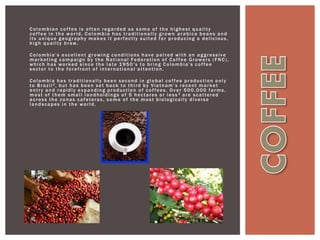
Colombian coffee is often regarded as some of the highest quality
coffee in the world. Colombia has traditionally grown arabica beans and
its unique geography makes it perfectly suited for producing a delicious,
high quality brew.
Colombia’s excellent growing conditions have paired with an aggressive
marketing campaign by the National Federation of Coffee Growers (FNC),
which has worked since the late 1950’s to bring Colombia’s coffee
sector to the forefront of international attention.
Colombia has traditionally been second in global coffee production only
to Brazil2, but has been set back to third by Vietnam’s recent market
entry and rapidly expanding production of coffees. Over 500,000 farms,
most of them small landholdings of 5 hectares or less 3 are scattered
across the zonas cafeteras, some of the most biologically diverse
landscapes in the world.
In 2010, Colombia produced 8.9 million 60-kilo bags of green
coffee, w hich represents the first stage of coffee production.
This crop was valued at US$2.3 billion. In economic terms, this
means that coffee production represents 16% of the national
agricultural GDP.
Green coffee beans are then shipped throughout the world to
different companies that roast, package and distribute the
finished product under a variety of brand names.
According to the FNC, in the past five years, at least 37% of
Colombian coffee exports were shipped to the U.S., while
Germany received more than 10%.
United States, Germany and Japan, are the main buyers of
green coffee with a 64% stake in the total exported by
Colombia, followed in order of importance by Canada, Belgium
and Luxembourg, Holland (Netherlands), France, Sweden,
Spain, Italy and United Kingdom.
1. registration of exporters of green coffee.
2. registration of exporters of processed coffee,
roasted in grain, milled, soluble or liquid
extract.
3. registration of exporters of special coffees.
4. commercial invoice.
5. Certificate of origin.
6. permission of the customs office.
7. authorization for shipment.
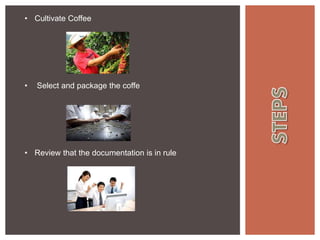
• Cultivate Coffee
• Select and package the coffe
• Review that the documentation is in rule
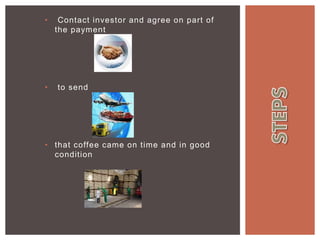
• Contact investor and agree on part of
the payment
• to send
• that coffee came on time and in good
condition
CYBERGRAPHY
http://equalexchange.coop/history-of-coffee-in-colombia
http://www.cafedecolombia.com/docs/pdfcomercial/requisitosexport
ar.pdf
http://knowledge.wharton.upenn.edu/article/coffee-in-colombia-
waking-up-to-an-opportunity/

presentacion

  • 1.
  • 2.
    Colombian coffee isoften regarded as some of the highest quality coffee in the world. Colombia has traditionally grown arabica beans and its unique geography makes it perfectly suited for producing a delicious, high quality brew. Colombia’s excellent growing conditions have paired with an aggressive marketing campaign by the National Federation of Coffee Growers (FNC), which has worked since the late 1950’s to bring Colombia’s coffee sector to the forefront of international attention. Colombia has traditionally been second in global coffee production only to Brazil2, but has been set back to third by Vietnam’s recent market entry and rapidly expanding production of coffees. Over 500,000 farms, most of them small landholdings of 5 hectares or less 3 are scattered across the zonas cafeteras, some of the most biologically diverse landscapes in the world.
  • 3.
    In 2010, Colombiaproduced 8.9 million 60-kilo bags of green coffee, w hich represents the first stage of coffee production. This crop was valued at US$2.3 billion. In economic terms, this means that coffee production represents 16% of the national agricultural GDP. Green coffee beans are then shipped throughout the world to different companies that roast, package and distribute the finished product under a variety of brand names. According to the FNC, in the past five years, at least 37% of Colombian coffee exports were shipped to the U.S., while Germany received more than 10%. United States, Germany and Japan, are the main buyers of green coffee with a 64% stake in the total exported by Colombia, followed in order of importance by Canada, Belgium and Luxembourg, Holland (Netherlands), France, Sweden, Spain, Italy and United Kingdom.
  • 4.
    1. registration ofexporters of green coffee. 2. registration of exporters of processed coffee, roasted in grain, milled, soluble or liquid extract. 3. registration of exporters of special coffees. 4. commercial invoice. 5. Certificate of origin. 6. permission of the customs office. 7. authorization for shipment.
  • 5.
    • Cultivate Coffee •Select and package the coffe • Review that the documentation is in rule
  • 6.
    • Contact investorand agree on part of the payment • to send • that coffee came on time and in good condition
  • 7.