PAST CONTINUOUS/ 
SIMPLE PAST
Past cotinuous 
• The past continuous tense expresses action at a 
particular moment in the past. The action started 
before that moment but has not finished at that 
moment. 
•When we use the past continuous tense, our listener 
usually knows or understands what time we are 
talking about. Examples: 
• •I was working at 10pm last night. 
• •They were not playing football at 9am this morning. 
• •What were you doing when he arrived? 
• •She was cooking when I telephoned her.
Past Continuous 
•We often use the past continuous tense to "set the scene" in 
stories. We use it to describe the background situation at the 
moment when the action begins. Often, the story starts with 
the past continuous tense and then moves into the simple 
past tense. Here is an example: 
• " James Bond was driving through town. It was raining. The 
wind was blowing hard. Nobody was walking in the streets. 
Suddenly, Bond saw the killer in a telephone box..."
Past Continuous Tense + Simple Past Tense 
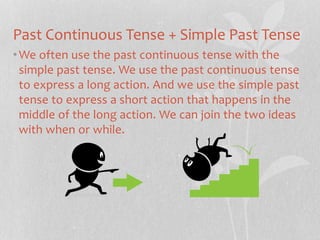
•We often use the past continuous tense with the 
simple past tense. We use the past continuous tense 
to express a long action. And we use the simple past 
tense to express a short action that happens in the 
middle of the long action. We can join the two ideas 
with when or while.
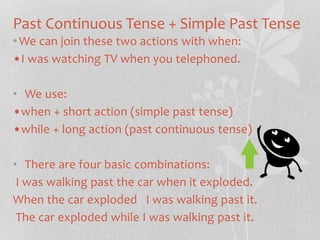
Past Continuous Tense + Simple Past Tense 
•We can join these two actions with when: 
•I was watching TV when you telephoned. 
• We use: 
•when + short action (simple past tense) 
•while + long action (past continuous tense) 
• There are four basic combinations: 
I was walking past the car when it exploded. 
When the car exploded I was walking past it. 
The car exploded while I was walking past it.
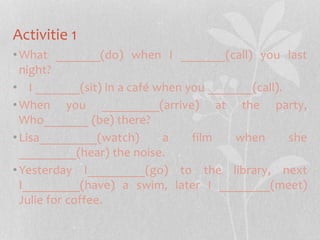
Activitie 1 
•What _______(do) when I _______(call) you last 
night? 
• I _______(sit) in a café when you _______(call). 
•When you _________(arrive) at the party, 
Who_______ (be) there? 
• Lisa_________(watch) a film when she 
_________(hear) the noise. 
• Yesterday I_________(go) to the library, next 
I_________(have) a swim, later I ________(meet) 
Julie for coffee.
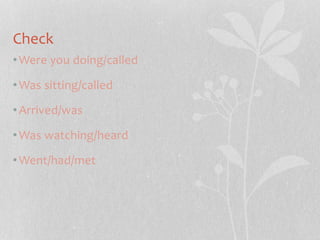
Check 
•Were you doing/called 
•Was sitting/called 
•Arrived/was 
•Was watching/heard 
•Went/had/met
Activitie 2 
• http://www.ego4u.com/en/cram-up/grammar/simpas-paspro/ 
exercises

Presentación7

  • 1.
  • 2.
    Past cotinuous •The past continuous tense expresses action at a particular moment in the past. The action started before that moment but has not finished at that moment. •When we use the past continuous tense, our listener usually knows or understands what time we are talking about. Examples: • •I was working at 10pm last night. • •They were not playing football at 9am this morning. • •What were you doing when he arrived? • •She was cooking when I telephoned her.
  • 3.
    Past Continuous •Weoften use the past continuous tense to "set the scene" in stories. We use it to describe the background situation at the moment when the action begins. Often, the story starts with the past continuous tense and then moves into the simple past tense. Here is an example: • " James Bond was driving through town. It was raining. The wind was blowing hard. Nobody was walking in the streets. Suddenly, Bond saw the killer in a telephone box..."
  • 4.
    Past Continuous Tense+ Simple Past Tense •We often use the past continuous tense with the simple past tense. We use the past continuous tense to express a long action. And we use the simple past tense to express a short action that happens in the middle of the long action. We can join the two ideas with when or while.
  • 5.
    Past Continuous Tense+ Simple Past Tense •We can join these two actions with when: •I was watching TV when you telephoned. • We use: •when + short action (simple past tense) •while + long action (past continuous tense) • There are four basic combinations: I was walking past the car when it exploded. When the car exploded I was walking past it. The car exploded while I was walking past it.
  • 6.
    Activitie 1 •What_______(do) when I _______(call) you last night? • I _______(sit) in a café when you _______(call). •When you _________(arrive) at the party, Who_______ (be) there? • Lisa_________(watch) a film when she _________(hear) the noise. • Yesterday I_________(go) to the library, next I_________(have) a swim, later I ________(meet) Julie for coffee.
  • 7.
    Check •Were youdoing/called •Was sitting/called •Arrived/was •Was watching/heard •Went/had/met
  • 8.
    Activitie 2 •http://www.ego4u.com/en/cram-up/grammar/simpas-paspro/ exercises