Present what you know
Author: Christopher Forest
Publisher: Capstone Press
2013
Chapter 1:Spread the word!
•Writing is a great way to share what
you know to your friends, family and
community. To provide information
is called expository writing.
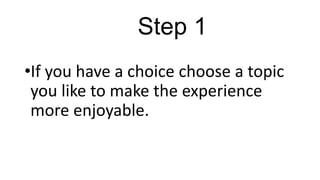
Step 1
•If you have a choice choose a topic
you like to make the experience
more enjoyable.
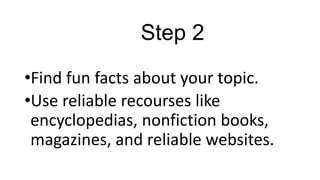
Step 2
•Find fun facts about your topic.
•Use reliable recourses like
encyclopedias, nonfiction books,
magazines, and reliable websites.
Step 3
•Develop a thesis
•A thesis is a statement that explains
what you are going to write about.
Step 4
•Make a plan to organize your plan
•The very first part is the
introduction that tells about the
thesis.
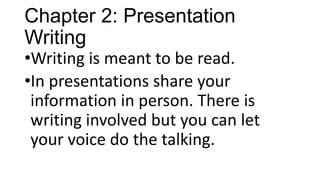
Chapter 2: Presentation
Writing
•Writing is meant to be read.
•In presentations share your
information in person. There is
writing involved but you can let
your voice do the talking.
Step 1
•Make two or three main points you
want to make clear.
Step 2
•Start with something attention
grabbing to make your listeners
interested.
•It may be a little fact or a startling
story.
•Use lively language to keep your
audience listening.
Step 3
•Make eye contact with the audience
and use hand gestures to emphasize
points.
•Avoid speaking in one tone. Put
excitement into your voice.
Step 4
•End on a note to keep your
audience thinking about what you
said.
•Make sure to practice. Give your
speech in front of something or
someone.
Chapter 3: Persuasive
Writing
•Do you have something to share?
•Writing persuasively will get your
point across
Step 1
•State your opinion this is your
opinion that you want others to
hear.
•Your claim should be easy to
understand.
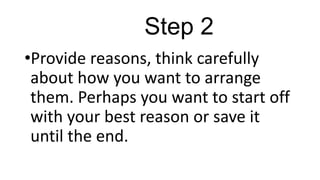
Step 2
•Provide reasons, think carefully
about how you want to arrange
them. Perhaps you want to start off
with your best reason or save it
until the end.
Step 3
•Give supporting facts and evidence
from your research.
•End strong, the conclusion is the
best part of your essay make it
interesting.

Present what you know

  • 1.
    Present what youknow Author: Christopher Forest Publisher: Capstone Press 2013
  • 2.
    Chapter 1:Spread theword! •Writing is a great way to share what you know to your friends, family and community. To provide information is called expository writing.
  • 3.
    Step 1 •If youhave a choice choose a topic you like to make the experience more enjoyable.
  • 4.
    Step 2 •Find funfacts about your topic. •Use reliable recourses like encyclopedias, nonfiction books, magazines, and reliable websites.
  • 5.
    Step 3 •Develop athesis •A thesis is a statement that explains what you are going to write about.
  • 6.
    Step 4 •Make aplan to organize your plan •The very first part is the introduction that tells about the thesis.
  • 7.
    Chapter 2: Presentation Writing •Writingis meant to be read. •In presentations share your information in person. There is writing involved but you can let your voice do the talking.
  • 8.
    Step 1 •Make twoor three main points you want to make clear.
  • 9.
    Step 2 •Start withsomething attention grabbing to make your listeners interested. •It may be a little fact or a startling story. •Use lively language to keep your audience listening.
  • 10.
    Step 3 •Make eyecontact with the audience and use hand gestures to emphasize points. •Avoid speaking in one tone. Put excitement into your voice.
  • 11.
    Step 4 •End ona note to keep your audience thinking about what you said. •Make sure to practice. Give your speech in front of something or someone.
  • 12.
    Chapter 3: Persuasive Writing •Doyou have something to share? •Writing persuasively will get your point across
  • 13.
    Step 1 •State youropinion this is your opinion that you want others to hear. •Your claim should be easy to understand.
  • 14.
    Step 2 •Provide reasons,think carefully about how you want to arrange them. Perhaps you want to start off with your best reason or save it until the end.
  • 15.
    Step 3 •Give supportingfacts and evidence from your research. •End strong, the conclusion is the best part of your essay make it interesting.