El presente perfecto
Español 5-6
El segundo semestre
¿Qué es el presente perfecto?
The present perfect is formed by
combining a helping verb (“have” or
“has”) with the past participle
Por ejemplo…
 For example:
I have played tennis.
She has sung at weddings.
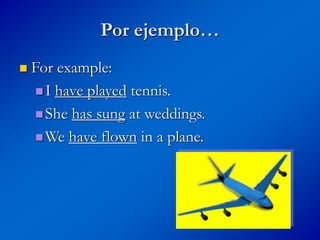
We have flown in a plane.
Para formar in inglés
 To form the present perfect we combine the
helping verb “have/has” with a past participle
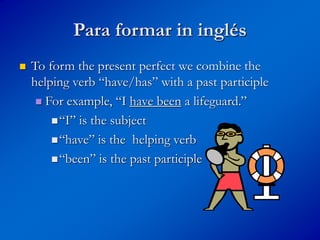
 For example, “I have been a lifeguard.”
“I” is the subject
“have” is the helping verb
“been” is the past participle
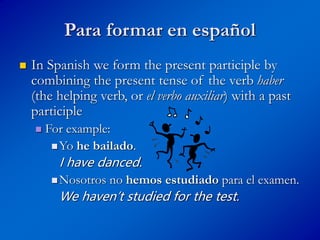
Para formar en español
 In Spanish we form the present participle by
combining the present tense of the verb haber
(the helping verb, or el verbo auxiliar) with a past
participle
 For example:
Yo he bailado.
I have danced.
Nosotros no hemos estudiado para el examen.
We haven’t studied for the test.
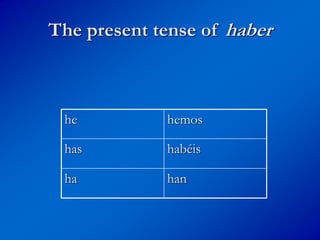
The present tense of haber
he hemos
has habéis
ha han
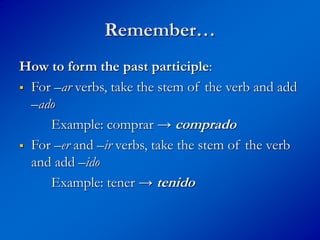
Remember…
How to form the past participle:
 For –ar verbs, take the stem of the verb and add
–ado
Example: comprar → comprado
 For –er and –ir verbs, take the stem of the verb
and add –ido
Example: tener → tenido
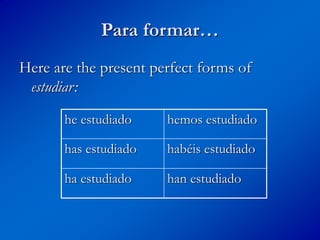
Para formar…
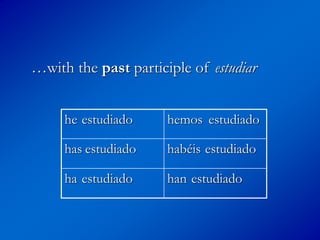
Here are the present perfect forms of
estudiar:
he estudiado hemos estudiado
has estudiado habéis estudiado
ha estudiado han estudiado
Para formar…
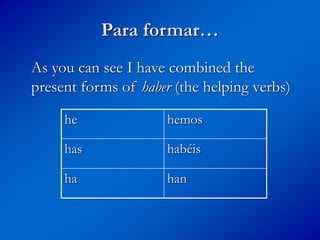
As you can see I have combined the
present forms of haber (the helping verbs)
he hemos
has habéis
ha han
…with the past participle of estudiar
he hemos
has habéis
ha han
estudiado estudiado
estudiado estudiado
estudiado estudiado
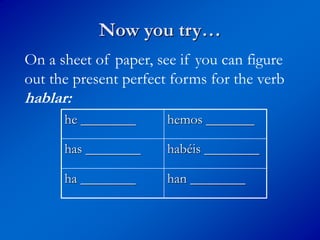
Now you try…
he ________ hemos _______
has ________ habéis ________
ha ________ han ________
On a sheet of paper, see if you can figure
out the present perfect forms for the verb
hablar:
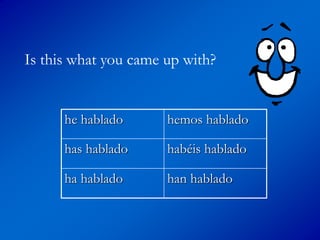
he hablado hemos hablado
has hablado habéis hablado
ha hablado han hablado
Is this what you came up with?
Let’s try another…
Now see if you can form the present perfect
forms of the verb tomar:
__ ________ ____ _______
___ ________ _____ ________
__ ________ ___ ________
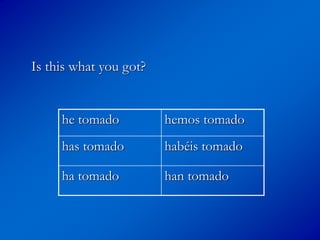
Is this what you got?
he tomado hemos tomado
has tomado habéis tomado
ha tomado han tomado
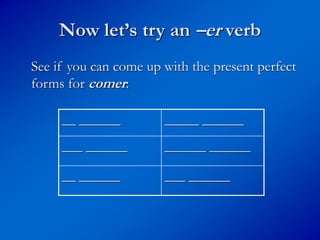
Now let’s try an –er verb
See if you can come up with the present perfect
forms for comer:
__ ______ _____ ______
___ ______ ______ ______
__ ______ ___ ______
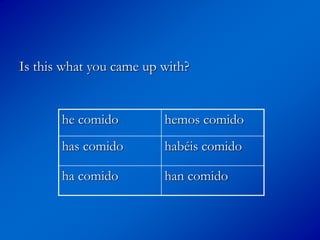
Is this what you came up with?
he comido hemos comido
has comido habéis comido
ha comido han comido
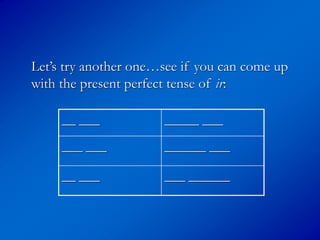
Let’s try another one…see if you can come up
with the present perfect tense of ir:
__ ___ _____ ___
___ ___ ______ ___
__ ___ ___ ______
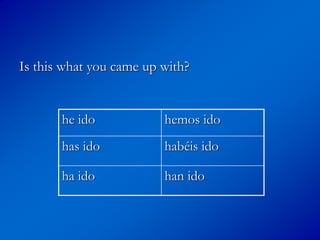
Is this what you came up with?
he ido hemos ido
has ido habéis ido
ha ido han ido
Many of you may have assumed that ir had an
irregular past participle. Afterall, it does have an
irregular present participle. But ir is actually
regular in this tense. Here are some verbs that
are irregular in the past participle:
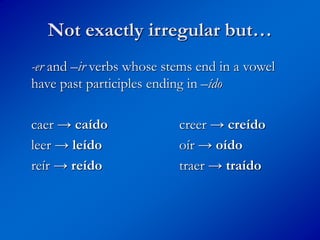
Not exactly irregular but…
-er and –ir verbs whose stems end in a vowel
have past participles ending in –ído
caer → caído creer → creído
leer → leído oír → oído
reír → reído traer → traído
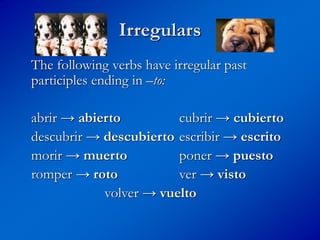
Irregulars
The following verbs have irregular past
participles ending in –to:
abrir → abierto cubrir → cubierto
descubrir → descubierto escribir → escrito
morir → muerto poner → puesto
romper → roto ver → visto
volver → vuelto
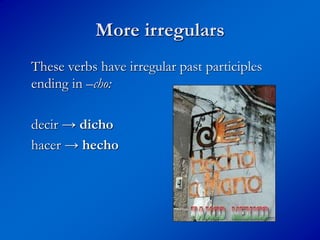
More irregulars
These verbs have irregular past participles
ending in –cho:
decir → dicho
hacer → hecho
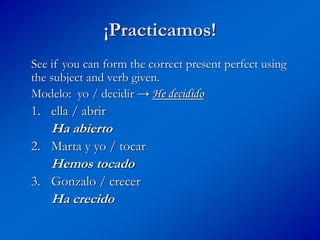
¡Practicamos!
See if you can form the correct present perfect using
the subject and verb given.
Modelo: yo / decidir → He decidido
1. ella / abrir
Ha abierto
2. Marta y yo / tocar
Hemos tocado
3. Gonzalo / crecer
Ha crecido
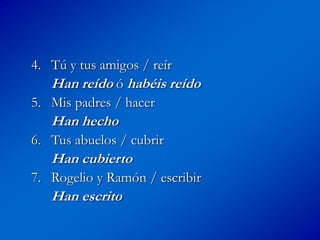
4. Tú y tus amigos / reír
Han reído ó habéis reído
5. Mis padres / hacer
Han hecho
6. Tus abuelos / cubrir
Han cubierto
7. Rogelio y Ramón / escribir
Han escrito
Y para más práctica…
Now go to this wesite:
http://www.colby.edu/~bknelson/SLC/pres_perf
.php

presentperfect.ppt

  • 1.
    El presente perfecto Español5-6 El segundo semestre
  • 2.
    ¿Qué es elpresente perfecto? The present perfect is formed by combining a helping verb (“have” or “has”) with the past participle
  • 3.
    Por ejemplo…  Forexample: I have played tennis. She has sung at weddings. We have flown in a plane.
  • 4.
    Para formar ininglés  To form the present perfect we combine the helping verb “have/has” with a past participle  For example, “I have been a lifeguard.” “I” is the subject “have” is the helping verb “been” is the past participle
  • 5.
    Para formar enespañol  In Spanish we form the present participle by combining the present tense of the verb haber (the helping verb, or el verbo auxiliar) with a past participle  For example: Yo he bailado. I have danced. Nosotros no hemos estudiado para el examen. We haven’t studied for the test.
  • 6.
    The present tenseof haber he hemos has habéis ha han
  • 7.
    Remember… How to formthe past participle:  For –ar verbs, take the stem of the verb and add –ado Example: comprar → comprado  For –er and –ir verbs, take the stem of the verb and add –ido Example: tener → tenido
  • 8.
    Para formar… Here arethe present perfect forms of estudiar: he estudiado hemos estudiado has estudiado habéis estudiado ha estudiado han estudiado
  • 9.
    Para formar… As youcan see I have combined the present forms of haber (the helping verbs) he hemos has habéis ha han
  • 10.
    …with the pastparticiple of estudiar he hemos has habéis ha han estudiado estudiado estudiado estudiado estudiado estudiado
  • 11.
    Now you try… he________ hemos _______ has ________ habéis ________ ha ________ han ________ On a sheet of paper, see if you can figure out the present perfect forms for the verb hablar:
  • 12.
    he hablado hemoshablado has hablado habéis hablado ha hablado han hablado Is this what you came up with?
  • 13.
    Let’s try another… Nowsee if you can form the present perfect forms of the verb tomar: __ ________ ____ _______ ___ ________ _____ ________ __ ________ ___ ________
  • 14.
    Is this whatyou got? he tomado hemos tomado has tomado habéis tomado ha tomado han tomado
  • 15.
    Now let’s tryan –er verb See if you can come up with the present perfect forms for comer: __ ______ _____ ______ ___ ______ ______ ______ __ ______ ___ ______
  • 16.
    Is this whatyou came up with? he comido hemos comido has comido habéis comido ha comido han comido
  • 17.
    Let’s try anotherone…see if you can come up with the present perfect tense of ir: __ ___ _____ ___ ___ ___ ______ ___ __ ___ ___ ______
  • 18.
    Is this whatyou came up with? he ido hemos ido has ido habéis ido ha ido han ido
  • 19.
    Many of youmay have assumed that ir had an irregular past participle. Afterall, it does have an irregular present participle. But ir is actually regular in this tense. Here are some verbs that are irregular in the past participle:
  • 20.
    Not exactly irregularbut… -er and –ir verbs whose stems end in a vowel have past participles ending in –ído caer → caído creer → creído leer → leído oír → oído reír → reído traer → traído
  • 21.
    Irregulars The following verbshave irregular past participles ending in –to: abrir → abierto cubrir → cubierto descubrir → descubierto escribir → escrito morir → muerto poner → puesto romper → roto ver → visto volver → vuelto
  • 22.
    More irregulars These verbshave irregular past participles ending in –cho: decir → dicho hacer → hecho
  • 23.
    ¡Practicamos! See if youcan form the correct present perfect using the subject and verb given. Modelo: yo / decidir → He decidido 1. ella / abrir Ha abierto 2. Marta y yo / tocar Hemos tocado 3. Gonzalo / crecer Ha crecido
  • 24.
    4. Tú ytus amigos / reír Han reído ó habéis reído 5. Mis padres / hacer Han hecho 6. Tus abuelos / cubrir Han cubierto 7. Rogelio y Ramón / escribir Han escrito
  • 25.
    Y para máspráctica… Now go to this wesite: http://www.colby.edu/~bknelson/SLC/pres_perf .php