Incorporating Technology Components with Smoking Cessation
The Young
Smokeless
Sasha Daily, Cuong Huynh, Ayla Pardo,
Matt Farrell & Van Bettis
And The
The Problem: Teens Smoking Tobacco
➢ Every day, almost 3,900 adolescents under 18 will try
their first cigarette
➢ About 30% of teen smokers will continue smoking and
die early from a smoke related disease
➢ Teen smokers are more likely to have panic attacks,
anxiety disorders and depression
➢ Tobacco is the leading cause of preventable death in the
U.S
Target Population
Primary Target:
Adolescent smokers and non-smokers (ages 11-24)
Characteristically, these are the years when beginner smokers pick up their first cigarette, and we want to use a pre-emptive
method that will avert the user from ever picking up their second cigarette, or any for that matter. (Gillman et al., 2009)
Secondary Target:
Parents/ Guardians of Adolescents
Older individuals can make a large impact on how adolescents view tobacco use.
Main Goals
➢ Reduce the Number of Adolescent Smokers
➢ Deter non-smokers from thinking about smoking
➢ Change Attitudes towards Smoking
➢ Increase Self-Management Skills
➢ Provide the necessary quit tools and information to help
people quit
Behavioral Objectives
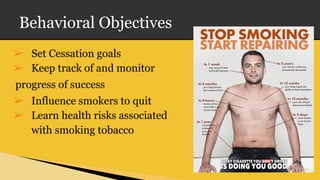
➢ Set Cessation goals
➢ Keep track of and monitor
progress of success
➢ Influence smokers to quit
➢ Learn health risks associated
with smoking tobacco
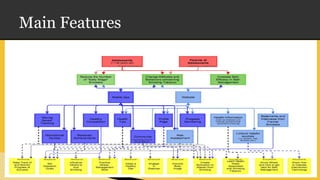
Main Features
Website
Homepage
➢ Main page of
the website
➢ Engage
Participants
➢ Navigational
tool
Designed by: Cuong Huynh
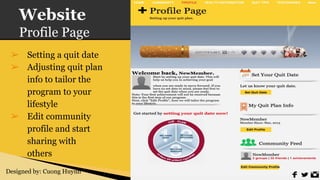
Website
Profile Page
➢ Setting a quit date
➢ Adjusting quit plan
info to tailor the
program to your
lifestyle
➢ Edit community
profile and start
sharing with
others
Designed by: Cuong Huynh
Website
The Community
➢ Support in thread-
style form
➢ Get support from
others
➢ Post your own story
➢ Read about other
successful interventions
Designed by: Cuong Huynh
Website
Health Information
➢ Determine how
smoking Tobacco
affects the human body
➢ Learn more about the
health risks associated
with smoking
➢ Interactive application
helps users visualize
what is happening to
their bodies
Designed by: Ayla Pardo
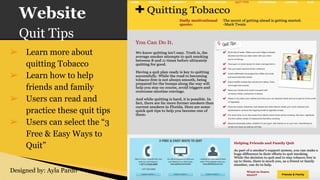
Website
Quit Tips
➢ Learn more about
quitting Tobacco
➢ Learn how to help
friends and family
➢ Users can read and
practice these quit tips
➢ Users can select the “3
Free & Easy Ways to
Quit”
Designed by: Ayla Pardo
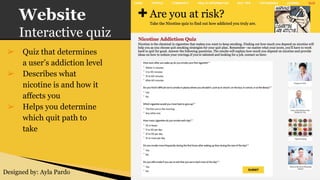
Website
Interactive quiz
➢ Quiz that determines
a user’s addiction level
➢ Describes what
nicotine is and how it
affects you
➢ Helps you determine
which quit path to
take
Designed by: Ayla Pardo
Website
Testimonials
➢ Place where users
can share their
stories and
experiences
➢ Interactive webpage
with a journal
submission link
“Share my story”
➢ Testimonies that aim
to inspire teens
Designed by: Matt Farrell
Website
Journal
➢ Personal
monitoring of
progress
➢ Motivating
Achievements
and goals
Designed by: Matt Farrell
Mobile App
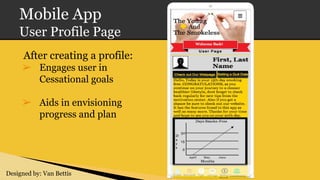
User Profile Page
Designed by: Van Bettis
After creating a profile:
➢ Engages user in
Cessational goals
➢ Aids in envisioning
progress and plan
And
Mobile App
Money Saved Tracking
➢ Motivates participant
via Incentives
➢ Aids in Visualization of
progress
Designed by: Sasha Daily
Mobile App
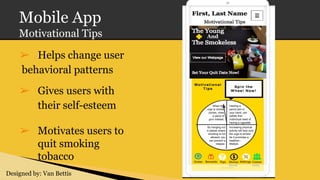
Motivational Tips
➢ Helps change user
behavioral patterns
➢ Gives users with
their self-esteem
➢ Motivates users to
quit smoking
tobacco
When the
urge to smoke
comes, chew
a piece of
gum instead.
Holding a
pencil pen in
your hand, can
satisfy that
instinctual need of
having a cigarette.
By hanging out
in places where
smoking is not
allowed, you
can prevent a
relapse.
Increasing physical
activity will help curb
the urge to smoke.
As it promotes a
healthier -
lifestyle.
And
Designed by: Van Bettis
Sources
➢ Kaai, S. C., Brown, K. S., Leatherdale, S. T., Manske, S. R., & Murnaghan, D. (2014).
We do not smoke but some of us are more susceptible than others: A multilevel
analysis of a sample of canadian youth in grades 9 to 12. Addictive
➢ Nicotine Addiction Quiz. (n.d.). Retrieved April 12, 2015, from http://smokefree.gov/nicotine-
addiction-quiz
➢ Youth and Tobacco Use. (2014, February 14). Retrieved April 12, 2015, from http://www.cdc.
gov/tobacco/data_statistics/fact_sheets/youth_data/tobacco_use/index.htm
➢ 11 Facts About Teen Smoking. (n.d.). Retrieved April 11, 2015, from https://www.dosomething.
org/facts/11-facts-about-teen-smoking
➢ Gilman, S. E., Rende, R., Boergers, J., Abrams, D. B., Buka, S. L., Clark, M. A., … Niaura, R. S.
(2009). Parental smoking and adolescent smoking initiation: an intergenerational perspective on
tobacco control. Pediatrics, 123(2), e274–e281. doi:10.1542/peds.2008-2251
➢ U.S. Department of Health and Human Services. The Health Consequences of Smoking—50
Years of Progress: A Report of the Surgeon General. (2014). Atlanta: U.S. Department of Health
and Human Services, Centers for Disease Control and Prevention, National Center for Chronic
Disease Prevention and Health Promotion, Office on Smoking and Health/

Pres e health

  • 1.
    Incorporating Technology Componentswith Smoking Cessation The Young Smokeless Sasha Daily, Cuong Huynh, Ayla Pardo, Matt Farrell & Van Bettis And The
  • 2.
    The Problem: TeensSmoking Tobacco ➢ Every day, almost 3,900 adolescents under 18 will try their first cigarette ➢ About 30% of teen smokers will continue smoking and die early from a smoke related disease ➢ Teen smokers are more likely to have panic attacks, anxiety disorders and depression ➢ Tobacco is the leading cause of preventable death in the U.S
  • 3.
    Target Population Primary Target: Adolescentsmokers and non-smokers (ages 11-24) Characteristically, these are the years when beginner smokers pick up their first cigarette, and we want to use a pre-emptive method that will avert the user from ever picking up their second cigarette, or any for that matter. (Gillman et al., 2009) Secondary Target: Parents/ Guardians of Adolescents Older individuals can make a large impact on how adolescents view tobacco use.
  • 4.
    Main Goals ➢ Reducethe Number of Adolescent Smokers ➢ Deter non-smokers from thinking about smoking ➢ Change Attitudes towards Smoking ➢ Increase Self-Management Skills ➢ Provide the necessary quit tools and information to help people quit
  • 5.
    Behavioral Objectives ➢ SetCessation goals ➢ Keep track of and monitor progress of success ➢ Influence smokers to quit ➢ Learn health risks associated with smoking tobacco
  • 6.
  • 7.
    Website Homepage ➢ Main pageof the website ➢ Engage Participants ➢ Navigational tool Designed by: Cuong Huynh
  • 8.
    Website Profile Page ➢ Settinga quit date ➢ Adjusting quit plan info to tailor the program to your lifestyle ➢ Edit community profile and start sharing with others Designed by: Cuong Huynh
  • 9.
    Website The Community ➢ Supportin thread- style form ➢ Get support from others ➢ Post your own story ➢ Read about other successful interventions Designed by: Cuong Huynh
  • 10.
    Website Health Information ➢ Determinehow smoking Tobacco affects the human body ➢ Learn more about the health risks associated with smoking ➢ Interactive application helps users visualize what is happening to their bodies Designed by: Ayla Pardo
  • 11.
    Website Quit Tips ➢ Learnmore about quitting Tobacco ➢ Learn how to help friends and family ➢ Users can read and practice these quit tips ➢ Users can select the “3 Free & Easy Ways to Quit” Designed by: Ayla Pardo
  • 12.
    Website Interactive quiz ➢ Quizthat determines a user’s addiction level ➢ Describes what nicotine is and how it affects you ➢ Helps you determine which quit path to take Designed by: Ayla Pardo
  • 13.
    Website Testimonials ➢ Place whereusers can share their stories and experiences ➢ Interactive webpage with a journal submission link “Share my story” ➢ Testimonies that aim to inspire teens Designed by: Matt Farrell
  • 14.
    Website Journal ➢ Personal monitoring of progress ➢Motivating Achievements and goals Designed by: Matt Farrell
  • 15.
    Mobile App User ProfilePage Designed by: Van Bettis After creating a profile: ➢ Engages user in Cessational goals ➢ Aids in envisioning progress and plan And
  • 16.
    Mobile App Money SavedTracking ➢ Motivates participant via Incentives ➢ Aids in Visualization of progress Designed by: Sasha Daily
  • 17.
    Mobile App Motivational Tips ➢Helps change user behavioral patterns ➢ Gives users with their self-esteem ➢ Motivates users to quit smoking tobacco When the urge to smoke comes, chew a piece of gum instead. Holding a pencil pen in your hand, can satisfy that instinctual need of having a cigarette. By hanging out in places where smoking is not allowed, you can prevent a relapse. Increasing physical activity will help curb the urge to smoke. As it promotes a healthier - lifestyle. And Designed by: Van Bettis
  • 18.
    Sources ➢ Kaai, S.C., Brown, K. S., Leatherdale, S. T., Manske, S. R., & Murnaghan, D. (2014). We do not smoke but some of us are more susceptible than others: A multilevel analysis of a sample of canadian youth in grades 9 to 12. Addictive ➢ Nicotine Addiction Quiz. (n.d.). Retrieved April 12, 2015, from http://smokefree.gov/nicotine- addiction-quiz ➢ Youth and Tobacco Use. (2014, February 14). Retrieved April 12, 2015, from http://www.cdc. gov/tobacco/data_statistics/fact_sheets/youth_data/tobacco_use/index.htm ➢ 11 Facts About Teen Smoking. (n.d.). Retrieved April 11, 2015, from https://www.dosomething. org/facts/11-facts-about-teen-smoking ➢ Gilman, S. E., Rende, R., Boergers, J., Abrams, D. B., Buka, S. L., Clark, M. A., … Niaura, R. S. (2009). Parental smoking and adolescent smoking initiation: an intergenerational perspective on tobacco control. Pediatrics, 123(2), e274–e281. doi:10.1542/peds.2008-2251 ➢ U.S. Department of Health and Human Services. The Health Consequences of Smoking—50 Years of Progress: A Report of the Surgeon General. (2014). Atlanta: U.S. Department of Health and Human Services, Centers for Disease Control and Prevention, National Center for Chronic Disease Prevention and Health Promotion, Office on Smoking and Health/