DATA PRE-PROCESSING CONCEPTS
PREPROCESSING OBJECTIVES
To improve data quality
To modify data to better fit specific data mining technique
MAJOR TASKS IN DATA PREPROCESSING
Data cleaning
 Fill in missing values, smooth noisy data, identify or remove outliers, and resolve inconsistencies
Data integration
 Integration of multiple databases, data cubes, or files
Data reduction
 Dimensionality reduction
 Numerosity reduction
 Data compression
Data transformation and data discretization
 Normalization
 Concept hierarchy generation
3
DATA QUALITY: MULTIDIMENSIONAL VIEW
Measures for data quality: A multidimensional view
Accuracy: correct or wrong, accurate or not
Completeness: not recorded, unavailable, …
Consistency: some modified but some not, dangling, …
Timeliness: timely update?
Believability: how trustable the data are correct?
Interpretability: how easily the data can be understood?
4
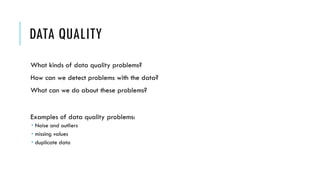
DATA QUALITY
What kinds of data quality problems?
How can we detect problems with the data?
What can we do about these problems?
Examples of data quality problems:
 Noise and outliers
 missing values
 duplicate data
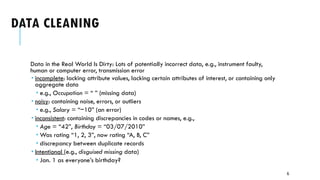
DATA CLEANING
Data in the Real World Is Dirty: Lots of potentially incorrect data, e.g., instrument faulty,
human or computer error, transmission error
 incomplete: lacking attribute values, lacking certain attributes of interest, or containing only
aggregate data
 e.g., Occupation = “ ” (missing data)
 noisy: containing noise, errors, or outliers
 e.g., Salary = “−10” (an error)
 inconsistent: containing discrepancies in codes or names, e.g.,
 Age = “42”, Birthday = “03/07/2010”
 Was rating “1, 2, 3”, now rating “A, B, C”
 discrepancy between duplicate records
 Intentional (e.g., disguised missing data)
 Jan. 1 as everyone’s birthday?
6
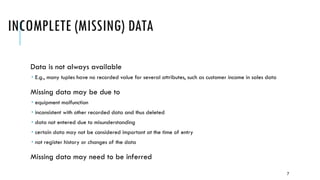
INCOMPLETE (MISSING) DATA
Data is not always available
 E.g., many tuples have no recorded value for several attributes, such as customer income in sales data
Missing data may be due to
 equipment malfunction
 inconsistent with other recorded data and thus deleted
 data not entered due to misunderstanding
 certain data may not be considered important at the time of entry
 not register history or changes of the data
Missing data may need to be inferred
7
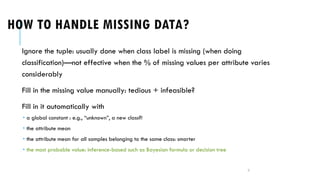
HOW TO HANDLE MISSING DATA?
Ignore the tuple: usually done when class label is missing (when doing
classification)—not effective when the % of missing values per attribute varies
considerably
Fill in the missing value manually: tedious + infeasible?
Fill in it automatically with
 a global constant : e.g., “unknown”, a new class?!
 the attribute mean
 the attribute mean for all samples belonging to the same class: smarter
 the most probable value: inference-based such as Bayesian formula or decision tree
8
9
NOISY DATA
Noise: random error or variance in a measured variable
Incorrect attribute values may be due to
 faulty data collection instruments
 data entry problems
 data transmission problems
 technology limitation
 inconsistency in naming convention
Other data problems which require data cleaning
 duplicate records
 incomplete data
 inconsistent data
HOW TO HANDLE NOISY DATA?
Binning (also used for discretization)
 first sort data and partition into (equal-frequency) bins
 then one can smooth by bin means, smooth by bin median, smooth by bin boundaries, etc.
 Binning methods smooth a sorted data value by consulting its "neighborhood," that is, the values around it, i.e.
they perform local smoothing.
Regression
 smooth by fitting the data into regression functions
Clustering
 detect and remove outliers
Combined computer and human inspection
 detect suspicious values and check by human (e.g., deal with possible outliers)
10
NOISE
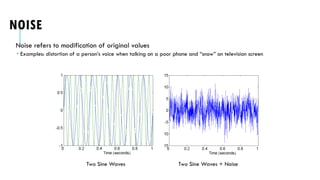
Noise refers to modification of original values
 Examples: distortion of a person’s voice when talking on a poor phone and “snow” on television screen
Two Sine Waves Two Sine Waves + Noise
DUPLICATE DATA
Data set may include data objects that are duplicates, or almost duplicates of one
another
 Major issue when merging data from heterogeous sources
Examples:
 Same person with multiple email addresses
Data cleaning
 Process of dealing with duplicate data issues
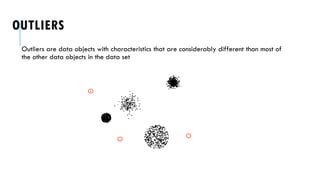
OUTLIERS
Outliers are data objects with characteristics that are considerably different than most of
the other data objects in the data set
DATA CLEANING AS A PROCESS
Data discrepancy detection
 Use metadata (e.g., domain, range, dependency, distribution)
 Check field overloading
 Check uniqueness rule, consecutive rule and null rule
 Use commercial tools
 Data scrubbing: use simple domain knowledge (e.g., postal code, spell-check) to detect errors and make corrections
 Data auditing: by analyzing data to discover rules and relationship to detect violators (e.g., correlation and clustering to find outliers)
Data migration and integration
 Data migration tools: allow transformations to be specified
 ETL (Extraction/Transformation/Loading) tools: allow users to specify transformations through a
graphical user interface
Integration of the two processes
 Iterative and interactive (e.g., Potter’s Wheels)
14

Data Preprocessing Concepts in Data Engineering

  • 1.
  • 2.
    PREPROCESSING OBJECTIVES To improvedata quality To modify data to better fit specific data mining technique
  • 3.
    MAJOR TASKS INDATA PREPROCESSING Data cleaning  Fill in missing values, smooth noisy data, identify or remove outliers, and resolve inconsistencies Data integration  Integration of multiple databases, data cubes, or files Data reduction  Dimensionality reduction  Numerosity reduction  Data compression Data transformation and data discretization  Normalization  Concept hierarchy generation 3
  • 4.
    DATA QUALITY: MULTIDIMENSIONALVIEW Measures for data quality: A multidimensional view Accuracy: correct or wrong, accurate or not Completeness: not recorded, unavailable, … Consistency: some modified but some not, dangling, … Timeliness: timely update? Believability: how trustable the data are correct? Interpretability: how easily the data can be understood? 4
  • 5.
    DATA QUALITY What kindsof data quality problems? How can we detect problems with the data? What can we do about these problems? Examples of data quality problems:  Noise and outliers  missing values  duplicate data
  • 6.
    DATA CLEANING Data inthe Real World Is Dirty: Lots of potentially incorrect data, e.g., instrument faulty, human or computer error, transmission error  incomplete: lacking attribute values, lacking certain attributes of interest, or containing only aggregate data  e.g., Occupation = “ ” (missing data)  noisy: containing noise, errors, or outliers  e.g., Salary = “−10” (an error)  inconsistent: containing discrepancies in codes or names, e.g.,  Age = “42”, Birthday = “03/07/2010”  Was rating “1, 2, 3”, now rating “A, B, C”  discrepancy between duplicate records  Intentional (e.g., disguised missing data)  Jan. 1 as everyone’s birthday? 6
  • 7.
    INCOMPLETE (MISSING) DATA Datais not always available  E.g., many tuples have no recorded value for several attributes, such as customer income in sales data Missing data may be due to  equipment malfunction  inconsistent with other recorded data and thus deleted  data not entered due to misunderstanding  certain data may not be considered important at the time of entry  not register history or changes of the data Missing data may need to be inferred 7
  • 8.
    HOW TO HANDLEMISSING DATA? Ignore the tuple: usually done when class label is missing (when doing classification)—not effective when the % of missing values per attribute varies considerably Fill in the missing value manually: tedious + infeasible? Fill in it automatically with  a global constant : e.g., “unknown”, a new class?!  the attribute mean  the attribute mean for all samples belonging to the same class: smarter  the most probable value: inference-based such as Bayesian formula or decision tree 8
  • 9.
    9 NOISY DATA Noise: randomerror or variance in a measured variable Incorrect attribute values may be due to  faulty data collection instruments  data entry problems  data transmission problems  technology limitation  inconsistency in naming convention Other data problems which require data cleaning  duplicate records  incomplete data  inconsistent data
  • 10.
    HOW TO HANDLENOISY DATA? Binning (also used for discretization)  first sort data and partition into (equal-frequency) bins  then one can smooth by bin means, smooth by bin median, smooth by bin boundaries, etc.  Binning methods smooth a sorted data value by consulting its "neighborhood," that is, the values around it, i.e. they perform local smoothing. Regression  smooth by fitting the data into regression functions Clustering  detect and remove outliers Combined computer and human inspection  detect suspicious values and check by human (e.g., deal with possible outliers) 10
  • 11.
    NOISE Noise refers tomodification of original values  Examples: distortion of a person’s voice when talking on a poor phone and “snow” on television screen Two Sine Waves Two Sine Waves + Noise
  • 12.
    DUPLICATE DATA Data setmay include data objects that are duplicates, or almost duplicates of one another  Major issue when merging data from heterogeous sources Examples:  Same person with multiple email addresses Data cleaning  Process of dealing with duplicate data issues
  • 13.
    OUTLIERS Outliers are dataobjects with characteristics that are considerably different than most of the other data objects in the data set
  • 14.
    DATA CLEANING ASA PROCESS Data discrepancy detection  Use metadata (e.g., domain, range, dependency, distribution)  Check field overloading  Check uniqueness rule, consecutive rule and null rule  Use commercial tools  Data scrubbing: use simple domain knowledge (e.g., postal code, spell-check) to detect errors and make corrections  Data auditing: by analyzing data to discover rules and relationship to detect violators (e.g., correlation and clustering to find outliers) Data migration and integration  Data migration tools: allow transformations to be specified  ETL (Extraction/Transformation/Loading) tools: allow users to specify transformations through a graphical user interface Integration of the two processes  Iterative and interactive (e.g., Potter’s Wheels) 14