1
Data Mining:
Concepts and Techniques
(3rd ed.)
— Chapter 3 —
Jiawei Han, Micheline Kamber, and Jian Pei
University of Illinois at Urbana-Champaign &
Simon Fraser University
Š2011 Han, Kamber & Pei. All rights reserved.
2
2
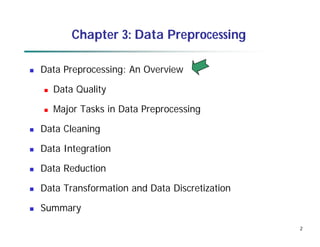
Chapter 3: Data Preprocessing
 Data Preprocessing: An Overview
 Data Quality
 Major Tasks in Data Preprocessing
 Data Cleaning
 Data Integration
 Data Reduction
 Data Transformation and Data Discretization
 Summary
3
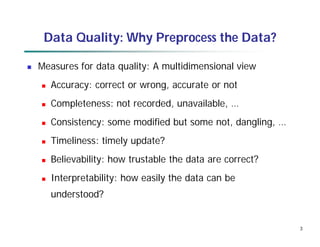
Data Quality: Why Preprocess the Data?
 Measures for data quality: A multidimensional view
 Accuracy: correct or wrong, accurate or not
 Completeness: not recorded, unavailable, …
 Consistency: some modified but some not, dangling, …
 Timeliness: timely update?
 Believability: how trustable the data are correct?
 Interpretability: how easily the data can be
understood?
4
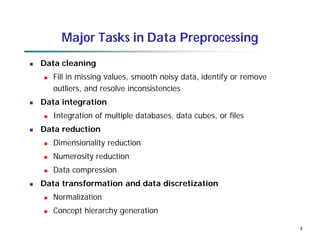
Major Tasks in Data Preprocessing
 Data cleaning
 Fill in missing values, smooth noisy data, identify or remove
outliers, and resolve inconsistencies
 Data integration
 Integration of multiple databases, data cubes, or files
 Data reduction
 Dimensionality reduction
 Numerosity reduction
 Data compression
 Data transformation and data discretization
 Normalization
 Concept hierarchy generation
5
5
Chapter 3: Data Preprocessing
 Data Preprocessing: An Overview
 Data Quality
 Major Tasks in Data Preprocessing
 Data Cleaning
 Data Integration
 Data Reduction
 Data Transformation and Data Discretization
 Summary
6
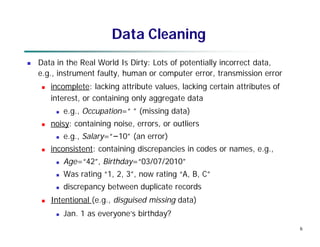
Data Cleaning
 Data in the Real World Is Dirty: Lots of potentially incorrect data,
e.g., instrument faulty, human or computer error, transmission error
 incomplete: lacking attribute values, lacking certain attributes of
interest, or containing only aggregate data
 e.g., Occupation=“ ” (missing data)
 noisy: containing noise, errors, or outliers
 e.g., Salary=“−10” (an error)
 inconsistent: containing discrepancies in codes or names, e.g.,
 Age=“42”, Birthday=“03/07/2010”
 Was rating “1, 2, 3”, now rating “A, B, C”
 discrepancy between duplicate records
 Intentional (e.g., disguised missing data)
 Jan. 1 as everyone’s birthday?
7
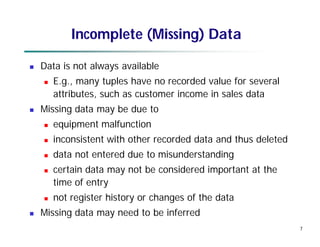
Incomplete (Missing) Data
 Data is not always available
 E.g., many tuples have no recorded value for several
attributes, such as customer income in sales data
 Missing data may be due to
 equipment malfunction
 inconsistent with other recorded data and thus deleted
 data not entered due to misunderstanding
 certain data may not be considered important at the
time of entry
 not register history or changes of the data
 Missing data may need to be inferred
8
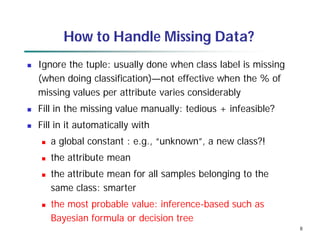
How to Handle Missing Data?
 Ignore the tuple: usually done when class label is missing
(when doing classification)—not effective when the % of
missing values per attribute varies considerably
 Fill in the missing value manually: tedious + infeasible?
 Fill in it automatically with
 a global constant : e.g., “unknown”, a new class?!
 the attribute mean
 the attribute mean for all samples belonging to the
same class: smarter
 the most probable value: inference-based such as
Bayesian formula or decision tree
9
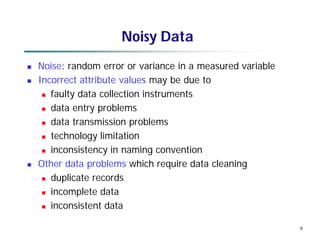
Noisy Data
 Noise: random error or variance in a measured variable
 Incorrect attribute values may be due to
 faulty data collection instruments
 data entry problems
 data transmission problems
 technology limitation
 inconsistency in naming convention
 Other data problems which require data cleaning
 duplicate records
 incomplete data
 inconsistent data
10
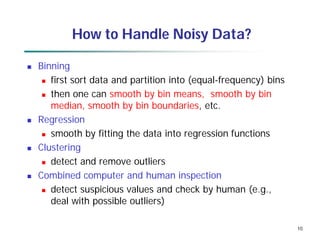
How to Handle Noisy Data?
 Binning
 first sort data and partition into (equal-frequency) bins
 then one can smooth by bin means, smooth by bin
median, smooth by bin boundaries, etc.
 Regression
 smooth by fitting the data into regression functions
 Clustering
 detect and remove outliers
 Combined computer and human inspection
 detect suspicious values and check by human (e.g.,
deal with possible outliers)
11
11
Chapter 3: Data Preprocessing
 Data Preprocessing: An Overview
 Data Quality
 Major Tasks in Data Preprocessing
 Data Cleaning
 Data Integration
 Data Reduction
 Data Transformation and Data Discretization
 Summary
12
12
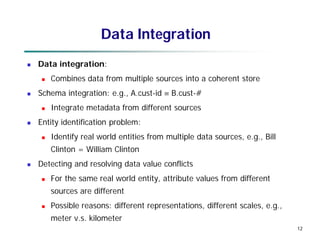
Data Integration
 Data integration:
 Combines data from multiple sources into a coherent store
 Schema integration: e.g., A.cust-id  B.cust-#
 Integrate metadata from different sources
 Entity identification problem:
 Identify real world entities from multiple data sources, e.g., Bill
Clinton = William Clinton
 Detecting and resolving data value conflicts
 For the same real world entity, attribute values from different
sources are different
 Possible reasons: different representations, different scales, e.g.,
meter v.s. kilometer
13
13
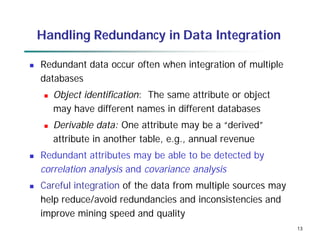
Handling Redundancy in Data Integration
 Redundant data occur often when integration of multiple
databases
 Object identification: The same attribute or object
may have different names in different databases
 Derivable data: One attribute may be a “derived”
attribute in another table, e.g., annual revenue
 Redundant attributes may be able to be detected by
correlation analysis and covariance analysis
 Careful integration of the data from multiple sources may
help reduce/avoid redundancies and inconsistencies and
improve mining speed and quality
14
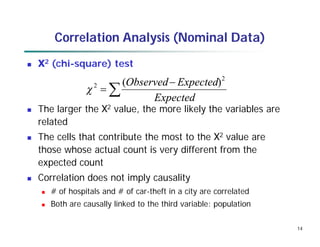
Correlation Analysis (Nominal Data)
 Χ2 (chi-square) test
 The larger the Χ2 value, the more likely the variables are
related
 The cells that contribute the most to the Χ2 value are
those whose actual count is very different from the
expected count
 Correlation does not imply causality
 # of hospitals and # of car-theft in a city are correlated
 Both are causally linked to the third variable: population



Expected
Expected
Observed 2
2 )
(

15
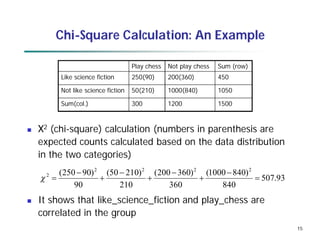
Chi-Square Calculation: An Example
 Χ2 (chi-square) calculation (numbers in parenthesis are
expected counts calculated based on the data distribution
in the two categories)
 It shows that like_science_fiction and play_chess are
correlated in the group
93
.
507
840
)
840
1000
(
360
)
360
200
(
210
)
210
50
(
90
)
90
250
( 2
2
2
2
2










Play chess Not play chess Sum (row)
Like science fiction 250(90) 200(360) 450
Not like science fiction 50(210) 1000(840) 1050
Sum(col.) 300 1200 1500
16
Correlation Analysis (Numeric Data)
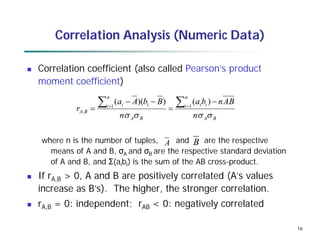
 Correlation coefficient (also called Pearson’s product
moment coefficient)
where n is the number of tuples, and are the respective
means of A and B, σA and σB are the respective standard deviation
of A and B, and ÎŁ(aibi) is the sum of the AB cross-product.
 If rA,B > 0, A and B are positively correlated (A’s values
increase as B’s). The higher, the stronger correlation.
 rA,B = 0: independent; rAB < 0: negatively correlated
B
A
n
i i
i
B
A
n
i i
i
B
A
n
B
A
n
b
a
n
B
b
A
a
r





 





 1
1
,
)
(
)
)(
(
A B
17
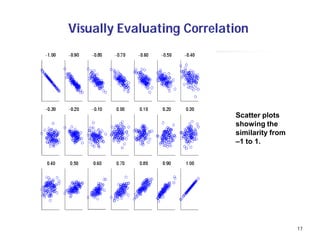
Visually Evaluating Correlation
Scatter plots
showing the
similarity from
–1 to 1.
18
Covariance (Numeric Data)
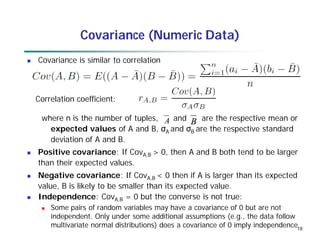
 Covariance is similar to correlation
where n is the number of tuples, and are the respective mean or
expected values of A and B, σA and σB are the respective standard
deviation of A and B.
 Positive covariance: If CovA,B > 0, then A and B both tend to be larger
than their expected values.
 Negative covariance: If CovA,B < 0 then if A is larger than its expected
value, B is likely to be smaller than its expected value.
 Independence: CovA,B = 0 but the converse is not true:
 Some pairs of random variables may have a covariance of 0 but are not
independent. Only under some additional assumptions (e.g., the data follow
multivariate normal distributions) does a covariance of 0 imply independence
A B
Correlation coefficient:
Co-Variance: An Example
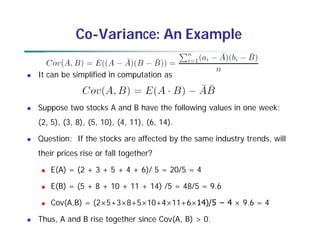
 It can be simplified in computation as
 Suppose two stocks A and B have the following values in one week:
(2, 5), (3, 8), (5, 10), (4, 11), (6, 14).
 Question: If the stocks are affected by the same industry trends, will
their prices rise or fall together?
 E(A) = (2 + 3 + 5 + 4 + 6)/ 5 = 20/5 = 4
 E(B) = (5 + 8 + 10 + 11 + 14) /5 = 48/5 = 9.6
 Cov(A,B) = (2×5+3×8+5×10+4×11+6×14)/5 − 4 × 9.6 = 4
 Thus, A and B rise together since Cov(A, B) > 0.
20
20
Chapter 3: Data Preprocessing
 Data Preprocessing: An Overview
 Data Quality
 Major Tasks in Data Preprocessing
 Data Cleaning
 Data Integration
 Data Reduction
 Data Transformation and Data Discretization
 Summary
21
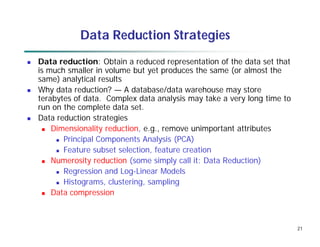
Data Reduction Strategies
 Data reduction: Obtain a reduced representation of the data set that
is much smaller in volume but yet produces the same (or almost the
same) analytical results
 Why data reduction? — A database/data warehouse may store
terabytes of data. Complex data analysis may take a very long time to
run on the complete data set.
 Data reduction strategies
 Dimensionality reduction, e.g., remove unimportant attributes
 Principal Components Analysis (PCA)
 Feature subset selection, feature creation
 Numerosity reduction (some simply call it: Data Reduction)
 Regression and Log-Linear Models
 Histograms, clustering, sampling
 Data compression
22
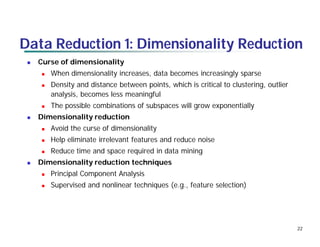
Data Reduction 1: Dimensionality Reduction
 Curse of dimensionality
 When dimensionality increases, data becomes increasingly sparse
 Density and distance between points, which is critical to clustering, outlier
analysis, becomes less meaningful
 The possible combinations of subspaces will grow exponentially
 Dimensionality reduction
 Avoid the curse of dimensionality
 Help eliminate irrelevant features and reduce noise
 Reduce time and space required in data mining
 Dimensionality reduction techniques
 Principal Component Analysis
 Supervised and nonlinear techniques (e.g., feature selection)
23
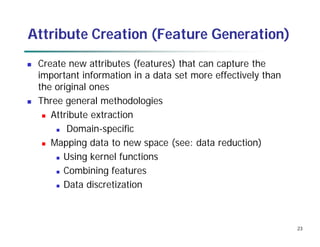
Attribute Creation (Feature Generation)
 Create new attributes (features) that can capture the
important information in a data set more effectively than
the original ones
 Three general methodologies
 Attribute extraction
 Domain-specific
 Mapping data to new space (see: data reduction)
 Using kernel functions
 Combining features
 Data discretization
24
Clustering
 Partition data set into clusters based on similarity, and
store cluster representation (e.g., centroid and diameter)
only
 Can have hierarchical clustering and be stored in multi-
dimensional index tree structures
 There are many choices of clustering definitions and
clustering algorithms
25
Sampling
 Sampling: obtaining a small sample s to represent the
whole data set N
 Allow a mining algorithm to run in complexity that is
potentially sub-linear to the size of the data
 Key principle: Choose a representative subset of the data
 Simple random sampling may have very poor
performance in the presence of skew
 Develop adaptive sampling methods, e.g., stratified
sampling
26
Types of Sampling
 Simple random sampling
 There is an equal probability of selecting any particular
item
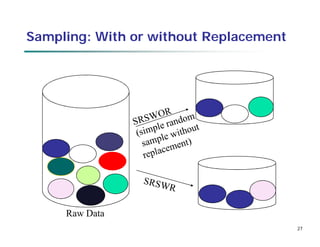
 Sampling without replacement
 Once an object is selected, it is removed from the
population
 Sampling with replacement
 A selected object is not removed from the population
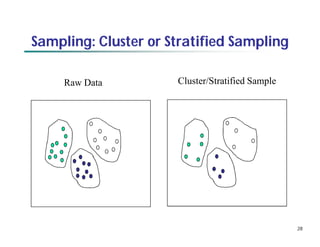
 Stratified sampling:
 Partition the data set, and draw samples from each
partition (proportionally, i.e., approximately the same
percentage of the data)
 Used in conjunction with skewed data
27
Sampling: With or without Replacement
Raw Data
28
Sampling: Cluster or Stratified Sampling
Raw Data Cluster/Stratified Sample
29
Data Reduction 3: Data Compression
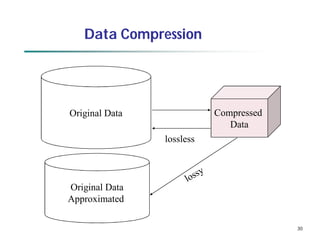
 String compression
 There are extensive theories and well-tuned algorithms
 Typically lossless, but only limited manipulation is
possible without expansion
 Audio/video compression
 Typically lossy compression, with progressive refinement
 Sometimes small fragments of signal can be
reconstructed without reconstructing the whole
 Dimensionality and numerosity reduction may also be
considered as forms of data compression
30
Data Compression
Original Data Compressed
Data
lossless
Original Data
Approximated
31
Chapter 3: Data Preprocessing
 Data Preprocessing: An Overview
 Data Quality
 Major Tasks in Data Preprocessing
 Data Cleaning
 Data Integration
 Data Reduction
 Data Transformation and Data Discretization
 Summary
32
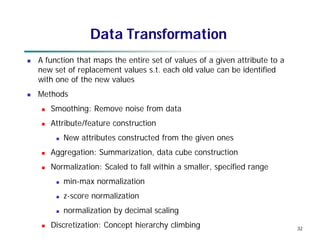
Data Transformation
 A function that maps the entire set of values of a given attribute to a
new set of replacement values s.t. each old value can be identified
with one of the new values
 Methods
 Smoothing: Remove noise from data
 Attribute/feature construction
 New attributes constructed from the given ones
 Aggregation: Summarization, data cube construction
 Normalization: Scaled to fall within a smaller, specified range
 min-max normalization
 z-score normalization
 normalization by decimal scaling
 Discretization: Concept hierarchy climbing
33
Normalization
 Min-max normalization: to [new_minA, new_maxA]
 Ex. Let income range $12,000 to $98,000 normalized to [0.0,
1.0]. Then $73,000 is mapped to
 Z-score normalization (Ο: mean, σ: standard deviation):
 Ex. Let Ο = 54,000, σ = 16,000. Then
 Normalization by decimal scaling
716
.
0
0
)
0
0
.
1
(
000
,
12
000
,
98
000
,
12
600
,
73





A
A
A
A
A
A
min
new
min
new
max
new
min
max
min
v
v _
)
_
_
(
' 




A
A
v
v




'
j
v
v
10
' Where j is the smallest integer such that Max(|ν’|) < 1
225
.
1
000
,
16
000
,
54
600
,
73


34
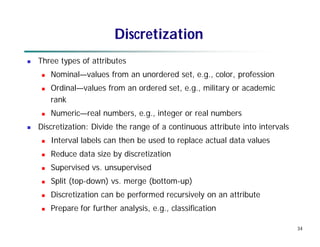
Discretization
 Three types of attributes
 Nominal—values from an unordered set, e.g., color, profession
 Ordinal—values from an ordered set, e.g., military or academic
rank
 Numeric—real numbers, e.g., integer or real numbers
 Discretization: Divide the range of a continuous attribute into intervals
 Interval labels can then be used to replace actual data values
 Reduce data size by discretization
 Supervised vs. unsupervised
 Split (top-down) vs. merge (bottom-up)
 Discretization can be performed recursively on an attribute
 Prepare for further analysis, e.g., classification
35
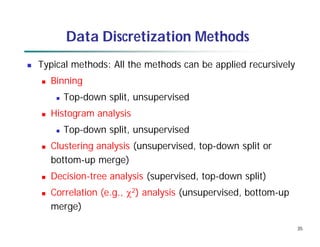
Data Discretization Methods
 Typical methods: All the methods can be applied recursively
 Binning
 Top-down split, unsupervised
 Histogram analysis
 Top-down split, unsupervised
 Clustering analysis (unsupervised, top-down split or
bottom-up merge)
 Decision-tree analysis (supervised, top-down split)
 Correlation (e.g., 2) analysis (unsupervised, bottom-up
merge)
36
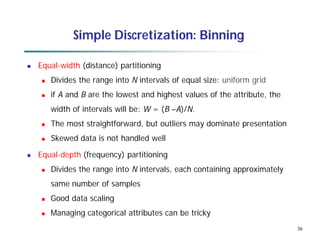
Simple Discretization: Binning
 Equal-width (distance) partitioning
 Divides the range into N intervals of equal size: uniform grid
 if A and B are the lowest and highest values of the attribute, the
width of intervals will be: W = (B –A)/N.
 The most straightforward, but outliers may dominate presentation
 Skewed data is not handled well
 Equal-depth (frequency) partitioning
 Divides the range into N intervals, each containing approximately
same number of samples
 Good data scaling
 Managing categorical attributes can be tricky
37
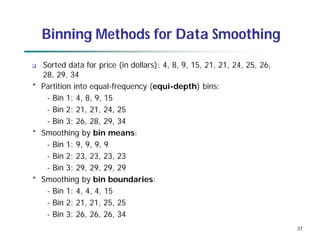
Binning Methods for Data Smoothing
 Sorted data for price (in dollars): 4, 8, 9, 15, 21, 21, 24, 25, 26,
28, 29, 34
* Partition into equal-frequency (equi-depth) bins:
- Bin 1: 4, 8, 9, 15
- Bin 2: 21, 21, 24, 25
- Bin 3: 26, 28, 29, 34
* Smoothing by bin means:
- Bin 1: 9, 9, 9, 9
- Bin 2: 23, 23, 23, 23
- Bin 3: 29, 29, 29, 29
* Smoothing by bin boundaries:
- Bin 1: 4, 4, 4, 15
- Bin 2: 21, 21, 25, 25
- Bin 3: 26, 26, 26, 34
38
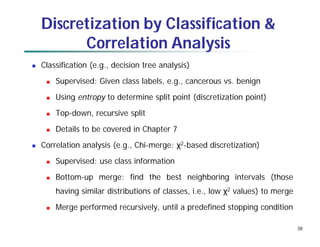
Discretization by Classification &
Correlation Analysis
 Classification (e.g., decision tree analysis)
 Supervised: Given class labels, e.g., cancerous vs. benign
 Using entropy to determine split point (discretization point)
 Top-down, recursive split
 Details to be covered in Chapter 7
 Correlation analysis (e.g., Chi-merge: χ2-based discretization)
 Supervised: use class information
 Bottom-up merge: find the best neighboring intervals (those
having similar distributions of classes, i.e., low χ2 values) to merge
 Merge performed recursively, until a predefined stopping condition
39
Chapter 3: Data Preprocessing
 Data Preprocessing: An Overview
 Data Quality
 Major Tasks in Data Preprocessing
 Data Cleaning
 Data Integration
 Data Reduction
 Data Transformation and Data Discretization
 Summary
40
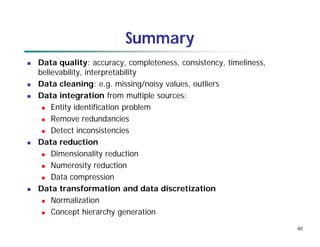
Summary
 Data quality: accuracy, completeness, consistency, timeliness,
believability, interpretability
 Data cleaning: e.g. missing/noisy values, outliers
 Data integration from multiple sources:
 Entity identification problem
 Remove redundancies
 Detect inconsistencies
 Data reduction
 Dimensionality reduction
 Numerosity reduction
 Data compression
 Data transformation and data discretization
 Normalization
 Concept hierarchy generation

03Preprocessing01.pdf

  • 1.
    1 Data Mining: Concepts andTechniques (3rd ed.) — Chapter 3 — Jiawei Han, Micheline Kamber, and Jian Pei University of Illinois at Urbana-Champaign & Simon Fraser University ©2011 Han, Kamber & Pei. All rights reserved.
  • 2.
    2 2 Chapter 3: DataPreprocessing  Data Preprocessing: An Overview  Data Quality  Major Tasks in Data Preprocessing  Data Cleaning  Data Integration  Data Reduction  Data Transformation and Data Discretization  Summary
  • 3.
    3 Data Quality: WhyPreprocess the Data?  Measures for data quality: A multidimensional view  Accuracy: correct or wrong, accurate or not  Completeness: not recorded, unavailable, …  Consistency: some modified but some not, dangling, …  Timeliness: timely update?  Believability: how trustable the data are correct?  Interpretability: how easily the data can be understood?
  • 4.
    4 Major Tasks inData Preprocessing  Data cleaning  Fill in missing values, smooth noisy data, identify or remove outliers, and resolve inconsistencies  Data integration  Integration of multiple databases, data cubes, or files  Data reduction  Dimensionality reduction  Numerosity reduction  Data compression  Data transformation and data discretization  Normalization  Concept hierarchy generation
  • 5.
    5 5 Chapter 3: DataPreprocessing  Data Preprocessing: An Overview  Data Quality  Major Tasks in Data Preprocessing  Data Cleaning  Data Integration  Data Reduction  Data Transformation and Data Discretization  Summary
  • 6.
    6 Data Cleaning  Datain the Real World Is Dirty: Lots of potentially incorrect data, e.g., instrument faulty, human or computer error, transmission error  incomplete: lacking attribute values, lacking certain attributes of interest, or containing only aggregate data  e.g., Occupation=“ ” (missing data)  noisy: containing noise, errors, or outliers  e.g., Salary=“−10” (an error)  inconsistent: containing discrepancies in codes or names, e.g.,  Age=“42”, Birthday=“03/07/2010”  Was rating “1, 2, 3”, now rating “A, B, C”  discrepancy between duplicate records  Intentional (e.g., disguised missing data)  Jan. 1 as everyone’s birthday?
  • 7.
    7 Incomplete (Missing) Data Data is not always available  E.g., many tuples have no recorded value for several attributes, such as customer income in sales data  Missing data may be due to  equipment malfunction  inconsistent with other recorded data and thus deleted  data not entered due to misunderstanding  certain data may not be considered important at the time of entry  not register history or changes of the data  Missing data may need to be inferred
  • 8.
    8 How to HandleMissing Data?  Ignore the tuple: usually done when class label is missing (when doing classification)—not effective when the % of missing values per attribute varies considerably  Fill in the missing value manually: tedious + infeasible?  Fill in it automatically with  a global constant : e.g., “unknown”, a new class?!  the attribute mean  the attribute mean for all samples belonging to the same class: smarter  the most probable value: inference-based such as Bayesian formula or decision tree
  • 9.
    9 Noisy Data  Noise:random error or variance in a measured variable  Incorrect attribute values may be due to  faulty data collection instruments  data entry problems  data transmission problems  technology limitation  inconsistency in naming convention  Other data problems which require data cleaning  duplicate records  incomplete data  inconsistent data
  • 10.
    10 How to HandleNoisy Data?  Binning  first sort data and partition into (equal-frequency) bins  then one can smooth by bin means, smooth by bin median, smooth by bin boundaries, etc.  Regression  smooth by fitting the data into regression functions  Clustering  detect and remove outliers  Combined computer and human inspection  detect suspicious values and check by human (e.g., deal with possible outliers)
  • 11.
    11 11 Chapter 3: DataPreprocessing  Data Preprocessing: An Overview  Data Quality  Major Tasks in Data Preprocessing  Data Cleaning  Data Integration  Data Reduction  Data Transformation and Data Discretization  Summary
  • 12.
    12 12 Data Integration  Dataintegration:  Combines data from multiple sources into a coherent store  Schema integration: e.g., A.cust-id  B.cust-#  Integrate metadata from different sources  Entity identification problem:  Identify real world entities from multiple data sources, e.g., Bill Clinton = William Clinton  Detecting and resolving data value conflicts  For the same real world entity, attribute values from different sources are different  Possible reasons: different representations, different scales, e.g., meter v.s. kilometer
  • 13.
    13 13 Handling Redundancy inData Integration  Redundant data occur often when integration of multiple databases  Object identification: The same attribute or object may have different names in different databases  Derivable data: One attribute may be a “derived” attribute in another table, e.g., annual revenue  Redundant attributes may be able to be detected by correlation analysis and covariance analysis  Careful integration of the data from multiple sources may help reduce/avoid redundancies and inconsistencies and improve mining speed and quality
  • 14.
    14 Correlation Analysis (NominalData)  Χ2 (chi-square) test  The larger the Χ2 value, the more likely the variables are related  The cells that contribute the most to the Χ2 value are those whose actual count is very different from the expected count  Correlation does not imply causality  # of hospitals and # of car-theft in a city are correlated  Both are causally linked to the third variable: population    Expected Expected Observed 2 2 ) ( 
  • 15.
    15 Chi-Square Calculation: AnExample  Χ2 (chi-square) calculation (numbers in parenthesis are expected counts calculated based on the data distribution in the two categories)  It shows that like_science_fiction and play_chess are correlated in the group 93 . 507 840 ) 840 1000 ( 360 ) 360 200 ( 210 ) 210 50 ( 90 ) 90 250 ( 2 2 2 2 2           Play chess Not play chess Sum (row) Like science fiction 250(90) 200(360) 450 Not like science fiction 50(210) 1000(840) 1050 Sum(col.) 300 1200 1500
  • 16.
    16 Correlation Analysis (NumericData)  Correlation coefficient (also called Pearson’s product moment coefficient) where n is the number of tuples, and are the respective means of A and B, σA and σB are the respective standard deviation of A and B, and Σ(aibi) is the sum of the AB cross-product.  If rA,B > 0, A and B are positively correlated (A’s values increase as B’s). The higher, the stronger correlation.  rA,B = 0: independent; rAB < 0: negatively correlated B A n i i i B A n i i i B A n B A n b a n B b A a r              1 1 , ) ( ) )( ( A B
  • 17.
    17 Visually Evaluating Correlation Scatterplots showing the similarity from –1 to 1.
  • 18.
    18 Covariance (Numeric Data) Covariance is similar to correlation where n is the number of tuples, and are the respective mean or expected values of A and B, σA and σB are the respective standard deviation of A and B.  Positive covariance: If CovA,B > 0, then A and B both tend to be larger than their expected values.  Negative covariance: If CovA,B < 0 then if A is larger than its expected value, B is likely to be smaller than its expected value.  Independence: CovA,B = 0 but the converse is not true:  Some pairs of random variables may have a covariance of 0 but are not independent. Only under some additional assumptions (e.g., the data follow multivariate normal distributions) does a covariance of 0 imply independence A B Correlation coefficient:
  • 19.
    Co-Variance: An Example It can be simplified in computation as  Suppose two stocks A and B have the following values in one week: (2, 5), (3, 8), (5, 10), (4, 11), (6, 14).  Question: If the stocks are affected by the same industry trends, will their prices rise or fall together?  E(A) = (2 + 3 + 5 + 4 + 6)/ 5 = 20/5 = 4  E(B) = (5 + 8 + 10 + 11 + 14) /5 = 48/5 = 9.6  Cov(A,B) = (2×5+3×8+5×10+4×11+6×14)/5 − 4 × 9.6 = 4  Thus, A and B rise together since Cov(A, B) > 0.
  • 20.
    20 20 Chapter 3: DataPreprocessing  Data Preprocessing: An Overview  Data Quality  Major Tasks in Data Preprocessing  Data Cleaning  Data Integration  Data Reduction  Data Transformation and Data Discretization  Summary
  • 21.
    21 Data Reduction Strategies Data reduction: Obtain a reduced representation of the data set that is much smaller in volume but yet produces the same (or almost the same) analytical results  Why data reduction? — A database/data warehouse may store terabytes of data. Complex data analysis may take a very long time to run on the complete data set.  Data reduction strategies  Dimensionality reduction, e.g., remove unimportant attributes  Principal Components Analysis (PCA)  Feature subset selection, feature creation  Numerosity reduction (some simply call it: Data Reduction)  Regression and Log-Linear Models  Histograms, clustering, sampling  Data compression
  • 22.
    22 Data Reduction 1:Dimensionality Reduction  Curse of dimensionality  When dimensionality increases, data becomes increasingly sparse  Density and distance between points, which is critical to clustering, outlier analysis, becomes less meaningful  The possible combinations of subspaces will grow exponentially  Dimensionality reduction  Avoid the curse of dimensionality  Help eliminate irrelevant features and reduce noise  Reduce time and space required in data mining  Dimensionality reduction techniques  Principal Component Analysis  Supervised and nonlinear techniques (e.g., feature selection)
  • 23.
    23 Attribute Creation (FeatureGeneration)  Create new attributes (features) that can capture the important information in a data set more effectively than the original ones  Three general methodologies  Attribute extraction  Domain-specific  Mapping data to new space (see: data reduction)  Using kernel functions  Combining features  Data discretization
  • 24.
    24 Clustering  Partition dataset into clusters based on similarity, and store cluster representation (e.g., centroid and diameter) only  Can have hierarchical clustering and be stored in multi- dimensional index tree structures  There are many choices of clustering definitions and clustering algorithms
  • 25.
    25 Sampling  Sampling: obtaininga small sample s to represent the whole data set N  Allow a mining algorithm to run in complexity that is potentially sub-linear to the size of the data  Key principle: Choose a representative subset of the data  Simple random sampling may have very poor performance in the presence of skew  Develop adaptive sampling methods, e.g., stratified sampling
  • 26.
    26 Types of Sampling Simple random sampling  There is an equal probability of selecting any particular item  Sampling without replacement  Once an object is selected, it is removed from the population  Sampling with replacement  A selected object is not removed from the population  Stratified sampling:  Partition the data set, and draw samples from each partition (proportionally, i.e., approximately the same percentage of the data)  Used in conjunction with skewed data
  • 27.
    27 Sampling: With orwithout Replacement Raw Data
  • 28.
    28 Sampling: Cluster orStratified Sampling Raw Data Cluster/Stratified Sample
  • 29.
    29 Data Reduction 3:Data Compression  String compression  There are extensive theories and well-tuned algorithms  Typically lossless, but only limited manipulation is possible without expansion  Audio/video compression  Typically lossy compression, with progressive refinement  Sometimes small fragments of signal can be reconstructed without reconstructing the whole  Dimensionality and numerosity reduction may also be considered as forms of data compression
  • 30.
    30 Data Compression Original DataCompressed Data lossless Original Data Approximated
  • 31.
    31 Chapter 3: DataPreprocessing  Data Preprocessing: An Overview  Data Quality  Major Tasks in Data Preprocessing  Data Cleaning  Data Integration  Data Reduction  Data Transformation and Data Discretization  Summary
  • 32.
    32 Data Transformation  Afunction that maps the entire set of values of a given attribute to a new set of replacement values s.t. each old value can be identified with one of the new values  Methods  Smoothing: Remove noise from data  Attribute/feature construction  New attributes constructed from the given ones  Aggregation: Summarization, data cube construction  Normalization: Scaled to fall within a smaller, specified range  min-max normalization  z-score normalization  normalization by decimal scaling  Discretization: Concept hierarchy climbing
  • 33.
    33 Normalization  Min-max normalization:to [new_minA, new_maxA]  Ex. Let income range $12,000 to $98,000 normalized to [0.0, 1.0]. Then $73,000 is mapped to  Z-score normalization (μ: mean, σ: standard deviation):  Ex. Let μ = 54,000, σ = 16,000. Then  Normalization by decimal scaling 716 . 0 0 ) 0 0 . 1 ( 000 , 12 000 , 98 000 , 12 600 , 73      A A A A A A min new min new max new min max min v v _ ) _ _ ( '      A A v v     ' j v v 10 ' Where j is the smallest integer such that Max(|ν’|) < 1 225 . 1 000 , 16 000 , 54 600 , 73  
  • 34.
    34 Discretization  Three typesof attributes  Nominal—values from an unordered set, e.g., color, profession  Ordinal—values from an ordered set, e.g., military or academic rank  Numeric—real numbers, e.g., integer or real numbers  Discretization: Divide the range of a continuous attribute into intervals  Interval labels can then be used to replace actual data values  Reduce data size by discretization  Supervised vs. unsupervised  Split (top-down) vs. merge (bottom-up)  Discretization can be performed recursively on an attribute  Prepare for further analysis, e.g., classification
  • 35.
    35 Data Discretization Methods Typical methods: All the methods can be applied recursively  Binning  Top-down split, unsupervised  Histogram analysis  Top-down split, unsupervised  Clustering analysis (unsupervised, top-down split or bottom-up merge)  Decision-tree analysis (supervised, top-down split)  Correlation (e.g., 2) analysis (unsupervised, bottom-up merge)
  • 36.
    36 Simple Discretization: Binning Equal-width (distance) partitioning  Divides the range into N intervals of equal size: uniform grid  if A and B are the lowest and highest values of the attribute, the width of intervals will be: W = (B –A)/N.  The most straightforward, but outliers may dominate presentation  Skewed data is not handled well  Equal-depth (frequency) partitioning  Divides the range into N intervals, each containing approximately same number of samples  Good data scaling  Managing categorical attributes can be tricky
  • 37.
    37 Binning Methods forData Smoothing  Sorted data for price (in dollars): 4, 8, 9, 15, 21, 21, 24, 25, 26, 28, 29, 34 * Partition into equal-frequency (equi-depth) bins: - Bin 1: 4, 8, 9, 15 - Bin 2: 21, 21, 24, 25 - Bin 3: 26, 28, 29, 34 * Smoothing by bin means: - Bin 1: 9, 9, 9, 9 - Bin 2: 23, 23, 23, 23 - Bin 3: 29, 29, 29, 29 * Smoothing by bin boundaries: - Bin 1: 4, 4, 4, 15 - Bin 2: 21, 21, 25, 25 - Bin 3: 26, 26, 26, 34
  • 38.
    38 Discretization by Classification& Correlation Analysis  Classification (e.g., decision tree analysis)  Supervised: Given class labels, e.g., cancerous vs. benign  Using entropy to determine split point (discretization point)  Top-down, recursive split  Details to be covered in Chapter 7  Correlation analysis (e.g., Chi-merge: χ2-based discretization)  Supervised: use class information  Bottom-up merge: find the best neighboring intervals (those having similar distributions of classes, i.e., low χ2 values) to merge  Merge performed recursively, until a predefined stopping condition
  • 39.
    39 Chapter 3: DataPreprocessing  Data Preprocessing: An Overview  Data Quality  Major Tasks in Data Preprocessing  Data Cleaning  Data Integration  Data Reduction  Data Transformation and Data Discretization  Summary
  • 40.
    40 Summary  Data quality:accuracy, completeness, consistency, timeliness, believability, interpretability  Data cleaning: e.g. missing/noisy values, outliers  Data integration from multiple sources:  Entity identification problem  Remove redundancies  Detect inconsistencies  Data reduction  Dimensionality reduction  Numerosity reduction  Data compression  Data transformation and data discretization  Normalization  Concept hierarchy generation