Presentation
How to fill out a Log Frame
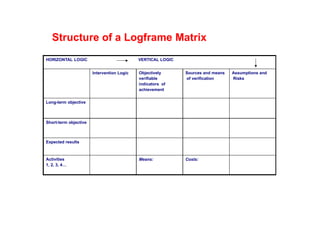
HORIZONTAL LOGIC VERTICAL LOGIC
Intervention Logic Objectively
verifiable
indicators of
achievement
Sources and means
of verification
Assumptions and
Risks
Long-term objective
Short-term objective
Expected results
Activities
1, 2, 3, 4…
Means: Costs:
Structure of a Logframe Matrix
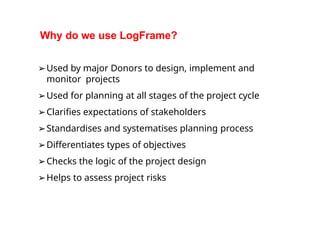
Why do we use LogFrame?
➢Used by major Donors to design, implement and
monitor projects
➢Used for planning at all stages of the project cycle
➢Clarifies expectations of stakeholders
➢Standardises and systematises planning process
➢Differentiates types of objectives
➢Checks the logic of the project design
➢Helps to assess project risks
Current
Situatio
n
Inputs
Activities
Short-
term
objective
Expected results
Long-term objective
Projec
t
Hierarchy of objectives
Long-term objective
Why is the project relevant to society, in terms of the longer-term
benefits to beneficiaries and the wider benefits to other
groups? The long-term objective will not be achieved by the
project alone, but will require the impacts of other programmes
and projects as well.
Example: Youth unemployment decreased by 20%
Short-term objective
A specific change in a situation to be achieved immediately (on
short term) after the termination of the project.
Defined in terms of the benefits to be received by the project
beneficiaries or target group as a result of utilising the services
provided by the programme.
Example: A business college functioning
Terminology
Expected results
The specific results that can be expected to be produced by the project itself
It should be possible for the project management to be held accountable for
their delivery.
Example: Business college renovated and
equipped 30 trainers trained
10 business curricula developed
4 of the college's managers trained
Activities
The actions to be performed in order to transfer inputs into
results
Example: Train trainers
Implement of Management
training Identify and purchase of
equipment
Inputs
The resources of the
project
Example: 6 work months of
consultancy 12 months of
training
Resources for equipment
and renovation
Terminology
Confusing Words
Long-term objective: Wider Objective
Overall Objective
General Objective
Development
Objective
Short-term objective: Specific Objective
Immediate
Objective Project
Purpose
Expected results: Outputs
Outcome
s
Activities: Action
s
Inputs: Resources
Means
Narrativ
e
Long-
term
objective
Short-
term
objective
Expecte
d
results
Activitie
s
LogFrame - Objectives
Writing Objectives and Results
1. The verb should show a completed state (Typically the
past tense)
2. Objectives are positive
3. Put the word at the end of the sentence
4. Typical language for expressing objectives
Reduced - Minimized – Established - Improved - Enlarged -
Maximized Strengthened - Achieved – Functioning - Enhanced -
Reinforced - Decreased
Examples:
- Unemployment decreased
- Management capacity enhanced
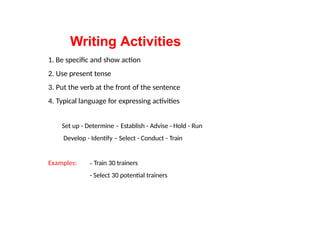
Writing Activities
1. Be specific and show action
2. Use present tense
3. Put the verb at the front of the sentence
4. Typical language for expressing activities
Set up - Determine – Establish - Advise - Hold - Run
Develop - Identify – Select - Conduct - Train
Examples: - Train 30 trainers
- Select 30 potential trainers
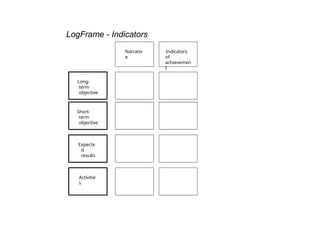
Narrativ
e
Long-
term
objective
Short-
term
objective
Expecte
d
results
Activitie
s
Indicators
of
achievemen
t
LogFrame - Indicators
How indicators are described
Target group (for whom/what to be measured)
➢ Quantity (how much)
➢ Quality (how well)
➢ Time (by when)
➢ Location (where)
Example
➢ Define objective - e.g. education status improved
➢ Define target group - e.g. graduates completing degree courses
➢ Specify quality - e.g. number of graduates completing degree courses increased
➢ Specify quantity - e.g. number of graduates completing degree courses increased
from 500 to 1000
➢ Specify timeframe - e.g. number of graduates increased from 500 to 1000 per year
by the year 2004
➢ Specify place - e.g. number of graduates from the Business College
completing degree courses increased from 500 to 1000 per year by the year
2004
Some characteristics
• Indicators are quantitative
• Indicators let you know that something is
changing or has changed
• Indicators are measurable
• Indicators are selected/created by people
• Indicators can be different from situation
to situation
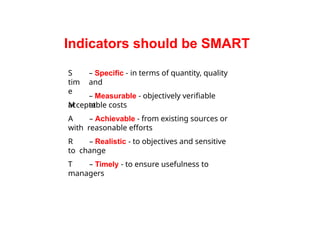
Indicators should be SMART
S
tim
e
M
– Specific - in terms of quantity, quality
and
– Measurable - objectively verifiable
at
acceptable costs
A – Achievable - from existing sources or
with reasonable efforts
R – Realistic - to objectives and sensitive
to change
T – Timely - to ensure usefulness to
managers
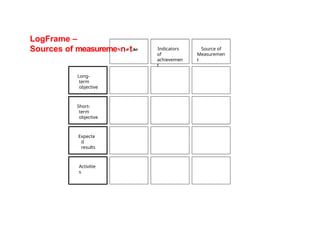
LogFrame –
Sources of measuremeNna
rrta
ti
v
e
Long-
term
objective
Short-
term
objective
Expecte
d
results
Activitie
s
Indicators
of
achievemen
t
Source of
Measuremen
t
Sources of Measurement
Specify
➢ Source of information
➢ Means of collection
Specify
➢ Format
➢ Who
➢ How regularly
Narrativ
e
Long-
term
objective
Short-
term
objective
Expecte
d
results
Activitie
s
Indicators
of
achievemen
t
Source of
Measuremen
t
Pre-
conditions
Assumption
s and
risks
Assumptions and Risks
Long-term
objective
Short-term
objective
Expected
results
Activitie
s Pre-
Conditions
Assumptions
and Risks
Assumptions
and Risks
Assumptions
and Risks
contribute
to
together with
achiev
e
achiev
e
together with
produc
e
together with
allo
w
The Role of Assumptions
19 November 2006 Project Management
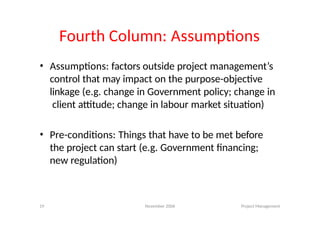
Fourth Column: Assumptions
• Assumptions: factors outside project management’s
control that may impact on the purpose-objective
linkage (e.g. change in Government policy; change in
client attitude; change in labour market situation)
• Pre-conditions: Things that have to be met before
the project can start (e.g. Government financing;
new regulation)
Narrativ
e
Long-
term
objective
Decreased
youth
unemployment
Short-
term
objective
Expecte
d
results
Activitie
s
Business
College
functioning
1.College
renovated
and
equipped
2.Curricula
developed
3. Trainers
trained
*Identification
and renovation
of buildings
*Purchase
and
installation
* Develop
Training
curriculum and
train trainers
Over 10
years
5% per year
300 students
certified per
year
Balanced
budgets
*10 classrooms
*General
facilities
*10 two-
year
curricula
*30 trainers
Inpu
t
Indicators
of
achievemen
t
national and
regional
statistics
Yearbooks
and other
records
Account
s
Site visits
Progress
reports
Costs
Source of
Measuremen
t
National
economy
recovers steadily
National
vocational
training strategy
continue
s
Pre-
conditions
All parties
provide the
agreed
contributions
No major
changes in
expert or
purchasing
prices
Assumption
s and
risks
*College staff
stays
*State
grants
continue
*Not more
than normal
drop-out rate
Enough
trainers can be
identified
Building can
be identified
Example

Preparing Logframe - How and elements in it

  • 1.
    Presentation How to fillout a Log Frame
  • 2.
    HORIZONTAL LOGIC VERTICALLOGIC Intervention Logic Objectively verifiable indicators of achievement Sources and means of verification Assumptions and Risks Long-term objective Short-term objective Expected results Activities 1, 2, 3, 4… Means: Costs: Structure of a Logframe Matrix
  • 3.
    Why do weuse LogFrame? ➢Used by major Donors to design, implement and monitor projects ➢Used for planning at all stages of the project cycle ➢Clarifies expectations of stakeholders ➢Standardises and systematises planning process ➢Differentiates types of objectives ➢Checks the logic of the project design ➢Helps to assess project risks
  • 4.
  • 5.
    Long-term objective Why isthe project relevant to society, in terms of the longer-term benefits to beneficiaries and the wider benefits to other groups? The long-term objective will not be achieved by the project alone, but will require the impacts of other programmes and projects as well. Example: Youth unemployment decreased by 20% Short-term objective A specific change in a situation to be achieved immediately (on short term) after the termination of the project. Defined in terms of the benefits to be received by the project beneficiaries or target group as a result of utilising the services provided by the programme. Example: A business college functioning Terminology
  • 6.
    Expected results The specificresults that can be expected to be produced by the project itself It should be possible for the project management to be held accountable for their delivery. Example: Business college renovated and equipped 30 trainers trained 10 business curricula developed 4 of the college's managers trained Activities The actions to be performed in order to transfer inputs into results Example: Train trainers Implement of Management training Identify and purchase of equipment Inputs The resources of the project Example: 6 work months of consultancy 12 months of training Resources for equipment and renovation Terminology
  • 7.
    Confusing Words Long-term objective:Wider Objective Overall Objective General Objective Development Objective Short-term objective: Specific Objective Immediate Objective Project Purpose Expected results: Outputs Outcome s Activities: Action s Inputs: Resources Means
  • 8.
  • 9.
    Writing Objectives andResults 1. The verb should show a completed state (Typically the past tense) 2. Objectives are positive 3. Put the word at the end of the sentence 4. Typical language for expressing objectives Reduced - Minimized – Established - Improved - Enlarged - Maximized Strengthened - Achieved – Functioning - Enhanced - Reinforced - Decreased Examples: - Unemployment decreased - Management capacity enhanced
  • 10.
    Writing Activities 1. Bespecific and show action 2. Use present tense 3. Put the verb at the front of the sentence 4. Typical language for expressing activities Set up - Determine – Establish - Advise - Hold - Run Develop - Identify – Select - Conduct - Train Examples: - Train 30 trainers - Select 30 potential trainers
  • 11.
  • 12.
    How indicators aredescribed Target group (for whom/what to be measured) ➢ Quantity (how much) ➢ Quality (how well) ➢ Time (by when) ➢ Location (where) Example ➢ Define objective - e.g. education status improved ➢ Define target group - e.g. graduates completing degree courses ➢ Specify quality - e.g. number of graduates completing degree courses increased ➢ Specify quantity - e.g. number of graduates completing degree courses increased from 500 to 1000 ➢ Specify timeframe - e.g. number of graduates increased from 500 to 1000 per year by the year 2004 ➢ Specify place - e.g. number of graduates from the Business College completing degree courses increased from 500 to 1000 per year by the year 2004
  • 13.
    Some characteristics • Indicatorsare quantitative • Indicators let you know that something is changing or has changed • Indicators are measurable • Indicators are selected/created by people • Indicators can be different from situation to situation
  • 14.
    Indicators should beSMART S tim e M – Specific - in terms of quantity, quality and – Measurable - objectively verifiable at acceptable costs A – Achievable - from existing sources or with reasonable efforts R – Realistic - to objectives and sensitive to change T – Timely - to ensure usefulness to managers
  • 15.
    LogFrame – Sources ofmeasuremeNna rrta ti v e Long- term objective Short- term objective Expecte d results Activitie s Indicators of achievemen t Source of Measuremen t
  • 16.
    Sources of Measurement Specify ➢Source of information ➢ Means of collection Specify ➢ Format ➢ Who ➢ How regularly
  • 17.
  • 18.
    Long-term objective Short-term objective Expected results Activitie s Pre- Conditions Assumptions and Risks Assumptions andRisks Assumptions and Risks contribute to together with achiev e achiev e together with produc e together with allo w The Role of Assumptions
  • 19.
    19 November 2006Project Management Fourth Column: Assumptions • Assumptions: factors outside project management’s control that may impact on the purpose-objective linkage (e.g. change in Government policy; change in client attitude; change in labour market situation) • Pre-conditions: Things that have to be met before the project can start (e.g. Government financing; new regulation)
  • 20.
    Narrativ e Long- term objective Decreased youth unemployment Short- term objective Expecte d results Activitie s Business College functioning 1.College renovated and equipped 2.Curricula developed 3. Trainers trained *Identification and renovation ofbuildings *Purchase and installation * Develop Training curriculum and train trainers Over 10 years 5% per year 300 students certified per year Balanced budgets *10 classrooms *General facilities *10 two- year curricula *30 trainers Inpu t Indicators of achievemen t national and regional statistics Yearbooks and other records Account s Site visits Progress reports Costs Source of Measuremen t National economy recovers steadily National vocational training strategy continue s Pre- conditions All parties provide the agreed contributions No major changes in expert or purchasing prices Assumption s and risks *College staff stays *State grants continue *Not more than normal drop-out rate Enough trainers can be identified Building can be identified Example