PREFORMULATION STUDY FOR
CANDESARTAN CILEXETIL
BUCCAL (EFFERVESCENT)
TABLET
Prepared by:
Aishwarya Mahangade
First year M. Pharmacy, Department of Pharmaceutics,
P.E.Societies Modern College of Pharmacy, Nigdi
Introduction to Drug
• Candesartan cilexetil is a novel, potent, and highly selective non-
peptide angiotensin II type 1 receptor blocker. It is a hydrophobic drug
that belongs to the BCS Class II drug. For enhancement, the
bioavailability and quick systemic action of Candesartan cilexetil a
novel formulation of buccal (effervescent) tablet, was designed.
• Its ionization constant is about 6.0, and LogP value is 4.79 2,
• Therapeutic Use: It is mainly used in the treatment of hypertension.
When it is administered orally, it is completely hydrolyzed from
candesartan cilexetil to candesartan, an active moiety.
• It is a hydrophobic drug that belongs to the BCS Class II drug.
• Its oral bioavailability is 15-40%; hence it is poorly absorbing from GIT.
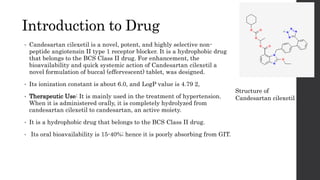
Structure of
Candesartan cilexetil
Why preformulation is important?
• A preformulation study is a group of the testing parameter that focus on the
physicochemical parameter of drug substance that could affect the drug
performance and development of dosage form.
• The preformulation study provides information that supports developing
effective, bioavailable, safe, stable, and robust formulation.
• Preformulation study gives information regarding the physicochemical
properties of drug substance, its compatibility with other Excipients,
solubility, and partition coefficient of drug substance, an analytical method
for evaluation of drug substance.
Types of preformulation studies
• Micromeritics properties
1. Bulk density (du),
2. Tapped density (db),
3. Compressibility Index (% C)
• HPLC method for estimation
• Solubility studies
• Relative Humidity.
• FTIR and DSC.
• Melting point
• Hygroscopicity
Micromeritic properties
• Bulk Density (DU): An accurately weighed sample of granulation was carefully added to the measuring
cylinder with the aid of a funnel. Then the volume was noted. Apparent bulk density was determined by
the following formula:-
DU = M /Vu
Where M = Mass of granulation in g Vu = volume of granulation (Initial untapped volume).
• Tapped Bulk Density: (DB): The above procedure was followed. The volume of the packing was determined
in an apparatus consisting of a graduated cylinder mounted on a mechanical tapping device. The final
volume was tapped till no further reduction in volume was noted. Packed bulk density was determined by
the following formula.
DB = m/Vb
Where m = mass of granulation in gm Vb = volume
of granulation (Final tapped volume).
Significance: Particle density shows the packing of powder particles.
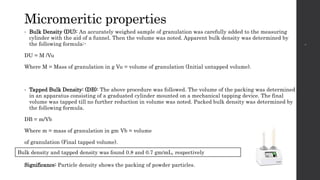
Bulk density and tapped density was found 0.8 and 0.7 gm/mL, respectively
Micromeritic properties
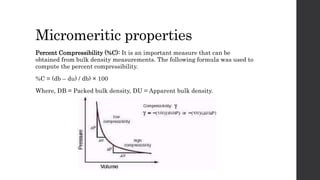
Percent Compressibility (%C): It is an important measure that can be
obtained from bulk density measurements. The following formula was used to
compute the percent compressibility.
%C = (db – du) / db) × 100
Where, DB = Packed bulk density, DU = Apparent bulk density.
HPLC method of estimation
• The separation principle of HPLC is based on the distribution of the analyte
(sample) between a mobile phase (eluent) and a stationary phase (packing
material of the column). Depending on the chemical structure of the analyte,
the molecules are retarded while passing the stationary phase.
• A detection unit (e.g. UV detector) recognizes the analytes after leaving the
column. The signals are converted and recorded by a data management
system (computer software) and then shown in a chromatogram.
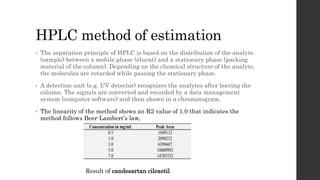
• The linearity of the method shows an R2 value of 1.0 that indicates the
method follows Beer-Lambert's law,
Result of candesartan cilexetil
Solubility Studies
• Significance: Solubility data helps to predict the dissolution media condition,
selection of mobile phase, and diluent for development of the
chromatographic method, possible interaction, and stability of the API in
particular media.
• Procedure: Take 200 ml flask. Add 100 ml solvent (Buffers/ purified water).
Shake the flake by a magnetic stirrer. Maintain a temperature of 37 °C. Add
drugs until it remains undissolved. Shake the flask for 12hr.
• Filter the solution with a 0.45 μ filter, analyses filtrate by assay analysis
method. Dilute the sample if required. pH-dependent solubility of
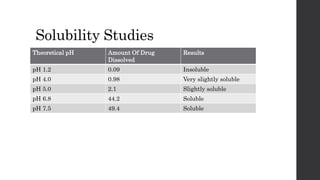
candesartan cilexetil was done in various pH media at temperature 25oC.
The media for solubility tests were purified water, phosphate buffer pH 1.2,
4.0, 5.0, 6.8, and 7.5.
Solubility Studies
Theoretical pH Amount Of Drug
Dissolved
Results
pH 1.2 0.09 Insoluble
pH 4.0 0.98 Very slightly soluble
pH 5.0 2.1 Slightly soluble
pH 6.8 44.2 Soluble
pH 7.5 49.4 Soluble
Hygroscopicity
• Hygroscopicity is the measurement of a material's ability to absorb or
release water as a function of humidity (i.e. water activity).
• The ideal way of measuring Hygroscopicity would be to create a Moisture
sorption isotherm by looking at the change in water content vs. relative
humidity at a constant temperature.
The ability of Candesartan cilexetil to absorb moisture was less than 0.1% when it was exposed to
80% Relative Humidity for 24 H. This indicates that the material was non-hygroscopic in nature.
Melting Point Determination
• The melting point of a substance is the temperature at which the material
changes from a solid to a liquid state. Pure crystalline substances have a
clear, sharply defined melting point. During the melting process, all of the
energy added to a substance is consumed as heat of fusion, and the
temperature remains constant.
• Melting Point Determination: Fill a capillary tube with crystals about 3 mm
high. Put the capillary tube (open end down) into the crystals and tap it on
the bottom of the crystallization dish to get the crystals into the tube. Force
the crystals to slide to the bottom of the tube using one of the following
methods:
• Tap the tube (open end up) on the lab bench; drop the capillary tube through
a 2-3 foot piece of glass tubing, or rub the capillary tube along a piece of wire
gauze. Place the capillary tube in the MEL-TEMP melting point apparatus.
Melting Point Determination
• Set the MEL-TEMP at a high enough level to make a rapid determination of
the melting point. Observe the melting process through the magnifying lens.
• Once a melting point range is determined, prepare another capillary tube
(tubes should only be used once and then discarded) and set the MEL-TEMP
to the appropriate power level, based on the power level/temperature chart.
This time, make sure that the increase in temperature is no more than 2 °C
per minute. Again, observe through the lens.
The melting range for Candesartan Cilexetil was found to be 161-165OC.
Compatibility studies
FTIR and DSC
• FTIR analysis is used for the identification of organic, inorganic, and
polymeric materials utilizing infrared light for scanning the samples.
Alterations in the characteristic pattern of absorption bands clearly indicate
a change in the material composition.
• Differential scanning calorimetry (DSC) is a thermoanalytical technique in
which the difference in the amount of heat required to increase the
temperature of a sample and reference is measured as a function of
temperature.
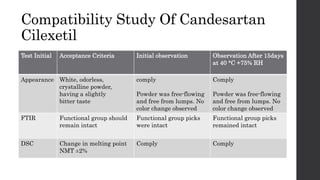
Compatibility Study Of Candesartan
Cilexetil
Test Initial Acceptance Criteria Initial observation Observation After 15days
at 40 °C +75% RH
Appearance White, odorless,
crystalline powder,
having a slightly
bitter taste
comply
Powder was free-flowing
and free from lumps. No
color change observed
Comply
Powder was free-flowing
and free from lumps. No
color change observed
FTIR Functional group should
remain intact
Functional group picks
were intact
Functional group picks
remained intact
DSC Change in melting point
NMT ±2%
Comply Comply
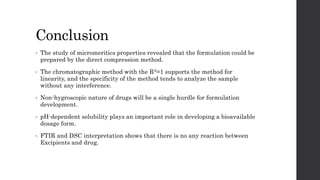
Conclusion
• The study of micromeritics properties revealed that the formulation could be
prepared by the direct compression method.
• The chromatographic method with the R2=1 supports the method for
linearity, and the specificity of the method tends to analyze the sample
without any interference.
• Non-hygroscopic nature of drugs will be a single hurdle for formulation
development.
• pH-dependent solubility plays an important role in developing a bioavailable
dosage form.
• FTIR and DSC interpretation shows that there is no any reaction between
Excipients and drug.

Preformulation study for candesartan cilexetil buccal (effervescent

  • 1.
    PREFORMULATION STUDY FOR CANDESARTANCILEXETIL BUCCAL (EFFERVESCENT) TABLET Prepared by: Aishwarya Mahangade First year M. Pharmacy, Department of Pharmaceutics, P.E.Societies Modern College of Pharmacy, Nigdi
  • 2.
    Introduction to Drug •Candesartan cilexetil is a novel, potent, and highly selective non- peptide angiotensin II type 1 receptor blocker. It is a hydrophobic drug that belongs to the BCS Class II drug. For enhancement, the bioavailability and quick systemic action of Candesartan cilexetil a novel formulation of buccal (effervescent) tablet, was designed. • Its ionization constant is about 6.0, and LogP value is 4.79 2, • Therapeutic Use: It is mainly used in the treatment of hypertension. When it is administered orally, it is completely hydrolyzed from candesartan cilexetil to candesartan, an active moiety. • It is a hydrophobic drug that belongs to the BCS Class II drug. • Its oral bioavailability is 15-40%; hence it is poorly absorbing from GIT. Structure of Candesartan cilexetil
  • 3.
    Why preformulation isimportant? • A preformulation study is a group of the testing parameter that focus on the physicochemical parameter of drug substance that could affect the drug performance and development of dosage form. • The preformulation study provides information that supports developing effective, bioavailable, safe, stable, and robust formulation. • Preformulation study gives information regarding the physicochemical properties of drug substance, its compatibility with other Excipients, solubility, and partition coefficient of drug substance, an analytical method for evaluation of drug substance.
  • 4.
    Types of preformulationstudies • Micromeritics properties 1. Bulk density (du), 2. Tapped density (db), 3. Compressibility Index (% C) • HPLC method for estimation • Solubility studies • Relative Humidity. • FTIR and DSC. • Melting point • Hygroscopicity
  • 5.
    Micromeritic properties • BulkDensity (DU): An accurately weighed sample of granulation was carefully added to the measuring cylinder with the aid of a funnel. Then the volume was noted. Apparent bulk density was determined by the following formula:- DU = M /Vu Where M = Mass of granulation in g Vu = volume of granulation (Initial untapped volume). • Tapped Bulk Density: (DB): The above procedure was followed. The volume of the packing was determined in an apparatus consisting of a graduated cylinder mounted on a mechanical tapping device. The final volume was tapped till no further reduction in volume was noted. Packed bulk density was determined by the following formula. DB = m/Vb Where m = mass of granulation in gm Vb = volume of granulation (Final tapped volume). Significance: Particle density shows the packing of powder particles. Bulk density and tapped density was found 0.8 and 0.7 gm/mL, respectively
  • 6.
    Micromeritic properties Percent Compressibility(%C): It is an important measure that can be obtained from bulk density measurements. The following formula was used to compute the percent compressibility. %C = (db – du) / db) × 100 Where, DB = Packed bulk density, DU = Apparent bulk density.
  • 7.
    HPLC method ofestimation • The separation principle of HPLC is based on the distribution of the analyte (sample) between a mobile phase (eluent) and a stationary phase (packing material of the column). Depending on the chemical structure of the analyte, the molecules are retarded while passing the stationary phase. • A detection unit (e.g. UV detector) recognizes the analytes after leaving the column. The signals are converted and recorded by a data management system (computer software) and then shown in a chromatogram. • The linearity of the method shows an R2 value of 1.0 that indicates the method follows Beer-Lambert's law, Result of candesartan cilexetil
  • 8.
    Solubility Studies • Significance:Solubility data helps to predict the dissolution media condition, selection of mobile phase, and diluent for development of the chromatographic method, possible interaction, and stability of the API in particular media. • Procedure: Take 200 ml flask. Add 100 ml solvent (Buffers/ purified water). Shake the flake by a magnetic stirrer. Maintain a temperature of 37 °C. Add drugs until it remains undissolved. Shake the flask for 12hr. • Filter the solution with a 0.45 μ filter, analyses filtrate by assay analysis method. Dilute the sample if required. pH-dependent solubility of candesartan cilexetil was done in various pH media at temperature 25oC. The media for solubility tests were purified water, phosphate buffer pH 1.2, 4.0, 5.0, 6.8, and 7.5.
  • 9.
    Solubility Studies Theoretical pHAmount Of Drug Dissolved Results pH 1.2 0.09 Insoluble pH 4.0 0.98 Very slightly soluble pH 5.0 2.1 Slightly soluble pH 6.8 44.2 Soluble pH 7.5 49.4 Soluble
  • 10.
    Hygroscopicity • Hygroscopicity isthe measurement of a material's ability to absorb or release water as a function of humidity (i.e. water activity). • The ideal way of measuring Hygroscopicity would be to create a Moisture sorption isotherm by looking at the change in water content vs. relative humidity at a constant temperature. The ability of Candesartan cilexetil to absorb moisture was less than 0.1% when it was exposed to 80% Relative Humidity for 24 H. This indicates that the material was non-hygroscopic in nature.
  • 11.
    Melting Point Determination •The melting point of a substance is the temperature at which the material changes from a solid to a liquid state. Pure crystalline substances have a clear, sharply defined melting point. During the melting process, all of the energy added to a substance is consumed as heat of fusion, and the temperature remains constant. • Melting Point Determination: Fill a capillary tube with crystals about 3 mm high. Put the capillary tube (open end down) into the crystals and tap it on the bottom of the crystallization dish to get the crystals into the tube. Force the crystals to slide to the bottom of the tube using one of the following methods: • Tap the tube (open end up) on the lab bench; drop the capillary tube through a 2-3 foot piece of glass tubing, or rub the capillary tube along a piece of wire gauze. Place the capillary tube in the MEL-TEMP melting point apparatus.
  • 12.
    Melting Point Determination •Set the MEL-TEMP at a high enough level to make a rapid determination of the melting point. Observe the melting process through the magnifying lens. • Once a melting point range is determined, prepare another capillary tube (tubes should only be used once and then discarded) and set the MEL-TEMP to the appropriate power level, based on the power level/temperature chart. This time, make sure that the increase in temperature is no more than 2 °C per minute. Again, observe through the lens. The melting range for Candesartan Cilexetil was found to be 161-165OC.
  • 13.
    Compatibility studies FTIR andDSC • FTIR analysis is used for the identification of organic, inorganic, and polymeric materials utilizing infrared light for scanning the samples. Alterations in the characteristic pattern of absorption bands clearly indicate a change in the material composition. • Differential scanning calorimetry (DSC) is a thermoanalytical technique in which the difference in the amount of heat required to increase the temperature of a sample and reference is measured as a function of temperature.
  • 14.
    Compatibility Study OfCandesartan Cilexetil Test Initial Acceptance Criteria Initial observation Observation After 15days at 40 °C +75% RH Appearance White, odorless, crystalline powder, having a slightly bitter taste comply Powder was free-flowing and free from lumps. No color change observed Comply Powder was free-flowing and free from lumps. No color change observed FTIR Functional group should remain intact Functional group picks were intact Functional group picks remained intact DSC Change in melting point NMT ±2% Comply Comply
  • 15.
    Conclusion • The studyof micromeritics properties revealed that the formulation could be prepared by the direct compression method. • The chromatographic method with the R2=1 supports the method for linearity, and the specificity of the method tends to analyze the sample without any interference. • Non-hygroscopic nature of drugs will be a single hurdle for formulation development. • pH-dependent solubility plays an important role in developing a bioavailable dosage form. • FTIR and DSC interpretation shows that there is no any reaction between Excipients and drug.