MODULE 1
Predictive Analytics and Modeling in Life Insurance
About Life Insurance
• Contract between an insurance policy holder and an insurer or
assurer, where the insurer promises to pay a designated beneficiary
a sum of money (the benefit) in exchange for a premium, upon the
death of an insured person (often the policy holder).
• Two categories: protection and investment policies.
• History: burial clubs in Rome, then in London 1706 there was first
company in London to offer life insurance.
• Why is it useful for individuals to have life insurance?
Individual Perspective
o Providing survivors way to pay monthly bills. Also, payment of
descendant's final expenses and mortgages.
o In USA, funding future education expenses.
o Paying amount due for assets.
o Insuring insurability. That is the chance your health gets worse soon.
• Insurance companies try to charge a premium and hopefully end
payment will be lower than sum of premiums collected.
• Insurance company takes on risk made by individual. By insuring
large pool of individuals, it diversifies risk and makes it manageable.
• Insurance company has fixed cost (administration and similar) and
also final claim.
• Premiums cover insurance company’s costs and also provide it with
profit.
Benefits for Business – Insurance
Companies
• There are legal problems, which we will not discuss in detail in this
course.
• Interesting for us: managing risk. Offering competitive premium
which will still provide insurance company a profit.
• First attempts (still relevant): mortality tables.
• Get the actual duration before person dies as close as possible.
• Special cases: What happens if there is a suicide?
Challenges for Insurance Company
o It gets complicated, but if it is within two years, then, in USA company
does not have to cover. This is different in different countries and even
states.
• Defining the best possible premium – amount of money insurance
policy holder pays and how often (usually every month).
• Defining benefits.
• What to do with paid premiums/money? If it just keeps it, inflation
might devalue it.
• Reinsurance problem – what if it comes to shock because of which a
lot of people die at once (example disease)?
• Assurance and insurance: also protection of events that might
happen
Challenges for Insurance Company
• Problems are usually of mathematical nature
• Insurance company needs models to reduce risk and predict the
future.
• This helps them with planning and making their business
sustainable.
• There comes the need for predictive models and modeling in
general.
Challenges for Insurance Company
Predictive Modeling Usability
• The mortality tables provide a baseline for the cost of insurance, but
the health and family history of the individual applicant is also taken
into account
• The investigation and resulting evaluation is termed underwriting.
• Factors to include:
o Personal medical history
o Family medical history
o Driving record
o Height and weight matrix, BMI (Body Mass Index)
Predictive Modeling Usability
• Predictive modeling also improves
marketing and risk classification.
• Fraud detection and differentiation is
another usage.
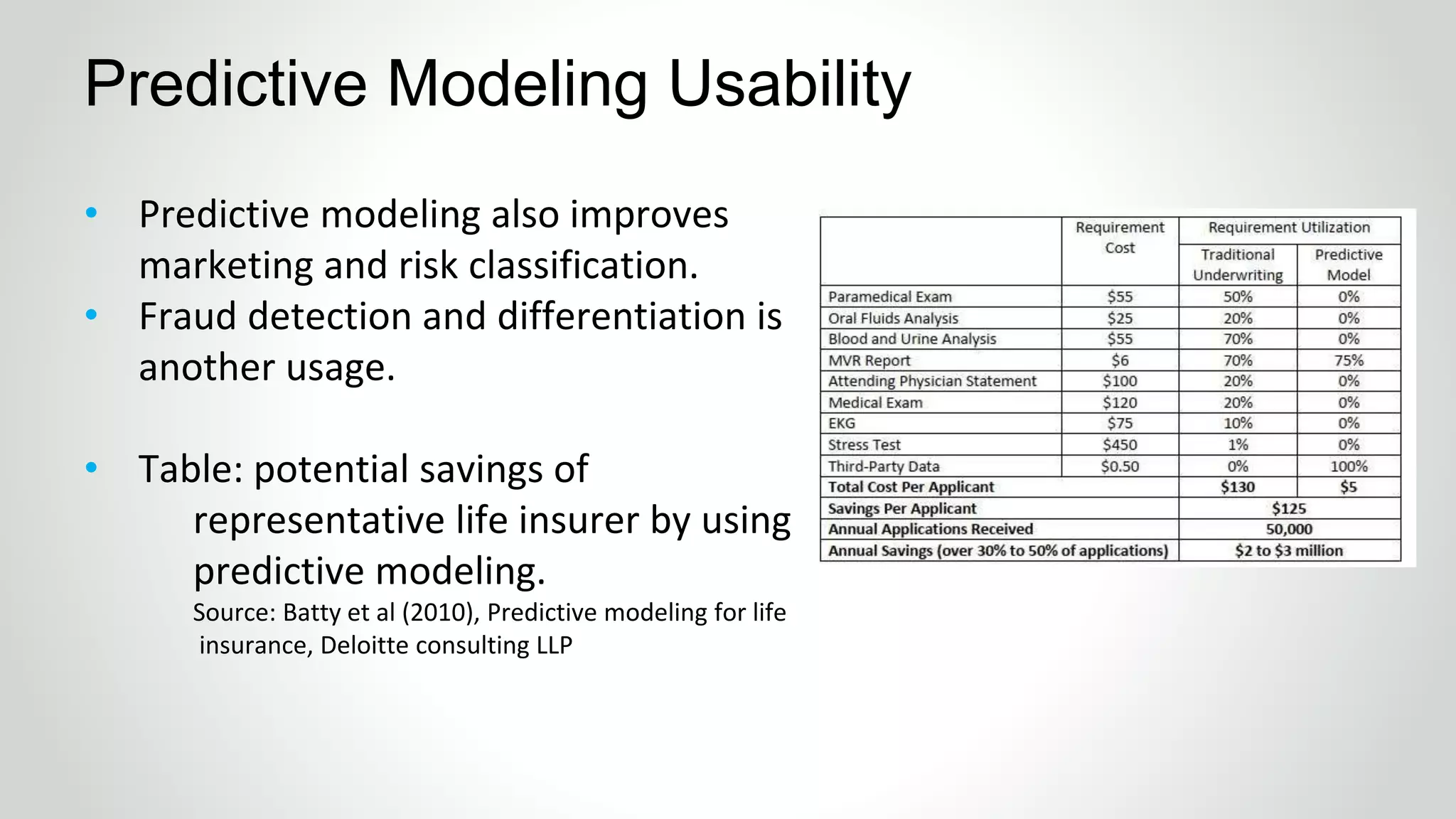
• Table: potential savings of
representative life insurer by using
predictive modeling.
Source: Batty et al (2010), Predictive modeling for life
insurance, Deloitte consulting LLP
Brief History of Predictive Analytics in
Insurance
• 17th century: use of mortality tables (John Graunt and Edmund Halley).
• In 20th century, general insurance actuaries used generalized linear
models and empirical Bayes techniques for pricing of short-term
insurance policies.
• Between 1787 and 1837 more than two dozen life insurance
companies were started, but fewer than half a dozen survived.
• As the time went on, the datasets were becoming bigger and more
things could be used for predictions.
Brief History of Predictive Analytics in
Insurance
• The real growth of predictive analytics came in last 50 years.
• They started using questioners and collecting people’s information
about their habits and their past records.
• https://www.geico.com/life-insurance/ - online insurance where
premium is immediately calculated.
• Above uses a lot of different variables.

Predictive Analytics and Modeling in Product Pricing (Personal and Commercial Insurance)

  • 2.
    MODULE 1 Predictive Analyticsand Modeling in Life Insurance
  • 3.
    About Life Insurance •Contract between an insurance policy holder and an insurer or assurer, where the insurer promises to pay a designated beneficiary a sum of money (the benefit) in exchange for a premium, upon the death of an insured person (often the policy holder). • Two categories: protection and investment policies. • History: burial clubs in Rome, then in London 1706 there was first company in London to offer life insurance.
  • 4.
    • Why isit useful for individuals to have life insurance? Individual Perspective o Providing survivors way to pay monthly bills. Also, payment of descendant's final expenses and mortgages. o In USA, funding future education expenses. o Paying amount due for assets. o Insuring insurability. That is the chance your health gets worse soon.
  • 5.
    • Insurance companiestry to charge a premium and hopefully end payment will be lower than sum of premiums collected. • Insurance company takes on risk made by individual. By insuring large pool of individuals, it diversifies risk and makes it manageable. • Insurance company has fixed cost (administration and similar) and also final claim. • Premiums cover insurance company’s costs and also provide it with profit. Benefits for Business – Insurance Companies
  • 6.
    • There arelegal problems, which we will not discuss in detail in this course. • Interesting for us: managing risk. Offering competitive premium which will still provide insurance company a profit. • First attempts (still relevant): mortality tables. • Get the actual duration before person dies as close as possible. • Special cases: What happens if there is a suicide? Challenges for Insurance Company o It gets complicated, but if it is within two years, then, in USA company does not have to cover. This is different in different countries and even states.
  • 7.
    • Defining thebest possible premium – amount of money insurance policy holder pays and how often (usually every month). • Defining benefits. • What to do with paid premiums/money? If it just keeps it, inflation might devalue it. • Reinsurance problem – what if it comes to shock because of which a lot of people die at once (example disease)? • Assurance and insurance: also protection of events that might happen Challenges for Insurance Company
  • 8.
    • Problems areusually of mathematical nature • Insurance company needs models to reduce risk and predict the future. • This helps them with planning and making their business sustainable. • There comes the need for predictive models and modeling in general. Challenges for Insurance Company
  • 9.
    Predictive Modeling Usability •The mortality tables provide a baseline for the cost of insurance, but the health and family history of the individual applicant is also taken into account • The investigation and resulting evaluation is termed underwriting. • Factors to include: o Personal medical history o Family medical history o Driving record o Height and weight matrix, BMI (Body Mass Index)
  • 10.
    Predictive Modeling Usability •Predictive modeling also improves marketing and risk classification. • Fraud detection and differentiation is another usage. • Table: potential savings of representative life insurer by using predictive modeling. Source: Batty et al (2010), Predictive modeling for life insurance, Deloitte consulting LLP
  • 11.
    Brief History ofPredictive Analytics in Insurance • 17th century: use of mortality tables (John Graunt and Edmund Halley). • In 20th century, general insurance actuaries used generalized linear models and empirical Bayes techniques for pricing of short-term insurance policies. • Between 1787 and 1837 more than two dozen life insurance companies were started, but fewer than half a dozen survived. • As the time went on, the datasets were becoming bigger and more things could be used for predictions.
  • 12.
    Brief History ofPredictive Analytics in Insurance • The real growth of predictive analytics came in last 50 years. • They started using questioners and collecting people’s information about their habits and their past records. • https://www.geico.com/life-insurance/ - online insurance where premium is immediately calculated. • Above uses a lot of different variables.