International Research Journal of Engineering and Technology (IRJET) e-ISSN: 2395-0056
Volume: 10 Issue: 09 | Sep 2023 www.irjet.net p-ISSN: 2395-0072
© 2023, IRJET | Impact Factor value: 8.226 | ISO 9001:2008 Certified Journal | Page 586
Prediction of Wireless Sensor Network and Attack using Machine
Learning Technique
M. Nirmala Devi1, V. Pavithra2
1Student, M.E, Dept. of Computer Science and Engineering, T.J.S Engineering College, Tamil Nadu, India
2Assistant Professor, Dept. of Computer Science and Engineering,T.J.S Engineering College, Tamil Nadu, India
---------------------------------------------------------------------***---------------------------------------------------------------------
Abstract - Wireless sensor network has attractedsignificant
attention in research and development due to its tremendous
applications in medical, military and defence, medical,
environmental, industrial, infrastructure protection, and
commercial applications to enable to interact with eachother
controlled remotely. A Wireless Sensor Network (WSN) has
wide applications such as environmental monitoring and
tracking of the target nodes for communication. The sensor
nodes are equipped with wireless interfaces used for
communication between the nodes and another network.
Wireless Sensor Network suffers from many constraints that
make security a primary challenge. When the sensor node is
deployed in a communication environment unattended, the
nodes are vulnerable to various attacks. The analysis of
dataset by supervised machine learning technique(SMLT) to
capture several information’s like, variable identification,
univariate analysis, bivariate and multivariate analysis,
missing value treatments etc. A comparative study between
machine learning algorithms had been carried out in order to
determine which algorithm is the most accurate in predicting
the type WSN attacks. The results show that the effectiveness
of the proposed machine learning algorithm technique can be
compared with best accuracy, precision, Recall, F1 Score,
Sensitivity, and Specificity.
Key Words: Anaconda Navigator, Jupyterlab, Spyder,
PyCharm, Orange 3 app, Jupyter Notebook, RStudio.
1.INTRODUCTION
Wireless Sensor Network (WSN) is one of the best strategies
for some continuous applications, because of its
minimization, cost-viability, and simplicity of sending. The
capability of the WSN is to screen the field of interest, gather
the information, and send it to the base station (Passage)for
post-handling examination. Countless sensor hubs are
utilized in some WSN executions. What'smore,theseremote
hubs have a restricted battery durationand memorylimit.In
this way, to get the most out of these WSNs, there should be
an administration framework for these WSN hubs fit for
directing the relationship among themselves and with the
passageway too.
For instance, the ZigBee and 6LoWPAN are two conventions
that help the board in WSNs created by the Web Designing
Group (IETF) for standard transmission over IEEE 802.15.4.
These conventions support current administration
frameworks to utilize IEEE 802.15.4 in the 2.4 GHz bandand
backing short transmission. For instance, 6LoWPAN IPv6
gives an association between WSNs in view of IP tends to be
on various layers. It additionally utilizes the 6LoWPAN Low
Power and Misfortune Organization (RPL) standard to plan
the organization geography and utilizations the AES
encryption calculation to get the WSN association.Bethat as
it may, as the geography of these kinds of organizations is
continually transforming, it will affect network directing
systems, delay, multi-facet plan, inclusion, Nature of
Administrations (QoS), and shortcoming recognition. Inthis
way, it is important to rethink theadministrationofWSNsby
planning or consolidating new conventions to manage the
idea of the conditions for which these implanted gadgetsare
planned.
Many overviews talked about the job of AI
calculations in different fields of wireless sensor networks
and the Internet of Things (IoT). Moreover, ML calculations
enjoy an extraordinary benefit in breaking down bundles as
they travel between WSN hubs and recognizing dubious
hubs.
2. EXISTING SYSTE
In a Wireless Sensor Networks (WSN) based fluid pipeline
leak monitoring system, numerous sensors are deployed
along the pipeline networks. A great number of
measurements arecontinuouslytransmittedfromthesensor
nodes to their corresponding sink nodes. The energy
consumed on data transmission dominates the pressure
wave propagation speed, can be online updated, resulting in
improvement of the leak localization accuracy. power
depletion of a WSN system. To reduce the amount of data
transmission and prolong the lifetime of WSN, in this paper,
a Combined Dual-Prediction based Data Fusion (CDPDF)
method is proposed. Transmissions are only triggered if the
measurement is substantially different from the predicted
value. Furthermore, unlike existingmethodswhichestablish
the predictor by merely consideringthemeasurementsfrom
a single sensor, the proposed CDPDF learns and updates the
predictor by integrating measurements from multiple
neighboring sensors, hence the spatial cross-correlation is
taken into account and the prediction accuracy is
significantly improved. In this paper, an Enhanced Leak
Detection and Isolation (EnLDI) method is also proposed in
International Research Journal of Engineering and Technology (IRJET) e-ISSN: 2395-0056
Volume: 10 Issue: 09 | Sep 2023 www.irjet.net p-ISSN: 2395-0072
© 2023, IRJET | Impact Factor value: 8.226 | ISO 9001:2008 Certified Journal | Page 587
which several important parameters, such as the friction
factor and the
3. PROPOSED WORK
The proposed model is to build a machinelearningmodel for
predicting wsn attacks. Previously they finds the accurate
leak detection and isolation results only. wsn attack
detection is an important technique for recognizing fraud
activities, suspicious activities, network intrusion,andother
abnormal events that may have great significance but are
difficult to detect. The machine learning model is built by
applying proper
data science techniques like variable identification which is
the dependent and independent variables. Each and every
column’s features are analyzed.Thenthe pre-processingand
visualization of the data are done. The model is built based
on the previous dataset where the algorithm learnsdata and
gets trained different algorithms are used for better
comparisons. The performance metrics are calculated and
compared.
4. METHODOLOGY
4. 1 Preparing Dataset
This Dataset contains 500 records. It is classified
into 5 classes.
 Blackhole
 Flooding
 Grayhole
 Normal
 Scheduling
5. ANACONDA NAVIGATOR
Anaconda Navigator is a desktop graphical user
interface (GUI) included in Anaconda® distribution that
allows you to launch applications and easily manage conda
packages, environments, and channels without using
command-linecommands.Navigatorcansearchforpackages
on Anaconda.org or in a local Anaconda Repository.
Anaconda. Now, if you are primarily doing data
science work, Anaconda is also a great option. Anaconda is
created by Continuum Analytics, and it is a Python
distribution that comes preinstalled with lots of useful
python libraries for data science.
Anaconda is a distribution of the Python and R
programming languages for scientific computing (data
science, machine learning applications, large-scale data
processing, predictive analytics, etc.), that aims to simplify
package management and deployment.
In order to run, many scientific packagesdependon
specific versions of other packages. Data scientists often use
multiple versions of many packages and use multiple
environments to separate these different versions.
The command-lineprogram conda isbotha package
manager and an environment manager. This helps data
scientists ensure that each version of each package has all
the dependencies it requires and works correctly.
Navigator is an easy, point-and-click way to work
with packages and environments without needing to type
conda commands in a terminal window. You can use it to
find the packages you want, install them in an environment,
run the packages, and update them – all inside Navigator.
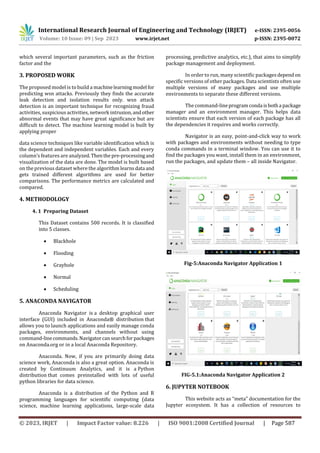
Fig-5:Anaconda Navigator Application 1
FIG-5.1:Anaconda Navigator Application 2
6. JUPYTER NOTEBOOK
This website acts as “meta” documentation for the
Jupyter ecosystem. It has a collection of resources to
International Research Journal of Engineering and Technology (IRJET) e-ISSN: 2395-0056
Volume: 10 Issue: 09 | Sep 2023 www.irjet.net p-ISSN: 2395-0072
© 2023, IRJET | Impact Factor value: 8.226 | ISO 9001:2008 Certified Journal | Page 588
navigate the tools and communities in thisecosystem,andto
help you get started.
Project Jupyter is a project and community whose
goal is to "develop open-source software, open-standards,
and services for interactive computing across dozens of
programming languages". It was spun off from IPython in
2014 by Fernando Perez.
Notebook documents are documents produced by
the Jupyter Notebook App, which contain both computer
code (e.g. python) and rich text elements (paragraph,
equations, figures, links, etc…). Notebook documents are
both human-readable documents containing the analysis
description and the results (figures, tables, etc.) as well as
executable documents which can be run to perform data
analysis.
7.System Architecture
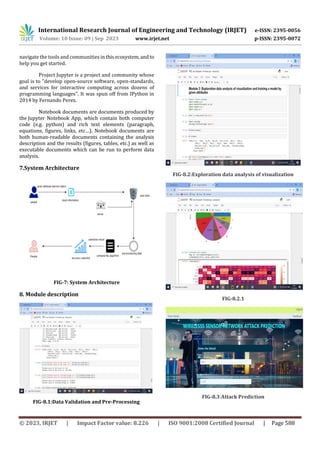
FIG-7: System Architecture
8. Module description
FIG-8.1:Data Validation and Pre-Processing
FIG-8.2:Exploration data analysis of visualization
FIG-8.2.1
FIG-8.3:Attack Prediction
International Research Journal of Engineering and Technology (IRJET) e-ISSN: 2395-0056
Volume: 10 Issue: 09 | Sep 2023 www.irjet.net p-ISSN: 2395-0072
© 2023, IRJET | Impact Factor value: 8.226 | ISO 9001:2008 Certified Journal | Page 589
FIG-8.3.1
FIG-8.3.2: Data Set
9. Conclusion
The analytical process started from data cleaning and
processing, missing value, exploratory analysis and finally
model building and evaluation. The best accuracy on public
test set of higher accuracy score algorithm will be find out.
The founded one is used in the application which can help to
find the Wireless Sensor Network Attack Prediction.
The analytical process started from data cleaning and
processing, missing value, exploratory analysis and finally
model building and evaluation. The best accuracy on public
test set of higher accuracy score algorithm will be find out.
The founded one is used in the application which can help to
find the Wireless Sensor Network Attack Prediction.
10. Reference
[1] S. Lee and T. Chung, "Data aggregation for wireless
sensor networks using self-organizing map" in Artificial
Intelligence and Simulation, Berlin, Germany:Springer-
Verlag, vol. 3397, pp. 508-517, 2005.
[2] R. Arroyo-Valles, R. Alaiz-Rodriguez, A. Guerrero-
Curieses and J. Cid-Sueiro, "Q-probabilistic routing in
wireless sensor networks", Proc. 3rd Int. Conf. Intell. Sensors
Sensor Netw. Inf., pp. 1-6, 2007.
[3] C. Guestrin, P. Bodik, R. Thibaux, M. Paskin and S.
Madden, "Distributed regression: Anefficientframework for
modeling sensor network data", Proc. 3rd Int. Symp. Inf.
Process. Sensor Netw., pp. 1-10, 2004.
[4] J. Barbancho, C. León, F. Molina and A. Barbancho,"Anew
QoS routing algorithm based on self-organizing maps for
wireless sensor networks", Telecommun. Syst., vol.36,no.1–
3, pp. 73-83, Nov. 2007.
[5] J.-M. Kim, S.-H. Park, Y.-J. Han and T.-M. Chung, "CHEF:
Cluster head election mechanism using fuzzy logic in
wireless sensor networks", Proc. 10thInt. Conf. Adv. Commun.
Technol., vol. 1, pp. 654-659, 2008.
[6] W. B. Heinzelman, Application-specific protocol
architectures for wireless networks, 2000.
[7] P. Zappi et al., "Activity recognition from on-body
sensors: Accuracy-power trade-off by dynamic sensor
selection" in Wireless Sensor Networks, Berlin, Germany:
Springer-Verlag, pp. 17-33, 2008.

Prediction of Wireless Sensor Network and Attack using Machine Learning Technique

  • 1.
    International Research Journalof Engineering and Technology (IRJET) e-ISSN: 2395-0056 Volume: 10 Issue: 09 | Sep 2023 www.irjet.net p-ISSN: 2395-0072 © 2023, IRJET | Impact Factor value: 8.226 | ISO 9001:2008 Certified Journal | Page 586 Prediction of Wireless Sensor Network and Attack using Machine Learning Technique M. Nirmala Devi1, V. Pavithra2 1Student, M.E, Dept. of Computer Science and Engineering, T.J.S Engineering College, Tamil Nadu, India 2Assistant Professor, Dept. of Computer Science and Engineering,T.J.S Engineering College, Tamil Nadu, India ---------------------------------------------------------------------***--------------------------------------------------------------------- Abstract - Wireless sensor network has attractedsignificant attention in research and development due to its tremendous applications in medical, military and defence, medical, environmental, industrial, infrastructure protection, and commercial applications to enable to interact with eachother controlled remotely. A Wireless Sensor Network (WSN) has wide applications such as environmental monitoring and tracking of the target nodes for communication. The sensor nodes are equipped with wireless interfaces used for communication between the nodes and another network. Wireless Sensor Network suffers from many constraints that make security a primary challenge. When the sensor node is deployed in a communication environment unattended, the nodes are vulnerable to various attacks. The analysis of dataset by supervised machine learning technique(SMLT) to capture several information’s like, variable identification, univariate analysis, bivariate and multivariate analysis, missing value treatments etc. A comparative study between machine learning algorithms had been carried out in order to determine which algorithm is the most accurate in predicting the type WSN attacks. The results show that the effectiveness of the proposed machine learning algorithm technique can be compared with best accuracy, precision, Recall, F1 Score, Sensitivity, and Specificity. Key Words: Anaconda Navigator, Jupyterlab, Spyder, PyCharm, Orange 3 app, Jupyter Notebook, RStudio. 1.INTRODUCTION Wireless Sensor Network (WSN) is one of the best strategies for some continuous applications, because of its minimization, cost-viability, and simplicity of sending. The capability of the WSN is to screen the field of interest, gather the information, and send it to the base station (Passage)for post-handling examination. Countless sensor hubs are utilized in some WSN executions. What'smore,theseremote hubs have a restricted battery durationand memorylimit.In this way, to get the most out of these WSNs, there should be an administration framework for these WSN hubs fit for directing the relationship among themselves and with the passageway too. For instance, the ZigBee and 6LoWPAN are two conventions that help the board in WSNs created by the Web Designing Group (IETF) for standard transmission over IEEE 802.15.4. These conventions support current administration frameworks to utilize IEEE 802.15.4 in the 2.4 GHz bandand backing short transmission. For instance, 6LoWPAN IPv6 gives an association between WSNs in view of IP tends to be on various layers. It additionally utilizes the 6LoWPAN Low Power and Misfortune Organization (RPL) standard to plan the organization geography and utilizations the AES encryption calculation to get the WSN association.Bethat as it may, as the geography of these kinds of organizations is continually transforming, it will affect network directing systems, delay, multi-facet plan, inclusion, Nature of Administrations (QoS), and shortcoming recognition. Inthis way, it is important to rethink theadministrationofWSNsby planning or consolidating new conventions to manage the idea of the conditions for which these implanted gadgetsare planned. Many overviews talked about the job of AI calculations in different fields of wireless sensor networks and the Internet of Things (IoT). Moreover, ML calculations enjoy an extraordinary benefit in breaking down bundles as they travel between WSN hubs and recognizing dubious hubs. 2. EXISTING SYSTE In a Wireless Sensor Networks (WSN) based fluid pipeline leak monitoring system, numerous sensors are deployed along the pipeline networks. A great number of measurements arecontinuouslytransmittedfromthesensor nodes to their corresponding sink nodes. The energy consumed on data transmission dominates the pressure wave propagation speed, can be online updated, resulting in improvement of the leak localization accuracy. power depletion of a WSN system. To reduce the amount of data transmission and prolong the lifetime of WSN, in this paper, a Combined Dual-Prediction based Data Fusion (CDPDF) method is proposed. Transmissions are only triggered if the measurement is substantially different from the predicted value. Furthermore, unlike existingmethodswhichestablish the predictor by merely consideringthemeasurementsfrom a single sensor, the proposed CDPDF learns and updates the predictor by integrating measurements from multiple neighboring sensors, hence the spatial cross-correlation is taken into account and the prediction accuracy is significantly improved. In this paper, an Enhanced Leak Detection and Isolation (EnLDI) method is also proposed in
  • 2.
    International Research Journalof Engineering and Technology (IRJET) e-ISSN: 2395-0056 Volume: 10 Issue: 09 | Sep 2023 www.irjet.net p-ISSN: 2395-0072 © 2023, IRJET | Impact Factor value: 8.226 | ISO 9001:2008 Certified Journal | Page 587 which several important parameters, such as the friction factor and the 3. PROPOSED WORK The proposed model is to build a machinelearningmodel for predicting wsn attacks. Previously they finds the accurate leak detection and isolation results only. wsn attack detection is an important technique for recognizing fraud activities, suspicious activities, network intrusion,andother abnormal events that may have great significance but are difficult to detect. The machine learning model is built by applying proper data science techniques like variable identification which is the dependent and independent variables. Each and every column’s features are analyzed.Thenthe pre-processingand visualization of the data are done. The model is built based on the previous dataset where the algorithm learnsdata and gets trained different algorithms are used for better comparisons. The performance metrics are calculated and compared. 4. METHODOLOGY 4. 1 Preparing Dataset This Dataset contains 500 records. It is classified into 5 classes.  Blackhole  Flooding  Grayhole  Normal  Scheduling 5. ANACONDA NAVIGATOR Anaconda Navigator is a desktop graphical user interface (GUI) included in Anaconda® distribution that allows you to launch applications and easily manage conda packages, environments, and channels without using command-linecommands.Navigatorcansearchforpackages on Anaconda.org or in a local Anaconda Repository. Anaconda. Now, if you are primarily doing data science work, Anaconda is also a great option. Anaconda is created by Continuum Analytics, and it is a Python distribution that comes preinstalled with lots of useful python libraries for data science. Anaconda is a distribution of the Python and R programming languages for scientific computing (data science, machine learning applications, large-scale data processing, predictive analytics, etc.), that aims to simplify package management and deployment. In order to run, many scientific packagesdependon specific versions of other packages. Data scientists often use multiple versions of many packages and use multiple environments to separate these different versions. The command-lineprogram conda isbotha package manager and an environment manager. This helps data scientists ensure that each version of each package has all the dependencies it requires and works correctly. Navigator is an easy, point-and-click way to work with packages and environments without needing to type conda commands in a terminal window. You can use it to find the packages you want, install them in an environment, run the packages, and update them – all inside Navigator. Fig-5:Anaconda Navigator Application 1 FIG-5.1:Anaconda Navigator Application 2 6. JUPYTER NOTEBOOK This website acts as “meta” documentation for the Jupyter ecosystem. It has a collection of resources to
  • 3.
    International Research Journalof Engineering and Technology (IRJET) e-ISSN: 2395-0056 Volume: 10 Issue: 09 | Sep 2023 www.irjet.net p-ISSN: 2395-0072 © 2023, IRJET | Impact Factor value: 8.226 | ISO 9001:2008 Certified Journal | Page 588 navigate the tools and communities in thisecosystem,andto help you get started. Project Jupyter is a project and community whose goal is to "develop open-source software, open-standards, and services for interactive computing across dozens of programming languages". It was spun off from IPython in 2014 by Fernando Perez. Notebook documents are documents produced by the Jupyter Notebook App, which contain both computer code (e.g. python) and rich text elements (paragraph, equations, figures, links, etc…). Notebook documents are both human-readable documents containing the analysis description and the results (figures, tables, etc.) as well as executable documents which can be run to perform data analysis. 7.System Architecture FIG-7: System Architecture 8. Module description FIG-8.1:Data Validation and Pre-Processing FIG-8.2:Exploration data analysis of visualization FIG-8.2.1 FIG-8.3:Attack Prediction
  • 4.
    International Research Journalof Engineering and Technology (IRJET) e-ISSN: 2395-0056 Volume: 10 Issue: 09 | Sep 2023 www.irjet.net p-ISSN: 2395-0072 © 2023, IRJET | Impact Factor value: 8.226 | ISO 9001:2008 Certified Journal | Page 589 FIG-8.3.1 FIG-8.3.2: Data Set 9. Conclusion The analytical process started from data cleaning and processing, missing value, exploratory analysis and finally model building and evaluation. The best accuracy on public test set of higher accuracy score algorithm will be find out. The founded one is used in the application which can help to find the Wireless Sensor Network Attack Prediction. The analytical process started from data cleaning and processing, missing value, exploratory analysis and finally model building and evaluation. The best accuracy on public test set of higher accuracy score algorithm will be find out. The founded one is used in the application which can help to find the Wireless Sensor Network Attack Prediction. 10. Reference [1] S. Lee and T. Chung, "Data aggregation for wireless sensor networks using self-organizing map" in Artificial Intelligence and Simulation, Berlin, Germany:Springer- Verlag, vol. 3397, pp. 508-517, 2005. [2] R. Arroyo-Valles, R. Alaiz-Rodriguez, A. Guerrero- Curieses and J. Cid-Sueiro, "Q-probabilistic routing in wireless sensor networks", Proc. 3rd Int. Conf. Intell. Sensors Sensor Netw. Inf., pp. 1-6, 2007. [3] C. Guestrin, P. Bodik, R. Thibaux, M. Paskin and S. Madden, "Distributed regression: Anefficientframework for modeling sensor network data", Proc. 3rd Int. Symp. Inf. Process. Sensor Netw., pp. 1-10, 2004. [4] J. Barbancho, C. León, F. Molina and A. Barbancho,"Anew QoS routing algorithm based on self-organizing maps for wireless sensor networks", Telecommun. Syst., vol.36,no.1– 3, pp. 73-83, Nov. 2007. [5] J.-M. Kim, S.-H. Park, Y.-J. Han and T.-M. Chung, "CHEF: Cluster head election mechanism using fuzzy logic in wireless sensor networks", Proc. 10thInt. Conf. Adv. Commun. Technol., vol. 1, pp. 654-659, 2008. [6] W. B. Heinzelman, Application-specific protocol architectures for wireless networks, 2000. [7] P. Zappi et al., "Activity recognition from on-body sensors: Accuracy-power trade-off by dynamic sensor selection" in Wireless Sensor Networks, Berlin, Germany: Springer-Verlag, pp. 17-33, 2008.