Discrete Mathematics
BCSC 0010
Module 2
Predicate logic
(Predicates and Quantifiers)
Predicates and Quantifiers
• Propositional logic cannot adequately express the meaning of
statements in mathematics and in natural language.
Example
• "Every computer connected to the university network is
functioning properly."
Introduction
• Predicate logic is used to express the meaning of a wide
range of statements in mathematics and computer science
• Predicates
• Quantifiers
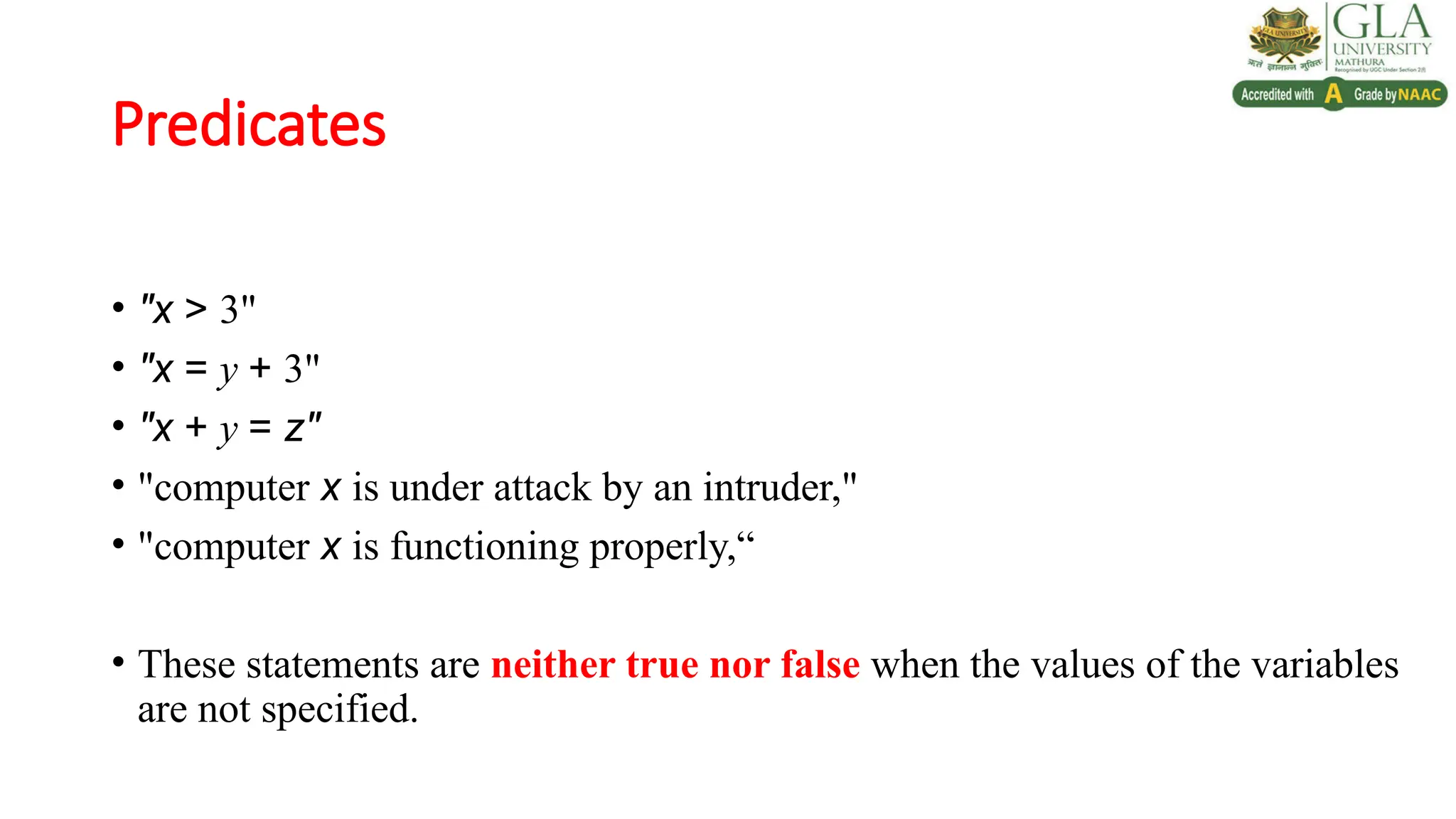
Predicates
• "x > 3"
• "x = y + 3"
• "x + y = z"
• "computer x is under attack by an intruder,"
• "computer x is functioning properly,“
• These statements are neither true nor false when the values of the variables
are not specified.
Predicates
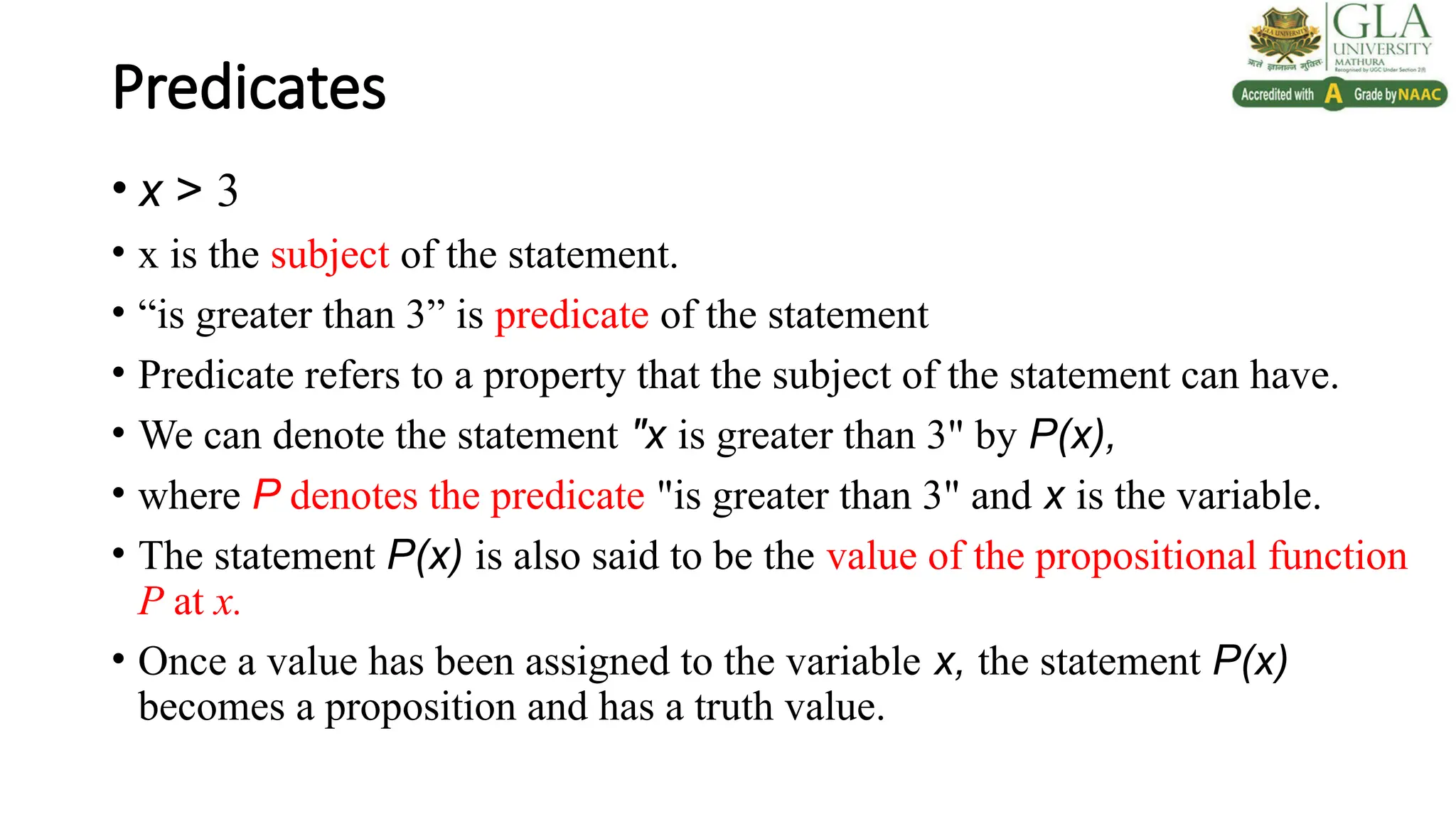
• x > 3
• x is the subject of the statement.
• “is greater than 3” is predicate of the statement
• Predicate refers to a property that the subject of the statement can have.
• We can denote the statement "x is greater than 3" by P(x),
• where P denotes the predicate "is greater than 3" and x is the variable.
• The statement P(x) is also said to be the value of the propositional function
P at x.
• Once a value has been assigned to the variable x, the statement P(x)
becomes a proposition and has a truth value.
Example
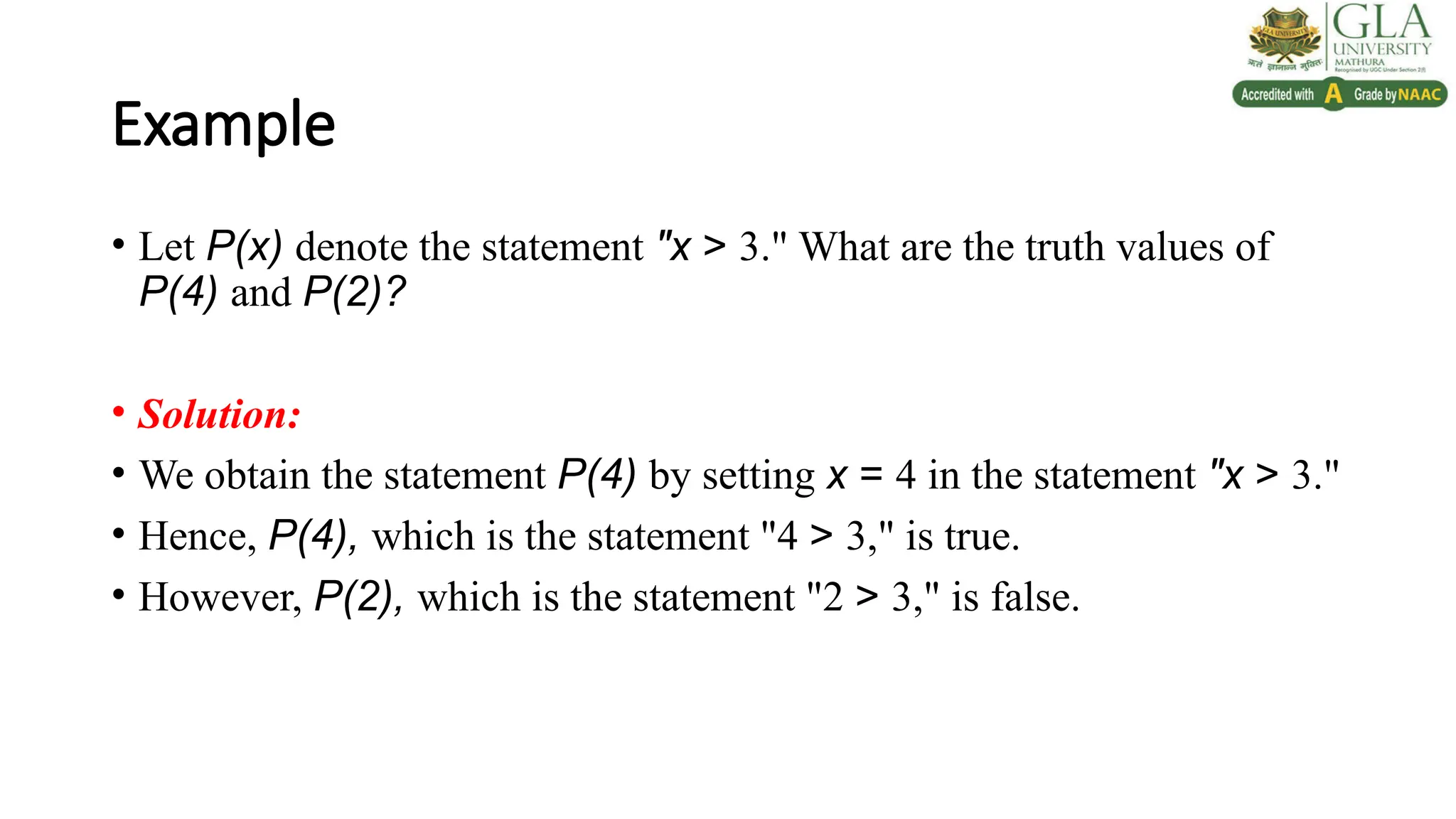
• Let P(x) denote the statement "x > 3." What are the truth values of
P(4) and P(2)?
• Solution:
• We obtain the statement P(4) by setting x = 4 in the statement "x > 3."
• Hence, P(4), which is the statement "4 > 3," is true.
• However, P(2), which is the statement "2 > 3," is false.
Example
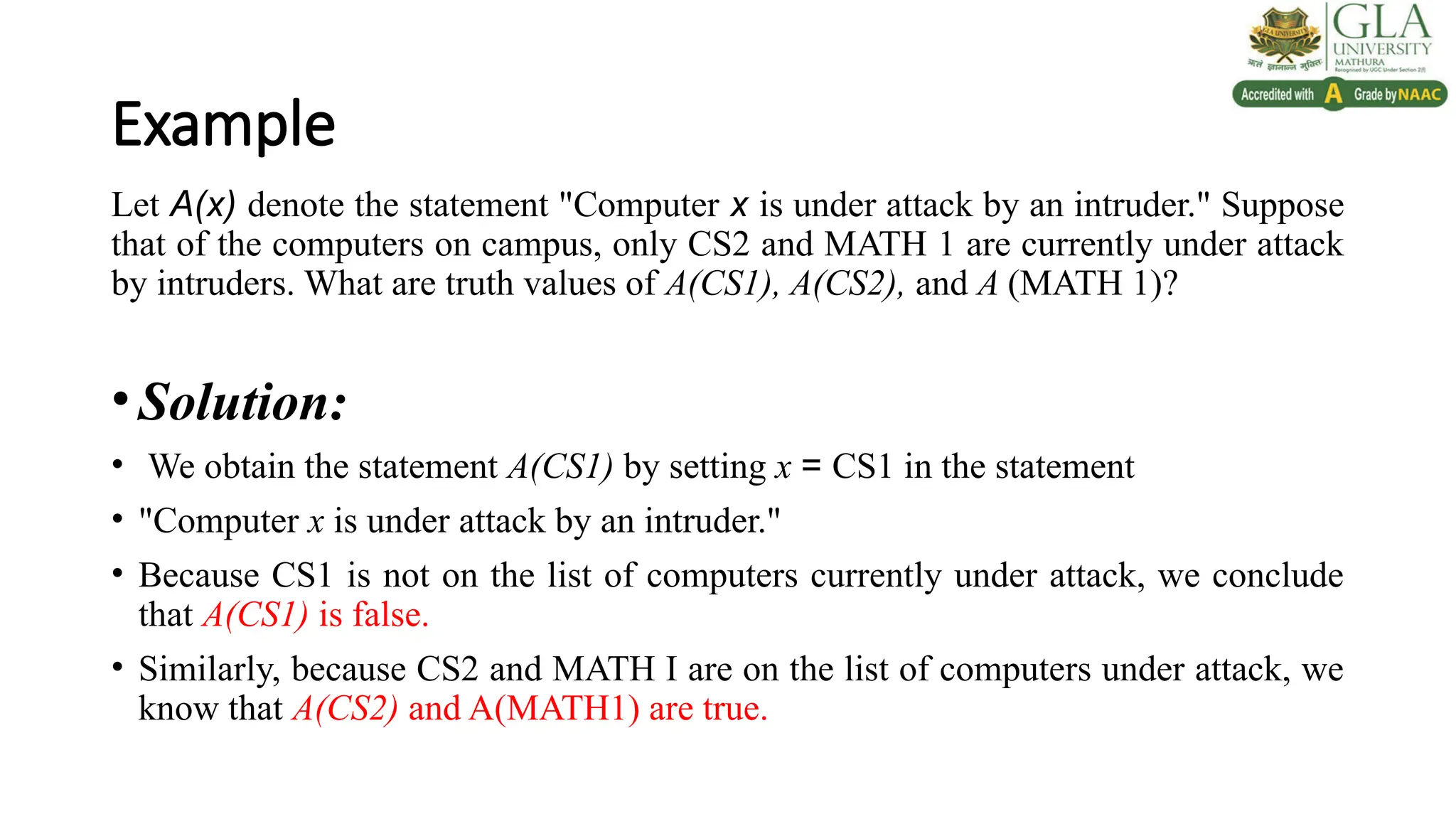
Let A(x) denote the statement "Computer x is under attack by an intruder." Suppose
that of the computers on campus, only CS2 and MATH 1 are currently under attack
by intruders. What are truth values of A(CS1), A(CS2), and A (MATH 1)?
•Solution:
• We obtain the statement A(CS1) by setting x = CS1 in the statement
• "Computer x is under attack by an intruder."
• Because CS1 is not on the list of computers currently under attack, we conclude
that A(CS1) is false.
• Similarly, because CS2 and MATH I are on the list of computers under attack, we
know that A(CS2) and A(MATH1) are true.
Statements with more than one variable
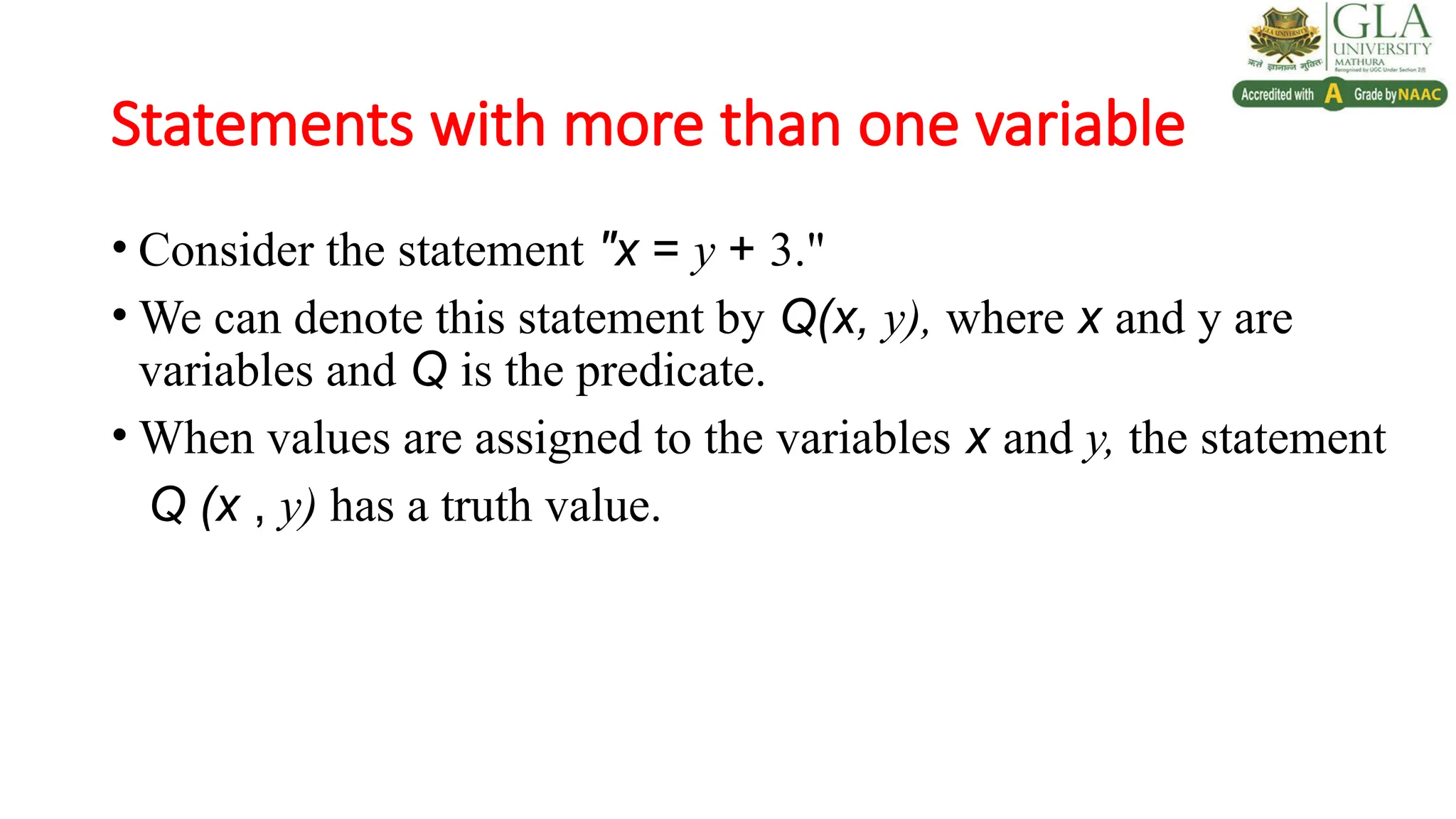
• Consider the statement "x = y + 3."
• We can denote this statement by Q(x, y), where x and y are
variables and Q is the predicate.
• When values are assigned to the variables x and y, the statement
Q (x , y) has a truth value.
Example
Let Q(x, y) denote the statement "x = y + 3." What are the truth values of
the propositions Q( 1, 2) and Q(3, 0)?
• Solution:
• To obtain Q( 1, 2), set x = 1 and y = 2 in the statement Q(x, y).
• Hence, Q( 1,2) is the statement "1 = 2 + 3" which is false.
• The statement Q(3,0) is the proposition "3 = 0 + 3 " which is true.
Statement with n variables
• In general, a statement involving the n variables x1, x2, ….. , xn can be
denoted by
• A statement of the form P(x1,x2,……..xn) is the value of the
propositional function P at the n-tuple (x1,x2,……..xn) and P is also
called a n-place predicate or a n-ary predicate.
Quantifiers
• When the variables in a propositional function are assigned values,
the resulting statement becomes a proposition with a certain truth
value.
• However, there is another important way, called quantification, to
create a proposition from a propositional function.
• Quantification expresses the extent to which a predicate is true over
a range of elements.
Quantifiers
• In English, the words all, some, many, none, and few are used in
quantifications.
• Two types of quantification
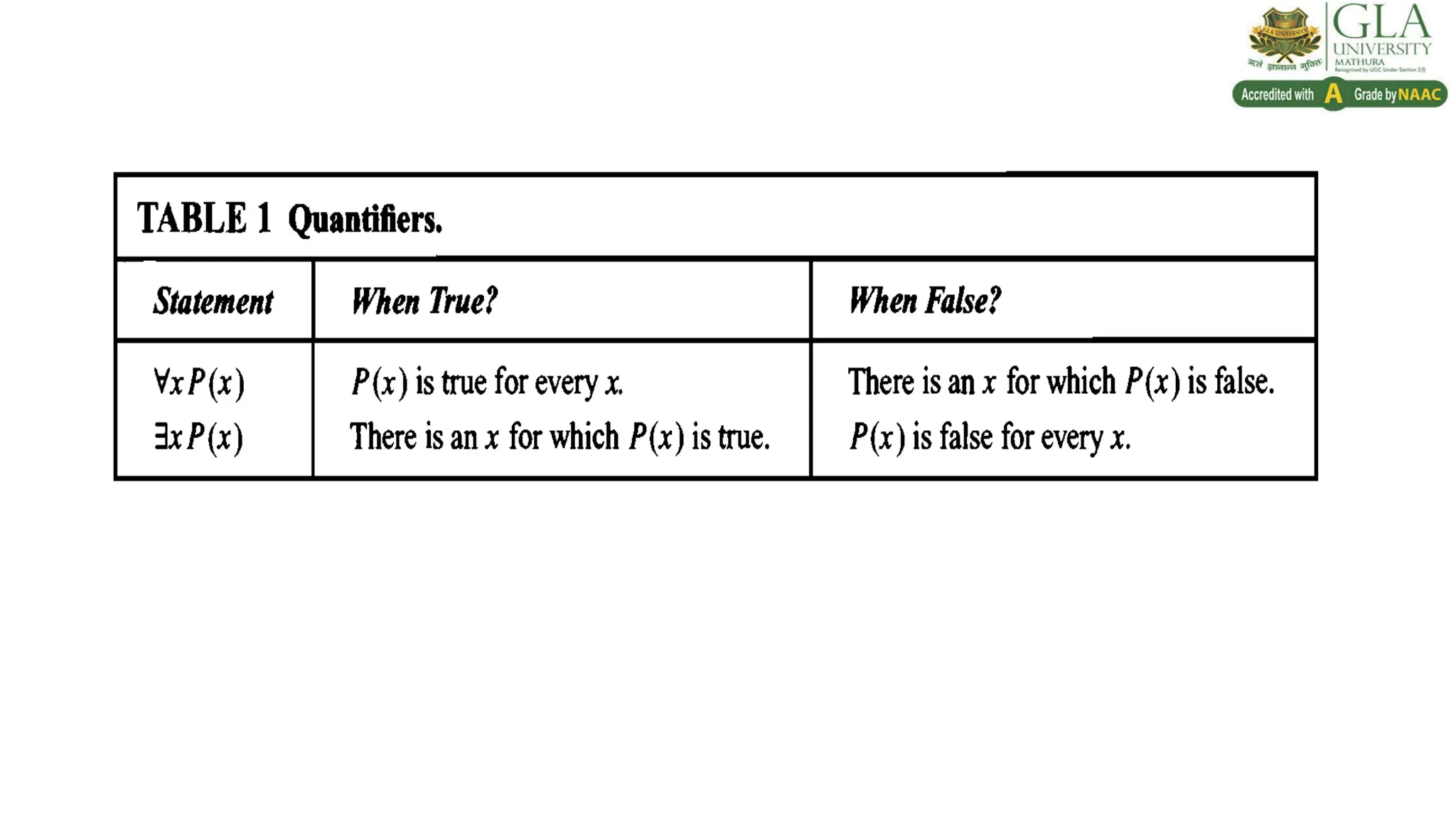
• universal quantification: tells us that a predicate is true for every
element under consideration,
• existential quantification: which tells us that there is one or more
element under consideration for which the predicate is true.
• The area of logic that deals with predicates and quantifiers is called
the predicate calculus.
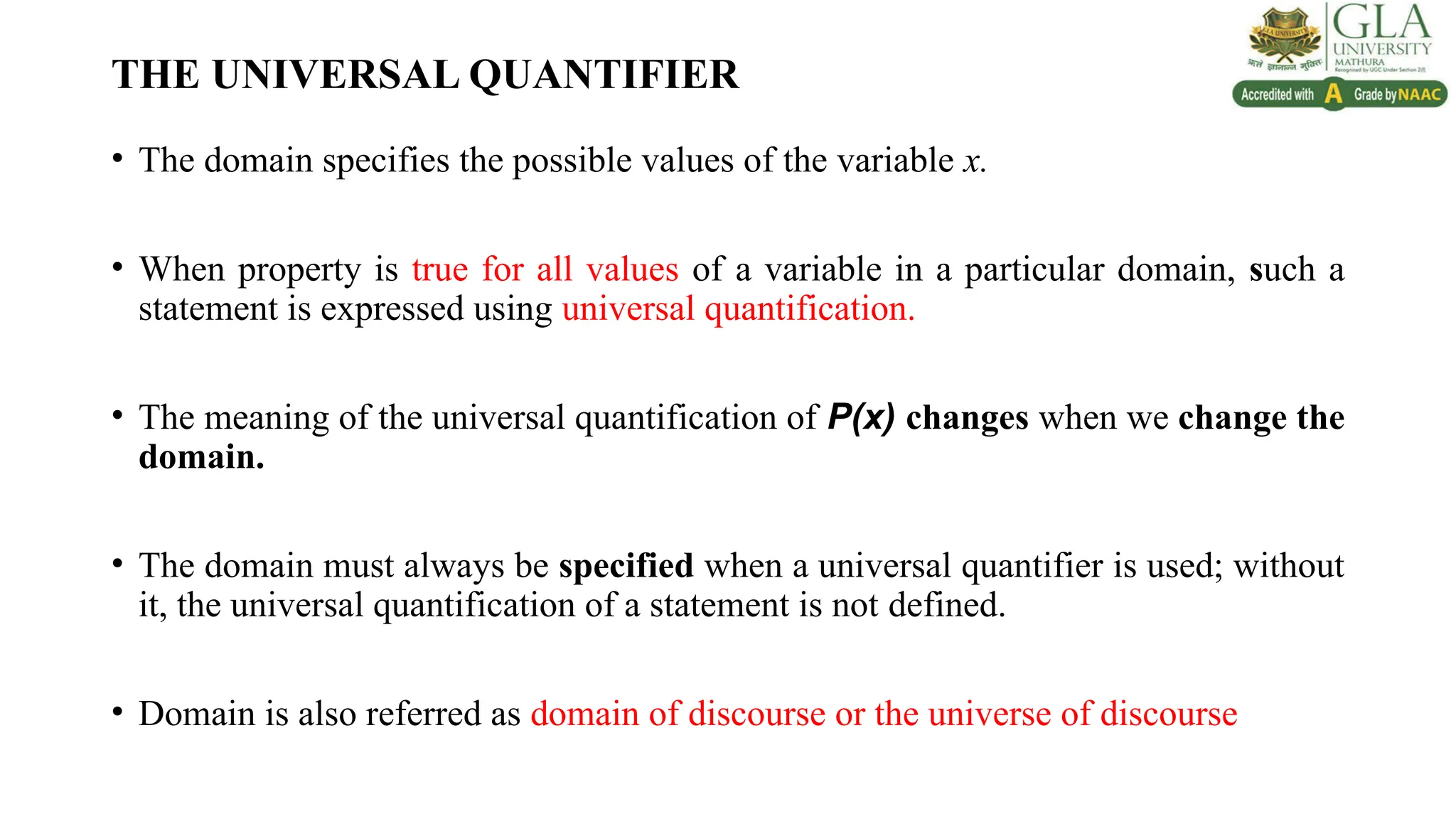
THE UNIVERSAL QUANTIFIER
• The domain specifies the possible values of the variable x.
• When property is true for all values of a variable in a particular domain, such a
statement is expressed using universal quantification.
• The meaning of the universal quantification of P(x) changes when we change the
domain.
• The domain must always be specified when a universal quantifier is used; without
it, the universal quantification of a statement is not defined.
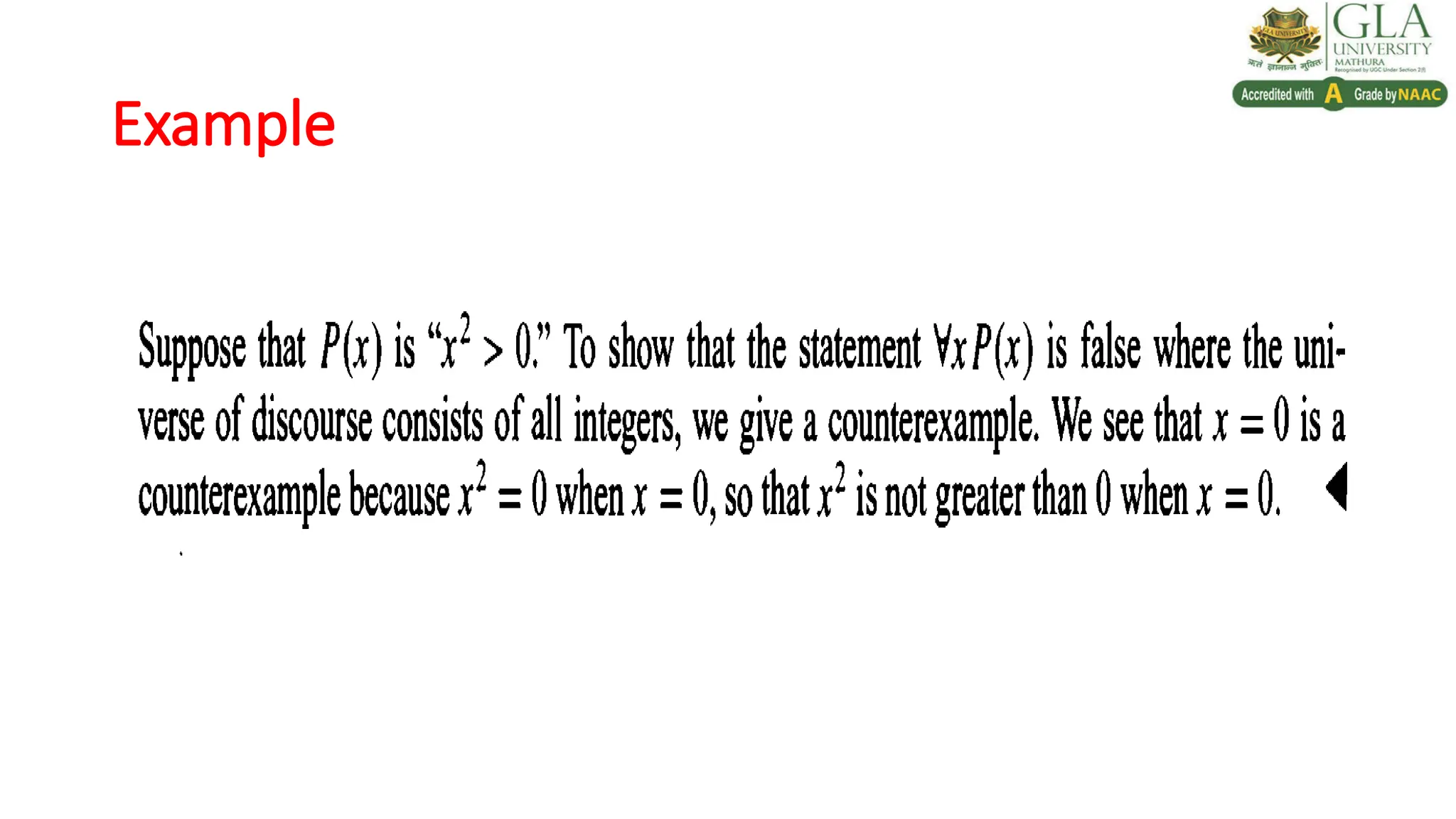
• Domain is also referred as domain of discourse or the universe of discourse
Example
Example
Example
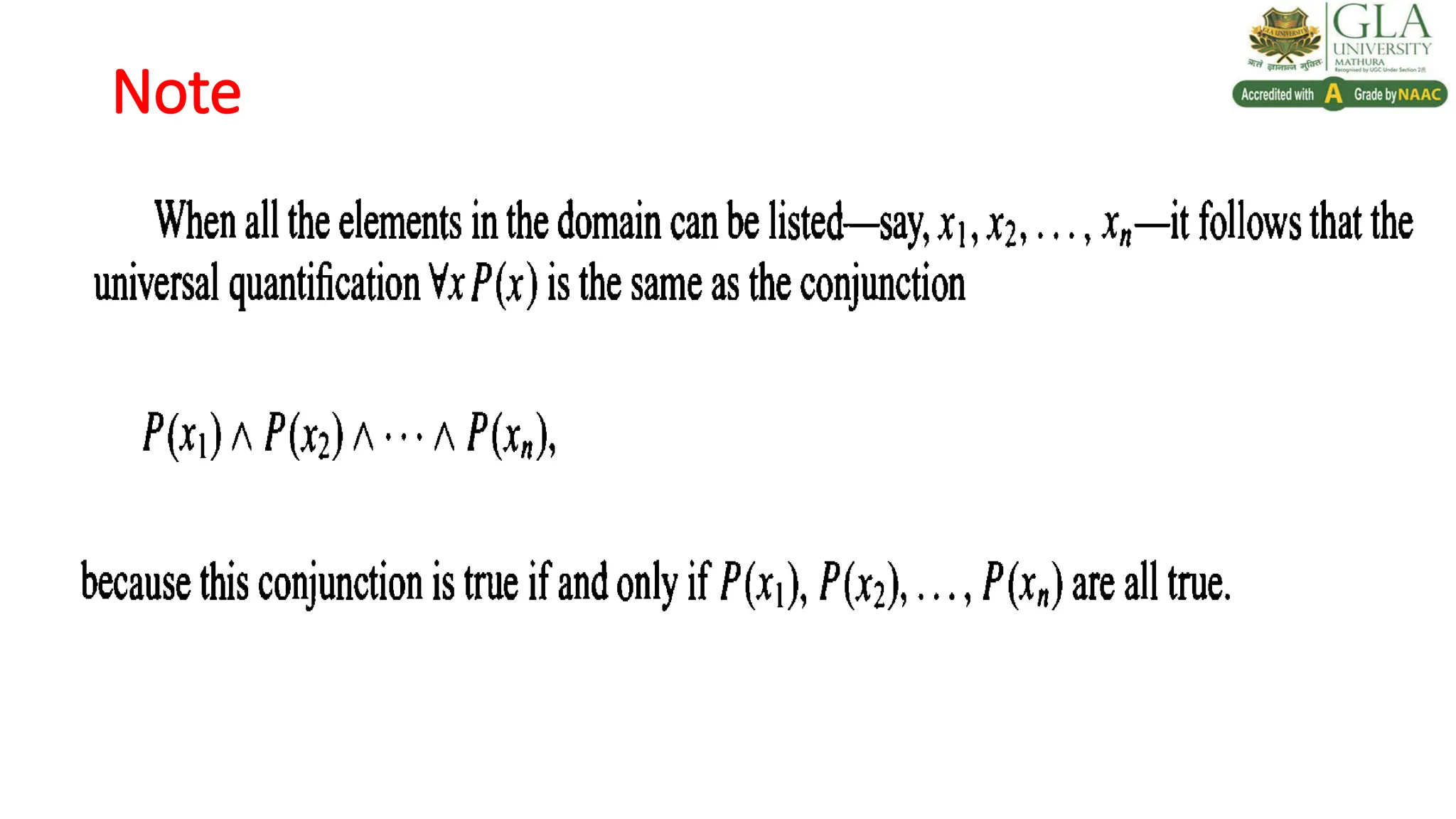
Note
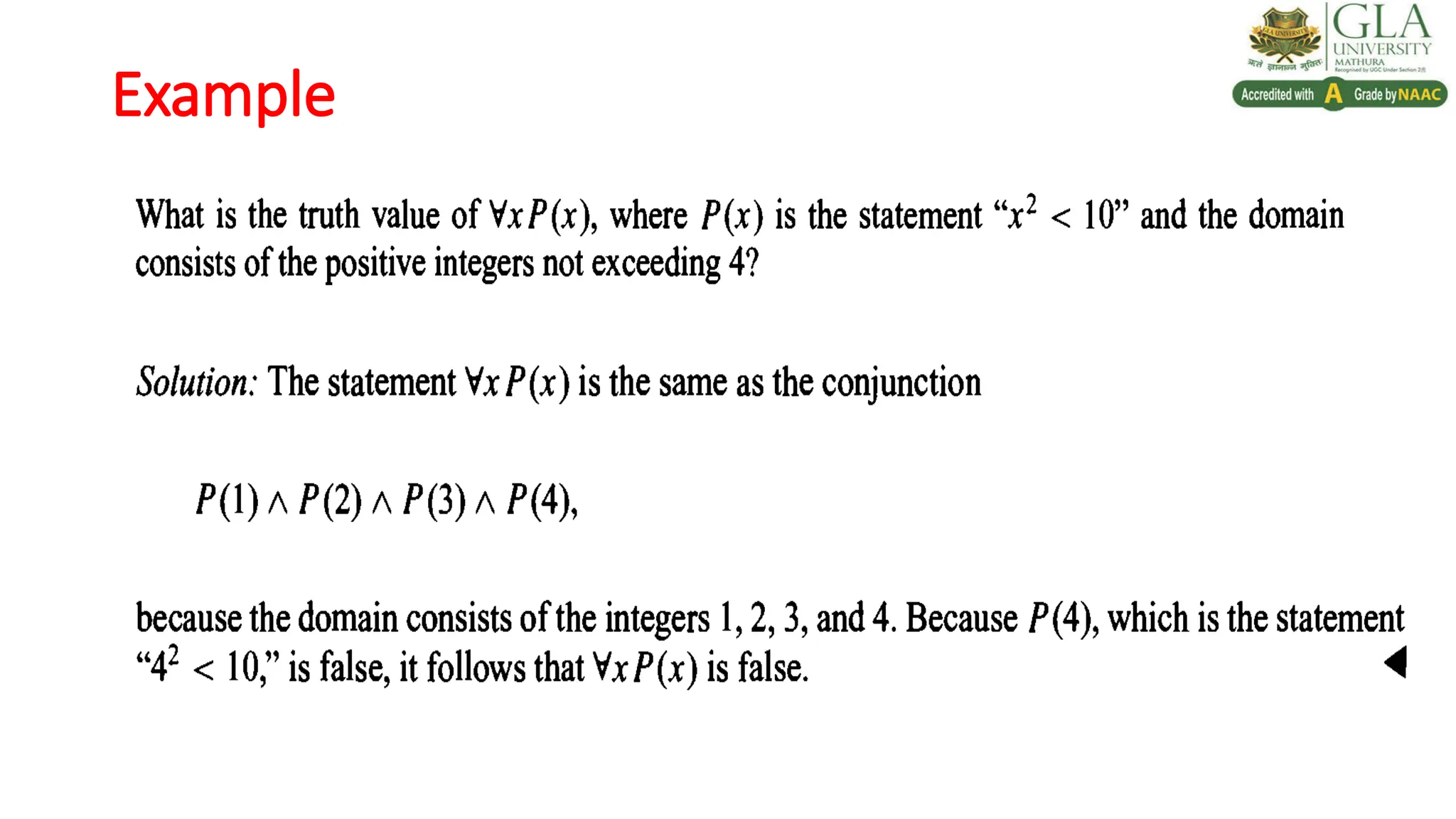
Example
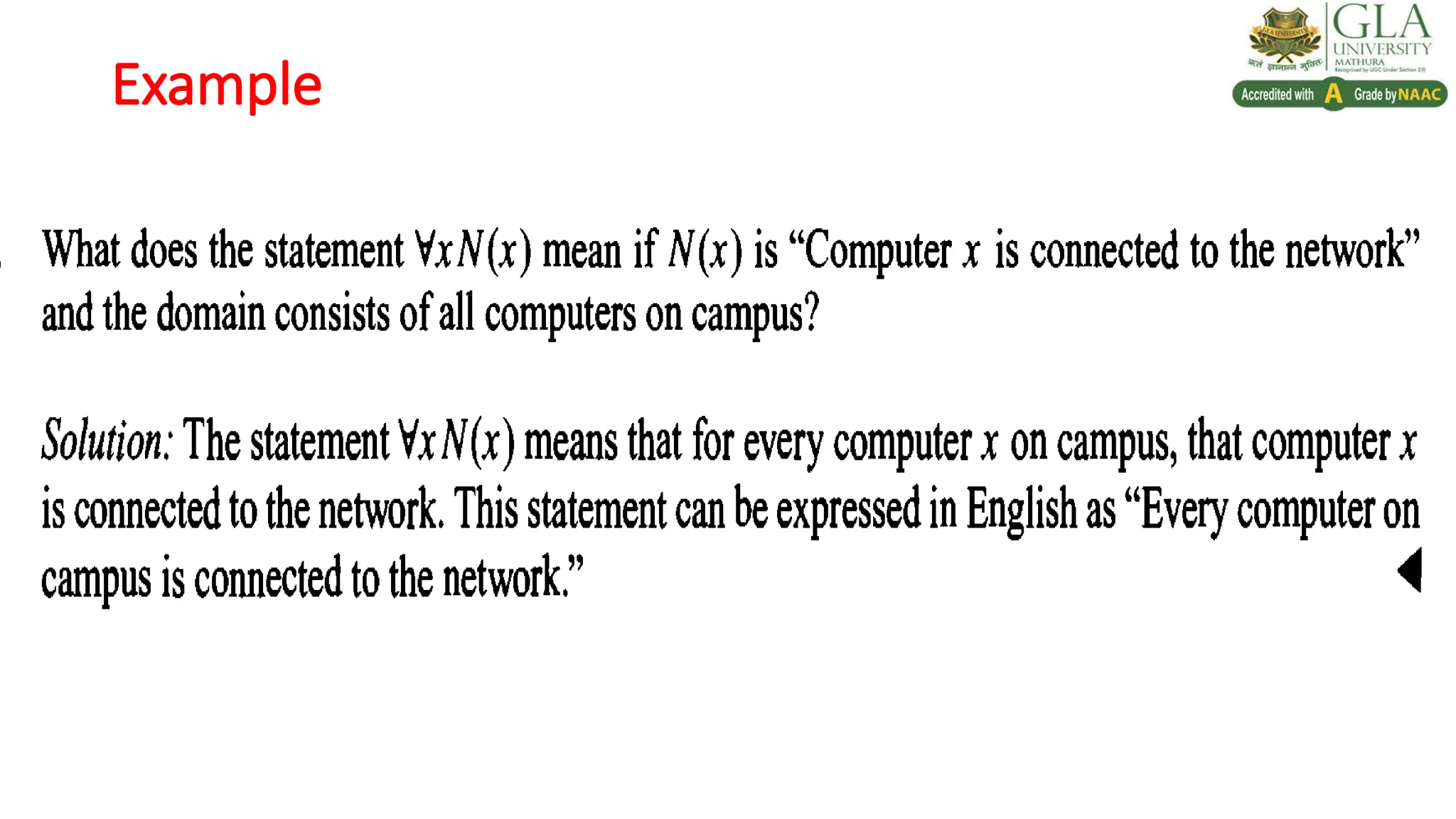
Example
THE EXISTENTIAL QUANTIFIER
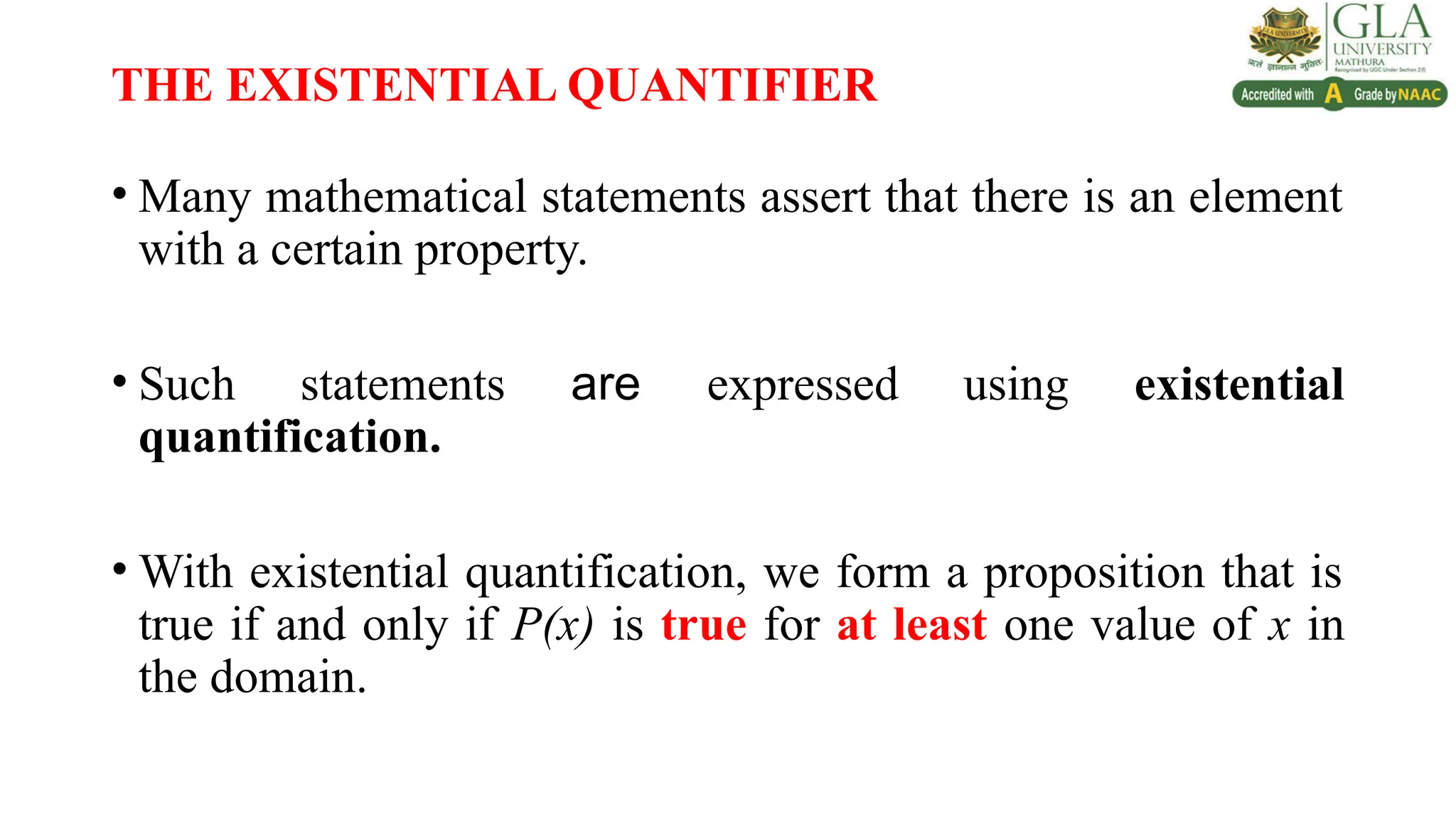
• Many mathematical statements assert that there is an element
with a certain property.
• Such statements are expressed using existential
quantification.
• With existential quantification, we form a proposition that is
true if and only if P(x) is true for at least one value of x in
the domain.
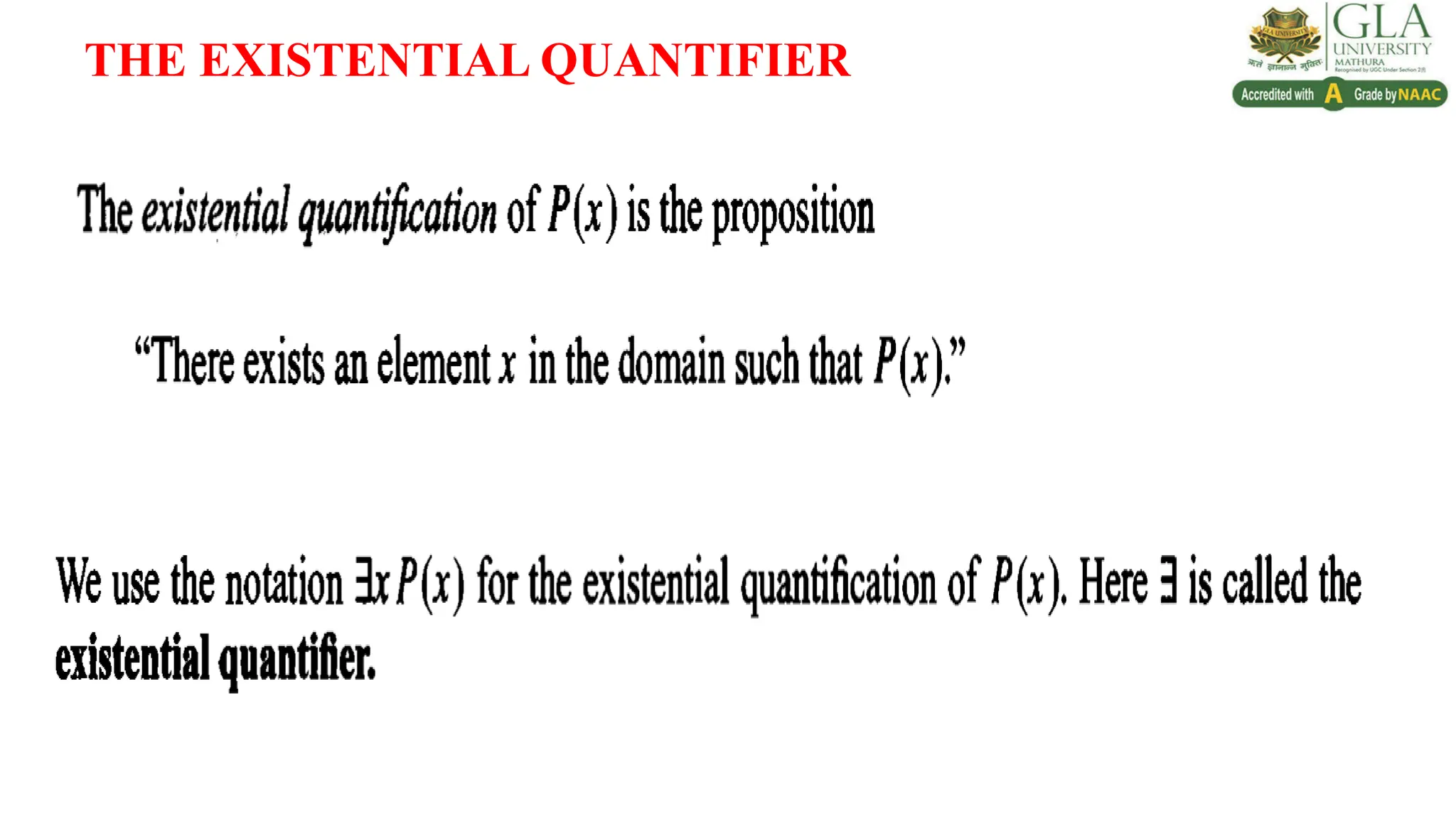
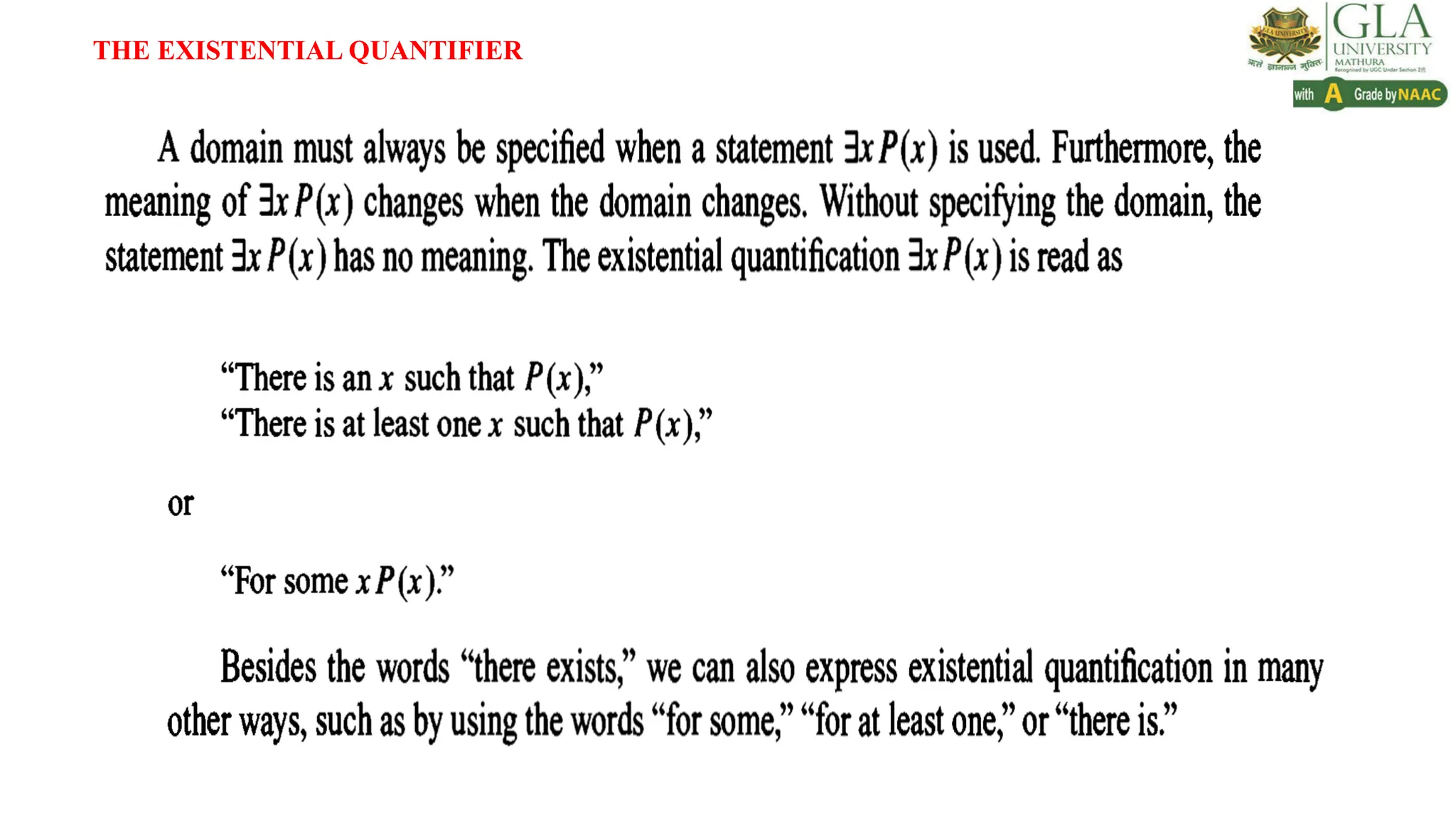
THE EXISTENTIAL QUANTIFIER
Example
Example
Note
Example
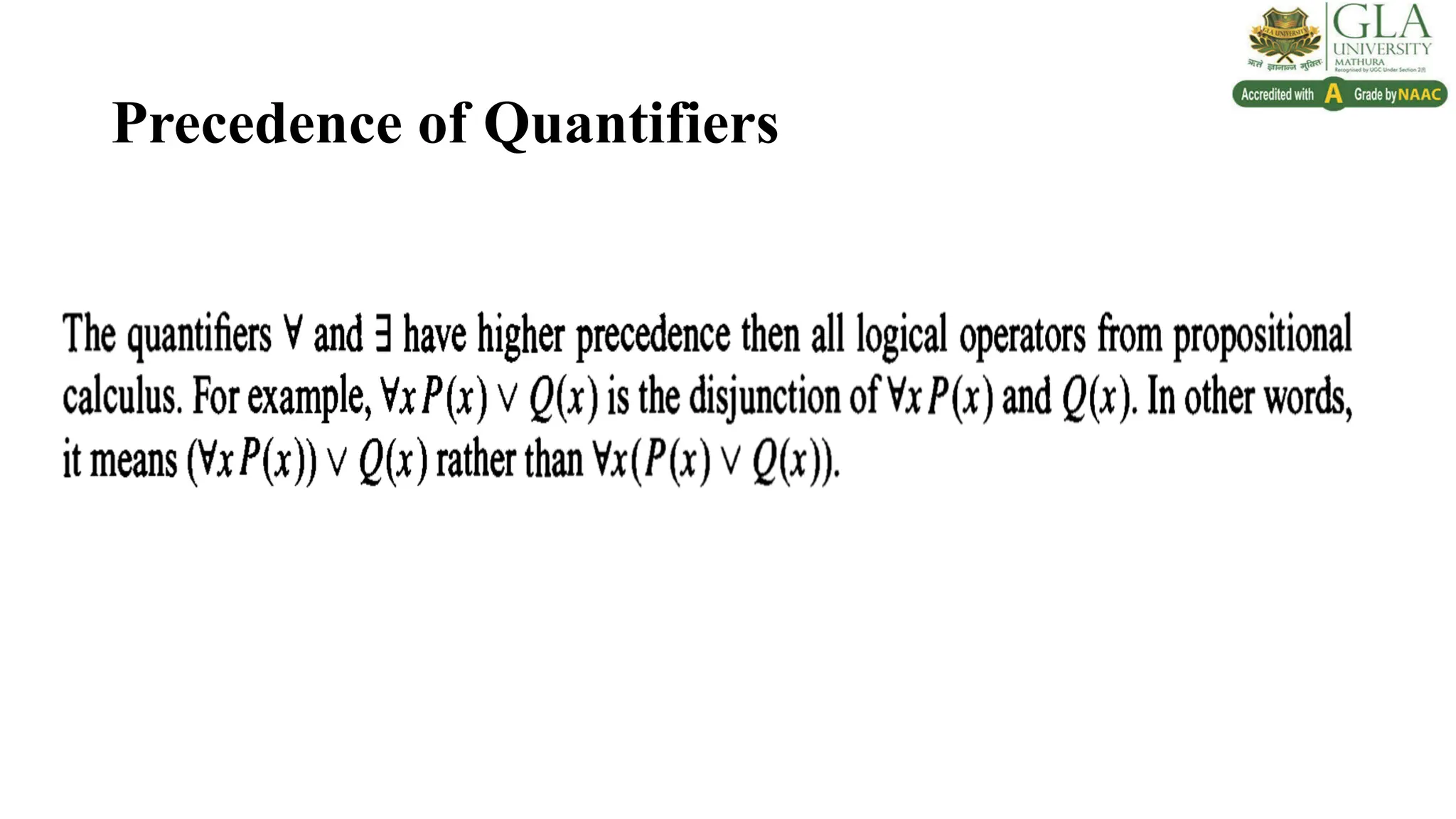
Precedence of Quantifiers
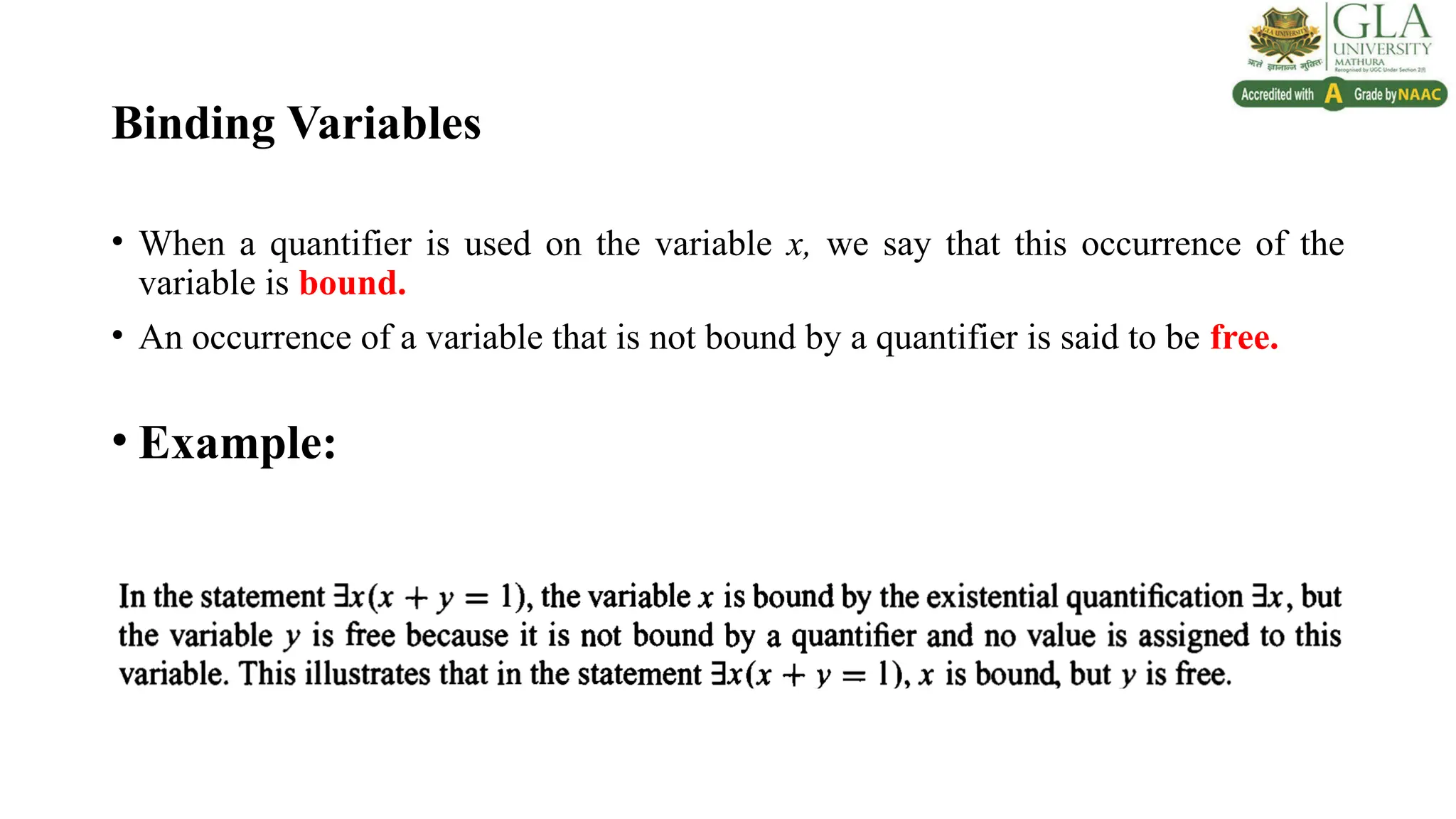
Binding Variables
• When a quantifier is used on the variable x, we say that this occurrence of the
variable is bound.
• An occurrence of a variable that is not bound by a quantifier is said to be free.
• Example:
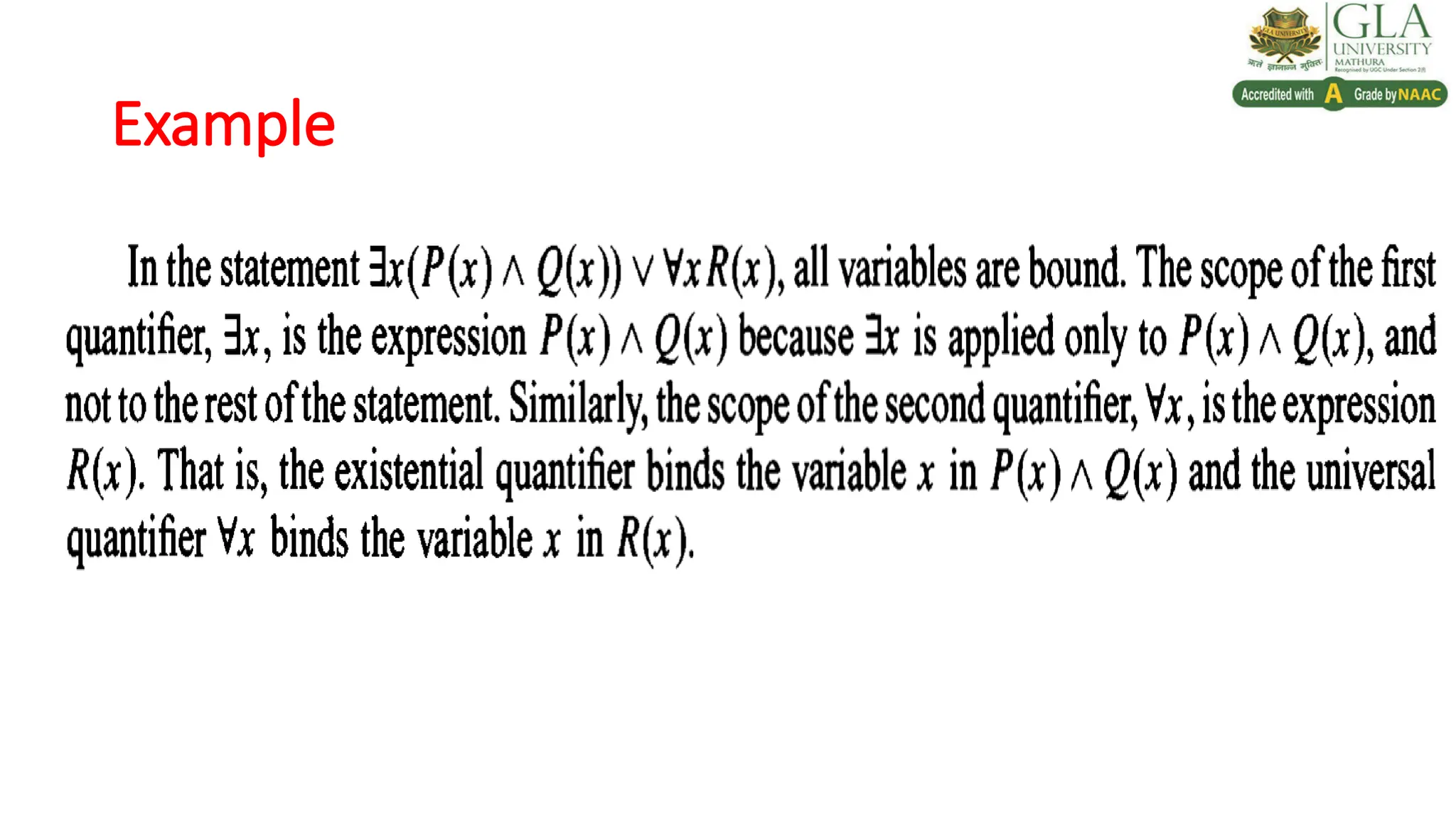
Example

predicate and appliedmathemeticsfour.pptx

  • 1.
    Discrete Mathematics BCSC 0010 Module2 Predicate logic (Predicates and Quantifiers)
  • 2.
    Predicates and Quantifiers •Propositional logic cannot adequately express the meaning of statements in mathematics and in natural language. Example • "Every computer connected to the university network is functioning properly."
  • 3.
    Introduction • Predicate logicis used to express the meaning of a wide range of statements in mathematics and computer science • Predicates • Quantifiers
  • 4.
    Predicates • "x >3" • "x = y + 3" • "x + y = z" • "computer x is under attack by an intruder," • "computer x is functioning properly,“ • These statements are neither true nor false when the values of the variables are not specified.
  • 5.
    Predicates • x >3 • x is the subject of the statement. • “is greater than 3” is predicate of the statement • Predicate refers to a property that the subject of the statement can have. • We can denote the statement "x is greater than 3" by P(x), • where P denotes the predicate "is greater than 3" and x is the variable. • The statement P(x) is also said to be the value of the propositional function P at x. • Once a value has been assigned to the variable x, the statement P(x) becomes a proposition and has a truth value.
  • 6.
    Example • Let P(x)denote the statement "x > 3." What are the truth values of P(4) and P(2)? • Solution: • We obtain the statement P(4) by setting x = 4 in the statement "x > 3." • Hence, P(4), which is the statement "4 > 3," is true. • However, P(2), which is the statement "2 > 3," is false.
  • 7.
    Example Let A(x) denotethe statement "Computer x is under attack by an intruder." Suppose that of the computers on campus, only CS2 and MATH 1 are currently under attack by intruders. What are truth values of A(CS1), A(CS2), and A (MATH 1)? •Solution: • We obtain the statement A(CS1) by setting x = CS1 in the statement • "Computer x is under attack by an intruder." • Because CS1 is not on the list of computers currently under attack, we conclude that A(CS1) is false. • Similarly, because CS2 and MATH I are on the list of computers under attack, we know that A(CS2) and A(MATH1) are true.
  • 8.
    Statements with morethan one variable • Consider the statement "x = y + 3." • We can denote this statement by Q(x, y), where x and y are variables and Q is the predicate. • When values are assigned to the variables x and y, the statement Q (x , y) has a truth value.
  • 9.
    Example Let Q(x, y)denote the statement "x = y + 3." What are the truth values of the propositions Q( 1, 2) and Q(3, 0)? • Solution: • To obtain Q( 1, 2), set x = 1 and y = 2 in the statement Q(x, y). • Hence, Q( 1,2) is the statement "1 = 2 + 3" which is false. • The statement Q(3,0) is the proposition "3 = 0 + 3 " which is true.
  • 10.
    Statement with nvariables • In general, a statement involving the n variables x1, x2, ….. , xn can be denoted by • A statement of the form P(x1,x2,……..xn) is the value of the propositional function P at the n-tuple (x1,x2,……..xn) and P is also called a n-place predicate or a n-ary predicate.
  • 11.
    Quantifiers • When thevariables in a propositional function are assigned values, the resulting statement becomes a proposition with a certain truth value. • However, there is another important way, called quantification, to create a proposition from a propositional function. • Quantification expresses the extent to which a predicate is true over a range of elements.
  • 12.
    Quantifiers • In English,the words all, some, many, none, and few are used in quantifications. • Two types of quantification • universal quantification: tells us that a predicate is true for every element under consideration, • existential quantification: which tells us that there is one or more element under consideration for which the predicate is true. • The area of logic that deals with predicates and quantifiers is called the predicate calculus.
  • 13.
    THE UNIVERSAL QUANTIFIER •The domain specifies the possible values of the variable x. • When property is true for all values of a variable in a particular domain, such a statement is expressed using universal quantification. • The meaning of the universal quantification of P(x) changes when we change the domain. • The domain must always be specified when a universal quantifier is used; without it, the universal quantification of a statement is not defined. • Domain is also referred as domain of discourse or the universe of discourse
  • 15.
  • 16.
  • 17.
  • 18.
  • 19.
  • 20.
  • 21.
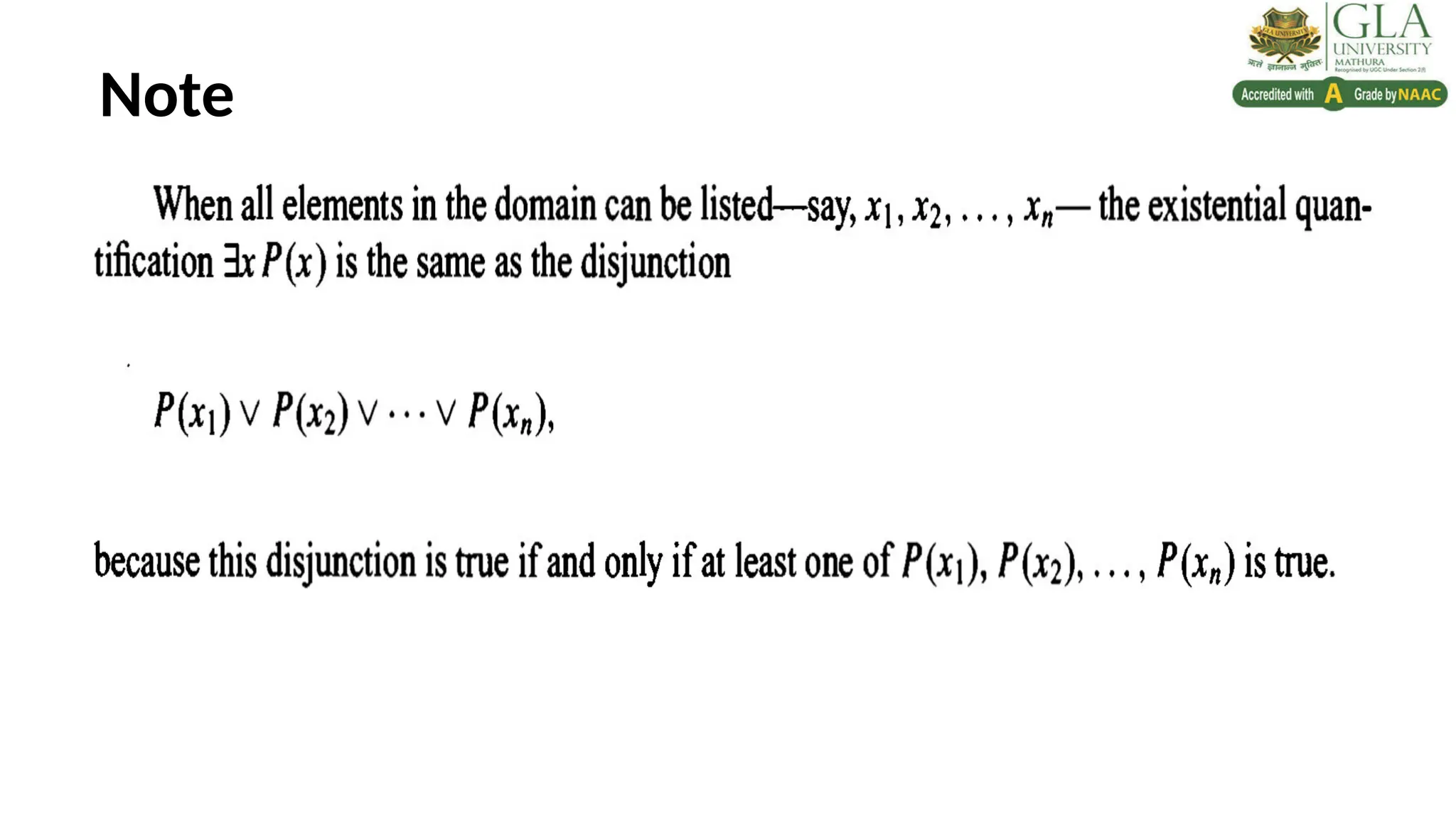
    THE EXISTENTIAL QUANTIFIER •Many mathematical statements assert that there is an element with a certain property. • Such statements are expressed using existential quantification. • With existential quantification, we form a proposition that is true if and only if P(x) is true for at least one value of x in the domain.
  • 22.
  • 23.
  • 25.
  • 26.
  • 27.
  • 28.
  • 29.
  • 30.
    Binding Variables • Whena quantifier is used on the variable x, we say that this occurrence of the variable is bound. • An occurrence of a variable that is not bound by a quantifier is said to be free. • Example:
  • 31.