International Journal of Trend in Scientific Research and Development (IJTSRD)
Volume: 3 | Issue: 3 | Mar-Apr 2019 Available Online: www.ijtsrd.com e-ISSN: 2456 - 6470
@ IJTSRD | Unique Paper ID - IJTSRD22793 | Volume – 3 | Issue – 3 | Mar-Apr 2019 Page: 403
Precision Farming
Kartikeya Bhatia1, Devendra Duda2
1B.Tech Student, 2Assistant Professor
1,2Department of Electrical Engineering, Poornima College of Engineering, Jaipur, Rajasthan, India
How to cite this paper: Kartikeya
Bhatia | Devendra Duda "Precision
Farming" Published in International
Journal of Trend in Scientific Research
and Development
(ijtsrd), ISSN: 2456-
6470, Volume-3 |
Issue-3, April 2019,
pp.403-406, URL:
http://www.ijtsrd.co
m/papers/ijtsrd227
93.pdf
Copyright © 2019 by author(s) and
International Journal of Trend in
Scientific Research and Development
Journal. This is an Open Access article
distributed under
the terms of the
Creative Commons
Attribution License (CC BY 4.0)
(http://creativecommons.org/licenses/
by/4.0)
ABSTRACT
precision mean ”the quality of being clear or exact”. Farmer tries hard to get the
result but we need the smart way and result oriented. The history of India’s
development has been inexorably linked to that of its farmers, and the nation’s
growth with that of its agronomics. Agronomicsprovideshighestcontributionto
nation income. Agronomics needed top most priority because the Government
and the nation would both fail to succeed if agronomics could not be successful.
Today we are living in 21st century where automation is playing significant role
in human life. Automation allows us to control appliances automatic control.
Today industries are using automation and controlmachinewhich is high in cost
and not suitable for using in a field.
So as to help both government and our farmer, we can use intelligent irrigation
techniques with the use of IoT (internet of things) and by building network of
farmer and agriculturist to share their ideas and experience, as a full-fledged
force solution to the need .this can be easily done by organizing and analysing
the live and collected over timedata,allowingfarmerstotakepre-emptiveaction
for healthy harvest of their crops collecting live data using sensors which are
placed across the land further sent to the cloud further under taking predictive
analytics to enhance crops nutrition thususingpredictiveanalysis ondatatofind
better solution. The IoT connected devices stream live data on the land allowing
data-informed decisions on planning the resources and harvesting of farm.
Keywords: Precision Farming; IoT; Raspberry pi; Cloud-data; Farming;
Automation; Intelligent Irrigation
1. INTRODUCTION
As per 2018, Agronomics employed 50% of the Indian work
force and contributed 17-18% to country’s GDP. India ranks
second worldwide in farm outputs. The history of
Agronomics in India dates back to Indus Valley Civilization
Era and even now nothing much has changed. We are still
using the old method of Irrigation we needtocomeupwith a
precision way of farming. Our agronomics active will
improve tremendously.
The farm big data collects and stores the data aboutframer’s
name, crops, pest control for different crops, climatechange,
water availability in differentplaceandseasons,government
support for different area, type of crops etc. the entire farm
big data stored in various storage devices which isunderthe
control of 3nd party vendors. Here data privacy and security
come into mind. Because the fame big data is a combination
of public data, private data, industrial data and data from
Government. Therefor the data privacy and security is
required hence data security and private have to keep in
mind.
2. EXISTING TECHNOLOGY
2.1. Smart Agronomics
Present day agronomics includes use of expansive number
of horticultural actualizes from sowing to edit collectingand
stockpiles. Utilizing countless makes the whole task shrewd
and savvy because of high exactness. The agronomics part
has been encountering robotization and mechanical
hardware are playing pivotal operational exactness. Self-
governing tractors, mechanical collectors, automated
weeders and automated information scouts as of now
supplement ranch gear. Flying symbolism is another
operational procedure where substantial homestead zones
are checked. Satellites, planes and as of late unmanned
automatons are sent for areal symbolism tasks. For
accomplishing the keen agronomics, the accompanying
instruments and advancements are required:
Sensor fusion
Combinational sensors
Developing newer sensor types
Robotics
Remote Sensing
In-field Sensing
Data Management
Variable Rate Applications
Telematics
In-field Sensing
Artificial intelligence (AI)
Key Sensors, Robotics and Artificial Intelligence
IJTSRD22793
International Journal of Trend in Scientific Research and Development (IJTSRD) @ www.ijtsrd.com eISSN: 2456-6470
@ IJTSRD | Unique Paper ID - IJTSRD22793 | Volume – 3 | Issue – 3 | Mar-Apr 2019 Page: 404
2.2. Need of Sensors in agronomics
A huge lose 10% of worldwide nourishmentgeneration,
can occur with plant sicknesses and irritation in
business horticultural yields on the planet. Pesticides
are exceptionally useful to control the plant illnesses
and bugs. The utilization of pesticides can expand the
expense for yielding thebusinessharvests andraisesthe
threat of dangerous buildup. When the plant illnesses
and vermin are recognized in cutting edge, at that point
Plant maladies and nuisancecontrolwould be proficient.
The expense for distinguishing these infections and
vermin utilizing conventional methodologies is more.
Today, the new innovation came into the general
population. The whole agronomics fields are securedby
satellites, sensors, rambles and so forth. The ranchers
are utilizing rambles for gathering and keeping up the
information of various yields, bothers, water offices and
so forth. The key purposes behind utilizing sensors are:
Absolute need to increase global food production
Being able to analyze soil conditions
Adverse environmental impact reduction
Continuous monitoringtoenablecorrectivemeasuresin
real time
High precision achieved while using agricultural
implements
Effective cost savings by waste reduction
Automate agricultural produce monitoring
The remote detecting framework gives an innocuous and
savvy procedures for distinguishingand measuringtheplant
infections and nuisances effectively. With quick
urbanization, cultivable zone is probably going to contract.
So as to capture decay and increment crop creation both
horticulturalresearchersandsensortechnologistshavebeen
working intently. Sorts of sensors for agronomics segment
Biological
Water sensors
Meteorological sensors
Range finders
Temperature sensors
Sensors for positioning, navigation, and obstacle
detection
Level sensors – for crop storages silos
LiDAR, Radar, Laser, Sonar – for accident avoidance
Hygrometers
Position sensors – sprayers, harvesters, sowing
GPS (for geolocation-GNSS receivers, RTK signals) - can
accurately position a moving vehiclewithin30cmorless
using GPS
3. PROPOSED SYSTEM
In this paper the refreshed information with respect to
temperature and stickiness in any zones can be gotten to
utilizing sensor, Raspberry pi3 and IOT innovation. The
principle point of the proposed framework is to observing
the continuous temperature and relative mugginess in a
financially savvy at fixed interim of time. In this observing
hub is raspberry pi3 and sensor is DHT11.Raspberry pi is
utilized to store and show the temperature and relative
stickiness, and is modified utilizing python language. The
DHT11 Temperature and Humidity Sensor includes a
temperature and moistness sensor gives computerized yield
however DHT11 is for the most part utilized for the
stickiness estimation. Highlights of sensors incorporates
high unwavering quality and long haul soundness In thisthe
temperature is shown degree Celsius or Fahrenheit. The
information being prepared by Raspberry pi will be
refreshed ceaselessly on cloud server. WIFI isappended soit
gets information with assistanceof web and client can access
or control temperature and moistness from any piece of the
world.
Advantages of proposed system
We can get present information regarding temperature and
humidity in a particular place.
The size of python code is very less and it reduces the time
complexity and space complexity in raspberry pi 3 model B.
It is very useful for industries, pharmacies as it is used to
detect the temperature.
Accessible from anywhere, efficient, user friendly.
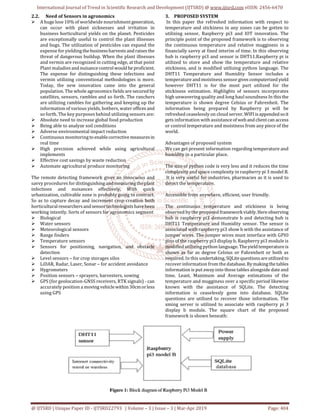
The continuous temperature and stickiness is being
observed by the proposed frameworkviably.Hereobserving
hub is raspberry pi3 demonstrate b and detecting hub is
DHT11 Temperature and Humidity sensor. The sensor is
associated with raspberry pi3 show b with the assistance of
jumper wires. The jumper wires must interface with GPIO
pins of the raspberry pi3 display b. Raspberry pi3 module is
modified utilizing python language. Theyield temperatureis
shown as far as degree Celsius or Fahrenheit or both as
required. In this undertaking,SQLitequestionsareutilized to
recover information from the database.Bymakingthetables
information is put away into those tables alongside dateand
time. Least, Maximum and Average estimations of the
temperature and mugginess over a specific period likewise
known with the assistance of SQLite. The detecting
information is ceaselessly gone into database. SQLite
questions are utilized to recover those information. The
xming server is utilized to associate with raspberry pi 3
display b module. The square chart of the proposed
framework is shown beneath:
International Journal of Trend in Scientific Research and Development (IJTSRD) @ www.ijtsrd.com eISSN: 2456-6470
@ IJTSRD | Unique Paper ID - IJTSRD22793 | Volume – 3 | Issue – 3 | Mar-Apr 2019 Page: 405
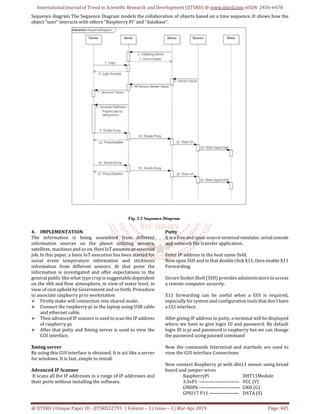
Sequence diagram The Sequence Diagram models the collaboration of objects based on a time sequence. It shows how the
object “user” interacts with others “Raspberry Pi” and “database”.
4. IMPLEMENTATION
The information is being assembled from different
information sources on the planet utilizing sensors,
satellites, machines and so on. HereIoTassumesan essential
job. In this paper, a basic IoT execution has been started for
social event temperature information and stickiness
information from different sensors. At that point the
information is investigated and offer expectations to the
general public like what type crop is suggestable dependent
on the ebb and flow atmosphere, in view of water level, in
view of cost upheld by Government and so forth. Procedure
to associate raspberry pi to workstation
Firstly make wifi connection into shared mode.
Connect the raspberry pi to the laptop using USB cable
and ethernet cable.
Then advanced IP scanner is used to scan the IP address
of raspberry pi.
After that putty and Xming server is used to view the
GUI interface.
Xming server
By using this GUI interface is obtained. It is act like a server
for windows. It is fast, simple to install.
Advanced IP Scanner
It scans all the IP addresses in a range of IP addresses and
their ports without installing the software.
Putty
It is a free and open-source terminal emulator, serialconsole
and network file transfer application.
Enter IP address in the host name field.
Now open SSH and in that double click X11, then enable X11
Forwarding.
Secure Socket Shell (SSH) provides administrators to access
a remote computer securely.
X11 forwarding can be useful when a GUI is required,
especially for system and configuration tools thatdon'thave
a CLI interface.
After giving IP address in putty, a terminal will be displayed
where we have to give login ID and password. By default
login ID is pi and password is raspberry but we can change
the password using passwd command
Now the commands lxterminal and startlxde are used to
view the GUI interface Connections
Now connect Raspberry pi with dht11 sensor using bread
board and jumper wires
RaspberryPi DHT11Module
3.3vP1 -———————— VCC (V)
GNDP6 -———————— GND (G)
GPIO17 P11 —————— DATA (S)
International Journal of Trend in Scientific Research and Development (IJTSRD) @ www.ijtsrd.com eISSN: 2456-6470
@ IJTSRD | Unique Paper ID - IJTSRD22793 | Volume – 3 | Issue – 3 | Mar-Apr 2019 Page: 406
5. RESULTS AND DISCUSSION
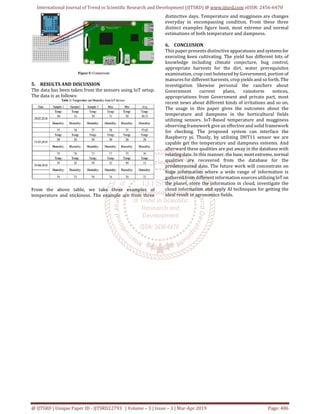
The data has been taken from the sensors using IoT setup.
The data is as follows:
From the above table, we take three examples of
temperature and stickiness. The example are from three
distinctive days. Temperature and mugginess are changes
everyday in encompassing condition. From these three
distinct examples figure least, most extreme and normal
estimations of both temperature and dampness.
6. CONCLUSION
This paper presents distinctive apparatuses and systems for
executing keen cultivating. The yield has different bits of
knowledge including climate conjecture, bug control,
appropriate harvests for the dirt, water prerequisites
examination, crop cost bolstered by Government, portion of
manures for different harvests, crop yields and so forth. The
investigation likewise personal the ranchers about
Government current plans, rainstorm notices,
appropriations from Government and private part, most
recent news about different kinds of irritations and so on.
The usage in this paper gives the outcomes about the
temperature and dampness in the horticultural fields
utilizing sensors. IoT-Based temperature and mugginess
observing framework give an effective and solid framework
for checking. The proposed system can interface the
Raspberry pi. Thusly, by utilizing DHT11 sensor we are
capable get the temperature and dampness esteems. And
afterward these qualities are put away in the database with
relating date. In this manner, the base, mostextreme, normal
qualities are recovered from the database for the
predetermined date. The future work will concentrate on
huge information where a wide range of information is
gathered from different information sources utilizingIoT on
the planet, store the information in cloud, investigate the
cloud information and apply AI techniques for getting the
ideal result in agronomics fields.

Precision Farming

  • 1.
    International Journal ofTrend in Scientific Research and Development (IJTSRD) Volume: 3 | Issue: 3 | Mar-Apr 2019 Available Online: www.ijtsrd.com e-ISSN: 2456 - 6470 @ IJTSRD | Unique Paper ID - IJTSRD22793 | Volume – 3 | Issue – 3 | Mar-Apr 2019 Page: 403 Precision Farming Kartikeya Bhatia1, Devendra Duda2 1B.Tech Student, 2Assistant Professor 1,2Department of Electrical Engineering, Poornima College of Engineering, Jaipur, Rajasthan, India How to cite this paper: Kartikeya Bhatia | Devendra Duda "Precision Farming" Published in International Journal of Trend in Scientific Research and Development (ijtsrd), ISSN: 2456- 6470, Volume-3 | Issue-3, April 2019, pp.403-406, URL: http://www.ijtsrd.co m/papers/ijtsrd227 93.pdf Copyright © 2019 by author(s) and International Journal of Trend in Scientific Research and Development Journal. This is an Open Access article distributed under the terms of the Creative Commons Attribution License (CC BY 4.0) (http://creativecommons.org/licenses/ by/4.0) ABSTRACT precision mean ”the quality of being clear or exact”. Farmer tries hard to get the result but we need the smart way and result oriented. The history of India’s development has been inexorably linked to that of its farmers, and the nation’s growth with that of its agronomics. Agronomicsprovideshighestcontributionto nation income. Agronomics needed top most priority because the Government and the nation would both fail to succeed if agronomics could not be successful. Today we are living in 21st century where automation is playing significant role in human life. Automation allows us to control appliances automatic control. Today industries are using automation and controlmachinewhich is high in cost and not suitable for using in a field. So as to help both government and our farmer, we can use intelligent irrigation techniques with the use of IoT (internet of things) and by building network of farmer and agriculturist to share their ideas and experience, as a full-fledged force solution to the need .this can be easily done by organizing and analysing the live and collected over timedata,allowingfarmerstotakepre-emptiveaction for healthy harvest of their crops collecting live data using sensors which are placed across the land further sent to the cloud further under taking predictive analytics to enhance crops nutrition thususingpredictiveanalysis ondatatofind better solution. The IoT connected devices stream live data on the land allowing data-informed decisions on planning the resources and harvesting of farm. Keywords: Precision Farming; IoT; Raspberry pi; Cloud-data; Farming; Automation; Intelligent Irrigation 1. INTRODUCTION As per 2018, Agronomics employed 50% of the Indian work force and contributed 17-18% to country’s GDP. India ranks second worldwide in farm outputs. The history of Agronomics in India dates back to Indus Valley Civilization Era and even now nothing much has changed. We are still using the old method of Irrigation we needtocomeupwith a precision way of farming. Our agronomics active will improve tremendously. The farm big data collects and stores the data aboutframer’s name, crops, pest control for different crops, climatechange, water availability in differentplaceandseasons,government support for different area, type of crops etc. the entire farm big data stored in various storage devices which isunderthe control of 3nd party vendors. Here data privacy and security come into mind. Because the fame big data is a combination of public data, private data, industrial data and data from Government. Therefor the data privacy and security is required hence data security and private have to keep in mind. 2. EXISTING TECHNOLOGY 2.1. Smart Agronomics Present day agronomics includes use of expansive number of horticultural actualizes from sowing to edit collectingand stockpiles. Utilizing countless makes the whole task shrewd and savvy because of high exactness. The agronomics part has been encountering robotization and mechanical hardware are playing pivotal operational exactness. Self- governing tractors, mechanical collectors, automated weeders and automated information scouts as of now supplement ranch gear. Flying symbolism is another operational procedure where substantial homestead zones are checked. Satellites, planes and as of late unmanned automatons are sent for areal symbolism tasks. For accomplishing the keen agronomics, the accompanying instruments and advancements are required: Sensor fusion Combinational sensors Developing newer sensor types Robotics Remote Sensing In-field Sensing Data Management Variable Rate Applications Telematics In-field Sensing Artificial intelligence (AI) Key Sensors, Robotics and Artificial Intelligence IJTSRD22793
  • 2.
    International Journal ofTrend in Scientific Research and Development (IJTSRD) @ www.ijtsrd.com eISSN: 2456-6470 @ IJTSRD | Unique Paper ID - IJTSRD22793 | Volume – 3 | Issue – 3 | Mar-Apr 2019 Page: 404 2.2. Need of Sensors in agronomics A huge lose 10% of worldwide nourishmentgeneration, can occur with plant sicknesses and irritation in business horticultural yields on the planet. Pesticides are exceptionally useful to control the plant illnesses and bugs. The utilization of pesticides can expand the expense for yielding thebusinessharvests andraisesthe threat of dangerous buildup. When the plant illnesses and vermin are recognized in cutting edge, at that point Plant maladies and nuisancecontrolwould be proficient. The expense for distinguishing these infections and vermin utilizing conventional methodologies is more. Today, the new innovation came into the general population. The whole agronomics fields are securedby satellites, sensors, rambles and so forth. The ranchers are utilizing rambles for gathering and keeping up the information of various yields, bothers, water offices and so forth. The key purposes behind utilizing sensors are: Absolute need to increase global food production Being able to analyze soil conditions Adverse environmental impact reduction Continuous monitoringtoenablecorrectivemeasuresin real time High precision achieved while using agricultural implements Effective cost savings by waste reduction Automate agricultural produce monitoring The remote detecting framework gives an innocuous and savvy procedures for distinguishingand measuringtheplant infections and nuisances effectively. With quick urbanization, cultivable zone is probably going to contract. So as to capture decay and increment crop creation both horticulturalresearchersandsensortechnologistshavebeen working intently. Sorts of sensors for agronomics segment Biological Water sensors Meteorological sensors Range finders Temperature sensors Sensors for positioning, navigation, and obstacle detection Level sensors – for crop storages silos LiDAR, Radar, Laser, Sonar – for accident avoidance Hygrometers Position sensors – sprayers, harvesters, sowing GPS (for geolocation-GNSS receivers, RTK signals) - can accurately position a moving vehiclewithin30cmorless using GPS 3. PROPOSED SYSTEM In this paper the refreshed information with respect to temperature and stickiness in any zones can be gotten to utilizing sensor, Raspberry pi3 and IOT innovation. The principle point of the proposed framework is to observing the continuous temperature and relative mugginess in a financially savvy at fixed interim of time. In this observing hub is raspberry pi3 and sensor is DHT11.Raspberry pi is utilized to store and show the temperature and relative stickiness, and is modified utilizing python language. The DHT11 Temperature and Humidity Sensor includes a temperature and moistness sensor gives computerized yield however DHT11 is for the most part utilized for the stickiness estimation. Highlights of sensors incorporates high unwavering quality and long haul soundness In thisthe temperature is shown degree Celsius or Fahrenheit. The information being prepared by Raspberry pi will be refreshed ceaselessly on cloud server. WIFI isappended soit gets information with assistanceof web and client can access or control temperature and moistness from any piece of the world. Advantages of proposed system We can get present information regarding temperature and humidity in a particular place. The size of python code is very less and it reduces the time complexity and space complexity in raspberry pi 3 model B. It is very useful for industries, pharmacies as it is used to detect the temperature. Accessible from anywhere, efficient, user friendly. The continuous temperature and stickiness is being observed by the proposed frameworkviably.Hereobserving hub is raspberry pi3 demonstrate b and detecting hub is DHT11 Temperature and Humidity sensor. The sensor is associated with raspberry pi3 show b with the assistance of jumper wires. The jumper wires must interface with GPIO pins of the raspberry pi3 display b. Raspberry pi3 module is modified utilizing python language. Theyield temperatureis shown as far as degree Celsius or Fahrenheit or both as required. In this undertaking,SQLitequestionsareutilized to recover information from the database.Bymakingthetables information is put away into those tables alongside dateand time. Least, Maximum and Average estimations of the temperature and mugginess over a specific period likewise known with the assistance of SQLite. The detecting information is ceaselessly gone into database. SQLite questions are utilized to recover those information. The xming server is utilized to associate with raspberry pi 3 display b module. The square chart of the proposed framework is shown beneath:
  • 3.
    International Journal ofTrend in Scientific Research and Development (IJTSRD) @ www.ijtsrd.com eISSN: 2456-6470 @ IJTSRD | Unique Paper ID - IJTSRD22793 | Volume – 3 | Issue – 3 | Mar-Apr 2019 Page: 405 Sequence diagram The Sequence Diagram models the collaboration of objects based on a time sequence. It shows how the object “user” interacts with others “Raspberry Pi” and “database”. 4. IMPLEMENTATION The information is being assembled from different information sources on the planet utilizing sensors, satellites, machines and so on. HereIoTassumesan essential job. In this paper, a basic IoT execution has been started for social event temperature information and stickiness information from different sensors. At that point the information is investigated and offer expectations to the general public like what type crop is suggestable dependent on the ebb and flow atmosphere, in view of water level, in view of cost upheld by Government and so forth. Procedure to associate raspberry pi to workstation Firstly make wifi connection into shared mode. Connect the raspberry pi to the laptop using USB cable and ethernet cable. Then advanced IP scanner is used to scan the IP address of raspberry pi. After that putty and Xming server is used to view the GUI interface. Xming server By using this GUI interface is obtained. It is act like a server for windows. It is fast, simple to install. Advanced IP Scanner It scans all the IP addresses in a range of IP addresses and their ports without installing the software. Putty It is a free and open-source terminal emulator, serialconsole and network file transfer application. Enter IP address in the host name field. Now open SSH and in that double click X11, then enable X11 Forwarding. Secure Socket Shell (SSH) provides administrators to access a remote computer securely. X11 forwarding can be useful when a GUI is required, especially for system and configuration tools thatdon'thave a CLI interface. After giving IP address in putty, a terminal will be displayed where we have to give login ID and password. By default login ID is pi and password is raspberry but we can change the password using passwd command Now the commands lxterminal and startlxde are used to view the GUI interface Connections Now connect Raspberry pi with dht11 sensor using bread board and jumper wires RaspberryPi DHT11Module 3.3vP1 -———————— VCC (V) GNDP6 -———————— GND (G) GPIO17 P11 —————— DATA (S)
  • 4.
    International Journal ofTrend in Scientific Research and Development (IJTSRD) @ www.ijtsrd.com eISSN: 2456-6470 @ IJTSRD | Unique Paper ID - IJTSRD22793 | Volume – 3 | Issue – 3 | Mar-Apr 2019 Page: 406 5. RESULTS AND DISCUSSION The data has been taken from the sensors using IoT setup. The data is as follows: From the above table, we take three examples of temperature and stickiness. The example are from three distinctive days. Temperature and mugginess are changes everyday in encompassing condition. From these three distinct examples figure least, most extreme and normal estimations of both temperature and dampness. 6. CONCLUSION This paper presents distinctive apparatuses and systems for executing keen cultivating. The yield has different bits of knowledge including climate conjecture, bug control, appropriate harvests for the dirt, water prerequisites examination, crop cost bolstered by Government, portion of manures for different harvests, crop yields and so forth. The investigation likewise personal the ranchers about Government current plans, rainstorm notices, appropriations from Government and private part, most recent news about different kinds of irritations and so on. The usage in this paper gives the outcomes about the temperature and dampness in the horticultural fields utilizing sensors. IoT-Based temperature and mugginess observing framework give an effective and solid framework for checking. The proposed system can interface the Raspberry pi. Thusly, by utilizing DHT11 sensor we are capable get the temperature and dampness esteems. And afterward these qualities are put away in the database with relating date. In this manner, the base, mostextreme, normal qualities are recovered from the database for the predetermined date. The future work will concentrate on huge information where a wide range of information is gathered from different information sources utilizingIoT on the planet, store the information in cloud, investigate the cloud information and apply AI techniques for getting the ideal result in agronomics fields.