Challenge the future
SuperGPS: Signal Processing for Precise Wireless
Positioning
Circuits & Systems
Why do we need precise positioning?
How often do you ask yourself questions like:
• Where is my bike, wallet or keys?
• Where is my child?
• Where are my parents or grandparents, and are they well?
Imagine that using wireless signals:
• We are able to detect fall of a person.
• Cars are able to position themselves within lane-level accuracy.
?
What are the challenges?
For many interesting applications, current positioning approaches are
not accurate enough!
The positioning starts with estimating the underlying multipath channel
between transmitter (Tx) and receiver (Rx).
The resolution of time delay estimation of multipath components
depends on:
• Bandwidth of the signals used for channel probing.
• Signal to noise ratio (SNR) of the received signals.
The radio spectrum is a scarce resource, thus bandwidth and power of
communication signals are limited by radio regulatory bodies.
What is our approach?
What is the relevance for KPN?
KPN’s massive wireless infrastructure, together with
our innovations have the potential for the
development of innovative services, e.g.:
• IoT positioning and tracking
• Radio analytics for health care and elderly tracking
• Autonomous driving and cargo delivery
• Precise positioning for smart cities and factories
Author: Tarik Kazaz (C&S)
Supervisors: Alle-Jan van der Veen (C&S) and Gerard Janssen (C&S)
Project collaborators: Christiaan Tiberius (GRS), Cherif Diouf (GRS),
Farnaz Chamanzadeh (C&S) and Han Dun (GRS)
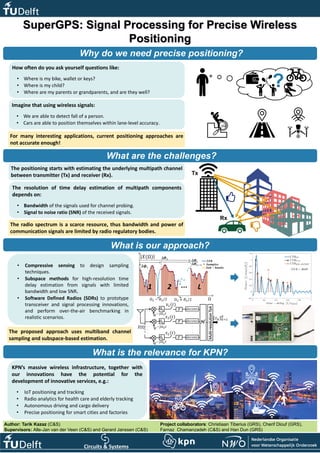
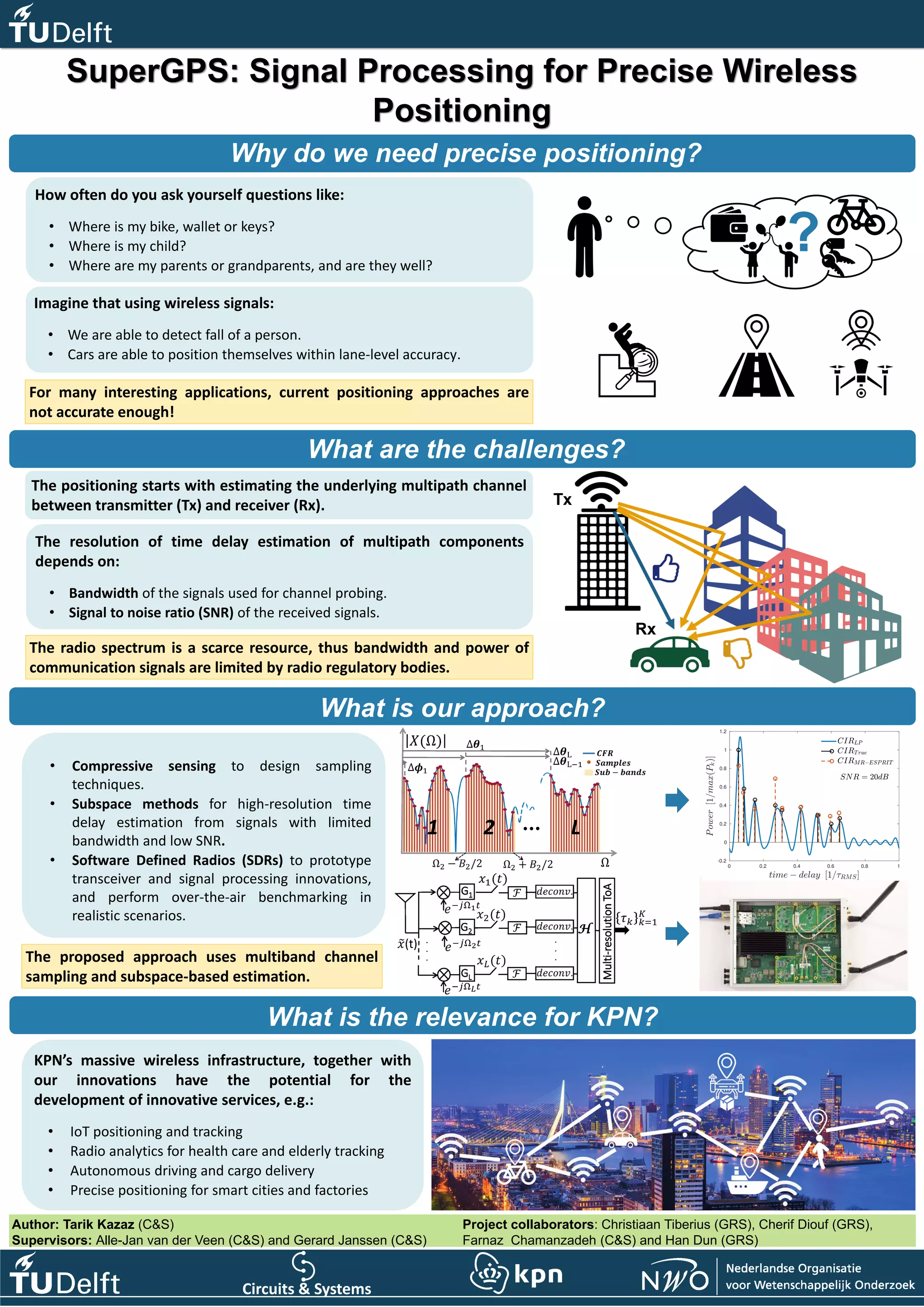
The proposed approach uses multiband channel
sampling and subspace-based estimation.
• Compressive sensing to design sampling
techniques.
• Subspace methods for high-resolution time
delay estimation from signals with limited
bandwidth and low SNR.
• Software Defined Radios (SDRs) to prototype
transceiver and signal processing innovations,
and perform over-the-air benchmarking in
realistic scenarios.

Precise positioning

  • 1.
    Challenge the future SuperGPS:Signal Processing for Precise Wireless Positioning Circuits & Systems Why do we need precise positioning? How often do you ask yourself questions like: • Where is my bike, wallet or keys? • Where is my child? • Where are my parents or grandparents, and are they well? Imagine that using wireless signals: • We are able to detect fall of a person. • Cars are able to position themselves within lane-level accuracy. ? What are the challenges? For many interesting applications, current positioning approaches are not accurate enough! The positioning starts with estimating the underlying multipath channel between transmitter (Tx) and receiver (Rx). The resolution of time delay estimation of multipath components depends on: • Bandwidth of the signals used for channel probing. • Signal to noise ratio (SNR) of the received signals. The radio spectrum is a scarce resource, thus bandwidth and power of communication signals are limited by radio regulatory bodies. What is our approach? What is the relevance for KPN? KPN’s massive wireless infrastructure, together with our innovations have the potential for the development of innovative services, e.g.: • IoT positioning and tracking • Radio analytics for health care and elderly tracking • Autonomous driving and cargo delivery • Precise positioning for smart cities and factories Author: Tarik Kazaz (C&S) Supervisors: Alle-Jan van der Veen (C&S) and Gerard Janssen (C&S) Project collaborators: Christiaan Tiberius (GRS), Cherif Diouf (GRS), Farnaz Chamanzadeh (C&S) and Han Dun (GRS) The proposed approach uses multiband channel sampling and subspace-based estimation. • Compressive sensing to design sampling techniques. • Subspace methods for high-resolution time delay estimation from signals with limited bandwidth and low SNR. • Software Defined Radios (SDRs) to prototype transceiver and signal processing innovations, and perform over-the-air benchmarking in realistic scenarios.