Navigation Signal Processing for GNSS Software Receivers 1st Edition Thomas Pany
Navigation Signal Processing for GNSS Software Receivers 1st Edition Thomas Pany
Navigation Signal Processing for GNSS Software Receivers 1st Edition Thomas Pany
Navigation Signal Processing for GNSS Software Receivers 1st Edition Thomas Pany
Navigation Signal Processing for GNSS Software Receivers 1st Edition Thomas Pany
1.
Visit https://ebookultra.com todownload the full version and
explore more ebooks
Navigation Signal Processing for GNSS Software
Receivers 1st Edition Thomas Pany
_____ Click the link below to download _____
https://ebookultra.com/download/navigation-signal-
processing-for-gnss-software-receivers-1st-edition-
thomas-pany/
Explore and download more ebooks at ebookultra.com
2.
Here are somesuggested products you might be interested in.
Click the link to download
Digital satellite navigation and geophysics a practical
guide with GNSS signal simulator and receiver laboratory
1st Edition Ivan G Petrovski
https://ebookultra.com/download/digital-satellite-navigation-and-
geophysics-a-practical-guide-with-gnss-signal-simulator-and-receiver-
laboratory-1st-edition-ivan-g-petrovski/
Signal Processing with Free Software Practical Experiments
1st Edition François Auger
https://ebookultra.com/download/signal-processing-with-free-software-
practical-experiments-1st-edition-francois-auger/
Signal Processing for Digital Communications Artech House
Signal Processing Library George J. Miao
https://ebookultra.com/download/signal-processing-for-digital-
communications-artech-house-signal-processing-library-george-j-miao/
Signal Processing for Wireless Communications 1st Edition
Boccuzzi
https://ebookultra.com/download/signal-processing-for-wireless-
communications-1st-edition-boccuzzi/
3.
Signal Processing forNeuroscientists 1st Edition Wim Van
Drongelen
https://ebookultra.com/download/signal-processing-for-
neuroscientists-1st-edition-wim-van-drongelen/
Signal Processing for Mobile Communications Handbook 1st
Edition Mohamed Ibnkahla
https://ebookultra.com/download/signal-processing-for-mobile-
communications-handbook-1st-edition-mohamed-ibnkahla/
Digital Signal Processing Mathematical and Computational
Methods Software Development and Applications Second
Edition Jonathan M Blackledge
https://ebookultra.com/download/digital-signal-processing-
mathematical-and-computational-methods-software-development-and-
applications-second-edition-jonathan-m-blackledge/
Genomic Signal Processing 1st Edition Ilya Shmulevich
https://ebookultra.com/download/genomic-signal-processing-1st-edition-
ilya-shmulevich/
Signal processing noise 1st Edition Vyacheslav Tuzlukov
https://ebookultra.com/download/signal-processing-noise-1st-edition-
vyacheslav-tuzlukov/
5.
Navigation Signal Processingfor GNSS Software
Receivers 1st Edition Thomas Pany Digital Instant
Download
Author(s): Thomas Pany
ISBN(s): 9781608070275, 1608070271
Edition: 1
File Details: PDF, 8.36 MB
Year: 2010
Language: english
Contents
Preface xiii
Acknowledgments xvii
Chapter1
Radio Navigation Signals 1
1.1 Signal Generation 1
1.2 Signal Propagation 2
1.3 Signal Conditioning 3
1.4 Motivation for a Generic Signal Model 4
1.5 Sampling 5
1.6 Deterministic Received Signal Model 6
1.7 Stochastic Noise Model 6
1.8 Short-Period Signal Model 7
1.8.1 Zeroth-Order Moment of Signal Power 8
1.8.2 First-Order Moment of Signal Power 8
1.8.3 Second-Order Moment of Signal Power 9
1.8.4 First-Order Moment of Signal Power Variations 9
1.8.5 Separation of Code and Carrier Correlation 10
1.9 Exemplary Signals 11
1.9.1 A Model for the GPS C/A-Code Signal 11
1.9.2 A Model for the Galileo E1 Open-Service Signal 13
1.9.3 Pulsed GNSS Signals 14
1.9.4 Gaussian Double Pulse 15
References 16
Chapter 2
Software-Defined Radio 17
2.1 Definitions 17
2.2 Communication Radios 19
2.2.1 GNU Radio 19
2.2.2 Joint Tactical Radio System 19
2.3 GNSS Software Receivers 22
2.3.1 Front Ends 22
2.3.2 Illustrative Applications 25
2.3.3 High-End GNSS Software Receivers 28
2.4 Technology Evaluation and Discussion 30
References 30
11.
Contents vii
4.3.1 Modelfor One or More Propagation Paths 73
4.3.2 Single Propagation Path 76
4.3.3 Correlation Point 91
4.3.4 Linearization 97
4.3.5 Multiple Propagation Paths 98
4.3.6 Two Propagation Paths: Code-Phase CRLB 100
4.3.7 Two Propagation Paths: Doppler CRLB 104
4.3.8 Two Propagation Paths: Remark on Other Bounds 104
4.4 Data Reduction 106
4.4.1 Sufficient Statistics 106
4.4.2 Multicorrelator Approach 107
4.4.3 First-Derivative Approach 107
4.4.4 Colored Noise 108
4.5 Bayesian Approach 108
4.5.1 Minimum Mean-Squared Error Estimation 109
4.5.2 Kalman–Bucy Filter 110
4.5.3 Other Filters 112
4.5.4 Use of Kalman Filters in GNSS Signal Processing 113
4.6 Squaring Loss Revisited 114
4.7 Numerical Simulation 117
4.7.1 Evaluation of Bounds 118
4.7.2 Cost Function 119
4.7.3 LSQ Solution 120
4.8 Discussion 124
References 125
Chapter 5
Signal Detection 129
5.1 Detection Principles 129
5.1.1 Simple Hypothesis Testing 130
5.1.2 Composite Hypothesis Testing 131
5.2 Detection Domains 133
5.2.1 Pseudorange Domain Detection 133
5.2.2 Position Domain Detection 133
5.3 Preprocessing 133
5.4 Clairvoyant Detector for Uniformly Distributed Phase 134
5.5 Energy Detector 137
5.6 Bayesian Detector 138
5.7 Generalized Likelihood-Ratio Detector 140
5.7.1 Single Coherent Integration 141
5.7.2 Multiple Coherent Integrations 142
5.7.3 Considering Navigation Signal Interference 147
5.7.4 Data and Pilot 149
5.8 System-Detection Performance 154
5.8.1 Idealized Assumptions 155
5.8.2 Mean Acquisition Time 155
12.
5.8.3 System Probabilities156
5.8.4 Independent Bin Approximation 156
5.8.5 Code-Phase and Doppler Losses 157
5.9 Long Integration Times and Differential Detectors 158
5.10 Discussion 159
References 161
Chapter 6
Sample Preprocessing 163
6.1 ADC Quantization 163
6.1.1 Quantization Rule 163
6.1.2 Matched Filter 165
6.1.3 Evaluation of Expected Values 167
6.1.4 Infinite Number of Bits 169
6.1.5 Numerical Evaluation 170
6.2 Noise-Floor Determination 174
6.3 ADC Requirements for Pulse Blanking 174
6.3.1 Front-End Gain and Recovery Time 175
6.3.2 Pulse Blanking 175
6.3.3 ADC Resolution 176
6.4 Handling Colored Noise 178
6.4.1 Spectral Whitening 178
6.4.2 Modified Reference Signals 179
6.4.3 Overcompensation of the Incoming Signal 180
6.4.4 Implementation Issues 180
6.5 Sub-Nyquist Sampling 180
References 182
Chapter 7
Correlators 185
7.1 Correlator and Waveform-Based Tracking 185
7.2 Generic Correlator 187
7.2.1 Expected Value 188
7.2.2 Covariance 189
7.2.3 Variance 191
7.3 Correlator Types with Illustration 191
7.3.1 P-Correlator 192
7.3.2 F-Correlator 193
7.3.3 D-Correlator 194
7.3.4 W-Correlator 194
7.4 Difference Correlators 197
7.4.1 Single-Difference P-Correlators 197
7.4.2 Double-Difference P-Correlators 199
7.5 Noisy Reference Signal for Codeless Tracking 200
7.5.1 Expected Value 202
7.5.2 Covariance 202
viii Contents
9.4.2 Discussion andOther Algorithms 250
9.5 Fast Fourier Transform 251
9.5.1 Algorithm 251
9.5.2 Convolution Theorem 252
9.5.3 Time-Domain Correlation and Data Preparation 253
9.5.4 Spectral Shifting 256
9.5.5 Limited-Size Inverse FFT 257
9.5.6 Circular Correlation with Doppler Preprocessing 260
9.5.7 Handling Secondary Codes 263
9.5.8 Asymptotic Computational Performance 267
9.5.9 Reported FFT Performance Values 267
9.5.10 Discussion and Number of Correlators 269
9.6 Reality Check for Signal Tracking 271
9.7 Power Consumption 272
9.8 Discussion 274
References 275
Chapter 10
GNSS SDR RTK System Concept 277
10.1 Technology Enablers 277
10.1.1 Ultra-Mobile PCs 277
10.1.2 Cost-Effective High-Rate Data Links 278
10.2 System Overview 279
10.2.1 Setup 279
10.2.2 Sample Applications 280
10.2.3 Test Installation and Used Signals 280
10.3 Key Algorithms and Components 281
10.4 High-Sensitivity Acquisition Engine 281
10.4.1 Doppler Search Space 282
10.4.2 Correlation Method 284
10.4.3 Clock Stability 284
10.4.4 Line-of-Sight Dynamics 287
10.4.5 Flow Diagram and FFT Algorithms 287
10.4.6 Acquisition Time 288
10.5 Assisted Tracking 289
10.5.1 Vector-Hold Tracking 290
10.5.2 Double-Difference Correlator 291
10.6 Low-Cost Pseudolites 297
10.6.1 Continuous-Time Signals 299
10.6.2 Pulsed Signals 299
10.7 RTK Engine 304
References 305
Chapter 11
Exemplary Source Code 307
11.1 Intended Use 307
Contents
15.
Contents xi
11.2 Setup307
11.2.1 Required Software 307
11.2.2 Preparing the Simulation 308
11.2.3 Signal Selection and Simulation Parameters 308
11.3 Routines 308
11.3.1 True Cramér-Rao Lower Bound 308
11.3.2 Discriminator Noise Analysis 308
11.3.3 FFT Acquisition 308
11.3.4
Simplified Vector Tracking with Multipath Mitigation
and Spectral Whitening 309
Appendix
A.1 Complex Least-Squares Adjustment 311
A.1.1 Definitions 311
A.1.2 Probability Density Function 312
A.1.3 The Adjustment 312
A.1.4 Real- and Complex-Valued Estimated Parameters 314
A.1.5 A Posteriori Variance of Unit Weight 315
A.1.6 Example 318
A.1.7 Discussion 320
A.2 Representing Digital GNSS Signals 320
A.2.1 Complex-Valued Input Signal 320
A.2.2 Real-Valued Input Signal 321
A.2.3 Comparing Real- and Complex-Valued Signals 322
A.3 Correlation Function Invariance 326
A.4 Useful Formulas 329
A.4.1 Fourier Transform 329
A.4.2 Correlation Function 331
A.4.3 Correlation with an Auxiliary Function 332
A.4.4 Correlation with Doppler 333
A.4.5 Correlation in Continuous Time 334
A.4.6 Probability Density Functions 336
References 338
Abbreviations 339
List of Symbols 343
About the Author 345
Index 347
16.
xiii
Preface
The continuous developmentsof software-defined radio technology resulted in the
appearance of the first real-time GPS software radios at the beginning of this cen-
tury. For the first time, it was possible to realize a complete GNSS receiver without
going into the depths of cumbersome hardware development that requires develop-
ment or programming of low-level digital circuitry. The hardware development ef-
forts were indeed so high that only a very limited number of companies or research
institutes could afford them. Furthermore, the implementation constraints were so
severe, especially for the first generation of GPS receivers, that often crude signal-
processing approximations were necessary to allow a real implementation. Cur-
rently, software-defined radio technology not only allows receiver implementations
by a larger research community, but also drastically increases the signal-processing
capabilities. It also has the potential to become, in certain navigation areas, a com-
mercial success.
Software radio technology provides an opportunity to design a new class of
GNSS receivers, being more flexible and easier to develop than their FPGA- or
ASIC-based counterparts. Therefore, this text reviews navigation signal detection
and estimation algorithms and their implementation in a software radio. A focus
is put on high-precision applications for GNSS signals and an innovative RTK re-
ceiver concept based on difference correlators is proposed.
This text makes extensive use of the least-squares principle. The least-squares
principle is the typical basis for the calculation of a navigation solution. An adjust-
ment or a Kalman filter calculates positions from pseudorange observations in vir-
tually any GNSS receiver. Within this text, the least-squares principle is consistently
extended to also allow signal samples as observations. In contrast to the pseudorange-
observation equation, the signal sample model is highly non-linear, causing a num-
ber of difficulties that are discussed. Furthermore, signal sample observations can
be complex-valued.
In the author’s opinion, the development of a navigation receiver does not nec-
essarily require an in-depth theoretical knowledge of signal-estimation and signal-
detection theory. The basic algorithms like correlation and tracking can also be
understood on an intuitive basis. Indeed many textbooks skip the highly theoretical
signal-estimation and signal-detection framework and focus on engineering aspects.
The question arises: What can we learn from the theoretical treatment that is pre-
sented here? First, the theory allows a performance assessment without building a
receiver. By providing benchmarks like the Cramér-Rao lower bound or the clair-
voyant detector, the theory serves also as a reference with which to compare a real
implementation. This text attempts to generalize the existing theory for arbitrary
navigation signal waveforms, going beyond existing GNSS signals. The theoretical
17.
treatment also giveshints for optimal algorithms; useful examples that are discussed
are spectral whitening and the least-squares-based multipath-estimating discrimina-
tor. Efficient algorithms are found in the frequency domain for signal acquisition,
which itself would justify the effort of going into theoretical details. Furthermore,
the theoretical analysis points out that new developments could be expected in the
field of direct-position estimation (in a single-step procedure, instead of estimating
a position via pseudoranges), which should give advantages in terms of interference
robustness and sensitivity. Sensitivity might be further increased by using Bayesian
techniques (like a particle filter) that do not rely on a linearized signal model.
Unfortunately, the existing navigation signal-processing theory has limits and
does not always provide an optimal algorithm for detection or estimation. Ex
amples are the nonexistence of a uniform most powerful detector for acquisition and
the nonexistence of a minimum variance unbiased code-phase or Doppler estimator
for finitely received signal power. In addition, the practical usability of Bayesian
techniques within signal processing (apart from the Kalman filter) is not completely
assessed. Overall, it seems that a theoretically optimal navigation receiver is out-of-
reach today, even if only signal processing is considered. However, software radio
technology closes the gap between existing theory and real implementation.
Overview
Within this text, the navigation signal processing theory is described for generic navi-
gation signals to allow a broad range of applications, beyond that of GNSS. Require-
ments for navigation signals are introduced in Chapter 1 and are illustrated with one
GPS, one Galileo, and two pulsed signals. Software-defined radio technology will be
introduced in Chapter 2, together with the architecture and the data flow of a per-
manent GNSS reference station in Chapter 3. Chapters 4 and 5 focus on theoretical
signal-processing aspects and Chapters 6 through 9 shift the focus to implementation.
An innovative high-precision software radio concept is presented in Chapter 10 using
double-difference correlators, in addition to double-difference pseudorange and carrier-
phase observations to increase carrier-phase tracking stability for real-time kinematic
applications. Finally, on the Artech House Web site, www.artechhouse.com, this book
has some MATLAB and assembler programs that illustrate the core signal-processing
concepts of a navigation receiver. Chapter 11 describes this software.
Summary of Presented Signal-Processing Theory
In Chapter 1, requirements are formulated that a generic navigation signal has to
fulfill to allow for the simultaneous estimation of the code phase, the Doppler and
the carrier phase. Based on those requirements, Chapter 4 reviews the estimation
theory for navigation signals using a consistent mathematical notation and derives
the theory from first principles. The presented mathematical derivations are very
detailed and with the finite sample rate approach, a reader should be able to adapt
the theory for his or her purposes easily. The finite sample rate description is also
chosen to enable a software receiver developer to establish a one-to-one correspon-
dence of theory and implementation at every stage of signal processing.
xiv Preface
19.
com/static/reslib/pany/pany1.html. The sourcecode includes the FFT acquisition
methods and multipath-estimating tracking. Furthermore, MATLAB scripts for
the true Cramér-Rao lower bound as well as for the thermal-noise analysis of the
noncoherent discriminators are included. The scripts run with the four exemplary
navigation signals of Chapter 1 and are outlined in Chapter 11.
Book’s Usage for Practical Receiver Implementation
This book should help in building advanced navigation software receivers. It is
not a beginner’s book and the reader should be familiar with the architecture
of a GNSS software receiver, which is, for example, excellently described by
Borre’s book mentioned in Chapter 2. Borre’s book also comes with a complete
MATLABreceiverandourtextmayhelpyoutoextendthisreceiverforhigh-sensitivity
applications using efficient FFT techniques or for high-precision applications ap-
plying multipath-mitigation schemes or stable double-difference carrier-phase
tracking.
To build a navigation software receiver, you need there things: navigation sig-
nal samples, a software framework that handles the data flow, and efficient core
algorithms.
Signal samples can be obtained by one of the GNSS front ends described in
Chapter 2 or you can use the single-channel signal generator of Chapter 11. Some-
times, the front-end manufacturers can provide you with exemplary signal-sample
streams, too.
Writing a software receiver framework from scratch can be a quite tedious
work. The framework handles the enormous amount of signal samples, synchro-
nizes the different receiver channels, computes the position, and provides some
standard output formats. You can short-cut this by adapting the MATLAB source
code mentioned above. Another possibility to avoid this cumbersome work is to
use a commercial software receiver having an application programming interface,
which you can plug into your own source code. Chapter 11 provides you with a
single-channel framework that demonstrates how to convert the sample stream into
pseudorange measurements.
Finally, the core algorithms can actually be found within this text. They are
derived in a way that they can be adapted easily for a specific framework and the
assembler code should help to realize them efficiently.
xvi Preface
20.
xvii
Acknowledgments
This work wouldnot have been possible without the support from numerous co-
workers and colleagues. I am especially grateful to the researchers of the University
of Federal Armed Forces in Munich, to the researchers at the IFEN GmbH, and to
many colleagues from research institutes from all over the world.
I am grateful to Professor Günter W. Hein for continually encouraging me to
enter this field, for his uninterrupted belief in technology, and for showing me ways
of going beyond limits. Professor Bernd Eissfeller established the basis for GNSS
receiver technology research at the Institute of Geodesy and Navigation. His con-
tribution to this work cannot be overvalued. I would also like to thank Professor
Jörn Thielecke for fruitful discussions. With his knowledge on communication and
navigation signal processing, he showed me several important links between both
fields.
22.
Radio Navigation Signals
output,or to the digitized signal obtained after (optional) downconversion and
filtering of the received signal.
The broadcast navigation signal structure is known to the receiver and will be
characterized in the following paragraphs. A good way to do this is to merge the
frontend filter into the output filter (i.e., into a combined filter) and to describe the
signal after the output filter. This simplification is useful for signal processing pur-
poses and is valid, because both antennas, the propagation path, and the frontend
filter act as linear systems to the signal. Nonlinear effects of the amplifiers or mixer
are not considered.
Without the combined filter (or output filter), the transmitted signal rS is writ-
ten as
( ) ( ) ( )cos(2 )
S S RF
r t a d t c t f t
π
¥
= (1.1)
Here, fRF is the carrier frequency in hertz, c (t) is the infinite bandwidth signal
representation at baseband, and d(t) represents a broadcast navigation message.
The transmitted signal is described in the signal-in-space (SIS) interface control doc-
ument (ICD) [1, 2]. The symbol aS denotes the signal amplitude in arbitrary units.
Other signals might be transmitted on the same carrier frequency by the same
satellite. For example, the Global Positioning System (GPS) C/A signal is broadcast
in phase quadrature with the P(Y) signal on the L1 (1,575.42 MHz) carrier fre-
quency. The access to the different signals is controlled via c (t). Different wave-
forms of c∞(t) can be used to realize code division multiple access (CDMA), time
division multiple access (TDMA), or—by including a carrier into c (t)—frequency
division multiple access (FDMA) schemes.
With the combined filter, the signal is mathematically written as
= - +
( ) ( ) ( )sin(2 ) ( ) ( )cos(2 )
S S Q RF S I RF
r t a d t c t f t a d t c t f t
π π (1.2)
with
( ) ( ) ( )
I Q
c t c t ic t
= + (1.3)
representing the filtered baseband representation of the signal obtained by applying
(1.10). The signal cQ(t) is an artifact generated by the filter. The filter does not affect
d(t), as long as the data rate (e.g., 50 bit/s) is much smaller than the filter bandwidth
(e.g., 2 MHz). If the radio frequency (RF) is much higher than the filter bandwidth,
cQ(t) is small and can be ignored.
Using a complex notation, the signal after the combined filter is given as
( ) Re{ ( ) ( )exp(2 )}
S S RF
r t a d t c t if t
π
= (1.4)
1.2 Signal Propagation
According to Fermat’s principle, the line-of-sight component of the signal rS(t)
travels along the shortest propagation path from the transmitter to the receiver.
Eventually, one or more reflected signals [i.e., copies of rS(t)] are superimposed with
the line-of-sight signal. Each copy has a different amplitude, Doppler, carrier phase
23.
1.3 Signal Conditioning
delay,or code phase delay. Furthermore, the line-of-sight component is delayed by
the atmosphere. Accurate modeling of the propagation effects is one of the key ele-
ments to obtain a precise position and this topic is covered in many satellite navi-
gation text books [3, 4]. We will not go into the modeling details, but will instead
focus on a model for the received signal that can be used as a basis for delay and
Doppler estimation.
Delays affect the carrier and the data-modulating signals c(t), d(t) differently.
Frequency-independent (nondispersive) delays are caused by the geometric distance
and by the electrically neutral part of the atmosphere (troposphere). Frequency-
dependent (dispersive) delays are caused by the ionosphere and by the receiver and
transmitter hardware. Dispersive and nondispersive delays add up and result in the
group delay τG, delaying c(t) and d(t). The carrier is delayed by the phase delay τP.
The delays τG and τP are not equal because the ionospheric delay contributes to
each of them with a different sign. The difference is typically less than 100m and
varies with a frequency not more than 0.05 Hz if no scintillations are present. Also,
hardware group and phase delay are generally different.
The group delay, τG, affects c(t) via
,0
( ) ( ( )) ( )
G D G
c t c t t c t
τ α τ
® - » - (1.5)
and similarly for d(t). The phase delay, τP, affects the carrier via
,0
exp(2 ) exp(2 ( ( ))) exp(2 ( ))
RF RF P RF D P
if t if t t if t
π π τ π α τ
® - » - (1.6)
with
/ ,0 / 0 0
( ) (1 )
G P G P D
t t
τ τ α
= - - (1.7)
The coefficient αD
1
D
v
c
α = - (1.8)
is the Doppler effect, caused by the change in the group/phase delay, expressed as
velocity v in meters per second. The linearization is carried out around the epoch t0.
If the signal duration Tcoh under consideration is short, the Doppler effect on c(t),
d(t) can be ignored, as in
,0 0
( ) ( ( ))
coh D G
c
T c t c t t
vB
α τ τ
Þ - » - (1.9)
and similarly for d(t), where B denotes the signal (or data message) bandwidth in
hertz.
1.3 Signal Conditioning
After signal reception by the antenna, the signal is amplified, filtered, and eventually
downconverted. Amplification changes the amplitude of the signal (from aS to a),
but leaves the signal structure invariant.
24.
Radio Navigation Signals
Thefrontend filter limits the bandwidth of the received navigation signals and
of the received noise. It also rejects out-of-band signals. The frontend filter is typi-
cally of lower bandwidth than the output filter and neglecting the output filter is a
reasonable approximation. The resulting filter is a band pass filter and is described
by its baseband equivalent H via
¥
=
( ) ( ( ))
c t H c t (1.10)
For signal estimation and detection, it is largely irrelevant at which center fre-
quency the filter operates; it can be placed at the RF, at the IF, or at baseband. Nor-
mally, filters with discrete components or SAW filters operating at the IF are used,
but discrete polyphase filters at baseband have also been utilized. Global navigation
satellite system (GNSS) receivers normally do not integrate the filter into a chip
solution.
Downconversion changes the signal carrier model by
,0 ,0
exp(2 ( )) exp(2 ( ) 2 )
RF D P RF D P LO
if t if t if t
π α τ π α τ π
- ® - - (1.11)
where fLO is the local oscillator frequency in hertz.
For each transmitter and propagation path, a signal of the form
0 ,0
( ) ( ( ))exp(2 ( ) 2 )
rec RF D P LO
r t ac t t if t if t
τ π α τ π
= - - - (1.12)
arrives at the front end’s ADC(s). The ADC(s) either quantize(s) the real and the
imaginary part of the signal or quantizes only one of them (see Appendix A.2).
1.4 Motivation for a Generic Signal Model
By specifying core signal elements, it is possible to reduce the amount of information
that is necessary to analyze a navigation system. The baseband representation of
the navigation signal c(t), the time over which d(t) remains constant, and the carrier
frequency represent core elements that determine to a large extent how precisely a
receiver can estimate code and carrier delay, the Doppler shift, and, consequently,
its position. They are summarized in Table 1.1.
The assumptions imposed on the received signals are kept as general as pos-
sible to allow the application of the developed theory to a wide range of signals. It
focuses mostly on conventional GNSS continuous-time CDMA signals using binary
phase shift keying (BPSK), binary offset carrier (BOC), multiplexed BOC (MBOC),
alternative BOC (AltBOC), or any other spread-spectrum technique. Furthermore,
Table 1.1 Influence of Navigation Signal Elements on
Signal Processing Parameters
Signal Element Affected Signal Processing Parameter
c(t) Code correlation function Rc,c,
Doppler correlation function
d(t) Coherent integration time Tcoh,
Doppler correlation function
25.
1.5 Sampling
pulsed signalsare included because they are being used by pseudolites, by LORAN-C,
or RADAR-like ranging systems. In principle, the theory can also be adapted for
sonar ranging systems and, with some limitations, for optical ranging systems. Only
one frequency band is considered (e.g., GPS L1); a generalization from a sampling
of one frequency band to multiple frequency bands is obvious, but one should be
take care that all bands are sampled synchronously.
No assumption on the relation of the signal bandwidth to the sampling rate is
made and, in particular, sub-Nyquist sampling rates can be used. No assumption on
the modulation scheme is made as long as the received signal waveform at baseband
c(t) is known a priori to the receiver. Eventually, filters influence the theory via the
waveform c(t). The more narrow the filter bandwidth, the smoother the waveform
will be.
The filter bandwidth and characteristics define how much noise power is be-
ing received: the wider the bandwidth, the higher the noise power. For simplicity, a
unity noise power is assumed in (1.16) and it is important to keep in mind that only
ratios between power levels have meaningful values, as described in Section 1.8.1.
In that sense, (1.16) defines the power scale.
The Nyquist criterion does not fully apply because the waveform c(t) is known
to the receiver beforehand. Consequently, there is no need to reconstruct the signal
waveform from the received samples [5]. As shown in Section 6.5, a good choice
for the sample rate is exactly equal to the Nyquist rate (e.g., being equal to the noise
bandwidth). Lower sample rates yield less-independent signal samples, thereby gen-
erally decreasing the accuracy of the obtained estimates. The accuracy decrease can
be modeled as an effective signal power loss. This observation is also true when
multiple reflections of the same signal are received.
In the rest of this chapter, we will formulate generic conditions for navigations
signals. Later, we illustrate the conditions with two GNSS signals and two pulsed
terrestrial navigation signals. In addition to those parameters, the number of re-
ceived signals, the amplitude, and the geometric placement of the transmitters affect
the positioning result (see Sections 4.1.3 and 8.4).
1.5 Sampling
In the following, a number of L signal samples are considered, indexed by m. The
index m assumes, in general, the values
{ }
1, ,L
µ Î … (1.13)
The sampling epoch tm in seconds for the sample m is given by
s
t
f
µ
µ
= (1.14)
and fs defines the ADC sample rate in samples per second. Optionally, the sampling
epochs can be offset by a fixed amount of time, which will not explicitly be men-
tioned here.
For each sampling epoch tm, a complex-valued (i.e., I plus Q) signal sample is
generated. We chose a complex signal representation to work with more compact
26.
Radio Navigation Signals
expressionscompared to working with real-valued signal representations using,
for example, only the I-component. In Appendix A.2, it is shown that both signal
representations are equivalent. Additionally, it is possible to derive an equation us-
ing the complex-valued signal representation and then to adapt the final result for
the real-valued signal representation. This can be done by taking the real compo-
nent of the obtained results or by similar methods. This approach is used in Chap-
ters 7 and 8. The GNSS SDR implementation of Chapter 2 works internally with a
real-valued signal representation.
1.6 Deterministic Received Signal Model
A digitized received signal sample is modeled as a complex random variable Sm be-
ing composed of a deterministic part rm and a purely stochastic part Nm,
;
m
m
S r N r N
µ µ µ µ µ
= + = +
å (1.15)
The deterministic part is the sum of all received signals rm;m broadcast from one
or more transmitters propagating along one or more paths; for example, the index
m distinguishes not only the different emitters, but also the different propagation
paths. Furthermore, m may distinguish different signal components (e.g., data and
pilot signals) broadcast by the same transmitter.
1.7 Stochastic Noise Model
The baseline assumption for the stochastic component of the received signal is to
model it as complex-valued uncorrelated white noise having unity variance in each
component
,
0, 0, 2
N N N N N N
µ υ µ υ µ υ µ υ
δ
= = =
N N N
(1.16)
and zero mean
0
Nµ =
N
(1.17)
The white noise originates from the received and internally generated noise.
In general, it is assumed that the amplitudes of the individual noise random
variables Nm are Gaussian distributed. However, important results described in the
following chapters also hold for arbitrary amplitude distributions of Nm, provided
that (1.16) and (1.17) hold. A common example of a non-Gaussian noise distribu-
tion is the ADC quantization noise, which will be discussed in Section 6.1.
It is important to recognize that the comparably simple white-noise spectral
characteristic is sufficient to model many navigation receiver frontends, as long as
the sample rate is properly chosen (see Section 6.5). In fact, if (1.16) is not fulfilled,
which occurs when oversampling is employed and results in nonwhite noise, then
the operation of spectral whitening can be applied as described in Section 6.4. The
operation of spectral whitening yields uncorrelated noise samples that allow the
operation to work with the simple noise model (1.16) and simultaneously reduces
27.
1.8 Short-Period SignalModel
the estimated parameters’ variances. If spectral whitening cannot be employed,
methods discussed in Section 7.6 show how to adapt the results obtained under the
assumption of white noise for the case of colored noise.
1.8 Short-Period Signal Model
The deterministic component of the received signal model is the superposition of a
number of signals. Each signal may be different but they are required to share the same
structure, which will be defined later. The index m is abandoned in the following.
This structure is valid for short periods of time, typically being related to the
coherent integration time and being on the order of a few tens of milliseconds at
maximum in a standard GNSS receiver implementation.
We assume that the deterministic part of the received signal samples is modeled
during a sufficiently short interval as
1
( )exp
2 s
L
r ac t i t
f
µ µ µ
τ ω ϕ
ì ü
æ ö
æ ö
+
ï ï
= - - -
í ý
ç ÷
ç ÷
è ø
è ø
ï ï
î þ
(1.18)
Here, a denotes the signal amplitude in arbitrary units, τ is the delay (or code
phase) of the signal in seconds, j is the carrier phase of the signal in radians, and ω
is the angular frequency plus Doppler in radians per second. All values are instan-
taneous values and refer to a particular interval. The relation of the values between
the different intervals will not be specified here.
The signal amplitude a is a measure for the received signal power and the delay
τ relates to the geometric distance between transmitter and receiver. The carrier
phase j contains information of the geometric distance, but is also used to ac-
commodate a possible broadcast navigation message. The angular frequency ω is
given by the nominal frequency (being either zero, an intermediate frequency, or
the nominal carrier frequency) plus a Doppler offset caused by the relative velocity
between transmitter and receiver.
The signal c(t) is the baseband representation of the broadcast navigation signal
waveform (eventually complex-valued). In the example of a GPS C/A-code transmit-
ter, it is a 1-ms pseudorandom noise signal using a BPSK modulation scheme. The
signal c(t) is affected by filters located on either the transmitter or the receiver side.
It is important to recognize that the signal c(t) can be quite arbitrary and could
assume a CDMA spreading code or a pulsed waveform. The important requirement,
however, is that the waveform c(t) must be known to the receiver before receiving
it. Additionally, five more requirements are formulated next. Three of these require-
ments, provided in Sections 1.8.1 through 1.8.3, are mostly of a formal nature (i.e.,
they relate to the definitions of constants and interval boundaries) and pose only few
constraints on the waveform itself. The other two requirements, given in Sections
1.8.4 and 1.8.5, are more strict and need to be fulfilled if the signal will allow sepa-
ration of Doppler estimates from delay estimates. The two conditions given in Sec-
tions 1.8.1 and 1.8.4 are extended to be compatible with the used estimation scheme
(complex least-squares adjustment). The extensions are trivially fulfilled if the sig-
nal c(t) is real-valued and the extensions ensure that the code phase, the Doppler,
28.
Radio Navigation Signals
andthe complex amplitude estimates are uncorrelated in the event that only a line-
of-sight signal is present.
It should be noted that the requirements formulated next need to be fulfilled
sufficiently, but not necessarily exactly. Overall, they ensure that the Fisher informa-
tion matrix (4.60) can be sufficiently approximated by a diagonal matrix.
1.8.1 Zeroth-Order Moment of Signal Power
The signal waveform at baseband is required to have an average unity power during
the interval of interest, for example,
2
1
1
( ) 1
L
c t
L
µ
µ
τ
=
- »
å (1.19)
This is required so that only the signal amplitude a contains information of the
received signal power and the waveform c(t) is assumed to be independent from the ac-
tual received power. This equation is approximately valid for all τ values of interest.
The numerical value of a itself is meaningless as it is expressed in arbitrary
units. However, it can be related to the ratio between signal power and noise power
spectral density C/N0, which is described in detail in Appendix A.2. Because of
(1.19), the following equation holds:
2
0
/
2
s
f a
C N = (1.20)
The value of C/N0 is expressed in hertz.
Equation (1.19) implies that
- - »
í ý
1
1
Re ( ) ( ) 0
L
c t c t
L
µ µ
µ
τ τ
=
ì ü
ï ï
¢
ï ï
î þ
å (1.21)
according to Appendix A.4.2. Note, c denotes the first derivative of the waveform
c. To avoid correlations between the imaginary part of the code phase estimate with
the complex signal amplitude, it is required that the imaginary part of the above
expression vanishes; overall, we require
- - »
1
1
( ) ( ) 0
L
c t c t
L
µ µ
µ
τ τ
=
¢
å (1.22)
Equation (1.22) is trivially fulfilled, if the waveform c(t) is real valued.
1.8.2 First-Order Moment of Signal Power
The first-order moment in time of the signal power, with respect to the midpoint of
the interval of interest, is required to vanish; for example,
ç ÷
è ø
2
1
1
( ) 0
2
L
s
L
t c t
f
µ µ
µ
τ
=
æ ö
+
- - »
å (1.23)
29.
1.8 Short-Period SignalModel
This requirement ensures that estimates for the angular frequency and the car-
rier phase are uncorrelated with each other, which will be shown in Section 4.3.2.
This equation is approximately valid for all τ values of interest. The requirement
is fulfilled if the signal power is located symmetrically in time with respect to the
midpoint of the interval.
1.8.3 Second-Order Moment of Signal Power
The second-order moment in time of the signal power with respect to the midpoint
of the interval of interest evaluates to
µ µ µ
2 2 3
2 2
2
1 1
1 2 1
( ) ( )
2 2 12
L L
freq
s s s
L L L L
t c t c t
f f f
µ
µ
τ τ χ
= =
æ ö æ ö
+ - - -
- - = - »
ç ÷ ç ÷
è ø è ø
å å
µ
(1.24)
The constant χfreq measures the nonuniformity of the signal power distribution
in time. If the signal power is constant during time (i.e., |c(t)|2
= 1), then χfreq = 1.
This constant will be much smaller than 1, causing a reduced frequency estimation
accuracy, especially for single pulses. This equation is approximately valid for all τ
values of interest.
1.8.4 First-Order Moment of Signal Power Variations
Motivated by the requirement of Section 1.8.2, the first-order moment in time of
the first derivative of the signal power, with respect to the midpoint of the interval
of interest, is required to vanish; for example,
2
1
1
( ) 0
2
L
s
L
t c t
f
µ µ
µ
τ
τ
=
æ ö
+ 
- - »
ç ÷ 
è ø
æ ö
ç ÷
è ø
å (1.25)
This implies that
1
1
Re ( ) ( ) 0
2
L
s
L
t c t c t
f
µ µ µ
µ
τ τ
τ
=
æ ö
+ 
ì ü
- - - »
í ý
ç ÷ 
è ø î þ
å (1.26)
and, additionally, it is required that the imaginary part vanishes; overall, it is re-
quired that
1
1
( ) ( ) 0
2
L
s
L
t c t c t
f
µ µ µ
µ
τ τ
=
æ ö
+
- - - »
¢
ç ÷
è ø
å (1.27)
This requirement ensures that Doppler estimates and code phase estimates are
uncorrelated, which will be shown in Section 4.3.2. This equation is approximately
valid for all τ values of interest. This requirement is nontrivial and might not hold
for certain waveforms c(t). An example for which it does not hold occurs if c(t) as-
sumes a single Gaussian bell-shaped curve. In that case, complex-valued delay and
complex-valued Doppler estimates are totally correlated.
30.
10 Radio NavigationSignals
1.8.5 Separation of Code and Carrier Correlation
When we consider two waveforms, c1(t) and c2(t), and their cross-correlation in-
cluding Doppler (see also Appendix A.4.4), then we require that the code correla-
tion be sufficiently well separated from the Doppler contribution. More specifically,
it is required that
1 2
1 2 ,
1
1
( ) ( )exp ( ) ( )
2
L
c c
s
L
c t c t i t L R
f
µ µ µ
µ
τ ω κ ω τ
=
ì ü
æ ö
+
ï ï
- - »
í ý
ç ÷
è ø
ï ï
î þ
å (1.28)
is approximately fulfilled for a properly chosen function κ(ω), with κ(0) = 1. Equa-
tion (1.28) is fulfilled for all signals occurring in a certain navigation problem. The
function κ(ω) is universal and applies to transmitted, received, or internally gener-
ated signal pairs (e.g., baseband signal plus P-, D-, F-, or W-correlator reference
signals of Chapter 7) and to any combination of them.
In the case of a timely uniform distributed signal power |c1(t)| = |c2(t)| = const.,
the function κ(ω) is given as
2 2 2sin
2
( ) sinc
2
coh coh
coh
i T i T
coh
coh coh
T
i e e T
T T
ω ω
ω
ω
κ ω
ω ω
-
æ ö
ç ÷
- è ø æ ö
» = = ç ÷
è ø
æ
è
ö
ø
(1.29)
Here, Tcoh = L/fs denotes the integration time in seconds.
Assuming a signal c(t) that fulfills (1.19), then κ(0) 1 and the conditions (1.23)
and (1.28) require that κ(ω) fulfills
2
0
1
2
1
1
( ) exp
2
1
( ) (0) 0
2
(0) 0
L
s
L
s
L
i c t i t
f
L
c t t iL
f
µ µ ω
µ
µ µ
µ
τ ω
ω
τ κ
κ
=
=
=
æ ö
ì ü
æ ö
¶ +
ï ï
æ ö
- - -
ç ÷
í ý
ç ÷ ç ÷
è ø
¶ è ø
ï ï
è ø
î þ
æ ö
+
= - - » - »
¢
ç ÷
è ø
Þ »
¢
å
å
(1.30)
Furthermore, the conditions (1.24) and (1.28) imply for κ(ω)
2
2
0
1
2 3
2
2
1
2
2
1
( ) exp
2
1
( ) (0)
2 12
1
(0)
12
L
s
L
freq
s s
freq
s
L
i c t i t
f
L L L
c t t L
f f
L
f
µ µ ω
µ
µ µ
µ
τ ω
ω
τ κ χ
κ χ
=
=
=
æ ö
ì ü
æ ö
¶ +
ï ï
æ ö
- - -
ç ÷
í ý
ç ÷ ç ÷
è ø
¶ è ø
ï ï
è ø
î þ
æ ö
+ -
= - - » - »
¢¢
ç ÷
è ø
-
Þ » -
¢¢
å
å (1.31)
31.
1.9 Exemplary Signals 11
Forlarge L and Tcoh L/fs, the conditions are summarized as
2
(0) 1
(0) 0
1
(0)
12
freq coh
T
κ
κ
κ χ
»
»
¢
» -
¢¢
(1.32)
1.9 Exemplary Signals
This section illustrates the generic signal model with four types of navigation sig-
nals. Table 1.2 summarizes signal parameters of the four exemplary navigation
signals. For each signal, we chose a typical coherent integration time. The pulsed
open-service (OS) pilot signal is introduced in detail in Section 1.9.3 and Chapter
10 and uses TR = 100 ms and TP = 4 ms.
1.91 A Model for the GPS C/A-Code Signal
The American GPS is the most popular navigation system worldwide. Its first de-
velopment satellites were launched in 1978. Currently, 32 GPS satellites orbit the
Earth and transmit navigation signals on three different frequencies: L1, L2, and
L5. Of all the signals, the C/A-code signal on L1 is best known. All mass-market
GNSS receivers make use of it and it is also the workhorse for professional and
scientific applications. Originally, the C/A-code signal was forseen for acquisition
of the P(Y) code.
The C/A-code signal utilizes the CDMA scheme and the pseudorandom noise
(PRN) code sequences are Gold sequences 1 ms in length at a chipping rate of fc =
1.023 Mchip/s employing the BPSK modulation scheme. Details of the signal can
be found in [1].
A baseband model of the signal is given by a convolution of the PRN code se-
quence cn with the single-chip waveform p∞(t)
( ) ( )
n c
n
c t c p tf n
¥
¥ ¥
=-¥
= -
å (1.33)
The elements of the spreading code sequence cn assume values of –1 and +1 and
the sequence is periodic with a period of NPRN = 1,023,
Table 1.2 Important Parameters of Exemplary Navigation Signals
Typical
Tcoh (ms)
R¢¢
–
c,c(0) (ms)–2
κ(ω)
GPS C/A 20 –21.37 (1.29) with Tcoh = 20 ms
Galileo OS Data 4 –76.59 (1.29) with Tcoh = 4 ms
Galileo OS Pilot 100 –87.58 (1.29) with Tcoh = 100 ms
Pulsed OS Pilot 100 –87.58 (1.29) with Tcoh = 4 ms
Gaussian Double Pulse 1 –0.005 (A.124)
32.
12 Radio NavigationSignals
PRN
n n mN
c c m
+
= ÎZ (1.34)
The navigation message amplitude d(t) assumes values of –1 and +1 and re-
mains constant over the 20-ms bit duration. Spreading code sequences and bits are
synchronized.
The signal chip waveform is given by
1 0 1
( )
0 otherwise
n
p n
¥
£
ì
= í
î
(1.35)
As with any PRN code sequence, the C/A-code sequence can be modeled by
a sequence of uniform distributed, binary (–1 and +1), and independent random
variables with
,
n m n m
C C δ
=
C
(1.36)
This model is only an approximation to the signal. Especially for short codes
like the C/A code, significant deviations (nonvanishing cross-correlation and side
autocorrelation peaks) may occur. However, (1.36) is useful because it allows a
uniform treatment of the entire GPS C/A-code signal family, independent from the
PRN code number.
A filter affects the single-chip waveform and leaves the spreading code sequence
untouched,
( ( )) ( ( )) ( )
n c n c
n n
H c t c H p tf n c p tf n
¥ ¥
¥ ¥
=-¥ =-¥
= - = -
å å (1.37)
The filtered single-chip waveform p(t) must be normalized to fulfill the require-
ment of Section 1.8.1. Using (1.36), the correlation function of the signal can be
simplified as
,
1 1 ,
1 ,
,
1 ,
1
1
0
1 1
( ) ( ) ( ) ( ) ( )
1
( ) ( )
1
( ) ( )
1
( ) ( )
1
(
L c
L L
c c m c n c
m n
L
m c n c
m n
L
n m c c
m n
L
c c
n
t f
n
R c t c t c p t f m c p t f n
L L
C p t f m C p t f n
L
p t f m p t f n
L
p t f n p t f n
L
p t
L
µ µ µ µ
µ µ
µ µ
µ
µ µ
µ
µ µ
µ
µ
τ τ τ
τ
δ τ
τ
¥
= = =-¥
¥
= =-¥
¥
= =-¥
¥
=-¥ =
-
=
= - = - - - »
» - - -
= - - -
= - - -
»
å å å
å å
å å
å å
å
C
1
, ,
1 0
) ( ) ( ) ( )
L c
t f
L
c c p p L c p p
n
f n p t f n R t f R
µ
µ
τ τ τ
-
= =
- - - » =
å å
(1.38)
and tL fc is the number of chips contained in the sampling interval.
37.
17
17
C H AP T E R 2
Software-Defined Radio
This chapter revises the software-defined radio concept by providing definitions of
terms; it shows the connections between GNSS software radios and developments
in the communications area. GNSS software radio applications are presented and it
is argued that software radios are suitable for high-end GNSS receivers.
2.1 Definitions
A (true) software radio is a radio consisting of an antenna, an ADC/DAC, and
a programmable unit (processor) that runs a piece of software. In contrast, a
software-defined radio (SDR), generally, is a design principle to realize one or more
components of a radio in a configurable manner. In the extreme case, the term SDR
can be applied to radios that support different standards by sharing the same hard-
ware unit (or software modules) but running them with different parameter sets
[such as parameter-controlled SDR (PaC-SDR)].
Both radio design methods emphasize the inherent flexibility of software com-
pared to hardware to reduce development efforts and maintain a certain level of
flexibility and compatibility in the radio or to realize complex operations efficiently
[e.g., a handover between different protocols such as the global system for mo-
bile communication (GSM) and the universal mobile telecommunications system
(UMTS)]. As a drawback, SDRs often place higher requirements on the underlying
hardware in terms of power consumption and processing performance compared
to the radio as an application-specific integrated circuit (ASIC).
J. Mitola presented the software-radio idea to a broad community in 1995.
Mitola had previously worked on increasing flexibility and interoperability of radios
[1]. A comprehensive summary of SDR, including origins, drivers, and perspectives,
was published by Tuttlebee in [2]. Recent aspects of network and user administration
that explain flexible mobile communication networks are covered in [3]. These in-
clude adaptive protocol layers, organization of different services, security aspects, in-
telligent (cognitive) radios, spectrum pooling, and automatic modulation detection.
A key characteristic of SDR techniques is the mixture of classical radio technol-
ogy (e.g., modulation, demodulation, and channel estimation) and modern, mostly
object-oriented, software techniques. The hardware of a SDR is required to have
increased flexibility for it to be compatible to the SDR software, which follows
standards and procedures that mimic the functionally of classical radios.
SDRs can be created using different hardware technologies. The lowest levels
of a SDR, which include an antenna and an amplifier, do not differ from conven-
tional hardware radios. At the next level, a SDR might directly digitize the received
RF broadband signal, or it may first downconvert and filter it before carrying out
38.
18 Software-Defined Radio
digitalsampling. It is known that for direct sampling of a broad frequency band
(e.g., 0.8–2.2 GHz, which contains all digital civilian mobile phone communica-
tion standards) not only is a high sampling rate (e.g., 4.4 GHz) required, a high bit
resolution to control signal dynamics of all signals in the frequency range is also
required. Assuming a constant sampling rate, the ADC-bit resolution increases by
1.5 bits every 8 years [4]. It is therefore expected that in future SDRs, only limited
parts of the RF spectrum will be sampled [3]. Furthermore, power consumption of
the ADC and of the subsequent signal-processing units would increase dramatically
if they had to operate for a very broad frequency band.
After the signal has been converted to its digital form, it is processed by the
radio. Digital signal-processing elements in a SDR exist in configurable ASICs, field-
programmable gate arrays (FPGAs), digital signal processors (DSPs), and general
purpose processors (GPPs). Note that this work focuses on the receive function of a
radio, but that the discussion also applies to the transmission path if the data flow
is reversed.
Reconfigurable ASICs are related to the technique called PaC-SDR. For PaC-
SDR, several communication standards are investigated with respect to their
similarities and differences. Common algorithms are designed, which can then be
configured using different parameter sets to work for the investigated communi-
cation standards. These algorithms might then be realized as ASICs or software
modules. PaC-SDR implies that the standards under consideration do not differ
completely. PaC-SDR can be considered as the least flexible form of a SDR as in-
field software updates are not possible. In contrast, modular SDR (Mod-SDR) is
a technique to run the required algorithms as software modules on exchangeable
hardware (i.e., on a processor or on FPGAs). This not only allows reconfiguration
of the algorithms with different parameters, but also allows complete reorganiza-
tion or updating of the algorithm. The main problem with Mod-SDR is that the
software and the underlying hardware need to be compatible. Wiesler discusses
three methods to run Mod-SDR software [5]:
There exists a standardized hardware platform including compilers and li-
braries. The compiler directly generates binary code for this platform stan-
dard. The software is developed specifically for this platform and can be easily
downloaded. The disadvantage is that hardware manufacturers have to follow
this standard strictly and cannot incorporate their own code or hardware.
The compiler generates generic code (similar to the case for JAVA compil-
ers) and the hardware manufacturers provide a translator from the generic
code to the binary code of the platform. This allows more freedom for the
hardware manufacturers in their hardware development. On the other hand,
standardization is still required at the level of the generic language. It is also
known that directly generated binary code often runs faster than translated
code, which is important for real-time radio applications.
Every hardware manufacturer develops its own software specifically for its
own hardware radio. There exists no SDR standard, which maintains com-
petitiveness among different manufacturers and protects their intellectual
property. Software updates are performed primarily when upgrading to new
standards or when errors have to be corrected.
1.
2.
3.
39.
2.2 Communication Radios19
In the context of GNSS SDR, the third solution dominates although some ef-
forts have been undertaken to realize a GNSS radio under the JTRS SCA [6] or
as a GNU radio [7]. It is also known that GNSS SDRs often serve as prototype
platforms for later ASIC designs or the investigation of different signal-processing
algorithms. The use of prototype SDRs is common in research and development
but is usually not relevant for deployed radios. Overall, the term SDR covers an
enormous number of techniques.
2.2 Communication Radios
A vast number of communication software radio implementations exist because the
often small bandwidth of a communication channel allows for an efficient compu-
tational implementation on a DSP. The examples in Sections 2.2.1 and 2.2.2 pro-
vide insight into the underlying architecture of high-complexity software radios:
2.2.1 GNU Radio
GNU Radio is an open-source project consisting of a library of signal-processing
blocks written in C++ and Python scripts used to connect the signal-processing
blocks [8]. The GNU radio software runs on the PC platform under various operat-
ing systems. The Universal Software Radio Peripheral (USRP) is a dedicated front-
end hardware, and allows receiving and transmitting radio signals in the frequency
range from direct current (DC) to 2.9 GHz [9]. The USRP can be connected to the
GNU radio running on the PC via a USB 2.0 connector. The GNU radio project
started in 1998 as a toolkit for learning about, building, and deploying SDRs. It is
currently an official GNU project.
The C++ building blocks process an infinite stream of data flowing from their
input ports to their output ports. A building block can, for example, implement an
FIR filter or perform FM demodulation. Some building blocks connect to hardware
like the PC speaker, microphone, or screen on the user side, or to the USRP on the
RF side. The Python script defines the sample rate of the radio, selects the C++
building blocks, and defines the connections between the building blocks.
Because the GNU Radio project provides full source-code access, new applica-
tions can be developed with relative ease. However, the software does not follow
any industry standards and seems to focus on the research sector. GNU Radio ap-
plications are numerous and include an HDTV receiver. The USRP includes a small
FPGA, which performs minor tasks (e.g., digital upconversions and downconver-
sions) on the FPGA instead of on the PC.
Initial attempts have been undertaken to process GPS signals with the GNU Ra-
dio [7]. A GLONASS receiver has been developed that uses the USRP as a front end
but uses its own software framework [10].
2.2.2 Joint Tactical Radio System
The largest field of application for SDRs is currently in the military domain. Apart
from reduced development costs and increased flexibility, a military SDR approach
40.
20 Software-Defined Radio
offersthe possibility of reprogramming radios in the field, allowing changes in cryp-
tographic methods to be performed easily. Of importance is the potential to form
ad-hoc networks in the field that allow the exchange of various data (e.g., speech,
text, maps) between soldiers and the command center.
Several programs exist in different nations to replace legacy radios with SDRs.
Due to the size of those programs, great efforts have been undertaken to standard-
ize and coordinate the development efforts. The US Department of Defense (DoD)
program Joint Tactical Radio System (JTRS), briefly introduced in Section 2.3, is
based on the work of the Joint Program Executive Office for the JTRS [2, 11]. It is
important to note that other programs exist as well [12].
The JTRS program was initiated in early 1997 to replace existing legacy radios
in the DoD inventory. It evolved from separate radio replacement programs to an
integrated effort to network multiple weapon system platforms focusing especially
on the last tactical mile. JTRS is intended to link the global information grid (GIG)
to the military personnel. This goal would be achieved by developing a family of
interoperable SDRs that operate as nodes in a network to ensure secure wireless
communication and networking services for mobile and fixed forces.
Within the context of JTRS, waveform is a technical term of importance. A
waveform is the entire set of radio and communication functions that occur from
the user’s input to the radio frequency output and vice versa. A JTRS-waveform
implementation consists of a waveform application code, radio set devices, and
radio system applications. Originally, there were 32 JTRS waveforms; that num-
ber has been reduced to nine: Wideband Networking Waveform (WNW), Soldier
Radio Waveform (SRW), Joint Airborne Networking–Tactical Edge (JAN-TE),
Mobile User Objective System (MUOS), Single Channel Ground and Airborne Ra-
dio System (SINCGARS), Link-16, Enhanced Position Location Reporting System
(EPLRS), HF, and UHF SATCOM [13]. The JTRS also considered different form
factors that are defined as the linear dimensions and configuration of a device.
The JTRS program tries to exploit key SDR elements to achieve the develop-
ment of the system within the allocated budget. The key element—government-
purpose rights—ensures software reusability among different product lines. This is
achieved partly by the JTRS information repository, which is available to industry
vendors. Currently, it consists of 3.5 million lines of code, including 15 waveforms
and two operating environments.
The next key element—the open-systems architecture approach—focuses on an
overarching systems-engineering model. This model directs performance, design specifi-
cations, and standards for the operation of the system. It is based on the freely available
software communication architecture (SCA) [13]. The SCA is based on a standardized
operating environment implementing portable operating system interface (POSIX) and
middleware (software that ties together other software blocks) implementing the Com-
mon Object Requesting Broker Architecture (CORBA) standard.
The key feature, as shown in Figure 2.1, is that the receiver is a multiprocessor
system. The software communications architecture (SCA) requires the underlying
operation of the system to realize POSIX application programming interfaces (APIs)
between the operating system and the applications. The communication of different
parts of the software (objects) running on different processors (GPPs, DSPs, and
FPGAs) is of the utmost importance. This is facilitated by the CORBA middleware.
42.
22 Software-Defined Radio
SCA.However, investigations to implement the GPS waveform under the SCA are
underway [6].
2.3 GNSS Software Receivers
The idea of a GNSS SDR gained broad attention with the Ph.D. thesis of D. Akos
[15]. In that work, the core concepts were implemented and 30 seconds of GPS data
was processed until a SPS position fix was achieved. To demonstrate the flexibility,
GLONASS signals were successfully acquired and tracked.
The work by Akos performed all the signal processing in the postprocessing
mode, but soon thereafter a real-time implementation was achieved on a DSP and
on a general-purpose PC [16].
There are many pieces of software from different research groups which do
one part (e.g., fast Fourier transform (FFT) acquisition of CDMA signals) or all
of the GNSS processing in postprocessing and do not claim to be a SDR [17].
Because of the inherent flexibility of SDR, it is difficult to give a precise definition
for a GNSS software radio. For example, a GNSS receiver always has a proces-
sor that is responsible for the user interface and the position, velocity, and time
(PVT) calculation. Often this processor is used for tracking-loop control. In con-
trast, simple communication receivers (e.g., an FM radio) can be built without any
programmable elements. In a strict sense, even very old GPS receivers were SDRs
because at least one programmable element was involved. Additional confusion
arose because GNSS receiver prototyping is commonly done using an FPGA for sig-
nal correlation. Whereas this approach clearly uses a SDR, within the GNSS com-
munity there is a tendency to call only an operational DSP/GPP receiver a software
receiver.
Within this work, we define a GNSS software receiver as a real-time (capable)
GNSS receiver that does all the signal processing after downconversion and sam-
pling on a general-purpose processor. This processor can either be part of an em-
bedded platform or part of a standalone computer. Eventually, some small part of
the signal conditioning (e.g., IF filtering or sample rate reduction) can be done by
a programmable logic device (PLD) or FPGA. In contrast if the major part of the
signal correlation is done in an FPGA, then it shall be called an FPGA receiver. If
the signal correlation is done on an ASIC, the receiver will be called a hardware
receiver. Furthermore, we use the terms receiver and radio synonymously.
2.3.1 Front Ends
From the very beginning of GNSS software receivers, the software development was
accompanied by dedicated front-end development. As pointed in an earlier article,
three types of software receiver front ends emerged, which are distinguished by
their hardware interfaces [18]:
USB 2.0 front ends, mostly for the PC sector, see Figure 2.3;
Front ends with proprietary (e.g., serial SPI, SSP) interfaces at the digital-
signal level for the embedded sector;
43.
2.3 GNSS SoftwareReceivers 23
Front ends using COTS ADC converters using their own interface or industry
standards such as PCI or PCI64.
The number of frequencies, the bandwidth of the sampled frequency bands, the
sample rate, and the number of ADC bits influence, to a large extent, the architec-
ture of the software receiver. This is mainly because, with an increasing amount of
incoming data, the processing power requirements and IF sample interface specifi-
cations change. On the other hand, several front-end architectures such as (super)
heterodyne, direct baseband, low-IF, and direct-RF sampling have been used in
conjunction with GNSS software receivers, but the influence of the front-end archi-
tecture on the software is rather low. It is essentially sufficient to adapt the IF within
the software and eventually work with complex (I/Q) or real (I) input samples.
A good front-end design is crucial to achieving high receiver performance be-
cause analog design mistakes can often not be compensated by the processing soft-
ware. Good front ends are, of course, also required for hardware receivers. The
only difference between a hardware receiver and a software receiver front end is
that the software receiver tries to keep the sample rate as low as possible to reduce
the computational load. Typically, the sample rate is chosen slightly above or even
below the Nyquist rate, as will be discussed in Section 6.5. In contrast, the hard-
ware receiver might use a higher sample rate to achieve, for instance, a small corre-
lator spacing. For example, a sample rate of 16 MHz for a GPS C/A-code hardware
receiver allows a correlator spacing down to 0.064 chip, whereas a sample rate of
4 MHz limits the spacing to 0.25 chip (assuming that different correlators are ob-
tained by shifting the generated PRN code signal by one sample).
To illustrate typical front-end designs for software receivers, consider the four
types of front ends whose key parameters are listed in Table 2.1. The first is used
for an embedded system focusing on mass-market applications. The second is a
research and development USB-based front end for L1 signals. The third has been
partly specified at the University FAF Munich and is designed for a GNSS refer-
ence station receiver. The fourth is a flexible signal analysis system (created as a
laboratory setup at the University FAF Munich) that is able to receive two L-band
frequency bands with arbitrary center frequencies.
The information gathered for the embedded system is based on commercial
information, and it should be noted that no specification of the IF filter could be
found [22]. In fact, the data sheet states that the IF filter order should be tailored
Figure 2.3 Different software receiver front ends, all with USB connectors, from left: embedded
[19] (copyright Maxim Integrated Products), RD L1 [20] (copyright IFEN GmbH), and reference
station GNSS receiver [21]. (Copyright Fraunhofer IIS; all images reprinted with permission.)
44.
24 Software-Defined Radio
tothe specific application and that, for example, a standalone GPS receiver will not
require stop-band attenuation as strong as that required by a GPS receiver for an in-
tegrated wireless handset [19]. Furthermore, the spectral purity [i.e., the maximum
height of spikes within the IF power spectral density (PSD)] has not been verified
experimentally.
The embedded system uses two downconversion stages to bring the GPS L1
signal down to 3.78 MHz. Eventually, this allows for the use of a wider range of ref-
erence oscillator frequencies compared to a single downconversion stage. It includes
a SPI serial interface. The SPI is a de facto standard; many processors for embedded
systems include SPI controllers.
The RD L1 front end converts the RF to the IF of 96 MHz in a single step
and then uses bandpass sampling to further downconvert it to 4.348 MHz [20]. The
sampled IF signal is buffered before transfer over the USB port.
The reference station front end uses a heterodyne architecture. Each RF fre-
quency band is (separately) downconverted to 53.8 MHz. A discrete bandpass filter
limits the bandwidth before sampling and a real-valued IF signal is digitized. The
front end uses a 2- or 4-bit ADC. It has been demonstrated that the 4-bit ADC pro-
vides a significant performance gain if interference is present by being less sensitive
to saturation effects.
The highest flexibility can be achieved with a laboratory setup consisting of a
commercial ADC card (an ICS-572B is used here) with commercial off-the-shelf
(COTS) mixers and local oscillators. The components are connected through
SMA connectors. COTS mixers and low-noise amplifiers (LNAs) are available up
to frequencies of several GHz. The RF is downconverted to a selectable IF with
a single mixer. The ADC Nyquist bandwidth is 52.5 MHz. COTS lowpass fil-
ters are used to discard higher-frequency components. The design requires that
the antenna LNA already includes an RF filter to suppress the image frequency
Table 2.1 Front-End Parameters and Performance Figures
Name Embedded RD L1 Reference Station
Signal Analysis
System
Architecture Superheterodyne Heterodyne Low IF Heterodyne
Final IF 3.78 MHz 4.348 MHz 53.8 MHz 1–25 MHz
Number of bands 1 1 3 2
Carrier frequency L1 L1 L1, L2, L5 1–4.2 GHz
Bandwidth 3 MHz 10 MHz 13 or 18 MHz See text
Sample rate 6.5 MHz 23.104 MHz 40.96 MHz 105 MHz
Internal buffer — 32 MB None 64 MB
Number of bits 1.5–2.5 1.5 2 or 4 14
Filter characteristic Discrete L/C
or SAW, ceramic
Active discrete Discrete
(Bessel type)
—
Spectral purity — 2.5 dB 1 dB Generally worse
Gain 32–83 dB 36–106 dB 40–90 dB 24 dB
Noise figure 4.7 dB 1.6 dB 1.3 dB 2.5 dB
Analog stability — High High Low
Oscillator TCXO/crystal TCXO TCXO/external External
IF sample interface Serial (SPI, SSP) USB 2.0 2 × USB 2.0 PCI64
45.
2.3 GNSS SoftwareReceivers 25
at RF-2xIF. Furthermore, the experimental setup does not give a completely clean
digital IF signal and several spikes appear. The high number of bits results in a
high dynamic range of over 80 dB, making the system well suited for interference/
jamming applications.
When comparing the four front ends, one clearly sees the increase in the num-
ber of frequency bands, bandwidth, bits, and sample rate from the embedded solu-
tion to the signal analysis system. The noise figure is best for the reference station
front end, but it should be emphasized that the total receiver noise figure is mostly
determined by the low-noise amplifier (LNA) that is either integrated into the an-
tenna or located directly behind the antenna. The noise figure of the front end is less
important. All four front ends sample a real signal. This avoids the use of a second
ADC and simplifies the data transfer.
2.3.2 Illustrative Applications
Sections 2.3.2.1 through 2.3.2.4 will present applications where GNSS SDRs have
already been established. Software receivers are excellent teaching tools; two books
have already been published on this topic [23, 24].
2.3.2.1 ASIC Replacement
The most obvious application of a GNSS SDR receiver is to replace existing hard-
ware chip solutions. For laptops/mobile phones/PNDs (or in general, for embedded
systems), there already exists laboratory software as well as commercial solutions.
Software-GPS-enabled laptops have been on the market since 2008 [25].
On an embedded system or, more specifically, on a mobile phone or personal
navigation device (PND), a general-purpose processor is available. Therefore, the
possibility exists to run a GNSS SDR on this processor. The advantages are that a
GNSS baseband chip can be avoided and that the GNSS receiver interacts more
flexibly with other software on the same system. Provision of GNSS-aiding data via
the mobile phone data link, for example, is more easily achieved. Also, integration
with other sensors (e.g., WLAN) or any other user software provides potential ad-
vantages in obtaining an integrated position solution. The GNSS software can later
be upgraded for upcoming systems and services. An RF front end and an antenna
are still required and have to fulfill the same requirements as a hardware receiver.
The disadvantages of a software solution compared to a hardware solution include
increased processing load and power consumption.
Some design ideas exist for creating a complete GNSS SDR as an embedded
system, where a dedicated processor not running the application software is used
for the GNSS functions; that is, the GNSS SDR has the same form factor as a hard-
ware receiver. The processor basically replaces the baseband chip. The module itself
provides the same interfaces as a hardware receiver, but retains SDR flexibility.
The most critical issues for a SDR embedded receiver are the limited resources
in terms of processing power, memory size, and memory bandwidth. Commercial
solutions such as SiRFSoft are explicitly optimized for market-leading platforms
like the Intel XScale [26]. Those platforms provide dedicated instructions to speed
up signal-processing algorithms, like multiply-and-add commands. There are also
47.
2.3 GNSS SoftwareReceivers 27
side GPS receiver has a very short TTFF and is capable of tracking the high signal
dynamics.
An asset (e.g., container or car) tracking system could periodically record small
portions of IF samples that are temporarily stored in a nonvolatile memory. At some
point, the data is transferred to a PC that runs the server-side radio. By utilizing
ephemeris data and navigation data bits, the server-side radio can do a data wipe-
off to increase the acquisition sensitivity. Depending on the duration of the sample
snapshot, even high positioning accuracy can be obtained. A related mass-market
application could be to localize images shot by a digital camera. The IF samples
would then be stored with the image [32].
It should also be noted that all receiver performance parameters, such as sen-
sitivity, accuracy, and availability can be perfectly optimized if a GNSS signal is
recorded and processed in a postprocessing manner. For example, in postprocessing
mode, an unlimited number of correlators can be used.
2.3.2.3 GNSS Reflectometry
One of the applications where GNSS SDRs have gained much merit is in the area
of bistatic remote sensing. In this case, the GNSS signal is reflected by the earth’s
surface and is received by a receiver mounted on various platforms, ranging from a
tower over an airplane to space-borne receivers. The usefulness of these signals was
realized over a decade ago when scientists proposed a new method of ocean altim-
etry [33]. Meanwhile, the method has been adapted to measure sea roughness, wind
speed and direction, ice coverage, and soil moisture and has additional potential
applications in other remote-sensing areas.
In the case of a space-borne receiver, the bistatically scattered signal is diffusely
radiated from a large area of the earth’s surface, often covering tens of kilometers
and thousands of Hertz in Doppler as the observation geometry changes over the
scattering surface or glistening zone [34]. The receiver tracking the reflected sig-
nal has to correlate over a wide code phase and Doppler range involving a mul-
titude of correlators. Furthermore, the reflected signals are attenuated and show
strong amplitude fluctuations, such that high-end signal processing is generally
required.
Table 2.2 Server-Side GNSS Radio Applications
Name
Performance
Measure
Aiding Data
Utilization SDR Advantage
Missile tracking TTFF Ephemeris, coarse PVT High dynamics
Snapshot for E911 TTFF, accuracy Ephemeris, coarse PVT Reduced mobile unit
complexity
Asset tracking, image
tagging
Sensitivity Ephemeris, navigation
data bits
Increased sensitivity,
reliability, low power
consumption
GNSS science — All Realization of new
algorithms
Signal post processing Sensitivity, accuracy,
availability
All Highest possible
performance
48.
28 Software-Defined Radio
TheUnited Kingdom’s Disaster Monitoring Constellation satellites are exam-
ples of a SDR implementation for remote sensing [35]. These satellites normally use
two GPS antennas for rapid positioning. For remote sensing, a third antenna (an L1
high-gain, down-looking, left-handed polarized antenna) was added. The IF signal
of the down-looking antenna was sampled with a rate of 5.71 MHz and with 2 bits.
The data was stored on an onboard, solid-state data recorder. About 20 seconds of
data was sampled and later transmitted to the ground station for offline processing.
The reflected signals have been detected and Doppler delay maps have been pro-
duced. The data is available for other researchers to ensure that the valuable signal
is optimally analyzed [34].
2.3.2.4 GNSS Constellation Signal Generators and Spoofers
SDR technology can also be applied to generate GNSS signals in a flexible manner.
To the author’s knowledge, all available GNSS signal generators that are able to
simulate received GNSS signals of a whole satellite constellation use either FPGAs
or GPPs to generate the signals. A GNSS software signal generator based on a
GPP with RF output capability has been described by Pósfay [36]. The work [37]
describes a GNSS signal recorder and playback system used to collect real signals
(with traffic information) in the field and to play them back in the laboratory.
Humphreys describes a GPS spoofer that simultaneously receives GPS C/A-code
signals and transmits an adaptive spoofing signal. Both functions are created with
SDR technology on a DSP basis [38].
2.3.3 High-End GNSS Software Receivers
This work endorses the use of GNSS SDRs as high-end receivers. This is an area
where software receivers may gain increased importance in the future. New and
optimized signal-processing algorithms may be more easily developed on these plat-
forms and current and future processor technology will provide an abundance of
processing power. Software receiver developments are also discussed by the Inter-
national GNSS Service (IGS), an organization that generates precise ephemeris and
terrestrial reference frames based on a network of permanent GNSS receivers [39].
Signal processing (acquisition and tracking) in GNSS chips commonly boils
down to the evaluation of the cross-correlation function of the received signal with
locally generated replica signals. Signal processing in a chip is limited by the follow-
ing factors (among others):
A low number of bits are used to represent the received and the locally gener-
ated signal.
The received signal is processed as a stream (e.g., older signal samples are not
available for a reiteration).
Development efforts are generally high.
Inclusion of high-rate aiding data such as data wipe-off, (semi-)codeless
techniques, or deep GPS/INS integration requires explicit synchronization
lines.
49.
2.3 GNSS SoftwareReceivers 29
The GNSS signal and system design took into account these limitations. For
example, the GPS signals at baseband can be represented by one bit. The cross-
correlation among different signals is minimized so that a tracking channel can
generally ignore the influence of PRN codes broadcast from satellites other than the
one whose signal is being tracked.
However, these restrictions still limit the signal-processing capabilities of a
GNSS receiver and those limitations become relevant if the receiver performance
needs to be optimized. Currently, the receiver core technologies listed in Table 2.3
have been identified as areas where improvements can still be expected.
The presented limitations are not intrinsically hardware-receiver specific, but
could be solved more easily with a software solution. A high-end GNSS SDR will
run on a high-performance computer that generally consumes increased electrical
power. If it is assumed that sufficient electrical power is available (e.g., via a power
line), then a high-performance computer can provide nearly unlimited processing
power for the radio, simply by using multiple processors or cores. Because these
computers are equipped with large storage devices (RAM or hard discs) they over-
come nearly all deficiencies mentioned in Table 2.3. This work proposes algorithms
that exploit this increased processing power and demonstrates how the resulting
GNSS SDR outperforms an ASIC-based solution.
Table 2.3 Current High-End Hardware GNSS Receiver Deficiencies
Technology Measure Hardware Receiver Deficiency
Acquisition Sensitivity Still a low number of correlators are used, lack of
proper interference handling, no data wipe-off, short
( 20 ms) coherent integration times
Tracking Multipath error Generally suboptimal multipath-mitigation techniques
are used and multipath reflections are not tracked
Thermal noise error No data wipe-off, independent channel tracking used
(no vector tracking), locally generated signal not
band-limited
Transient errors No reiteration of signal correlation to follow high
dynamic signals
Interference Only crude interference mitigation (e.g., pulse blanking)
used, no adaptive filtering, no cancellation
GPS C/A-cycle slips Short ( 20 ms) coherent integration times, no data
wipe-off, thus Costas discriminators are used
GPS/INS integration Ultratight coupling seldom used due to high
implementation and synchronization efforts, loose or
close coupling schemes predominate; coherent
integration is based on a constant line-of-sight velocity,
ignoring user accelerations
Positioning TTFF TTFF is long if no aiding data is used
Accuracy Propagation channel characteristics (e.g., multipath
parameters) not used in positioning solution
Carrier phase Double differences are formed with carrier phase
pseudoranges; less cycle slips are expected if double
differences are formed with correlator values
Signal Level Interference Interference is normally neither detected nor mitigated
Flexibility Inclusion of new navigation signals is generally difficult
Reliability Signal-processing problems (e.g., cycle slips, loss of
lock) cannot be traced back because the input signal is
discarded after processing
50.
30 Software-Defined Radio
Recentdevelopments in ultramobile PCs will allow high-end GNSS signal-
processing algorithms to run on a platform with reduced power consumption. Ul-
tramobile PC components form the basis for the innovative real-time kinematic
(RTK) receiver concept discussed in Chapter 10.
2.4 Technology Evaluation and Discussion
Previously, it was demonstrated that no clear separation between a hardware re-
ceiver and software receiver could be drawn. Important parts of the signal process-
ing (e.g., tracking-loop closure) are often part of the receiver software (firmware) in
a typical GPS-chip solution. The chips may even utilize small processors to calculate
an FFT to acquire signals. On the other hand, software-GNSS radios utilize dedi-
cated hardware units to accelerate the signal processing. This may range from vec-
tor multiply-and-add units of high-performance processors to FPGAs. These units
often have a strict structure and the software utilizing them has to be optimized
specifically for them. Consequently, the GNSS SDR gives up some of its flexibility.
The distinction between a software and hardware receiver seems not to be very
helpful. However, the amount of work a receiver manufacturer puts into develop-
ing the receiver hardware platform is important. This may range from a developer
choosing a good laptop, to building his own CPU board, to finally designing an
ASIC. The hardware platform determines important real-time performance pa-
rameters like size, power consumption, and number of correlators. If only COTS
components are used (e.g., a low-end PC), these parameters are normally far from
optimal. On the other hand, wisely chosen processors integrated into an optimized
board may outperform classical ASIC correlator chip solutions for certain applica-
tions. However, developing a multiprocessor system may require similar efforts to
that of an ASIC design.
At the moment of writing, it is expected that SDR solutions based on COTS
components will continue to have some disadvantages in terms of size and power
consumption; these criteria are relevant for many positioning applications. COTS
software receivers will enter the market at the high-performance sector as reference
stations and in niche markets, like specialized RTK receivers. Because the receiver
life cycle is typically several years in the field of navigation, the GNSS SDR technol-
ogy will be mature when Galileo reaches its final operational capability. We also
expect that DSP or embedded processor-based solutions will be found in mass-
marketed products in the coming years.
References
[1] Mitola, J., “The Software Radio Architecture,” IEEE Commun. Mag., Vol. 33, No. 5,
1995, pp. 26–38.
[2] Tuttlebee, W., Software Defined Radio: Origins, Drivers and International Perspectives,
New York: Wiley, 2002.
[3] Rhiemeier, A.-R., Modulares Software Defined Radio, University Karlsruhe (TH), Kaiser-
straße 12, D-76131 Karlsruhe, http://digbib.ubka.uni-karlsruhe.de/volltexte/1000001174,
2004.
She has foundsome old things she had before you were born, and I think
her memory is beginning to awake. But, my dear, you must keep away.”
“She does not seem to notice whether I keep away or whether I show
myself,” said Mar. “Was ever such a thing dreamed of as that’s one mother
—one’s mother! should cast one off. In all the books I have ever read there
has never been anything like this.”
“Do you think it is her fault?” said Agnes, with sudden anger.
“How can I tell?” cried the boy. “It is no one’s fault, perhaps; but that
does not make it any easier to bear.”
“I could tell you whose fault it was,” cried Agnes. “Oh, nothing easier:
but it is not your poor mother, the unfortunate victim, who is to blame.”
Mar’s eyes blazed in his pale face. “Who is it? Who is it?” he cried.
“Oh, what a wicked woman I am,” cried Agnes, suddenly coming to
herself, “that I should try to make you hate another person who perhaps had
not as bad a meaning as I think. Oh, Mar, don’t let us ask whose fault it
was. Pray God only that it may be coming right—that my poor Mary——
You don’t love your mother, Mar.”
The boy looked at her intently, keenly, with his bright, anxious eyes. He
looked for a moment as if about to speak, and then turned hastily away.
“Ah, well,” said Agnes, with a sigh, “perhaps it is too much to expect:
but some time you will know better. She says that your father reproaches
her; that his face in his picture is changed; that she has done something
wrong and displeased him; but what it is she does not know. O, my poor
Mary, my poor Mary! And there is only me to stand by her in the whole
world.”
Mar turned round again with his big eyes all veiled and clouded with
tears. He tried to speak and could not. The boy was overwhelmed with
feelings which were too strong for him, which he could not either master or
understand.
“There is the carriage going to fetch her,” said Agnes, “and I must go
too. Good-bye, Mar. Oh, it’s a dreadful disappointment to me to go so soon,
not to have any more of you. I was your mother when you were little, Mar.
You were my baby, and now I don’t see you from year’s end to year’s end.
Nobody thinks it is anything to me.”
“Aunt Agnes——”
53.
“Oh Mar, mydear, never mind me, but think sometimes of your poor
mother living in a dream and not knowing—and that she may wake up
before she dies. God bless you, God bless you, my little Mar.”
Mar was not to be found when Duke came back to look for him, half
touched, half triumphant, having given Lady Frogmore, he thought, a few
things to think of, though he had not mentioned her son. He had kept his
consigné according to the letter of Agnes’ instructions, but he had given a
hint or two of someone who was waiting for him, and people whom Aunt
Mary would not care to see. “I know how particular you are,” the young
man had said. Lady Frogmore had not seemed to understand him, but no
doubt she understood him, and he hoped would feel ashamed of herself. All
this he meant to pour upon Mar, to indemnify him, by the fact that other
people cared for him, for his mother’s neglect; but Mar was nowhere to be
found. He did not appear at all till late in the afternoon, when he came in
very tired and pale, stumbling upstairs to the schoolroom so fatigued that he
could scarcely drag one foot after the other. He said he had been in the
woods, that he had not wanted any luncheon, that he wanted nothing now
except to lie down a little and rest, when his cousins and the servants
surrounded him open-mouthed. “Oh, Mar, mamma is so angry. She will not
let you come to the ball,” cried Tiny; and Letty gave him a little lecture
upon making everybody anxious. But the worst of all was when Letitia
herself appeared with a basin of soup in her hand and wrath in her
countenance. “I did not think after all the fuss that has been made about you
that you would choose this day to put us all out,” she cried, “but I ought to
have known that it was just the fuss and nonsense that would turn your silly
head. Take this at once, and you can go to bed: for you certainly shan’t
come down again to-night.”
“I don’t want anything,” said Mar, turning his head from the light.
“Take it this moment,” cried Letitia; “I am not going to be trifled with.
Nourishment you must have, and you shall have it so long as I am here to
see after you. I have got a hundred things to do, but I shan’t leave this room
till you have taken it. You can do what you will with the others, but you
shall not overcome me.”
“Oh, take it, Mar, take it; and then we shall be by ourselves, and I will sit
with you,” said Tiny. Mar was too tired almost to lift his head, but he had a
forlorn sense of youthful dignity, and would not give battle over the soup.
54.
And after hehad swallowed it he dozed a little, and was conscious for a
time of the comforting presence of Tiny, who, indeed, did a great deal for
him in staying half-an-hour with him when there was so many conflicting
occurrences going on downstairs—the decorations of the ballroom and the
laying of the long tables, and the flowers and all the preparations for the
evening, which were fast turning the sober everyday house into a fairy
palace. She stole away as soon as she had thought he had gone to sleep, not
without a struggle with her conscience, which she put to silence by asking it
indignantly what good she could do to Mar when he was asleep? The boy
dozed most of the evening, and when Duke and Letty rushed into the room
to announce a second victory over their mother, and that he must get up
directly for the ball, Mar only shook his head. He said they were to put his
windows open so that he might hear the music and that he would go to bed.
And it was thus that Mar spent the evening of the ball. He lay awake and
heard the music, and wondered to himself how they were enjoying it, and if
it was as beautiful as he had fancied it would be, and whether Letty was
dancing all the time, and if they ever thought of him lying upstairs listening.
They had all promised to come and see him from time to time, but nobody
came except Tiny on her way to bed, very angry to be sent upstairs at
twelve o’clock, and spoiling the effect of her toilette by her rage and her
tears. “They are going to keep it up for hours,” cried Tiny, “and how is a
person to sleep with all that row going on.” It amused him faintly to see
how angry Tiny was, and that she had entirely forgotten that he had already
lain awake listening to it for hours that seemed to him endless. Then when
fatigue began to conquer his wakefulness, and he was nearly asleep, there
flashed in a brilliant couple, Letty and Duke, making a tour de valse in
Mar’s little room, and bringing him sweetmeats from the supper table. They
did not come at the promised time, but as soon as they remembered, with
the careless, frank affectionateness of brothers and sisters—“It is nearly
dawn,” said Mar, lifting his dazzled eyes. “Oh not for hours yet,” they cried,
valsing off again, almost before he could say “How beautiful you are,
Letty.” It vexed the boy that she did not hear him say it, and the sound of
the carriages rattling up and down the avenue kept him awake for the rest of
the night. But it was no longer night; it was bright morning when the
visitors went away, and the house fell into uneasy silence at last—silence
that did not last long; for, of course, the servants had to be up again to put
everything straight, and prepare for the needs of the new day. Poor Mar, he
55.
too had lookedforward a little to the ball, to see it, and decide whether it
was as fine in reality as it was in books, and to see Letty dancing, and to
hear all the pleasant things that would be said of Duke. It was not so bad for
him as it would have been for a girl, who would have wanted to dance and
not merely to look on; but still it was a forlorn way of spending the first
night of splendor that since ever he was born had taken place in his own
house.
56.
CHAPTER XXXVI.
Letitia’s triumphand delight when she found that she was to have her ball
to herself, without the presence either of Lady Frogmore, who would have
made her seem second in what she called her own house, or Mar, who
would have been the hero of the evening had he appeared, were almost
more than words could say. It seemed to her too good to be true that Mary
should come, giving thus her sanction and approval, and then go away,
interfering with nothing; and that Mar should play into her hands, and
disqualify himself by the fatigue of his long ramble, a thing which she
could not have hoped for! It seemed to Mrs. Parke as if Providence had
taken the matter in hand, and was fighting for her. It is easy to be pious
when things go so much to one’s mind, and it is always so easy to deceive
one’s-self about the virtuousness of one’s aims. When a woman is scheming
for her children, and their benefit, does it not seem as if the stars in their
courses should fight for her? And Letitia would have indignantly flung off
the charge of selfishness: was it not all for Duke?—for her husband and her
children? that they should have everything they wanted and a happy life;
that they should, if possible, have all the honours of the race secured to
them, or at least should triumph as much as possible over the untoward
accident which had alienated these honors. It was not for herself, Letitia
would have said, with fine indignation—what could it matter for her? and
what could it be supposed but a mother’s first and highest duty to strive for
the advantage of Duke.
It must not be supposed, however, that Mrs. Parke’s treatment of Mar
had any distinct evil intention. It was her real conviction that the boy would
not live, and she dealt with him as the man in the parable dealt with the
talent which was given to him to make profit of, and which he laid up in a
napkin. Had she been more generously inspired she would have
endeavored, even by taking a risk, to stimulate the forces of the delicate
boy. Had he been her own son this is what she would have done; but
Letitia’s first thought was, not to save him, but that it might not be said he
had been exposed to any danger while under her charge. She thought that
she protected herself from all blame by making a hothouse plant of the boy,
and shutting him up from every wind that blew. “No one can say he has not
57.
been taken everycare of,” she said. Should “anything happen,” she, at least,
would thus be free from blame. It would be known to all that she had been
more careful of him than of her own—that she had not suffered the winds of
heaven to visit his cheeks too roughly. That she had kept him from fatigue,
from excitement, from everything calculated to hurt him. And in all this she
was sincere enough. That she had also wished to ignore him, to keep him in
the background, to give her own children the advantages which were meant
chiefly for Mar, did not hurt her conscience. It was not for herself—she
derived no benefit from the fact that Mar was not sent to school—on the
contrary it was a self denial to her, a bond preventing her from amusing
herself as she would, never leaving home except for a day or two. That it
gave to Duke the principal place, and made John a much more important
person in the county, were objects unconnected with Mrs. Parke’s
personality—then how could she be called selfish? It can never be
selfishness to strive for the pre-eminence of your husband and your child.
Thus Letitia made her conscience quite comfortable when it did by chance
give her a pinch. But generally it must be said her perfect conviction that
she was right, whatever she did, daunted her conscience and kept
everything quiet. Of course she was right! She had a delicate boy to bring
up who everybody said would never be reared, and she took such care of
him that he was never exposed to a draught, or suffered to escape from the
cotton wool in which her assiduous and constant attention enveloped him.
What could a woman do more? She thus put herself beyond the possibility
of reproach whatever happened, while strengthening the conviction of
everybody around that the young Lord Frogmore would never live to grow
up; but if people chose to form that conclusion the fault was not Letitia’s.
She shared it indeed herself, and shook her head over the state of Mar’s
health; but when amiable neighbors said, “If care will save him I am sure,
dear Mrs. Parke, you will do it,” she shook her hand again. “I do all I can,”
she said, “at the risk of being told I do more harm than good. Some people
think I should try bracing for him—exposing him like the other children.
But I think it is best to be on the safe side. I shall be blamed anyhow,
whatever happens, I know,” she would add with a smile. She would have
convinced anyone; and she did convince herself. She thought she was only
angry with Mar because it was so difficult to make him take proper
precautions. She was certain that she wished nothing but his good.
58.
It may besupposed that the exhibition in the tent, the sudden surging up
of Mar—the delicate boy whom nobody knew—into a distinct boyish
personality, suddenly producing himself in the most attractive and
characteristic way at Duke’s dinner, when she intended only Duke to be
thought of, was gall and bitterness to Letitia. She was almost beside herself
with rage and exasperation. It had been all planned for Duke. It had been
intended to give him the aspect of the heir (which he was sure to be
eventually), and if there can be supposed any more sharp deception, any
more poignant disappointment than Letitia’s, when she saw the other boy,
who was the shadow upon Duke’s sunshine, the barrier to his advancement,
pushed to the front, and so conducting himself there as to make it for ever
impossible to speak of him as of a sick and puny child—it would be very
difficult to find it. That she could have strangled Mar, and also Duke and
Letty, and everyone who was in the complot, in the exasperation of her
soul, is not too much to say. She had to conceal this under the appearance of
anxiety lest the boy should have harmed himself, and discoursed, as has
been seen, on the danger of excitement for him with a bitterness and energy
which went too far, and betrayed something of her real motive at least to
some of her children. But that real motive was not a guilty one. It was only
to keep Mar in the background and bring forward her own boy. That was all
—only to make Duke first, which by an accident he was not—which he
ought to be by age, the other being really no more than a child, a child to
whom it was pernicious to be brought forward like that, to be forced out of
the quiet life which was the only thing possible to him. Letitia found herself
able to carry matters with a high hand, both with her conscience and those
keen critics her children. Of course she was angry. It was the very worst
thing that could have happened to Mar. And for his poor mother, who had
fainted, what a shock!
When it happened after this that Mary fled, taking a hurried leave,
excusing herself anxiously, imploring Letitia not to think her unkind, and
left the course clear; and that Mar in his elation possibly after yesterday,
and foolish fancy that he had emancipated himself, went and took that long
walk and unfitted himself for the fatigue of the evening, Letitia’s spirit, we
will not say her heart, gave a bound of satisfaction. The stars in their
courses were fighting for her. She was mistress of her own entertainment,
undeniably the most important person, not over-shadowed by the woman
who never ought to have been Lady Frogmore. And when the county ladies,
59.
so many ofwhom had heard of it, began to talk to her of the event of
yesterday, and to express their satisfaction in hearing that her young
nephew was so much stronger and had made quite a speech and such a good
impression, Letitia felt herself supported by every right feeling in the
gravity with which she still continued to shake her head. “Ah, poor Mar!
yes, he did very well, poor boy, but it has cost him dear. I did not take much
satisfaction in his speech, for I knew it would cost him dear.”
“I suppose he is here to-night,” said the great lady of the county, putting
up her eyeglass and looking round her, “I want to see him if you will let me,
for his father and I were great friends. I want to ask him to Highwood now
he is getting old enough——”
“Oh, he is not here,” said Letitia. “He is in bed with a sort of nervous
attack and great weakness. I tell my Duke his cousin was not able for
excitement, but it is so difficult to make boys understand.”
“It was not that, mamma—it was the long walk,” whispered Letty at her
ear.
“I see the Miss Winfords without partners,” said Mrs. Parke severely,
“and shoals of young men about. Go and introduce them—you little
horror!” said the mother, the last words under her breath, and she turned
again to the great county lady. “I knew,” she said, “that he could not bear
anything of the kind. Absolute quiet is the only thing that suits poor Mar.
But my boy is very fond of him, and thinks it kindness to thrust him
forward. All pure affection, but affection does just as much harm as enmity
—or more sometimes.” Letitia spoke with a strength of conviction which
much impressed the ladies who were listening. “It is a great disappointment
to us all,” she said, “poor boy, that he can’t be here to-night.”
The same question was put to her again and again during the evening.
“Where is little Frogmore? I want to see little Frogmore. I hear he quite
distinguished himself at your tenants’ dinner, Parke.” “What have you done
with the boy? I made sure we should see him to-night.” “Where is the
young lord?”
These were the demands that flew about on every side.
John, carefully tutored by his wife, made an answer as much like hers as
it was possible for so different a speaker to make.
“Yes, he made a famous speech. He’s a fine boy, but overdid himself,
and my wife has put him to bed. My wife’s too careful over the boy,” said
60.
John.
“Ah, it isa great responsibility to have the care of children that are not
your own,” said someone standing by.
“I suppose so,” said Mr. Parke, smoothing his big moustache.
The responsibility would not have moved John. He would have let Mar
take his chance with the rest, and made no difference; but he had been well
tutored, and made to see that this would never do. “A mother’s always
anxious, you know,” he said. “As for me, I think it does more harm than
good.”
Letitia had, after much vexation, come to the conclusion that it was not a
bad thing John should talk like this. It would show that there was no
agreement between them for keeping Mar out of the way.
And the ball was most brilliantly successful—more successful, everyone
said, than any ball in the county had been for years. There was no shadow at
all upon it—no reminder to the family that they were temporary tenants,
and that in a few years they would all have to retire from the scene, which
they all used, and rejoiced in as if it were their own.
Mrs. Parke, in the satisfaction of finding all possible rivalry absent, felt
that her feet were upon her native heath as she had never done: she talked to
everybody of Duke’s prospects, and of the difference it made when he came
home. She spoke of the younger boys who would have their own way to
make, and must not think they would always have their father’s house to
fall back upon. She spoke of John’s good intelligence with the “tenants,”
and how well he was getting on with the Home Farm, which he had taken
into his own hands. For this night only she forgot to be careful; she took the
full enjoyment of the position, as if everything was her own. Nearly a dozen
years she had been in the house, with full command of everything. The
children had grown up in it. How could she help feeling that it was her
own? She forgot all about guardians and executors, and it seemed to her for
a blessed hour or two as if all difficulties had been smoothed away, and
Duke was indeed the heir, and she herself all but Lady Frogmore. Moments
of intoxication will come like this in everybody’s career—when we
remember nothing that is against us, and are able to believe that all we wish
is going to be fulfilled. It was remarked how Mrs. Parke’s eyes, not bright
by nature, glittered, and how her little person seemed to swell with
satisfaction and pride as she moved about doing the honors. But her aspect,
61.
I am afraid,was not regarded with sympathy by the greater part of her
guests. We are all apt to believe that the outer world takes our view and
regards matters from our standing point in such a moment of triumph. But
as a matter of fact that is precisely the time when it does not do so. Letitia’s
neighbors whispered to each other that Mrs. Parke looked as if everything
belonged to her—“which it doesn’t at all, you know,” and talked as if her
husband was the head of the house and her son the heir—“whereas, as soon
as little Frogmore comes of age they must all pack off.” They thought it bad
taste of Letitia not to have produced the boy. “If he’s as ill as that she might
have had him on the sofa. He ought to have showed for a little,” they said.
But Mrs. Parke was quite unconscious of their sentiments. There never had
been a time in her life when she had so ignored them. Always till now she
had retained a consciousness of what people would be saying. But this
evening it had vanished from her mind. She was fey, as people say in
Scotland; her prosperity had gone to her head and made her forget
everything that was not delightful. Either some great and critical moment or
perhaps death itself was in her way.
“Well,” she said, when all was over, “it has gone off as I never saw
anything go off before. Everything went well, the music and the floor and
the supper and the temper of the people. They were all so pleasant. The old
marchioness made me the prettiest of speeches. She said, ‘The Park has
never been so brilliant as in your time.’ The young people hoped we would
have one every year. I said perhaps—for after all there is nothing so easily
managed as a ball when it is a success.”
“You must remember, Letitia,” said John, “that there cannot be very
many years now before we’ve got to march out bag and baggage.”
“Oh, don’t speak nonsense,” she cried incredulously. In the sweep of her
excitement she would not receive that thought.
“But, mother, it’s true,” said Duke. “I’ve liked the ball awfully. You are
one for this sort of thing, nobody can do it like you. But of course when
Mar comes of age——”
“Oh, don’t speak to me of Mar. He’ll never come of age!” she cried in
the wildness of her elated mood. There was a universal cry: “Letitia!
Mother! Mamma!” in different tones of indignation and horror.
She was driven out of all sense of decorum in her heat and excitement.
“Oh, you set of fools!” Letitia said.
62.
CHAPTER XXXVII.
Next morningMar, who had slept little all night, was found to be feverish
and unwell, which was a state of affairs by no means unusual or alarming,
but which gave to Letitia a sort of additional triumph. “What did I say to
you?” she cried. “You dragged him out of the quiet that is natural at his age
and forced him to make a public appearance. You seem quite pleased with
yourselves, all of you, though I told you what would happen. And here he is
in bed again, and no telling when he may be allowed to get up.”
“It was the walk yesterday, mamma,” said Letty, “and not sleeping, what
with the noise and the music. It was not making that speech——”
“Of course you must know best,” said the mother, “and you have favored
me with your opinion to that effect before.”
“Oh, mamma, don’t please be angry. Mar says he is quite well enough to
get up. He says it is only because he didn’t sleep.”
“Of course, he knows best,” said Letitia. “You are all so sure of your
own wisdom. But I hope it will convince you that for his own interests that
sort of thing must not be done.”
She went away, however, without giving any distinct orders, and Mar got
up. But when he was up he was giddy and “queer,” so he said, and quite
disposed to lie down again. The tide of life was so strong in the house with
all these young people about that a delicate boy was not much remarked.
Duke would rush up in the middle of his own occupation with his tennis bat
still in his hand, or in his cricketing costume fresh from the village green,
and say “Hallo, Mar! no better? You must get better, old fellow, and come
and have a game.” And Letty came in many times a day to ask how he was
getting on. “You really must be better to-morrow, Mar,” she said. “Mamma
puts it all down to the tenants’ dinner, and says you should not have been
allowed to speak. She puts all the blame on Duke and me.”
“There is no blame,” said Mar; “it is only that I am such a poor creature.
I am never good for anything.”
“Well, you must be better to-morrow,” Letty would say, and go off to her
ride, or perhaps to her tennis which she too played very well. And then Tiny
63.
would come inwith her hair flying in her haste, as soon as her lesson was
over. “Are you better, Mar?”
“Oh, yes a little, but I shall not go downstairs to-day,” the boy would say,
smiling at her.
“Oh, it is too tiresome,” cried Tiny; “I want you to come with me and get
some water-lilies out of the pond. Duke’s always so busy; he will never do
anything. And I want you to come down the village with me to see the man
about those little dachshund puppies. It is too bad of you, Mar, to be ill now.
I want you so much.”
“I am very sorry, Tiny, but you see I can’t help myself.”
“Oh, you could if you would try hard; just put on a resolution and make
up your mind, and do, do be better to-morrow!” cried Tiny with vehemence.
It is to be feared that this earnestness was simply on Tiny’s own account, to
whom Mar was a most serviceable follower—but the boy was grateful for
this vigorous demand.
“I will if I can,” he said—and then Tiny flew off with her hair waving,
and he remained till the next visitor arrived. To tell the truth it was rather
pleasant to them all to find him there always ready to hear what they had to
say; and when they expressed their impatience with his illness, or ordered
him imperiously to get well, they were though unconsciously only half
sincere. “It’s nice to have you to run to always, Mar,” Tiny said, who, being
the youngest, was the most unabashed in the utterance of fact. And Mar
smiled and replied that it was nice to have them all coming to him. “If I am
ever dull I know I shall soon hear someone running upstairs.”
“But remember,” cried Tiny, “you have promised to be better to-
morrow.”
“Oh yes,” said Mar, “I shall be better to-morrow.”
“If you don’t, I heard mamma say she would send for the doctor, Mar.”
“I shall be better,” cried the boy. And as a matter of fact he did drag
himself downstairs and got out to the avenue in a dutiful endeavor to follow
Tiny to see after the dachshund puppies; but he grew so pale, and so soon
found out that he could not drag one foot after the other, that a great panic
arose among the young people. Duke was called from his tennis (for there
were visitors that afternoon and a great game was going on) by Tiny in a
voice more like that of a signal man in a gale than of a young lady. “Duke!”
she said, “Mar’s fainted!” which brought Duke with a rush like a regiment
64.
of cavalry acrossthe lawn, followed by Letty, her white dress flashing like a
ray of light across the shadows. Mar fainted! They flung themselves upon
him where he half sat, half lay upon a great trunk of a tree which had lain
there for years overgrown with moss and lichens—the very same upon
which Mary his mother had once thrown herself before he was born.
“No—I haven’t fainted—I’m only—very tired. I’ll go in again directly,”
said Mar.
“Oh can’t you carry him home, Duke? We’ll help you. Oh it is all my
fault,” cried Tiny, “if I had only known!”
“Old fellow,” cried Duke, who had the tears in his eyes, “if you’ll put
your arms round my neck I’ll carry you. I can, I can. Oh I wish you were
twice the weight.”
“Don’t worry him,” cried Letty. “He would rather walk with your arm
and mine. Oh, I did not know you were so ill, Mar!”
Here Letitia came hurrying towards them, which brought a little color
back to Mar’s cheeks.
“What’s the matter?” she said. “You have stopped two games rushing off
like mad creatures. Oh, I might have known it was Mar.”
“The two games may go to—Bath,” cried Duke, flinging away from him
with disdain the racquet which he had still been holding in his hand.
“I’m quite able to walk now,” said Mar. “I’ll go home. Go back to your
game, please. I’m not very well, Aunt Letitia. I couldn’t get on any further,
and Tiny took fright; that’s all.”
“You can give him your arm indoors, Duke, which he never ought to
have quitted. I can’t conceive what he means. He is always doing something
to pose as if he was not taken care of. Letty, go back to your friends—go
back when I tell you! I hope I know how to manage him. You can tell the
doctor to come when he has finished his game. It is a good thing he is here.
Now come along, Mar; a little energy. If you could walk so far as this
coming out, you may surely get back again.”
“Oh, easily,” said Mar. And though it was not easy at all he
accomplished it, and got back to the sofa in the schoolroom, where he had
spent so many wistful days, putting the best face upon it that he could, and
urging Duke to return to his game, which that light-hearted youth, quite
reassured to see that his cousin could walk and could smile, did not hesitate
65.
to do, flyingdownstairs heaven knows how many steps at a time to get back
to his play. The anxious group which had gathered around Mar like a
whirlwind, dispersed again in the same way, relieved, and thinking no evil.
Oh, yes, he was better—no worse than he often was; nothing to be
frightened about.
“And now, let’s finish our game,” said Duke.
The robust yet careless family affection, which would have done
anything for the weakling among them, left him cheerful and comforted as
soon as he was “better,” having no anxious thought.
And Mar was left to Letitia and her terse and unemotional questionings.
It was Mrs. Parke’s habit to take all his ailments as a sort of reproach to
herself.
“You might have known that it was not fit for you to go out in the
blazing sun,” she said; “but you seem to take a pleasure in behaving as if no
attention was ever paid to you.”
She went and got him a cushion with her own hands, and thrust it under
his head with an irritable movement, and walked up and down the room,
drawing down a blind over the window which gave Mar a glimpse of the
sky and green trees he loved, and putting things in order which needed no
arrangement.
“The doctor is a long time over his game,” she said to the old nurse, who
still attended to the wants of the schoolroom. “I think he might have come
before now.”
“Don’t let me keep you up here, Aunt Letitia,” said Mar. “There is not
much the matter with me; it is a pity to trouble the doctor.”
“You will please not meddle with what I do, Mar,” she replied. “If you
would only pay a little attention to what may be expected from yourself
——”
The doctor came at last, and asked a great many questions and looked
very grave. He ordered Mar to bed, not to lie on the sofa any longer, and
gave a great many directions about quiet and fresh air and beef tea. He
himself helped the boy to his room, and was so careful and so kind that
there came to Mar’s mind a half elation, half melancholy, in the thought that
he was going to be ill—that at last, after his years of delicate health, there
was going to be something the matter with him which would prove all that
Mrs. Parke had said, and of which he would possibly die. A great
66.
excitement, silent andsuppressed, rose in his mind with this thought. It was
alarming and strange, but it was not altogether unpleasing. There is a kind
of pre-eminence, of superiority, in being very ill to a boy. It was like going
into a battle. He felt solemnized, yet half amused. He was to be the hero of
a sort of drama—he was to be in danger of his life. It pleased his
imagination, which had so little food. And he tried to catch what the doctor
was saying when he followed Mrs. Parke into the next room. But by that
time he was getting drowsy, and his faculties dulled, and this he could not
do.
In the next room the conference was grave enough. “He has never been
ill before,” said the doctor. “I ever told you so from the first, Mrs. Parke,
delicate but not ill, and nothing that he might not shake off with time. But
he is ill now. If I am not mistaken he is in for an attack of typhoid, and I
fear a bad one. I’ll go straight to the hospital at Claremont and send you a
nurse—indeed, you had better have two nurses—care is everything. With
great care and unremitting attention we may pull him through.”
Letitia was pale, but she was ready for the emergency. “It will not be
dangerous for the others?” she said.
“No, no, there’s no danger for the others—unless your drains are bad.
But he says he was at that horrid little village on the other side of the Park
on Friday last, and got a drink of water there. That’s enough to account for
it. I’ve often spoken about the state of these cottages. It would be a kind of
strange justice if he were to be the first victim. I suppose you’ll let his
mother know?”
“What is the use of letting his mother know? She takes no notice of him.
I think I am the only mother he has ever known.”
“There was an aunt,” said the doctor, “who was very much devoted to
him. They ought to be told. The fever is high, and he has a delicate
constitution. He may have to fight for his life.”
“Will you come again to-night?” she said.
“I will send the nurses in at once if I can get two, otherwise, perhaps,
your old woman will take the night? I’ll come back first thing in the
morning. But I think you should let the relations know.”
When the doctor was gone Letitia followed him out of the room and
went to the schoolroom, which was quite cool and empty. She sat down
upon the sofa which had supported Mar’s languid limbs so long, and looked
67.
round her asif upon a new world. Her whole being was filled with
excitement which threatened to burst all bounds. She felt as if she must
have burst forth in laughing or in crying, and if she did not do so it was
because the influence of conventional rules and common decorum are too
strong to be broken. Every pulse was going like the wheels of a steam
engine, and her heart thumping like the great piston that keeps all in motion.
Was it anxiety and alarm for Mar that roused that tremendous tumult in her
brain? It is to be supposed that she thought so, or tried to make herself think
so for the moment. But she knew very well that this was only a gloss forced
by a horrified consciousness upon her, and that in the bottom of her heart it
was a sudden and dreadful hope which had sprung up in her mind. The
child had been so delicate all his life, one whom all the gossips declared she
would never rear; and this had left a vague anticipation as of something she
could not prevent, which would be good for them all if it came, modified by
a fear of what might be said should it happen in her house, which kept
Letitia always uneasy, and dictated those precautions which were half
regard for other people’s opinion, and half terror of herself. But Mar, though
he had been so delicate, had kept, perhaps for that very reason, curiously
free of the usual ailments of childhood. When he had them he had them in
the lightest form. Never before had this delicate boy, this interloper who
stood between Letitia and so many advantages, this child who everybody
prophesied could not live—never before had he visibly hung between life
and death. Typhoid fever! It was a name to chill the blood in the veins of
loving parents, of anxious friends. It made Letitia’s blood boil with a fever
of impatience, of desire, of horrible eagerness, at which she was terrified,
but which she could not restrain. It was not her fault. She had done nothing
to bring it about. He had got the poison out of her house because of his own
childish imprudence, exposing himself as she never would have allowed
him to expose himself. Letitia’s conscience was quite clear, and nobody
could blame her. And he would die—a creature so fragile, with so little life
in him, no constitution to fall back upon: there was no fear of a long and
terrible illness: a fever that sucked the strength away, and killed the
strongest men, would not last long in such a case as this. He would die. She
gasped with sensations unspeakable, and felt as if she could not get her
breath. He would die. The obstacle would be taken away from her path,
from John’s, from Duke’s, and nobody could say that she had done it, or
was in any way to blame. What a thought to invade and fill her whole
68.
consciousness, all thebeing of a woman who was a mother, and knew what
it was in a way to love those who belonged to her! She could not keep down
the wild buoyancy of her hope and exhilaration. This boy, who never ought
to have existed, who had been from his birth the obstacle to all her hopes,
this supplanter, this undesired, unnecessary child—he would die! and for
Letitia and all who belonged to her the future of her brightest hopes would
be secured at last.
But with this there sprang up in her mind a dreadful impatience. It did
not seem to her that she could go on day after day enduring all the
vicissitudes of this illness until the crisis came—if indeed his strength held
out till the crisis came. Sometimes the patient, if he were weak, collapsed
early, and the disease did not run its full course; sometimes it was rapid,
violent, foudroyant. A hundred confused calculations ran through her mind.
Mar had not life enough for that. Probably the fever would be slow with his
low vitality, not blazing but sapping the life away—and he would have to
keep up all through—expressing anxiety, watching day and night for the
change, looking on with outward calm while the doctors would go through
all that daily pantomime with the thermometer, which she would scarcely
be able to endure. Yes, this is how it would be—weeks of it, perhaps;
horrible, lingering on when it might just as well be over at once without all
this slow torture. Letitia remembered after what seemed a long time that she
had an afternoon party on the lawn, and that all her guests would be
wondering at her absence. She would have to put on a grave face, and speak
of her anxiety and his delicacy, and go through all the fantastic
performances which decorum demanded. But he would die—of that
certainty at least there could be no doubt now.
69.
CHAPTER XXXVIII.
The familywere all very much startled by the news, which Letitia
communicated only when the arrival of a nurse in the costume which is not
to be mistaken startled the household. “What does that woman want?” said
John, who was prejudiced like so many gentlemen against costume, and did
not like the professional air. “She is the nurse whom Dr. Barker has sent for
Mar.” “For Mar,” cried all the party with varying tones of expression.
Letitia looked round upon her husband and her children, and she felt that
there was not one of them who had any sympathy with her—who thought at
all of the consequences or of what would happen—if—— She was
provoked beyond expression by the look of alarm and imbecile anxiety on
all their faces. “What is the matter?” John said. “Is there anything more than
usual? I thought he had a cold. What is wrong with the boy?”
“Only an attack of typhoid,” Mrs. Parke said with angry gravity. They
never did sympathize with her or enter into any of her thoughts—though the
advantage she anticipated was to them chiefly, she said to herself angrily,
and not to her.
And that dreadful word was soon abroad in all the house. It was the
evening, after dinner, and all who were at home were in the drawing-room.
The two schoolboys, Reggie and Jack, had, of course, gone back to school.
And the young ones had been talking of their lawn tennis, and So and So’s
low service, and somebody’s volleying, and a great deal of other jargon.
They had been obliged to dress in a great hurry for dinner, and no one had
had the time to run in and ask for Mar. “Typhoid!” they cried, some of them
in loud, and some of them in low tones.
“Who says so? you are always fancying something dreadful. Does
Barker say so? And how did he get it?” said John. “I am sure we have had
trouble enough with the drains.”
“If one is to have it, one will have it, whatever is done about the drains,”
said Mrs. Parke.
“But oh, mamma,” said Letty, “why a nurse? I know a great deal about
nursing. There were those two ambulance classes. It would be so much
nicer for dear Mar to have his own people about him. Sarah would sit up at
night, she is very fond of him, and I would take care of him in the day.”
70.
Letitia did nottake the trouble to reply, but looked at the girl only,
crushing her as effectually as by a torrent of words. “He shall have every
care,” she said, “and the best that can be got, but he has no constitution, and
I fear it will go badly with him. There is no use in deceiving ourselves.”
“Don’t be a croaker,” cried John, getting up from his chair. It would have
been strange, perhaps, if there had not flashed across the mind of John all
that was implied in this evil augury. He was not quick, nor was he more
selfish than other men, but into the hearts of the most innocent there is
projected by times a picture as from a magic-lantern, showing as it seems
from without, not from within, in a sudden glare of diabolical light the
advantage which a great misfortune to someone else may bring them. John
was as much horrified by this sudden perception as if he had been
compassing the end of Mar. He cried out, “Good God!” which was in reality
an appeal against the devilish light that had flashed upon him without any
will of his; and then his voice melted, and he murmured, “Poor little Mar.
Poor little Mar!”
“Don’t give in in that way, father,” cried Duke. “Typhoid fever is bad
enough, but not so bad as mother makes out. Why, I know half a dozen men
who have had it. At Harrow there was one fellow as bad as bad could be,
and not strong, just like Mar, and he got round all right. The stronger the
fellow the worse it is for him. That’s what all the doctors say.”
These words brought a cold chill to Letitia. In her thoughts, by way of
forestalling all the disappointments there might happen, she had already
thought of this.
“Oh, mamma, send for some new book from Mudie’s directly,” said
Tiny; “when Mar is ill we can never get enough books to satisfy him.”
“Oh hold your tongue, Tiny. He will be too ill to read books,” said Letty
with tears, “and one must not let him talk either, but just a very little—nor
even talk to him to amuse him till the fever goes off.”
“How dull it will be for Mar!” cried Tiny. “I am sure I shall talk to him
and tell him everything. To be dull is as bad as having a fever. Because you
have gone to the ambulances you think you know—but I don’t believe in
keeping people so quiet. When I had the measles——”
“Be quiet both of you,” said Mrs. Parke, “and understand that neither of
you go near Mar. He must be left in the hands of the nurses—it is too
serious to play with. I shall go myself every day to see that all is right.”
71.
There was achorus of outcries at this decision, but Mrs. Parke was not
moved. “No one must disturb him,” she repeated. “The people who have the
best chance are the people in the hospitals—and Mar must be treated just as
if he were in a hospital.—I will not have him disturbed.”
“Is it so grave as that, Letitia?” asked John, very seriously, scarcely
looking at her. He began to divine partly from that gleam which had come
upon himself what must be in her mind.
“Nothing could be more grave,” she said, vehemently; “anyone except a
schoolboy or a silly girl must see that. What Duke says is nonsense. It
stands to reason that a weakly boy with no constitution to fall back upon,
attacked by a slow disease that eats away the strength——”
John Parke rose as if the thought were intolerable, and went out of the
room hurriedly. He was trying to escape from that devilish suggestion. The
boy would die; all the hindrances would be removed; the inheritance would
be his which he had always looked forward to, which had been supposed to
be his all his life. Not in John’s honest brain was that thought bred. It filled
him with horror of himself. It made him feel as if he were Mar’s murderer,
anticipating the boy’s doom. “God forgive me! God forgive me!” cried
John: and he went out covered with a cold dew of trouble to humble himself
and struggle with the demon. These horrible suggestions come sometimes
to the minds that most loathe them: which proves to many people that there
is a devil, a dreadful Satan, trying what harm he can do, even though we
grow contemptuous of the horns and hoofs.
The doctor, however, was not so gloomy as Letitia. “It is quite true that
he must not be disturbed; but keeping up his spirits is half the battle, and he
must not be abandoned either. Mrs. Parke is too anxious. I have always told
her she made more than was necessary of young Frogmore’s complaints.
He’s delicate, of course. Still there’s no reason for giving up hope.”
“My boy, Duke,” said John, “says that it’s worse for strong fellows than
for weak. I don’t know if he’s right.”
“Well, it’s never a good thing to be weak,” said Dr. Barker, “but there’s a
kind of truth in it. For the fever sometimes runs higher with a man in the
prime of life. Keep up your spirits. If no complications arise we’ll pull him
through.”
Those cheerful tones found no response in the countenance of Letitia,
which was tragical in the paleness of passionate feeling. Every word that
72.
was uttered bythe medical optimist was like a knell in Letitia’s heart. If it
should be so indeed—but it could not, it would not be so.
“Mrs. Parke has always taken too serious a view,” said the cheerful
doctor. “I have told her so for years.”
“I don’t say that I don’t always take a serious view,” said Letitia. “It is
my temperament I suppose—but you will bear me witness, doctor, that I
never have been so anxious about my own children as I have been about
Mar.”
“Yes, that is true,” said the doctor, with a quick glance at her, in which
there was something uncertain, doubtful. Perhaps it was the look of
suppressed excitement in her which struck Dr. Barker as something strange.
She was not an over-anxious mother. Was it love or another sentiment that
made her so tragic about Mar? A slight shiver ran over the honest and
sensible country practitioner, but he was far too little accustomed to evil
passions to follow it further. He could not take into his mind such a dreadful
thought; it was like a ghostly figure sweeping by in the dark, such as he
sometimes met on lonely roads on winter nights—not able to tell whether it
was a belated fugitive or a distorted shadow. Another subject of more
practical importance, as he thought, displaced this vague apprehension. “By
the by,” he said, “I must not forget one thing. I have been talking to you of
the state of those cottages on the other side of the park for years. I’ve got
the water to analyze which these poor people are drinking, and I believe it’s
the cause of poor young Frogmore’s illness. Let this be a reason at once for
seeing after their condition: at least it will be getting some good out of the
evil which now you cannot prevent. You know I’ve been talking about it for
years.”
“The cottages?” said John. He added, “You know I’m in a peculiar
position, I can do nothing without Blotting. It’s not as if it was my own
property.”
“Oh what is the use of talking of such things just now,” said Letitia,
sharply. There was a sort of half electrical glance between the two which
the doctor felt to blaze across him, scorching his face. He gave a horrified
look from one to the other, surprising that infernal light in Letitia’s eyes.
But John’s were covered with downcast eyelids, and the look of his
somewhat heavy face did not coincide with that unearthly, devilish flash.
Dr. Barker, however, was struck as a man might be struck by lightning. He
73.
seemed to losehis moral equilibrium for the moment. A chill horror ran in
his veins. When he thought of the boy-patient upstairs with his cheeks
growing hollow and his eyes large under the influence of the fever, and
these two, watching its progress, perhaps communicating to each other how
things were going, hoping for the worst and not the better conclusion, it was
as if the earth had been cut away from under his feet, and he saw himself
suddenly on the edge of a horrible precipice. He rode away upon his rounds
with a doubt whether it was safe to leave the house, whether he ought not to
set up some special guard that no evil should approach the boy. Poor boy,
with no one who loved him to look after him, but only dangerous hate and
the vigilance of an enemy! The honest country doctor had never in his life
been struck as he was that day with a sense of secret horror, danger, and
possible crime concealed under the smooth surface of ordinary existence.
Twice he turned back before he had got out of the avenue with the idea of
warning his nurses, recommending to them special vigilance, and not to
allow Mrs. Parke to have anything to do with the patient. But how dared he
do such a thing, to rouse any suspicion of the mistress of the house? He had
no evidence but a glance, and who could rely upon a look? He might, very
probably had, must have, mistaken it; and twice he turned his horse, and at
last rode away, but with a mind troubled by many anxious thoughts. He
consoled himself by thinking that with two nurses on whom he could
depend no harm could happen to the patient. But after all it was not so
much the harm that could happen as the dreadful idea that his nearest
relations were watching by his sick bed, hoping that he might never rise
from it, that upset the doctor. He said to himself that between that and doing
anything to expedite the end there was a great difference, and perhaps it was
impossible when there was so much at stake not to be conscious what a
difference it would make. Dr. Barker had been in the district a long time,
and remembered Lord Frogmore’s marriage, and how everybody said it was
very hard upon John Parke. So it was, very hard. To expect so long that he
was to be his brother’s heir, and then to be suddenly cut out. There had been
a great deal of sympathy with him at the time, and perhaps it was
impossible now not to think if the boy was removed—— Perhaps it was
natural, inevitable, that the disappointed pair should be open to that thought.
But to imagine them watching, waiting, while the innocent boy lay ill,
hoping for a bad turn, higher fever, hopeless complications—— Good
heavens, could anything more dreadful be?
74.
John Parke wasinnocent of entertaining such thoughts. But he divined
them, and his heart was wrung within him. He scarcely spoke to Letitia
while the fever strengthened its hold upon Mar, but went solemnly morning
and evening to the door to ask of the nurses how their patient was.
Sometimes he stood at the open door looking in, saying as well as he could
a cheerful good-morning to the boy. “Make haste and get well, my lad,” he
would say; and John, though he was not given to anything of the kind,
would sometimes bring a rose and sometimes a piece of flowering myrtle
from the great tree at the door of the conservatory to lay on the little table at
Mar’s bedside. Mar, when he was able to remark them, was much touched
by these little attentions, and John would go away again soothed by the
sight of the active nurses in their white aprons, and the quiet and order of
the sick room. It was a comfort to think that everything was being done.
This is a great consolation to every kind looker-on whose anxiety is less
urgent than that of love. John never saw Letitia there; he knew that the
nurse who was on duty, if moved by no profound sentiment for one patient
more than another was yet on the whole desirous that every one should get
well, and had her professional reputation more or less involved in the
success of her nursing. There was thus at least no hostile sentiment, only
well wishers, careful watchers, concerned for his recovery, who were near
the boy.
But neither he nor any one any more than the doctor had any fear of
Letitia as if she had been capable of plotting against the young life. No, no,
no, a hundred times no. They divined the passion that was in her, the sense
of a possibility which would change everything in life, and perhaps, perhaps
a wish against which in her heart no doubt she struggled, and would not
allow that the balance should turn the wrong way. John pushed the thought
from him with passion, ashamed of himself for his suspicion of his wife. He
felt that she would not be sorry for Mar’s obliteration—such a faint, young,
powerless personality—from existence: which would have such tremendous
consequences that her mind was carried away by them. And that was bad
enough, but it was all. She would not harm him any more than she would
harm Duke; and at the utmost, when all was said, the only evidence against
Letitia even to this extent was a strange gleam which had got into her eyes.
75.
CHAPTER XXXIX.
Mar’s illnesscontinued week after week, never violent, but never ending.
He was not very ill, but his life was being slowly drained away. The fire of
the fever was low, not a great flame, blazing and devouring, but it went on
and on. The third week passed, and the fourth, with renewed and
disappointed expectations of a change, but none came. “It will run out the
six weeks,” said the doctor. “And then—?” Ah, who could say. The good
doctor, who had taken care of Mar all his life, turned away from the
question. “It all depends upon his strength,” he said. His strength! but he
had no strength. He was as weak as a child. The nurse lifted him in her arms
like an infant—a skeleton, with long, long limbs. It seemed a farce to speak
of his strength, as if there was any hope in that.
Duke had gone away before this time—his leave had come to an end,
and he had been allowed to come in and say good-bye to his cousin. “I
thought you would have been up and about before I went,” said Duke,
blustering a little to keep himself from crying. “You are a lazy beggar, to be
lying there with nothing the matter. I don’t think there’s anything the matter
with you. You just like to lie there and keep us all slaving attendance. You
know you were always a lazy beggar.”
Mar did nothing but smile, as he had always done at Duke’s jokes which
were not great jokes. He said, “Is your leave over?” with his faint voice.
“But you could have a day or two again if I sent for you, Duke?”
“Oh, yes,” said Duke, “you must send for me the first time you are
allowed to get out, to help you downstairs. I’ll come, never fear.” But after
a little more of this tearful smiling talk, the young man beckoned softly to
the nursing sister to come with him to the door. “What do you think he
means about sending for me?” he said, with a face almost as pale as Mar’s.
The nurse looked at him and shook her head. She too had grown to like
the patient boy. She put up her hand to her eyes to dash away the rising
tears. “He must not see that I have been crying,” she said.
“Is that what he means? Do you think that’s what he means? And do you
think so too?” cried Duke. “Oh, don’t say so, nurse, don’t say so; it would
break my heart.”
76.
“I won’t sayso,” she replied. “I think with such a young thing as that
there is always hope.”
“And you know a lot,” said Duke, “as much as the doctor. God bless you
for saying so! But you think that is what he means? And he lies there—and
smiles—and thinks—of that,” said the young man, with his face full of awe.
He set out in all the vigor of his young life in the brightness of the summer
day to his light work and boundless amusement with all the world before
him—and Mar lying there, smiling, thinking of that. Duke felt as if his own
lightly beating heart stood still in the poignancy of the contrast. Oh, why
could not he give some of his life to help out that flickering existence? He
went away feeling that there was a pall over the sunshine, and that nothing
would ever be truly bright again. But to be sure that was a mood that could
not last.
Mrs. Parke had given orders at first that the girls were not to go near the
sick room, but she had not thought then how long it would go on, an endless
dreadful ordeal. And when they stole in, now Letty, now Tiny, their mother
either did not find it out or made no remark. Letitia during all this time of
suspense was of a very strange aspect—her husband and her children did
not know what to make of her. She talked very little to them; did not
interfere with their pursuits as she usually did. She seemed to care for
nothing. Naturally there were no guests or entertainments of any kind, and
her interest in her household affairs, which was usually so minute and
unending, seemed to have faded altogether. She wrote no letters, made no
calls, her social life seemed to come to an end. She did not even go to
church, which was a habit she had always kept up rigorously. Three or four
times a day she went to the sick room for news of the patient, and it was
there alone that she seemed to wake up completely. She put the nurses
through a catechism of questions. She attended upon the doctor when he
came, and listened to everything he said and that was said to him with a
hungry curiosity. Her countenance did not vary or betray it. It was known
that she was “over-anxious,” that she had always taken a despairing view.
When he was pronounced to be a little better there was a little quiver of her
head, like an unspoken contradiction; and when he was a little worse a sort
of assenting gleam came into her eyes. The nurses did not like her, and
answered her questions as briefly as possible. Her determination that
everything must go badly irritated the women, who had a natural
confidence in themselves and in what their nursing could do, and they both
77.
believed that shewas more satisfied when the news was bad than when it
was good. “She’s not like his mother,” they said between themselves, “and
she’s fixed in her mind from the first that this is how it’s to be—as some
people would rather see their mother die than be proved wrong in their
opinion.” They thought no worse of her than this. As a matter of fact Letitia
was very unhappy during this long suspense. She had never anticipated
anything of the kind. What she had expected was an illness which would
last perhaps a week, and this long lingering malady confounded and
exasperated her. She was angry with poor Mar for being so long about
deciding what to do, and with the doctor who would not say anything
definite, and the nurses whose opinions wavered from hour to hour. “How
is a person to tell when you are never in the same mind from one hour to
another?” she said with the resentment of highly excited nerves. She was
strung to the very highest pitch, thinking of nothing else, longing for a
crisis, that she might know what she had to look for. She was never at rest
for a moment whatever she was doing, but kept always listening, always
intent. Every step that approached she thought was some one come to call
her, to tell her there was a change. She dropped her work upon her knee, or
let her pen fall, to listen for every sound that arose. On the critical day of
each week when a crisis might be expected she was so restless that she
could not keep still. “My wife is so anxious,” John said, trying to persuade
himself that her anxiety was the natural anxiety, the desire that the patient
should get well. That anxiety is terrible enough as most know; but the other
anxiety, the horrible watch which is for the patient getting worse, the
longing for “a change” in the worst sense—a change that meant death, how
horrible is that, beyond all description! When she talked at all she talked of
his symptoms and of what the night nurse said, and what the other said. The
nurses took different sides as was natural. One of them was pessimist, the
other took the doctor’s view. It was the night nurse that was the gloomy one
—and with her Mrs. Parke was in the habit of having a long consultation
very early when she was relieved in the morning—a consultation from
which she derived a little satisfaction, and which calmed her nervous
excitement. But the day nurse with the cheerful look, who always insisted
that the patient was a little better, or looked a little brighter, or had a little
more strength, or at all events was “no worse,” brought back the nervous
excitement which was like a fire in her veins.
78.
The fifth weekhad begun, and the fight of life and death on the boy’s
wasted frame was becoming every hour more intense. Would his strength
hold out? “He has no strength,” said the night nurse. “I feel every hour as if
from minute to minute the collapse must come.” “I don’t say he isn’t very
weak,” said the more cheerful sister, “but you never can tell with a delicate
boy like that how strong the constitution may be. Sometimes it’s like iron
and steel, and yet no appearance.” The doctor stood and looked at the worn
young countenance upon the pillow. Mar had scarcely strength to open his
eyes, to respond to the doctor’s inquiries and acknowledge the stir of his
morning visit. There was a faint smile upon his face, and sometimes a
wistful look round upon the group about his bed, moving slowly from one
to another. His mind had never been affected. Sometimes he lay as if in a
dream, but when recalled was “always himself” the nurse said, “and that is
surely a good sign.” Dr. Barker did not deny that it was a good sign, but he
looked graver than ever. Letitia devoured him with eager eyes when they
stood face to face outside the sick room.
“What do you think, doctor?” she said.
“I have told you a hundred times what I think,” he replied, with the
petulance of distress. “I cannot form a new opinion every hour. If his
strength holds out he will do well. All depends upon that. I suppose,” he
added hastily, “his mother has been kept informed.”
“His mother—what does she care?” said Letitia in her excitement. “It is
a great thing to us, but it is nothing to her.”
“Yes, I can see it is a great thing to you,” he answered, with a clouded
countenance. “But she has been told I suppose?”
“Oh, what does it matter? What does it matter?” Letitia said within
herself in the misery of her suspense. But she wrung her hands till they hurt
her, and controlled herself. “I believe news has been sent,” she said.
“But that is not enough,” said the doctor, glad on his side to have some
reason to find fault, to relieve his own brain and heart with an outburst.
“She must be told that his state is very serious. She must be made to know
——”
“Then you think his state is very serious?” said Letitia, with a kind of
wildness of concealed exultation in her eyes.
“Have I ever said otherwise?” said the doctor. “Can anyone look at him
and not see that?—very grave but not hopeless, Mrs. Parke. You will never
79.
get me tosay more.”
“It is only because I want to know the truth,” she said, abashed.
“I will never tell you anything but the truth. The mother ought to know.
However indifferent she may be there must be some human feeling left. I
remember her as a very sweet woman. And then there was the aunt who was
devoted to the boy.”
“You speak as if there was but one,” said Letitia, with a forced smile.
“Oh, I do not overlook your anxiety, Mrs. Parke! No doubt it is very
great—but the other ladies must be told. Tell them——” The doctor paused
when he saw her hungry look. It flashed into her face that now she would
hear the exact truth how much there was to fear and how much to hope. She
looked at him as he paused, clasping her hands tight.
“Yes?” she said, breathless. The doctor, it was evident, had thought
better of what he was going to say.
“Tell them,” he said, “that the circumstances are serious: that there is an
absence of certain of the worse symptoms—but again that the matter is
grave. It all depends on how his strength keeps up. And that in the present
position of affairs I think they should be here.”
“You think they should be here,” Letitia repeated breathlessly. It seemed
to her the most satisfactory utterance she had yet heard.
“Yes, it would be an ease to your own mind to have his nearest relatives
on the spot. They would share your anxiety at least—and it is not as if there
was any want of room. They should have been here at once—to prevent
reflections—in case anything should happen.”
A lightning gleam seemed to come out of Letitia’s eyes—like that
electrical flash which the doctor had thought scorched him when Mar’s
illness began.
“Then you think——” she said with a heaving of her breast.
“I think no more than what I have said: but to have Lady Frogmore here
and Miss Hill would in any case be best.”
Letitia repeated “Lady Frogmore” unconsciously under her breath. It
was not of Mary she was thinking. It was of the next bearer of that title, the
woman towards whom the coronet was floating ghost-like in a sort of trail
of cloud.
80.
“I can’t believe,”said the doctor sharply, “that Lady Frogmore will be so
indifferent as is said to the condition of her son.”
Letitia went to her writing table when he was gone with a strange
buoyancy. She had not written any letters for some time, but there was a
sort of exultation in her now as if the end of her suspense was near. John
came in when she had seated herself and begun her letter. He had missed
the doctor and was anxious to hear what he had said. There was something
in his wife’s aspect which startled him. “The boy is better?” he exclaimed.
He gave her in the impulse of the moment a credit which she did not
deserve.
“Is he?” cried Letitia, turning round upon her chair with all the color
going out of her face. She added tremblingly, shrinking from her husband’s
eye, “Do you mean that there is a change?”
“I thought so,” he said gravely, “from the relieved look in your face.”
They contemplated each other for a moment in silence, John with pain
and distress, she shrinking a little from his eye. “I don’t know what you
mean,” she said; “though I might be relieved to think that the poor child
will not suffer much longer. I am to write to his mother, the doctor says.”
“To write to his mother! Then he has given up all hope?”
Letitia did not trust herself to speak, but she nodded her head in assent.
“Poor boy, poor boy!” cried John; “and poor Mary,” he added after a
moment, with a broken voice.
“It will be nothing to her,” said Mrs. Parke briefly.
“God knows! it may rouse her to understand what she’s losing: the
finest, promising boy, the most generous and patient——”
“Oh, John, I cannot put up with you!” cried Letitia, wild with agitation
and excitement. “The one creature that stood between your son and his
birthright—between you and everything you have looked for all your life.”
John Parke walked about the room in an agitation which was not simple
as his emotions generally were. His heart was wrung for the patient boy
who had grown up under his eye—but perhaps to forget all that this boy’s
death would bring him was impossible. He stamped his foot on the ground
as if to crush those horrible thoughts that would arise. “If I could buy little
Mar’s life with the sacrifice of everything!” he said, with an almost
hysterical break in his voice——
81.
“It is easysaying so,” she said; “but for my part Duke is more to me than
Mar!”
82.
CHAPTER XL.
“Then, Isuppose, there is scarcely any hope,” said Mr. Blotting, the other
executor who had come over to inquire after the patient. The country
altogether was moved for poor Mar. People who had never seen the boy
sent daily to inquire after him, and the farmers, who had cheered his speech,
talked of him and shook their heads as they met on their market days.
“There was no stuff in him,” they said; “all spirit, and nothing to ballast it.”
“No constitution from his cradle.” And they began to speculate on what
kind of landlord John Parke would be when he acted for himself with full
power. They all gave a regret to the boy; but that was the most important
question after all.
John Parke had not, however, waited, as his wife suggested, to take
measures to amend the cottages, where Mar had got what was probably to
be his death, and it was while they were walking across the park to inspect
the miserable little hamlet which was close to one of the gates that Mr.
Blotting had supposed that there was scarcely any hope.
“My wife has been told to write for his mother,” said John, very
seriously. “Barker would not take such a step as that, in the circumstances,
if he did not think it was coming very near.”
“Poor Lady Frogmore,” said Mr. Blotting, “perhaps it’s better for her,
poor thing, now, that she has known so little about him—though so
unnatural for a mother.”
“I wonder,” said John, “whether this blow may not stir everything up and
awaken her when it’s too late.”
“It’s to be hoped not, now,” said Mr. Blotting, “poor lady!” And he
added after a pause, “It will make a great change in your position, Parke. It
may be bad taste talking of it—but we can’t help thinking of it. It must be in
your mind as it is in mine.”
“I try not to think at all,” said John; “it’s horrible. If I could buy back the
boy’s life by any sacrifice——”
“I know, I know,” said the man of business, “that’s how one feels. But
you can’t, of course. It’s far beyond your hands. And if you throw back your
thoughts, it was a great disappointment when this poor boy was born. I felt
83.
it for one.I felt for you and Mrs. Parke deeply. It couldn’t have been
expected of a man like your brother, an old man who had never thought of
marrying. It was a cruel deception. I can suppose that the poor boy had very
engaging qualities, but it seemed a cruel business at the time——”
“It did, it did,” said John. “My wife felt it very much. It was she who
brought Mary, the present Lady Frogmore, into the family so to speak—and
she did feel it perhaps more than she ought.”
“Not more,” said Mr. Blotting; “it was very natural, I’m sure. Well, it is
an ill wind that blows nobody good, and you will at least get back your
rights. What will you do about those houses when they fall in, Parke? Of
course you can always command my best advice, but it will make a great
difference when I have no authority in the matter, and you are acting
altogether for yourself——”
“Don’t speak of it, Blotting. I can’t enter on such a question. So long as
there is life there is hope.”
But John Parke would have been more than man if he had not allowed a
thought or two to surprise him in this kind. He hated himself, but he could
not help it: that all this would be his, absolutely his, which he had been
managing for another; that he should be able to act independently, to think
of the children’s interests without any responsibility or restraint was a
wonderful thought. Poor little Mar! If he could redeem his young life by
any sacrifice! But he could not do that. Not all the lands attached to the
Frogmore peerage, or all belonging to the British crown, could have any
effect upon the disposition of the Supreme Disposer of events. John
acquiesced in this certainty with a sigh; and then he thought—how could he
help thinking?—of what, when he was a free agent, he would do.
The cottages were a very picturesque group of red roofs and antiquated
brickwork, situated picturesquely among a clump of trees. It was a thousand
pities to pull them down or do anything to them. They were always the first
sketch made by every amateur artist who visited the neighborhood, and they
figured two or three times in the Academy every year under the titles of “A
picturesque nook,” “The homes of our forefathers,” “A hamlet in
Blankshire,” etc. A rumor had been spread about in the neighborhood that
the cottages of Westgate were to be destroyed, and naturally the cottagers
were up in arms. As Mr. Parke and Mr. Blotting were seen approaching,
first one head and then another were seen at the doors, and finally a very
84.
old woman, benthalf-double with rheumatism, and with a head continually
moving with the tremble of palsy, came out from one of the houses and
confronted the gentlemen. “You ain’t a-going to do away with the cottages;
now don’t ye say so,” she said, following them wherever they went,
keeping between them and the houses, as though her feeble guardianship
could have done anything. “Oh, dearie, dearie! Gentlemen, don’t meddle
with the old places; they’ll tumble soon enough of themselves. Oh, don’t ye
touch the cottages, gentlemen!” she said.
“If we do anything to the cottages we’ll build you new ones, and far
better than these, with every convenience,” said Mr. Blotting, to whom the
picturesque told for nothing, and who would rather have had water laid on
than all the red roofs in the world.
“We don’t want no conveniences,” said the old woman. “We ’as what
suits us, and we don’t want nothin’ more. And what’s it all for, gentlemen,
as you’re a-pulling of us down? Because the young lord drinked a lot of
water when he didn’t ought to, when he was all in a sweat with his walk? I
told ’im not to, and I’d make him a cup of tea. But the young ones they
never pay no attention. And oh, my good gentlemen, what’s all the fuss
about the young lord? He was one as was born to die, he was. Does any of
our lads die of the water, them as drinks it every day? No, nor lasses either.
They’s used to it, and they’s strong and well, and plenty of air all their lives,
and nothin’ goes amiss with ’m. But yon young lord he’s as weakly as a
lamb in February. Just to look at his long thin legs, and his white face, and
you’d see there was nought that was solid in him. Don’t you go and judge
what’s good for us by ’im. Why, that one would ne’er have had no strength,
not if he’d been born and bred at Westgate. It wasn’t in ’im, and if it hadn’t
been one thing it would have been another. He was born to die, was that
young lord. There was his mother afore him that was druv crazed by that
tother lady as made a fuss about the baby coming. Lord, just think what a
woman to have a baby as couldn’t give her answer back, but went mad
when she was talked to! I was at the Park at the time. I was in the laundry,
and there wasn’t one of us servants that didn’t know.”
“What does she mean?” said John.
“Nothing. I should say,” cried Mr. Blotting. “Come, old lady, you’ve
given no reason why we shouldn’t pull down your old rookeries that are full
85.
of damp anddirt and the rot and mildew. Why, it would be far more
comfortable for yourselves. You would be ten times better.”
“Dirt yourself, mister,” cried the old woman in high indignation, “unless
it’s Sally Brown’s, the woman at the corner, as isn’t true Westgate, there
ain’t no dirt more than’s natural. And as for the young lord, you was always
told as you’d never rare him. And no more you haven’t, and as for it’s being
our well, as we drinks every day, it’s none of our well. And you just let us
alone, mister!” She turned instinctively to Mr. Blotting, as to the inferior
person of the two, although, old and nearly blind, she did not recognize
John.
“What’s that story about the lady,” he said.
The old woman glared at him with her bleared eyes. “You just let our
cottages alone, young gentleman,” she said.
“It’s not so easy as you think to mend matters,” said Mr. Blotting. “I
could have told you that. You’d better build your new cottages first, and
turn them into them before you pull down the old huts.”
“And let them die of typhoid in the meantime, like my poor boy.”
“Well, if they will, they will—and it’s not you nor me that will stop
them,” said Blotting, who in the way of tenants great and small was no
optimist. “They don’t care for your conveniences or for what means health
to others—but if there’s any money going they would like their share of
that.”
John had tossed half-a-crown into the old woman’s hand, who caught it
with marvellous cleverness considering her bad sight and doubled-up
figure, and he had not patience or tranquillity to do more. “We can send the
surveyor,” he said, “for see, I can’t be long absent without thinking
something must have happened while I’ve been away. Let’s go home.”
Letitia wrote her letter, not to Mary but Agnes—though she had a much
stronger aversion to Agnes than to her sister. It was short, guarded, telling
merely the fact of Mar’s illness, that it was very serious, that he was
attended by two trained hospital nurses and under the special care of Dr.
Barker, and that everything was done that could be done for him. She added
no invitation. “The doctor wishes me to write,” she said, “as he thinks it
very serious—and if anything further happens I will let you know. Of
course you will use your discretion as to whether you communicate this to
Mary or not. Probably she will not mind much—which will save her a great
86.
deal of grief,poor soul, in case things should turn out badly. He seems to
have caught this fever the day you went away in such a hurry. He deserted
us all and strolled off by himself into the park, and wore himself out. You
will know best whether you said anything to the boy to upset him. He
stopped tired at the houses at the Westgate, and asked for some water which
was given him from their well. Dr. Barker says this is quite enough to
account for it. It is a relief to me amidst all our trouble that he did not get it
from anything in my house.” And she ended by repeating her promise to
write again if there was “any change.” Letitia felt that she could now say
“my house” without hesitation. It was as good as her house now—her great
restlessness was calmed down. She went on and wrote a number of letters
telling the sad circumstances to her habitual correspondents, whom she
informed that her poor young nephew Lord Frogmore was lying dying, with
a great deal of emotion. She wrote very affectionately of Mar. It was easy
now to say that he was a dear boy, though always very delicate, never able
to do the things that the other boys did. “But he has twined himself very
much round all our hearts,” wrote Letitia, “and I don’t know how to console
the children who adore him.” She could say this without anger or any vivid
feeling in the certainty that Mar was going to die. For the first time since
she had known she completely approved of Mar. It was a sad thing, no
doubt, but it was for the best. He never could have been able to enjoy life—
the best that could have been looked for for him would have been an invalid
existence, never to be depended upon: and he was such a good boy, so well
prepared, looking forward to his release with such resignation and piety.
Letitia almost made herself cry, she gave such a touching account of Mar.
When she completed those letters she felt more calm than she had done for
many a day. The feeling of suspense was gone. The doctor she felt assured
would never have said so much if there had been any hope left. And now
she could permit herself to entertain these thoughts which had visited her at
intervals for years, and which she had not permitted to dwell in her mind,
thoughts captivating and attractive, of all the changes she would make and
all the things she would do when she came into her kingdom. There were
certain improvements to be made in this very house which she had always
wanted, which she decided upon the very first time she ever came to the
Park, while old Frogmore was still master of all. She had said to John on
that occasion (though she was not much more than a bride at the time), “I
shall change all the east wing, and turn the library into a second drawing-
87.
Welcome to ourwebsite – the ideal destination for book lovers and
knowledge seekers. With a mission to inspire endlessly, we offer a
vast collection of books, ranging from classic literary works to
specialized publications, self-development books, and children's
literature. Each book is a new journey of discovery, expanding
knowledge and enriching the soul of the reade
Our website is not just a platform for buying books, but a bridge
connecting readers to the timeless values of culture and wisdom. With
an elegant, user-friendly interface and an intelligent search system,
we are committed to providing a quick and convenient shopping
experience. Additionally, our special promotions and home delivery
services ensure that you save time and fully enjoy the joy of reading.
Let us accompany you on the journey of exploring knowledge and
personal growth!
ebookultra.com








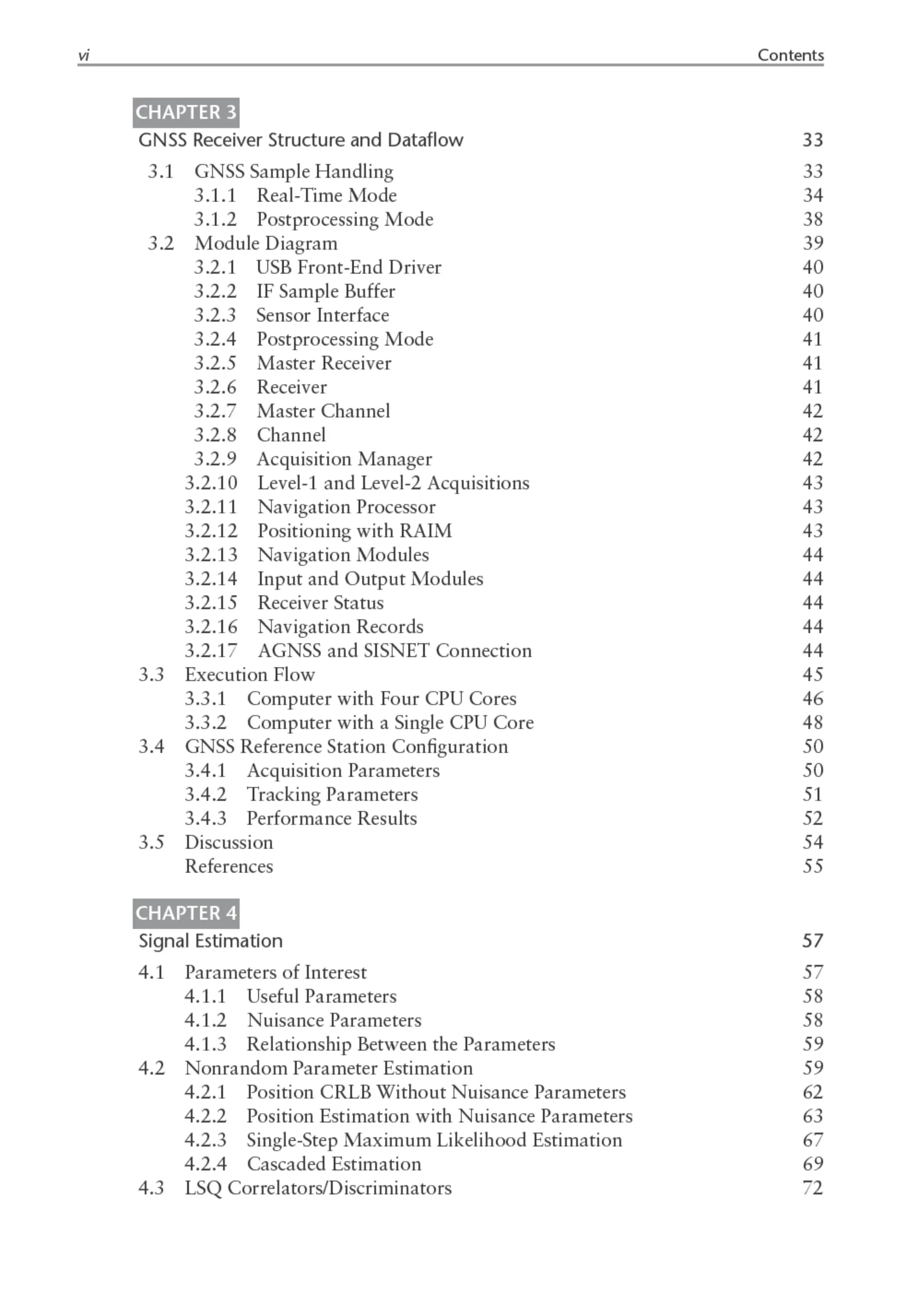




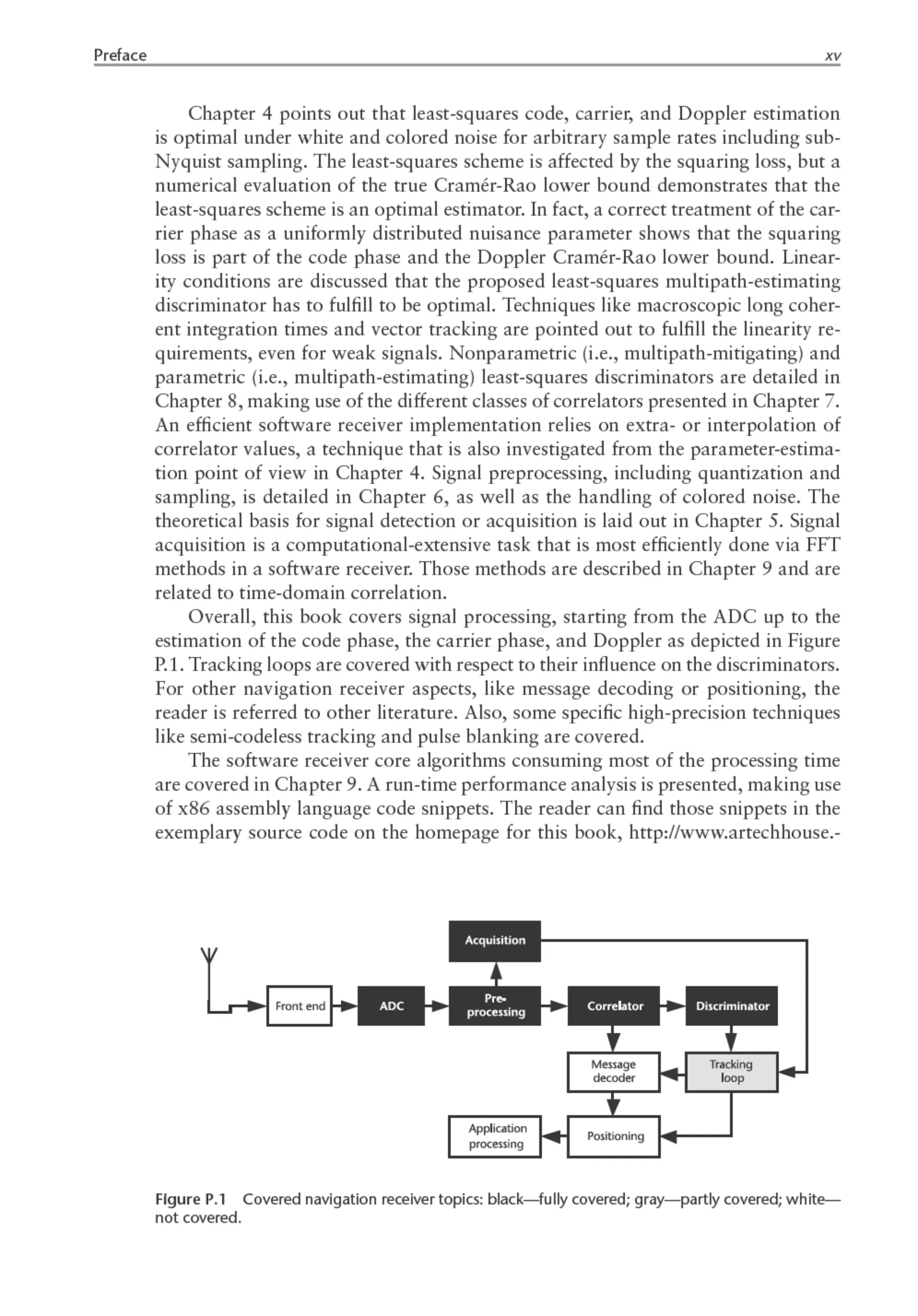
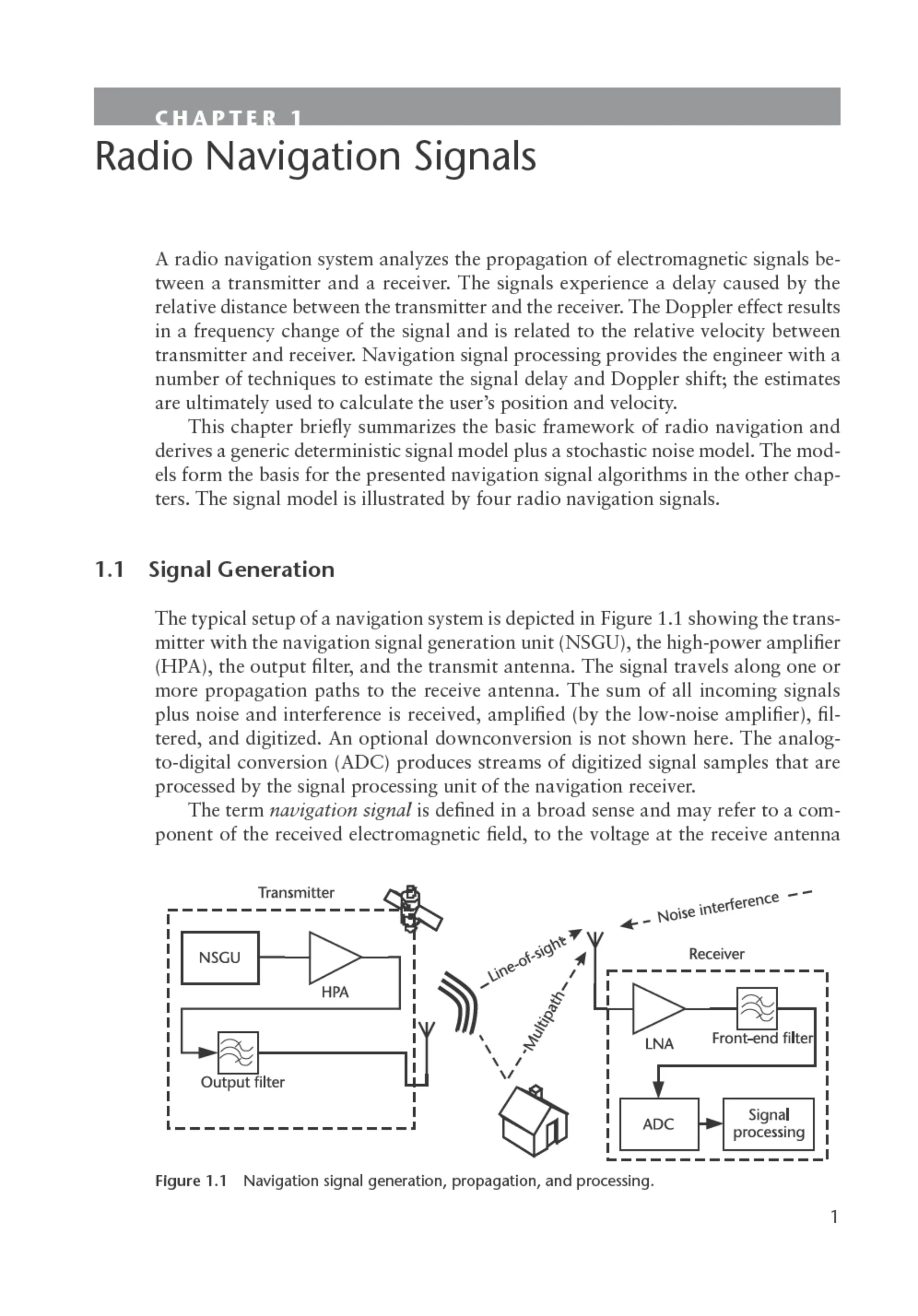
![Radio Navigation Signals
output, or to the digitized signal obtained after (optional) downconversion and
filtering of the received signal.
The broadcast navigation signal structure is known to the receiver and will be
characterized in the following paragraphs. A good way to do this is to merge the
frontend filter into the output filter (i.e., into a combined filter) and to describe the
signal after the output filter. This simplification is useful for signal processing pur-
poses and is valid, because both antennas, the propagation path, and the frontend
filter act as linear systems to the signal. Nonlinear effects of the amplifiers or mixer
are not considered.
Without the combined filter (or output filter), the transmitted signal rS is writ-
ten as
( ) ( ) ( )cos(2 )
S S RF
r t a d t c t f t
π
¥
= (1.1)
Here, fRF is the carrier frequency in hertz, c (t) is the infinite bandwidth signal
representation at baseband, and d(t) represents a broadcast navigation message.
The transmitted signal is described in the signal-in-space (SIS) interface control doc-
ument (ICD) [1, 2]. The symbol aS denotes the signal amplitude in arbitrary units.
Other signals might be transmitted on the same carrier frequency by the same
satellite. For example, the Global Positioning System (GPS) C/A signal is broadcast
in phase quadrature with the P(Y) signal on the L1 (1,575.42 MHz) carrier fre-
quency. The access to the different signals is controlled via c (t). Different wave-
forms of c∞(t) can be used to realize code division multiple access (CDMA), time
division multiple access (TDMA), or—by including a carrier into c (t)—frequency
division multiple access (FDMA) schemes.
With the combined filter, the signal is mathematically written as
= - +
( ) ( ) ( )sin(2 ) ( ) ( )cos(2 )
S S Q RF S I RF
r t a d t c t f t a d t c t f t
π π (1.2)
with
( ) ( ) ( )
I Q
c t c t ic t
= + (1.3)
representing the filtered baseband representation of the signal obtained by applying
(1.10). The signal cQ(t) is an artifact generated by the filter. The filter does not affect
d(t), as long as the data rate (e.g., 50 bit/s) is much smaller than the filter bandwidth
(e.g., 2 MHz). If the radio frequency (RF) is much higher than the filter bandwidth,
cQ(t) is small and can be ignored.
Using a complex notation, the signal after the combined filter is given as
( ) Re{ ( ) ( )exp(2 )}
S S RF
r t a d t c t if t
π
= (1.4)
1.2 Signal Propagation
According to Fermat’s principle, the line-of-sight component of the signal rS(t)
travels along the shortest propagation path from the transmitter to the receiver.
Eventually, one or more reflected signals [i.e., copies of rS(t)] are superimposed with
the line-of-sight signal. Each copy has a different amplitude, Doppler, carrier phase](https://image.slidesharecdn.com/38743-250301213413-d91cceff/75/Navigation-Signal-Processing-for-GNSS-Software-Receivers-1st-Edition-Thomas-Pany-22-2048.jpg)
![1.3 Signal Conditioning
delay, or code phase delay. Furthermore, the line-of-sight component is delayed by
the atmosphere. Accurate modeling of the propagation effects is one of the key ele-
ments to obtain a precise position and this topic is covered in many satellite navi-
gation text books [3, 4]. We will not go into the modeling details, but will instead
focus on a model for the received signal that can be used as a basis for delay and
Doppler estimation.
Delays affect the carrier and the data-modulating signals c(t), d(t) differently.
Frequency-independent (nondispersive) delays are caused by the geometric distance
and by the electrically neutral part of the atmosphere (troposphere). Frequency-
dependent (dispersive) delays are caused by the ionosphere and by the receiver and
transmitter hardware. Dispersive and nondispersive delays add up and result in the
group delay τG, delaying c(t) and d(t). The carrier is delayed by the phase delay τP.
The delays τG and τP are not equal because the ionospheric delay contributes to
each of them with a different sign. The difference is typically less than 100m and
varies with a frequency not more than 0.05 Hz if no scintillations are present. Also,
hardware group and phase delay are generally different.
The group delay, τG, affects c(t) via
,0
( ) ( ( )) ( )
G D G
c t c t t c t
τ α τ
® - » - (1.5)
and similarly for d(t). The phase delay, τP, affects the carrier via
,0
exp(2 ) exp(2 ( ( ))) exp(2 ( ))
RF RF P RF D P
if t if t t if t
π π τ π α τ
® - » - (1.6)
with
/ ,0 / 0 0
( ) (1 )
G P G P D
t t
τ τ α
= - - (1.7)
The coefficient αD
1
D
v
c
α = - (1.8)
is the Doppler effect, caused by the change in the group/phase delay, expressed as
velocity v in meters per second. The linearization is carried out around the epoch t0.
If the signal duration Tcoh under consideration is short, the Doppler effect on c(t),
d(t) can be ignored, as in
,0 0
( ) ( ( ))
coh D G
c
T c t c t t
vB
α τ τ
Þ - » - (1.9)
and similarly for d(t), where B denotes the signal (or data message) bandwidth in
hertz.
1.3 Signal Conditioning
After signal reception by the antenna, the signal is amplified, filtered, and eventually
downconverted. Amplification changes the amplitude of the signal (from aS to a),
but leaves the signal structure invariant.](https://image.slidesharecdn.com/38743-250301213413-d91cceff/75/Navigation-Signal-Processing-for-GNSS-Software-Receivers-1st-Edition-Thomas-Pany-23-2048.jpg)
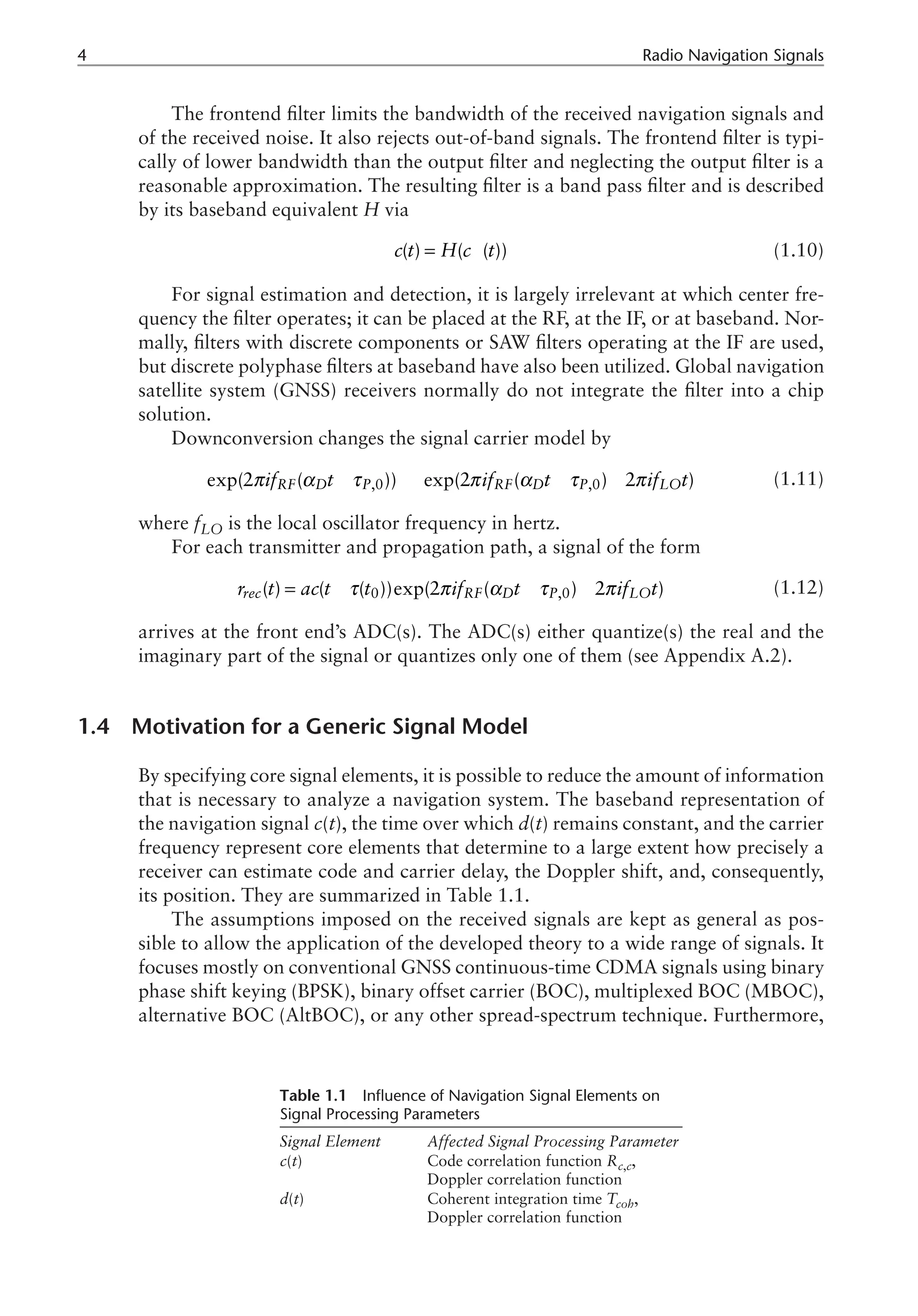
![1.5 Sampling
pulsed signals are included because they are being used by pseudolites, by LORAN-C,
or RADAR-like ranging systems. In principle, the theory can also be adapted for
sonar ranging systems and, with some limitations, for optical ranging systems. Only
one frequency band is considered (e.g., GPS L1); a generalization from a sampling
of one frequency band to multiple frequency bands is obvious, but one should be
take care that all bands are sampled synchronously.
No assumption on the relation of the signal bandwidth to the sampling rate is
made and, in particular, sub-Nyquist sampling rates can be used. No assumption on
the modulation scheme is made as long as the received signal waveform at baseband
c(t) is known a priori to the receiver. Eventually, filters influence the theory via the
waveform c(t). The more narrow the filter bandwidth, the smoother the waveform
will be.
The filter bandwidth and characteristics define how much noise power is be-
ing received: the wider the bandwidth, the higher the noise power. For simplicity, a
unity noise power is assumed in (1.16) and it is important to keep in mind that only
ratios between power levels have meaningful values, as described in Section 1.8.1.
In that sense, (1.16) defines the power scale.
The Nyquist criterion does not fully apply because the waveform c(t) is known
to the receiver beforehand. Consequently, there is no need to reconstruct the signal
waveform from the received samples [5]. As shown in Section 6.5, a good choice
for the sample rate is exactly equal to the Nyquist rate (e.g., being equal to the noise
bandwidth). Lower sample rates yield less-independent signal samples, thereby gen-
erally decreasing the accuracy of the obtained estimates. The accuracy decrease can
be modeled as an effective signal power loss. This observation is also true when
multiple reflections of the same signal are received.
In the rest of this chapter, we will formulate generic conditions for navigations
signals. Later, we illustrate the conditions with two GNSS signals and two pulsed
terrestrial navigation signals. In addition to those parameters, the number of re-
ceived signals, the amplitude, and the geometric placement of the transmitters affect
the positioning result (see Sections 4.1.3 and 8.4).
1.5 Sampling
In the following, a number of L signal samples are considered, indexed by m. The
index m assumes, in general, the values
{ }
1, ,L
µ Î … (1.13)
The sampling epoch tm in seconds for the sample m is given by
s
t
f
µ
µ
= (1.14)
and fs defines the ADC sample rate in samples per second. Optionally, the sampling
epochs can be offset by a fixed amount of time, which will not explicitly be men-
tioned here.
For each sampling epoch tm, a complex-valued (i.e., I plus Q) signal sample is
generated. We chose a complex signal representation to work with more compact](https://image.slidesharecdn.com/38743-250301213413-d91cceff/75/Navigation-Signal-Processing-for-GNSS-Software-Receivers-1st-Edition-Thomas-Pany-25-2048.jpg)
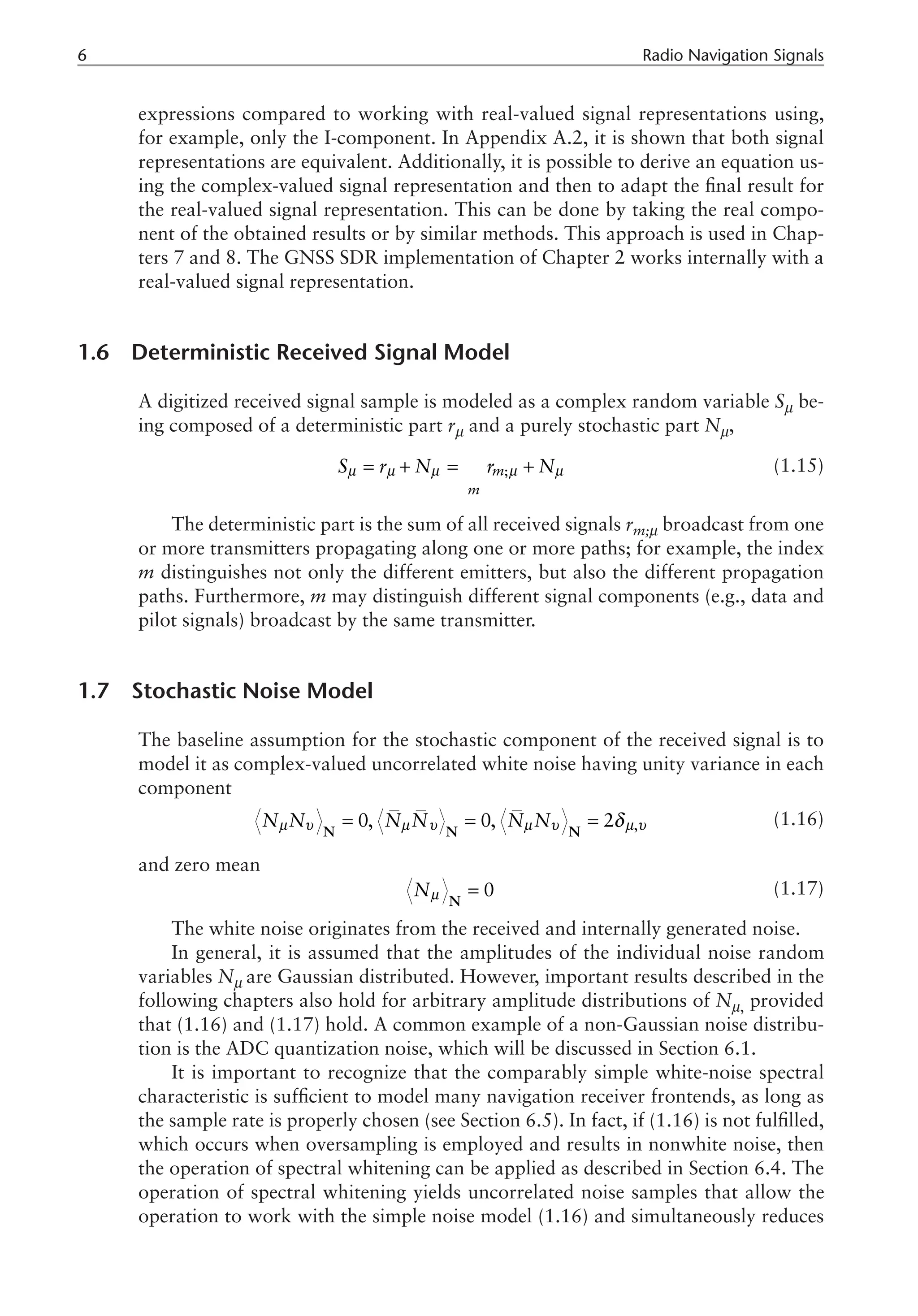
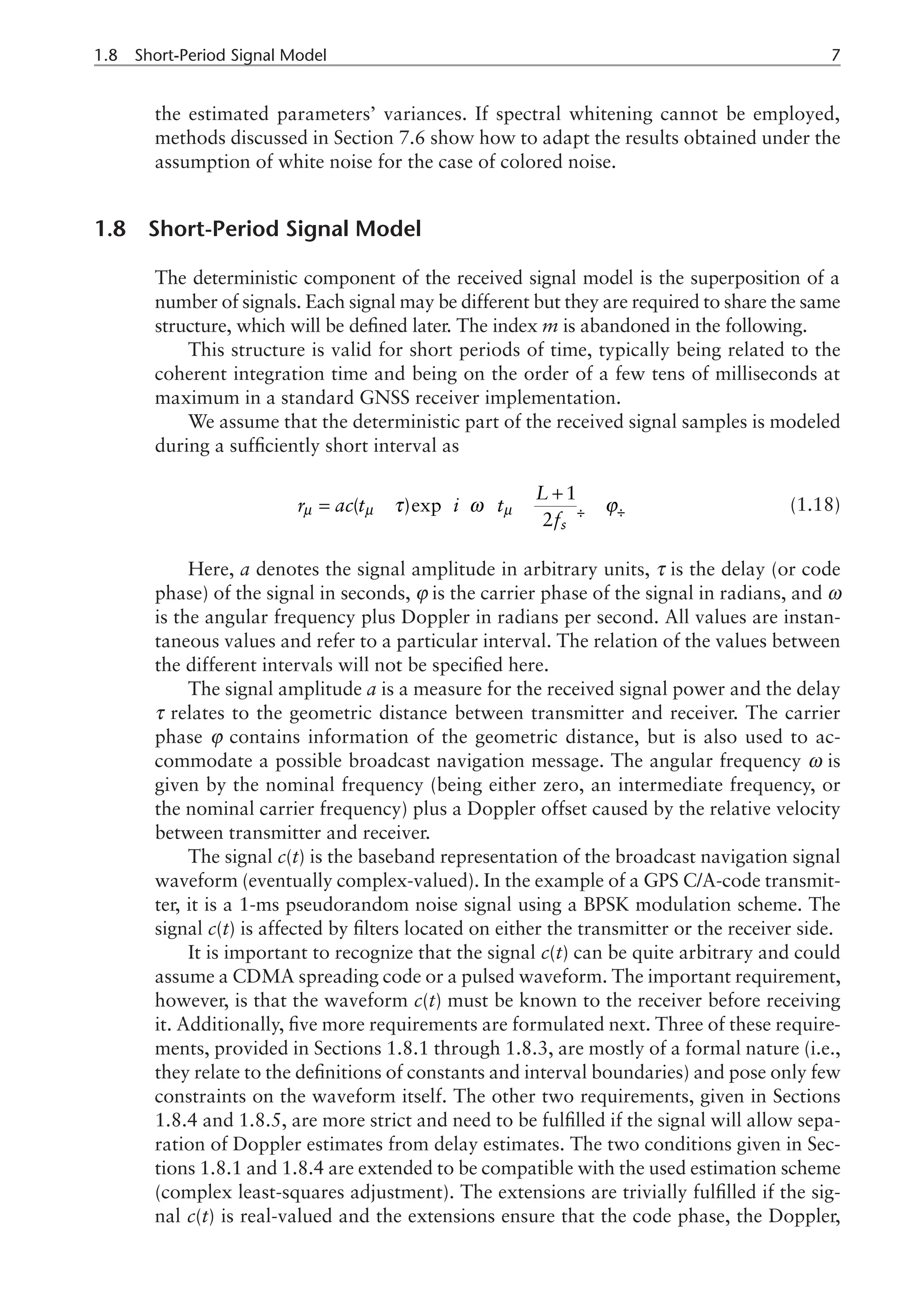

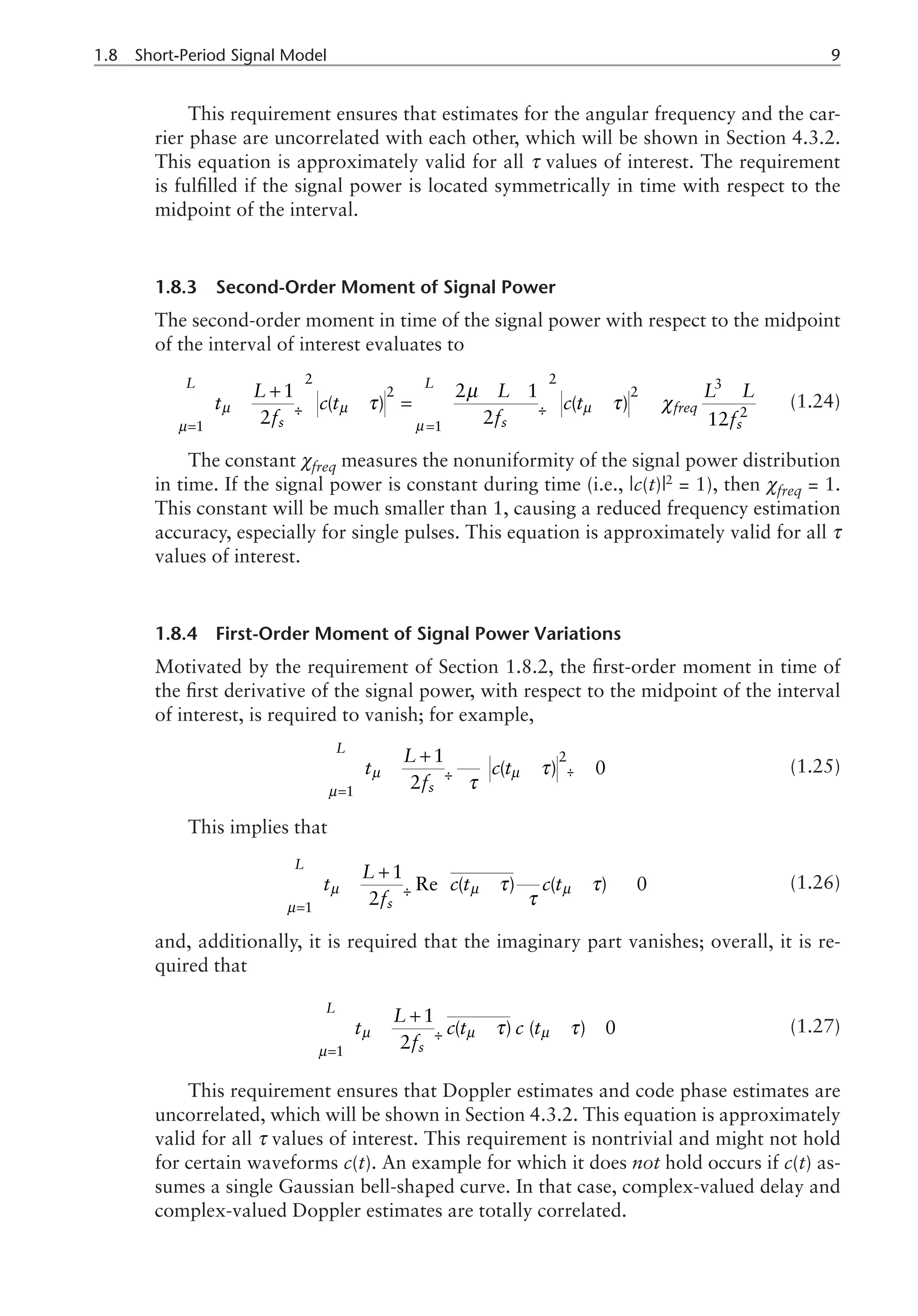

![1.9 Exemplary Signals 11
For large L and Tcoh L/fs, the conditions are summarized as
2
(0) 1
(0) 0
1
(0)
12
freq coh
T
κ
κ
κ χ
»
»
¢
» -
¢¢
(1.32)
1.9 Exemplary Signals
This section illustrates the generic signal model with four types of navigation sig-
nals. Table 1.2 summarizes signal parameters of the four exemplary navigation
signals. For each signal, we chose a typical coherent integration time. The pulsed
open-service (OS) pilot signal is introduced in detail in Section 1.9.3 and Chapter
10 and uses TR = 100 ms and TP = 4 ms.
1.91 A Model for the GPS C/A-Code Signal
The American GPS is the most popular navigation system worldwide. Its first de-
velopment satellites were launched in 1978. Currently, 32 GPS satellites orbit the
Earth and transmit navigation signals on three different frequencies: L1, L2, and
L5. Of all the signals, the C/A-code signal on L1 is best known. All mass-market
GNSS receivers make use of it and it is also the workhorse for professional and
scientific applications. Originally, the C/A-code signal was forseen for acquisition
of the P(Y) code.
The C/A-code signal utilizes the CDMA scheme and the pseudorandom noise
(PRN) code sequences are Gold sequences 1 ms in length at a chipping rate of fc =
1.023 Mchip/s employing the BPSK modulation scheme. Details of the signal can
be found in [1].
A baseband model of the signal is given by a convolution of the PRN code se-
quence cn with the single-chip waveform p∞(t)
( ) ( )
n c
n
c t c p tf n
¥
¥ ¥
=-¥
= -
å (1.33)
The elements of the spreading code sequence cn assume values of –1 and +1 and
the sequence is periodic with a period of NPRN = 1,023,
Table 1.2 Important Parameters of Exemplary Navigation Signals
Typical
Tcoh (ms)
R¢¢
–
c,c(0) (ms)–2
κ(ω)
GPS C/A 20 –21.37 (1.29) with Tcoh = 20 ms
Galileo OS Data 4 –76.59 (1.29) with Tcoh = 4 ms
Galileo OS Pilot 100 –87.58 (1.29) with Tcoh = 100 ms
Pulsed OS Pilot 100 –87.58 (1.29) with Tcoh = 4 ms
Gaussian Double Pulse 1 –0.005 (A.124)](https://image.slidesharecdn.com/38743-250301213413-d91cceff/75/Navigation-Signal-Processing-for-GNSS-Software-Receivers-1st-Edition-Thomas-Pany-31-2048.jpg)
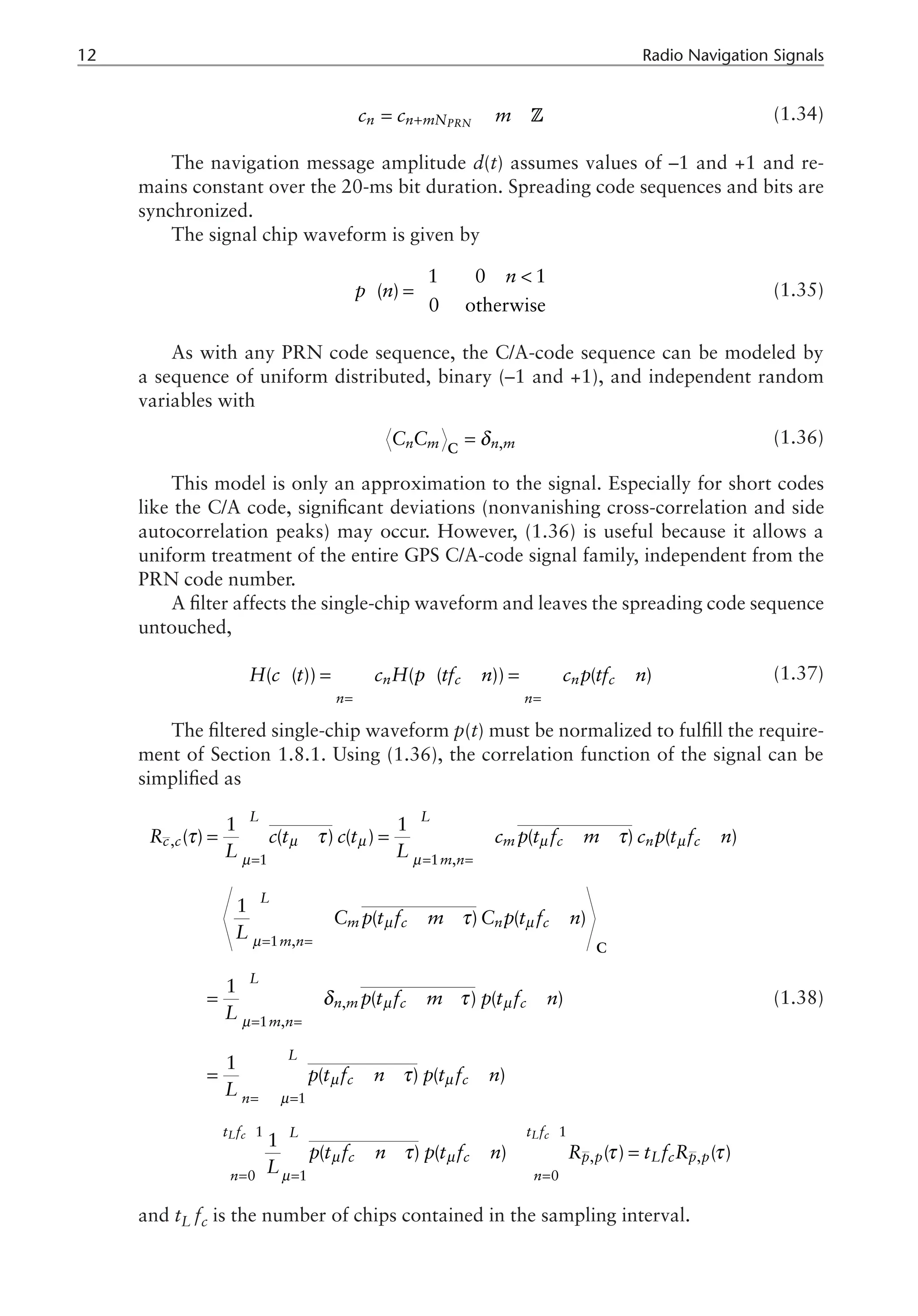
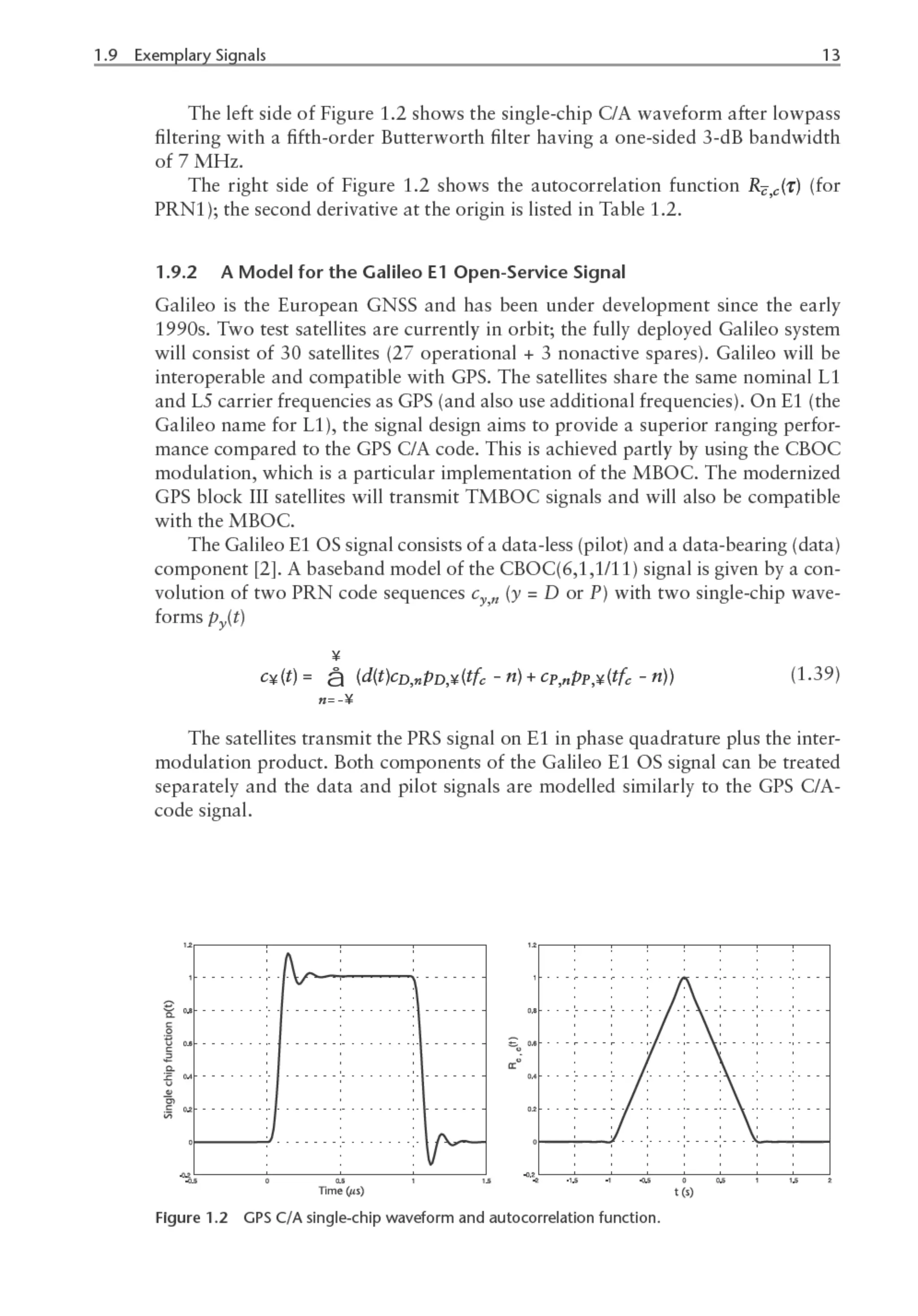
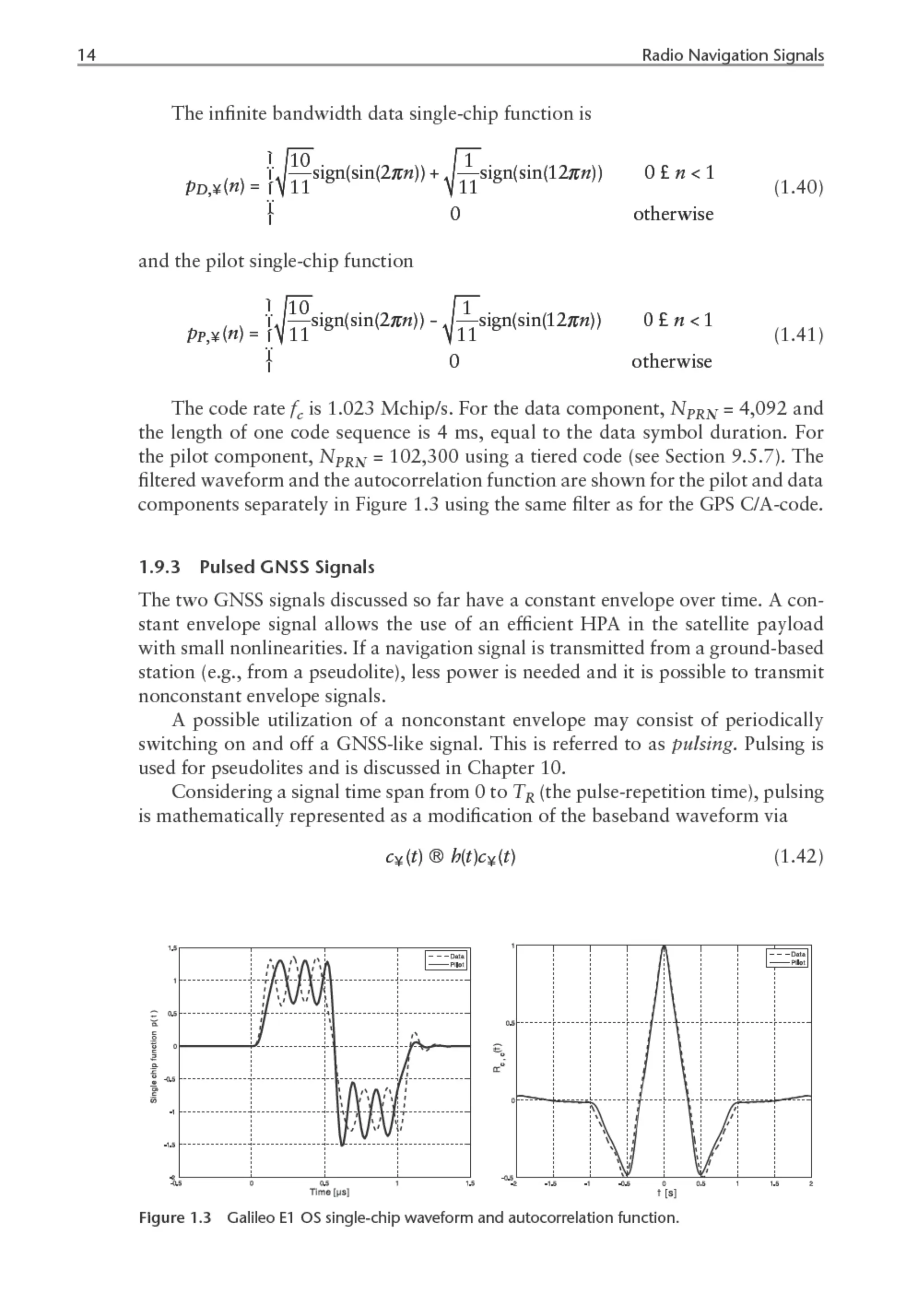
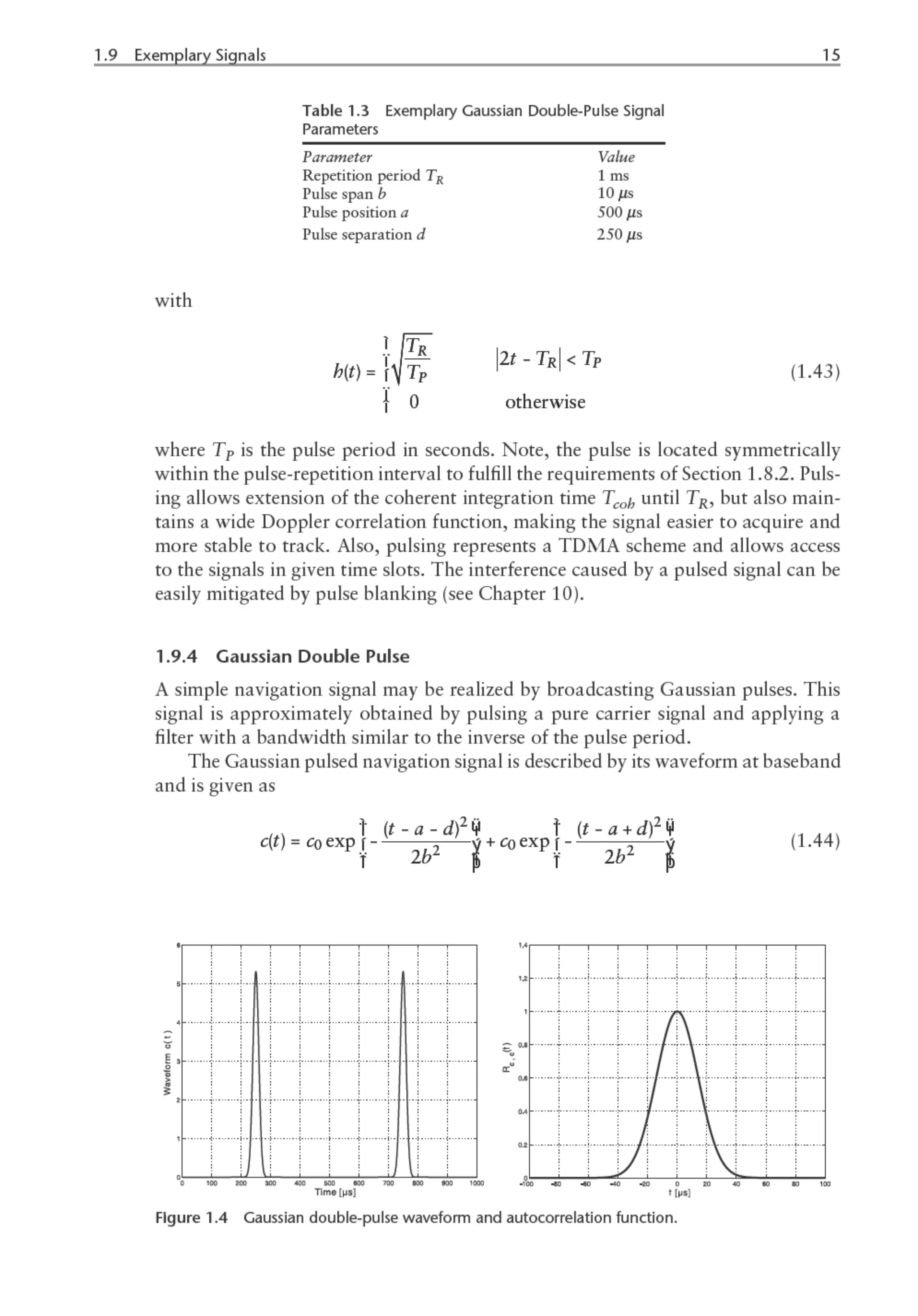
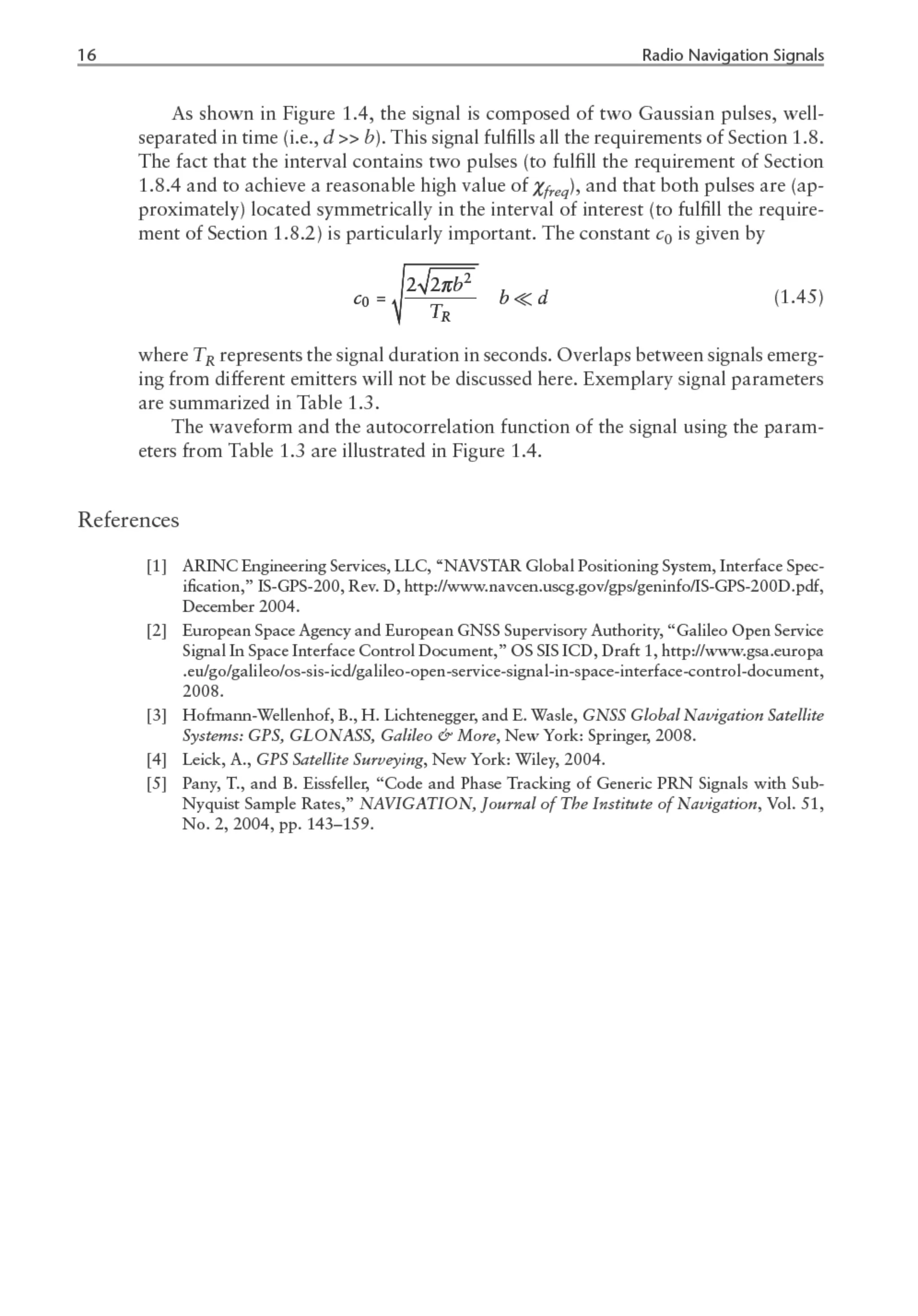
![17
17
C H A P T E R 2
Software-Defined Radio
This chapter revises the software-defined radio concept by providing definitions of
terms; it shows the connections between GNSS software radios and developments
in the communications area. GNSS software radio applications are presented and it
is argued that software radios are suitable for high-end GNSS receivers.
2.1 Definitions
A (true) software radio is a radio consisting of an antenna, an ADC/DAC, and
a programmable unit (processor) that runs a piece of software. In contrast, a
software-defined radio (SDR), generally, is a design principle to realize one or more
components of a radio in a configurable manner. In the extreme case, the term SDR
can be applied to radios that support different standards by sharing the same hard-
ware unit (or software modules) but running them with different parameter sets
[such as parameter-controlled SDR (PaC-SDR)].
Both radio design methods emphasize the inherent flexibility of software com-
pared to hardware to reduce development efforts and maintain a certain level of
flexibility and compatibility in the radio or to realize complex operations efficiently
[e.g., a handover between different protocols such as the global system for mo-
bile communication (GSM) and the universal mobile telecommunications system
(UMTS)]. As a drawback, SDRs often place higher requirements on the underlying
hardware in terms of power consumption and processing performance compared
to the radio as an application-specific integrated circuit (ASIC).
J. Mitola presented the software-radio idea to a broad community in 1995.
Mitola had previously worked on increasing flexibility and interoperability of radios
[1]. A comprehensive summary of SDR, including origins, drivers, and perspectives,
was published by Tuttlebee in [2]. Recent aspects of network and user administration
that explain flexible mobile communication networks are covered in [3]. These in-
clude adaptive protocol layers, organization of different services, security aspects, in-
telligent (cognitive) radios, spectrum pooling, and automatic modulation detection.
A key characteristic of SDR techniques is the mixture of classical radio technol-
ogy (e.g., modulation, demodulation, and channel estimation) and modern, mostly
object-oriented, software techniques. The hardware of a SDR is required to have
increased flexibility for it to be compatible to the SDR software, which follows
standards and procedures that mimic the functionally of classical radios.
SDRs can be created using different hardware technologies. The lowest levels
of a SDR, which include an antenna and an amplifier, do not differ from conven-
tional hardware radios. At the next level, a SDR might directly digitize the received
RF broadband signal, or it may first downconvert and filter it before carrying out](https://image.slidesharecdn.com/38743-250301213413-d91cceff/75/Navigation-Signal-Processing-for-GNSS-Software-Receivers-1st-Edition-Thomas-Pany-37-2048.jpg)
![18 Software-Defined Radio
digital sampling. It is known that for direct sampling of a broad frequency band
(e.g., 0.8–2.2 GHz, which contains all digital civilian mobile phone communica-
tion standards) not only is a high sampling rate (e.g., 4.4 GHz) required, a high bit
resolution to control signal dynamics of all signals in the frequency range is also
required. Assuming a constant sampling rate, the ADC-bit resolution increases by
1.5 bits every 8 years [4]. It is therefore expected that in future SDRs, only limited
parts of the RF spectrum will be sampled [3]. Furthermore, power consumption of
the ADC and of the subsequent signal-processing units would increase dramatically
if they had to operate for a very broad frequency band.
After the signal has been converted to its digital form, it is processed by the
radio. Digital signal-processing elements in a SDR exist in configurable ASICs, field-
programmable gate arrays (FPGAs), digital signal processors (DSPs), and general
purpose processors (GPPs). Note that this work focuses on the receive function of a
radio, but that the discussion also applies to the transmission path if the data flow
is reversed.
Reconfigurable ASICs are related to the technique called PaC-SDR. For PaC-
SDR, several communication standards are investigated with respect to their
similarities and differences. Common algorithms are designed, which can then be
configured using different parameter sets to work for the investigated communi-
cation standards. These algorithms might then be realized as ASICs or software
modules. PaC-SDR implies that the standards under consideration do not differ
completely. PaC-SDR can be considered as the least flexible form of a SDR as in-
field software updates are not possible. In contrast, modular SDR (Mod-SDR) is
a technique to run the required algorithms as software modules on exchangeable
hardware (i.e., on a processor or on FPGAs). This not only allows reconfiguration
of the algorithms with different parameters, but also allows complete reorganiza-
tion or updating of the algorithm. The main problem with Mod-SDR is that the
software and the underlying hardware need to be compatible. Wiesler discusses
three methods to run Mod-SDR software [5]:
There exists a standardized hardware platform including compilers and li-
braries. The compiler directly generates binary code for this platform stan-
dard. The software is developed specifically for this platform and can be easily
downloaded. The disadvantage is that hardware manufacturers have to follow
this standard strictly and cannot incorporate their own code or hardware.
The compiler generates generic code (similar to the case for JAVA compil-
ers) and the hardware manufacturers provide a translator from the generic
code to the binary code of the platform. This allows more freedom for the
hardware manufacturers in their hardware development. On the other hand,
standardization is still required at the level of the generic language. It is also
known that directly generated binary code often runs faster than translated
code, which is important for real-time radio applications.
Every hardware manufacturer develops its own software specifically for its
own hardware radio. There exists no SDR standard, which maintains com-
petitiveness among different manufacturers and protects their intellectual
property. Software updates are performed primarily when upgrading to new
standards or when errors have to be corrected.
1.
2.
3.](https://image.slidesharecdn.com/38743-250301213413-d91cceff/75/Navigation-Signal-Processing-for-GNSS-Software-Receivers-1st-Edition-Thomas-Pany-38-2048.jpg)
![2.2 Communication Radios 19
In the context of GNSS SDR, the third solution dominates although some ef-
forts have been undertaken to realize a GNSS radio under the JTRS SCA [6] or
as a GNU radio [7]. It is also known that GNSS SDRs often serve as prototype
platforms for later ASIC designs or the investigation of different signal-processing
algorithms. The use of prototype SDRs is common in research and development
but is usually not relevant for deployed radios. Overall, the term SDR covers an
enormous number of techniques.
2.2 Communication Radios
A vast number of communication software radio implementations exist because the
often small bandwidth of a communication channel allows for an efficient compu-
tational implementation on a DSP. The examples in Sections 2.2.1 and 2.2.2 pro-
vide insight into the underlying architecture of high-complexity software radios:
2.2.1 GNU Radio
GNU Radio is an open-source project consisting of a library of signal-processing
blocks written in C++ and Python scripts used to connect the signal-processing
blocks [8]. The GNU radio software runs on the PC platform under various operat-
ing systems. The Universal Software Radio Peripheral (USRP) is a dedicated front-
end hardware, and allows receiving and transmitting radio signals in the frequency
range from direct current (DC) to 2.9 GHz [9]. The USRP can be connected to the
GNU radio running on the PC via a USB 2.0 connector. The GNU radio project
started in 1998 as a toolkit for learning about, building, and deploying SDRs. It is
currently an official GNU project.
The C++ building blocks process an infinite stream of data flowing from their
input ports to their output ports. A building block can, for example, implement an
FIR filter or perform FM demodulation. Some building blocks connect to hardware
like the PC speaker, microphone, or screen on the user side, or to the USRP on the
RF side. The Python script defines the sample rate of the radio, selects the C++
building blocks, and defines the connections between the building blocks.
Because the GNU Radio project provides full source-code access, new applica-
tions can be developed with relative ease. However, the software does not follow
any industry standards and seems to focus on the research sector. GNU Radio ap-
plications are numerous and include an HDTV receiver. The USRP includes a small
FPGA, which performs minor tasks (e.g., digital upconversions and downconver-
sions) on the FPGA instead of on the PC.
Initial attempts have been undertaken to process GPS signals with the GNU Ra-
dio [7]. A GLONASS receiver has been developed that uses the USRP as a front end
but uses its own software framework [10].
2.2.2 Joint Tactical Radio System
The largest field of application for SDRs is currently in the military domain. Apart
from reduced development costs and increased flexibility, a military SDR approach](https://image.slidesharecdn.com/38743-250301213413-d91cceff/75/Navigation-Signal-Processing-for-GNSS-Software-Receivers-1st-Edition-Thomas-Pany-39-2048.jpg)
![20 Software-Defined Radio
offers the possibility of reprogramming radios in the field, allowing changes in cryp-
tographic methods to be performed easily. Of importance is the potential to form
ad-hoc networks in the field that allow the exchange of various data (e.g., speech,
text, maps) between soldiers and the command center.
Several programs exist in different nations to replace legacy radios with SDRs.
Due to the size of those programs, great efforts have been undertaken to standard-
ize and coordinate the development efforts. The US Department of Defense (DoD)
program Joint Tactical Radio System (JTRS), briefly introduced in Section 2.3, is
based on the work of the Joint Program Executive Office for the JTRS [2, 11]. It is
important to note that other programs exist as well [12].
The JTRS program was initiated in early 1997 to replace existing legacy radios
in the DoD inventory. It evolved from separate radio replacement programs to an
integrated effort to network multiple weapon system platforms focusing especially
on the last tactical mile. JTRS is intended to link the global information grid (GIG)
to the military personnel. This goal would be achieved by developing a family of
interoperable SDRs that operate as nodes in a network to ensure secure wireless
communication and networking services for mobile and fixed forces.
Within the context of JTRS, waveform is a technical term of importance. A
waveform is the entire set of radio and communication functions that occur from
the user’s input to the radio frequency output and vice versa. A JTRS-waveform
implementation consists of a waveform application code, radio set devices, and
radio system applications. Originally, there were 32 JTRS waveforms; that num-
ber has been reduced to nine: Wideband Networking Waveform (WNW), Soldier
Radio Waveform (SRW), Joint Airborne Networking–Tactical Edge (JAN-TE),
Mobile User Objective System (MUOS), Single Channel Ground and Airborne Ra-
dio System (SINCGARS), Link-16, Enhanced Position Location Reporting System
(EPLRS), HF, and UHF SATCOM [13]. The JTRS also considered different form
factors that are defined as the linear dimensions and configuration of a device.
The JTRS program tries to exploit key SDR elements to achieve the develop-
ment of the system within the allocated budget. The key element—government-
purpose rights—ensures software reusability among different product lines. This is
achieved partly by the JTRS information repository, which is available to industry
vendors. Currently, it consists of 3.5 million lines of code, including 15 waveforms
and two operating environments.
The next key element—the open-systems architecture approach—focuses on an
overarching systems-engineering model. This model directs performance, design specifi-
cations, and standards for the operation of the system. It is based on the freely available
software communication architecture (SCA) [13]. The SCA is based on a standardized
operating environment implementing portable operating system interface (POSIX) and
middleware (software that ties together other software blocks) implementing the Com-
mon Object Requesting Broker Architecture (CORBA) standard.
The key feature, as shown in Figure 2.1, is that the receiver is a multiprocessor
system. The software communications architecture (SCA) requires the underlying
operation of the system to realize POSIX application programming interfaces (APIs)
between the operating system and the applications. The communication of different
parts of the software (objects) running on different processors (GPPs, DSPs, and
FPGAs) is of the utmost importance. This is facilitated by the CORBA middleware.](https://image.slidesharecdn.com/38743-250301213413-d91cceff/75/Navigation-Signal-Processing-for-GNSS-Software-Receivers-1st-Edition-Thomas-Pany-40-2048.jpg)
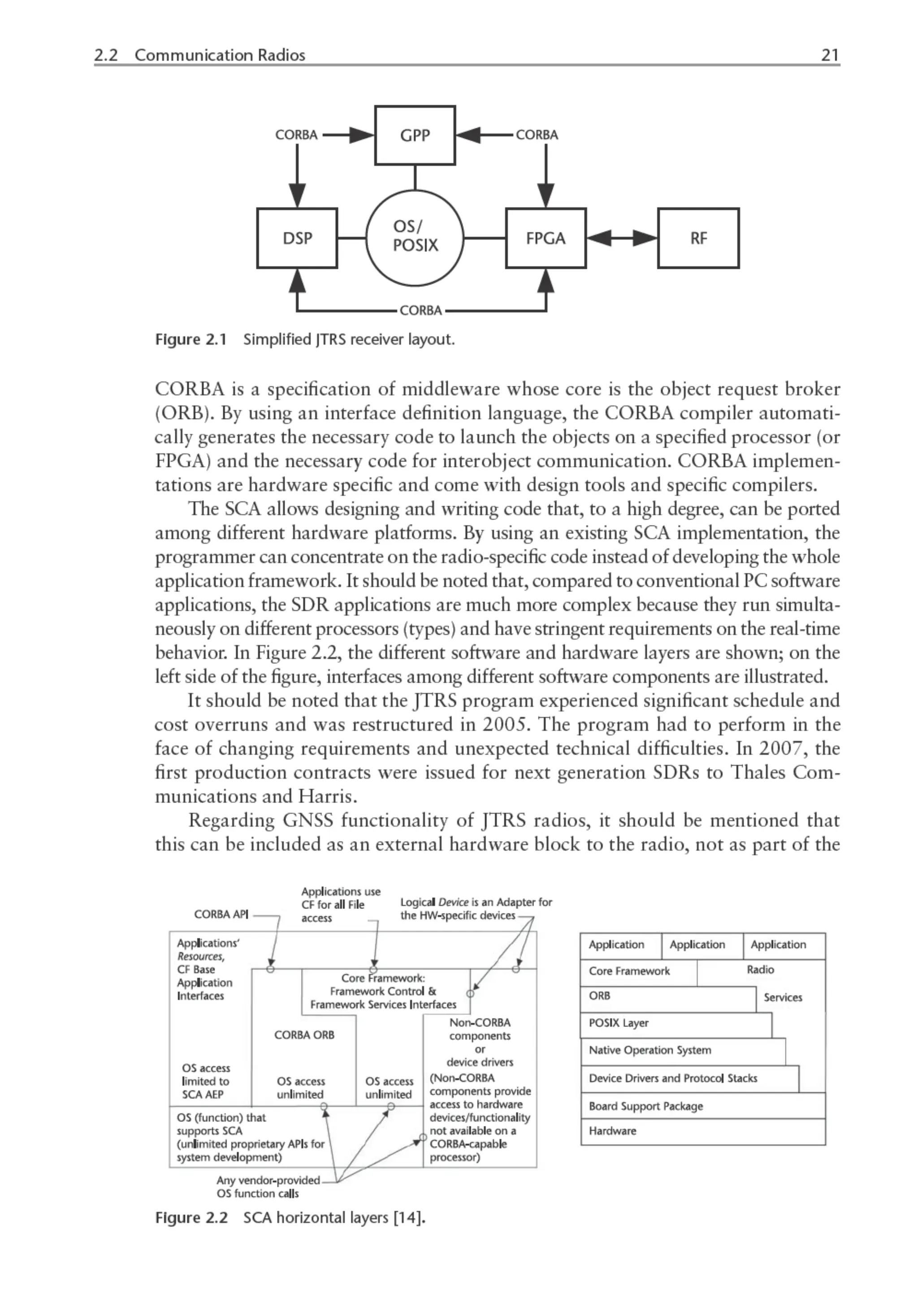
![22 Software-Defined Radio
SCA. However, investigations to implement the GPS waveform under the SCA are
underway [6].
2.3 GNSS Software Receivers
The idea of a GNSS SDR gained broad attention with the Ph.D. thesis of D. Akos
[15]. In that work, the core concepts were implemented and 30 seconds of GPS data
was processed until a SPS position fix was achieved. To demonstrate the flexibility,
GLONASS signals were successfully acquired and tracked.
The work by Akos performed all the signal processing in the postprocessing
mode, but soon thereafter a real-time implementation was achieved on a DSP and
on a general-purpose PC [16].
There are many pieces of software from different research groups which do
one part (e.g., fast Fourier transform (FFT) acquisition of CDMA signals) or all
of the GNSS processing in postprocessing and do not claim to be a SDR [17].
Because of the inherent flexibility of SDR, it is difficult to give a precise definition
for a GNSS software radio. For example, a GNSS receiver always has a proces-
sor that is responsible for the user interface and the position, velocity, and time
(PVT) calculation. Often this processor is used for tracking-loop control. In con-
trast, simple communication receivers (e.g., an FM radio) can be built without any
programmable elements. In a strict sense, even very old GPS receivers were SDRs
because at least one programmable element was involved. Additional confusion
arose because GNSS receiver prototyping is commonly done using an FPGA for sig-
nal correlation. Whereas this approach clearly uses a SDR, within the GNSS com-
munity there is a tendency to call only an operational DSP/GPP receiver a software
receiver.
Within this work, we define a GNSS software receiver as a real-time (capable)
GNSS receiver that does all the signal processing after downconversion and sam-
pling on a general-purpose processor. This processor can either be part of an em-
bedded platform or part of a standalone computer. Eventually, some small part of
the signal conditioning (e.g., IF filtering or sample rate reduction) can be done by
a programmable logic device (PLD) or FPGA. In contrast if the major part of the
signal correlation is done in an FPGA, then it shall be called an FPGA receiver. If
the signal correlation is done on an ASIC, the receiver will be called a hardware
receiver. Furthermore, we use the terms receiver and radio synonymously.
2.3.1 Front Ends
From the very beginning of GNSS software receivers, the software development was
accompanied by dedicated front-end development. As pointed in an earlier article,
three types of software receiver front ends emerged, which are distinguished by
their hardware interfaces [18]:
USB 2.0 front ends, mostly for the PC sector, see Figure 2.3;
Front ends with proprietary (e.g., serial SPI, SSP) interfaces at the digital-
signal level for the embedded sector;](https://image.slidesharecdn.com/38743-250301213413-d91cceff/75/Navigation-Signal-Processing-for-GNSS-Software-Receivers-1st-Edition-Thomas-Pany-42-2048.jpg)
![2.3 GNSS Software Receivers 23
Front ends using COTS ADC converters using their own interface or industry
standards such as PCI or PCI64.
The number of frequencies, the bandwidth of the sampled frequency bands, the
sample rate, and the number of ADC bits influence, to a large extent, the architec-
ture of the software receiver. This is mainly because, with an increasing amount of
incoming data, the processing power requirements and IF sample interface specifi-
cations change. On the other hand, several front-end architectures such as (super)
heterodyne, direct baseband, low-IF, and direct-RF sampling have been used in
conjunction with GNSS software receivers, but the influence of the front-end archi-
tecture on the software is rather low. It is essentially sufficient to adapt the IF within
the software and eventually work with complex (I/Q) or real (I) input samples.
A good front-end design is crucial to achieving high receiver performance be-
cause analog design mistakes can often not be compensated by the processing soft-
ware. Good front ends are, of course, also required for hardware receivers. The
only difference between a hardware receiver and a software receiver front end is
that the software receiver tries to keep the sample rate as low as possible to reduce
the computational load. Typically, the sample rate is chosen slightly above or even
below the Nyquist rate, as will be discussed in Section 6.5. In contrast, the hard-
ware receiver might use a higher sample rate to achieve, for instance, a small corre-
lator spacing. For example, a sample rate of 16 MHz for a GPS C/A-code hardware
receiver allows a correlator spacing down to 0.064 chip, whereas a sample rate of
4 MHz limits the spacing to 0.25 chip (assuming that different correlators are ob-
tained by shifting the generated PRN code signal by one sample).
To illustrate typical front-end designs for software receivers, consider the four
types of front ends whose key parameters are listed in Table 2.1. The first is used
for an embedded system focusing on mass-market applications. The second is a
research and development USB-based front end for L1 signals. The third has been
partly specified at the University FAF Munich and is designed for a GNSS refer-
ence station receiver. The fourth is a flexible signal analysis system (created as a
laboratory setup at the University FAF Munich) that is able to receive two L-band
frequency bands with arbitrary center frequencies.
The information gathered for the embedded system is based on commercial
information, and it should be noted that no specification of the IF filter could be
found [22]. In fact, the data sheet states that the IF filter order should be tailored
Figure 2.3 Different software receiver front ends, all with USB connectors, from left: embedded
[19] (copyright Maxim Integrated Products), RD L1 [20] (copyright IFEN GmbH), and reference
station GNSS receiver [21]. (Copyright Fraunhofer IIS; all images reprinted with permission.)](https://image.slidesharecdn.com/38743-250301213413-d91cceff/75/Navigation-Signal-Processing-for-GNSS-Software-Receivers-1st-Edition-Thomas-Pany-43-2048.jpg)
![24 Software-Defined Radio
to the specific application and that, for example, a standalone GPS receiver will not
require stop-band attenuation as strong as that required by a GPS receiver for an in-
tegrated wireless handset [19]. Furthermore, the spectral purity [i.e., the maximum
height of spikes within the IF power spectral density (PSD)] has not been verified
experimentally.
The embedded system uses two downconversion stages to bring the GPS L1
signal down to 3.78 MHz. Eventually, this allows for the use of a wider range of ref-
erence oscillator frequencies compared to a single downconversion stage. It includes
a SPI serial interface. The SPI is a de facto standard; many processors for embedded
systems include SPI controllers.
The RD L1 front end converts the RF to the IF of 96 MHz in a single step
and then uses bandpass sampling to further downconvert it to 4.348 MHz [20]. The
sampled IF signal is buffered before transfer over the USB port.
The reference station front end uses a heterodyne architecture. Each RF fre-
quency band is (separately) downconverted to 53.8 MHz. A discrete bandpass filter
limits the bandwidth before sampling and a real-valued IF signal is digitized. The
front end uses a 2- or 4-bit ADC. It has been demonstrated that the 4-bit ADC pro-
vides a significant performance gain if interference is present by being less sensitive
to saturation effects.
The highest flexibility can be achieved with a laboratory setup consisting of a
commercial ADC card (an ICS-572B is used here) with commercial off-the-shelf
(COTS) mixers and local oscillators. The components are connected through
SMA connectors. COTS mixers and low-noise amplifiers (LNAs) are available up
to frequencies of several GHz. The RF is downconverted to a selectable IF with
a single mixer. The ADC Nyquist bandwidth is 52.5 MHz. COTS lowpass fil-
ters are used to discard higher-frequency components. The design requires that
the antenna LNA already includes an RF filter to suppress the image frequency
Table 2.1 Front-End Parameters and Performance Figures
Name Embedded RD L1 Reference Station
Signal Analysis
System
Architecture Superheterodyne Heterodyne Low IF Heterodyne
Final IF 3.78 MHz 4.348 MHz 53.8 MHz 1–25 MHz
Number of bands 1 1 3 2
Carrier frequency L1 L1 L1, L2, L5 1–4.2 GHz
Bandwidth 3 MHz 10 MHz 13 or 18 MHz See text
Sample rate 6.5 MHz 23.104 MHz 40.96 MHz 105 MHz
Internal buffer — 32 MB None 64 MB
Number of bits 1.5–2.5 1.5 2 or 4 14
Filter characteristic Discrete L/C
or SAW, ceramic
Active discrete Discrete
(Bessel type)
—
Spectral purity — 2.5 dB 1 dB Generally worse
Gain 32–83 dB 36–106 dB 40–90 dB 24 dB
Noise figure 4.7 dB 1.6 dB 1.3 dB 2.5 dB
Analog stability — High High Low
Oscillator TCXO/crystal TCXO TCXO/external External
IF sample interface Serial (SPI, SSP) USB 2.0 2 × USB 2.0 PCI64](https://image.slidesharecdn.com/38743-250301213413-d91cceff/75/Navigation-Signal-Processing-for-GNSS-Software-Receivers-1st-Edition-Thomas-Pany-44-2048.jpg)
![2.3 GNSS Software Receivers 25
at RF-2xIF. Furthermore, the experimental setup does not give a completely clean
digital IF signal and several spikes appear. The high number of bits results in a
high dynamic range of over 80 dB, making the system well suited for interference/
jamming applications.
When comparing the four front ends, one clearly sees the increase in the num-
ber of frequency bands, bandwidth, bits, and sample rate from the embedded solu-
tion to the signal analysis system. The noise figure is best for the reference station
front end, but it should be emphasized that the total receiver noise figure is mostly
determined by the low-noise amplifier (LNA) that is either integrated into the an-
tenna or located directly behind the antenna. The noise figure of the front end is less
important. All four front ends sample a real signal. This avoids the use of a second
ADC and simplifies the data transfer.
2.3.2 Illustrative Applications
Sections 2.3.2.1 through 2.3.2.4 will present applications where GNSS SDRs have
already been established. Software receivers are excellent teaching tools; two books
have already been published on this topic [23, 24].
2.3.2.1 ASIC Replacement
The most obvious application of a GNSS SDR receiver is to replace existing hard-
ware chip solutions. For laptops/mobile phones/PNDs (or in general, for embedded
systems), there already exists laboratory software as well as commercial solutions.
Software-GPS-enabled laptops have been on the market since 2008 [25].
On an embedded system or, more specifically, on a mobile phone or personal
navigation device (PND), a general-purpose processor is available. Therefore, the
possibility exists to run a GNSS SDR on this processor. The advantages are that a
GNSS baseband chip can be avoided and that the GNSS receiver interacts more
flexibly with other software on the same system. Provision of GNSS-aiding data via
the mobile phone data link, for example, is more easily achieved. Also, integration
with other sensors (e.g., WLAN) or any other user software provides potential ad-
vantages in obtaining an integrated position solution. The GNSS software can later
be upgraded for upcoming systems and services. An RF front end and an antenna
are still required and have to fulfill the same requirements as a hardware receiver.
The disadvantages of a software solution compared to a hardware solution include
increased processing load and power consumption.
Some design ideas exist for creating a complete GNSS SDR as an embedded
system, where a dedicated processor not running the application software is used
for the GNSS functions; that is, the GNSS SDR has the same form factor as a hard-
ware receiver. The processor basically replaces the baseband chip. The module itself
provides the same interfaces as a hardware receiver, but retains SDR flexibility.
The most critical issues for a SDR embedded receiver are the limited resources
in terms of processing power, memory size, and memory bandwidth. Commercial
solutions such as SiRFSoft are explicitly optimized for market-leading platforms
like the Intel XScale [26]. Those platforms provide dedicated instructions to speed
up signal-processing algorithms, like multiply-and-add commands. There are also](https://image.slidesharecdn.com/38743-250301213413-d91cceff/75/Navigation-Signal-Processing-for-GNSS-Software-Receivers-1st-Edition-Thomas-Pany-45-2048.jpg)
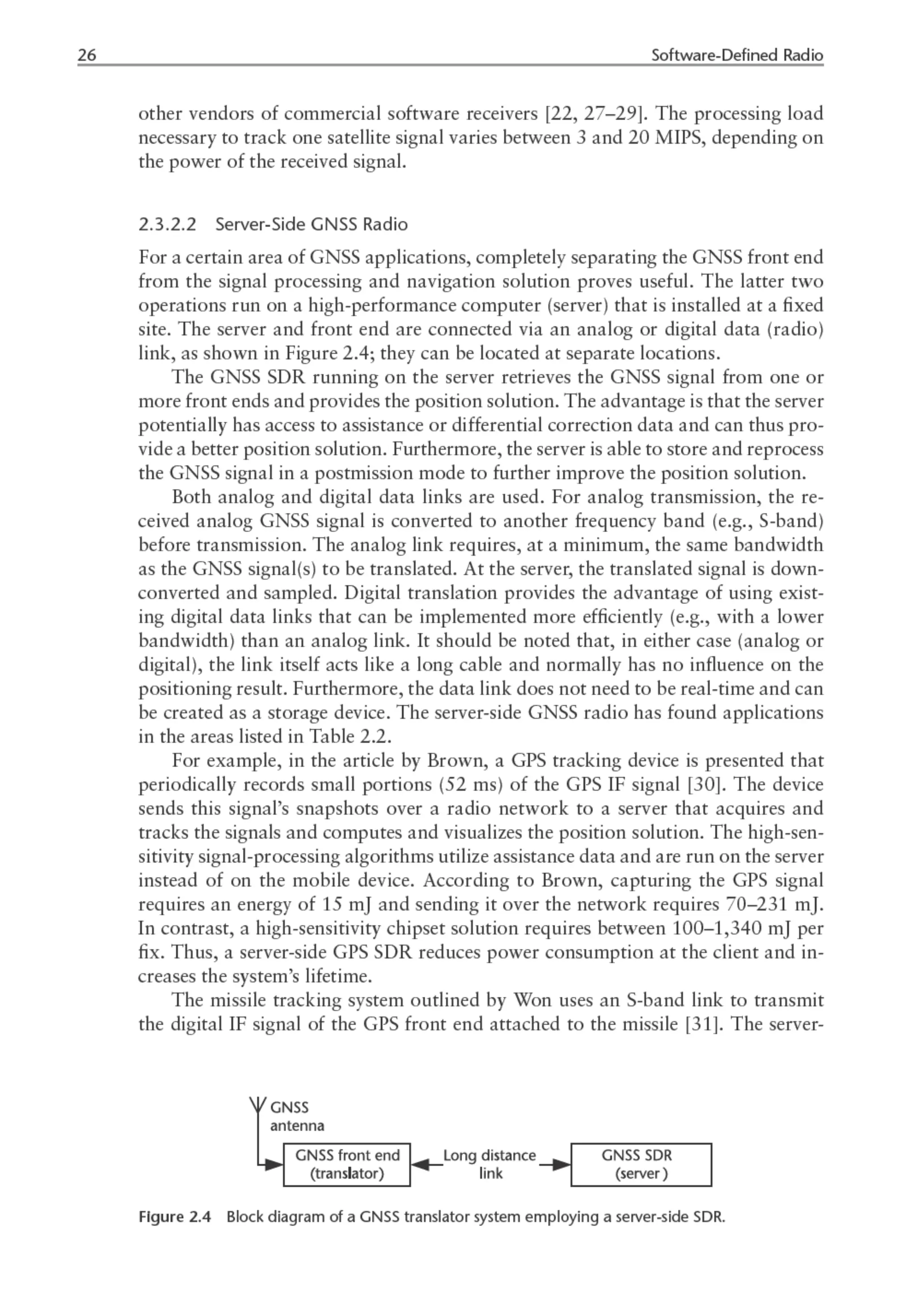
![2.3 GNSS Software Receivers 27
side GPS receiver has a very short TTFF and is capable of tracking the high signal
dynamics.
An asset (e.g., container or car) tracking system could periodically record small
portions of IF samples that are temporarily stored in a nonvolatile memory. At some
point, the data is transferred to a PC that runs the server-side radio. By utilizing
ephemeris data and navigation data bits, the server-side radio can do a data wipe-
off to increase the acquisition sensitivity. Depending on the duration of the sample
snapshot, even high positioning accuracy can be obtained. A related mass-market
application could be to localize images shot by a digital camera. The IF samples
would then be stored with the image [32].
It should also be noted that all receiver performance parameters, such as sen-
sitivity, accuracy, and availability can be perfectly optimized if a GNSS signal is
recorded and processed in a postprocessing manner. For example, in postprocessing
mode, an unlimited number of correlators can be used.
2.3.2.3 GNSS Reflectometry
One of the applications where GNSS SDRs have gained much merit is in the area
of bistatic remote sensing. In this case, the GNSS signal is reflected by the earth’s
surface and is received by a receiver mounted on various platforms, ranging from a
tower over an airplane to space-borne receivers. The usefulness of these signals was
realized over a decade ago when scientists proposed a new method of ocean altim-
etry [33]. Meanwhile, the method has been adapted to measure sea roughness, wind
speed and direction, ice coverage, and soil moisture and has additional potential
applications in other remote-sensing areas.
In the case of a space-borne receiver, the bistatically scattered signal is diffusely
radiated from a large area of the earth’s surface, often covering tens of kilometers
and thousands of Hertz in Doppler as the observation geometry changes over the
scattering surface or glistening zone [34]. The receiver tracking the reflected sig-
nal has to correlate over a wide code phase and Doppler range involving a mul-
titude of correlators. Furthermore, the reflected signals are attenuated and show
strong amplitude fluctuations, such that high-end signal processing is generally
required.
Table 2.2 Server-Side GNSS Radio Applications
Name
Performance
Measure
Aiding Data
Utilization SDR Advantage
Missile tracking TTFF Ephemeris, coarse PVT High dynamics
Snapshot for E911 TTFF, accuracy Ephemeris, coarse PVT Reduced mobile unit
complexity
Asset tracking, image
tagging
Sensitivity Ephemeris, navigation
data bits
Increased sensitivity,
reliability, low power
consumption
GNSS science — All Realization of new
algorithms
Signal post processing Sensitivity, accuracy,
availability
All Highest possible
performance](https://image.slidesharecdn.com/38743-250301213413-d91cceff/75/Navigation-Signal-Processing-for-GNSS-Software-Receivers-1st-Edition-Thomas-Pany-47-2048.jpg)
![28 Software-Defined Radio
The United Kingdom’s Disaster Monitoring Constellation satellites are exam-
ples of a SDR implementation for remote sensing [35]. These satellites normally use
two GPS antennas for rapid positioning. For remote sensing, a third antenna (an L1
high-gain, down-looking, left-handed polarized antenna) was added. The IF signal
of the down-looking antenna was sampled with a rate of 5.71 MHz and with 2 bits.
The data was stored on an onboard, solid-state data recorder. About 20 seconds of
data was sampled and later transmitted to the ground station for offline processing.
The reflected signals have been detected and Doppler delay maps have been pro-
duced. The data is available for other researchers to ensure that the valuable signal
is optimally analyzed [34].
2.3.2.4 GNSS Constellation Signal Generators and Spoofers
SDR technology can also be applied to generate GNSS signals in a flexible manner.
To the author’s knowledge, all available GNSS signal generators that are able to
simulate received GNSS signals of a whole satellite constellation use either FPGAs
or GPPs to generate the signals. A GNSS software signal generator based on a
GPP with RF output capability has been described by Pósfay [36]. The work [37]
describes a GNSS signal recorder and playback system used to collect real signals
(with traffic information) in the field and to play them back in the laboratory.
Humphreys describes a GPS spoofer that simultaneously receives GPS C/A-code
signals and transmits an adaptive spoofing signal. Both functions are created with
SDR technology on a DSP basis [38].
2.3.3 High-End GNSS Software Receivers
This work endorses the use of GNSS SDRs as high-end receivers. This is an area
where software receivers may gain increased importance in the future. New and
optimized signal-processing algorithms may be more easily developed on these plat-
forms and current and future processor technology will provide an abundance of
processing power. Software receiver developments are also discussed by the Inter-
national GNSS Service (IGS), an organization that generates precise ephemeris and
terrestrial reference frames based on a network of permanent GNSS receivers [39].
Signal processing (acquisition and tracking) in GNSS chips commonly boils
down to the evaluation of the cross-correlation function of the received signal with
locally generated replica signals. Signal processing in a chip is limited by the follow-
ing factors (among others):
A low number of bits are used to represent the received and the locally gener-
ated signal.
The received signal is processed as a stream (e.g., older signal samples are not
available for a reiteration).
Development efforts are generally high.
Inclusion of high-rate aiding data such as data wipe-off, (semi-)codeless
techniques, or deep GPS/INS integration requires explicit synchronization
lines.](https://image.slidesharecdn.com/38743-250301213413-d91cceff/75/Navigation-Signal-Processing-for-GNSS-Software-Receivers-1st-Edition-Thomas-Pany-48-2048.jpg)
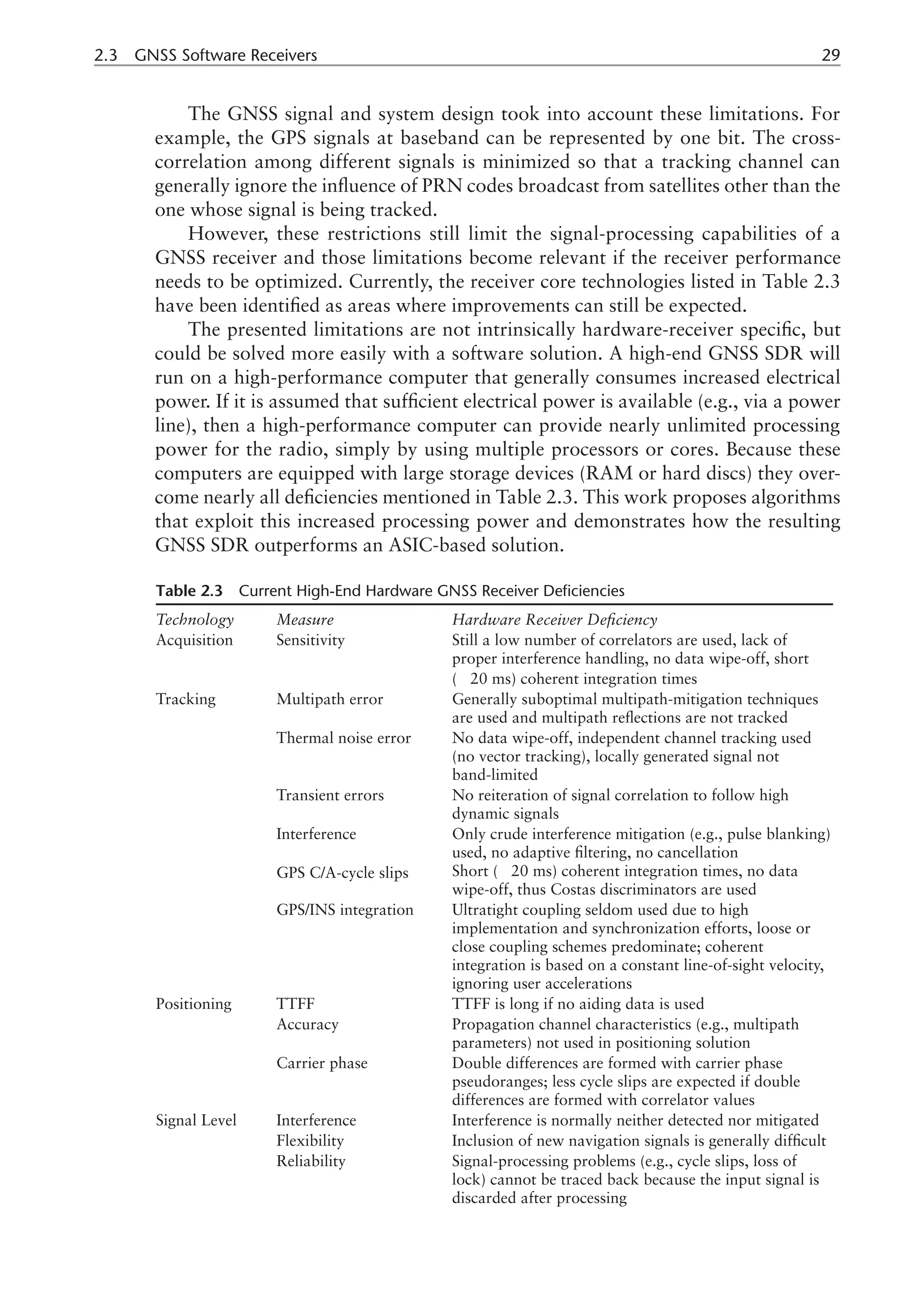
![30 Software-Defined Radio
Recent developments in ultramobile PCs will allow high-end GNSS signal-
processing algorithms to run on a platform with reduced power consumption. Ul-
tramobile PC components form the basis for the innovative real-time kinematic
(RTK) receiver concept discussed in Chapter 10.
2.4 Technology Evaluation and Discussion
Previously, it was demonstrated that no clear separation between a hardware re-
ceiver and software receiver could be drawn. Important parts of the signal process-
ing (e.g., tracking-loop closure) are often part of the receiver software (firmware) in
a typical GPS-chip solution. The chips may even utilize small processors to calculate
an FFT to acquire signals. On the other hand, software-GNSS radios utilize dedi-
cated hardware units to accelerate the signal processing. This may range from vec-
tor multiply-and-add units of high-performance processors to FPGAs. These units
often have a strict structure and the software utilizing them has to be optimized
specifically for them. Consequently, the GNSS SDR gives up some of its flexibility.
The distinction between a software and hardware receiver seems not to be very
helpful. However, the amount of work a receiver manufacturer puts into develop-
ing the receiver hardware platform is important. This may range from a developer
choosing a good laptop, to building his own CPU board, to finally designing an
ASIC. The hardware platform determines important real-time performance pa-
rameters like size, power consumption, and number of correlators. If only COTS
components are used (e.g., a low-end PC), these parameters are normally far from
optimal. On the other hand, wisely chosen processors integrated into an optimized
board may outperform classical ASIC correlator chip solutions for certain applica-
tions. However, developing a multiprocessor system may require similar efforts to
that of an ASIC design.
At the moment of writing, it is expected that SDR solutions based on COTS
components will continue to have some disadvantages in terms of size and power
consumption; these criteria are relevant for many positioning applications. COTS
software receivers will enter the market at the high-performance sector as reference
stations and in niche markets, like specialized RTK receivers. Because the receiver
life cycle is typically several years in the field of navigation, the GNSS SDR technol-
ogy will be mature when Galileo reaches its final operational capability. We also
expect that DSP or embedded processor-based solutions will be found in mass-
marketed products in the coming years.
References
[1] Mitola, J., “The Software Radio Architecture,” IEEE Commun. Mag., Vol. 33, No. 5,
1995, pp. 26–38.
[2] Tuttlebee, W., Software Defined Radio: Origins, Drivers and International Perspectives,
New York: Wiley, 2002.
[3] Rhiemeier, A.-R., Modulares Software Defined Radio, University Karlsruhe (TH), Kaiser-
straße 12, D-76131 Karlsruhe, http://digbib.ubka.uni-karlsruhe.de/volltexte/1000001174,
2004.](https://image.slidesharecdn.com/38743-250301213413-d91cceff/75/Navigation-Signal-Processing-for-GNSS-Software-Receivers-1st-Edition-Thomas-Pany-50-2048.jpg)