
Pre-service teachers’ perceptions and use
of social media in teaching practice
Konstantina
Kontopoulou
Research Day 25 June
2013
Social media and teaching practice
 Teaching practice is believed to be the most important
component of Teacher Education
 The nature of this course may cause learners several
problems; Stress, Isolation, Marginality
 Can open, social and participatory media help? ‘A core
function of Web 2.0 services is to support communication
between users’ (Crook 2008)
 Not many studies specifically deal with the integration of
social media into teaching practice for peer interaction
Main research questions
 How do pre-service teachers use social media in
their teaching practice?
 What are their perceptions about their use?
 What factors facilitate or inhibit their use?
Subsidiary questions
 SQ1. What are their initial perceptions about the usefulness of social
media in teaching practice?
 SQ2. Have their initial perceptions about social media in teaching
practice changed after the integration of these media into the course?
If so, how?
 SQ3. Do they believe peer interaction while on teaching practice was
important?
 SQ4. Do they believe that their sense of community was enhanced by
the integration of social media into the course?
 SQ5. Has this integration contributed to their satisfaction and
enhancement of professional knowledge?
Participants
3 groups of PGCE students undertaking teaching
practice
Each group will use a different social media tool
to interact with their peers: Facebook, Twitter and
Cloudworks
Data Gathering
Data will be collected at three points: before, during and
after teaching practice.
 Prior to teaching practice
1st
questionnaire
 During teaching practice
Online discussions on Facebook, Twitter, Cloudworks
 After teaching practice
2nd
questionnaire, Semi-structured interview
Selected Bibliography
 Archambault, L. and Kennedy, K. (2012) 'Offering preservice teachers field experiences
in K-12 online learning: a national survey of teacher education programs.', Journal of
Teacher Education, 63(3), 185-200.
 Aslan, S. and Reigeluth, C., M. (2011) 'A Trip to the Past and Future of Educational
Computing: Understanding Its Evolution', CONTEMPORARY EDUCATIONAL
TECHNOLOGY, 2(1), 1-17.
 Baek, S.G. and Ham, E.H. (2009) 'An evaluation study on the educational value of
teaching practicum in secondary schools', Asia Pacific Education Review, 10(2), 271-
280.
 Beck, C. and Kosnik, C. (Spring 2002) 'Components of a Good Practicum Placement:
Student Teacher Perceptions', Teacher Education Quarterly, 29(2), 81-98.
 Buckingham, D. (2007) Beyond Technology. Children's Learning in the Age of Digital
Culture, Malden, MA: Polity Press.
 Clark, W. Logan, K. Luckin, R. Mee, A. and Oliver, M. (2009) 'Beyond Web 2.0:
mapping the technology landscapes of young learners', Journal of Computer Assisted
Learning, 25(1), 56-69.
 Conole, G. (2012) Designing for Learning in an Open World, New York: Springer.
 Conole, G. and Alevizou, P. (2010). A literature review of the use of Web 2.0 tools in
Higher Education. HEA Academy, York, UK. Retrieved on 4th June 2012 from the
WWW:
http://www.heacademy.ac.uk/assets/EvidenceNet/Conole_Alevizou_2010.pdf
 Crook, C., Cummings, J., Fisher, T., Graber, R., Harrison, C., Lewin, C., Logal, K.,
Luckin, R.,Oliver, M. and Sharples, M. (2008) Web 2.0 technologies for learning: The
current landscape – opportunities, challenges, and tensions. A Report Becta.
Retrieved on the 28th of August 2012 from the World Wide Web:
http://webarchive.nationalarchives.gov.uk/20101102103713/http://research.becta.org.u
k/upload-dir/downloads/page_documents/research/web2_technologies_learning.pdf
 Darling-Hammond, L. (2006) 'Constructing 21st- Century Teacher Education', Journal
of Teacher Education, 57(3), 300-314.
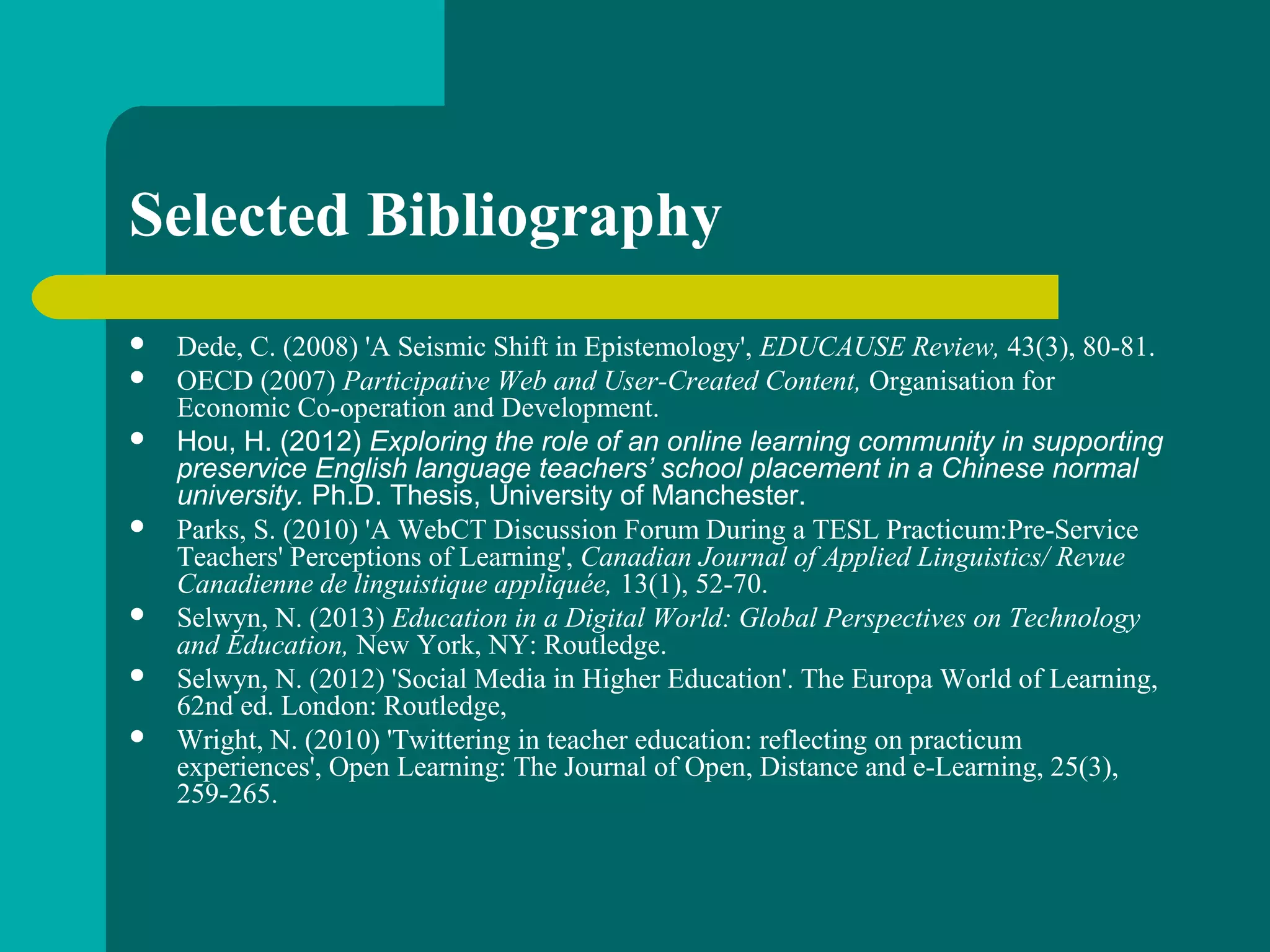
Selected Bibliography
 Dede, C. (2008) 'A Seismic Shift in Epistemology', EDUCAUSE Review, 43(3), 80-81.
 OECD (2007) Participative Web and User-Created Content, Organisation for
Economic Co-operation and Development.
 Hou, H. (2012) Exploring the role of an online learning community in supporting
preservice English language teachers’ school placement in a Chinese normal
university. Ph.D. Thesis, University of Manchester.
 Parks, S. (2010) 'A WebCT Discussion Forum During a TESL Practicum:Pre-Service
Teachers' Perceptions of Learning', Canadian Journal of Applied Linguistics/ Revue
Canadienne de linguistique appliquée, 13(1), 52-70.
 Selwyn, N. (2013) Education in a Digital World: Global Perspectives on Technology
and Education, New York, NY: Routledge.
 Selwyn, N. (2012) 'Social Media in Higher Education'. The Europa World of Learning,
62nd ed. London: Routledge,
 Wright, N. (2010) 'Twittering in teacher education: reflecting on practicum
experiences', Open Learning: The Journal of Open, Distance and e-Learning, 25(3),
259-265.
Selected Bibliography
 Dede, C. (2008) 'A Seismic Shift in Epistemology', EDUCAUSE Review, 43(3), 80-81.
 OECD (2007) Participative Web and User-Created Content, Organisation for
Economic Co-operation and Development.
 Hou, H. (2012) Exploring the role of an online learning community in supporting
preservice English language teachers’ school placement in a Chinese normal
university. Ph.D. Thesis, University of Manchester.
 Parks, S. (2010) 'A WebCT Discussion Forum During a TESL Practicum:Pre-Service
Teachers' Perceptions of Learning', Canadian Journal of Applied Linguistics/ Revue
Canadienne de linguistique appliquée, 13(1), 52-70.
 Selwyn, N. (2013) Education in a Digital World: Global Perspectives on Technology
and Education, New York, NY: Routledge.
 Selwyn, N. (2012) 'Social Media in Higher Education'. The Europa World of Learning,
62nd ed. London: Routledge,
 Wright, N. (2010) 'Twittering in teacher education: reflecting on practicum
experiences', Open Learning: The Journal of Open, Distance and e-Learning, 25(3),
259-265.

Pre service teachers' perceptions and use of social media in teaching practice

  • 1.
    Pre-service teachers’ perceptionsand use of social media in teaching practice Konstantina Kontopoulou Research Day 25 June 2013
  • 2.
    Social media andteaching practice  Teaching practice is believed to be the most important component of Teacher Education  The nature of this course may cause learners several problems; Stress, Isolation, Marginality  Can open, social and participatory media help? ‘A core function of Web 2.0 services is to support communication between users’ (Crook 2008)  Not many studies specifically deal with the integration of social media into teaching practice for peer interaction
  • 3.
    Main research questions How do pre-service teachers use social media in their teaching practice?  What are their perceptions about their use?  What factors facilitate or inhibit their use?
  • 4.
    Subsidiary questions  SQ1.What are their initial perceptions about the usefulness of social media in teaching practice?  SQ2. Have their initial perceptions about social media in teaching practice changed after the integration of these media into the course? If so, how?  SQ3. Do they believe peer interaction while on teaching practice was important?  SQ4. Do they believe that their sense of community was enhanced by the integration of social media into the course?  SQ5. Has this integration contributed to their satisfaction and enhancement of professional knowledge?
  • 5.
    Participants 3 groups ofPGCE students undertaking teaching practice Each group will use a different social media tool to interact with their peers: Facebook, Twitter and Cloudworks
  • 6.
    Data Gathering Data willbe collected at three points: before, during and after teaching practice.  Prior to teaching practice 1st questionnaire  During teaching practice Online discussions on Facebook, Twitter, Cloudworks  After teaching practice 2nd questionnaire, Semi-structured interview
  • 7.
    Selected Bibliography  Archambault,L. and Kennedy, K. (2012) 'Offering preservice teachers field experiences in K-12 online learning: a national survey of teacher education programs.', Journal of Teacher Education, 63(3), 185-200.  Aslan, S. and Reigeluth, C., M. (2011) 'A Trip to the Past and Future of Educational Computing: Understanding Its Evolution', CONTEMPORARY EDUCATIONAL TECHNOLOGY, 2(1), 1-17.  Baek, S.G. and Ham, E.H. (2009) 'An evaluation study on the educational value of teaching practicum in secondary schools', Asia Pacific Education Review, 10(2), 271- 280.  Beck, C. and Kosnik, C. (Spring 2002) 'Components of a Good Practicum Placement: Student Teacher Perceptions', Teacher Education Quarterly, 29(2), 81-98.
  • 8.
     Buckingham, D.(2007) Beyond Technology. Children's Learning in the Age of Digital Culture, Malden, MA: Polity Press.  Clark, W. Logan, K. Luckin, R. Mee, A. and Oliver, M. (2009) 'Beyond Web 2.0: mapping the technology landscapes of young learners', Journal of Computer Assisted Learning, 25(1), 56-69.  Conole, G. (2012) Designing for Learning in an Open World, New York: Springer.  Conole, G. and Alevizou, P. (2010). A literature review of the use of Web 2.0 tools in Higher Education. HEA Academy, York, UK. Retrieved on 4th June 2012 from the WWW: http://www.heacademy.ac.uk/assets/EvidenceNet/Conole_Alevizou_2010.pdf  Crook, C., Cummings, J., Fisher, T., Graber, R., Harrison, C., Lewin, C., Logal, K., Luckin, R.,Oliver, M. and Sharples, M. (2008) Web 2.0 technologies for learning: The current landscape – opportunities, challenges, and tensions. A Report Becta. Retrieved on the 28th of August 2012 from the World Wide Web: http://webarchive.nationalarchives.gov.uk/20101102103713/http://research.becta.org.u k/upload-dir/downloads/page_documents/research/web2_technologies_learning.pdf  Darling-Hammond, L. (2006) 'Constructing 21st- Century Teacher Education', Journal of Teacher Education, 57(3), 300-314. Selected Bibliography
  • 9.
    Selected Bibliography  Dede,C. (2008) 'A Seismic Shift in Epistemology', EDUCAUSE Review, 43(3), 80-81.  OECD (2007) Participative Web and User-Created Content, Organisation for Economic Co-operation and Development.  Hou, H. (2012) Exploring the role of an online learning community in supporting preservice English language teachers’ school placement in a Chinese normal university. Ph.D. Thesis, University of Manchester.  Parks, S. (2010) 'A WebCT Discussion Forum During a TESL Practicum:Pre-Service Teachers' Perceptions of Learning', Canadian Journal of Applied Linguistics/ Revue Canadienne de linguistique appliquée, 13(1), 52-70.  Selwyn, N. (2013) Education in a Digital World: Global Perspectives on Technology and Education, New York, NY: Routledge.  Selwyn, N. (2012) 'Social Media in Higher Education'. The Europa World of Learning, 62nd ed. London: Routledge,  Wright, N. (2010) 'Twittering in teacher education: reflecting on practicum experiences', Open Learning: The Journal of Open, Distance and e-Learning, 25(3), 259-265.
  • 10.
    Selected Bibliography  Dede,C. (2008) 'A Seismic Shift in Epistemology', EDUCAUSE Review, 43(3), 80-81.  OECD (2007) Participative Web and User-Created Content, Organisation for Economic Co-operation and Development.  Hou, H. (2012) Exploring the role of an online learning community in supporting preservice English language teachers’ school placement in a Chinese normal university. Ph.D. Thesis, University of Manchester.  Parks, S. (2010) 'A WebCT Discussion Forum During a TESL Practicum:Pre-Service Teachers' Perceptions of Learning', Canadian Journal of Applied Linguistics/ Revue Canadienne de linguistique appliquée, 13(1), 52-70.  Selwyn, N. (2013) Education in a Digital World: Global Perspectives on Technology and Education, New York, NY: Routledge.  Selwyn, N. (2012) 'Social Media in Higher Education'. The Europa World of Learning, 62nd ed. London: Routledge,  Wright, N. (2010) 'Twittering in teacher education: reflecting on practicum experiences', Open Learning: The Journal of Open, Distance and e-Learning, 25(3), 259-265.

Editor's Notes

  • #2 It is a good idea to include the details of the session where you do the presentation and the date so that you can refer to at a later date, including your progress reports etc.
  • #3 Make this slide 4
  • #4 You can move this slide to the front, perhaps as the second slide. Title could be ‘Main research questions’
  • #5 Title could be ‘Subsidiary questions’.
  • #7 Here you might have a few questions (although it is a bit too early for you to have done any work on) on aspects such as ‘Research design’, ‘Research approach’, etc. Dr Chris Comber’s session will be helpful in this regard (after lunch session). Do you have any access to research methods books? Perhaps we can look into this in the morning of the 13 th , and you can visit our library to browse some relevant books.