Station 1: Why are you here today?
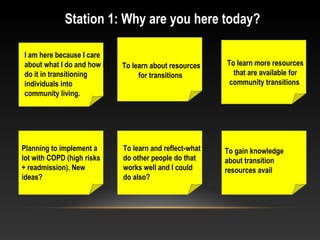
I am here because I care
about what I do and how I
do it in transitioning
individuals into
community living. 
To learn about resources
for transitions
To learn more resources
that are available for
community transitions
Planning to implement a
lot with COPD (high risks
+ readmission). New
ideas?
To learn and reflect-what
do other people do that
works well and I could
do also?
To gain knowledge
about transition
resources avail
Station 1: Why are you here today?
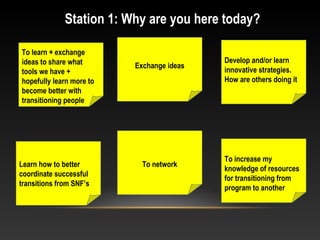
To learn + exchange
ideas to share what
tools we have +
hopefully learn more to
become better with
transitioning people
Exchange ideas
Develop and/or learn
innovative strategies.
How are others doing it
Learn how to better
coordinate successful
transitions from SNF’s
To network
To increase my
knowledge of resources
for transitioning from
program to another
Station 1: Why are you here today?
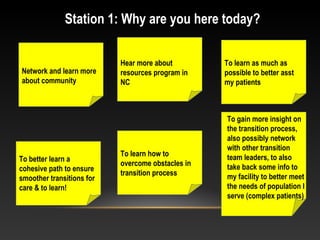
Network and learn more
about community
Hear more about
resources program in
NC
To learn as much as
possible to better asst
my patients
To better learn a
cohesive path to ensure
smoother transitions for
care & to learn!
To gain more insight on
the transition process,
also possibly network
with other transition
team leaders, to also
take back some info to
my facility to better meet
the needs of population I
serve (complex patients)
To learn how to
overcome obstacles in
transition process
Station 1: Why are you here today?
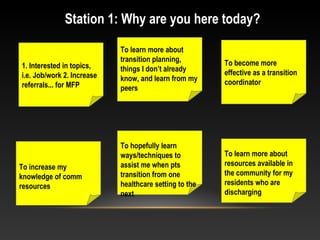
1. Interested in topics,
i.e. Job/work 2. Increase
referrals... for MFP
To learn more about
transition planning,
things I don’t already
know, and learn from my
peers
To become more
effective as a transition
coordinator
To increase my
knowledge of comm
resources
To hopefully learn
ways/techniques to
assist me when pts
transition from one
healthcare setting to the
next
To learn more about
resources available in
the community for my
residents who are
discharging
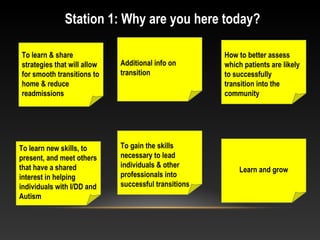
Station 1: Why are you here today?
To learn & share
strategies that will allow
for smooth transitions to
home & reduce
readmissions
Additional info on
transition
How to better assess
which patients are likely
to successfully
transition into the
community
To learn new skills, to
present, and meet others
that have a shared
interest in helping
individuals with I/DD and
Autism
To gain the skills
necessary to lead
individuals & other
professionals into
successful transitions
Learn and grow
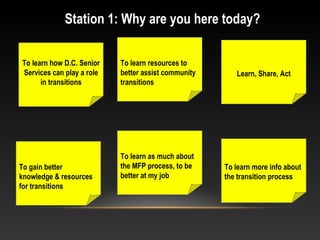
Station 1: Why are you here today?
To learn how D.C. Senior
Services can play a role
in transitions
To learn resources to
better assist community
transitions
Learn, Share, Act
To gain better
knowledge & resources
for transitions
To learn as much about
the MFP process, to be
better at my job
To learn more info about
the transition process
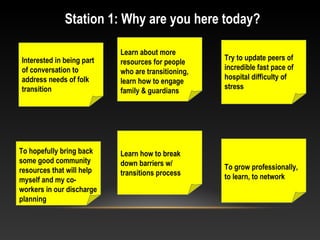
Station 1: Why are you here today?
Interested in being part
of conversation to
address needs of folk
transition
Learn about more
resources for people
who are transitioning,
learn how to engage
family & guardians
Try to update peers of
incredible fast pace of
hospital difficulty of
stress
To hopefully bring back
some good community
resources that will help
myself and my co-
workers in our discharge
planning
Learn how to break
down barriers w/
transitions process
To grow professionally,
to learn, to network
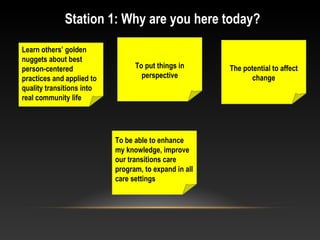
Station 1: Why are you here today?
Learn others’ golden
nuggets about best
person-centered
practices and applied to
quality transitions into
real community life
To put things in
perspective
The potential to affect
change
To be able to enhance
my knowledge, improve
our transitions care
program, to expand in all
care settings
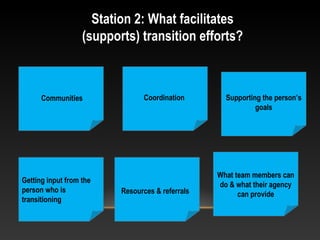
Station 2: What facilitates
(supports) transition efforts?
Communities Coordination Supporting the person’s
goals
Getting input from the
person who is
transitioning
Resources & referrals
What team members can
do & what their agency
can provide
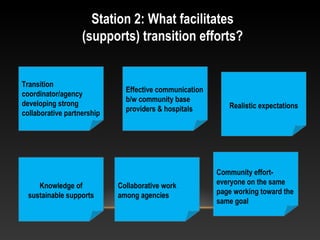
Station 2: What facilitates
(supports) transition efforts?
Transition
coordinator/agency
developing strong
collaborative partnership
Effective communication
b/w community base
providers & hospitals Realistic expectations
Knowledge of
sustainable supports
Collaborative work
among agencies
Community effort-
everyone on the same
page working toward the
same goal
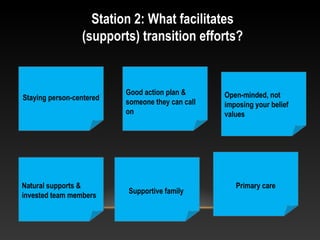
Station 2: What facilitates
(supports) transition efforts?
Staying person-centered
Good action plan &
someone they can call
on
Open-minded, not
imposing your belief
values
Natural supports &
invested team members
Supportive family
Primary care
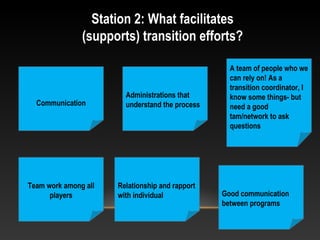
Station 2: What facilitates
(supports) transition efforts?
Communication
Administrations that
understand the process
A team of people who we
can rely on! As a
transition coordinator, I
know some things- but
need a good
tam/network to ask
questions
Team work among all
players
Relationship and rapport
with individual Good communication
between programs
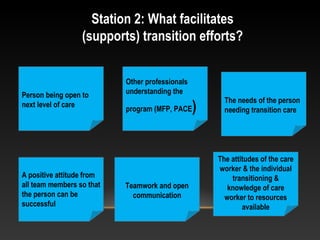
Station 2: What facilitates
(supports) transition efforts?
Person being open to
next level of care
Other professionals
understanding the
program (MFP, PACE)
The needs of the person
needing transition care
A positive attitude from
all team members so that
the person can be
successful
Teamwork and open
communication
The attitudes of the care
worker & the individual
transitioning &
knowledge of care
worker to resources
available
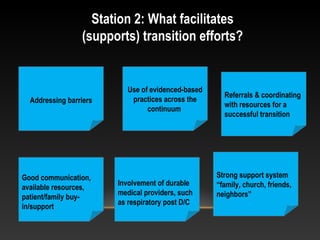
Station 2: What facilitates
(supports) transition efforts?
Addressing barriers
Use of evidenced-based
practices across the
continuum
Referrals & coordinating
with resources for a
successful transition
Good communication,
available resources,
patient/family buy-
in/support
Involvement of durable
medical providers, such
as respiratory post D/C
Strong support system
“family, church, friends,
neighbors”
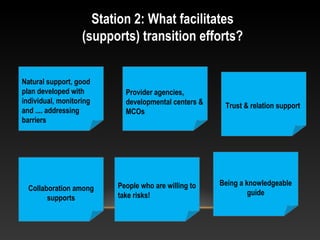
Station 2: What facilitates
(supports) transition efforts?
Natural support, good
plan developed with
individual, monitoring
and .... addressing
barriers
Provider agencies,
developmental centers &
MCOs
Trust & relation support
Collaboration among
supports
People who are willing to
take risks!
Being a knowledgeable
guide
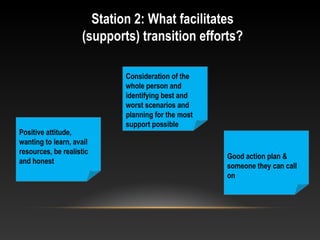
Station 2: What facilitates
(supports) transition efforts?
Positive attitude,
wanting to learn, avail
resources, be realistic
and honest
Consideration of the
whole person and
identifying best and
worst scenarios and
planning for the most
support possible
Good action plan &
someone they can call
on
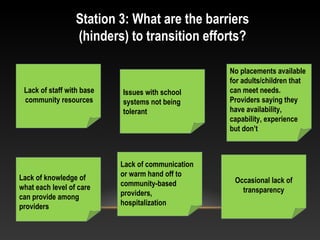
Station 3: What are the barriers
(hinders) to transition efforts?
Lack of staff with base
community resources
Issues with school
systems not being
tolerant
No placements available
for adults/children that
can meet needs.
Providers saying they
have availability,
capability, experience
but don’t
Lack of knowledge of
what each level of care
can provide among
providers
Lack of communication
or warm hand off to
community-based
providers,
hospitalization
Occasional lack of
transparency
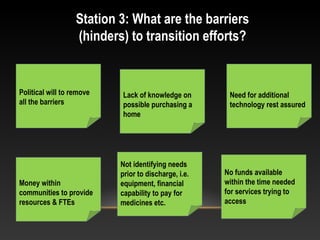
Station 3: What are the barriers
(hinders) to transition efforts?
Political will to remove
all the barriers
Lack of knowledge on
possible purchasing a
home
Need for additional
technology rest assured
Money within
communities to provide
resources & FTEs
Not identifying needs
prior to discharge, i.e.
equipment, financial
capability to pay for
medicines etc.
No funds available
within the time needed
for services trying to
access
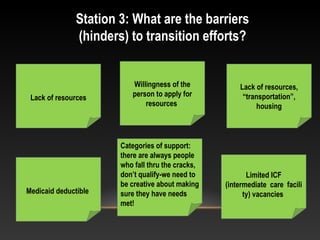
Station 3: What are the barriers
(hinders) to transition efforts?
Lack of resources
Willingness of the
person to apply for
resources
Lack of resources,
“transportation”,
housing
Medicaid deductible
Categories of support:
there are always people
who fall thru the cracks,
don’t qualify-we need to
be creative about making
sure they have needs
met!
Limited ICF
(intermediate care facili
ty) vacancies
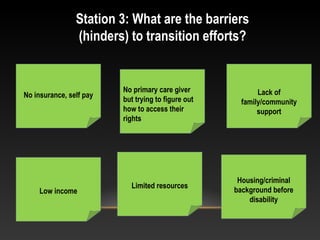
Station 3: What are the barriers
(hinders) to transition efforts?
No insurance, self pay
No primary care giver
but trying to figure out
how to access their
rights
Lack of
family/community
support
Low income
Limited resources
Housing/criminal
background before
disability
Station 3: What are the barriers
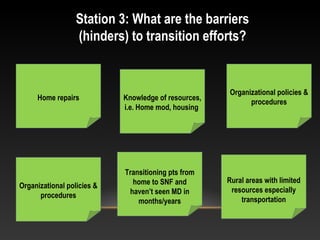
(hinders) to transition efforts?
Home repairs Knowledge of resources,
i.e. Home mod, housing
Organizational policies &
procedures
Organizational policies &
procedures
Transitioning pts from
home to SNF and
haven’t seen MD in
months/years
Rural areas with limited
resources especially
transportation
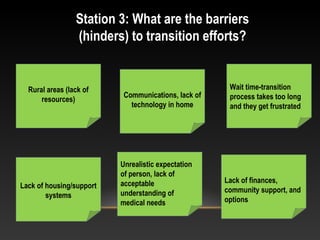
Station 3: What are the barriers
(hinders) to transition efforts?
Rural areas (lack of
resources)
Communications, lack of
technology in home
Wait time-transition
process takes too long
and they get frustrated
Lack of housing/support
systems
Unrealistic expectation
of person, lack of
acceptable
understanding of
medical needs
Lack of finances,
community support, and
options
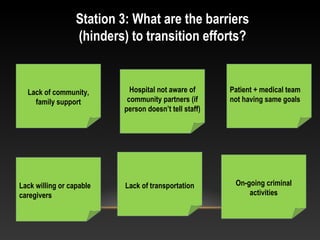
Station 3: What are the barriers
(hinders) to transition efforts?
Lack of community,
family support
Hospital not aware of
community partners (if
person doesn’t tell staff)
Patient + medical team
not having same goals
Lack willing or capable
caregivers
Lack of transportation On-going criminal
activities
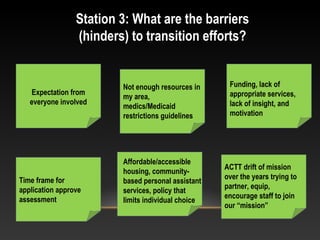
Station 3: What are the barriers
(hinders) to transition efforts?
Expectation from
everyone involved
Not enough resources in
my area,
medics/Medicaid
restrictions guidelines
Funding, lack of
appropriate services,
lack of insight, and
motivation
Time frame for
application approve
assessment
Affordable/accessible
housing, community-
based personal assistant
services, policy that
limits individual choice
ACTT drift of mission
over the years trying to
partner, equip,
encourage staff to join
our “mission”
Station 3: What are the barriers
(hinders) to transition efforts?
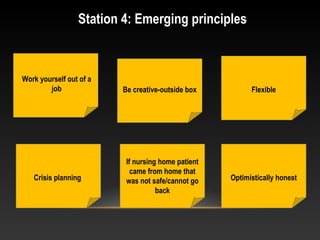
Station 4: Emerging principles
Work yourself out of a
job Be creative-outside box Flexible
Crisis planning
If nursing home patient
came from home that
was not safe/cannot go
back
Optimistically honest
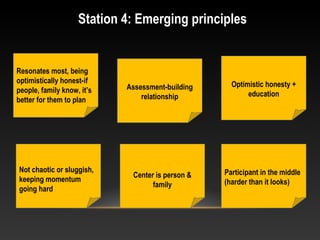
Station 4: Emerging principles
Resonates most, being
optimistically honest-if
people, family know, it’s
better for them to plan
Assessment-building
relationship
Optimistic honesty +
education
Not chaotic or sluggish,
keeping momentum
going hard
Center is person &
family
Participant in the middle
(harder than it looks)
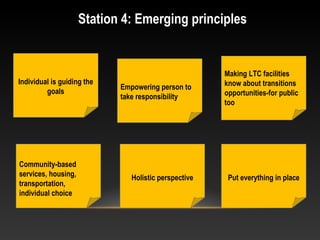
Station 4: Emerging principles
Individual is guiding the
goals
Empowering person to
take responsibility
Making LTC facilities
know about transitions
opportunities-for public
too
Community-based
services, housing,
transportation,
individual choice
Holistic perspective Put everything in place
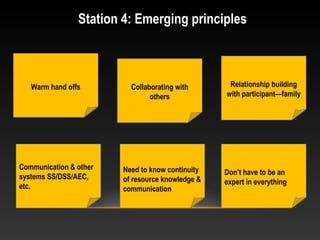
Station 4: Emerging principles
Warm hand offs Collaborating with
others
Relationship building
with participant—family
Communication & other
systems SS/DSS/AEC,
etc.
Need to know continuity
of resource knowledge &
communication
Don’t have to be an
expert in everything
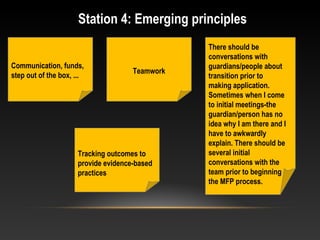
Station 4: Emerging principles
Teamwork
Communication, funds,
step out of the box, ...
There should be
conversations with
guardians/people about
transition prior to
making application.
Sometimes when I come
to initial meetings-the
guardian/person has no
idea why I am there and I
have to awkwardly
explain. There should be
several initial
conversations with the
team prior to beginning
the MFP process.
Tracking outcomes to
provide evidence-based
practices

Pre meeting interactive learning carousel may-21_2015_six per slide

  • 1.
    Station 1: Whyare you here today? I am here because I care about what I do and how I do it in transitioning individuals into community living.  To learn about resources for transitions To learn more resources that are available for community transitions Planning to implement a lot with COPD (high risks + readmission). New ideas? To learn and reflect-what do other people do that works well and I could do also? To gain knowledge about transition resources avail
  • 2.
    Station 1: Whyare you here today? To learn + exchange ideas to share what tools we have + hopefully learn more to become better with transitioning people Exchange ideas Develop and/or learn innovative strategies. How are others doing it Learn how to better coordinate successful transitions from SNF’s To network To increase my knowledge of resources for transitioning from program to another
  • 3.
    Station 1: Whyare you here today? Network and learn more about community Hear more about resources program in NC To learn as much as possible to better asst my patients To better learn a cohesive path to ensure smoother transitions for care & to learn! To gain more insight on the transition process, also possibly network with other transition team leaders, to also take back some info to my facility to better meet the needs of population I serve (complex patients) To learn how to overcome obstacles in transition process
  • 4.
    Station 1: Whyare you here today? 1. Interested in topics, i.e. Job/work 2. Increase referrals... for MFP To learn more about transition planning, things I don’t already know, and learn from my peers To become more effective as a transition coordinator To increase my knowledge of comm resources To hopefully learn ways/techniques to assist me when pts transition from one healthcare setting to the next To learn more about resources available in the community for my residents who are discharging
  • 5.
    Station 1: Whyare you here today? To learn & share strategies that will allow for smooth transitions to home & reduce readmissions Additional info on transition How to better assess which patients are likely to successfully transition into the community To learn new skills, to present, and meet others that have a shared interest in helping individuals with I/DD and Autism To gain the skills necessary to lead individuals & other professionals into successful transitions Learn and grow
  • 6.
    Station 1: Whyare you here today? To learn how D.C. Senior Services can play a role in transitions To learn resources to better assist community transitions Learn, Share, Act To gain better knowledge & resources for transitions To learn as much about the MFP process, to be better at my job To learn more info about the transition process
  • 7.
    Station 1: Whyare you here today? Interested in being part of conversation to address needs of folk transition Learn about more resources for people who are transitioning, learn how to engage family & guardians Try to update peers of incredible fast pace of hospital difficulty of stress To hopefully bring back some good community resources that will help myself and my co- workers in our discharge planning Learn how to break down barriers w/ transitions process To grow professionally, to learn, to network
  • 8.
    Station 1: Whyare you here today? Learn others’ golden nuggets about best person-centered practices and applied to quality transitions into real community life To put things in perspective The potential to affect change To be able to enhance my knowledge, improve our transitions care program, to expand in all care settings
  • 9.
    Station 2: Whatfacilitates (supports) transition efforts? Communities Coordination Supporting the person’s goals Getting input from the person who is transitioning Resources & referrals What team members can do & what their agency can provide
  • 10.
    Station 2: Whatfacilitates (supports) transition efforts? Transition coordinator/agency developing strong collaborative partnership Effective communication b/w community base providers & hospitals Realistic expectations Knowledge of sustainable supports Collaborative work among agencies Community effort- everyone on the same page working toward the same goal
  • 11.
    Station 2: Whatfacilitates (supports) transition efforts? Staying person-centered Good action plan & someone they can call on Open-minded, not imposing your belief values Natural supports & invested team members Supportive family Primary care
  • 12.
    Station 2: Whatfacilitates (supports) transition efforts? Communication Administrations that understand the process A team of people who we can rely on! As a transition coordinator, I know some things- but need a good tam/network to ask questions Team work among all players Relationship and rapport with individual Good communication between programs
  • 13.
    Station 2: Whatfacilitates (supports) transition efforts? Person being open to next level of care Other professionals understanding the program (MFP, PACE) The needs of the person needing transition care A positive attitude from all team members so that the person can be successful Teamwork and open communication The attitudes of the care worker & the individual transitioning & knowledge of care worker to resources available
  • 14.
    Station 2: Whatfacilitates (supports) transition efforts? Addressing barriers Use of evidenced-based practices across the continuum Referrals & coordinating with resources for a successful transition Good communication, available resources, patient/family buy- in/support Involvement of durable medical providers, such as respiratory post D/C Strong support system “family, church, friends, neighbors”
  • 15.
    Station 2: Whatfacilitates (supports) transition efforts? Natural support, good plan developed with individual, monitoring and .... addressing barriers Provider agencies, developmental centers & MCOs Trust & relation support Collaboration among supports People who are willing to take risks! Being a knowledgeable guide
  • 16.
    Station 2: Whatfacilitates (supports) transition efforts? Positive attitude, wanting to learn, avail resources, be realistic and honest Consideration of the whole person and identifying best and worst scenarios and planning for the most support possible Good action plan & someone they can call on
  • 17.
    Station 3: Whatare the barriers (hinders) to transition efforts? Lack of staff with base community resources Issues with school systems not being tolerant No placements available for adults/children that can meet needs. Providers saying they have availability, capability, experience but don’t Lack of knowledge of what each level of care can provide among providers Lack of communication or warm hand off to community-based providers, hospitalization Occasional lack of transparency
  • 18.
    Station 3: Whatare the barriers (hinders) to transition efforts? Political will to remove all the barriers Lack of knowledge on possible purchasing a home Need for additional technology rest assured Money within communities to provide resources & FTEs Not identifying needs prior to discharge, i.e. equipment, financial capability to pay for medicines etc. No funds available within the time needed for services trying to access
  • 19.
    Station 3: Whatare the barriers (hinders) to transition efforts? Lack of resources Willingness of the person to apply for resources Lack of resources, “transportation”, housing Medicaid deductible Categories of support: there are always people who fall thru the cracks, don’t qualify-we need to be creative about making sure they have needs met! Limited ICF (intermediate care facili ty) vacancies
  • 20.
    Station 3: Whatare the barriers (hinders) to transition efforts? No insurance, self pay No primary care giver but trying to figure out how to access their rights Lack of family/community support Low income Limited resources Housing/criminal background before disability
  • 21.
    Station 3: Whatare the barriers (hinders) to transition efforts? Home repairs Knowledge of resources, i.e. Home mod, housing Organizational policies & procedures Organizational policies & procedures Transitioning pts from home to SNF and haven’t seen MD in months/years Rural areas with limited resources especially transportation
  • 22.
    Station 3: Whatare the barriers (hinders) to transition efforts? Rural areas (lack of resources) Communications, lack of technology in home Wait time-transition process takes too long and they get frustrated Lack of housing/support systems Unrealistic expectation of person, lack of acceptable understanding of medical needs Lack of finances, community support, and options
  • 23.
    Station 3: Whatare the barriers (hinders) to transition efforts? Lack of community, family support Hospital not aware of community partners (if person doesn’t tell staff) Patient + medical team not having same goals Lack willing or capable caregivers Lack of transportation On-going criminal activities
  • 24.
    Station 3: Whatare the barriers (hinders) to transition efforts? Expectation from everyone involved Not enough resources in my area, medics/Medicaid restrictions guidelines Funding, lack of appropriate services, lack of insight, and motivation Time frame for application approve assessment Affordable/accessible housing, community- based personal assistant services, policy that limits individual choice ACTT drift of mission over the years trying to partner, equip, encourage staff to join our “mission”
  • 25.
    Station 3: Whatare the barriers (hinders) to transition efforts?
  • 26.
    Station 4: Emergingprinciples Work yourself out of a job Be creative-outside box Flexible Crisis planning If nursing home patient came from home that was not safe/cannot go back Optimistically honest
  • 27.
    Station 4: Emergingprinciples Resonates most, being optimistically honest-if people, family know, it’s better for them to plan Assessment-building relationship Optimistic honesty + education Not chaotic or sluggish, keeping momentum going hard Center is person & family Participant in the middle (harder than it looks)
  • 28.
    Station 4: Emergingprinciples Individual is guiding the goals Empowering person to take responsibility Making LTC facilities know about transitions opportunities-for public too Community-based services, housing, transportation, individual choice Holistic perspective Put everything in place
  • 29.
    Station 4: Emergingprinciples Warm hand offs Collaborating with others Relationship building with participant—family Communication & other systems SS/DSS/AEC, etc. Need to know continuity of resource knowledge & communication Don’t have to be an expert in everything
  • 30.
    Station 4: Emergingprinciples Teamwork Communication, funds, step out of the box, ... There should be conversations with guardians/people about transition prior to making application. Sometimes when I come to initial meetings-the guardian/person has no idea why I am there and I have to awkwardly explain. There should be several initial conversations with the team prior to beginning the MFP process. Tracking outcomes to provide evidence-based practices