The Course of Empire
• 1492: Columbus discovers Americas for Europeans
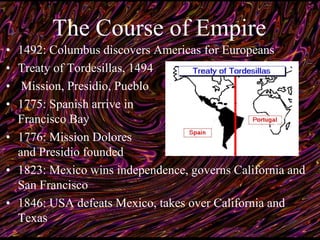
• Treaty of Tordesillas, 1494
• Mission, Presidio, Pueblo
• 1775: Spanish arrive in San
Francisco Bay
• 1776: Mission Dolores
and Presidio founded
• 1823: Mexico wins independence, governs California and
San Francisco
• 1846: USA defeats Mexico, takes over California and
Texas
Expansion and Empire
1783: Treaty of Versailles (USA acquires land
for Ohio, Illinois, Wisconsin, etc.)
1803: Louisiana Purchase
1819: Florida purchased from Spain
1845: Texas annexed
1846: Oregon/Washington ceded by England
1846: Mexican War wins California
Overseas Empire
1867: Alaska acquired
1898: Spanish American War brings Puerto Rico,
Philippines, and Guam
1898: Hawaii annexed
1969: Americans land on the moon
The Internet?
Our Rapid Multiplication
“It is impossible not to look forward to
distant times, when our rapid
multiplication will expand itself beyond
our limits and cover the whole northern,
if not the southern, continent with a
people speaking the same language,
governed in similar forms and by
similar laws.”
— Thomas Jefferson, 1801
Manifest
Destiny
MANIFEST DESTINY
It is our manifest destiny to
overspread and to possess
the whole of this continent,
which Providence has given
us.
— John Sullivan (1845)
destiny noun
1.The inevitable or necessary fate to which a
particular person or thing is destined; lot.
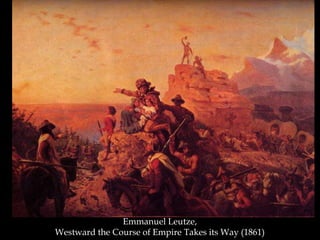
Emmanuel Leutze,
Westward the Course of Empire Takes its Way (1861)
Dare I but say a prophesy,
As sung the holy men of old,
Of rock-built cities yet to be
Along these shining shores of gold,
Crowding athirst into the sea,
What wondrous marvels might be told!
Enough to know that Empire here
Shall burn her loftiest, brightest star.
—Poet of the Sierras (1860)
San Francisco: The Star Of Empire?
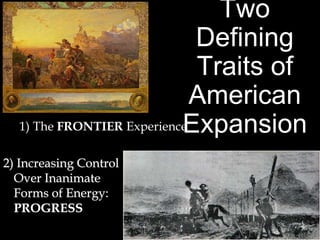
Two
Defining
Traits of
American
Expansion
2) Increasing Control
Over Inanimate
Forms of Energy:
PROGRESS
1) The FRONTIER Experience
American Farmers, Trappers, Explorers
The Mexican Hope for California: good citizen farmers
The Mexican Fear #1 : the trapper
The Mexican Fear #2 : unstoppable progress
“We find ourselves threatened by hordes of Yankee
emigrants...whose progress we cannot arrest. Already
have the wagons of that perfidious people scaled the
almost inaccessible summits of the Sierra Nevada,
crossed the entire continent, and penetrated the fruitful
valley of the Sacramento... Already they are cultivating
farms, establishing vineyards, erecting mills, sawing
lumber, and doing a thousand other things which seem
natural to them,” -- Governor Pio Pico, just before the American
annexation of California
Dana’s Prophesy
“If California ever becomes a prosperous
country, this bay will be the center of its
prosperity. The abundance of wood and
water; the extreme fertility of its shores;
the excellence of its climate, which is as
near to being perfect as any in the world;
and its facilities for navigation... all fit it
for a place of great importance.” —
Richard Henry Dana (writing in 1836)
“Excellence of Climate”
The coldest month of the year is....?
January (mean temperature = 50 degrees)
The warmest month of the year is....?
September (61.5 degrees)
Yearly Rainfall:
22” in San Francisco
15” in San Jose
45” in Kentfield
Tip of San Francisco peninsula: 2/3 of daylight hours
in sunshine: second sunniest major city in America
Dancing in Yerba Buena
[On Portsmouth Square] many pleasant hours
passed in the enjoyment of the light fandangoes and
mazy waltzes by the dark eyed, semi-aborigines of
California, who were wont to assemble from far
and near at the beck and nod of those in authority,
in crowds which could scarcely be counted, and
“trip the light fantastic toe” for two or three days in
succession, barely giving themselves time to
partake of refreshments enough to keep body and
soul together.
From Filings from an Old Saw, by Joseph T. Downey, 1853
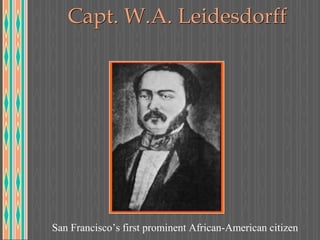
Capt. W.A. Leidesdorff
San Francisco’s first prominent African-American citizen
William Leidesdorff
“... one of those shrewd spirits which are often found forcing
their way against all obstacles to a station which they hardly
dream of. Watch him now, ‘tis the Sabbath, dressed in his
flashy Consular uniform, revelling in all the glory of navy
blue, gold lace and gilt buttons, cane in hand, he hobbles
about, the potentate, ruler, master and sovereign of a dozen
half dressed Indians, who serve him with oriental obedience
— his word is law, his nod imperative, and the Czar of Russia
is not more of a monarch over this thousands than is the
Capt..... over his Indian serfs. He too has passed away, and
that too, at the very moment when the golden sun began to
rise in all her majesty upon the Eureka State.” — Filings from
an Old Saw, page 55
San Francisco (and California) independence from Mexico, 1846
....the assembled crowd of the free and enlightened
citizens of Mexico, at last forced into their brains that
they had by some magical proceeding suddenly been
metamorphosed into citizens of the U. States, and
unanimously wanted to go where liquor could be had,
and drink a health and long life to that flag. The
Indians consequently rushed frantically to one
pulperee, Capt Leidesdorf and the aristocracy to Bob
Ridley’s bar-room, and the second class and the Dutch
to Tinker’s. These houses being on the four corners of
the square, one in the door of the barracks could see
the manoeuvres in each of them...
Celebration!
For the first hour things went quiet enough, but soon the
strong water began to work, and such a confusion of
sounds could never have been heard since the Babel Tower
arrangement, as came from these three corners. First would
be heard a drunken viva from an Indian who would come
out of pulperee No. 1, gaze up at the flag and over he
would go at full length upon the grass... Then the
aristocrats would raise a hip, hip, hip and a cheering “three
times three,” then from Tinker’s a strange jumble of words,
in which hurrah, viva, hip, pah, and Got verdam, were only
too plainly distinguishable. This Pandemonium lasted for
some hours, in fact until sundown, when the Commandant
sent a guard to warn the revellers that as the town was now
under martial law, they must cease their orgies and retire to
their respective homes...
Celebration Aftermath
But few, however, were able to do so, and
the greater part of them either slept in
Tinker’s alley or on the grass in the
plaza, and only awoke with the
morning’s first beams, to wonder what
was the cause of yesterday’s spree.
(Filings from an Old Saw)
A Proclamation concerning Native Americans
in San Francisco at the outset of American rule
“It having come to the knowledge of the Commander in Chief of
this district, that certain persons have been and still are
imprisoning and holding to service Indians against their
will...without due regard to their rights as freemen. It is hereby
ordered, that all such persons so holding or detaining Indians
shall release them, and permit them to return to their own
homes...
The Indian population must not be regarded in the light of slaves,
but it is deemed necessary that the Indians within the Settlement
shall have employment, with the right of choosing their own
master and employer...
All Indians must be required to obtain service, not not be
permitted to wander about the country in idle and dissolute
manner; if found doing so, they will be liable to arrest and
punishment by labor on PUBLIC WORKS at the direction of the
Magistrate.” — Captain John B. Montgomery, Sept. 15, 1846
The California Star, 1847
First San Francisco newspaper
Produced on that printing machine the
Mormons brought
Poetry, advice, sermons, notices, news
The public forum
STARTING IN THE WORLD
from The California Star, January 16, 1847
Many an unwise parent labors hard
and lives sparingly all his life for the
purpose of leaving enough to give his
children a start in the world, as it is
called.
Setting a young man afloat with money
left him by his relatives is like tying
bladders under the arms of one who
cannot swim. Ten chances to one he
will lose his bladders and go to the
bottom…
STARTING IN THE WORLD 3
Teach him to swim and he will never need
the bladders.Give your child a sound
education and you have done enough for
him. See also that his morals are pure, his
mind cultivated and his whole nature made
subservient to the laws which govern man,
and you will have given what will be of
more value than the wealth of the Indies.
You have given him a start which no
misfortunes can deprive him of. The earlier
you teach him to depend on his own
resources, the better.
Olde-Fashioned Humor from The California Star
A SECRET
“How do you do, Mrs. Tome, have you herd the
story about Mrs. Ludy?”
“Why, no, really, Mrs. Gad, what is it -- do tell.”
“Oh, I promised not to tell it for all the world! -- No,
I must never tell on’t. I’m affraid it will get out.”
“Why, I’ll never tell on’t as long as I live, just as
true as the world; what is it, come, tell.”
“Now, you won’t say anything about it, will you”
“No, I’ll never open my head about it-- never. Hope
to die this minute.”
“Well, if you’ll believe me, Mrs. Fundy told
me last night, that Mrs. Trot told her that her
sister’s husband was told by a person who
dreamed it, that Mrs. Trouble’s oldest
daughter told Mrs. Nichens that her
grandmother herd by a letter she got from
her third sister’s second husband’s oldest
brother’s step-daughter, that it was reported
by the captain of a clam boat just arrived
from the Feegee Islands, that the mermaids
about that section wore shark skin bustles
stuffed with pickled eel’s toes.”
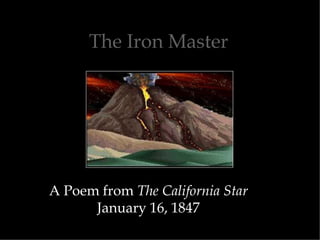
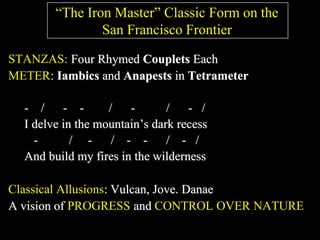
The Iron Master
A Poem from The California Star
January 16, 1847
“The Iron Master” Classic Form on the
San Francisco Frontier
STANZAS: Four Rhymed Couplets Each
METER: Iambics and Anapests in Tetrameter
- / - - / - / - /
I delve in the mountain’s dark recess
- / - / - - / - /
And build my fires in the wilderness
Classical Allusions: Vulcan, Jove. Danae
A vision of PROGRESS and CONTROL OVER NATURE
I.
I delve in the mountain’s dark recess
And build my fires in the wilderness;
The red rock crumbles beneath my blast,
While the tall trees tremble and stand aghast;
At the midnight hour my furnace glows,
And the liquid ore in a red stream flows,
Till the mountain’s heart is melted down,
And seared by fire is its sylvan crown.
THE IRON MASTER
The Iron Master II
Old Cyclops worked in his cavern dire
To tip the arrows of Jove with fire;
But I in my mountain crevice toil,
And make the rocks in my cauldron boil,
That man may hurl on his fiercest foes
The iron rain and the saber blows;
And send on the long and quivering wire
The silent thought with a wing of fire.
The Iron Master III
I burn the woods, and I melt the hills,
While the liquid ore from the earth distills,
That over the railroad track may run
The iron horse to outstrip the sun:
That ponderous wheels may dash the brine,
And play with monsters of the line.
While islands of coral seem to be
But milestones placed in the deep blue sea.
The Iron Master IV
When night comes on and the storm is out,
And the rain falls merrily about,
My mountain fires with a ruddier glow,
Are seen to burn by the drones below;
And as my merry men pass around,
Their shadows seem on the bright background,
Each like a Vulcan huge and dire,
Forging a thunderbolt of fire.
The Iron Master V
Richer than Danae’s golden rain
Is the wealth I send to the fertile plain,
The Press that gives to the nations light;
The wheel that turns with a thousands might;
The plow that furrows the stubborn field;
The sickle that reaps the harvest's yield,
Are hidden now in that shapeless bloom
Which I have borne from the cavern’s gloom.
The Iron Master VI
The miser may squander his golden hoard,
And the warrior fall on his bloody sword;
The iron horse may be stiff and chill,
And the wheels of a thousand mills be still;
The steamer may sink on her ocean way,
And the fire refuse on its wire to play;
With me, the earth would forget to mourn,
And leap at a blast of my mountain horn.
-- Anonymous, in The California Star, January 16, 1847
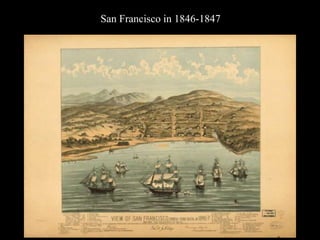
San Francisco in 1846-1847
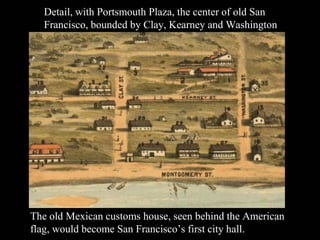
Detail, with Portsmouth Plaza, the center of old San
Francisco, bounded by Clay, Kearney and Washington
The old Mexican customs house, seen behind the American
flag, would become San Francisco’s first city hall.
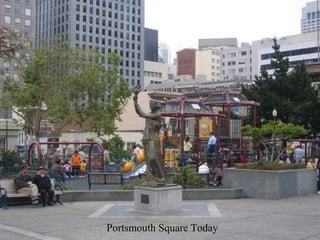
Portsmouth Square Today
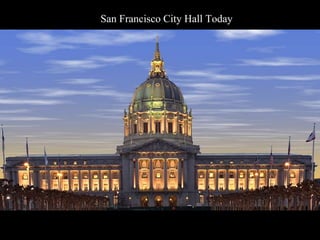
San Francisco City Hall Today
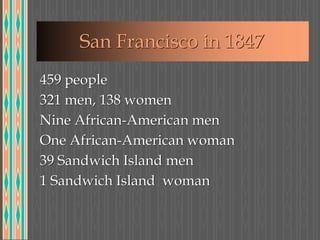
San Francisco in 1847
459 people
321 men, 138 women
Nine African-American men
One African-American woman
39 Sandwich Island men
1 Sandwich Island woman
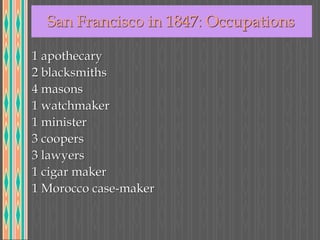
San Francisco in 1847: Occupations
1 apothecary
2 blacksmiths
4 masons
1 watchmaker
1 minister
3 coopers
3 lawyers
1 cigar maker
1 Morocco case-maker
finis

Pre Gold Rush San Francisco

  • 2.
    The Course ofEmpire • 1492: Columbus discovers Americas for Europeans • Treaty of Tordesillas, 1494 • Mission, Presidio, Pueblo • 1775: Spanish arrive in San Francisco Bay • 1776: Mission Dolores and Presidio founded • 1823: Mexico wins independence, governs California and San Francisco • 1846: USA defeats Mexico, takes over California and Texas
  • 3.
    Expansion and Empire 1783:Treaty of Versailles (USA acquires land for Ohio, Illinois, Wisconsin, etc.) 1803: Louisiana Purchase 1819: Florida purchased from Spain 1845: Texas annexed 1846: Oregon/Washington ceded by England 1846: Mexican War wins California
  • 4.
    Overseas Empire 1867: Alaskaacquired 1898: Spanish American War brings Puerto Rico, Philippines, and Guam 1898: Hawaii annexed 1969: Americans land on the moon The Internet?
  • 5.
    Our Rapid Multiplication “Itis impossible not to look forward to distant times, when our rapid multiplication will expand itself beyond our limits and cover the whole northern, if not the southern, continent with a people speaking the same language, governed in similar forms and by similar laws.” — Thomas Jefferson, 1801
  • 6.
  • 7.
    MANIFEST DESTINY It isour manifest destiny to overspread and to possess the whole of this continent, which Providence has given us. — John Sullivan (1845) destiny noun 1.The inevitable or necessary fate to which a particular person or thing is destined; lot.
  • 8.
    Emmanuel Leutze, Westward theCourse of Empire Takes its Way (1861)
  • 9.
    Dare I butsay a prophesy, As sung the holy men of old, Of rock-built cities yet to be Along these shining shores of gold, Crowding athirst into the sea, What wondrous marvels might be told! Enough to know that Empire here Shall burn her loftiest, brightest star. —Poet of the Sierras (1860) San Francisco: The Star Of Empire?
  • 10.
    Two Defining Traits of American Expansion 2) IncreasingControl Over Inanimate Forms of Energy: PROGRESS 1) The FRONTIER Experience
  • 11.
    American Farmers, Trappers,Explorers The Mexican Hope for California: good citizen farmers The Mexican Fear #1 : the trapper The Mexican Fear #2 : unstoppable progress “We find ourselves threatened by hordes of Yankee emigrants...whose progress we cannot arrest. Already have the wagons of that perfidious people scaled the almost inaccessible summits of the Sierra Nevada, crossed the entire continent, and penetrated the fruitful valley of the Sacramento... Already they are cultivating farms, establishing vineyards, erecting mills, sawing lumber, and doing a thousand other things which seem natural to them,” -- Governor Pio Pico, just before the American annexation of California
  • 12.
    Dana’s Prophesy “If Californiaever becomes a prosperous country, this bay will be the center of its prosperity. The abundance of wood and water; the extreme fertility of its shores; the excellence of its climate, which is as near to being perfect as any in the world; and its facilities for navigation... all fit it for a place of great importance.” — Richard Henry Dana (writing in 1836)
  • 13.
    “Excellence of Climate” Thecoldest month of the year is....? January (mean temperature = 50 degrees) The warmest month of the year is....? September (61.5 degrees) Yearly Rainfall: 22” in San Francisco 15” in San Jose 45” in Kentfield Tip of San Francisco peninsula: 2/3 of daylight hours in sunshine: second sunniest major city in America
  • 14.
    Dancing in YerbaBuena [On Portsmouth Square] many pleasant hours passed in the enjoyment of the light fandangoes and mazy waltzes by the dark eyed, semi-aborigines of California, who were wont to assemble from far and near at the beck and nod of those in authority, in crowds which could scarcely be counted, and “trip the light fantastic toe” for two or three days in succession, barely giving themselves time to partake of refreshments enough to keep body and soul together. From Filings from an Old Saw, by Joseph T. Downey, 1853
  • 15.
    Capt. W.A. Leidesdorff SanFrancisco’s first prominent African-American citizen
  • 16.
    William Leidesdorff “... oneof those shrewd spirits which are often found forcing their way against all obstacles to a station which they hardly dream of. Watch him now, ‘tis the Sabbath, dressed in his flashy Consular uniform, revelling in all the glory of navy blue, gold lace and gilt buttons, cane in hand, he hobbles about, the potentate, ruler, master and sovereign of a dozen half dressed Indians, who serve him with oriental obedience — his word is law, his nod imperative, and the Czar of Russia is not more of a monarch over this thousands than is the Capt..... over his Indian serfs. He too has passed away, and that too, at the very moment when the golden sun began to rise in all her majesty upon the Eureka State.” — Filings from an Old Saw, page 55
  • 17.
    San Francisco (andCalifornia) independence from Mexico, 1846 ....the assembled crowd of the free and enlightened citizens of Mexico, at last forced into their brains that they had by some magical proceeding suddenly been metamorphosed into citizens of the U. States, and unanimously wanted to go where liquor could be had, and drink a health and long life to that flag. The Indians consequently rushed frantically to one pulperee, Capt Leidesdorf and the aristocracy to Bob Ridley’s bar-room, and the second class and the Dutch to Tinker’s. These houses being on the four corners of the square, one in the door of the barracks could see the manoeuvres in each of them...
  • 18.
    Celebration! For the firsthour things went quiet enough, but soon the strong water began to work, and such a confusion of sounds could never have been heard since the Babel Tower arrangement, as came from these three corners. First would be heard a drunken viva from an Indian who would come out of pulperee No. 1, gaze up at the flag and over he would go at full length upon the grass... Then the aristocrats would raise a hip, hip, hip and a cheering “three times three,” then from Tinker’s a strange jumble of words, in which hurrah, viva, hip, pah, and Got verdam, were only too plainly distinguishable. This Pandemonium lasted for some hours, in fact until sundown, when the Commandant sent a guard to warn the revellers that as the town was now under martial law, they must cease their orgies and retire to their respective homes...
  • 19.
    Celebration Aftermath But few,however, were able to do so, and the greater part of them either slept in Tinker’s alley or on the grass in the plaza, and only awoke with the morning’s first beams, to wonder what was the cause of yesterday’s spree. (Filings from an Old Saw)
  • 20.
    A Proclamation concerningNative Americans in San Francisco at the outset of American rule “It having come to the knowledge of the Commander in Chief of this district, that certain persons have been and still are imprisoning and holding to service Indians against their will...without due regard to their rights as freemen. It is hereby ordered, that all such persons so holding or detaining Indians shall release them, and permit them to return to their own homes... The Indian population must not be regarded in the light of slaves, but it is deemed necessary that the Indians within the Settlement shall have employment, with the right of choosing their own master and employer... All Indians must be required to obtain service, not not be permitted to wander about the country in idle and dissolute manner; if found doing so, they will be liable to arrest and punishment by labor on PUBLIC WORKS at the direction of the Magistrate.” — Captain John B. Montgomery, Sept. 15, 1846
  • 21.
    The California Star,1847 First San Francisco newspaper Produced on that printing machine the Mormons brought Poetry, advice, sermons, notices, news The public forum
  • 22.
    STARTING IN THEWORLD from The California Star, January 16, 1847 Many an unwise parent labors hard and lives sparingly all his life for the purpose of leaving enough to give his children a start in the world, as it is called. Setting a young man afloat with money left him by his relatives is like tying bladders under the arms of one who cannot swim. Ten chances to one he will lose his bladders and go to the bottom…
  • 23.
    STARTING IN THEWORLD 3 Teach him to swim and he will never need the bladders.Give your child a sound education and you have done enough for him. See also that his morals are pure, his mind cultivated and his whole nature made subservient to the laws which govern man, and you will have given what will be of more value than the wealth of the Indies. You have given him a start which no misfortunes can deprive him of. The earlier you teach him to depend on his own resources, the better.
  • 24.
    Olde-Fashioned Humor fromThe California Star A SECRET “How do you do, Mrs. Tome, have you herd the story about Mrs. Ludy?” “Why, no, really, Mrs. Gad, what is it -- do tell.” “Oh, I promised not to tell it for all the world! -- No, I must never tell on’t. I’m affraid it will get out.” “Why, I’ll never tell on’t as long as I live, just as true as the world; what is it, come, tell.” “Now, you won’t say anything about it, will you” “No, I’ll never open my head about it-- never. Hope to die this minute.”
  • 25.
    “Well, if you’llbelieve me, Mrs. Fundy told me last night, that Mrs. Trot told her that her sister’s husband was told by a person who dreamed it, that Mrs. Trouble’s oldest daughter told Mrs. Nichens that her grandmother herd by a letter she got from her third sister’s second husband’s oldest brother’s step-daughter, that it was reported by the captain of a clam boat just arrived from the Feegee Islands, that the mermaids about that section wore shark skin bustles stuffed with pickled eel’s toes.”
  • 26.
    The Iron Master APoem from The California Star January 16, 1847
  • 27.
    “The Iron Master”Classic Form on the San Francisco Frontier STANZAS: Four Rhymed Couplets Each METER: Iambics and Anapests in Tetrameter - / - - / - / - / I delve in the mountain’s dark recess - / - / - - / - / And build my fires in the wilderness Classical Allusions: Vulcan, Jove. Danae A vision of PROGRESS and CONTROL OVER NATURE
  • 28.
    I. I delve inthe mountain’s dark recess And build my fires in the wilderness; The red rock crumbles beneath my blast, While the tall trees tremble and stand aghast; At the midnight hour my furnace glows, And the liquid ore in a red stream flows, Till the mountain’s heart is melted down, And seared by fire is its sylvan crown. THE IRON MASTER
  • 29.
    The Iron MasterII Old Cyclops worked in his cavern dire To tip the arrows of Jove with fire; But I in my mountain crevice toil, And make the rocks in my cauldron boil, That man may hurl on his fiercest foes The iron rain and the saber blows; And send on the long and quivering wire The silent thought with a wing of fire.
  • 30.
    The Iron MasterIII I burn the woods, and I melt the hills, While the liquid ore from the earth distills, That over the railroad track may run The iron horse to outstrip the sun: That ponderous wheels may dash the brine, And play with monsters of the line. While islands of coral seem to be But milestones placed in the deep blue sea.
  • 31.
    The Iron MasterIV When night comes on and the storm is out, And the rain falls merrily about, My mountain fires with a ruddier glow, Are seen to burn by the drones below; And as my merry men pass around, Their shadows seem on the bright background, Each like a Vulcan huge and dire, Forging a thunderbolt of fire.
  • 32.
    The Iron MasterV Richer than Danae’s golden rain Is the wealth I send to the fertile plain, The Press that gives to the nations light; The wheel that turns with a thousands might; The plow that furrows the stubborn field; The sickle that reaps the harvest's yield, Are hidden now in that shapeless bloom Which I have borne from the cavern’s gloom.
  • 33.
    The Iron MasterVI The miser may squander his golden hoard, And the warrior fall on his bloody sword; The iron horse may be stiff and chill, And the wheels of a thousand mills be still; The steamer may sink on her ocean way, And the fire refuse on its wire to play; With me, the earth would forget to mourn, And leap at a blast of my mountain horn. -- Anonymous, in The California Star, January 16, 1847
  • 34.
  • 35.
    Detail, with PortsmouthPlaza, the center of old San Francisco, bounded by Clay, Kearney and Washington The old Mexican customs house, seen behind the American flag, would become San Francisco’s first city hall.
  • 36.
  • 37.
  • 38.
    San Francisco in1847 459 people 321 men, 138 women Nine African-American men One African-American woman 39 Sandwich Island men 1 Sandwich Island woman
  • 39.
    San Francisco in1847: Occupations 1 apothecary 2 blacksmiths 4 masons 1 watchmaker 1 minister 3 coopers 3 lawyers 1 cigar maker 1 Morocco case-maker
  • 40.