Access by UK SMEs to
professional and academic
       information
    Publishing Research Consortium
               Mark Ware
•   Founding partners

    •   ALPSP

    •   Publishers Association

    •   STM

•   Corresponding partners

    •   AAUP

    •   AAP/PSP
Research objectives
•   Journal content, but not in isolation

    •   in the context of other types of information

•   Importance of information

•   Use made

•   How obtained

•   SMEs compared to other groups


                           3
Small & Medium Enterprises

•   Small < 50 employees

•   Medium < 250 employees

•   4.7 million

•   99.9% of UK companies

•   60% of private sector employment

•   % science-based/high-tech unknown


                       4
Previously known

•   Importance of SMEs to innovation and to
    economic growth and job creation

•   Importance of basic research to economy and
    to innovation

•   Publications one of many factors

    •   but an important one


                         5
Knowledge transfer routes
 •   Publications

 •   Informal contacts

 •   Public conferences and meetings

 •   Hiring trained scientists and engineers

 •   Joint research

 •   Contract research

 •   Temporary personnel exchanges
                          6
Methodology

•   Survey & interviews

•   Methodology

•   Response rate

•   Demographics


                          7
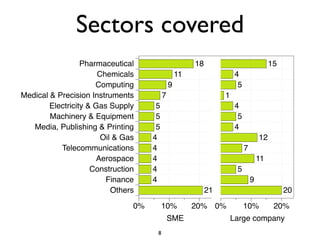
Sectors covered
                  Pharmaceutical                       18                               15
                       Chemicals                  11                  4
                      Computing               9                        5
Medical & Precision Instruments           7                      1
        Electricity & Gas Supply      5                               4
        Machinery & Equipment         5                                5
   Media, Publishing & Printing       5                               4
                        Oil & Gas    4                                             12
           Telecommunications        4                                     7
                      Aerospace      4                                             11
                     Construction    4                                5
                         Finance     4                                         9
                           Others                           21                               20

                                0%        10%          20% 0%              10%           20%
                                              SME                    Large company
                                      8
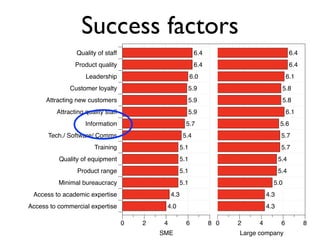
Success factors
                Quality of staff                             6.4                              6.4
                Product quality                              6.4                              6.4
                    Leadership                           6.0                                 6.1
              Customer loyalty                          5.9                              5.8
      Attracting new customers                          5.9                              5.8
         Attracting quality staff                       5.9                                  6.1
                    Information                         5.7                             5.6
      Tech./ Software/ Comms                           5.4                               5.7
                        Training                   5.1                                   5.7
          Quality of equipment                     5.1                                  5.4
                 Product range                     5.1                                  5.4
          Minimal bureaucracy                      5.1                              5.0
 Access to academic expertise                    4.3                              4.3
Access to commercial expertise               4.0                                  4.3

                                    0   2    4          6          8 0   2    4          6          8
                                            SME                          Large company
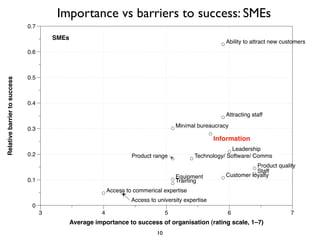
Importance vs barriers to success: SMEs
                              0.7

                                        SMEs
                                                                                                           Ability to attract new customers
                              0.6


                              0.5
Relative barrier to success


                              0.4
                                                                                                           Attracting staff
                                                                                         Minimal bureaucracy
                              0.3
                                                                                                       Information
                                                                                                             Leadership
                              0.2                                     Product range            Technology/ Software/ Comms
                                                                                                                      Product quality
                                                                                                                      Staff
                                                                                         Equipment         Customer loyalty
                              0.1                                                        Training
                                                             Access to commerical expertise
                                                                      Access to university expertise
                               0
                                    3                    4                           5                     6                         7
                                               Average importance to success of organisation (rating scale, 1–7)
                                                                                10
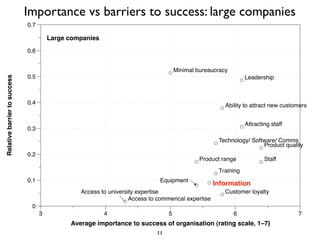
Importance vs barriers to success: large companies
                              0.7

                                        Large companies
                              0.6


                                                                                      Minimal bureaucracy
                              0.5
Relative barrier to success


                                                                                                                Leadership


                              0.4                                                                       Ability to attract new customers


                                                                                                                Attracting staff
                              0.3

                                                                                                     Technology/ Software/ Comms
                                                                                                                     Product quality
                              0.2
                                                                                               Product range            Staff
                                                                                                     Training
                              0.1                                             Equipment
                                                                                                    Information
                                                 Access to university expertise                         Customer loyalty
                                                                   Access to commerical expertise
                               0
                                    3                     4                       5                         6                       7
                                              Average importance to success of organisation (rating scale, 1–7)
                                                                             11
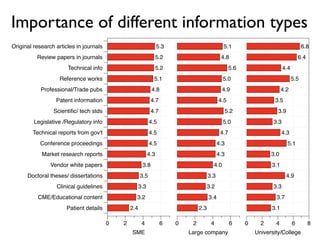
Importance of different information types
Original research articles in journals                             5.3                          5.1                                     6.8
          Review papers in journals                                5.2                         4.8                                    6.4
                       Technical info                              5.2                               5.6                    4.4
                    Reference works                            5.1                              5.0                               5.5
            Professional/Trade pubs                           4.8                               4.9                        4.2
                  Patent information                          4.7                             4.5                     3.5
                 Scientific/ tech stds                         4.7                                   5.2                 3.9
         Legislative /Regulatory info                        4.5                                5.0                   3.3
        Technical reports from gov't                         4.5                               4.7                         4.3
           Conference proceedings                            4.5                              4.3                             5.1
            Market research reports                          4.3                              4.3                    3.0
                Vendor white papers                     3.8                               4.0                        3.1
      Doctoral theses/ dissertations                   3.5                              3.3                                  4.9
                  Clinical guidelines                  3.3                              3.2                           3.3
           CME/Educational content                 3.2                                  3.4                            3.7
                      Patient details            2.4                              2.3                                3.1

                                         0   2          4           6    0    2          4           6     0     2     4          6         8
                                                 SME                         Large company                     University/College
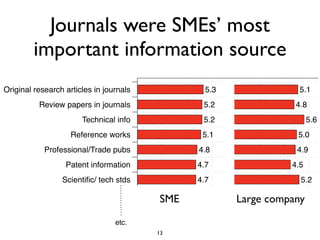
Journals were SMEs’ most
        important information source
Original research articles in journals           5.3                5.1
          Review papers in journals              5.2               4.8
                       Technical info            5.2                    5.6
                    Reference works              5.1               5.0
            Professional/Trade pubs             4.8                4.9
                  Patent information           4.7                4.5
                 Scientific/ tech stds          4.7                     5.2
         Legislative /Regulatory info          4.5                 5.0
                                         SME           Large company
        Technical reports from gov't           4.5                4.7
                             etc.
           Conference proceedings              4.5               4.3
                                         13
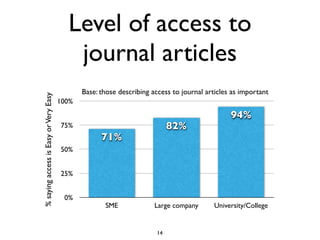
Level of access to
                                          journal articles
                                              Base: those describing access to journal articles as important
% saying access is Easy or Very Easy


                                       100%

                                                                                               94%
                                       75%                                 82%
                                                    71%
                                       50%


                                       25%


                                        0%
                                                     SME              Large company      University/College


                                                                      14
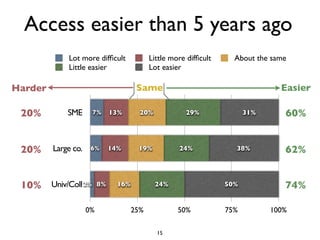
Access easier than 5 years ago
             Lot more difficult               Little more difficult     About the same
             Little easier                   Lot easier

Harder                                  Same                                      Easier

 20%         SME      7%       13%       20%            29%               31%      60%


 20%     Large co.    6%       14%      19%           24%             38%          62%


 10% Univ/Coll 2%         8%     16%           24%                  50%            74%

                     0%                25%            50%           75%         100%

                                               15
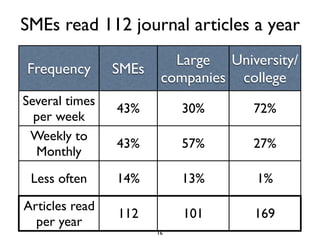
SMEs read 112 journal articles a year
                          Large University/
Frequency       SMEs
                        companies college
Several times
                43%         30%     72%
  per week
 Weekly to
                43%         57%     27%
  Monthly
 Less often     14%         13%      1%

Articles read
                112         101     169
  per year
                       16
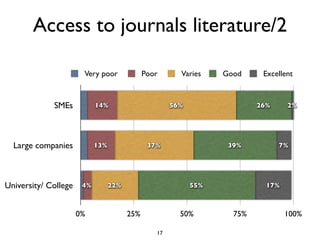
Access to journals literature/2

                       Very poor              Poor      Varies    Good     Excellent


             SMEs           14%                       56%                 26%     2%


  Large companies           13%                37%                 39%          7%


University/ College    4%         22%                       55%             17%


                      0%                25%             50%         75%           100%

                                                 17
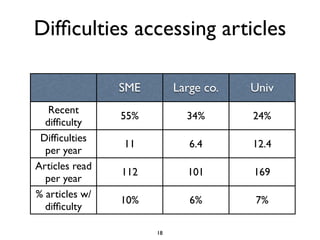
Difficulties accessing articles

                SME        Large co.   Univ
   Recent
                55%          34%       24%
  difficulty
 Difficulties
                11            6.4      12.4
  per year
Articles read
                112          101       169
  per year
% articles w/
                10%           6%       7%
  difficulty

                      18
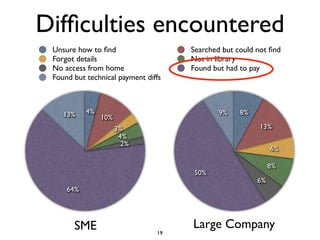
Difficulties encountered
 Unsure how to find                   Searched but could not find
 Forgot details                      Not in library
 No access from home                 Found but had to pay
 Found but technical payment diffs


    13%    4%                                9%    8%
                10%
                      3%                                13%
                       4%
                        2%
                                                             6%

                                                             8%
                                     50%
                                                        6%
     64%


       SME                           Large Company
                                19
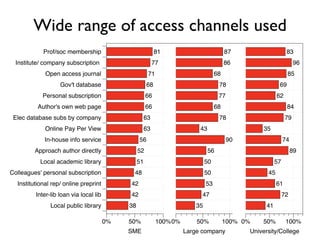
Wide range of access channels used
            Prof/soc membership                             81                           87                     83
  Institute/ company subscription                       77                               86                         96
             Open access journal                       71                           68                          85
                   Gov't database                      68                            78                    69
            Personal subscription                      66                            77                   62
          Author's own web page                        66                           68                          84
 Elec database subs by company                     63                                78                        79
             Online Pay Per View                   63                      43                       35
             In-house info service                56                                      90                   74
         Approach author directly                 52                            56                                  89
           Local academic library                 51                           50                         57
Colleagues' personal subscription             48                               50                    45
  Institutional rep/ online preprint         42                                53                         61
         Inter-lib loan via local lib        42                             47                                 72
               Local public library          38                           35                         41

                                        0%   50%            100% 0%       50%            100% 0%   50%          100%
                                             SME                      Large company            University/College
Pay Per View

•   only 5% of SME reported channel uses

•   1/3 used at least once per month

•   Lots of issues

    •   high prices

    •   inhibits browsing

    •   uninformative/misleading abstracts

    •   non-corporate payment mechanism

                            21
Local academic libraries

•   Rarely used: ~1% of channel uses

•   Issues

    •   level of library interest?

    •   perceived problems with publisher licences

    •   requirement for walk-in access


                            22
Professional associations
•   Physical libraries => virtual

•   Cost effective

•   Highly targeted

•   Issues

    •   small library budgets

    •   licence constraints


                              23
National licence?
•   Who would mediate/administer?

    •   JISC/HEIs?

    •   British Library?

    •   PLS?

•   Size of the access gap

•   Benefits

•   Self-sustaining?


                           24
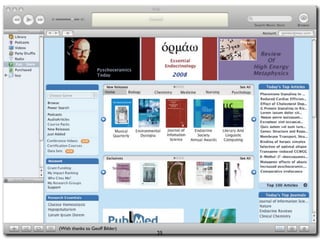
(With thanks to Geoff Bilder)
                                25
iTunes model (“iPub”)
•   single portal, comprehensive aggregation

•   intuitive user interface

•   low price

•   meaningful previews

•   one-click purchase (w/corporate options)

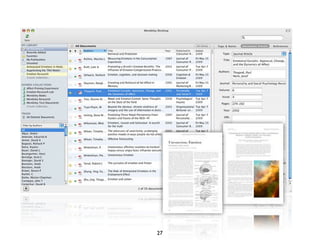
•   integration with reference management
    software

•   recommendation engines

•   multiple media types
                           26
27
Summary
•   High value of information to SMEs
•   Journals highly used
•   Mixed picture on access, but SMEs worse than large
    companies (& universities)

•   55% experienced recent difficulty
    •   ~ 10% of articles read per year

    •   payment barrier the main difficulty cited
•   Wide range of access channels
    •   PPV problematic, walk-in access inconvenient

•   Options: PPV; online libraries; national licence?
                            28
Further information
•   Full report on PRC website

    •   http://is.gd/32TM3

•   Companion report (additional information)

    •   http://is.gd/32TO1

•   These slides

    •   http://www.slideshare.net/mrkwr

•   Mark Ware

    •   www.markwareconsulting.com

                             29

PRC SME Access Talk

  • 1.
    Access by UKSMEs to professional and academic information Publishing Research Consortium Mark Ware
  • 2.
    Founding partners • ALPSP • Publishers Association • STM • Corresponding partners • AAUP • AAP/PSP
  • 3.
    Research objectives • Journal content, but not in isolation • in the context of other types of information • Importance of information • Use made • How obtained • SMEs compared to other groups 3
  • 4.
    Small & MediumEnterprises • Small < 50 employees • Medium < 250 employees • 4.7 million • 99.9% of UK companies • 60% of private sector employment • % science-based/high-tech unknown 4
  • 5.
    Previously known • Importance of SMEs to innovation and to economic growth and job creation • Importance of basic research to economy and to innovation • Publications one of many factors • but an important one 5
  • 6.
    Knowledge transfer routes • Publications • Informal contacts • Public conferences and meetings • Hiring trained scientists and engineers • Joint research • Contract research • Temporary personnel exchanges 6
  • 7.
    Methodology • Survey & interviews • Methodology • Response rate • Demographics 7
  • 8.
    Sectors covered Pharmaceutical 18 15 Chemicals 11 4 Computing 9 5 Medical & Precision Instruments 7 1 Electricity & Gas Supply 5 4 Machinery & Equipment 5 5 Media, Publishing & Printing 5 4 Oil & Gas 4 12 Telecommunications 4 7 Aerospace 4 11 Construction 4 5 Finance 4 9 Others 21 20 0% 10% 20% 0% 10% 20% SME Large company 8
  • 9.
    Success factors Quality of staff 6.4 6.4 Product quality 6.4 6.4 Leadership 6.0 6.1 Customer loyalty 5.9 5.8 Attracting new customers 5.9 5.8 Attracting quality staff 5.9 6.1 Information 5.7 5.6 Tech./ Software/ Comms 5.4 5.7 Training 5.1 5.7 Quality of equipment 5.1 5.4 Product range 5.1 5.4 Minimal bureaucracy 5.1 5.0 Access to academic expertise 4.3 4.3 Access to commercial expertise 4.0 4.3 0 2 4 6 8 0 2 4 6 8 SME Large company
  • 10.
    Importance vs barriersto success: SMEs 0.7 SMEs Ability to attract new customers 0.6 0.5 Relative barrier to success 0.4 Attracting staff Minimal bureaucracy 0.3 Information Leadership 0.2 Product range Technology/ Software/ Comms Product quality Staff Equipment Customer loyalty 0.1 Training Access to commerical expertise Access to university expertise 0 3 4 5 6 7 Average importance to success of organisation (rating scale, 1–7) 10
  • 11.
    Importance vs barriersto success: large companies 0.7 Large companies 0.6 Minimal bureaucracy 0.5 Relative barrier to success Leadership 0.4 Ability to attract new customers Attracting staff 0.3 Technology/ Software/ Comms Product quality 0.2 Product range Staff Training 0.1 Equipment Information Access to university expertise Customer loyalty Access to commerical expertise 0 3 4 5 6 7 Average importance to success of organisation (rating scale, 1–7) 11
  • 12.
    Importance of differentinformation types Original research articles in journals 5.3 5.1 6.8 Review papers in journals 5.2 4.8 6.4 Technical info 5.2 5.6 4.4 Reference works 5.1 5.0 5.5 Professional/Trade pubs 4.8 4.9 4.2 Patent information 4.7 4.5 3.5 Scientific/ tech stds 4.7 5.2 3.9 Legislative /Regulatory info 4.5 5.0 3.3 Technical reports from gov't 4.5 4.7 4.3 Conference proceedings 4.5 4.3 5.1 Market research reports 4.3 4.3 3.0 Vendor white papers 3.8 4.0 3.1 Doctoral theses/ dissertations 3.5 3.3 4.9 Clinical guidelines 3.3 3.2 3.3 CME/Educational content 3.2 3.4 3.7 Patient details 2.4 2.3 3.1 0 2 4 6 0 2 4 6 0 2 4 6 8 SME Large company University/College
  • 13.
    Journals were SMEs’most important information source Original research articles in journals 5.3 5.1 Review papers in journals 5.2 4.8 Technical info 5.2 5.6 Reference works 5.1 5.0 Professional/Trade pubs 4.8 4.9 Patent information 4.7 4.5 Scientific/ tech stds 4.7 5.2 Legislative /Regulatory info 4.5 5.0 SME Large company Technical reports from gov't 4.5 4.7 etc. Conference proceedings 4.5 4.3 13
  • 14.
    Level of accessto journal articles Base: those describing access to journal articles as important % saying access is Easy or Very Easy 100% 94% 75% 82% 71% 50% 25% 0% SME Large company University/College 14
  • 15.
    Access easier than5 years ago Lot more difficult Little more difficult About the same Little easier Lot easier Harder Same Easier 20% SME 7% 13% 20% 29% 31% 60% 20% Large co. 6% 14% 19% 24% 38% 62% 10% Univ/Coll 2% 8% 16% 24% 50% 74% 0% 25% 50% 75% 100% 15
  • 16.
    SMEs read 112journal articles a year Large University/ Frequency SMEs companies college Several times 43% 30% 72% per week Weekly to 43% 57% 27% Monthly Less often 14% 13% 1% Articles read 112 101 169 per year 16
  • 17.
    Access to journalsliterature/2 Very poor Poor Varies Good Excellent SMEs 14% 56% 26% 2% Large companies 13% 37% 39% 7% University/ College 4% 22% 55% 17% 0% 25% 50% 75% 100% 17
  • 18.
    Difficulties accessing articles SME Large co. Univ Recent 55% 34% 24% difficulty Difficulties 11 6.4 12.4 per year Articles read 112 101 169 per year % articles w/ 10% 6% 7% difficulty 18
  • 19.
    Difficulties encountered Unsurehow to find Searched but could not find Forgot details Not in library No access from home Found but had to pay Found but technical payment diffs 13% 4% 9% 8% 10% 3% 13% 4% 2% 6% 8% 50% 6% 64% SME Large Company 19
  • 20.
    Wide range ofaccess channels used Prof/soc membership 81 87 83 Institute/ company subscription 77 86 96 Open access journal 71 68 85 Gov't database 68 78 69 Personal subscription 66 77 62 Author's own web page 66 68 84 Elec database subs by company 63 78 79 Online Pay Per View 63 43 35 In-house info service 56 90 74 Approach author directly 52 56 89 Local academic library 51 50 57 Colleagues' personal subscription 48 50 45 Institutional rep/ online preprint 42 53 61 Inter-lib loan via local lib 42 47 72 Local public library 38 35 41 0% 50% 100% 0% 50% 100% 0% 50% 100% SME Large company University/College
  • 21.
    Pay Per View • only 5% of SME reported channel uses • 1/3 used at least once per month • Lots of issues • high prices • inhibits browsing • uninformative/misleading abstracts • non-corporate payment mechanism 21
  • 22.
    Local academic libraries • Rarely used: ~1% of channel uses • Issues • level of library interest? • perceived problems with publisher licences • requirement for walk-in access 22
  • 23.
    Professional associations • Physical libraries => virtual • Cost effective • Highly targeted • Issues • small library budgets • licence constraints 23
  • 24.
    National licence? • Who would mediate/administer? • JISC/HEIs? • British Library? • PLS? • Size of the access gap • Benefits • Self-sustaining? 24
  • 25.
    (With thanks toGeoff Bilder) 25
  • 26.
    iTunes model (“iPub”) • single portal, comprehensive aggregation • intuitive user interface • low price • meaningful previews • one-click purchase (w/corporate options) • integration with reference management software • recommendation engines • multiple media types 26
  • 27.
  • 28.
    Summary • High value of information to SMEs • Journals highly used • Mixed picture on access, but SMEs worse than large companies (& universities) • 55% experienced recent difficulty • ~ 10% of articles read per year • payment barrier the main difficulty cited • Wide range of access channels • PPV problematic, walk-in access inconvenient • Options: PPV; online libraries; national licence? 28
  • 29.
    Further information • Full report on PRC website • http://is.gd/32TM3 • Companion report (additional information) • http://is.gd/32TO1 • These slides • http://www.slideshare.net/mrkwr • Mark Ware • www.markwareconsulting.com 29