Tax Classification of
            Optometric Practices
Established Practices                                 New Practices

       9%                     S Corporation
                                                            7%
                                                       6%
 10%                          Sole Proprietor

                              Partnership       24%
19%          63%                                                 63%
                              C Corporation


             Source: MBA and FPA Practice Profile, 2010
Setting of Optometric Practices
  Established Practices                             New Practices
         100%                                           100%
          3%                                            1%
                          Enclosed shopping mall        16%
         16%

         19%              Medical office building
                                                        28%
                          Office building: mixed
         24%              businesses
                          Strip mall
                                                        44%
         39%              Free-standing office

                                                        12%


        Source: MBA and FPA Practice Profile, 2010
Optometric Practice Specializations
                                   (% of practices specializing)


                             Established Practices                  New Practices

Dry Eye Therapy                           73%                                  67%


Hard-to-fit Contact Lenses                70%                              58%


Glaucoma Treatment                     61%                                53%


Pediatric Eye Care                 40%                                   41%


Low Vision                   12%                                   9%


Sports Vision                12%                                   13%


                     Source: MBA and FPA Practice Profile, 2010
Optometric Practices with
           Large Ethnic Populations
                       (% of practices with 25% or more of ethnic group)


                       Established Practices                         New Practices

Hispanic                             22%                                   15%


African-American               14%                                          17%


Asian                       9%                                             14%


                   Source: MBA and FPA Practice Profile, 2010
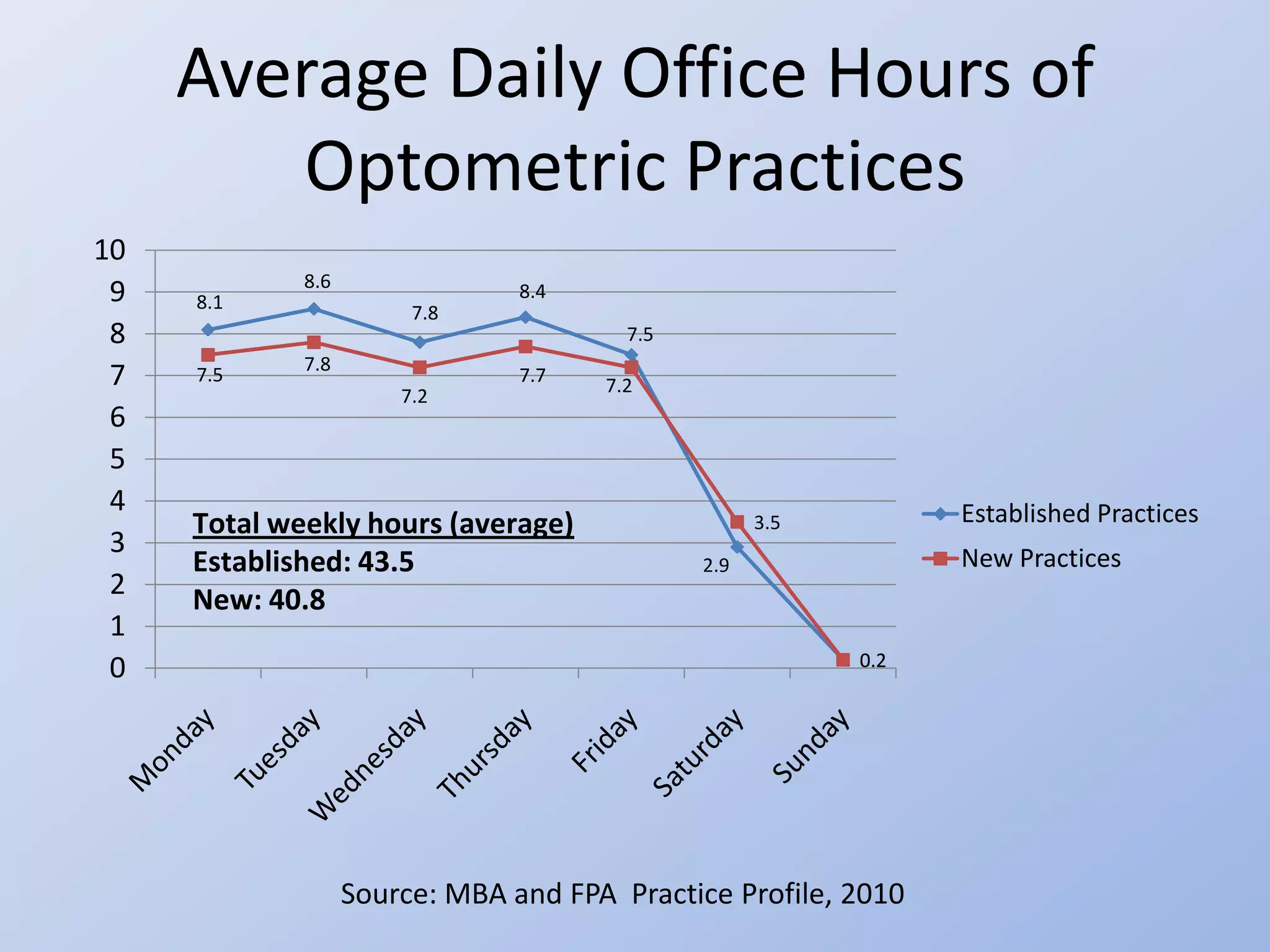
Average Daily Office Hours of
        Optometric Practices
10
             8.6
 9   8.1
                                8.4
                        7.8
 8                                      7.5
             7.8
 7   7.5                        7.7   7.2
                       7.2
 6
 5
 4                                                              Established Practices
     Total weekly hours (average)                   3.5
 3                                                              New Practices
     Established: 43.5                        2.9
 2   New: 40.8
 1
 0                                                        0.2


                   Source: MBA and FPA Practice Profile, 2010
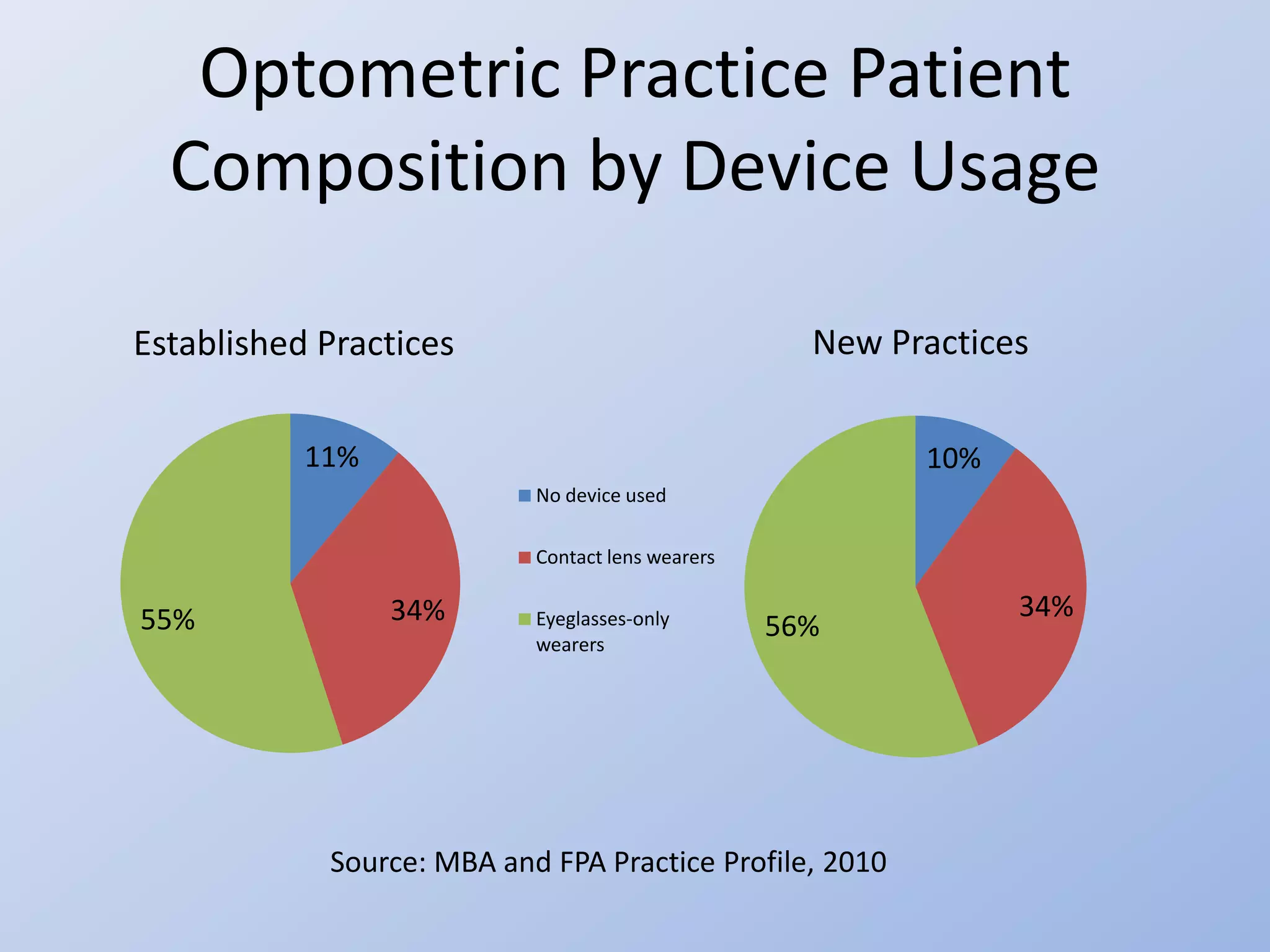
Optometric Practice Patient
  Composition by Device Usage

Established Practices                               New Practices

           11%                                            10%
                           No device used

                           Contact lens wearers


55%              34%       Eyeglasses-only                      34%
                           wearers
                                                  56%


            Source: MBA and FPA Practice Profile, 2010
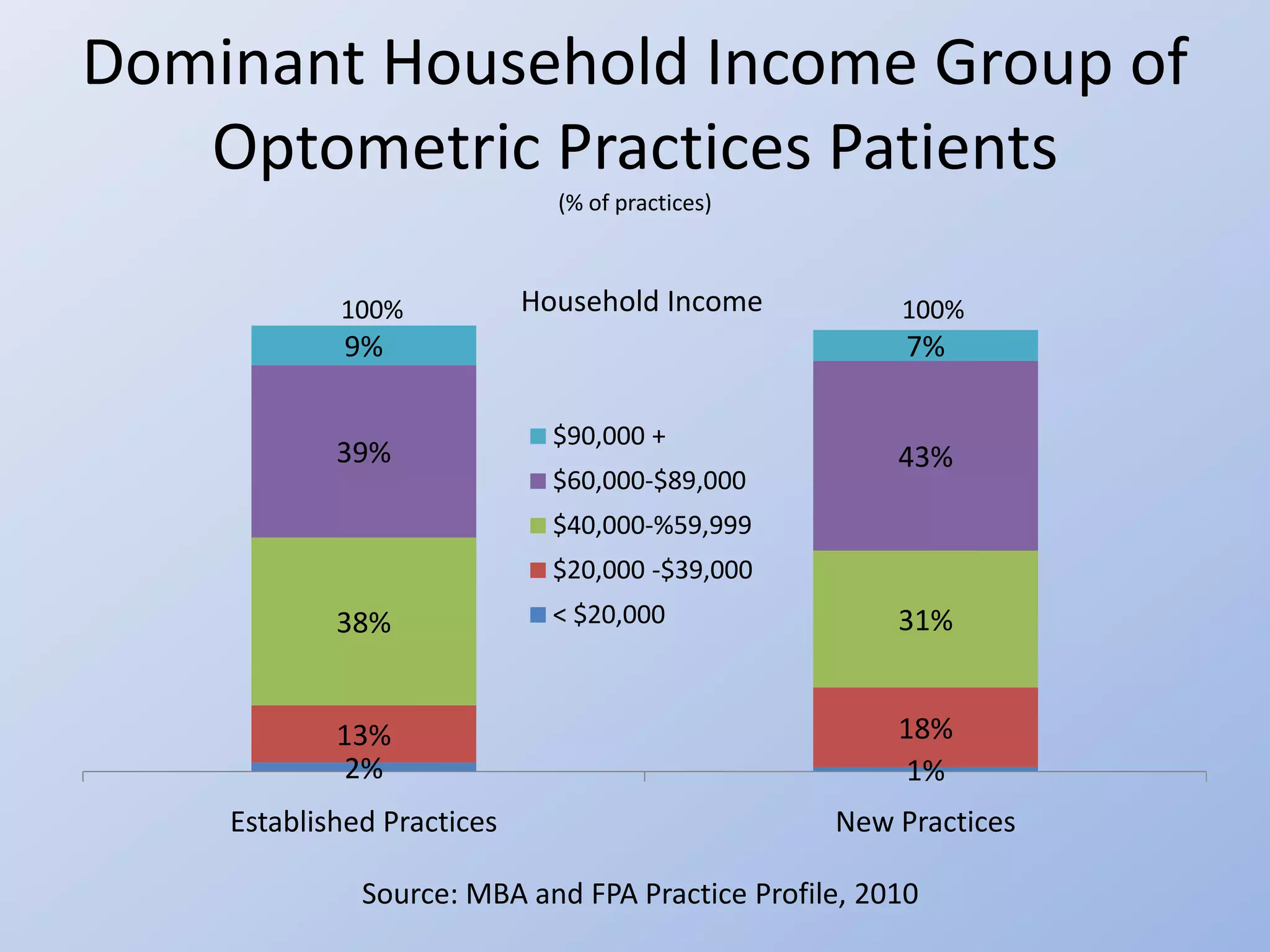
Dominant Household Income Group of
   Optometric Practices Patients
                              (% of practices)


            100%            Household Income          100%
            9%                                         7%

                              $90,000 +
            39%                                       43%
                              $60,000-$89,000
                              $40,000-%59,999
                              $20,000 -$39,000
            38%               < $20,000               31%


            13%                                       18%
            2%                                         1%
    Established Practices                        New Practices

              Source: MBA and FPA Practice Profile, 2010
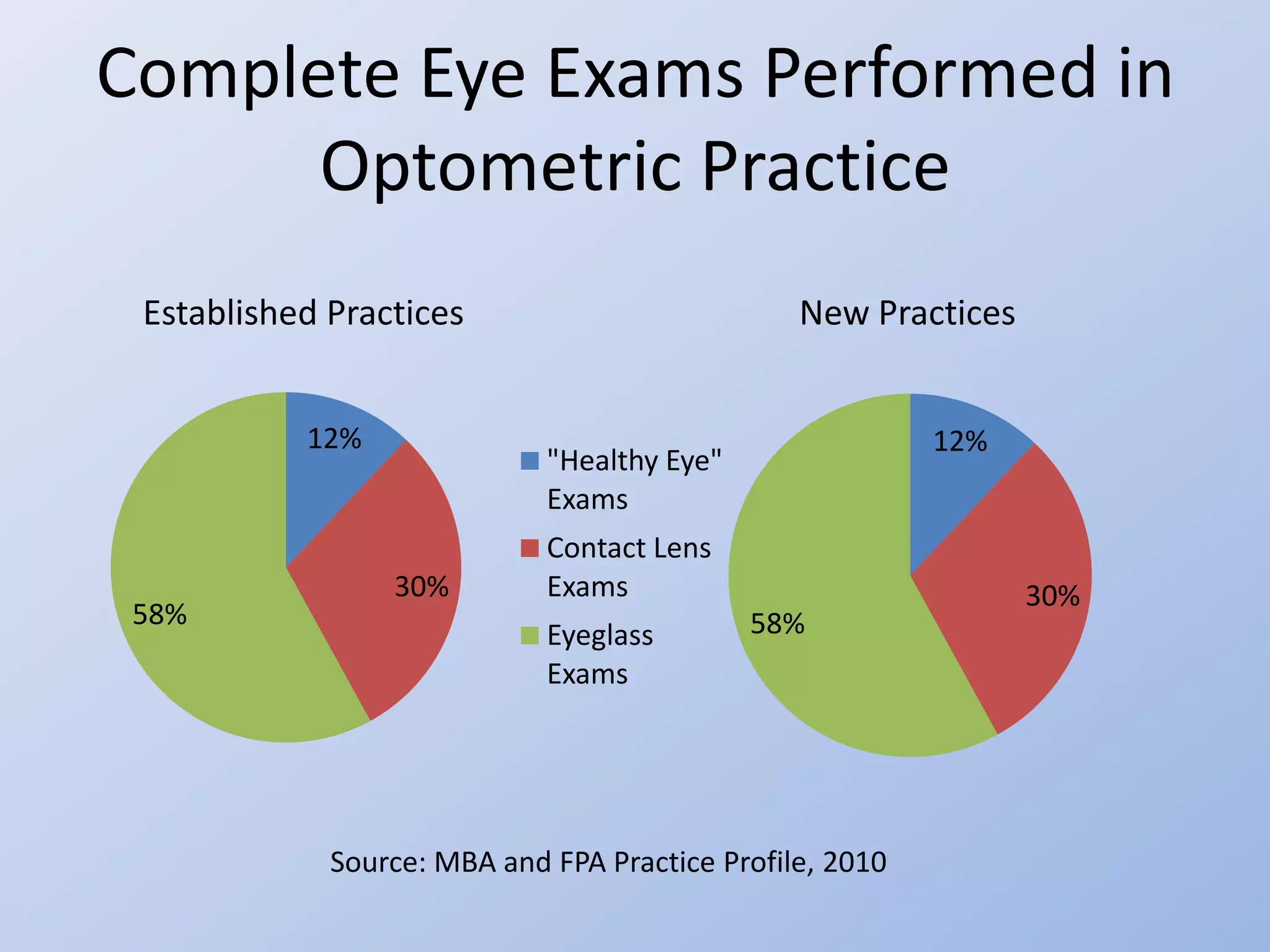
Complete Eye Exams Performed in
      Optometric Practice
 Established Practices                          New Practices


           12%                                            12%
                             "Healthy Eye"
                             Exams
                             Contact Lens
                 30%         Exams                              30%
 58%                                         58%
                             Eyeglass
                             Exams


             Source: MBA and FPA Practice Profile, 2010
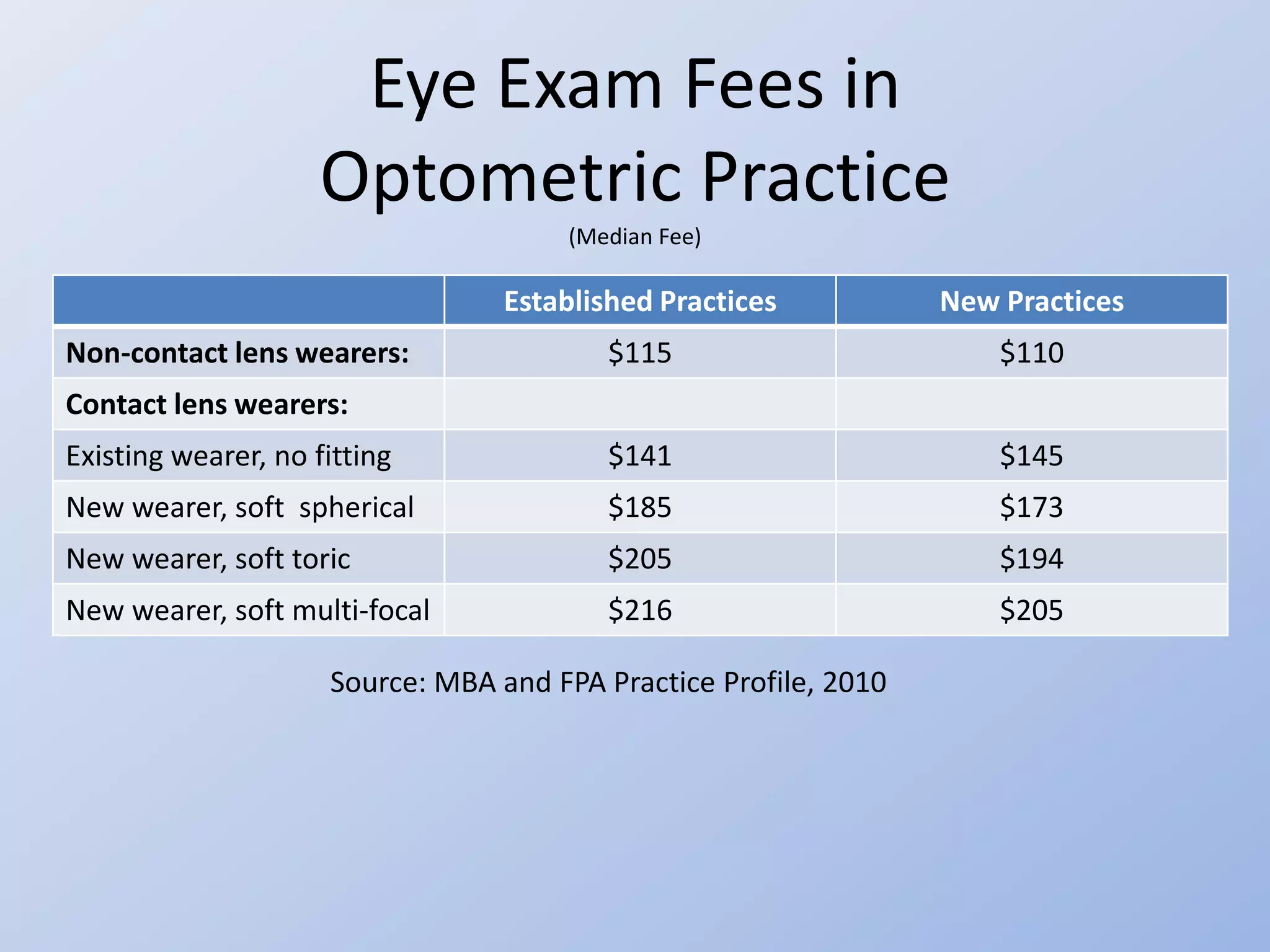
Eye Exam Fees in
                     Optometric Practice
                                      (Median Fee)

                                  Established Practices           New Practices
Non-contact lens wearers:                 $115                        $110
Contact lens wearers:
Existing wearer, no fitting               $141                        $145
New wearer, soft spherical                $185                        $173
New wearer, soft toric                    $205                        $194
New wearer, soft multi-focal              $216                        $205

                     Source: MBA and FPA Practice Profile, 2010
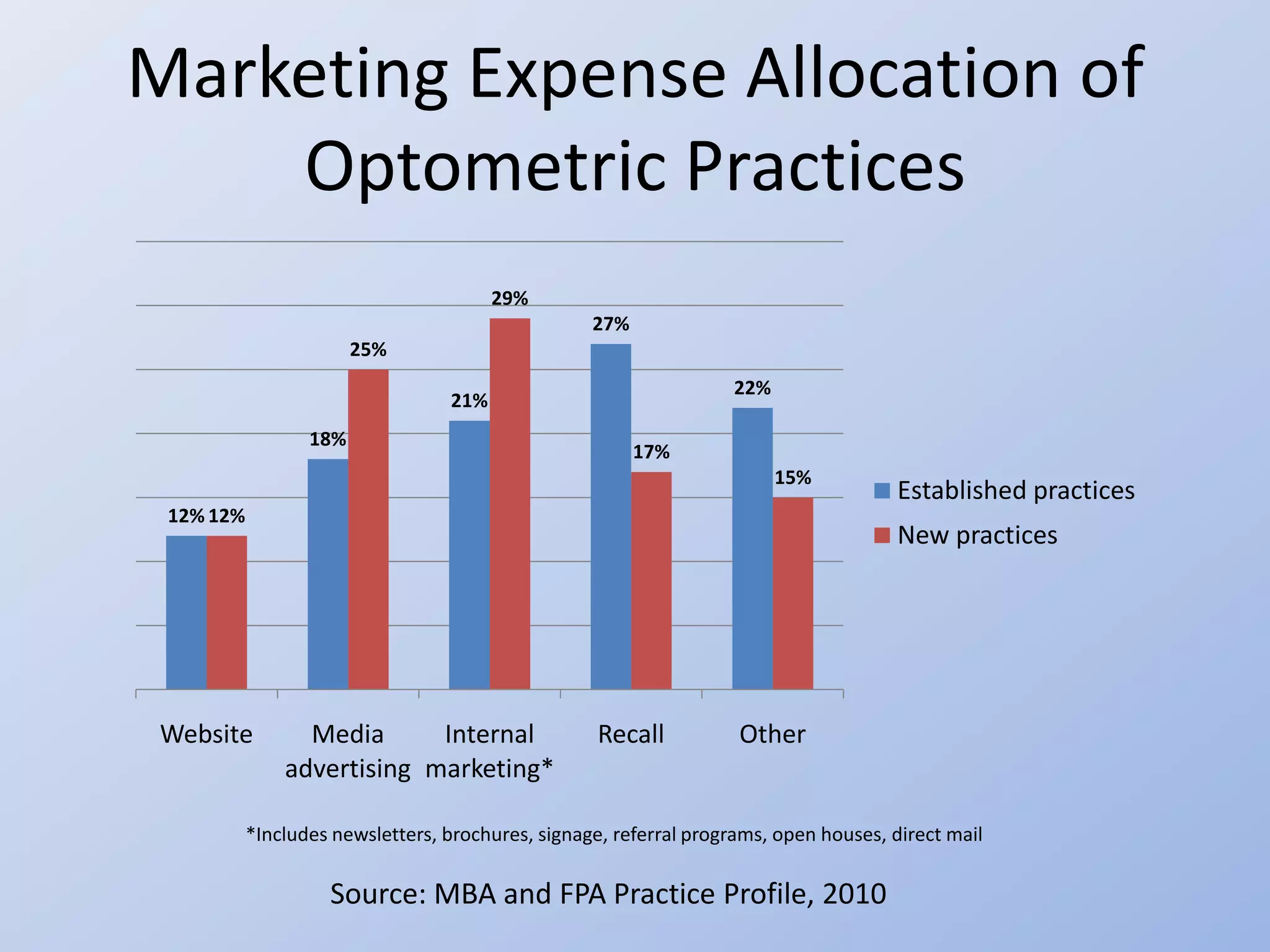
Marketing Expense Allocation of
    Optometric Practices
                                        29%
                                                   27%
                        25%
                                                                   22%
                                  21%
                  18%
                                                         17%
                                                                         15%
                                                                                       Established practices
 12% 12%
                                                                                       New practices


 Website         Media      Internal                Recall          Other
               advertising marketing*

           *Includes newsletters, brochures, signage, referral programs, open houses, direct mail

                    Source: MBA and FPA Practice Profile, 2010
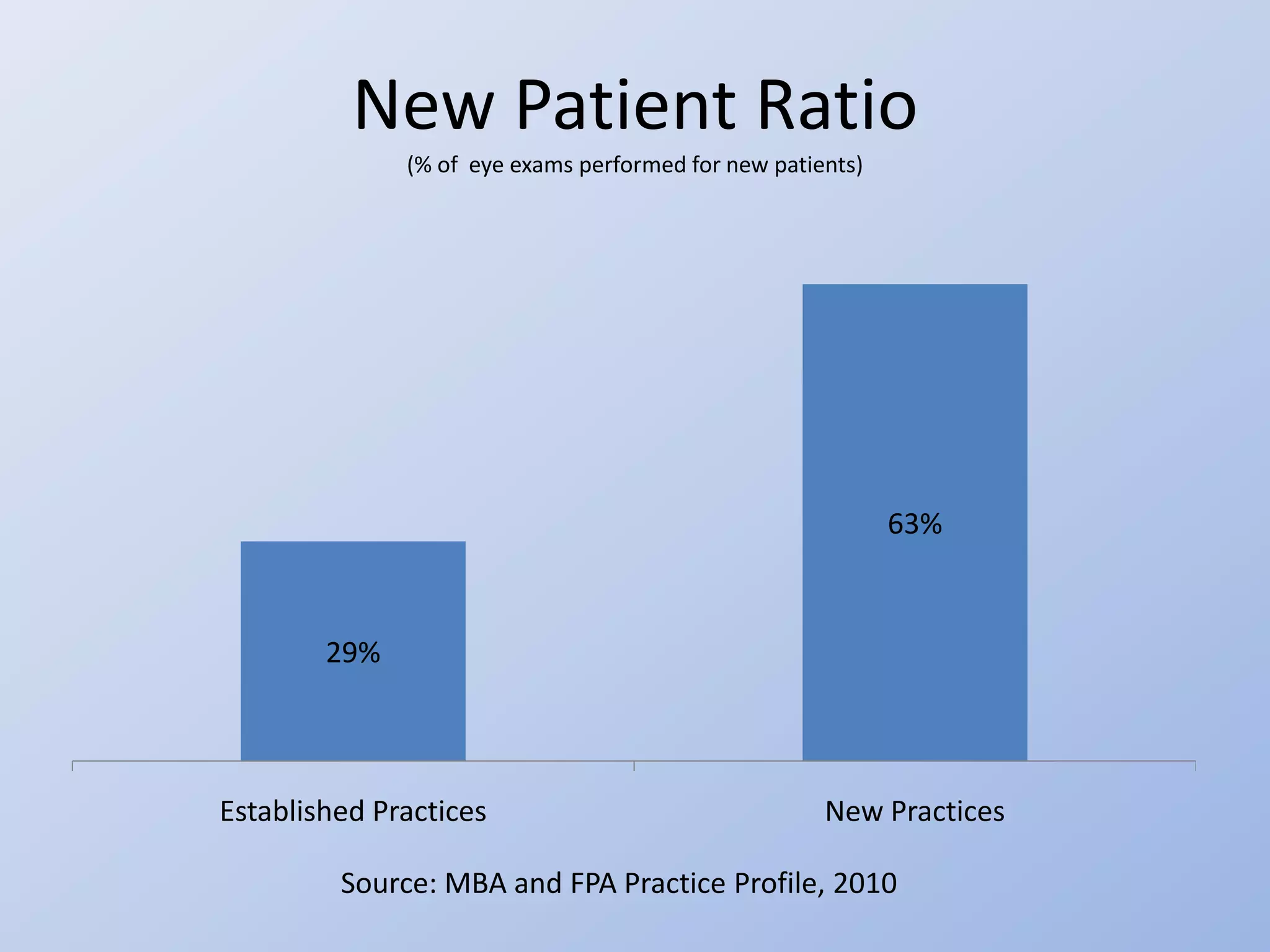
New Patient Ratio
              (% of eye exams performed for new patients)


                                                            63%


        29%


Established Practices                                New Practices

         Source: MBA and FPA Practice Profile, 2010
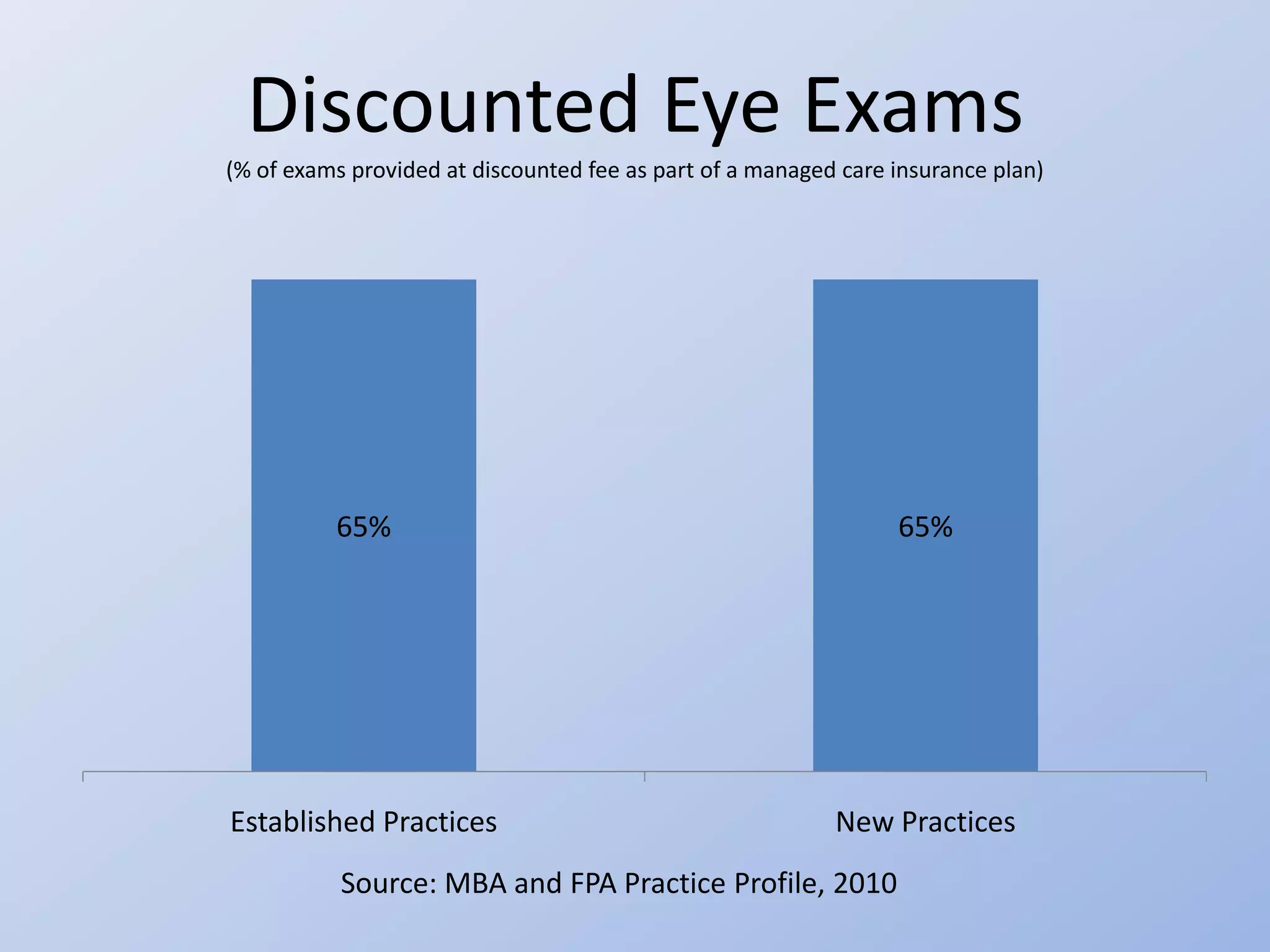
Discounted Eye Exams
(% of exams provided at discounted fee as part of a managed care insurance plan)


          65%                                                    65%


Established Practices                                      New Practices
           Source: MBA and FPA Practice Profile, 2010
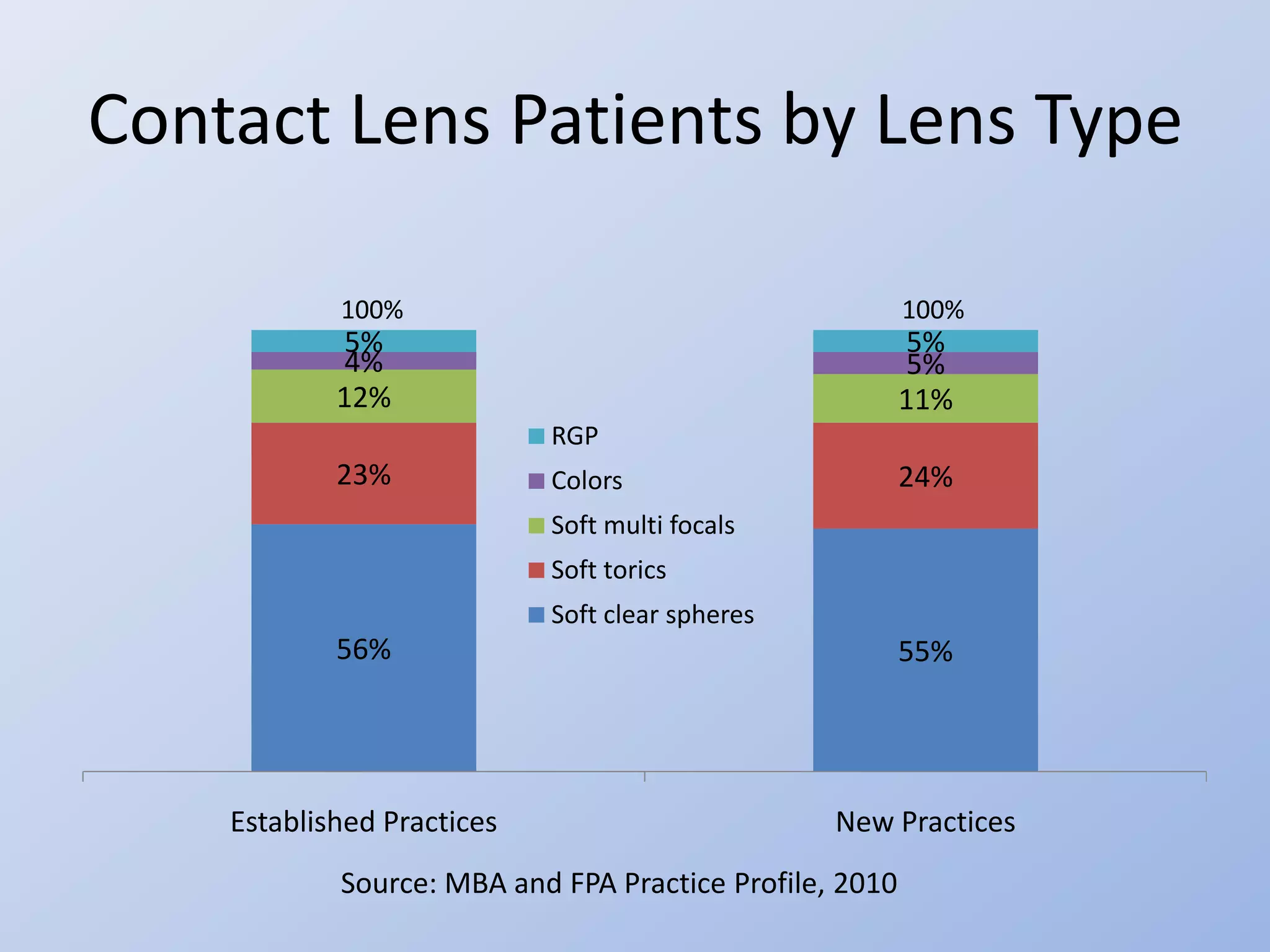
Contact Lens Patients by Lens Type

            100%                                         100%
            5%                                            5%
            4%                                            5%
            12%                                          11%
                            RGP
            23%             Colors                       24%
                            Soft multi focals
                            Soft torics
                            Soft clear spheres
            56%                                          55%


    Established Practices                        New Practices
            Source: MBA and FPA Practice Profile, 2010
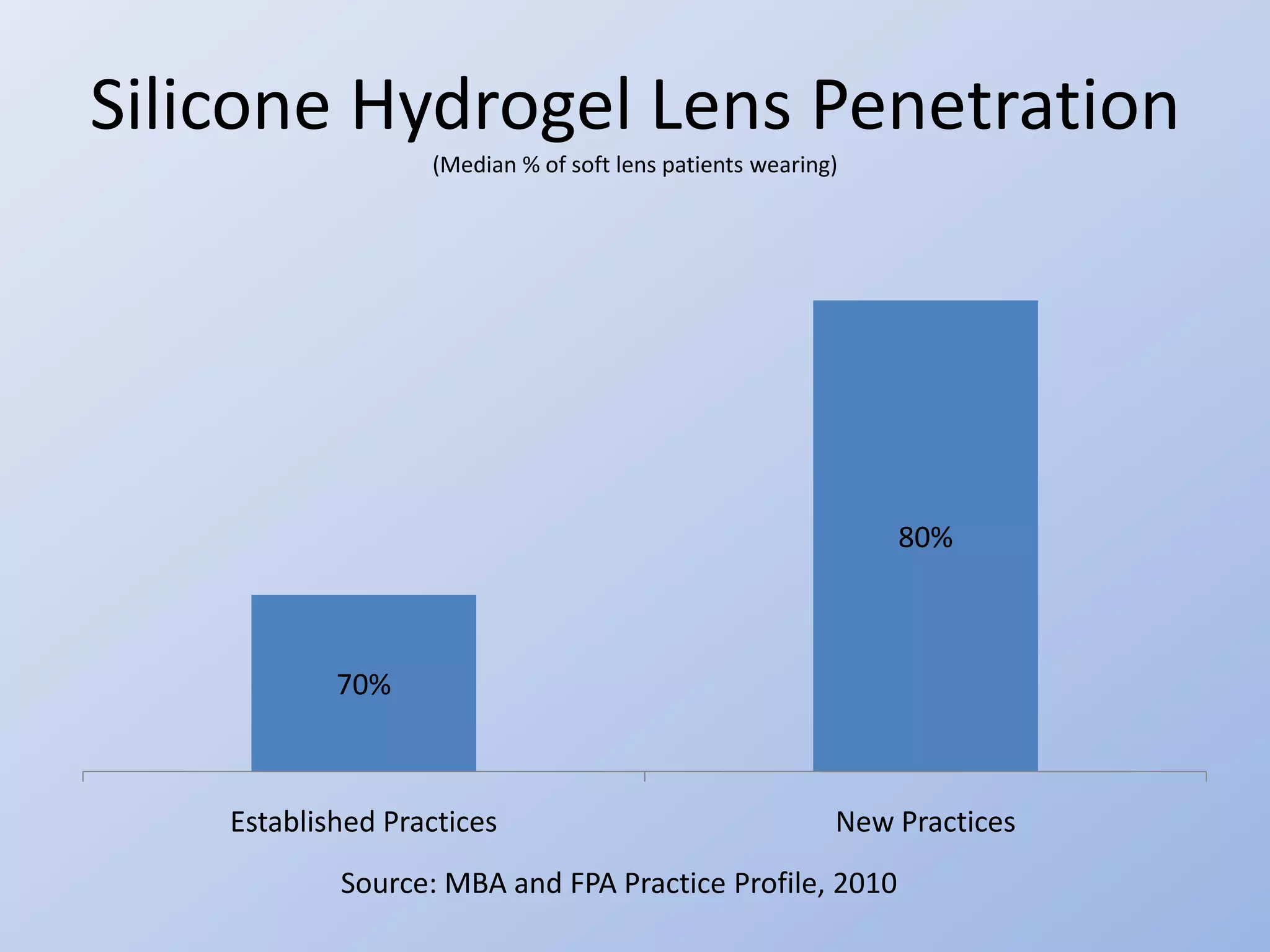
Silicone Hydrogel Lens Penetration
                   (Median % of soft lens patients wearing)


                                                              80%


            70%


    Established Practices                                 New Practices
            Source: MBA and FPA Practice Profile, 2010
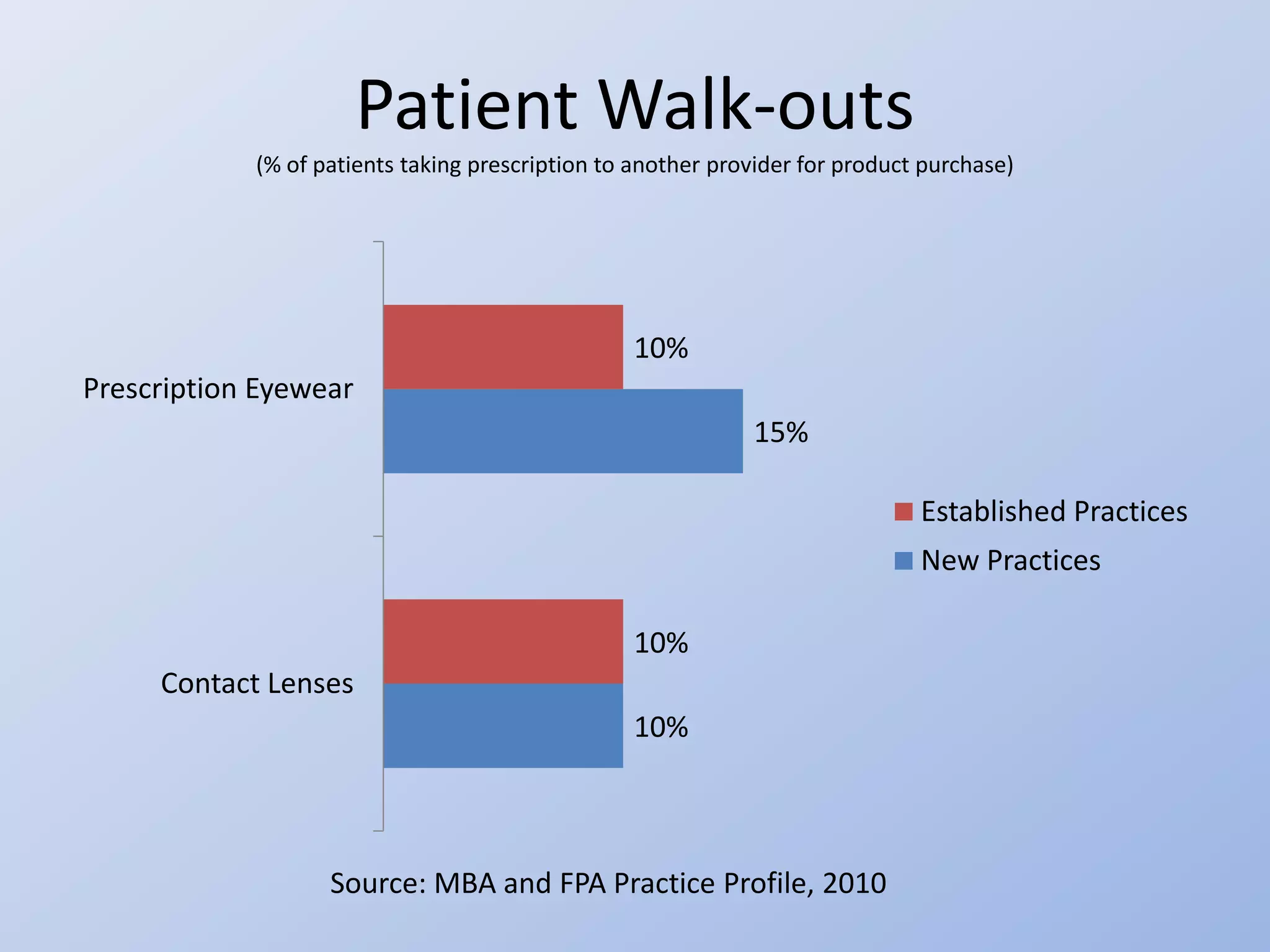
Patient Walk-outs
            (% of patients taking prescription to another provider for product purchase)


                                                 10%
Prescription Eyewear
                                                             15%

                                                                              Established Practices
                                                                              New Practices

                                                 10%
     Contact Lenses
                                                 10%


                   Source: MBA and FPA Practice Profile, 2010
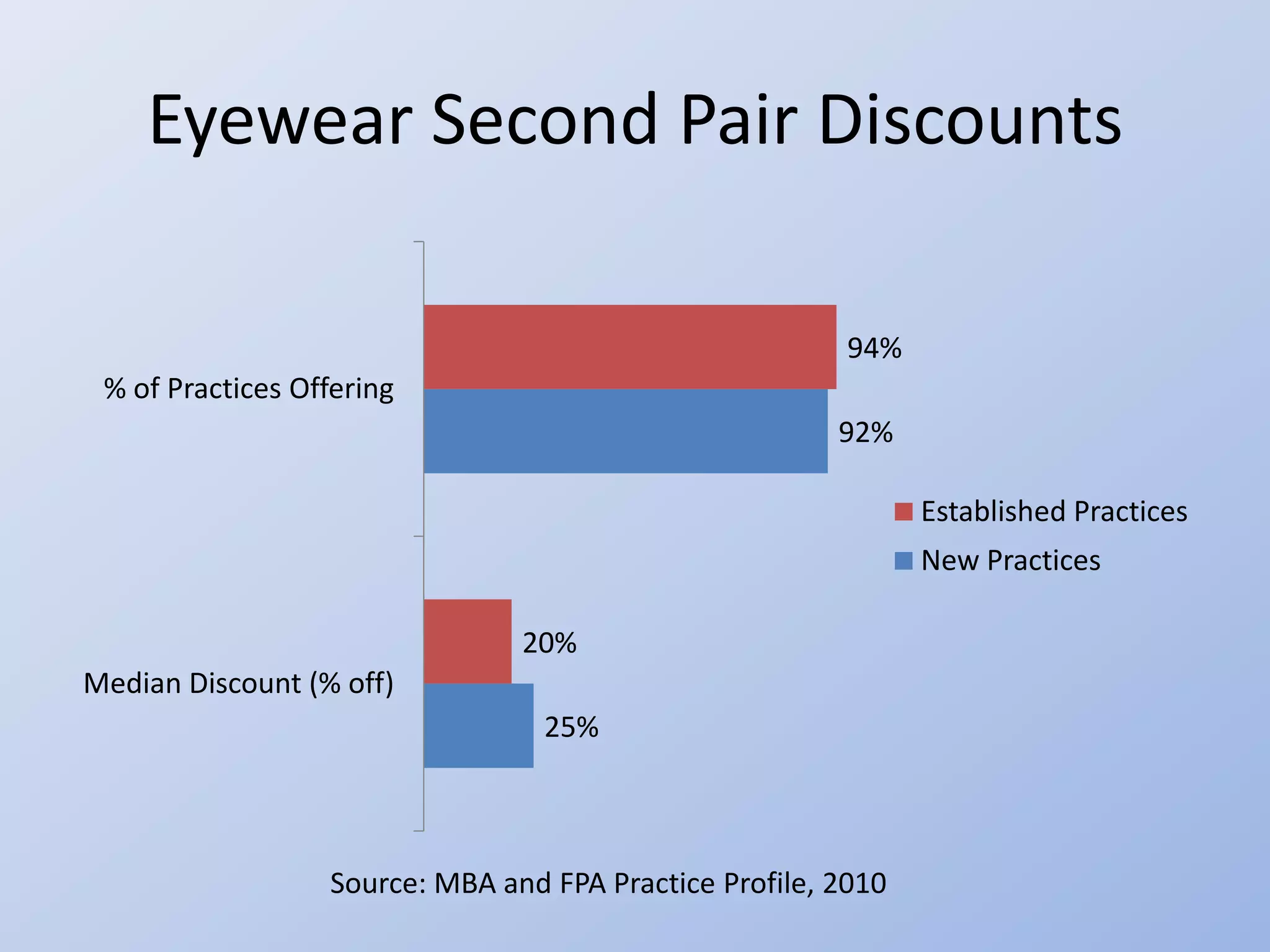
Eyewear Second Pair Discounts

                                                         94%
 % of Practices Offering
                                                        92%

                                                               Established Practices
                                                               New Practices

                                20%
Median Discount (% off)
                                  25%


                  Source: MBA and FPA Practice Profile, 2010
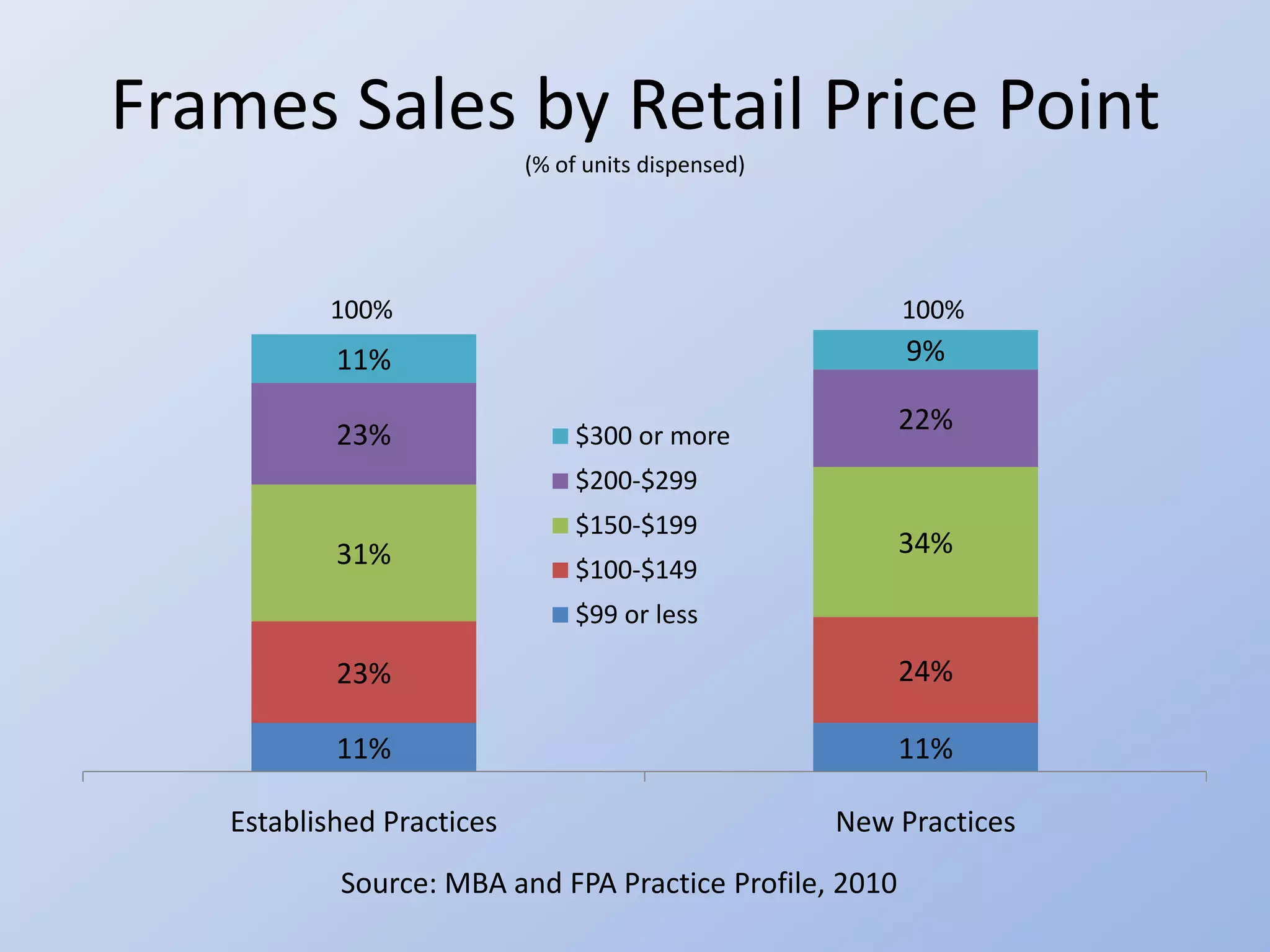
Frames Sales by Retail Price Point
                           (% of units dispensed)


          100%                                          100%
           11%                                           9%

           23%                  $300 or more
                                                        22%
                                $200-$299
                                $150-$199
           31%                                          34%
                                $100-$149
                                $99 or less

           23%                                          24%

           11%                                          11%

   Established Practices                            New Practices
           Source: MBA and FPA Practice Profile, 2010
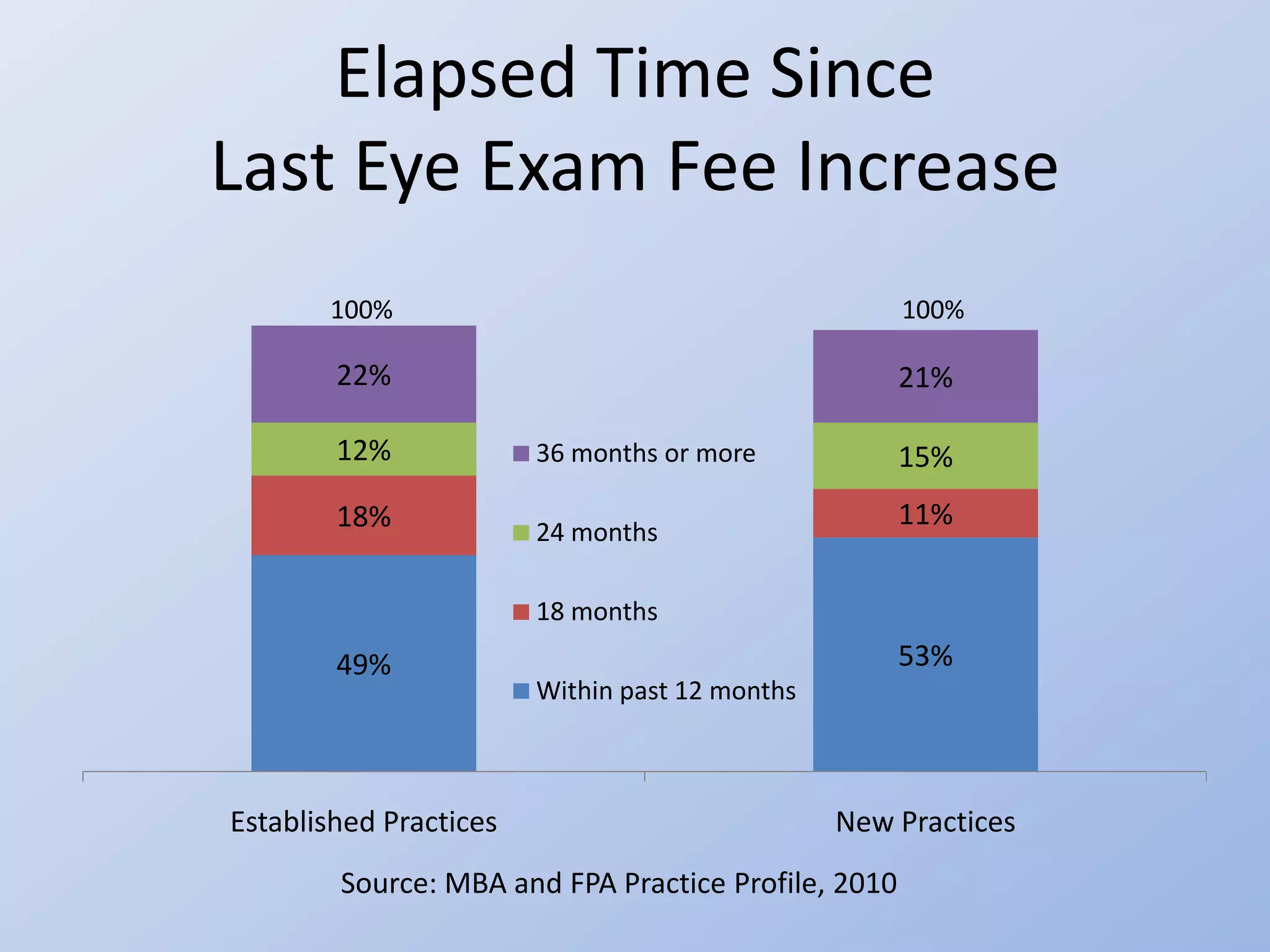
Elapsed Time Since
Last Eye Exam Fee Increase
       100%                                          100%

        22%                                          21%

        12%             36 months or more            15%
        18%                                          11%
                        24 months

                        18 months
        49%                                          53%
                        Within past 12 months


Established Practices                           New Practices
        Source: MBA and FPA Practice Profile, 2010
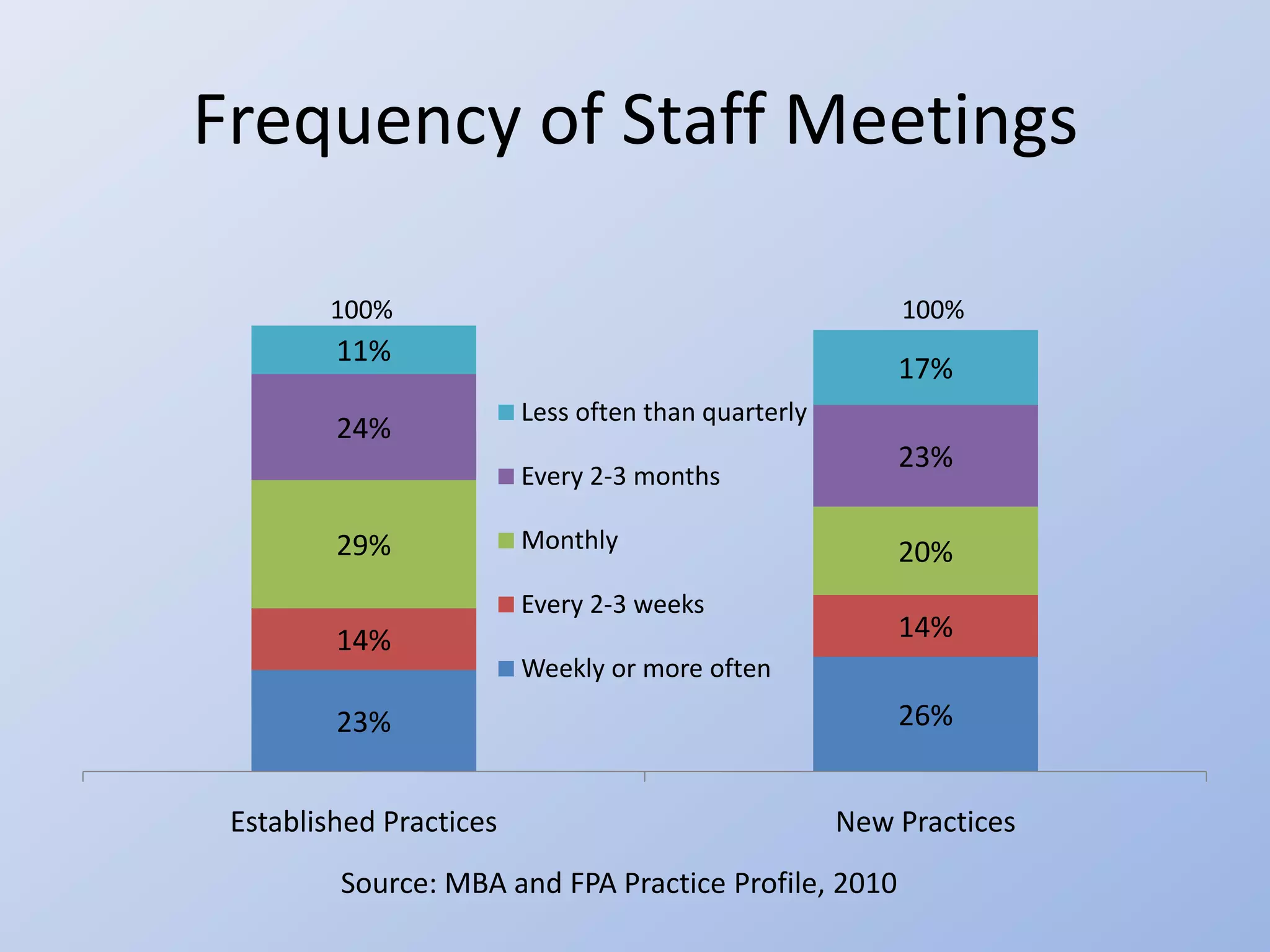
Frequency of Staff Meetings

        100%                                             100%
         11%
                                                         17%
                         Less often than quarterly
         24%
                                                         23%
                         Every 2-3 months

         29%             Monthly                         20%
                         Every 2-3 weeks
         14%                                             14%
                         Weekly or more often
         23%                                             26%


 Established Practices                               New Practices
         Source: MBA and FPA Practice Profile, 2010
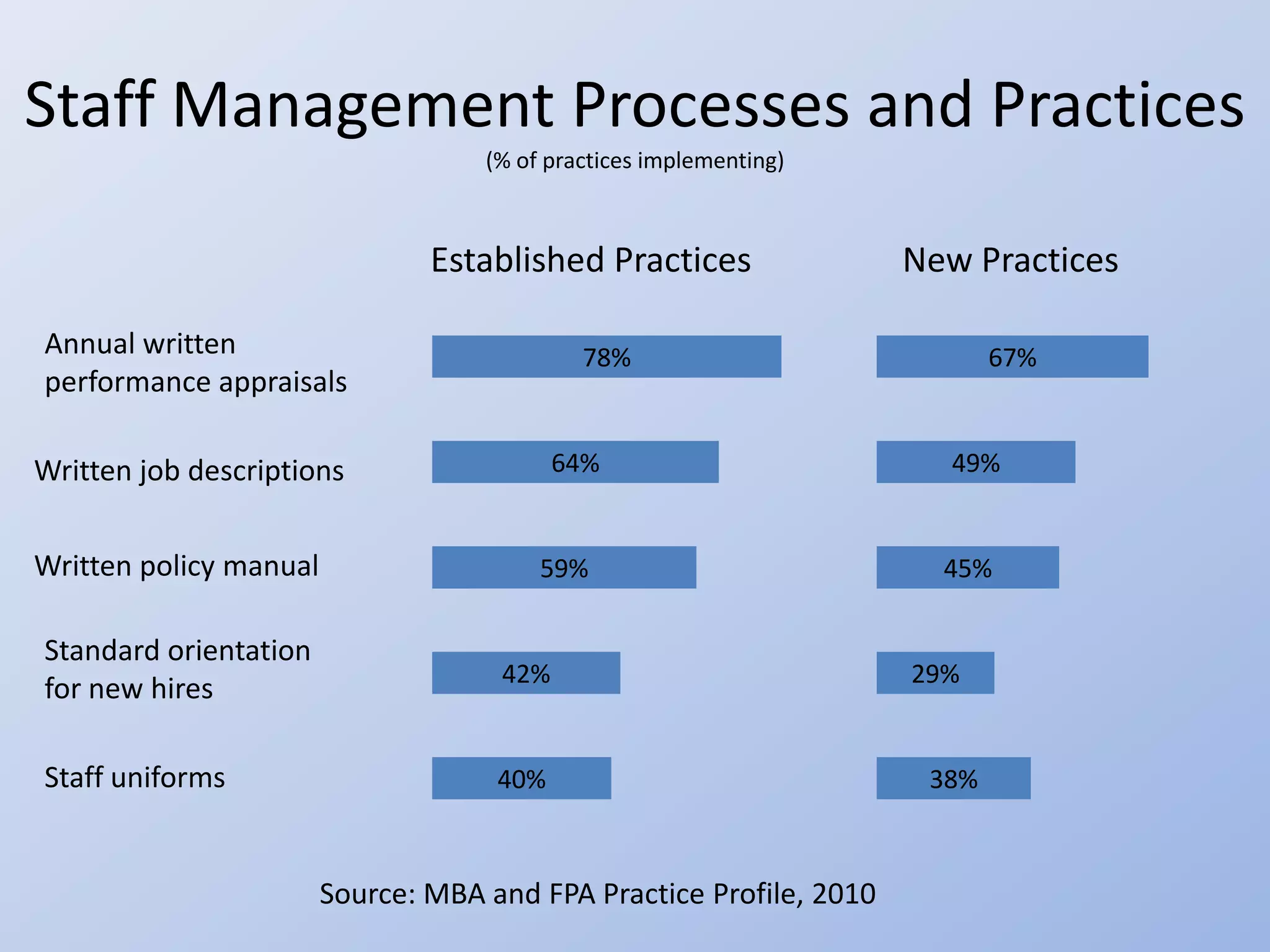
Staff Management Processes and Practices
                                    (% of practices implementing)


                                Established Practices                New Practices

Annual written                               78%                            67%
performance appraisals

Written job descriptions                   64%                         49%


Written policy manual                    59%                           45%

Standard orientation
                                     42%                             29%
for new hires

Staff uniforms                       40%                              38%


                        Source: MBA and FPA Practice Profile, 2010
Financial Management Processes and Procedures
                                     (% of practices implementing)


                                  Established Practices              New Practices

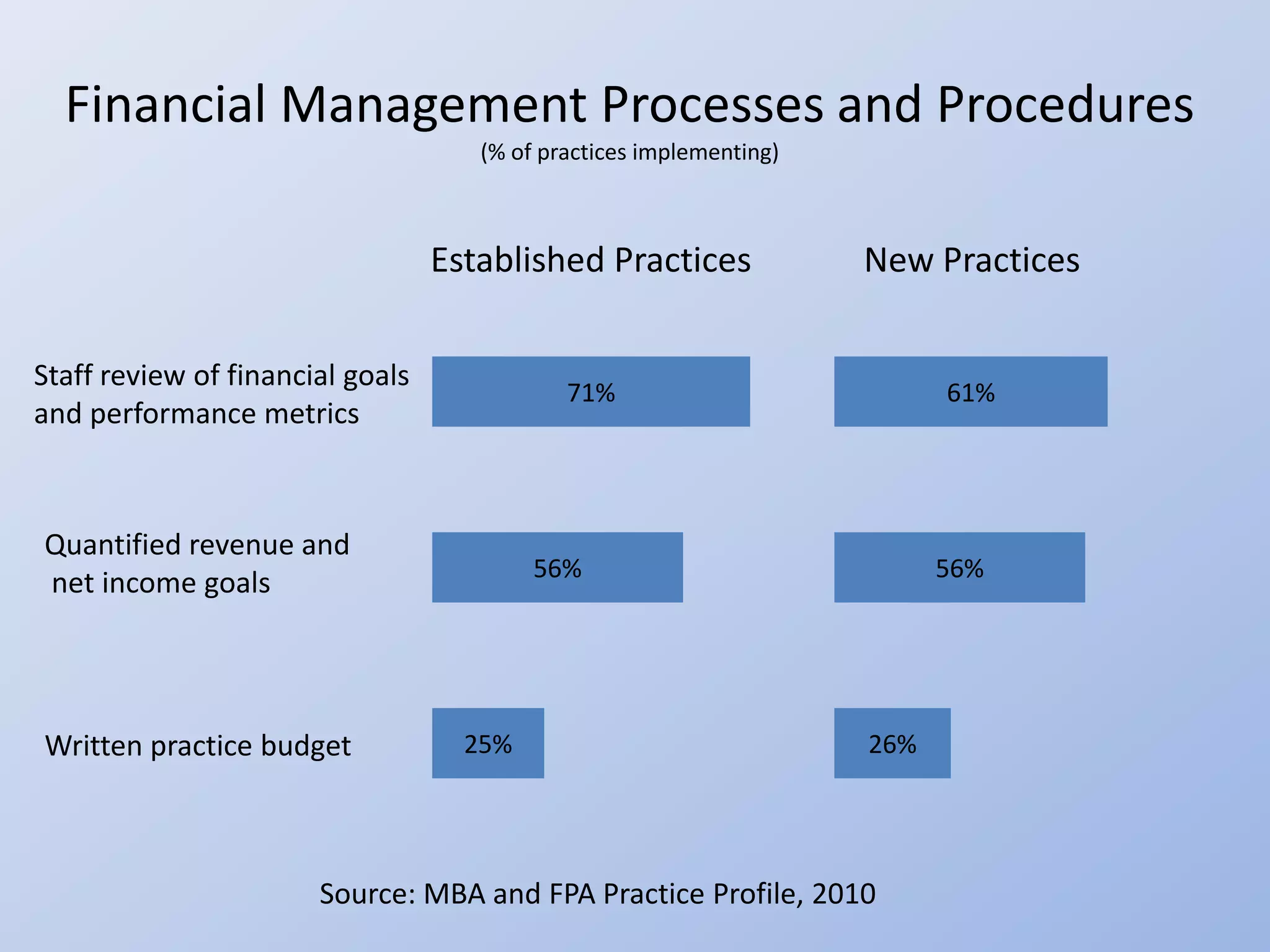
Staff review of financial goals
                                             71%                           61%
and performance metrics


Quantified revenue and
                                          56%                              56%
net income goals


Written practice budget             25%                              26%


                       Source: MBA and FPA Practice Profile, 2010
Marketing Management Processes and Procedures
                                      (% of practice implementing)


                                  Established Practices              New Practices

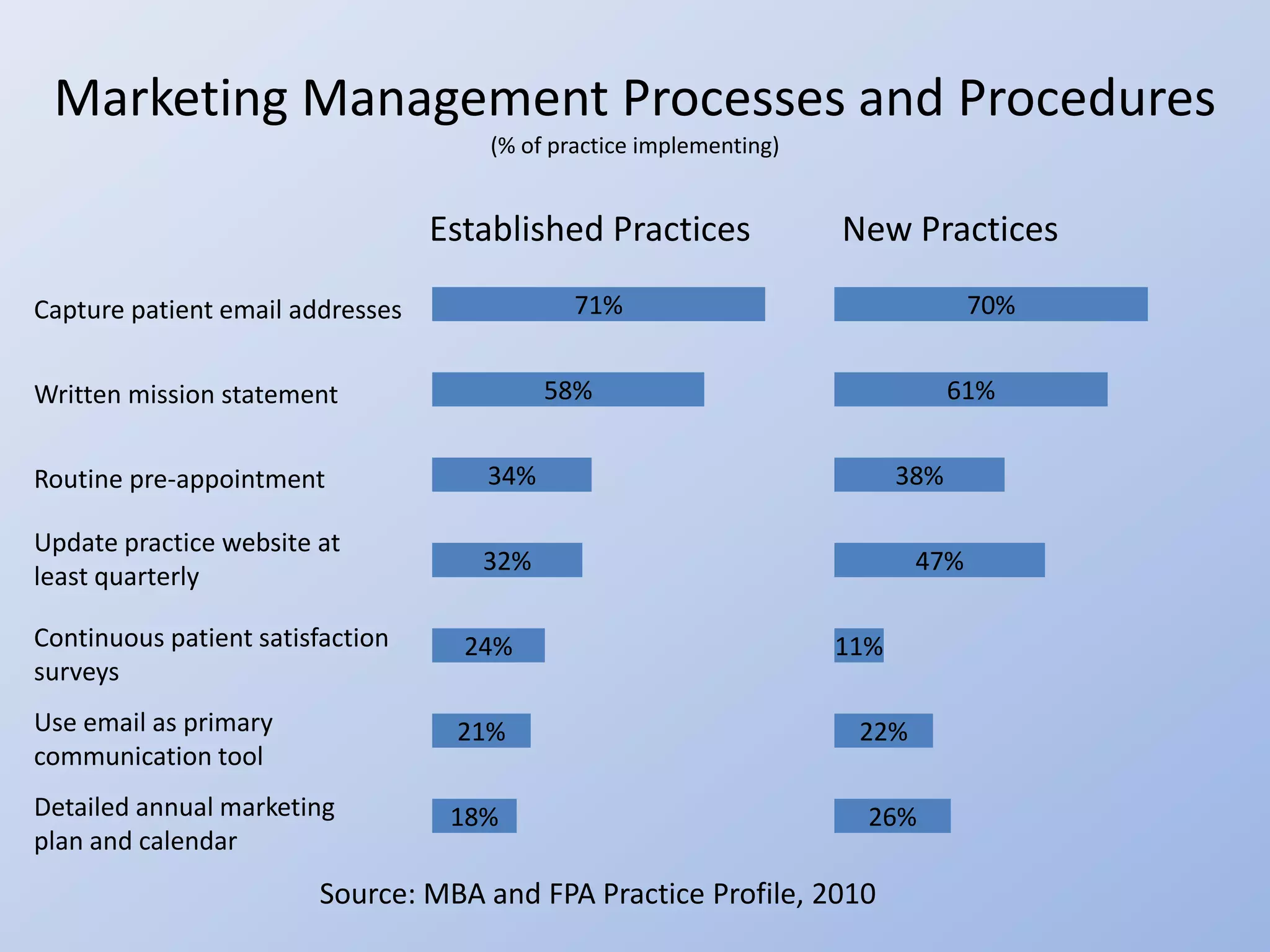
Capture patient email addresses               71%                                 70%


Written mission statement                  58%                                   61%


Routine pre-appointment              34%                                   38%

Update practice website at
                                     32%                                    47%
least quarterly

Continuous patient satisfaction     24%                              11%
surveys
Use email as primary               21%                                22%
communication tool
Detailed annual marketing          18%                                 26%
plan and calendar
                        Source: MBA and FPA Practice Profile, 2010
Source of New Patients
        100%                                         100%


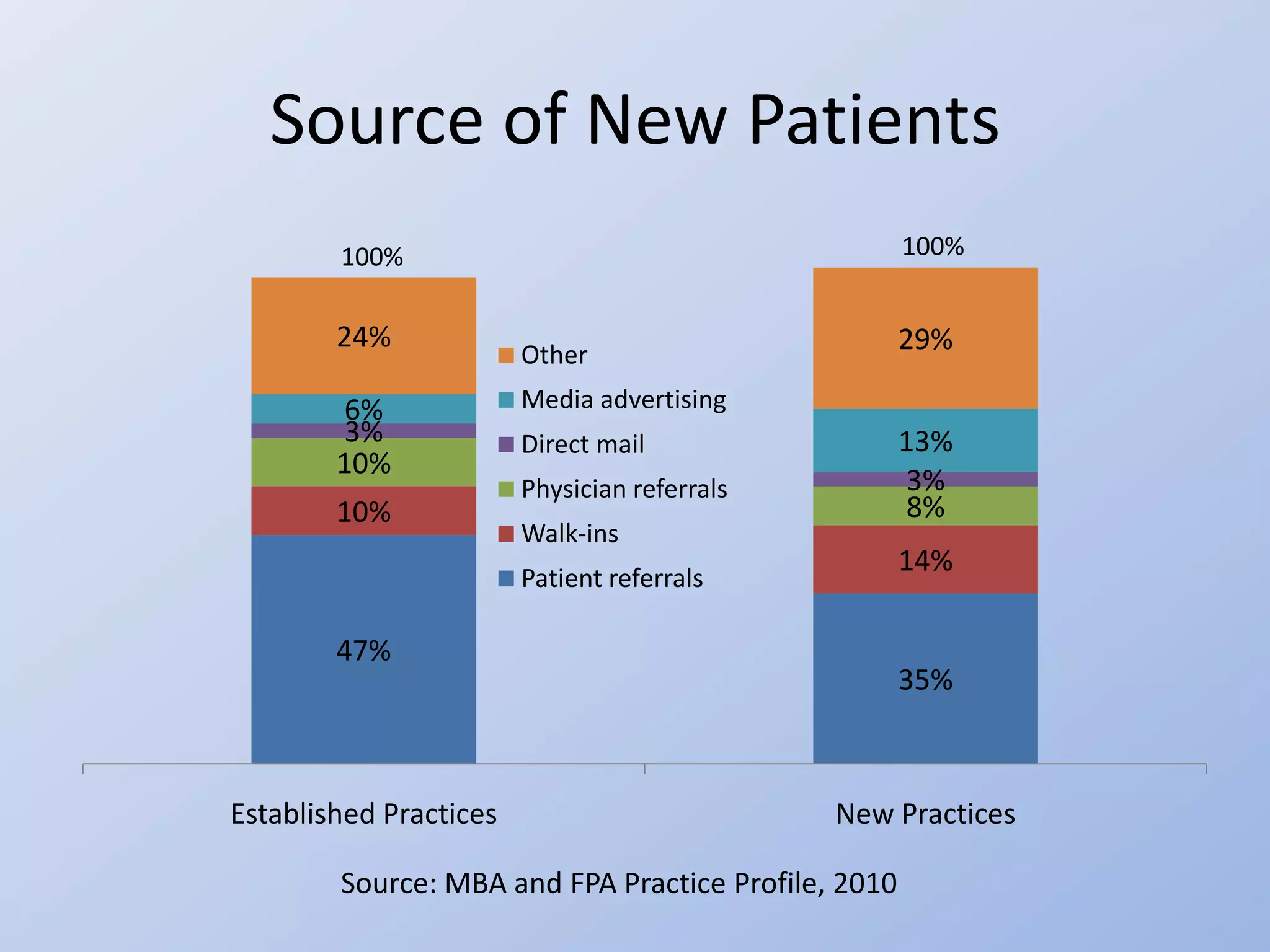
        24%                                          29%
                        Other
         6%             Media advertising
         3%             Direct mail                  13%
        10%
                        Physician referrals           3%
        10%                                           8%
                        Walk-ins
                                                     14%
                        Patient referrals

        47%
                                                     35%


Established Practices                         New Practices

        Source: MBA and FPA Practice Profile, 2010
Soft Lens Annual Supply Sales
                      (% of patients purchasing annual supply during exam visit)


                              Established Practices                       New Practices


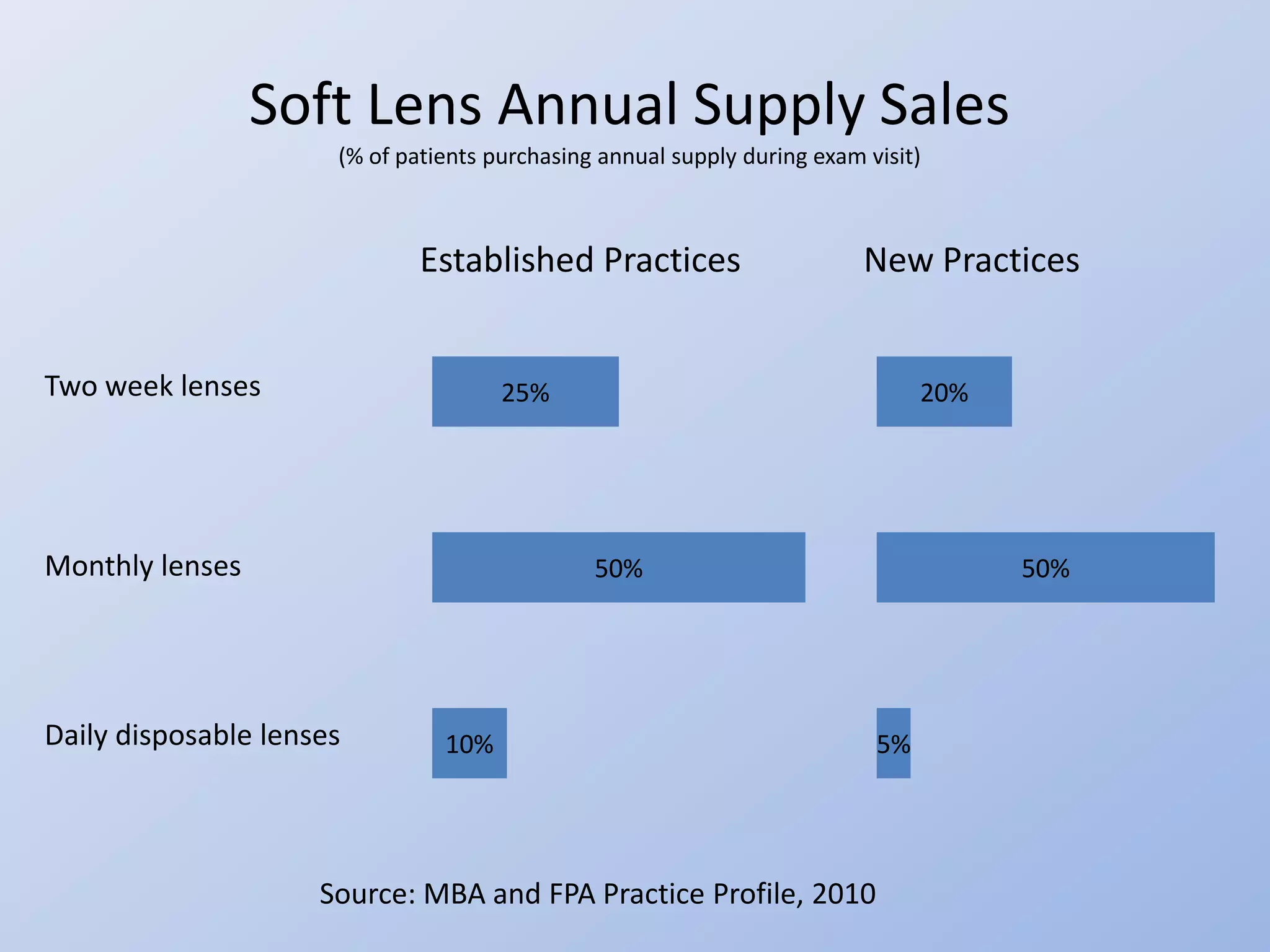
Two week lenses                       25%                                       20%


Monthly lenses                                 50%                                    50%


Daily disposable lenses         10%                                        5%


                     Source: MBA and FPA Practice Profile, 2010
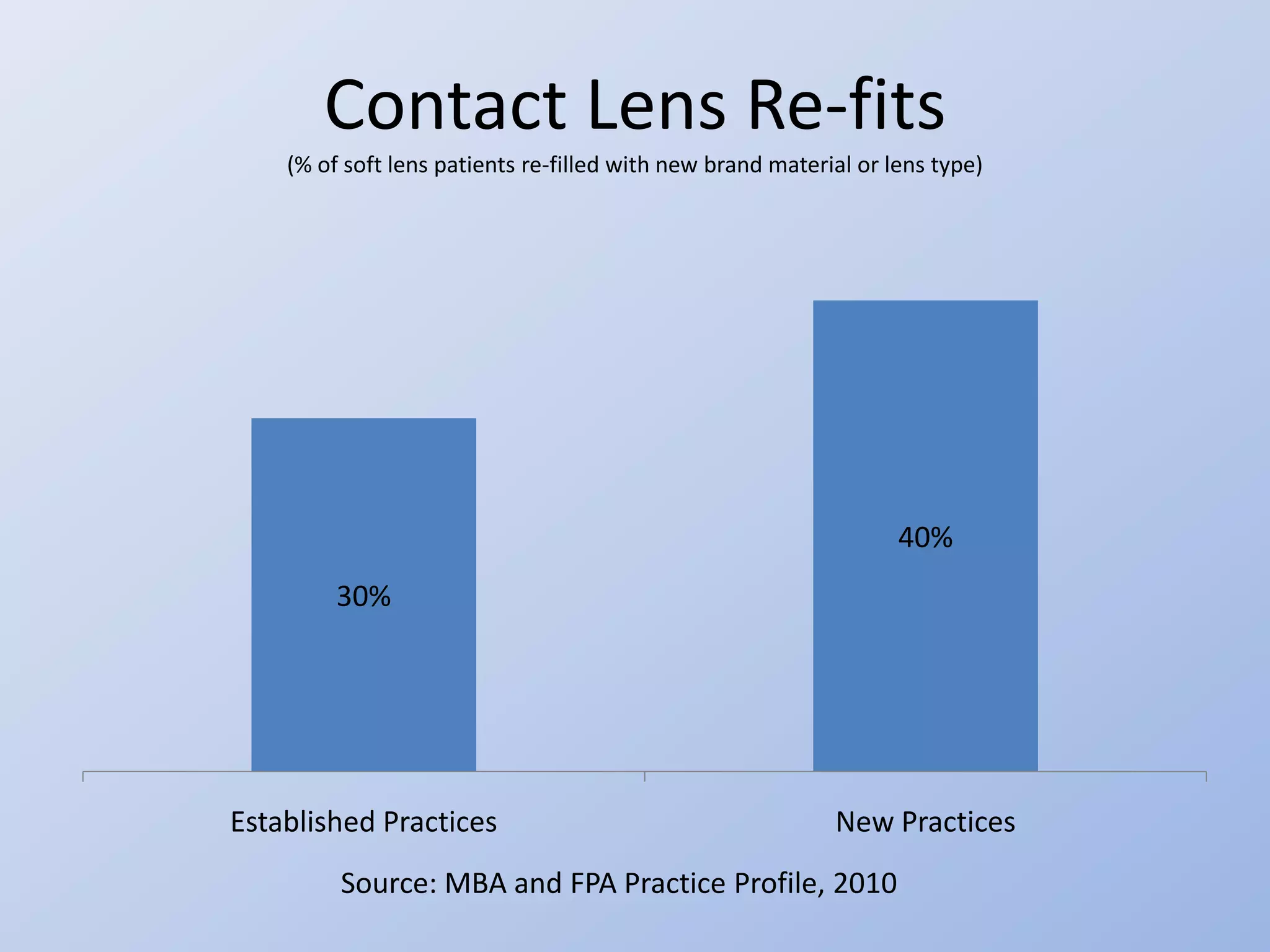
Contact Lens Re-fits
    (% of soft lens patients re-filled with new brand material or lens type)


                                                                   40%
         30%


Established Practices                                       New Practices
         Source: MBA and FPA Practice Profile, 2010
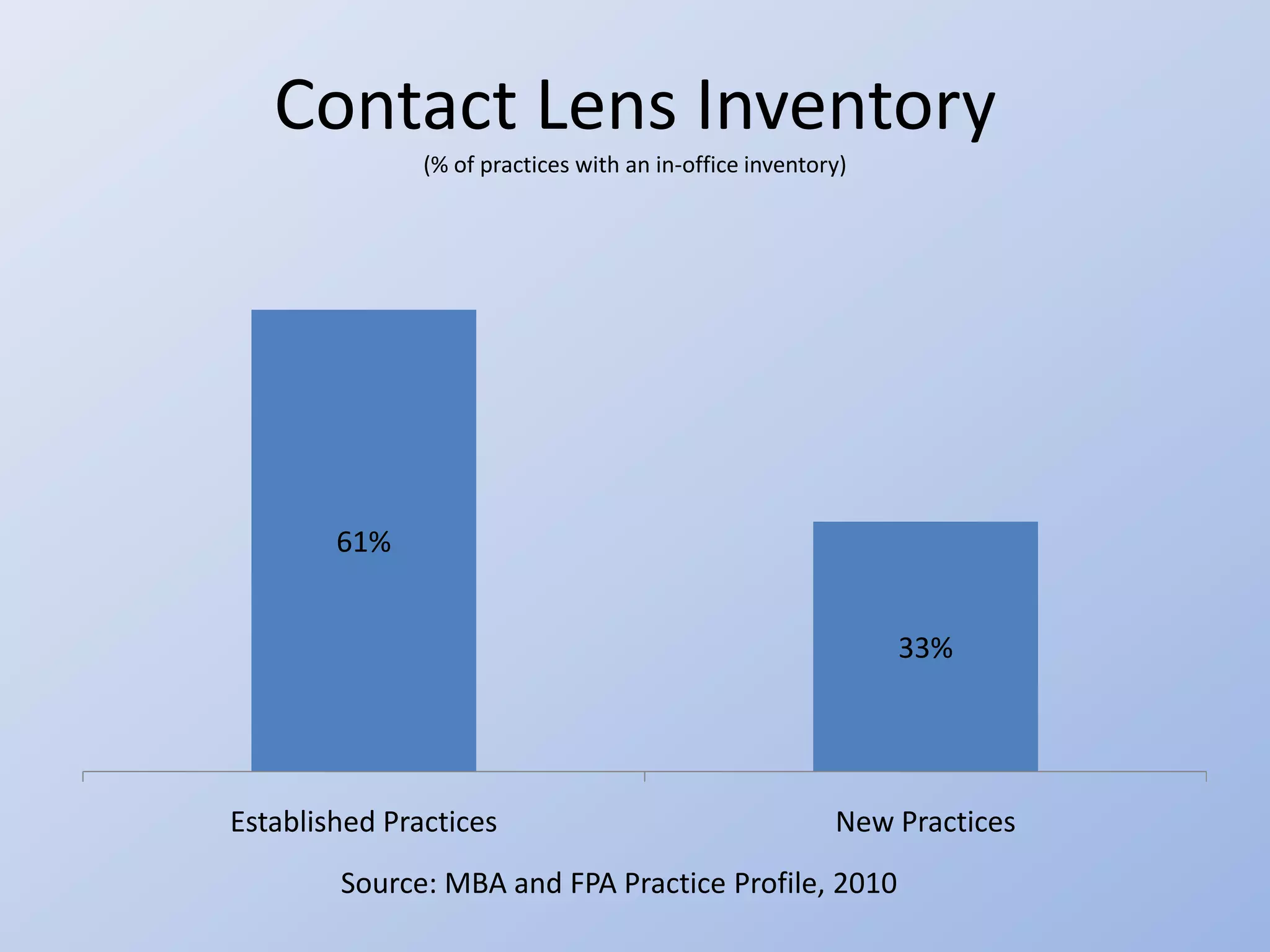
Contact Lens Inventory
               (% of practices with an in-office inventory)


        61%


                                                              33%


Established Practices                                    New Practices
        Source: MBA and FPA Practice Profile, 2010
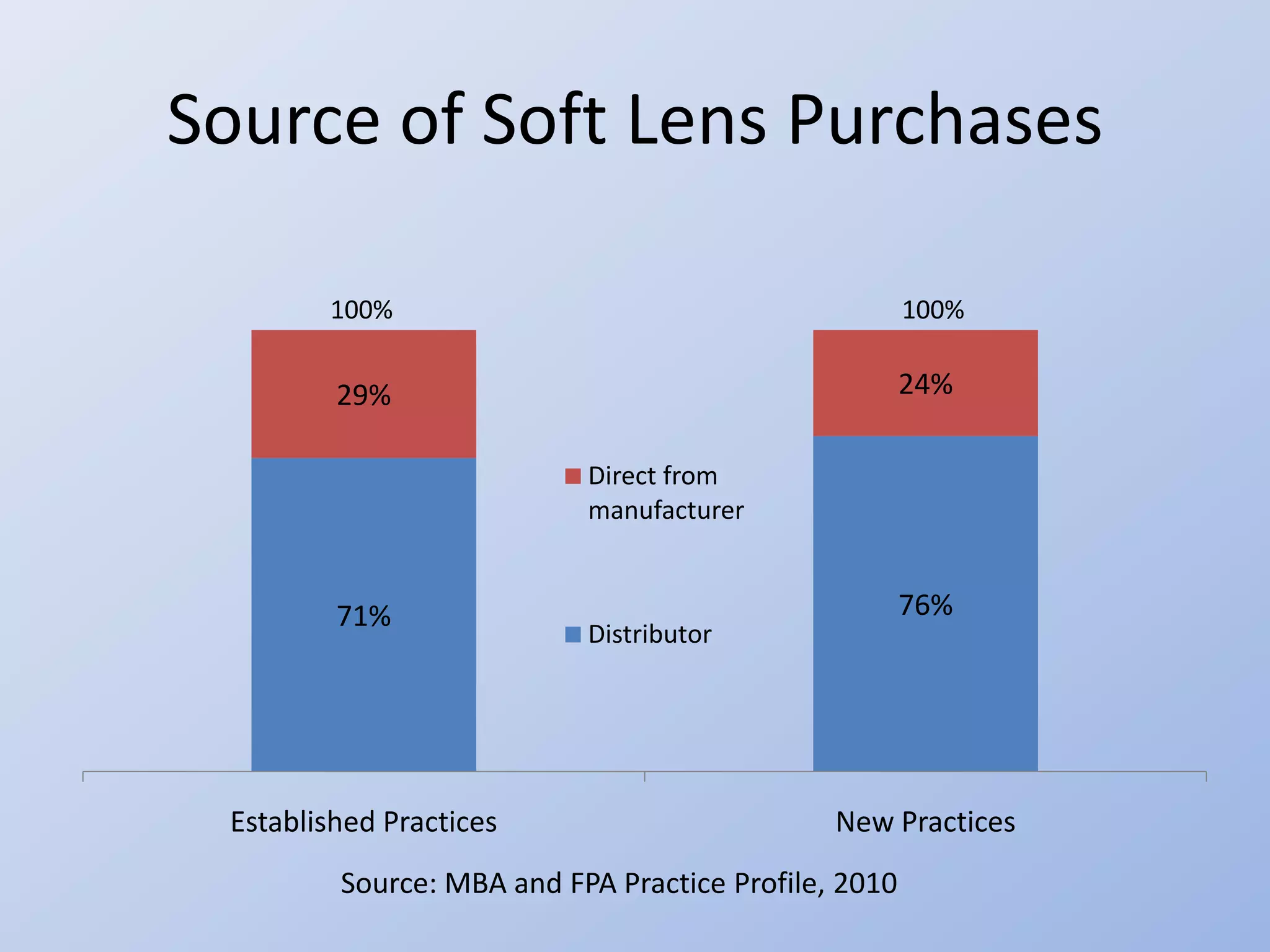
Source of Soft Lens Purchases

        100%                                          100%


         29%                                          24%

                           Direct from
                           manufacturer


         71%                                          76%
                           Distributor


 Established Practices                        New Practices
         Source: MBA and FPA Practice Profile, 2010
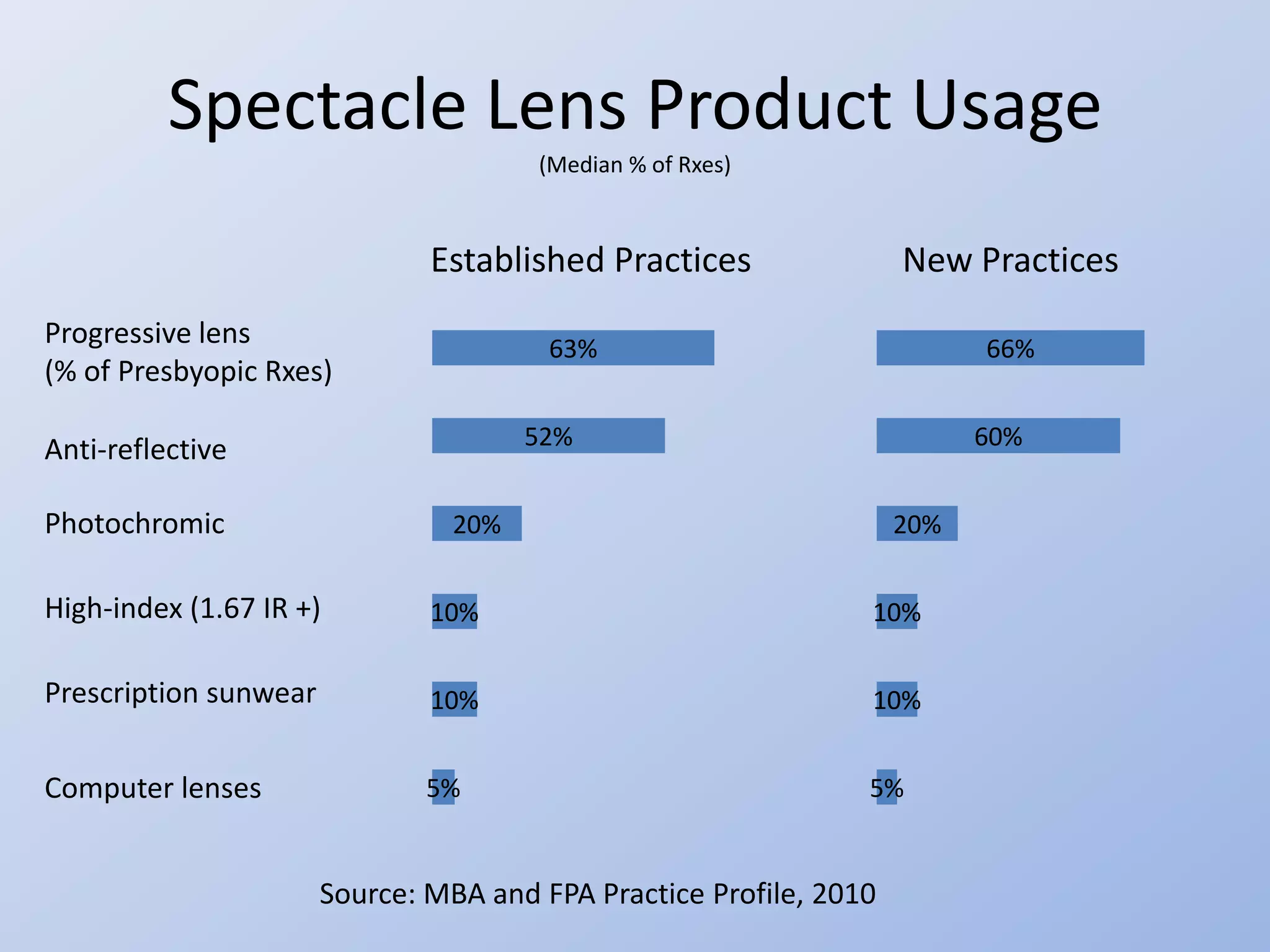
Spectacle Lens Product Usage
                                       (Median % of Rxes)


                               Established Practices                New Practices
Progressive lens                        63%                               66%
(% of Presbyopic Rxes)

Anti-reflective                        52%                                60%


Photochromic                     20%                                20%


High-index (1.67 IR +)         10%                              10%

Prescription sunwear           10%                              10%


Computer lenses                5%                               5%


                       Source: MBA and FPA Practice Profile, 2010
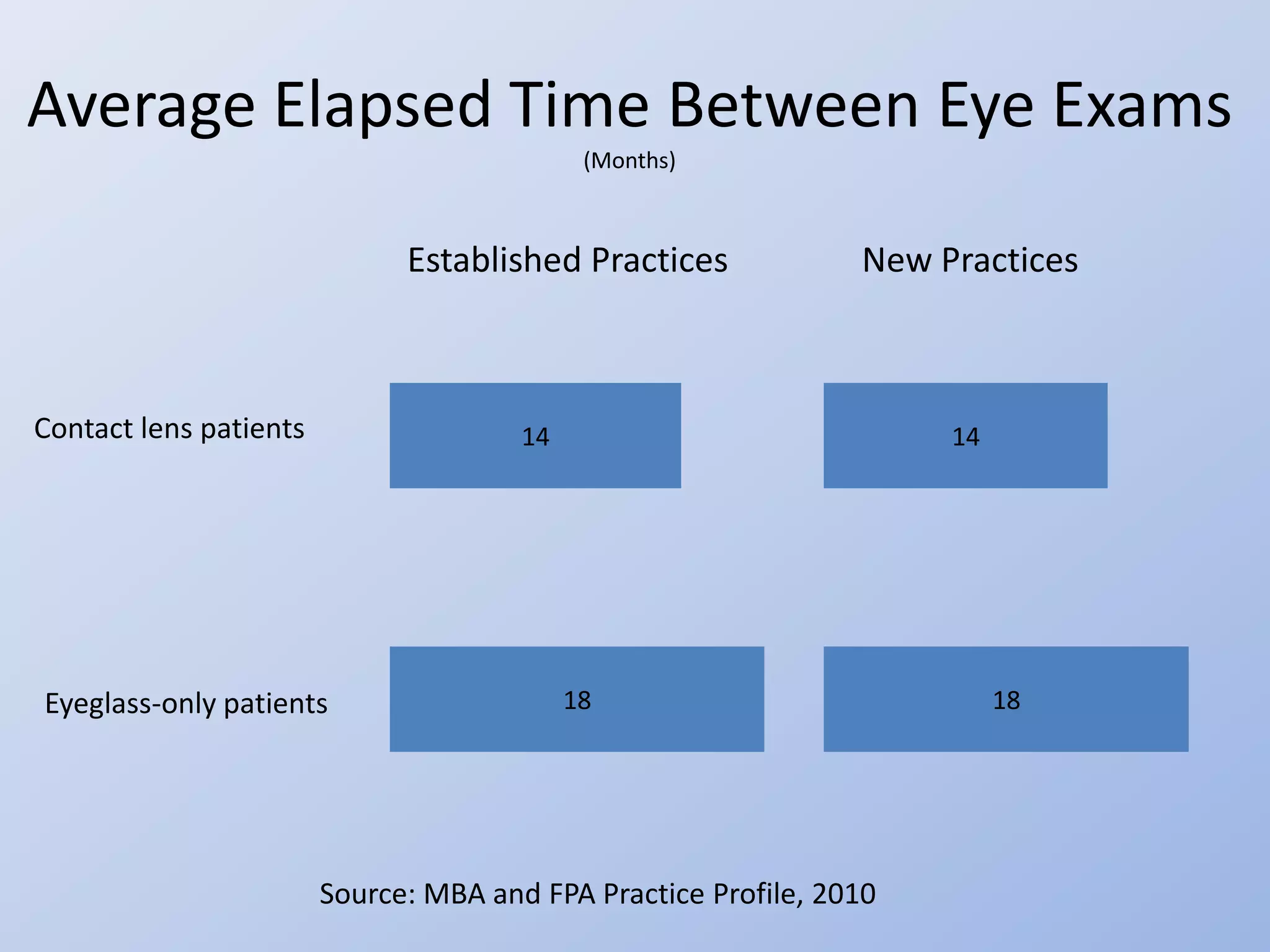
Average Elapsed Time Between Eye Exams
                                             (Months)


                              Established Practices             New Practices


Contact lens patients                  14                            14


Eyeglass-only patients                      18                            18


                        Source: MBA and FPA Practice Profile, 2010
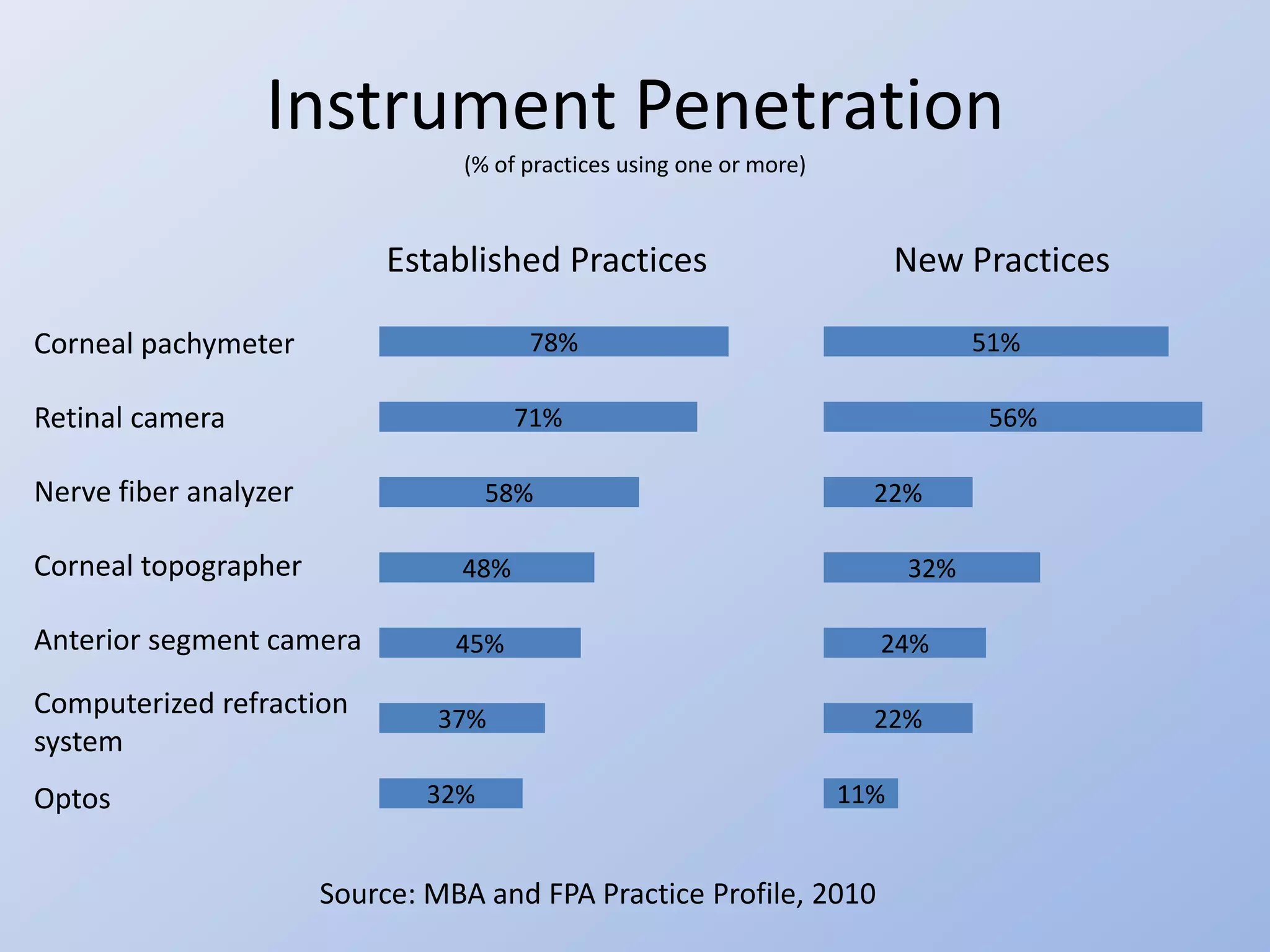
Instrument Penetration
                                 (% of practices using one or more)


                            Established Practices                           New Practices

Corneal pachymeter                     78%                                        51%

Retinal camera                         71%                                         56%

Nerve fiber analyzer                 58%                                22%

Corneal topographer              48%                                        32%

Anterior segment camera          45%                                    24%

Computerized refraction        37%                                      22%
system
Optos                          32%                                    11%


                       Source: MBA and FPA Practice Profile, 2010
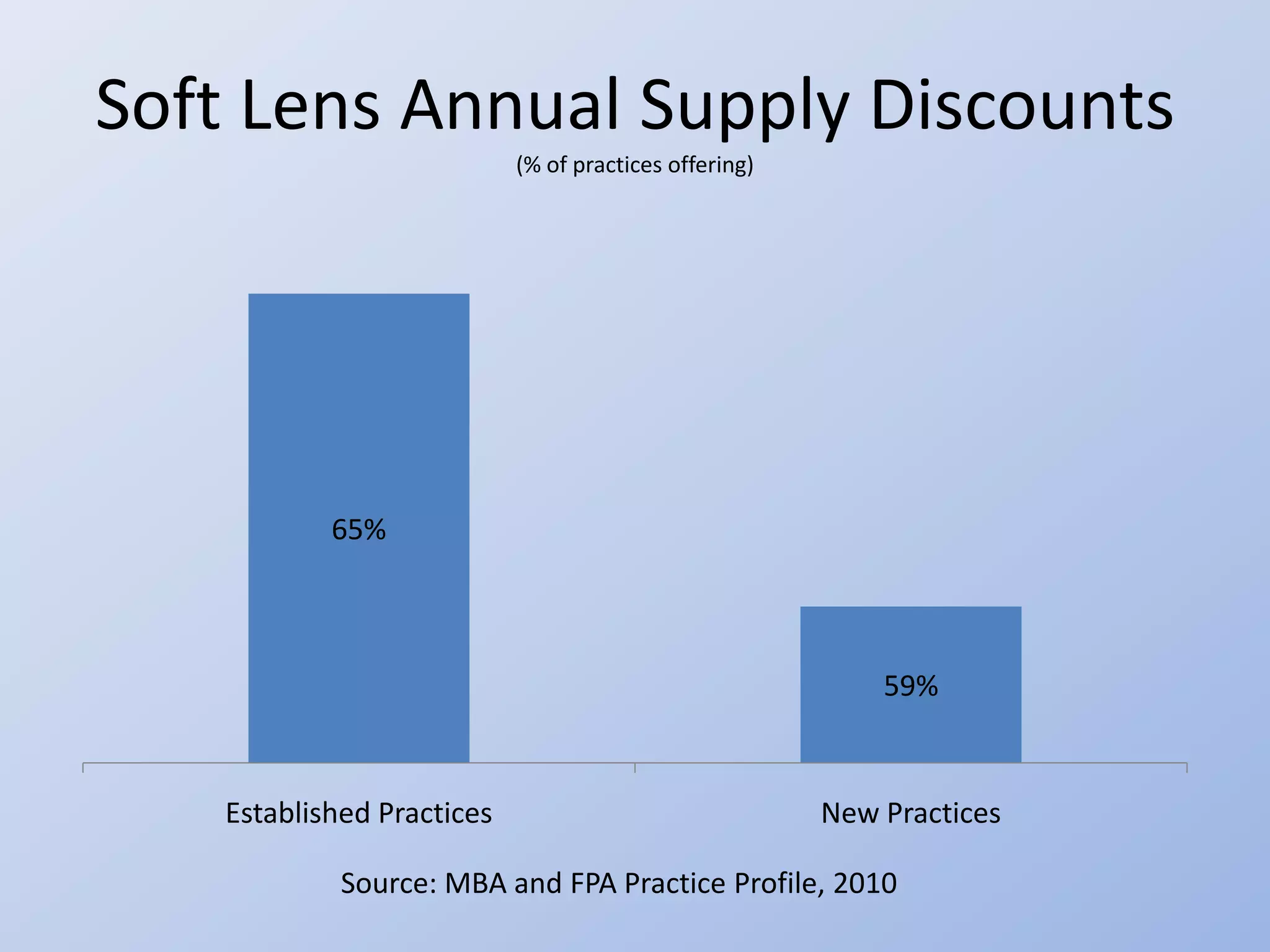
Soft Lens Annual Supply Discounts
                           (% of practices offering)


           65%


                                                           59%


   Established Practices                               New Practices

            Source: MBA and FPA Practice Profile, 2010
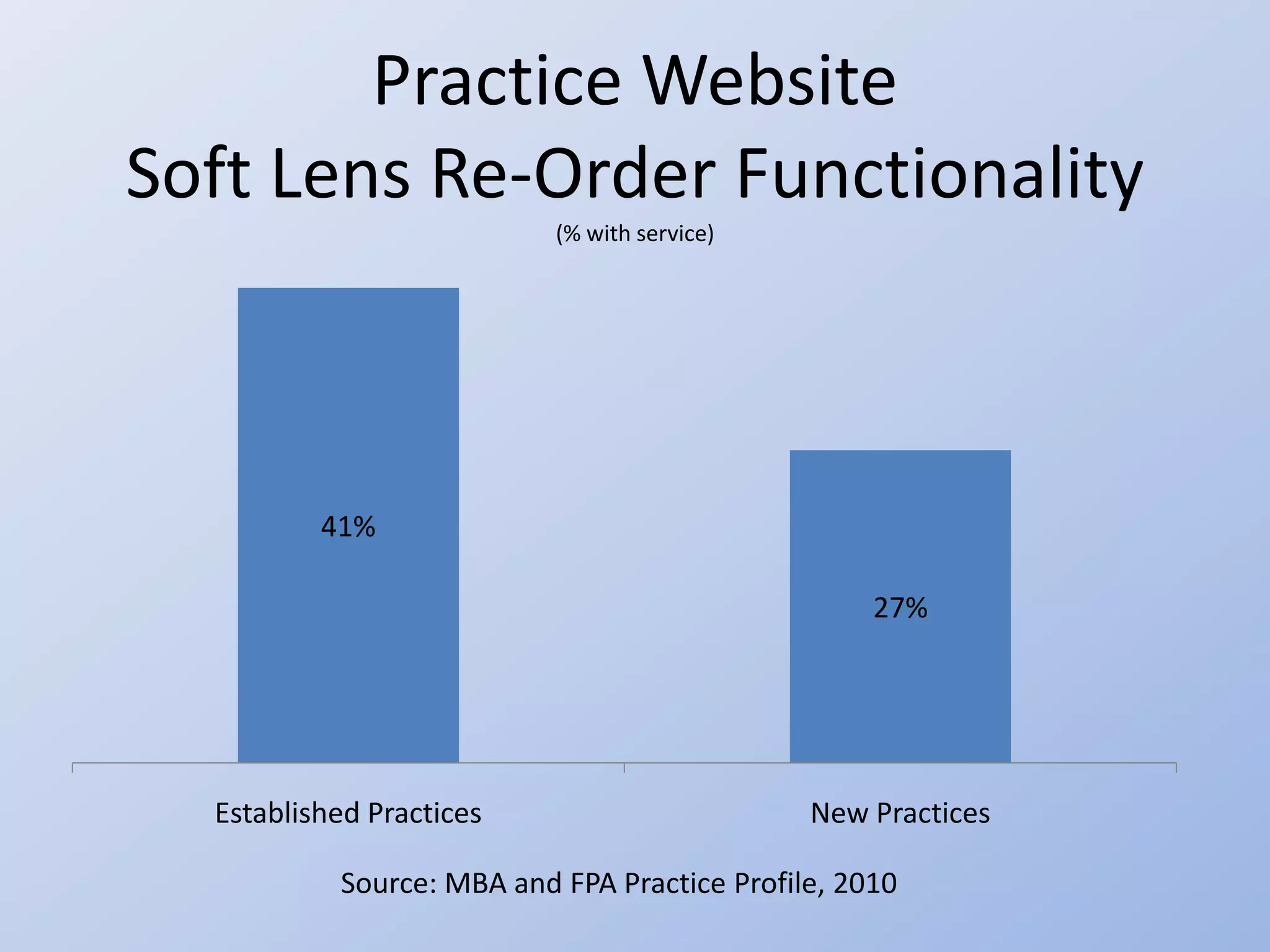
Practice Website
Soft Lens Re-Order Functionality
                           (% with service)


          41%

                                                   27%


  Established Practices                       New Practices

           Source: MBA and FPA Practice Profile, 2010
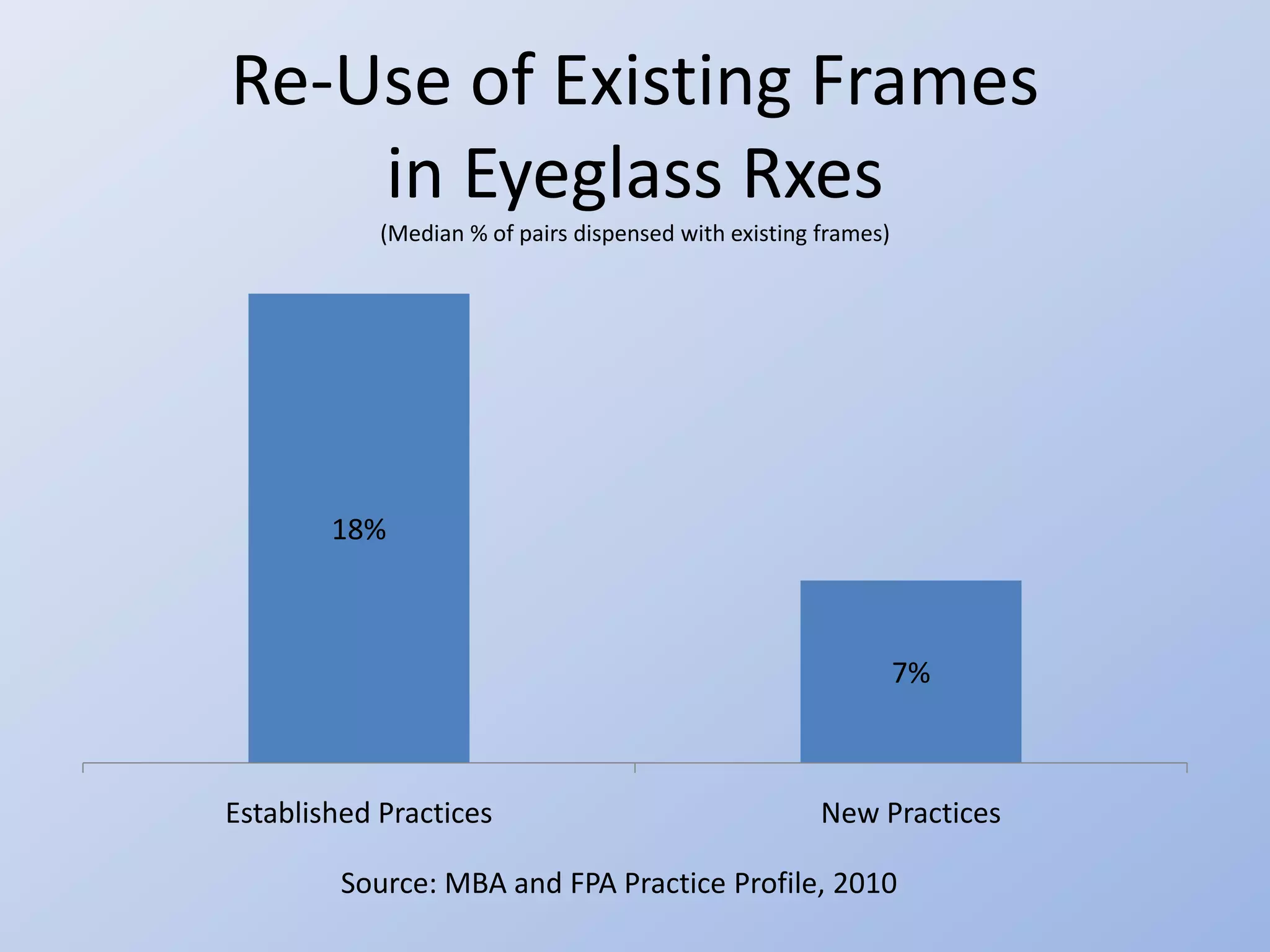
Re-Use of Existing Frames
    in Eyeglass Rxes
            (Median % of pairs dispensed with existing frames)


        18%


                                                                 7%


Established Practices                                  New Practices

         Source: MBA and FPA Practice Profile, 2010
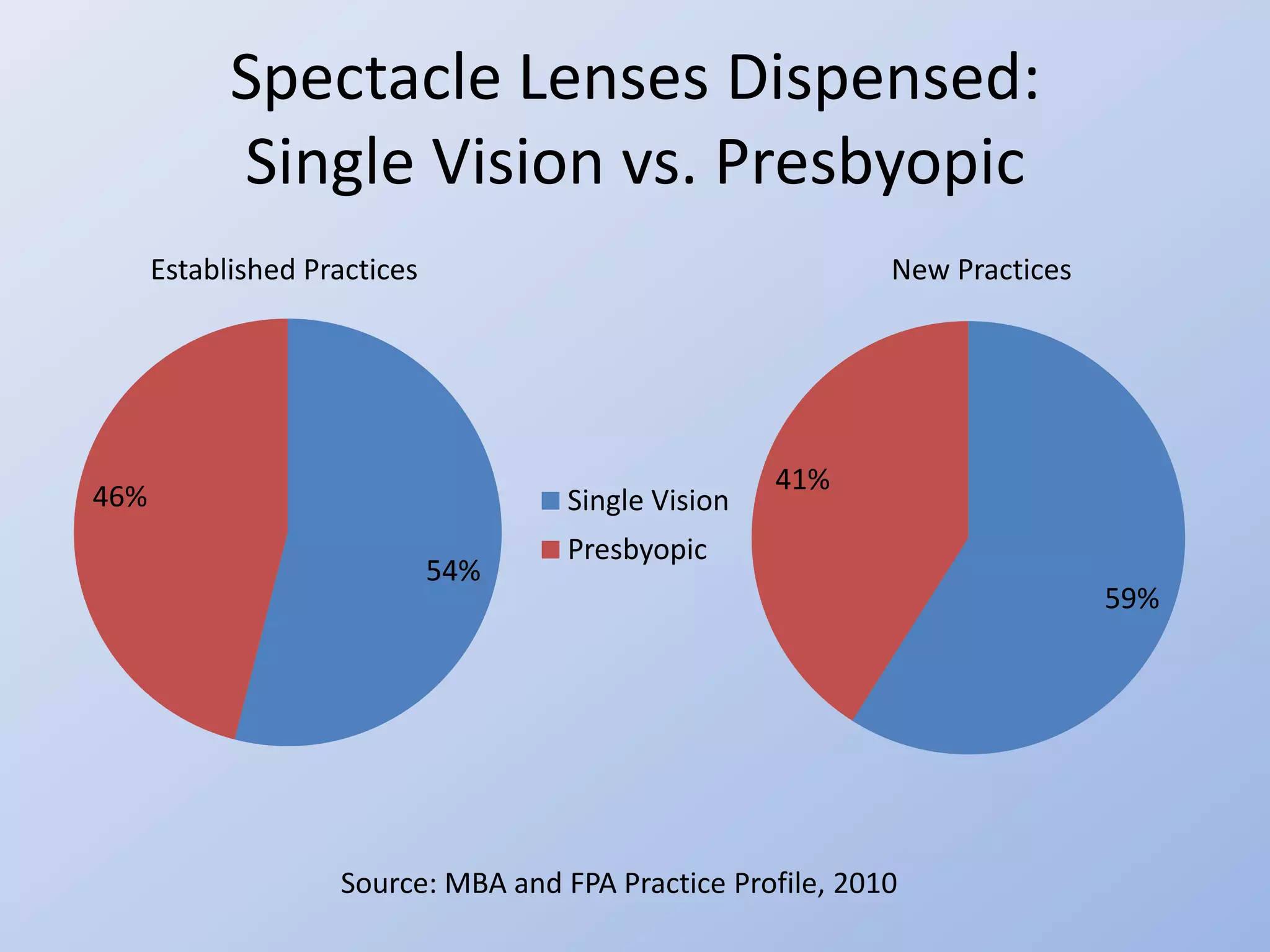
Spectacle Lenses Dispensed:
            Single Vision vs. Presbyopic
      Established Practices                                  New Practices


                                                     41%
46%                                  Single Vision
                                     Presbyopic
                              54%
                                                                             59%


                    Source: MBA and FPA Practice Profile, 2010
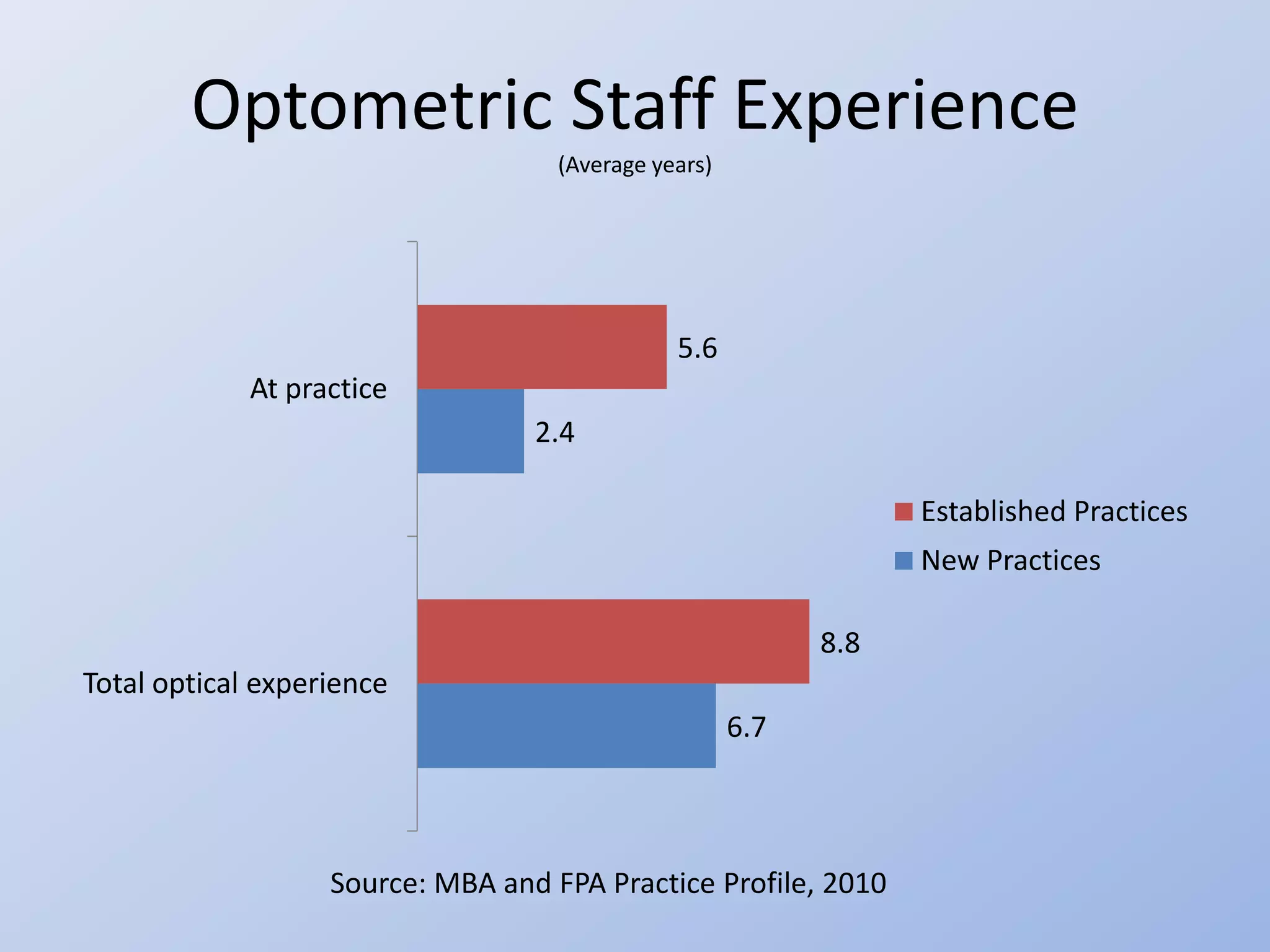
Optometric Staff Experience
                                    (Average years)


                                               5.6
             At practice
                                  2.4

                                                                  Established Practices
                                                                  New Practices

                                                            8.8
Total optical experience
                                                      6.7


                   Source: MBA and FPA Practice Profile, 2010
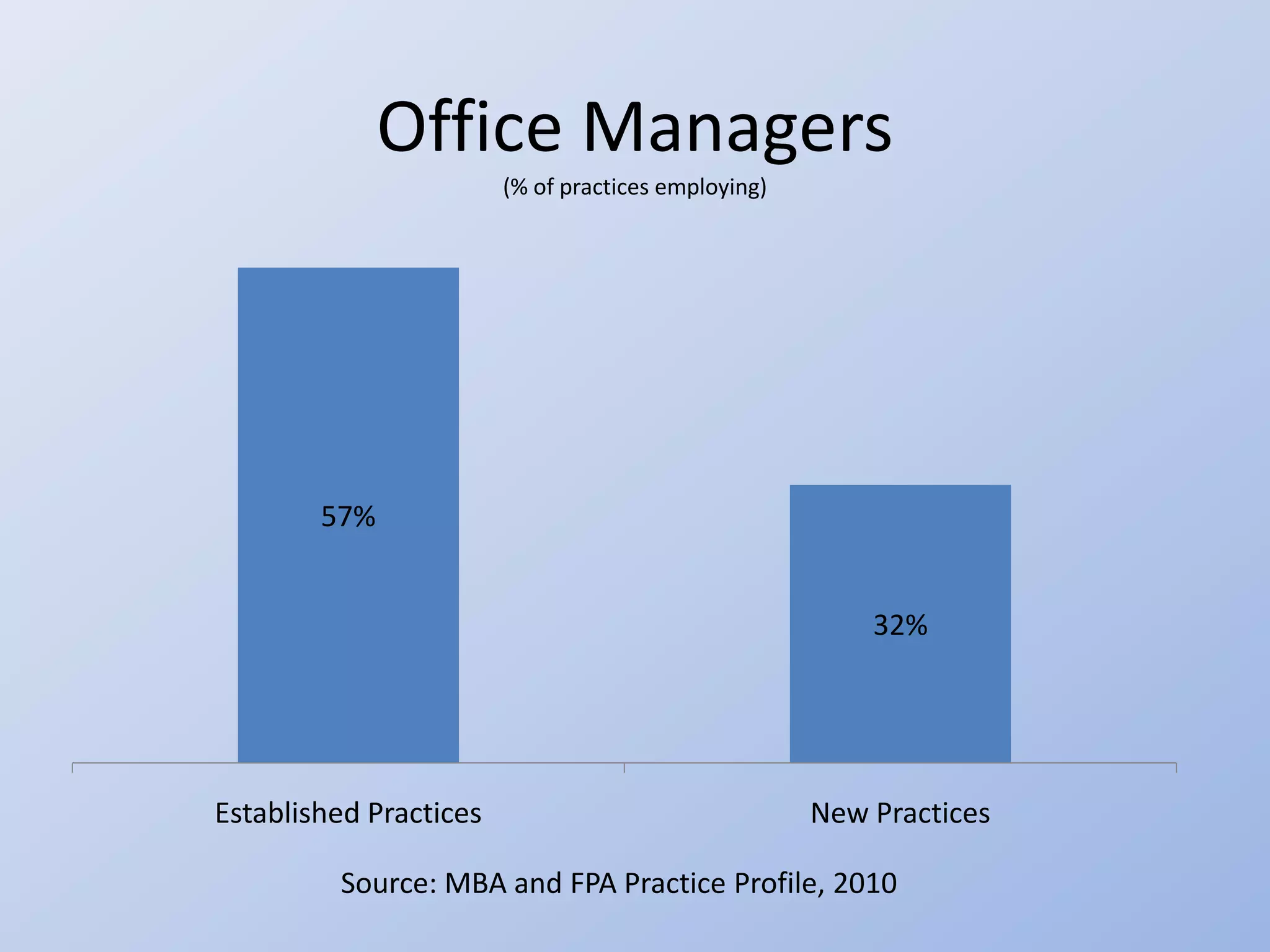
Office Managers
                        (% of practices employing)


        57%


                                                         32%


Established Practices                                New Practices

         Source: MBA and FPA Practice Profile, 2010
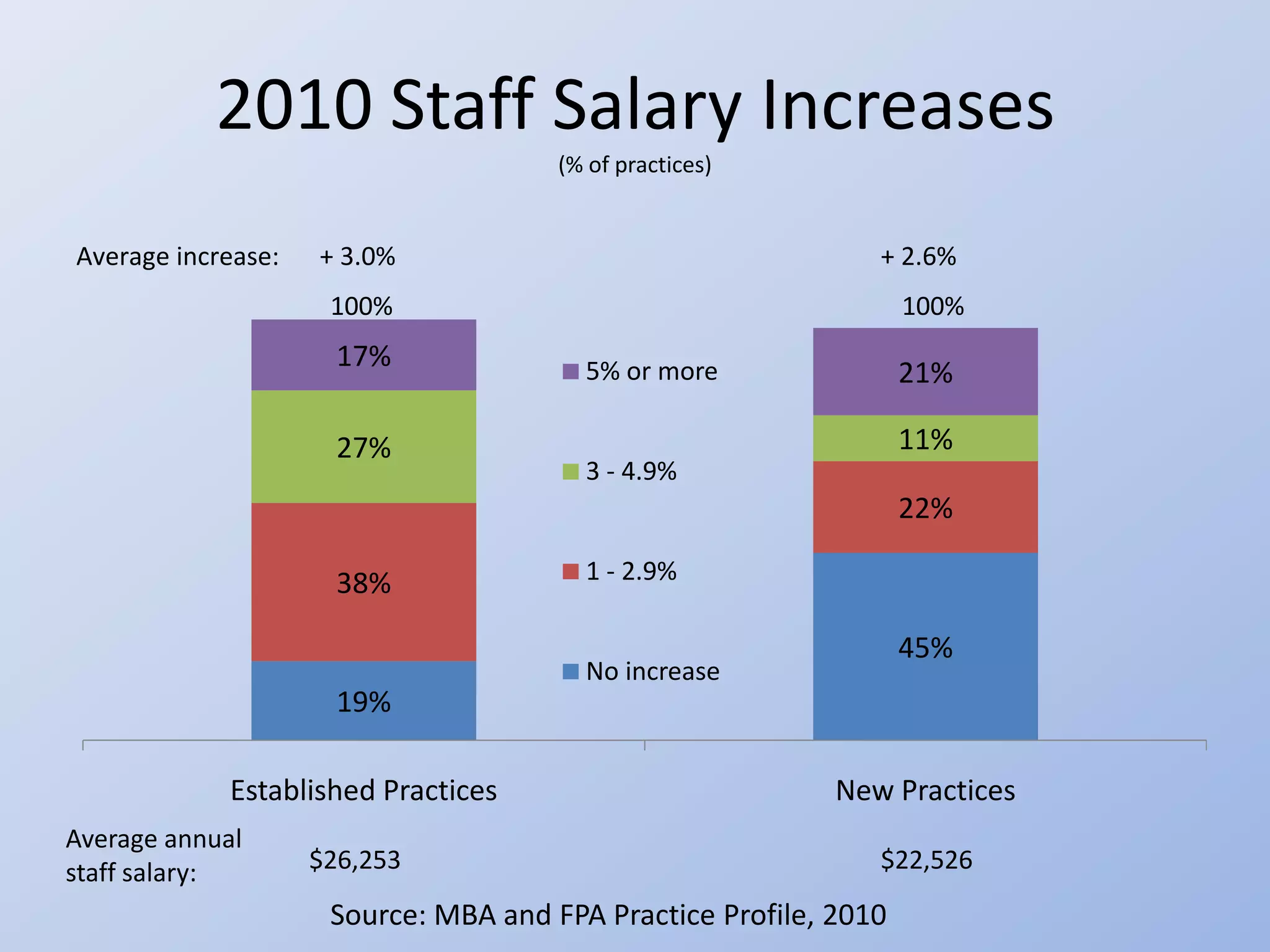
2010 Staff Salary Increases
                                      (% of practices)


Average increase:   + 3.0%                                    + 2.6%
                     100%                                         100%
                      17%               5% or more                21%

                      27%                                         11%
                                        3 - 4.9%
                                                                  22%

                      38%               1 - 2.9%

                                                                  45%
                                        No increase
                      19%

             Established Practices                         New Practices
Average annual
staff salary:       $26,253                                   $22,526
                     Source: MBA and FPA Practice Profile, 2010
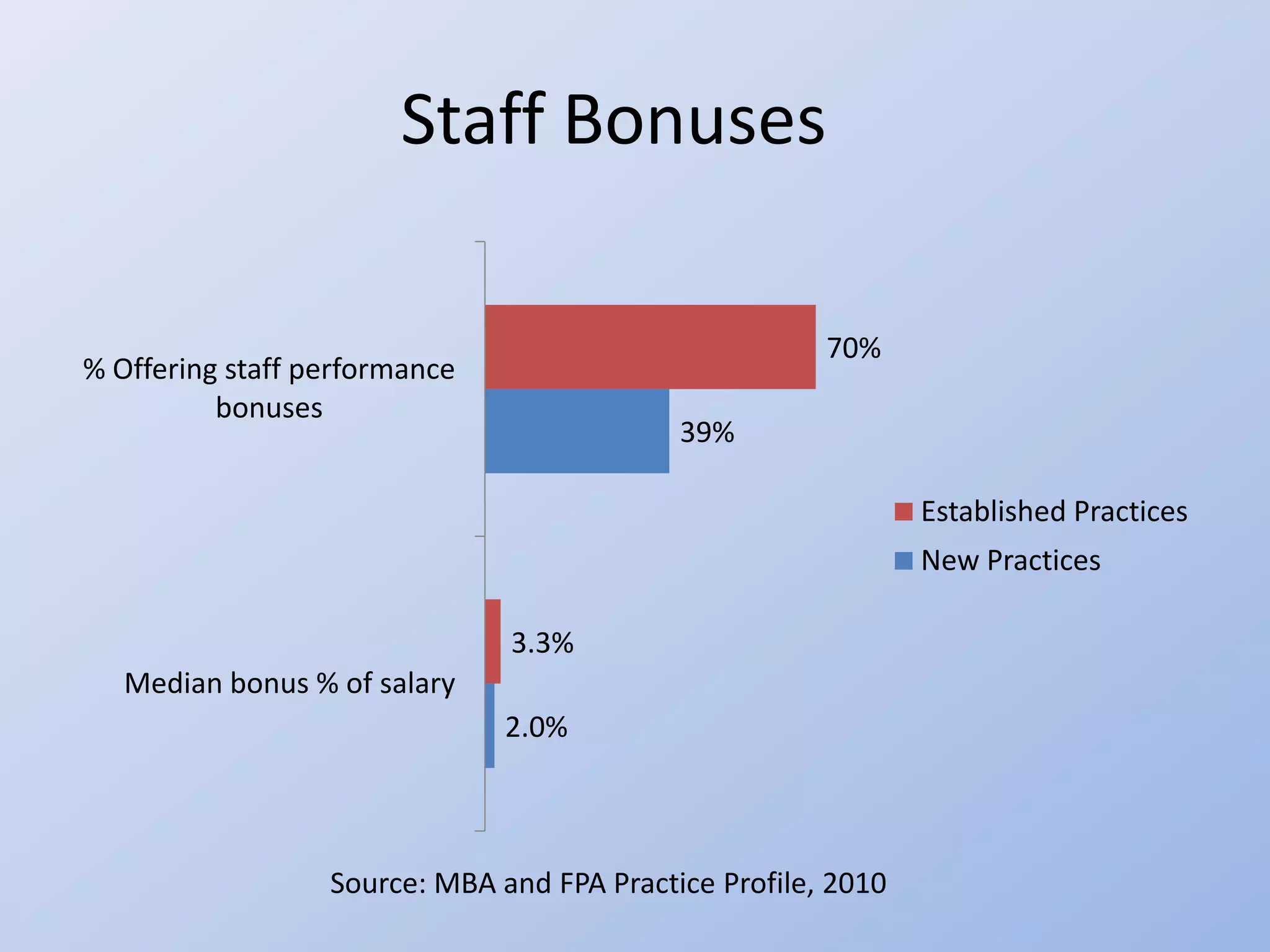
Staff Bonuses

                                                       70%
% Offering staff performance
          bonuses
                                            39%

                                                               Established Practices
                                                               New Practices

                               3.3%
   Median bonus % of salary
                               2.0%


                  Source: MBA and FPA Practice Profile, 2010
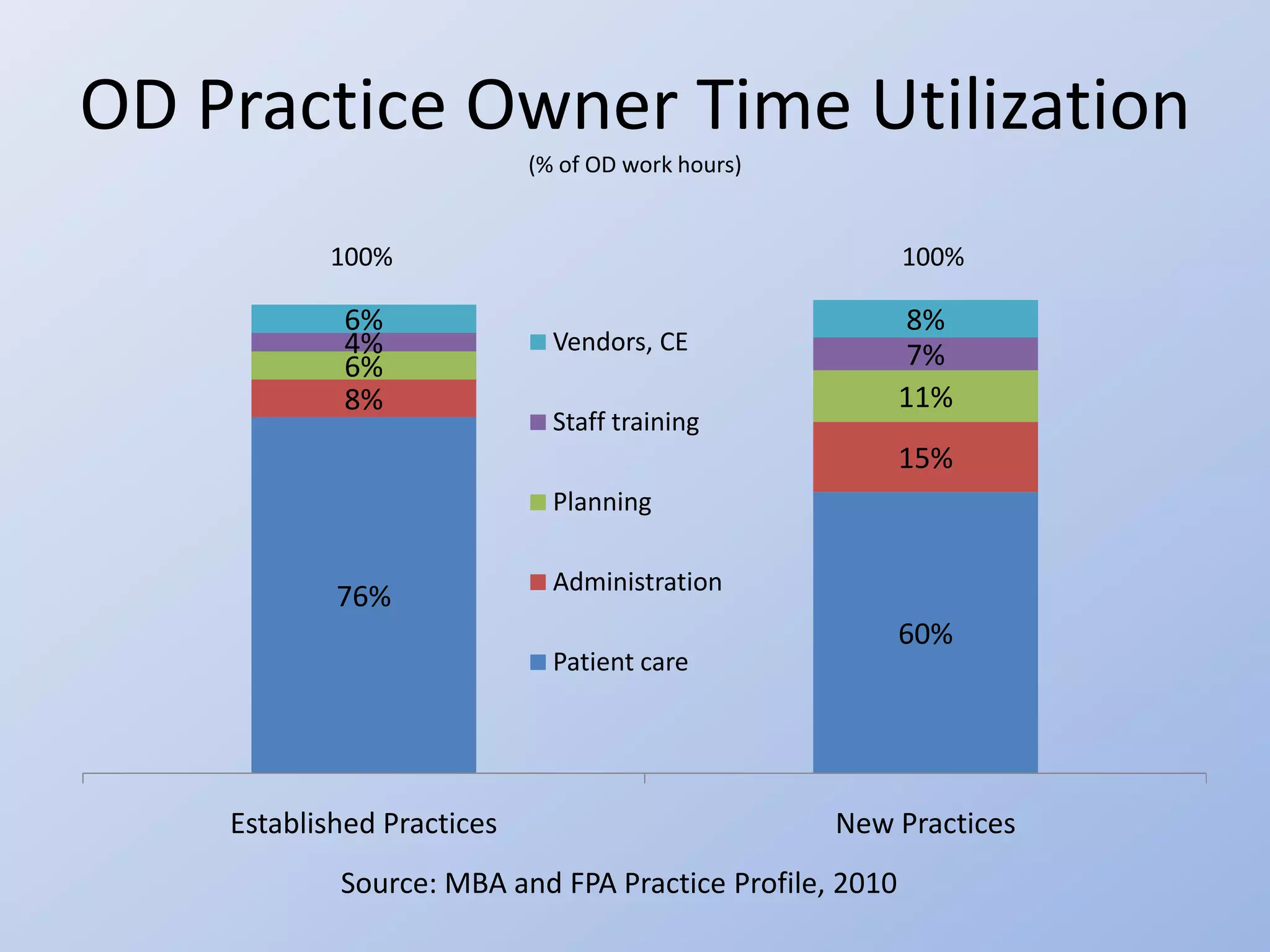
OD Practice Owner Time Utilization
                            (% of OD work hours)


           100%                                          100%

            6%                                            8%
            4%                Vendors, CE
            6%                                            7%
            8%                                           11%
                              Staff training
                                                         15%
                              Planning

                              Administration
            76%
                                                         60%
                              Patient care


    Established Practices                          New Practices
            Source: MBA and FPA Practice Profile, 2010
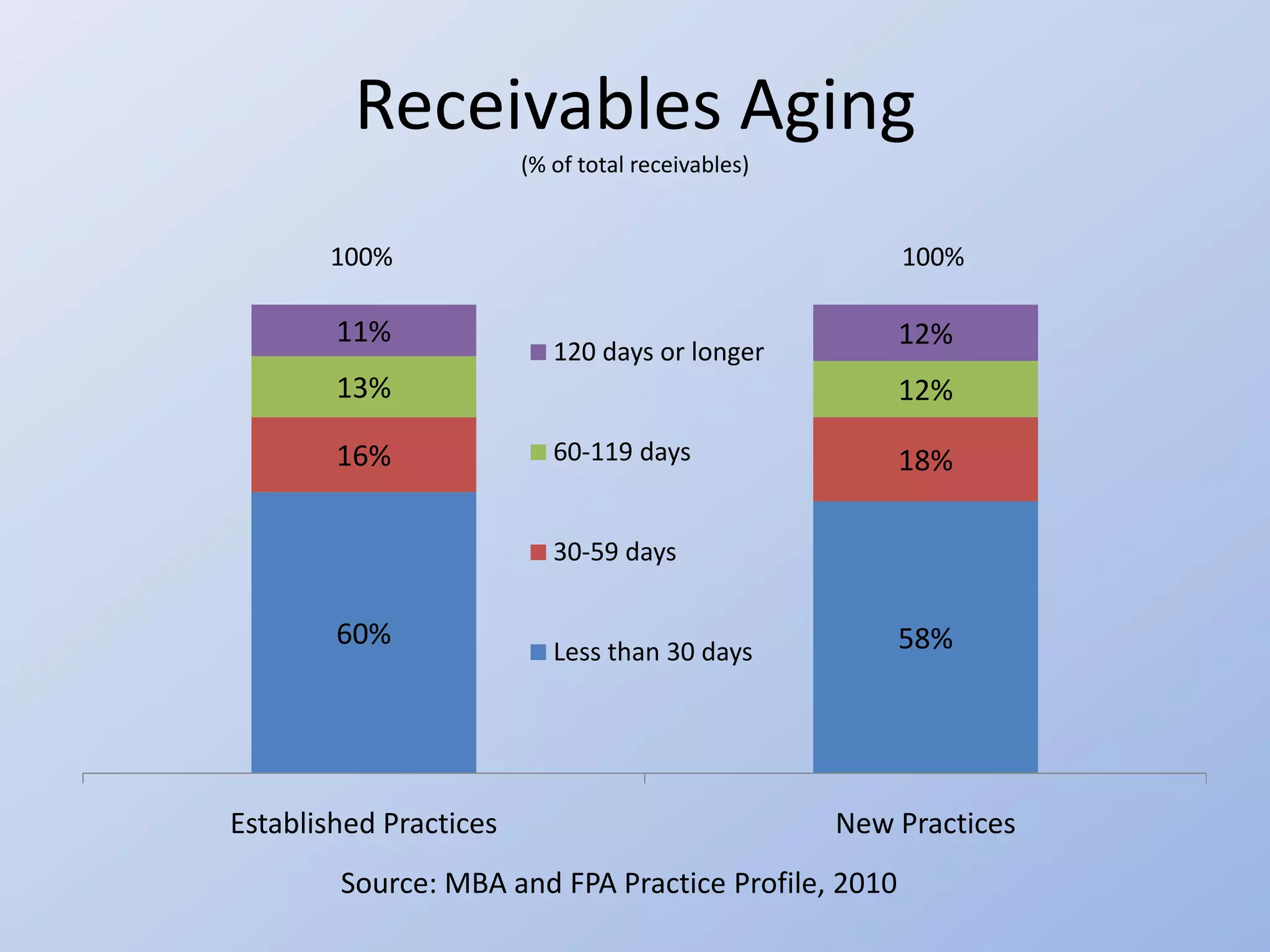
Receivables Aging
                        (% of total receivables)


       100%                                            100%

        11%                                            12%
                           120 days or longer
        13%                                            12%

        16%                60-119 days                 18%

                           30-59 days

        60%                                            58%
                           Less than 30 days


Established Practices                              New Practices
        Source: MBA and FPA Practice Profile, 2010

Practice profile

  • 1.
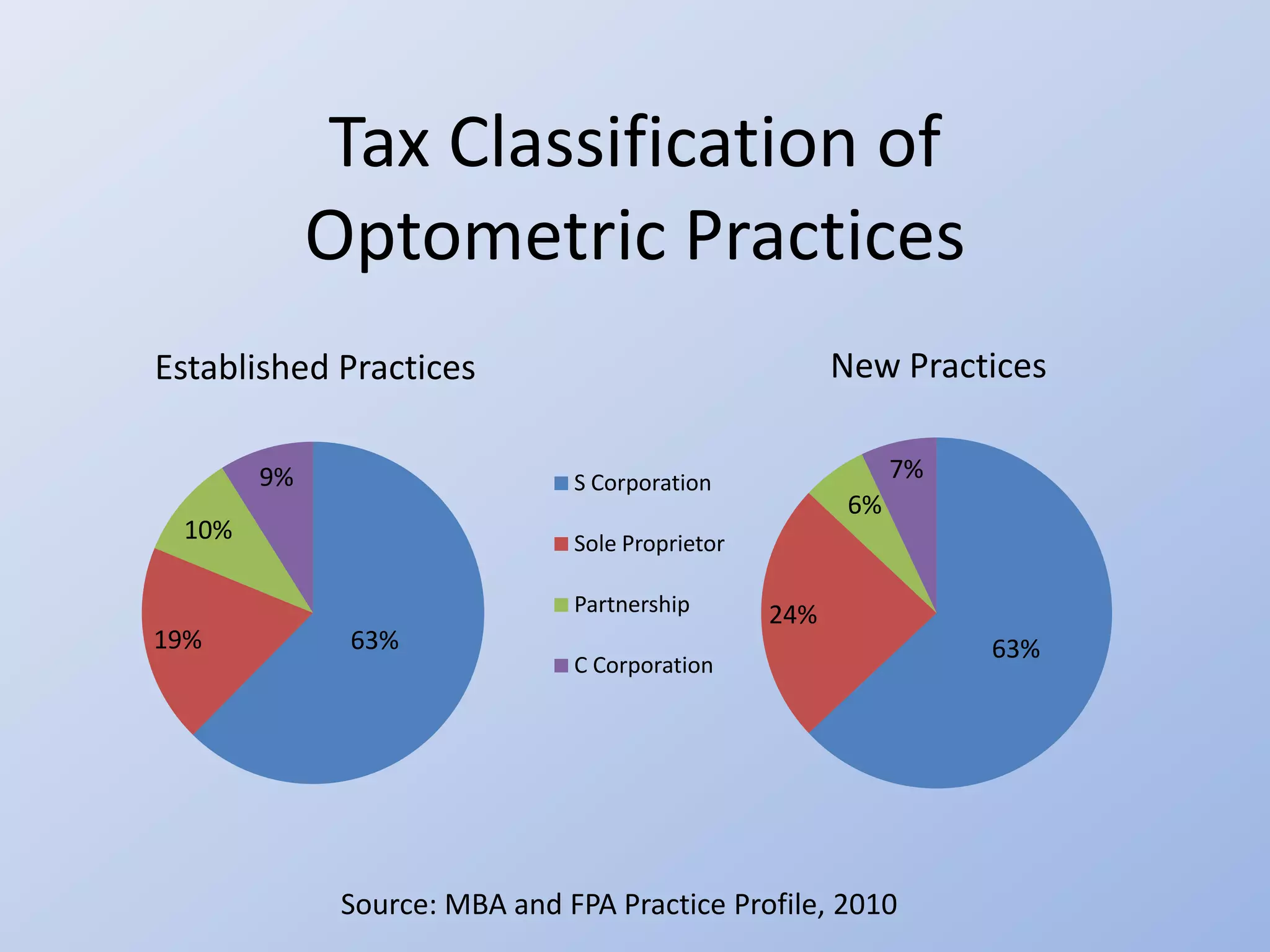
    Tax Classification of Optometric Practices Established Practices New Practices 9% S Corporation 7% 6% 10% Sole Proprietor Partnership 24% 19% 63% 63% C Corporation Source: MBA and FPA Practice Profile, 2010
  • 2.
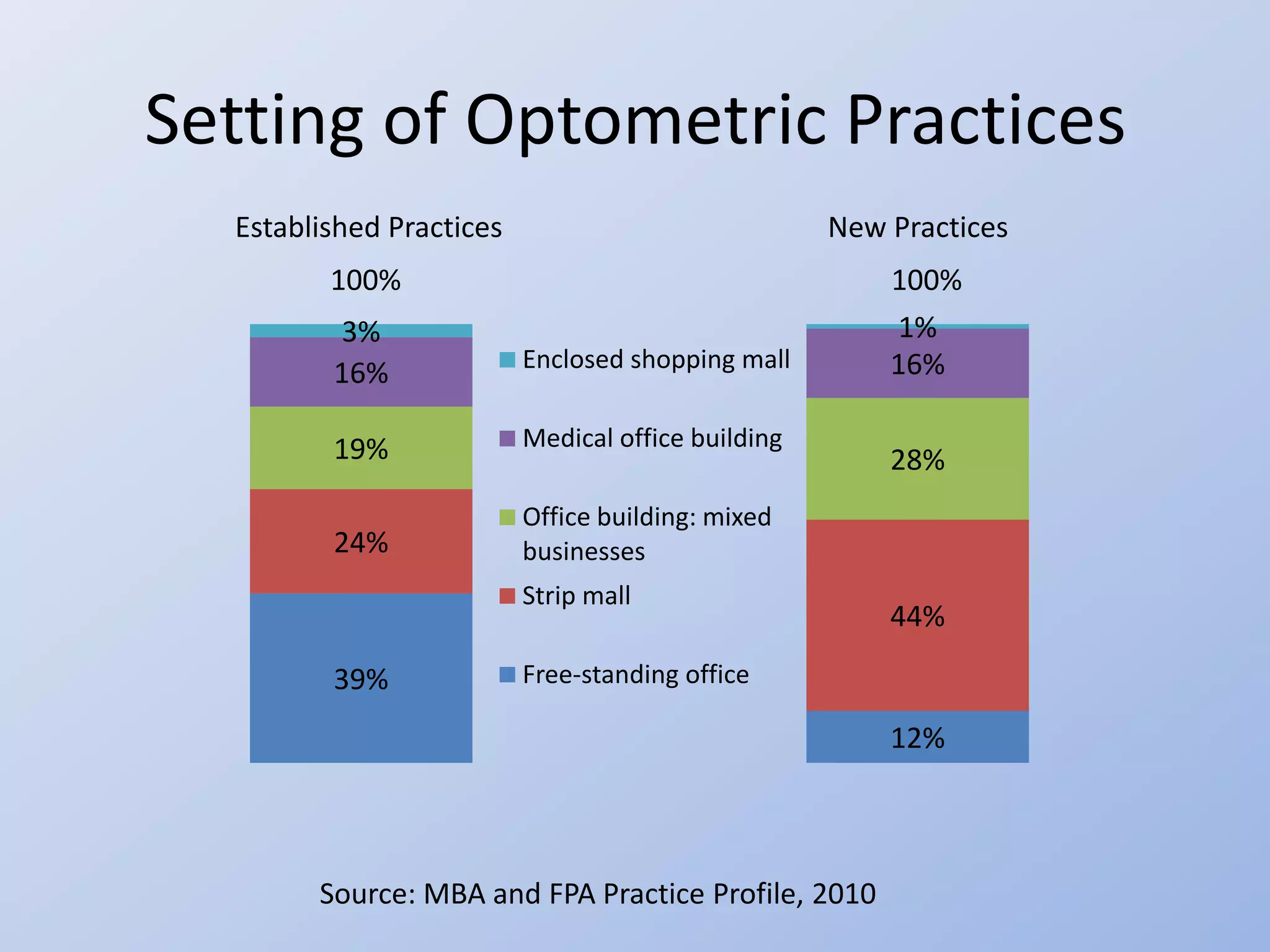
    Setting of OptometricPractices Established Practices New Practices 100% 100% 3% 1% Enclosed shopping mall 16% 16% 19% Medical office building 28% Office building: mixed 24% businesses Strip mall 44% 39% Free-standing office 12% Source: MBA and FPA Practice Profile, 2010
  • 3.
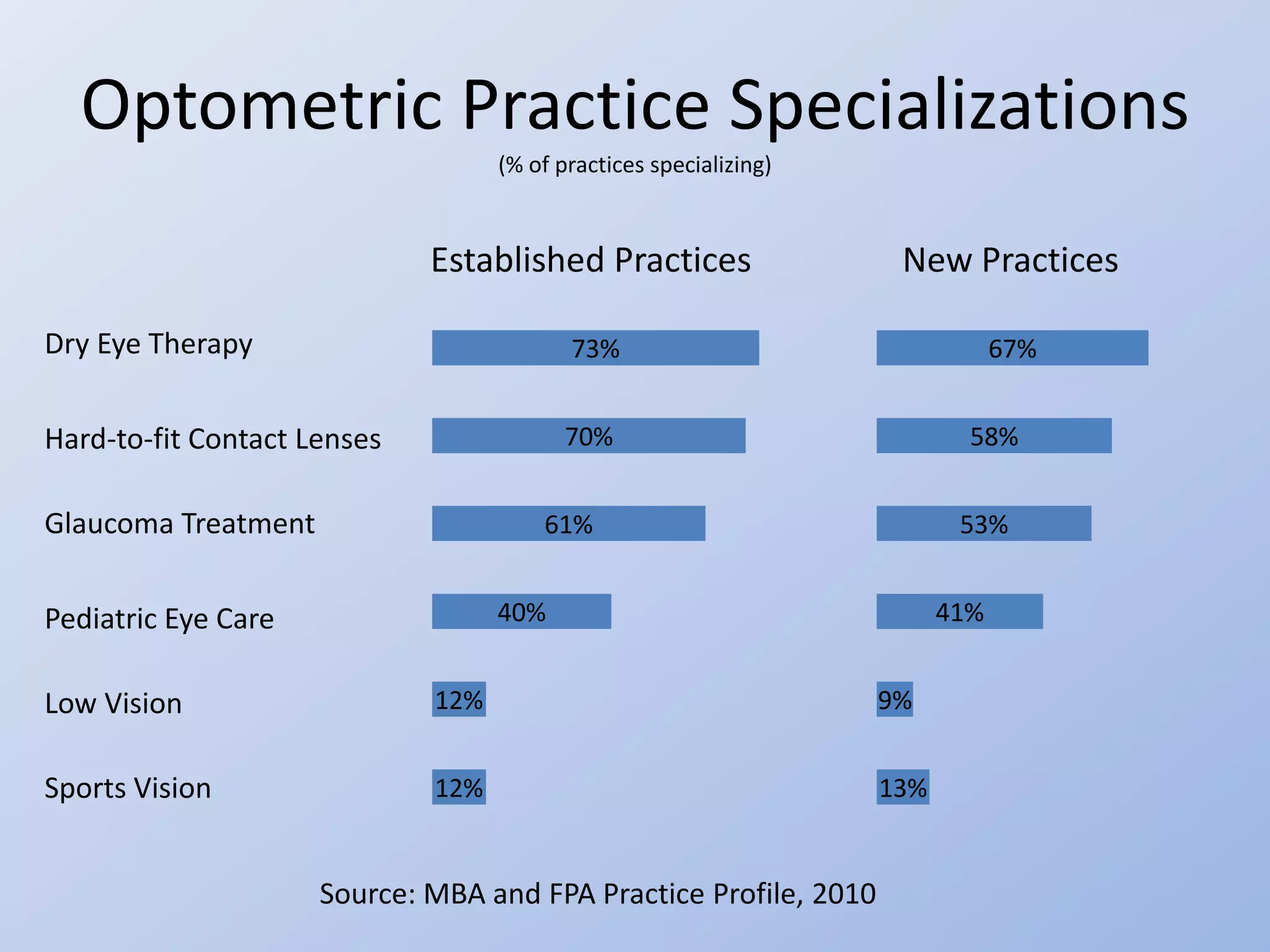
    Optometric Practice Specializations (% of practices specializing) Established Practices New Practices Dry Eye Therapy 73% 67% Hard-to-fit Contact Lenses 70% 58% Glaucoma Treatment 61% 53% Pediatric Eye Care 40% 41% Low Vision 12% 9% Sports Vision 12% 13% Source: MBA and FPA Practice Profile, 2010
  • 4.
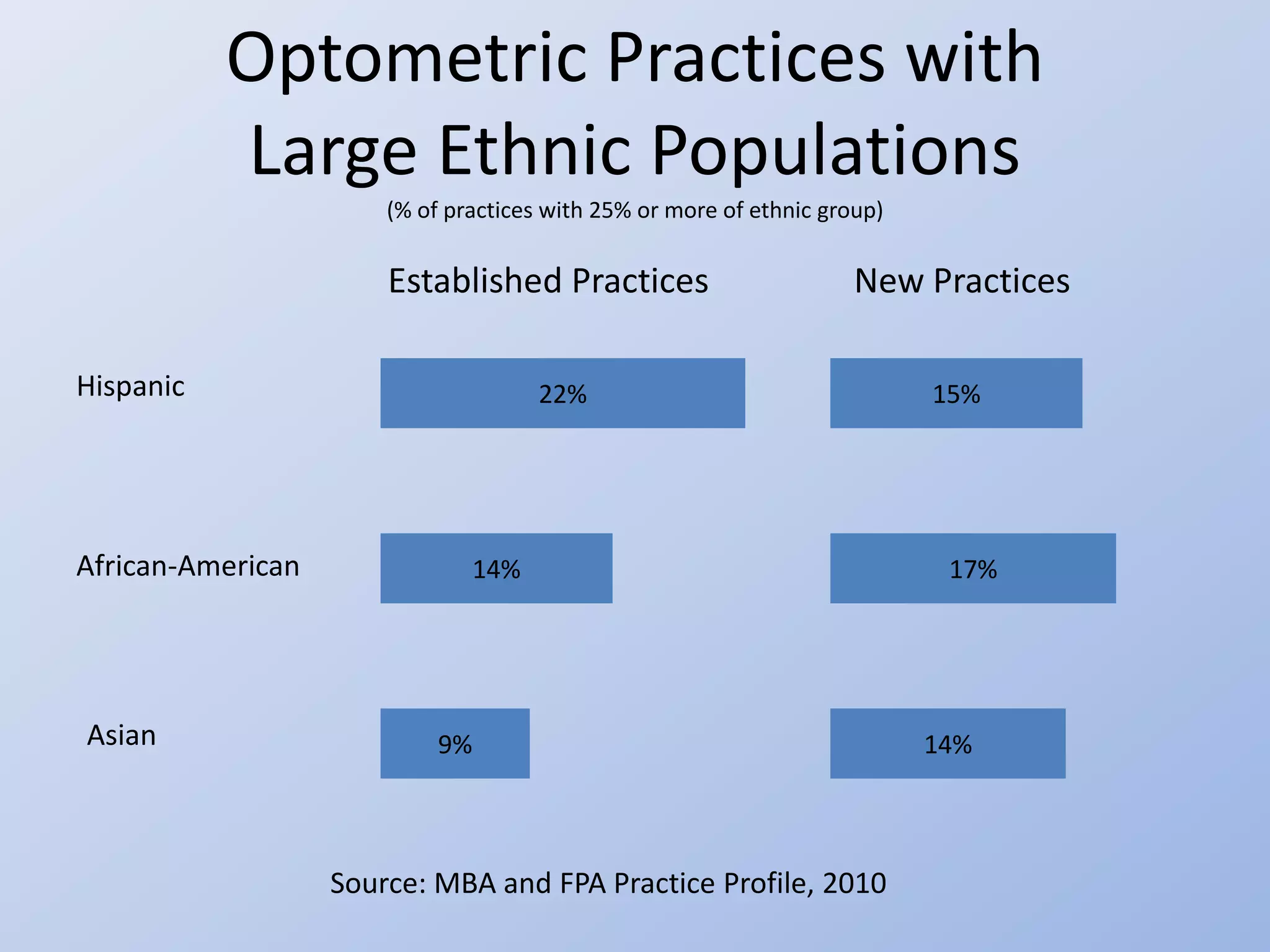
    Optometric Practices with Large Ethnic Populations (% of practices with 25% or more of ethnic group) Established Practices New Practices Hispanic 22% 15% African-American 14% 17% Asian 9% 14% Source: MBA and FPA Practice Profile, 2010
  • 5.
    Average Daily OfficeHours of Optometric Practices 10 8.6 9 8.1 8.4 7.8 8 7.5 7.8 7 7.5 7.7 7.2 7.2 6 5 4 Established Practices Total weekly hours (average) 3.5 3 New Practices Established: 43.5 2.9 2 New: 40.8 1 0 0.2 Source: MBA and FPA Practice Profile, 2010
  • 6.
    Optometric Practice Patient Composition by Device Usage Established Practices New Practices 11% 10% No device used Contact lens wearers 55% 34% Eyeglasses-only 34% wearers 56% Source: MBA and FPA Practice Profile, 2010
  • 7.
    Dominant Household IncomeGroup of Optometric Practices Patients (% of practices) 100% Household Income 100% 9% 7% $90,000 + 39% 43% $60,000-$89,000 $40,000-%59,999 $20,000 -$39,000 38% < $20,000 31% 13% 18% 2% 1% Established Practices New Practices Source: MBA and FPA Practice Profile, 2010
  • 8.
    Complete Eye ExamsPerformed in Optometric Practice Established Practices New Practices 12% 12% "Healthy Eye" Exams Contact Lens 30% Exams 30% 58% 58% Eyeglass Exams Source: MBA and FPA Practice Profile, 2010
  • 9.
    Eye Exam Feesin Optometric Practice (Median Fee) Established Practices New Practices Non-contact lens wearers: $115 $110 Contact lens wearers: Existing wearer, no fitting $141 $145 New wearer, soft spherical $185 $173 New wearer, soft toric $205 $194 New wearer, soft multi-focal $216 $205 Source: MBA and FPA Practice Profile, 2010
  • 10.
    Marketing Expense Allocationof Optometric Practices 29% 27% 25% 22% 21% 18% 17% 15% Established practices 12% 12% New practices Website Media Internal Recall Other advertising marketing* *Includes newsletters, brochures, signage, referral programs, open houses, direct mail Source: MBA and FPA Practice Profile, 2010
  • 11.
    New Patient Ratio (% of eye exams performed for new patients) 63% 29% Established Practices New Practices Source: MBA and FPA Practice Profile, 2010
  • 12.
    Discounted Eye Exams (%of exams provided at discounted fee as part of a managed care insurance plan) 65% 65% Established Practices New Practices Source: MBA and FPA Practice Profile, 2010
  • 13.
    Contact Lens Patientsby Lens Type 100% 100% 5% 5% 4% 5% 12% 11% RGP 23% Colors 24% Soft multi focals Soft torics Soft clear spheres 56% 55% Established Practices New Practices Source: MBA and FPA Practice Profile, 2010
  • 14.
    Silicone Hydrogel LensPenetration (Median % of soft lens patients wearing) 80% 70% Established Practices New Practices Source: MBA and FPA Practice Profile, 2010
  • 15.
    Patient Walk-outs (% of patients taking prescription to another provider for product purchase) 10% Prescription Eyewear 15% Established Practices New Practices 10% Contact Lenses 10% Source: MBA and FPA Practice Profile, 2010
  • 16.
    Eyewear Second PairDiscounts 94% % of Practices Offering 92% Established Practices New Practices 20% Median Discount (% off) 25% Source: MBA and FPA Practice Profile, 2010
  • 17.
    Frames Sales byRetail Price Point (% of units dispensed) 100% 100% 11% 9% 23% $300 or more 22% $200-$299 $150-$199 31% 34% $100-$149 $99 or less 23% 24% 11% 11% Established Practices New Practices Source: MBA and FPA Practice Profile, 2010
  • 18.
    Elapsed Time Since LastEye Exam Fee Increase 100% 100% 22% 21% 12% 36 months or more 15% 18% 11% 24 months 18 months 49% 53% Within past 12 months Established Practices New Practices Source: MBA and FPA Practice Profile, 2010
  • 19.
    Frequency of StaffMeetings 100% 100% 11% 17% Less often than quarterly 24% 23% Every 2-3 months 29% Monthly 20% Every 2-3 weeks 14% 14% Weekly or more often 23% 26% Established Practices New Practices Source: MBA and FPA Practice Profile, 2010
  • 20.
    Staff Management Processesand Practices (% of practices implementing) Established Practices New Practices Annual written 78% 67% performance appraisals Written job descriptions 64% 49% Written policy manual 59% 45% Standard orientation 42% 29% for new hires Staff uniforms 40% 38% Source: MBA and FPA Practice Profile, 2010
  • 21.
    Financial Management Processesand Procedures (% of practices implementing) Established Practices New Practices Staff review of financial goals 71% 61% and performance metrics Quantified revenue and 56% 56% net income goals Written practice budget 25% 26% Source: MBA and FPA Practice Profile, 2010
  • 22.
    Marketing Management Processesand Procedures (% of practice implementing) Established Practices New Practices Capture patient email addresses 71% 70% Written mission statement 58% 61% Routine pre-appointment 34% 38% Update practice website at 32% 47% least quarterly Continuous patient satisfaction 24% 11% surveys Use email as primary 21% 22% communication tool Detailed annual marketing 18% 26% plan and calendar Source: MBA and FPA Practice Profile, 2010
  • 23.
    Source of NewPatients 100% 100% 24% 29% Other 6% Media advertising 3% Direct mail 13% 10% Physician referrals 3% 10% 8% Walk-ins 14% Patient referrals 47% 35% Established Practices New Practices Source: MBA and FPA Practice Profile, 2010
  • 24.
    Soft Lens AnnualSupply Sales (% of patients purchasing annual supply during exam visit) Established Practices New Practices Two week lenses 25% 20% Monthly lenses 50% 50% Daily disposable lenses 10% 5% Source: MBA and FPA Practice Profile, 2010
  • 25.
    Contact Lens Re-fits (% of soft lens patients re-filled with new brand material or lens type) 40% 30% Established Practices New Practices Source: MBA and FPA Practice Profile, 2010
  • 26.
    Contact Lens Inventory (% of practices with an in-office inventory) 61% 33% Established Practices New Practices Source: MBA and FPA Practice Profile, 2010
  • 27.
    Source of SoftLens Purchases 100% 100% 29% 24% Direct from manufacturer 71% 76% Distributor Established Practices New Practices Source: MBA and FPA Practice Profile, 2010
  • 28.
    Spectacle Lens ProductUsage (Median % of Rxes) Established Practices New Practices Progressive lens 63% 66% (% of Presbyopic Rxes) Anti-reflective 52% 60% Photochromic 20% 20% High-index (1.67 IR +) 10% 10% Prescription sunwear 10% 10% Computer lenses 5% 5% Source: MBA and FPA Practice Profile, 2010
  • 29.
    Average Elapsed TimeBetween Eye Exams (Months) Established Practices New Practices Contact lens patients 14 14 Eyeglass-only patients 18 18 Source: MBA and FPA Practice Profile, 2010
  • 30.
    Instrument Penetration (% of practices using one or more) Established Practices New Practices Corneal pachymeter 78% 51% Retinal camera 71% 56% Nerve fiber analyzer 58% 22% Corneal topographer 48% 32% Anterior segment camera 45% 24% Computerized refraction 37% 22% system Optos 32% 11% Source: MBA and FPA Practice Profile, 2010
  • 31.
    Soft Lens AnnualSupply Discounts (% of practices offering) 65% 59% Established Practices New Practices Source: MBA and FPA Practice Profile, 2010
  • 32.
    Practice Website Soft LensRe-Order Functionality (% with service) 41% 27% Established Practices New Practices Source: MBA and FPA Practice Profile, 2010
  • 33.
    Re-Use of ExistingFrames in Eyeglass Rxes (Median % of pairs dispensed with existing frames) 18% 7% Established Practices New Practices Source: MBA and FPA Practice Profile, 2010
  • 34.
    Spectacle Lenses Dispensed: Single Vision vs. Presbyopic Established Practices New Practices 41% 46% Single Vision Presbyopic 54% 59% Source: MBA and FPA Practice Profile, 2010
  • 35.
    Optometric Staff Experience (Average years) 5.6 At practice 2.4 Established Practices New Practices 8.8 Total optical experience 6.7 Source: MBA and FPA Practice Profile, 2010
  • 36.
    Office Managers (% of practices employing) 57% 32% Established Practices New Practices Source: MBA and FPA Practice Profile, 2010
  • 37.
    2010 Staff SalaryIncreases (% of practices) Average increase: + 3.0% + 2.6% 100% 100% 17% 5% or more 21% 27% 11% 3 - 4.9% 22% 38% 1 - 2.9% 45% No increase 19% Established Practices New Practices Average annual staff salary: $26,253 $22,526 Source: MBA and FPA Practice Profile, 2010
  • 38.
    Staff Bonuses 70% % Offering staff performance bonuses 39% Established Practices New Practices 3.3% Median bonus % of salary 2.0% Source: MBA and FPA Practice Profile, 2010
  • 39.
    OD Practice OwnerTime Utilization (% of OD work hours) 100% 100% 6% 8% 4% Vendors, CE 6% 7% 8% 11% Staff training 15% Planning Administration 76% 60% Patient care Established Practices New Practices Source: MBA and FPA Practice Profile, 2010
  • 40.
    Receivables Aging (% of total receivables) 100% 100% 11% 12% 120 days or longer 13% 12% 16% 60-119 days 18% 30-59 days 60% 58% Less than 30 days Established Practices New Practices Source: MBA and FPA Practice Profile, 2010

Editor's Notes

  • #2 Most Optometric Practices are S Corporations 63% of private optometric practices are S corporations, both among established practices and new practices in business for three years or less. Sole proprietorship is the next most common tax classification of private ODs.
  • #3 Established and New Practices Work in Different Office Settings The most common setting for large established optometric practices is a free standing office building. For new practices, however, strip mall locations are most prevalent, with 44% of new practices in this type of setting. Just 12% of new practices operate in a free-standing building. It is assumed that strip mall locations have lower rental costs and are more affordable to new practices Just 24% of established practices are located in strip malls.
  • #4 Dry Eye Therapy and Hard-to-fit Contacts are the Most Prevalent Optometric Specializations 73% of established optometric practices and 67% of new practices specialize in dry eye therapy. Hard-to-fit contact lenses are a specialty of 70% of established practice and 58% of new practices. Very few optometric practices specialize in low vision or sports vision.
  • #5 Many Optometric Practices Have Large Concentrations of Hispanic Patients 22% of established private optometric practices report that one quarter or more of their patient base is of Hispanic origin. 15% of new practices say they have such a concentration of Hispanic patients. Relatively few practice have as large a concentration of African American or Asian patients.
  • #6 Established Optometric Practices Are Open More Hours Established optometric practices are open for business an average of 43.5 hours per week, compared to 40.8 hours for new practices. While not shown in the graphic, average weekly office hours are positively correlated with practice size. During weekdays, fewest hours are worked on Wednesdays and Fridays and most hours on Tuesdays and Thursdays. Many practices are open on Saturdays, but generally hours are limited. Very few practices are open on Sundays.
  • #7 Eyeglass-only Wearers Dominate Optometric Practices In established private optometric practices, 55% of patients wear eyeglasses-only, 34% ever wear contact lenses and 11% use no corrective device. It is estimated that 23-25% of patients in typical practices are full time contact lens wearers. The patient composition of new practices is virtually identical.
  • #8 Typical Patients of One-half of Optometric Practices Are Affluent 48% of established OD practice owners estimate that their typical patient has household income of $60,000 or more. Just 15% estimate that their typical patient household income is less than $40,000. The composition of typical household incomes of patients of new practices is similar in distribution.  The U.S. Bureau of Labor Statistics reported that the median household income before taxes in 2009 was $46,012.
  • #9 58% of Eye Exams Are Basic Refractions Nearly six-in-ten eye exams performed in private optometric practices are basic refractions for eyeglass wearing patients. 30% of exams are contact lens exams and 12% are “healthy eye” exams for patients not requiring correction. The mix of exams in new practices is identical, indicating that new practices, typically with younger owners, are no more likely to fit contact lenses than are established practices.
  • #10 New Optometric Practice Exam Fees Are Somewhat Lower Than in Established Practices The undiscounted exam fees charged direct pay patients are typically 3-5% lower in new optometric practices than in established practices. Other MBA analyses show that larger practices tend to charge somewhat higher exam fees.  The basic fee for a comprehensive exam for eyeglass patients was $115 in 2010 among established private optometric practices, the same as during 2009. Fees for new contact lens patients are considerably higher.
  • #11 Optometric Practices Spend Nearly Half of Marketing Budget For Patient Recall and Internal Marketing Typical private optometric practices spend relatively little for marketing, typically just 2% of gross revenue. New practices typically spend about 5% of revenue on marketing. In established practices, an average of 27% of the marketing budget for spent for recall programs and 21% for internal marketing activities such as brochures, referral programs, open houses and patient mailings. Established practices spend just 18% of their marketing budget on media advertising, with newspaper ads accounting for most spending in this category. To attract new patients, new practices spend a somewhat higher share of their marketing budgets on media advertising.
  • #12 29% of Exams Are Performed for New Patients In established private optometric practices, a median of 29% of complete eye exams are performed for patients new to the practice. New patient ratio is considerably higher among new practices, over half of which are started from scratch with no existing patient base. In established practices, a new patient ratio below 20% may indicate risk of a declining patient base, because patient attrition from relocations and vision insurance changes can total 15-20% annually.
  • #13 65% of Eye Exams Are Discounted Both new and established private optometric practices report that a median of 65% of the eye exams they perform are provided at a discounted fee as part of a managed care insurance plan. This ratio varies widely across practices.
  • #14 Spherical Lenses Are Worn by 56% of Patients, Specialty Lenses and RGPs by 44% New and established optometric practices have similar distributions of contact lens wearer base by lens type. During 2010 soft torics were worn by 23% of contact lens patients in established practices, a ratio that has grown steadily in recent years. Penetration of soft multi-focal lenses has grown more rapidly than any other lens category. Soft multi-focals continue to be under-utilized by a large number of practices. 40% of practices report that 5% or fewer of their patients wear soft multi-focals. Based on contact lens industry audits of retail sales by lens type, ODs somewhat over-estimate the proportion of patients wearing specialty lenses.
  • #15 Silicone Hydrogel Lens Penetration Higher in New Practices New practices report that 80% of their soft lens patients wear silicone hydrogel materials, compared to a media of 70% among established private optometric practices. Penetration has grown steadily in recent years. Presumably the lower ratio of silicone hydrogel usage in established practices is because these practices have larger bases of soft lens patients who have worn traditional materials for many years and have not yet been upgraded.
  • #16 10% or More of Private Practice Patients Buy Eyewear and Contact Lenses Elsewhere. Optometric practice owners estimate that 10% of their contact lens and eyeglass wearing patients take their prescription elsewhere for filling. It is likely that owners over-estimate their capture rate of the device purchases of patients and under-estimate walk-outs. Jobson Optical Research surveys show that independent ECPs account for two-thirds of eye exams performed, but 55% of contact lens sales and 49% of eyeglass sales. These data suggest actual capture rates among independents of 82% for contact lenses (18% walk-out) and 73% for eyewear (27% walk-out).
  • #17 Nearly All Private Optometric Practices Discount Second Pairs of Eyewear More than 90% of new and established practices offer discounts when eyeglass patients purchase a second pair of eyewear. The median discount offered by established practices is 20% and is 25% in new practices. ODs also report that just 10% of patients actually purchase second pairs on exam day. Prescription sunwear is the most common second pair purchase.
  • #18 Premium Frames Account for One-third of Units Dispensed in Optometric Practices Frames priced above $200 at retail account for 34% of frames unit sales in established private optometric practices and 31% in new practices. Just 11% of frames units in established practices are priced at $300 or more, and 9% in new practices. The median retail value of frames sold is estimated to be $174 in established practices and $172 in new practices.
  • #19 Half of Private Optometric Practices Raised Fees During Past 12 Months 49% of established practice owners and 53% of new owners report that they raised comprehensive exam fees during the past 12 months. One-in-five owners have not raised fees in more than two years.
  • #20 65% of Established OD Practice Conduct Staff Meetings Monthly or More Often Two-thirds of private practice owners conduct frequent staff meetings; one-third conduct staff meetings quarterly or less often. Nearly one-in-four practices conduct weekly staff meetings.
  • #21 Performance Appraisals Performed in 40% of Practices; 59% of Established Practice Require Staff Uniforms Most private optometric practices do not provide annual written performance appraisals to patients. New practices are much less likely to have written job descriptions for staff positions than are established practices and are less likely to require uniforms.
  • #22 Few Private Optometric Practices Have Written Annual Budgets 25% of established practice and 26% of new practice have a written annual expense budget – a basic financial management tool. Over six years of measurement, this proportion has not changed significantly. Just over half of practices have quantified revenue and net income goals for the current year. 71% of established practices review financial and other performance goals with staff.
  • #23 Few Private Optometric Practices Develop Annual Marketing Plans Just 18% of established private optometric practices develop an annual marketing plan and calendar and 26% of new practices do. Most practices develop a mission statement, but only about half of those ever make reference to it in staff meetings. While most practices capture patients’ email addresses, few use email as a primary communications tool. Most practices have a website, but only one third of established practices update their site quarterly or more often. One third of established practices pre-appoint patients and 24% conduct on-going patient satisfaction surveys.
  • #24 Patient Referrals are Largest Source of New Patients for Private Optometric Practices Established private optometric practices report that an average of 47% of new patients come from referrals by existing patients, compared to 35% for new practices. Relatively few patients are attracted by media advertising or direct mail. It is presumed that the “other” category is primarily referrals from managed vision care plans. Walk-ins produce 10% of new patients in established private practices. By comparison, walk-ins produce 25% or more of patients in many retail optical chain settings.
  • #25 Annual Supply Sales Greater for Monthly Lenses Established private optometric practices estimate that half of patients wearing monthly replacement lenses purchase four boxes on exam day. That compares to 25% of patients wearing two-week lenses who buy eight boxes. Purchase audits suggest that ECPs over-estimate their actual ratio of annual supply sales, but studies confirm a significantly higher ratio of annual supply purchases for monthly lenses. Retailers know that it is always easier to sell fewer units than more units to customers. Studies also show that a majority of two-week lens wearers stretch the interval between replacements beyond two weeks, many to once a month or less. Fewer monthly lens wearers stretch lens usage beyond the doctor-recommended interval.
  • #26 New Practices Are More Active Re-fitters of Soft Lens Patients New optometric practices report that a median of 40% of soft lens patients were re-fitted into a new brand, material or lens type during 2010, compared to 30% of soft lens wearers in established practices.
  • #27 Most Established Optometric Practices Stock Soft Lens Inventory; Few New Practices Do 61% of established private optometric practices have in-office inventory of soft lens, compared to 33% of new practices. Practices with inventory tend to stock too few boxes to achieve a high fill rate on exam day.
  • #28 Private Practice Optometrists Source More Than 70% of Soft Lenses from Distributors 71% of the purchases of established practices is from soft lens distributors and 76% of purchases of new practices. Distributors’ share of OD soft lens purchases has steadily increased over the past decade. Larger practices source a slightly smaller share of soft lenses from distributors.
  • #29 AR Lens Usage Higher Among New Optometric Practices A median of 60% of spectacle lens prescriptions by new optometric practices incorporate anti-reflective treatments, compared to 52% in established practices. Nearly two-thirds of presbyopic Rxes are progressive lenses. Photochromic lenses are used in 20% of Rxes.ODs somewhat over-state their usage of higher performance lens products.
  • #30 Contact Lens Patients Have More Frequent Eye Exams Both established and new optometric practice owners estimate that the average interval between eye exams by contact lens patients is 14 months and is 18 months for eyeglass-only patients. ECPs under-estimate the actual elapsed time between patient eye exams. From consumer survey data, it is estimated that the median interval between exams for contact lens patients is 18 months, and for glasses-only wearers is 24-27 months. There is no evidence that the frequency of eye exams by either wearer group is increasing in the general population.
  • #31 Pachymeters and Retinal Cameras Are Most Widely Used Advanced Diagnostic Instruments Among established optometric practices, 78% use a corneal pachymeter and 71% use a retinal camera. The penetration of diagnostic instruments is much lower in new optometric practices than among established practices.
  • #32 Most ODs Discount Soft Lens Annual Supply Purchases 65% of established private optometric practices and 59% of new practices discount the price of soft lenses when patients purchase an annual supply quantity of boxes.
  • #33 Four-in-Ten Practices Offer Internet Re-order of Soft Lenses 41% of established private optometric practices offer patients the ability to re-order soft lenses on their practice websites. New practices are less likely to offer this functionality. Penetration of practice website soft lens re-order systems has increased over the past three years.
  • #34 Nearly One-In-Five Eyewear Rxes Re-use Existing Frames Established private optometric practices report that 18% of the eyewear Rxes they dispense re-use the frames that patients had been wearing. The re-use ratio is just 7% among new practices.
  • #35 54% of Spectacle Lens Rxes Are Single Vision Lenses; 46% Are Presbyopic Lenses Established private optometric practices report that an average of 54% of eyewear Rxes incorporate single vision lenses and 46% presbyopic lenses (progressives or bifocal/trifocal). In new practices, a somewhat higher ratio of lenses dispensed are single vision, consistent with the lower average age of patients in new practices.
  • #36 Optometric Practice Staff Average Optical Experience Is Nine Years In established private optometric practices, the average years of optical experience of staff members is 8.8 years, compared to 6.6 years for staff in new practices. The average tenure of staff in established practices is 5.6 years.
  • #37 Most Established Optometric Practices Have Full-time Office Managers 57% of established private optometric practices employ full-time office managers, just 32% of new practices do. Office managers are the highest paid staff members in optometric practices with an average annual salary of $43,000, compared to $27,000 for all positions combined
  • #38 Average Staff Salary Increase Was 3% During 2010 In established private optometric practices, the average salary increase of non-OD staff members was 3% during 2010. New practices increased staff salaries an average of 2.6%. 19% of established practices gave no salary increases to staff during 2010. The most common increases given were in the 1-3% range.
  • #39 Most Established Optometric Practices Offer Staff Performance Bonuses 70% of established private optometric practices offer performance bonuses to staff, compared to 39% of new practices. The median bonus offered in established practices is equivalent to 3.3% of annual salary.
  • #40 Three-fourths of OD Owner Time Spent in Patient Care Owners of established private optometric practices report that 76% of their working hours are spent in patient care. Planning activities account for just 6% of office time. New practices owners spend 60% of their office hours in patient care, probably reflecting the smaller patient bases in these practices and a higher number of open appointment slots.
  • #41 Most OD Receivables Aged Less Than 30 Days 60% of accounts receivable in established private optometric practices are aged less than 30 days; 11% are 120 or more days past due. New practices report similar accounts receivable aging.