Practice for Test

    By: Miss O
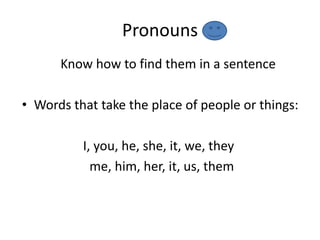
Pronouns
      Know how to find them in a sentence

• Words that take the place of people or things:

          I, you, he, she, it, we, they
            me, him, her, it, us, them
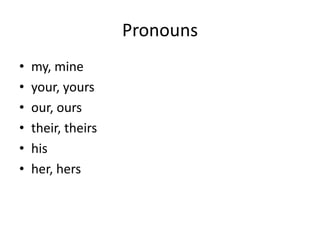
Pronouns
•   my, mine
•   your, yours
•   our, ours
•   their, theirs
•   his
•   her, hers
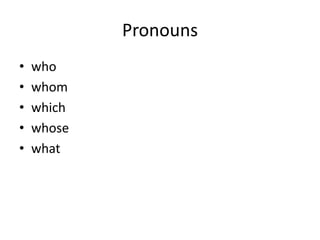
Pronouns
•   who
•   whom
•   which
•   whose
•   what
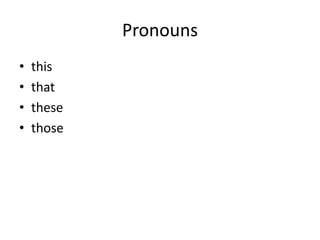
Pronouns
•   this
•   that
•   these
•   those
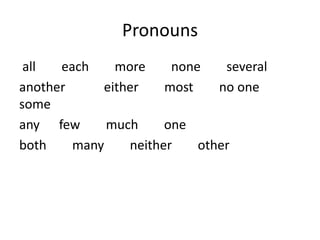
Pronouns
 all  each    more     none    several
another     either    most    no one
some
any few      much     one
both    many    neither    other
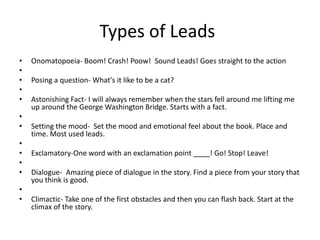
Types of Leads
•   Onomatopoeia- Boom! Crash! Poow! Sound Leads! Goes straight to the action
•
•   Posing a question- What's it like to be a cat?
•
•   Astonishing Fact- I will always remember when the stars fell around me lifting me
    up around the George Washington Bridge. Starts with a fact.
•
•   Setting the mood- Set the mood and emotional feel about the book. Place and
    time. Most used leads.
•
•   Exclamatory-One word with an exclamation point           ! Go! Stop! Leave!
•
•   Dialogue- Amazing piece of dialogue in the story. Find a piece from your story that
    you think is good.
•
•   Climactic- Take one of the first obstacles and then you can flash back. Start at the
    climax of the story.
What is a lead?
•   What is a lead?
•   Leads are crafted, you have to learn.
•   The first sentence in a story
•   Makes it interesting
•   Hooks the reader
•   Introduce the book
•   Emotional tie
•   Vivid words, good description
•   They flash pictures in your mind with concrete details
•   The best lead puts you right in the middle of something
    happening. Action!
How to study
• To study you should practice practice practice
  by reviewing this power point, memorizing
  pronouns, knowing definitions and knowing
  what a lead is.

• There will be no surprises and the test will be
  about 50 points
GOOD LUCK
Study Tips

•   Be prepared
•   Know everything on this PowerPoint
•   Study
•   Practice
•   Make practice tests
•   Don’t stress!

Practice for test

  • 1.
  • 2.
    Pronouns Know how to find them in a sentence • Words that take the place of people or things: I, you, he, she, it, we, they me, him, her, it, us, them
  • 3.
    Pronouns • my, mine • your, yours • our, ours • their, theirs • his • her, hers
  • 4.
    Pronouns • who • whom • which • whose • what
  • 5.
    Pronouns • this • that • these • those
  • 6.
    Pronouns all each more none several another either most no one some any few much one both many neither other
  • 7.
    Types of Leads • Onomatopoeia- Boom! Crash! Poow! Sound Leads! Goes straight to the action • • Posing a question- What's it like to be a cat? • • Astonishing Fact- I will always remember when the stars fell around me lifting me up around the George Washington Bridge. Starts with a fact. • • Setting the mood- Set the mood and emotional feel about the book. Place and time. Most used leads. • • Exclamatory-One word with an exclamation point ! Go! Stop! Leave! • • Dialogue- Amazing piece of dialogue in the story. Find a piece from your story that you think is good. • • Climactic- Take one of the first obstacles and then you can flash back. Start at the climax of the story.
  • 8.
    What is alead? • What is a lead? • Leads are crafted, you have to learn. • The first sentence in a story • Makes it interesting • Hooks the reader • Introduce the book • Emotional tie • Vivid words, good description • They flash pictures in your mind with concrete details • The best lead puts you right in the middle of something happening. Action!
  • 9.
    How to study •To study you should practice practice practice by reviewing this power point, memorizing pronouns, knowing definitions and knowing what a lead is. • There will be no surprises and the test will be about 50 points
  • 10.
    GOOD LUCK Study Tips • Be prepared • Know everything on this PowerPoint • Study • Practice • Make practice tests • Don’t stress!