Lord Jesus, please give me a good mind
that I may do all my works well in such a
way that I will make you happy. Help me
to understand and remember all the
things that I must learn. Help me to enjoy
and be happy with the subject which I
find so hard. Amen
LET US
PRAY…
QUANTITAIV
E
RESEARCH
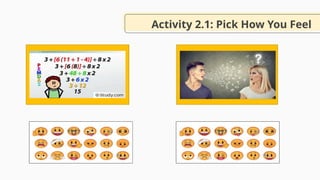
Activity 2.1: Pick How You Feel
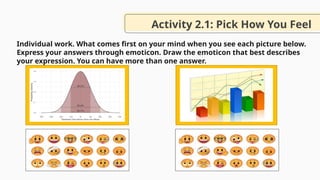
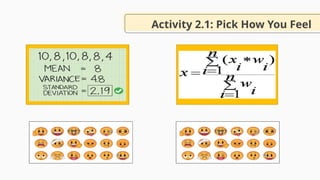
Individual work. What comes first on your mind when you see each picture below.
Express your answers through emoticon. Draw the emoticon that best describes
your expression. You can have more than one answer.
Activity 2.1: Pick How You Feel
02
01
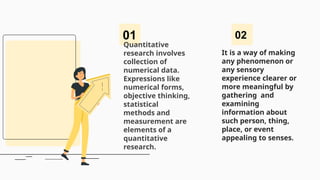
Quantitative
research involves
collection of
numerical data.
Expressions like
numerical forms,
objective thinking,
statistical
methods and
measurement are
elements of a
quantitative
research.
It is a way of making
any phenomenon or
any sensory
experience clearer or
more meaningful by
gathering and
examining
information about
such person, thing,
place, or event
appealing to senses.
Behavior]
1. Determining the respondents’ academic grades and arrived at
96, 97, 78, and 60.
2. Determining the respondents’ level of agreement to factors
that correlate with academic performance.
3. Determining respondents’ stress levels from 1-10 and arrived
at 5, 6, 7 and 8
4. Computing for the strength of relationship between the family
stress with academic performance where you arrived at .7328
interpreted as strong relationship of variables.
Characteristics of Quantitative
Research
Objective
Uses numbers and figures
Focuses on the object of the study
Exclude own thoughts and feelings about the
subject or object
Characterized by real or factual
Analogous to scientific or experimental
thinking
It does not just identify problems but theorize,
hypothesize, analyze, infer and create.
Strengths of Quantitative Research
1. Samples of individuals can be selected to
ensure that the results will be the
representative of the population studied.
2. Structural factors that determine how
inequalities are produced can be analyzed.
3. Quantitative estimates can be obtained
of the magnitude and distribution of
impact
4. Standardized approaches permit the
study to be replicated with the production
of comparable findings
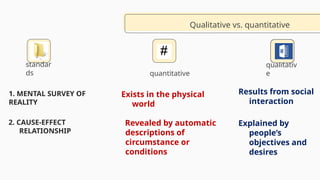
QUALITATIVE RESEARCH vs.
QUANTITATIVE RESEARCH
standar
ds
qualitativ
e
Results from social
interaction
1. MENTAL SURVEY OF
REALITY
Qualitative vs. quantitative
quantitative
Exists in the physical
world
2. CAUSE-EFFECT
RELATIONSHIP
Revealed by automatic
descriptions of
circumstance or
conditions
Explained by
people’s
objectives and
desires
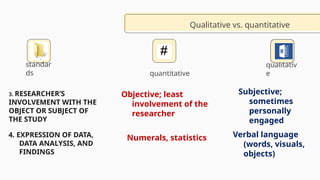
standar
ds
qualitativ
e
Subjective;
sometimes
personally
engaged
3. RESEARCHER’S
INVOLVEMENT WITH THE
OBJECT OR SUBJECT OF
THE STUDY
Qualitative vs. quantitative
quantitative
Objective; least
involvement of the
researcher
4. EXPRESSION OF DATA,
DATA ANALYSIS, AND
FINDINGS
Numerals, statistics Verbal language
(words, visuals,
objects)
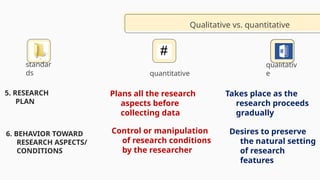
standar
ds
qualitativ
e
Takes place as the
research proceeds
gradually
5. RESEARCH
PLAN
Qualitative vs. quantitative
quantitative
Plans all the research
aspects before
collecting data
6. BEHAVIOR TOWARD
RESEARCH ASPECTS/
CONDITIONS
Control or manipulation
of research conditions
by the researcher
Desires to preserve
the natural setting
of research
features
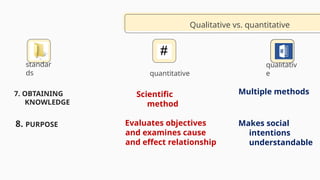
standar
ds
qualitativ
e
Multiple methods
7. OBTAINING
KNOWLEDGE
Qualitative vs. quantitative
quantitative
Scientific
method
8. PURPOSE Evaluates objectives
and examines cause
and effect relationship
Makes social
intentions
understandable
standar
ds
qualitativ
e
Thematic codal
ways,
competence
based
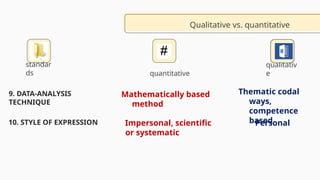
9. DATA-ANALYSIS
TECHNIQUE
Qualitative vs. quantitative
quantitative
Mathematically based
method
10. STYLE OF EXPRESSION Impersonal, scientific
or systematic
Personal
standar
ds
qualitativ
e
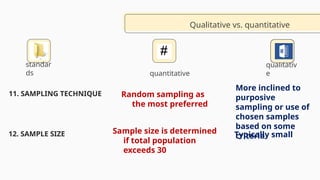
More inclined to
purposive
sampling or use of
chosen samples
based on some
criteria
11. SAMPLING TECHNIQUE
Qualitative vs. quantitative
quantitative
Random sampling as
the most preferred
12. SAMPLE SIZE Sample size is determined
if total population
exceeds 30
Typically small
standar
ds
qualitativ
e
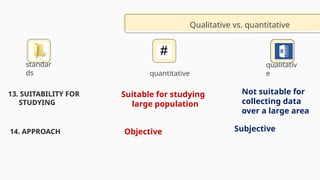
Not suitable for
collecting data
over a large area
13. SUITABILITY FOR
STUDYING
Qualitative vs. quantitative
quantitative
Suitable for studying
large population
14. APPROACH Objective Subjective
standar
ds
qualitativ
e
Explore complex
human issues
15. AIM
Qualitative vs. quantitative
quantitative
Test hypothesis, test
theories
16. PHILOSOPHICAL
FOUNDATION
Deductive Inductive
standar
ds
qualitativ
e
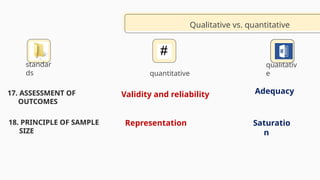
Adequacy
17. ASSESSMENT OF
OUTCOMES
Qualitative vs. quantitative
quantitative
Validity and reliability
18. PRINCIPLE OF SAMPLE
SIZE
Representation Saturatio
n
standar
ds
qualitativ
e
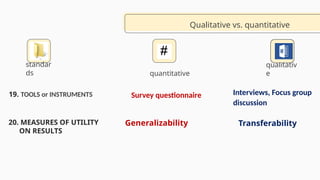
Interviews, Focus group
discussion
19. TOOLS or INSTRUMENTS
Qualitative vs. quantitative
quantitative
Survey questionnaire
20. MEASURES OF UTILITY
ON RESULTS
Generalizability Transferability
**Notice that quantitative
research involves sensory
experience; using your senses in
determining measurement and
counting of data (you use eyes,
nose, ear compared to abstract
of qualitative; you use
understanding and wisdom).

Practical Research 2 Week 2 for Prelims.pptx