Quantitative Versus
Qualitative
John B. Schorling, M.D., M.P.H.
Professor of Medicine and Public Heath Sciences
James R. Martindale, Ph.D.
Assistant Professor of Research and Public
Health Sciences
Objectives:
 Understand the major differences between
quantitative and qualitative approaches to
doing research
“If we knew what we were
doing, it wouldn’t be called
research, would it?”
Albert Einstein
The Right and the Left
 Quantitative research - numbers,
numbers, numbers
 Qualitative research - words, words,
words
Quantitative vs. Qualitative:
Assumptions about the World
 Based upon the idea
of “logical
positivism”, that is,
there is a singular
reality with stable,
social facts that are
separate from the
feelings and beliefs
of individuals.
 Based on the notion
of “constructivism”,
which assumes
multiple realities that
are socially
constructed through
individual and
collective
perceptions or views
of the same
situation.
Quantitative vs. Qualitative:
Research Purpose
 Seeks to establish
relationships and
explain causes of
changes in
measured variables.
That is, the goal of
science is to explain
and predict.
 Concern is with the
understanding of the
social phenomenon
from the
participants’
perspectives. This
requires, to some
degree, researcher
participation.
Quantitative vs. Qualitative:
Methods and Process
 The scientific
method, also known
as a priori or pre-
established design.
 Use of emergent
design utilizing
constant
comparison and
revision.
Quantitative vs. Qualitative:
Prototypical Studies
 Experimental or
correlational designs
are used to reduce
error, bias and the
influence of
extraneous
variables--control of
bias is through
design.
 Use of ethnography,
which helps readers
understand the
multiple
perspectives of the
situation by the
persons studied.
Subjectivity in data
analysis and
interpretation is
acknowledged.
Quantitative vs. Qualitative:
Researcher Role
 Detachment from
study in order to
avoid bias.
 Immersion in
situation and the
phenomenon being
studied.
Quantitative vs. Qualitative:
Context
 Context-free
generalizations
 Generalizations are
contextually-bound.
Quantitative vs. Qualitative:
Precision
 Obtained through
the use of
measurement and
statistics
 Provided by detailed
description of
phenomenon
Quantitative vs. Qualitative:
Verification
 Results replicated
by others.
 Extension of
understandings by
others.
Quantitative vs. Qualitative:
Explanation
 Traditionally,
parsimonious
explanations were
sought, but this may
be changing due to
technology.
 Summary through
narrative--
importance is placed
on reducing
complex realities to
simple explanations.
Quantitative vs. Qualitative:
Logical Reasoning
 DEDUCTIVE--
What’s the classic
example?
 INDUCTIVE--
anyone have an
example?
Quantitative vs. Qualitative:
Conditional Conclusions
 Statements of
statistical
probability.
 Tentative summary
interpretations.
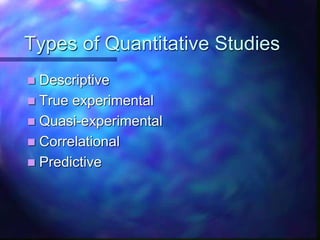
Types of Quantitative Studies
 Descriptive
 True experimental
 Quasi-experimental
 Correlational
 Predictive

Lesson-3-quantitative-vs-qualitative.ppt

  • 1.
    Quantitative Versus Qualitative John B.Schorling, M.D., M.P.H. Professor of Medicine and Public Heath Sciences James R. Martindale, Ph.D. Assistant Professor of Research and Public Health Sciences
  • 2.
    Objectives:  Understand themajor differences between quantitative and qualitative approaches to doing research
  • 3.
    “If we knewwhat we were doing, it wouldn’t be called research, would it?” Albert Einstein
  • 4.
    The Right andthe Left  Quantitative research - numbers, numbers, numbers  Qualitative research - words, words, words
  • 5.
    Quantitative vs. Qualitative: Assumptionsabout the World  Based upon the idea of “logical positivism”, that is, there is a singular reality with stable, social facts that are separate from the feelings and beliefs of individuals.  Based on the notion of “constructivism”, which assumes multiple realities that are socially constructed through individual and collective perceptions or views of the same situation.
  • 6.
    Quantitative vs. Qualitative: ResearchPurpose  Seeks to establish relationships and explain causes of changes in measured variables. That is, the goal of science is to explain and predict.  Concern is with the understanding of the social phenomenon from the participants’ perspectives. This requires, to some degree, researcher participation.
  • 7.
    Quantitative vs. Qualitative: Methodsand Process  The scientific method, also known as a priori or pre- established design.  Use of emergent design utilizing constant comparison and revision.
  • 8.
    Quantitative vs. Qualitative: PrototypicalStudies  Experimental or correlational designs are used to reduce error, bias and the influence of extraneous variables--control of bias is through design.  Use of ethnography, which helps readers understand the multiple perspectives of the situation by the persons studied. Subjectivity in data analysis and interpretation is acknowledged.
  • 9.
    Quantitative vs. Qualitative: ResearcherRole  Detachment from study in order to avoid bias.  Immersion in situation and the phenomenon being studied.
  • 10.
    Quantitative vs. Qualitative: Context Context-free generalizations  Generalizations are contextually-bound.
  • 11.
    Quantitative vs. Qualitative: Precision Obtained through the use of measurement and statistics  Provided by detailed description of phenomenon
  • 12.
    Quantitative vs. Qualitative: Verification Results replicated by others.  Extension of understandings by others.
  • 13.
    Quantitative vs. Qualitative: Explanation Traditionally, parsimonious explanations were sought, but this may be changing due to technology.  Summary through narrative-- importance is placed on reducing complex realities to simple explanations.
  • 14.
    Quantitative vs. Qualitative: LogicalReasoning  DEDUCTIVE-- What’s the classic example?  INDUCTIVE-- anyone have an example?
  • 15.
    Quantitative vs. Qualitative: ConditionalConclusions  Statements of statistical probability.  Tentative summary interpretations.
  • 16.
    Types of QuantitativeStudies  Descriptive  True experimental  Quasi-experimental  Correlational  Predictive