RESEARCH DESIGN
Refers to the overall plan and scheme for
conducting the study. A choice of research
design requires you to finalize your mind on the
purpose, philosophical basis, and types of data
of your research, including your method of
collecting, analyzing, interpreting, and
presenting the data
QUALITATIVE
RESEARCH DESIGNS
1. Case study
2. Ethnograph
3. Historycal study
4. Phenomenology
5. Groudedn theory
CASE STUDY
-describe a person, thing, or any creature
on Earth
-determine why such creature acts,
behaves, occurs, or exists in a particular
manner
- Interview, observation, and questionnaire
ETHNOGRAPHY
-studies cultural patterns and
perspectives of participants in their
natural settings
-Observation
-Living with the subjects in several
months
HISTORYCAL
-studies available data to study,
understand, and interpret past events
PHENOMENOLOGY ANS
GROUNDED THEORY
Phenomenology- Provides a rich description of
the lived experience
- Understanding the individual's life
experiences
-Unstructured Interview
Grounded Theory- Aims on developing a theory
to increase your understanding of something in
a psycho-social context
SAMPLING
-method or process of selecting respondents or
people to answer questions meant to yield data for a
research study.
Populatioin
bigger group from where you choose the sample
PROBABILITY SAMPLING
-it refers to a sampling technique in which
samples are obtained using some objective
chance mechanism, thus involving
randomization. They require the use of a
sampling frame. The probabilities of selection are
known.
-This is a technique when there is no way of
estimating the probability that each element
has of being included in the sample and no
assurance that every element has a chance of
being included.
NON-PROBABILITY SAMPLING
SIMPLE RANDOM SAMPLING
ALL ARE IN THE SAMPLING
-THE ONLY BASIS OF INCLUDING OR EXCLUDING MEMBERS IS BY
CHANCE OR OPPORTUNITY
SYSTEMATIC SAMPLING
-CHANCE AND SYSTEM ARE THE ONES TO DETERMINE WHO
SHOULD COMPOSE THE SAMPLE
TYPE OF PROBABILITY
SAMPLING
STRATIFIED SIMPLING
-The group compromising the sample is chosen in a
way that such group is liable to subdivision during
the data analysis stage
CLUSTER SIMPLING
This is a probability sampling that makes you isolate
a set of persons instead of individual members to
serve as sample members
TYPY OF NON PROBABILITY
SAMPLING
-Using a quota or a specific set of persons whom you
believe to have the characteristics of the target
population involved in the study is your way of
showing that you have chosen closely represents the
target population as regards such characteristics
QUATO SAMPLING
VOLUNTARY SIMPLING
• Sample selection are the ones volunteering to
constitute the sample, there is no need for you to
do any selection process
• You chose people whom you are sure could
correspond to the objectives of your study
PORPUSIVE OF JUDGEMENTAL SAMPLING
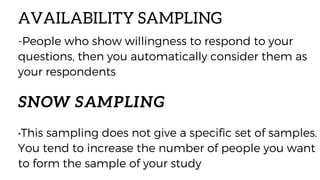
AVAILABILITY SAMPLING
-People who show willingness to respond to your
questions, then you automatically consider them as
your respondents
•This sampling does not give a specific set of samples.
You tend to increase the number of people you want
to form the sample of your study
SNOW SAMPLING

PRACTICAL RESEARCH 1 - QUALITATIVE RESEARCH SAMPLE ONLY

  • 2.
    RESEARCH DESIGN Refers tothe overall plan and scheme for conducting the study. A choice of research design requires you to finalize your mind on the purpose, philosophical basis, and types of data of your research, including your method of collecting, analyzing, interpreting, and presenting the data
  • 3.
    QUALITATIVE RESEARCH DESIGNS 1. Casestudy 2. Ethnograph 3. Historycal study 4. Phenomenology 5. Groudedn theory
  • 4.
    CASE STUDY -describe aperson, thing, or any creature on Earth -determine why such creature acts, behaves, occurs, or exists in a particular manner - Interview, observation, and questionnaire
  • 5.
    ETHNOGRAPHY -studies cultural patternsand perspectives of participants in their natural settings -Observation -Living with the subjects in several months
  • 6.
    HISTORYCAL -studies available datato study, understand, and interpret past events
  • 7.
    PHENOMENOLOGY ANS GROUNDED THEORY Phenomenology-Provides a rich description of the lived experience - Understanding the individual's life experiences -Unstructured Interview Grounded Theory- Aims on developing a theory to increase your understanding of something in a psycho-social context
  • 8.
    SAMPLING -method or processof selecting respondents or people to answer questions meant to yield data for a research study. Populatioin bigger group from where you choose the sample
  • 9.
    PROBABILITY SAMPLING -it refersto a sampling technique in which samples are obtained using some objective chance mechanism, thus involving randomization. They require the use of a sampling frame. The probabilities of selection are known.
  • 10.
    -This is atechnique when there is no way of estimating the probability that each element has of being included in the sample and no assurance that every element has a chance of being included. NON-PROBABILITY SAMPLING
  • 11.
    SIMPLE RANDOM SAMPLING ALLARE IN THE SAMPLING -THE ONLY BASIS OF INCLUDING OR EXCLUDING MEMBERS IS BY CHANCE OR OPPORTUNITY SYSTEMATIC SAMPLING -CHANCE AND SYSTEM ARE THE ONES TO DETERMINE WHO SHOULD COMPOSE THE SAMPLE TYPE OF PROBABILITY SAMPLING
  • 12.
    STRATIFIED SIMPLING -The groupcompromising the sample is chosen in a way that such group is liable to subdivision during the data analysis stage CLUSTER SIMPLING This is a probability sampling that makes you isolate a set of persons instead of individual members to serve as sample members
  • 13.
    TYPY OF NONPROBABILITY SAMPLING -Using a quota or a specific set of persons whom you believe to have the characteristics of the target population involved in the study is your way of showing that you have chosen closely represents the target population as regards such characteristics QUATO SAMPLING
  • 14.
    VOLUNTARY SIMPLING • Sampleselection are the ones volunteering to constitute the sample, there is no need for you to do any selection process • You chose people whom you are sure could correspond to the objectives of your study PORPUSIVE OF JUDGEMENTAL SAMPLING
  • 15.
    AVAILABILITY SAMPLING -People whoshow willingness to respond to your questions, then you automatically consider them as your respondents •This sampling does not give a specific set of samples. You tend to increase the number of people you want to form the sample of your study SNOW SAMPLING