Patama Gomutbutra MD.
Dip., Thai Board of Family Medicine
Grad Cert in Palliative Care APHN,UCSF
Dip., Thai Board of Neurology
_____________________________
Patthama.g@cmu.ac.th
Practical medical ethics in
Palliative care
1. Definition and elements of Palliative care
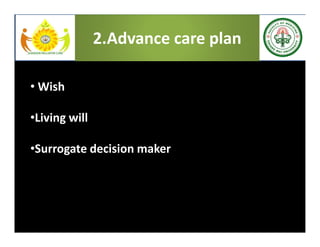
2. Advance care plan
3. Medical ethics
Outline
Case demonstration
60 years old widow no child. she is known case end
stage colon cancer PPS 40% (mostly bed bounded)
she was admitted from sepsis and multiorgan failure
she developed arrest. She talked with relatives want
to die peacfully without CPR. However, she had no
formal living will or any surrogate decision maker.
If you are her physician, what would you do.
A. CPR
B. Respect her choice let her go
• การดูแลแบบบริบาลบรรเทา (Palliative care)
• การดูแลในระยะท้าย (end of life care)
• การดูแลแบบบ้านพักระยะท้าย (Hospice)
1.Definition
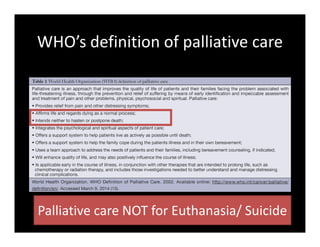
WHO’s definition of palliative care
Palliative care NOT for Euthanasia/ Suicide
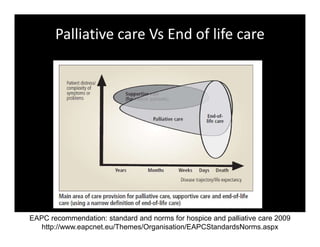
Palliative care Vs End of life care
EAPC recommendation: standard and norms for hospice and palliative care 2009
http://www.eapcnet.eu/Themes/Organisation/EAPCStandardsNorms.aspx
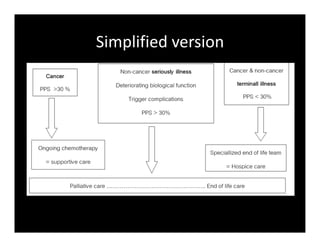
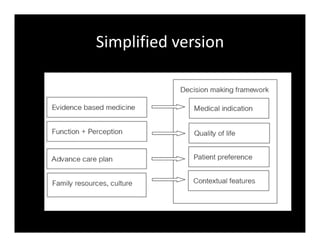
Simplified version
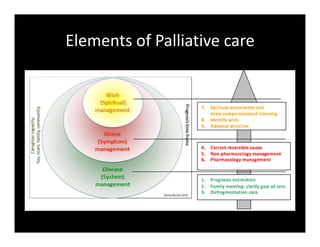
Elements of Palliative care
• Wish
•Living will
•Surrogate decision maker
2.Advance care plan
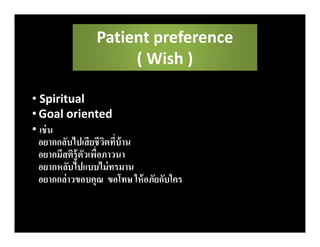
• Spiritual
• Goal oriented
• เช่น
อยากกลับไปเสียชีวิตทีบ้าน
อยากมีสติรู้ตัวเพือภาวนา
อยากหลับไปแบบไม่ทรมาน
อยากกล่าวขอบคุณ ขอโทษ ให้อภัยกับใคร
Patient preference
( Wish )
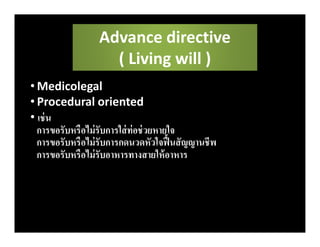
• Medicolegal
• Procedural oriented
• เช่น
การขอรับหรือไม่รับการใส่ท่อช่วยหายใจ
การขอรับหรือไม่รับการกดนวดหัวใจฟืนสัญญานชีพ
การขอรับหรือไม่รับอาหารทางสายให้อาหาร
Advance directive
( Living will )
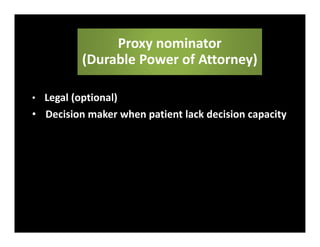
• Legal (optional)
• Decision maker when patient lack decision capacity
Proxy nominator
(Durable Power of Attorney)
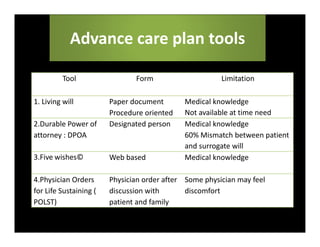
Tool Form Limitation
1. Living will Paper document
Procedure oriented
Medical knowledge
Not available at time need
2.Durable Power of
attorney : DPOA
Designated person Medical knowledge
60% Mismatch between patient
and surrogate will
3.Five wishes© Web based Medical knowledge
4.Physician Orders
for Life Sustaining (
POLST)
Physician order after
discussion with
patient and family
Some physician may feel
discomfort
Advance care plan tools
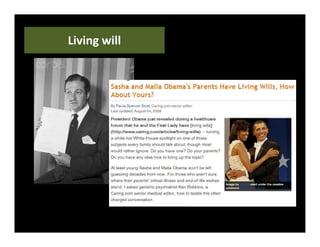
Living will
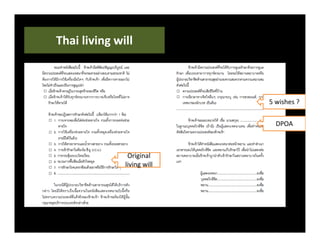
Original
living will
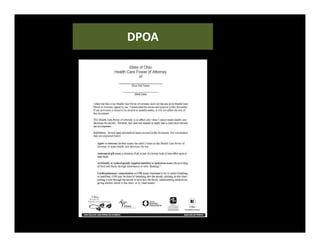
DPOA
5 wishes ?
Thai living will
DPOADPOA
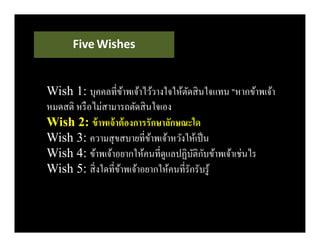
Wish 1: บุคคลทีข้าพเจ้าไว้วางใจให้ตัดสินใจแทน "หากข้าพเจ้า
หมดสติ หรือไม่สามารถตัดสินใจเอง
Wish 2: ข้าพเจ้าต้องการรักษาลักษณะใด
Wish 3: ความสุขสบายทีข้าพเจ้าหวังให้เป็น
Wish 4: ข้าพเจ้าอยากให้คนทีดูแลปฏิบัติกับข้าพเจ้าเช่นไร
Wish 5: สิงใดทีข้าพเจ้าอยากให้คนทีรักรับรู้
Five Wishes
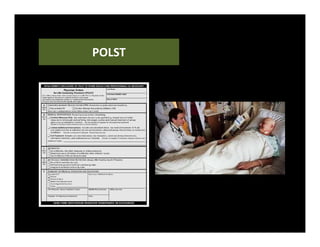
POLST
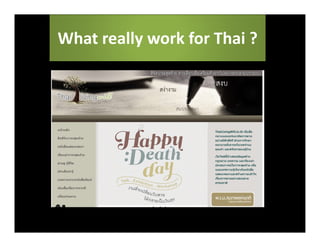
What really work for Thai ?
http://www.budnet.org/sunset/sites/default/
files/Baojai-final-2559-9-26.pdf
• Medical dilemma:
When ‘save life’ is not absolute answer
• Medical ethics
A systematic decision making in medical
dilemma
* 3.Medical ethics
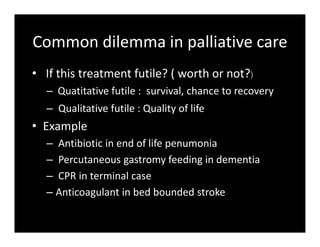
Common dilemma in palliative care
• If this treatment futile? ( worth or not?)
– Quatitative futile : survival, chance to recovery
– Qualitative futile : Quality of life
• Example
– Antibiotic in end of life penumonia
– Percutaneous gastromy feeding in dementia
– CPR in terminal case
– Anticoagulant in bed bounded stroke
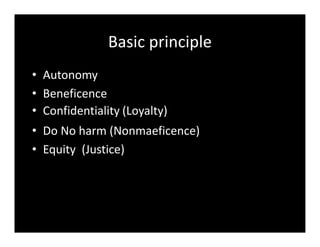
Basic principle
• Autonomy
• Beneficence
• Confidentiality (Loyalty)
• Do No harm (Nonmaeficence)
• Equity (Justice)
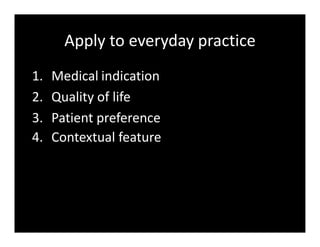
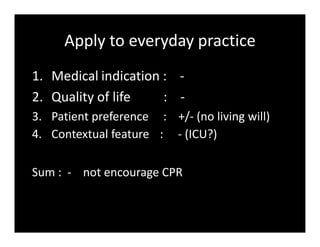
Apply to everyday practice
1. Medical indication
2. Quality of life
3. Patient preference
4. Contextual feature
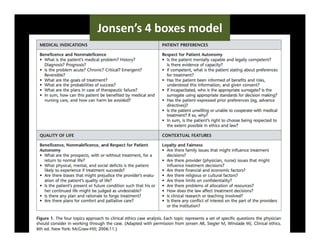
Jonsen’s 4 boxes model
Simplified version
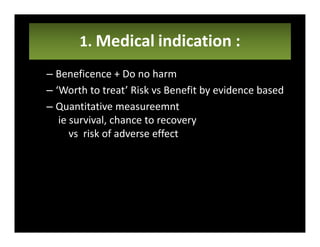
1. Medical indication :
– Beneficence + Do no harm
– ‘Worth to treat’ Risk vs Benefit by evidence based
– Quantitative measureemnt
ie survival, chance to recovery
vs risk of adverse effect
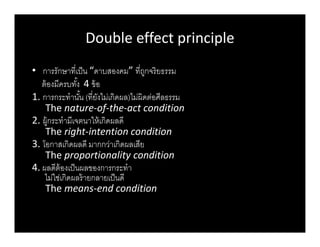
Double effect principle
• การรักษาทีเป็น “ดาบสองคม” ทีถูกจริยธรรม
ต้องมีครบทัง 4 ข้อ
1. การกระทํานัน (ทียังไม่เกิดผล)ไม่ผิดต่อศีลธรรม
The nature-of-the-act condition
2. ผู้กระทํามีเจตนาให้เกิดผลดี
The right-intention condition
3. โอกาสเกิดผลดี มากกว่าเกิดผลเสีย
The proportionality condition
4. ผลดีต้องเป็นผลของการกระทํา
ไม่ใช่เกิดผลร้ายกลายเป็นดี
The means-end condition
Double effect principleDouble effect principle
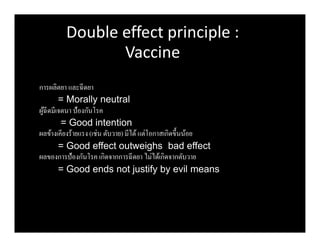
Double effect principle :
Vaccine
การผลิตยา และฉีดยา
= Morally neutral
ผู้ฉีดมีเจตนา ป้องกันโรค
= Good intention
ผลข้างเคียงร้ายแรง (เช่น ตับวาย) มีได้แต่โอกาสเกิดขึนน้อย
= Good effect outweighs bad effect
ผลของการป้องกันโรค เกิดจากการฉีดยา ไม่ได้เกิดจากตับวาย
= Good ends not justify by evil means
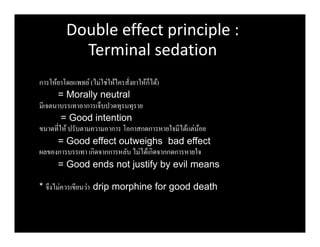
Double effect principle :
Terminal sedation
การให้ยาโดยแพทย์(ไม่ใช่ให้ใครสังยาให้ก็ได้)
= Morally neutral
มีเจตนาบรรเทาอาการเจ็บปวดทุรนทุราย
= Good intention
ขนาดทีให้ ปรับตามความอาการ โอกาสกดการหายใจมีได้แต่น้อย
= Good effect outweighs bad effect
ผลของการบรรเทา เกิดจากการหลับ ไม่ได้เกิดจากกดการหายใจ
= Good ends not justify by evil means
* จึงไม่ควรเขียนว่า drip morphine for good death
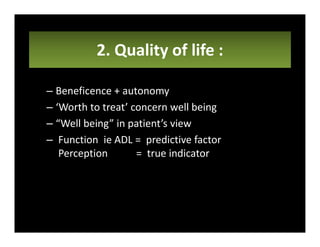
2. Quality of life :
– Beneficence + autonomy
– ‘Worth to treat’ concern well being
– “Well being” in patient’s view
– Function ie ADL = predictive factor
Perception = true indicator
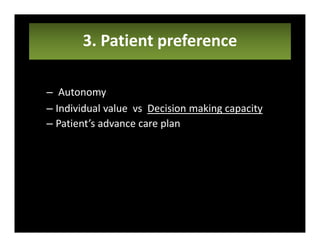
3. Patient preference
– Autonomy
– Individual value vs Decision making capacity
– Patient’s advance care plan
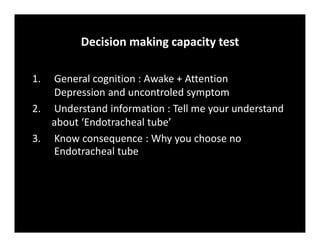
1. General cognition : Awake + Attention
Depression and uncontroled symptom
2. Understand information : Tell me your understand
about ‘Endotracheal tube’
3. Know consequence : Why you choose no
Endotracheal tube
Decision making capacity test
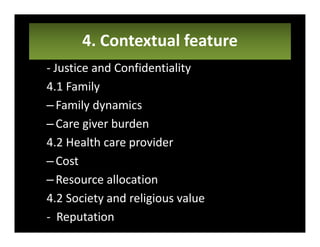
4. Contextual feature
- Justice and Confidentiality
4.1 Family
–Family dynamics
–Care giver burden
4.2 Health care provider
–Cost
–Resource allocation
4.2 Society and religious value
- Reputation
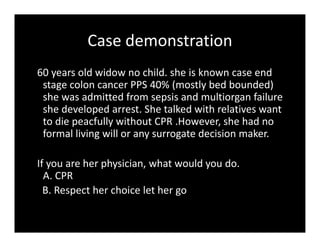
Case demonstration
60 years old widow no child. she is known case end
stage colon cancer PPS 40% (mostly bed bounded)
she was admitted from sepsis and multiorgan failure
she developed arrest. She talked with relatives want
to die peacfully without CPR .However, she had no
formal living will or any surrogate decision maker.
If you are her physician, what would you do.
A. CPR
B. Respect her choice let her go
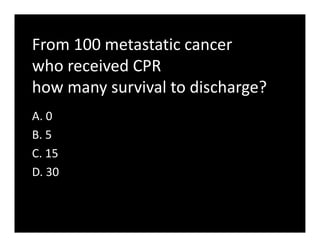
From 100 metastatic cancer
who received CPR
how many survival to discharge?
A. 0
B. 5
C. 15
D. 30
Apply to everyday practice
1. Medical indication : -
2. Quality of life : -
3. Patient preference : +/- (no living will)
4. Contextual feature : - (ICU?)
Sum : - not encourage CPR
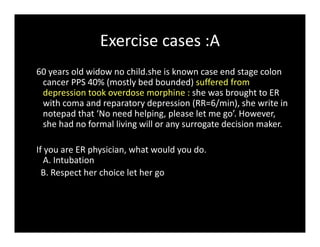
Exercise cases :A
60 years old widow no child.she is known case end stage colon
cancer PPS 40% (mostly bed bounded) suffered from
depression took overdose morphine : she was brought to ER
with coma and reparatory depression (RR=6/min), she write in
notepad that ‘No need helping, please let me go’. However,
she had no formal living will or any surrogate decision maker.
If you are ER physician, what would you do.
A. Intubation
B. Respect her choice let her go
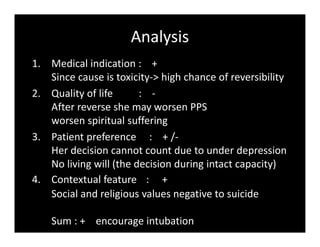
Analysis
1. Medical indication : +
Since cause is toxicity-> high chance of reversibility
2. Quality of life : -
After reverse she may worsen PPS
worsen spiritual suffering
3. Patient preference : + /-
Her decision cannot count due to under depression
No living will (the decision during intact capacity)
4. Contextual feature : +
Social and religious values negative to suicide
Sum : + encourage intubation
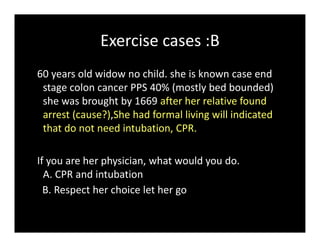
Exercise cases :B
60 years old widow no child. she is known case end
stage colon cancer PPS 40% (mostly bed bounded)
she was brought by 1669 after her relative found
arrest (cause?),She had formal living will indicated
that do not need intubation, CPR.
If you are her physician, what would you do.
A. CPR and intubation
B. Respect her choice let her go
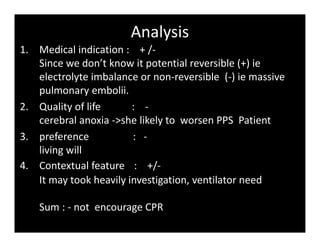
Analysis
1. Medical indication : + /-
Since we don’t know it potential reversible (+) ie
electrolyte imbalance or non-reversible (-) ie massive
pulmonary embolii.
2. Quality of life : -
cerebral anoxia ->she likely to worsen PPS Patient
3. preference : -
living will
4. Contextual feature : +/-
It may took heavily investigation, ventilator need
Sum : - not encourage CPR
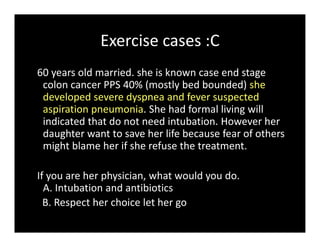
Exercise cases :C
60 years old married. she is known case end stage
colon cancer PPS 40% (mostly bed bounded) she
developed severe dyspnea and fever suspected
aspiration pneumonia. She had formal living will
indicated that do not need intubation. However her
daughter want to save her life because fear of others
might blame her if she refuse the treatment.
If you are her physician, what would you do.
A. Intubation and antibiotics
B. Respect her choice let her go
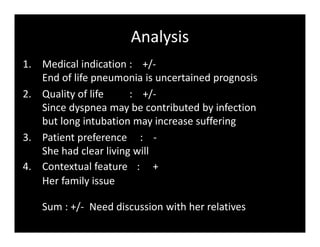
Analysis
1. Medical indication : +/-
End of life pneumonia is uncertained prognosis
2. Quality of life : +/-
Since dyspnea may be contributed by infection
but long intubation may increase suffering
3. Patient preference : -
She had clear living will
4. Contextual feature : +
Her family issue
Sum : +/- Need discussion with her relatives
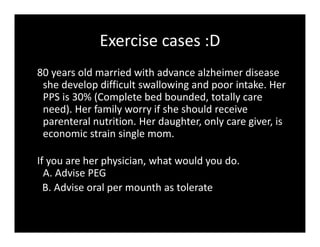
Exercise cases :D
80 years old married with advance alzheimer disease
she develop difficult swallowing and poor intake. Her
PPS is 30% (Complete bed bounded, totally care
need). Her family worry if she should receive
parenteral nutrition. Her daughter, only care giver, is
economic strain single mom.
If you are her physician, what would you do.
A. Advise PEG
B. Advise oral per mounth as tolerate
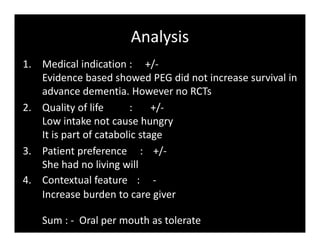
Analysis
1. Medical indication : +/-
Evidence based showed PEG did not increase survival in
advance dementia. However no RCTs
2. Quality of life : +/-
Low intake not cause hungry
It is part of catabolic stage
3. Patient preference : +/-
She had no living will
4. Contextual feature : -
Increase burden to care giver
Sum : - Oral per mouth as tolerate
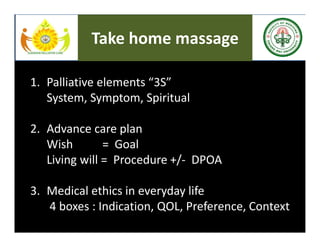
1. Palliative elements “3S”
System, Symptom, Spiritual
2. Advance care plan
Wish = Goal
Living will = Procedure +/- DPOA
3. Medical ethics in everyday life
4 boxes : Indication, QOL, Preference, Context
Take home massage

Practical medical ethics

  • 1.
    Patama Gomutbutra MD. Dip.,Thai Board of Family Medicine Grad Cert in Palliative Care APHN,UCSF Dip., Thai Board of Neurology _____________________________ Patthama.g@cmu.ac.th Practical medical ethics in Palliative care
  • 2.
    1. Definition andelements of Palliative care 2. Advance care plan 3. Medical ethics Outline
  • 3.
    Case demonstration 60 yearsold widow no child. she is known case end stage colon cancer PPS 40% (mostly bed bounded) she was admitted from sepsis and multiorgan failure she developed arrest. She talked with relatives want to die peacfully without CPR. However, she had no formal living will or any surrogate decision maker. If you are her physician, what would you do. A. CPR B. Respect her choice let her go
  • 4.
    • การดูแลแบบบริบาลบรรเทา (Palliativecare) • การดูแลในระยะท้าย (end of life care) • การดูแลแบบบ้านพักระยะท้าย (Hospice) 1.Definition
  • 5.
    WHO’s definition ofpalliative care Palliative care NOT for Euthanasia/ Suicide
  • 6.
    Palliative care VsEnd of life care EAPC recommendation: standard and norms for hospice and palliative care 2009 http://www.eapcnet.eu/Themes/Organisation/EAPCStandardsNorms.aspx
  • 7.
  • 8.
  • 9.
    • Wish •Living will •Surrogatedecision maker 2.Advance care plan
  • 10.
    • Spiritual • Goaloriented • เช่น อยากกลับไปเสียชีวิตทีบ้าน อยากมีสติรู้ตัวเพือภาวนา อยากหลับไปแบบไม่ทรมาน อยากกล่าวขอบคุณ ขอโทษ ให้อภัยกับใคร Patient preference ( Wish )
  • 11.
    • Medicolegal • Proceduraloriented • เช่น การขอรับหรือไม่รับการใส่ท่อช่วยหายใจ การขอรับหรือไม่รับการกดนวดหัวใจฟืนสัญญานชีพ การขอรับหรือไม่รับอาหารทางสายให้อาหาร Advance directive ( Living will )
  • 12.
    • Legal (optional) •Decision maker when patient lack decision capacity Proxy nominator (Durable Power of Attorney)
  • 13.
    Tool Form Limitation 1.Living will Paper document Procedure oriented Medical knowledge Not available at time need 2.Durable Power of attorney : DPOA Designated person Medical knowledge 60% Mismatch between patient and surrogate will 3.Five wishes© Web based Medical knowledge 4.Physician Orders for Life Sustaining ( POLST) Physician order after discussion with patient and family Some physician may feel discomfort Advance care plan tools
  • 14.
  • 15.
  • 16.
  • 17.
    Wish 1: บุคคลทีข้าพเจ้าไว้วางใจให้ตัดสินใจแทน"หากข้าพเจ้า หมดสติ หรือไม่สามารถตัดสินใจเอง Wish 2: ข้าพเจ้าต้องการรักษาลักษณะใด Wish 3: ความสุขสบายทีข้าพเจ้าหวังให้เป็น Wish 4: ข้าพเจ้าอยากให้คนทีดูแลปฏิบัติกับข้าพเจ้าเช่นไร Wish 5: สิงใดทีข้าพเจ้าอยากให้คนทีรักรับรู้ Five Wishes
  • 18.
  • 19.
    What really workfor Thai ?
  • 20.
  • 21.
    • Medical dilemma: When‘save life’ is not absolute answer • Medical ethics A systematic decision making in medical dilemma * 3.Medical ethics
  • 22.
    Common dilemma inpalliative care • If this treatment futile? ( worth or not?) – Quatitative futile : survival, chance to recovery – Qualitative futile : Quality of life • Example – Antibiotic in end of life penumonia – Percutaneous gastromy feeding in dementia – CPR in terminal case – Anticoagulant in bed bounded stroke
  • 23.
    Basic principle • Autonomy •Beneficence • Confidentiality (Loyalty) • Do No harm (Nonmaeficence) • Equity (Justice)
  • 24.
    Apply to everydaypractice 1. Medical indication 2. Quality of life 3. Patient preference 4. Contextual feature
  • 25.
  • 26.
  • 27.
    1. Medical indication: – Beneficence + Do no harm – ‘Worth to treat’ Risk vs Benefit by evidence based – Quantitative measureemnt ie survival, chance to recovery vs risk of adverse effect
  • 28.
    Double effect principle •การรักษาทีเป็น “ดาบสองคม” ทีถูกจริยธรรม ต้องมีครบทัง 4 ข้อ 1. การกระทํานัน (ทียังไม่เกิดผล)ไม่ผิดต่อศีลธรรม The nature-of-the-act condition 2. ผู้กระทํามีเจตนาให้เกิดผลดี The right-intention condition 3. โอกาสเกิดผลดี มากกว่าเกิดผลเสีย The proportionality condition 4. ผลดีต้องเป็นผลของการกระทํา ไม่ใช่เกิดผลร้ายกลายเป็นดี The means-end condition Double effect principleDouble effect principle
  • 29.
    Double effect principle: Vaccine การผลิตยา และฉีดยา = Morally neutral ผู้ฉีดมีเจตนา ป้องกันโรค = Good intention ผลข้างเคียงร้ายแรง (เช่น ตับวาย) มีได้แต่โอกาสเกิดขึนน้อย = Good effect outweighs bad effect ผลของการป้องกันโรค เกิดจากการฉีดยา ไม่ได้เกิดจากตับวาย = Good ends not justify by evil means
  • 30.
    Double effect principle: Terminal sedation การให้ยาโดยแพทย์(ไม่ใช่ให้ใครสังยาให้ก็ได้) = Morally neutral มีเจตนาบรรเทาอาการเจ็บปวดทุรนทุราย = Good intention ขนาดทีให้ ปรับตามความอาการ โอกาสกดการหายใจมีได้แต่น้อย = Good effect outweighs bad effect ผลของการบรรเทา เกิดจากการหลับ ไม่ได้เกิดจากกดการหายใจ = Good ends not justify by evil means * จึงไม่ควรเขียนว่า drip morphine for good death
  • 31.
    2. Quality oflife : – Beneficence + autonomy – ‘Worth to treat’ concern well being – “Well being” in patient’s view – Function ie ADL = predictive factor Perception = true indicator
  • 32.
    3. Patient preference –Autonomy – Individual value vs Decision making capacity – Patient’s advance care plan
  • 33.
    1. General cognition: Awake + Attention Depression and uncontroled symptom 2. Understand information : Tell me your understand about ‘Endotracheal tube’ 3. Know consequence : Why you choose no Endotracheal tube Decision making capacity test
  • 34.
    4. Contextual feature -Justice and Confidentiality 4.1 Family –Family dynamics –Care giver burden 4.2 Health care provider –Cost –Resource allocation 4.2 Society and religious value - Reputation
  • 35.
    Case demonstration 60 yearsold widow no child. she is known case end stage colon cancer PPS 40% (mostly bed bounded) she was admitted from sepsis and multiorgan failure she developed arrest. She talked with relatives want to die peacfully without CPR .However, she had no formal living will or any surrogate decision maker. If you are her physician, what would you do. A. CPR B. Respect her choice let her go
  • 36.
    From 100 metastaticcancer who received CPR how many survival to discharge? A. 0 B. 5 C. 15 D. 30
  • 38.
    Apply to everydaypractice 1. Medical indication : - 2. Quality of life : - 3. Patient preference : +/- (no living will) 4. Contextual feature : - (ICU?) Sum : - not encourage CPR
  • 39.
    Exercise cases :A 60years old widow no child.she is known case end stage colon cancer PPS 40% (mostly bed bounded) suffered from depression took overdose morphine : she was brought to ER with coma and reparatory depression (RR=6/min), she write in notepad that ‘No need helping, please let me go’. However, she had no formal living will or any surrogate decision maker. If you are ER physician, what would you do. A. Intubation B. Respect her choice let her go
  • 40.
    Analysis 1. Medical indication: + Since cause is toxicity-> high chance of reversibility 2. Quality of life : - After reverse she may worsen PPS worsen spiritual suffering 3. Patient preference : + /- Her decision cannot count due to under depression No living will (the decision during intact capacity) 4. Contextual feature : + Social and religious values negative to suicide Sum : + encourage intubation
  • 41.
    Exercise cases :B 60years old widow no child. she is known case end stage colon cancer PPS 40% (mostly bed bounded) she was brought by 1669 after her relative found arrest (cause?),She had formal living will indicated that do not need intubation, CPR. If you are her physician, what would you do. A. CPR and intubation B. Respect her choice let her go
  • 42.
    Analysis 1. Medical indication: + /- Since we don’t know it potential reversible (+) ie electrolyte imbalance or non-reversible (-) ie massive pulmonary embolii. 2. Quality of life : - cerebral anoxia ->she likely to worsen PPS Patient 3. preference : - living will 4. Contextual feature : +/- It may took heavily investigation, ventilator need Sum : - not encourage CPR
  • 43.
    Exercise cases :C 60years old married. she is known case end stage colon cancer PPS 40% (mostly bed bounded) she developed severe dyspnea and fever suspected aspiration pneumonia. She had formal living will indicated that do not need intubation. However her daughter want to save her life because fear of others might blame her if she refuse the treatment. If you are her physician, what would you do. A. Intubation and antibiotics B. Respect her choice let her go
  • 44.
    Analysis 1. Medical indication: +/- End of life pneumonia is uncertained prognosis 2. Quality of life : +/- Since dyspnea may be contributed by infection but long intubation may increase suffering 3. Patient preference : - She had clear living will 4. Contextual feature : + Her family issue Sum : +/- Need discussion with her relatives
  • 45.
    Exercise cases :D 80years old married with advance alzheimer disease she develop difficult swallowing and poor intake. Her PPS is 30% (Complete bed bounded, totally care need). Her family worry if she should receive parenteral nutrition. Her daughter, only care giver, is economic strain single mom. If you are her physician, what would you do. A. Advise PEG B. Advise oral per mounth as tolerate
  • 46.
    Analysis 1. Medical indication: +/- Evidence based showed PEG did not increase survival in advance dementia. However no RCTs 2. Quality of life : +/- Low intake not cause hungry It is part of catabolic stage 3. Patient preference : +/- She had no living will 4. Contextual feature : - Increase burden to care giver Sum : - Oral per mouth as tolerate
  • 47.
    1. Palliative elements“3S” System, Symptom, Spiritual 2. Advance care plan Wish = Goal Living will = Procedure +/- DPOA 3. Medical ethics in everyday life 4 boxes : Indication, QOL, Preference, Context Take home massage