












Practical Unit Testing:
“Good programmers write code, great programmers write tests.”


    Java Student User Group
              2009

           Peter Kofler, ‘Code Cop’
               @codecopkofler
              www.code-cop.org
        Copyright Peter Kofler, licensed under CC-BY.
PETER KOFLER, CODE-COP.ORG                  FANATIC ABOUT CODE QUALITY


                             Peter Kofler
  • Ph.D. in Applied Math
  • Java developer since 1999

  • fanatic about code quality
  • appointed ‘Code Cop’ in 2006

  • Senior Software Engineer at s-IT Solutions
PETER KOFLER, CODE-COP.ORG                     FANATIC ABOUT CODE QUALITY


                             Agenda
  • JUnit Basics
        – Test Methods, Assertions, Fixtures
  • Advanced Topics
        – Privates, Mocks, Timings, Singletons, J2EE
  • Tuning
  • Code Coverage
  • JUnit Extensions
        – Tools, Scripting, JUnit and the Build
PETER KOFLER, CODE-COP.ORG                        FANATIC ABOUT CODE QUALITY


                             A Little Survey...
  •    Who knows xUnit?
  •    Who knows JUnit 4?
  •    Who ever wrote a unit test?
  •    Who writes tests and tries to write them first?
  •    Who checks the coverage?
  •    Who ever produced a bug?
PETER KOFLER, CODE-COP.ORG                       FANATIC ABOUT CODE QUALITY


                         We Make Mistakes
  • at least I do... 
  • number of bugs proportional loc
        – 2 bugs per 1.000 loc (7 or even more...)
        – 1 bug per 10.000 loc in critical software
  • be paranoid when you write software
        – Assume you have lots of bugs.
        – Try to find these bugs aggressively.
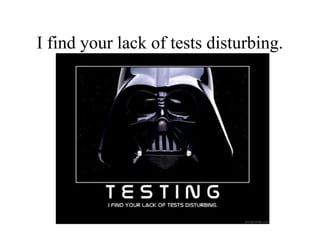
I find your lack of tests disturbing.
PETER KOFLER, CODE-COP.ORG                     FANATIC ABOUT CODE QUALITY


                     Wait - We Have Tests
  • almost every project has some “tests”
  • almost all of them are useless 
        – experiments how to use some library
        – main methods, waiting for user input, ...
        – tests that initialise the whole application and
          check nothing
        – tests that fail since long, etc.
                                              No You Don’t!
PETER KOFLER, CODE-COP.ORG                     FANATIC ABOUT CODE QUALITY


                             JUnit
  • a unit testing framework
  • active, dynamic black-box tests
        – some call it white-box tests (tbd)
  • works best with a number of small tests
  • You should know it (no excuses!)
        – You should use it (no excuses!)
        – I will not explain it here  www.junit.org
“Keep the bar green to keep the code clean”
PETER KOFLER, CODE-COP.ORG                    FANATIC ABOUT CODE QUALITY


                             Test Methods
  • unit test tests the methods of a single class
  • test case tests the response of a single
    method to a particular set of inputs
        – multiple test cases for a single method
        – public void testMethod() or @Test
        – test methods should be short, simple
        – tests without test methods are pointless
           Findbugs and PMD
PETER KOFLER, CODE-COP.ORG                       FANATIC ABOUT CODE QUALITY


                             Assertions
  • Don’t do any output from your unit tests!
  • check expectations programmatically
        – assertEquals,assertNull,assertTrue,...
        – test method without assert is pointless (PMD)
        – one test method - one assertion (tbd)
               • some work around PMD with assertTrue(true)
                   PMD: UnnecessaryBooleanAssertion
  • test runner reports failure on each test
PETER KOFLER, CODE-COP.ORG                       FANATIC ABOUT CODE QUALITY


                             Proper Assertions
  • add messages to asserts (tbd) ( PMD)
  • assertTrue(a.equals(b)) no message,
    better use assertEquals(a,b) ( PMD)
  • assert in Thread.run() not noticed
    ( Findbugs: IJU_...)
  • assert float in ranges of precision:
       assertEquals(expected, actual,
                    5*Math.ulp(expected))
PETER KOFLER, CODE-COP.ORG                    FANATIC ABOUT CODE QUALITY


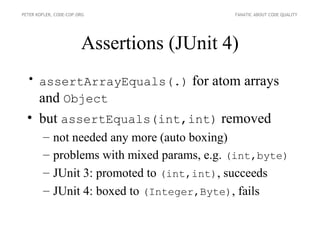
                        Assertions (JUnit 4)
  • assertArrayEquals(.) for atom arrays
    and Object
  • but assertEquals(int,int) removed
        –    not needed any more (auto boxing)
        –    problems with mixed params, e.g. (int,byte)
        –    JUnit 3: promoted to (int,int), succeeds
        –    JUnit 4: boxed to (Integer,Byte), fails
PETER KOFLER, CODE-COP.ORG               FANATIC ABOUT CODE QUALITY


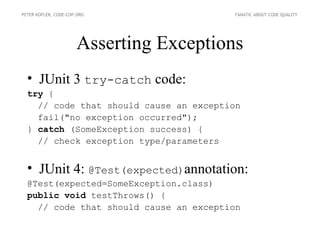
                      Asserting Exceptions
  • JUnit 3 try-catch code:
  try {
    // code that should cause an exception
    fail("no exception occurred");
  } catch (SomeException success) {
    // check exception type/parameters


  • JUnit 4: @Test(expected)annotation:
  @Test(expected=SomeException.class)
  public void testThrows() {
    // code that should cause an exception
PETER KOFLER, CODE-COP.ORG                        FANATIC ABOUT CODE QUALITY


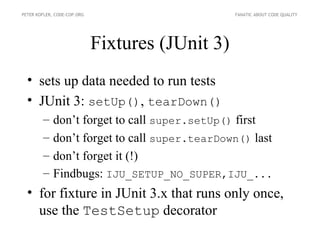
                             Fixtures (JUnit 3)
  • sets up data needed to run tests
  • JUnit 3: setUp(), tearDown()
        –    don’t forget to call super.setUp() first
        –    don’t forget to call super.tearDown() last
        –    don’t forget it (!)
        –    Findbugs: IJU_SETUP_NO_SUPER,IJU_...
  • for fixture in JUnit 3.x that runs only once,
    use the TestSetup decorator
PETER KOFLER, CODE-COP.ORG                    FANATIC ABOUT CODE QUALITY


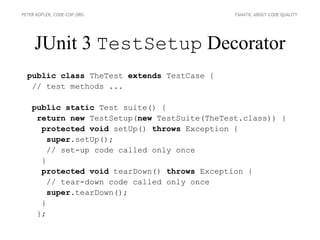
     JUnit 3 TestSetup Decorator
  public class TheTest extends TestCase {
   // test methods ...

    public static Test suite() {
     return new TestSetup(new TestSuite(TheTest.class)) {
      protected void setUp() throws Exception {
        super.setUp();
        // set-up code called only once
      }
      protected void tearDown() throws Exception {
        // tear-down code called only once
        super.tearDown();
      }
     };
PETER KOFLER, CODE-COP.ORG                      FANATIC ABOUT CODE QUALITY


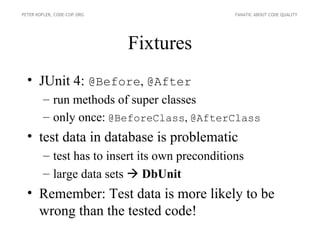
                             Fixtures
  • JUnit 4: @Before, @After
        – run methods of super classes
        – only once: @BeforeClass, @AfterClass
  • test data in database is problematic
        – test has to insert its own preconditions
        – large data sets  DbUnit
  • Remember: Test data is more likely to be
    wrong than the tested code!
PETER KOFLER, CODE-COP.ORG                          FANATIC ABOUT CODE QUALITY


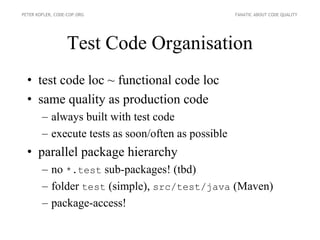
                  Test Code Organisation
  • test code loc ~ functional code loc
  • same quality as production code
        – always built with test code
        – execute tests as soon/often as possible
  • parallel package hierarchy
        – no *.test sub-packages! (tbd)
        – folder test (simple), src/test/java (Maven)
        – package-access!
PETER KOFLER, CODE-COP.ORG                FANATIC ABOUT CODE QUALITY


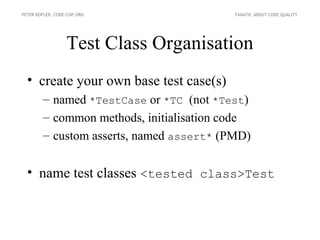
                  Test Class Organisation
  • create your own base test case(s)
        – named *TestCase or *TC (not *Test)
        – common methods, initialisation code
        – custom asserts, named assert* (PMD)


  • name test classes <tested class>Test
PETER KOFLER, CODE-COP.ORG                     FANATIC ABOUT CODE QUALITY


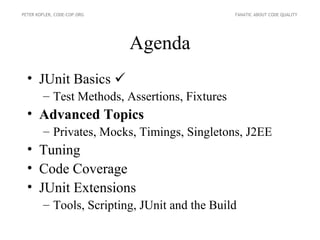
                             Agenda
  • JUnit Basics 
        – Test Methods, Assertions, Fixtures
  • Advanced Topics
        – Privates, Mocks, Timings, Singletons, J2EE
  • Tuning
  • Code Coverage
  • JUnit Extensions
        – Tools, Scripting, JUnit and the Build
PETER KOFLER, CODE-COP.ORG                    FANATIC ABOUT CODE QUALITY


                        Testing Private Data
  • “Wishing for White Box Testing (i.e. check
    a private field) is not a testing problem, it is
    a design problem.”
        – If you want to check internals - improve design.


  • if you have to:
        – Reflection: member.setAccessible(true)
Mocks
PETER KOFLER, CODE-COP.ORG                         FANATIC ABOUT CODE QUALITY


                        When to Use Mocks
  • To have a “real” unit test (cut dependencies)
  • “It is much simpler to simulate behaviour than
    it is to recreate that behaviour.”
  • use a mock when the real object is
        –   non-deterministic (e.g. current time)
        –   problematic during execution (e.g. user input)
        –   difficult to trigger (e.g. network error)
        –   not existing yet (team collaboration)
PETER KOFLER, CODE-COP.ORG                FANATIC ABOUT CODE QUALITY


                  How to Mock an Object
  • by hand
     – implement its interface (Eclipse Ctrl-1)
     – subclass it (beware complex constructors)
  • java.lang.reflect.Proxy
     – since 1.3
     – only for interfaces
     – nasty for more than 1 method
PETER KOFLER, CODE-COP.ORG                 FANATIC ABOUT CODE QUALITY


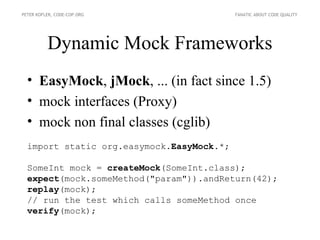
          Dynamic Mock Frameworks
  • EasyMock, jMock, ... (in fact since 1.5)
  • mock interfaces (Proxy)
  • mock non final classes (cglib)
  import static org.easymock.EasyMock.*;

  SomeInt mock = createMock(SomeInt.class);
  expect(mock.someMethod("param")).andReturn(42);
  replay(mock);
  // run the test which calls someMethod once
  verify(mock);
PETER KOFLER, CODE-COP.ORG                                                          FANATIC ABOUT CODE QUALITY


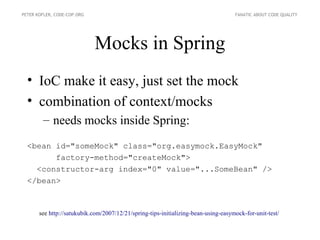
                             Mocks in Spring
  • IoC make it easy, just set the mock
  • combination of context/mocks
        – needs mocks inside Spring:
  <bean id="someMock" class="org.easymock.EasyMock"
        factory-method="createMock">
    <constructor-arg index="0" value="...SomeBean" />
  </bean>


       see http://satukubik.com/2007/12/21/spring-tips-initializing-bean-using-easymock-for-unit-test/
PETER KOFLER, CODE-COP.ORG                      FANATIC ABOUT CODE QUALITY


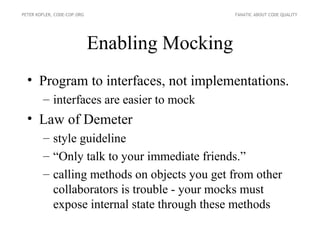
                             Enabling Mocking
  • Program to interfaces, not implementations.
        – interfaces are easier to mock
  • Law of Demeter
        – style guideline
        – “Only talk to your immediate friends.”
        – calling methods on objects you get from other
          collaborators is trouble - your mocks must
          expose internal state through these methods
PETER KOFLER, CODE-COP.ORG                       FANATIC ABOUT CODE QUALITY


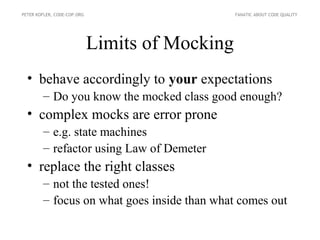
                             Limits of Mocking
  • behave accordingly to your expectations
        – Do you know the mocked class good enough?
  • complex mocks are error prone
        – e.g. state machines
        – refactor using Law of Demeter
  • replace the right classes
        – not the tested ones!
        – focus on what goes inside than what comes out
PETER KOFLER, CODE-COP.ORG                     FANATIC ABOUT CODE QUALITY


                             Testing Timings
  • timings (e.g. timeouts) are difficult
        – timing/scheduling is not guaranteed
        – short timings almost always fail
        – long timings slow down the execution
  • You will never get it right!
        – esp. not for Windows and Unix at same time
          mock the timer
PETER KOFLER, CODE-COP.ORG                            FANATIC ABOUT CODE QUALITY


                         Singletons are evil!
  • most overused design pattern
        – typical: public static Instance getInstance()
        – static methods (“mingletons”), e.g.
             System.currentTimeMillis()
        – static fields (“fingletons”)
        – ThreadLocal
  • most likely you have too many of them
       see http://c2.com/cgi/wiki?SingletonsAreEvil
PETER KOFLER, CODE-COP.ORG                        FANATIC ABOUT CODE QUALITY


                             Testing Singletons
  • problems for testing
        –    evil
        –    unknown dependencies
        –    initialisation often expensive (fixture)
        –    side effects in same class loader
        –    concurrency issues when testing in parallel
        –    can’t mock
PETER KOFLER, CODE-COP.ORG                        FANATIC ABOUT CODE QUALITY


   Testing Singletons “Brute Force”
  • straight forward
        – (fake) initialise singleton in fixture (setUp)
        – use Ant’s forkmode=“perTest”
        – slow2
  • if singletons can be reset
        – cleanup singleton in shutDown
        – make sure double initialisation fails
        – still slow, still no mock
PETER KOFLER, CODE-COP.ORG                               FANATIC ABOUT CODE QUALITY


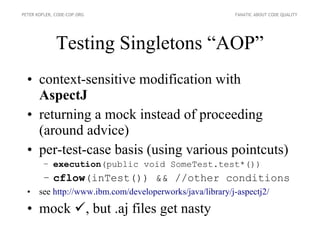
              Testing Singletons “AOP”
  • context-sensitive modification with
    AspectJ
  • returning a mock instead of proceeding
    (around advice)
  • per-test-case basis (using various pointcuts)
        – execution(public void SomeTest.test*())
        – cflow(inTest()) && //other conditions
  • see http://www.ibm.com/developerworks/java/library/j-aspectj2/

  • mock , but .aj files get nasty
PETER KOFLER, CODE-COP.ORG                      FANATIC ABOUT CODE QUALITY


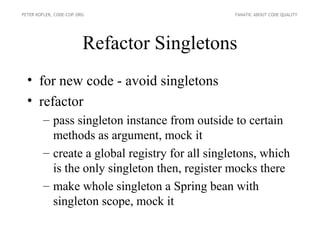
                         Refactor Singletons
  • for new code - avoid singletons
  • refactor
        – pass singleton instance from outside to certain
          methods as argument, mock it
        – create a global registry for all singletons, which
          is the only singleton then, register mocks there
        – make whole singleton a Spring bean with
          singleton scope, mock it
PETER KOFLER, CODE-COP.ORG               FANATIC ABOUT CODE QUALITY


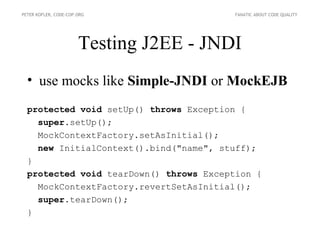
                       Testing J2EE - JNDI
  • use mocks like Simple-JNDI or MockEJB
  protected void setUp() throws Exception {
    super.setUp();
    MockContextFactory.setAsInitial();
    new InitialContext().bind("name", stuff);
  }
  protected void tearDown() throws Exception {
    MockContextFactory.revertSetAsInitial();
    super.tearDown();
  }
PETER KOFLER, CODE-COP.ORG                   FANATIC ABOUT CODE QUALITY


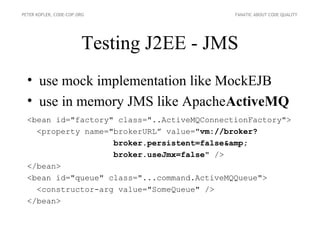
                        Testing J2EE - JMS
  • use mock implementation like MockEJB
  • use in memory JMS like ApacheActiveMQ
  <bean id="factory" class="..ActiveMQConnectionFactory">
    <property name="brokerURL” value="vm://broker?
                    broker.persistent=false&amp;
                    broker.useJmx=false" />
  </bean>
  <bean id="queue" class="...command.ActiveMQQueue">
    <constructor-arg value="SomeQueue" />
  </bean>
PETER KOFLER, CODE-COP.ORG                 FANATIC ABOUT CODE QUALITY


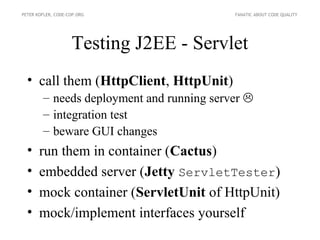
                    Testing J2EE - Servlet
  • call them (HttpClient, HttpUnit)
        – needs deployment and running server 
        – integration test
        – beware GUI changes
  •    run them in container (Cactus)
  •    embedded server (Jetty ServletTester)
  •    mock container (ServletUnit of HttpUnit)
  •    mock/implement interfaces yourself
PETER KOFLER, CODE-COP.ORG                FANATIC ABOUT CODE QUALITY


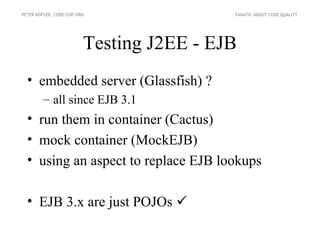
                         Testing J2EE - EJB
  • embedded server (Glassfish) ?
        – all since EJB 3.1
  • run them in container (Cactus)
  • mock container (MockEJB)
  • using an aspect to replace EJB lookups

  • EJB 3.x are just POJOs 
PETER KOFLER, CODE-COP.ORG                     FANATIC ABOUT CODE QUALITY


                             Agenda
  • JUnit Basics 
        – Test Methods, Assertions, Fixtures
  • Advanced Topics 
        – Privates, Mocks, Timings, Singletons, J2EE
  • Tuning
  • Code Coverage
  • JUnit Extensions
        – Tools, Scripting, JUnit and the Build
PETER KOFLER, CODE-COP.ORG                       FANATIC ABOUT CODE QUALITY


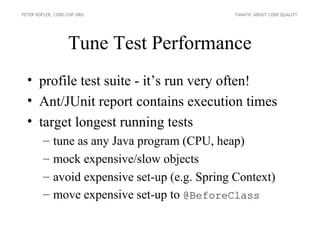
                   Tune Test Performance
  • profile test suite - it’s run very often!
  • Ant/JUnit report contains execution times
  • target longest running tests
        –    tune as any Java program (CPU, heap)
        –    mock expensive/slow objects
        –    avoid expensive set-up (e.g. Spring Context)
        –    move expensive set-up to @BeforeClass
PETER KOFLER, CODE-COP.ORG                FANATIC ABOUT CODE QUALITY


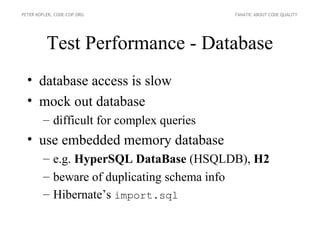
          Test Performance - Database
  • database access is slow
  • mock out database
        – difficult for complex queries
  • use embedded memory database
        – e.g. HyperSQL DataBase (HSQLDB), H2
        – beware of duplicating schema info
        – Hibernate’s import.sql
PETER KOFLER, CODE-COP.ORG                    FANATIC ABOUT CODE QUALITY


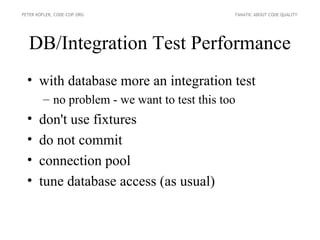
  DB/Integration Test Performance
  • with database more an integration test
        – no problem - we want to test this too
  •    don't use fixtures
  •    do not commit
  •    connection pool
  •    tune database access (as usual)
PETER KOFLER, CODE-COP.ORG                     FANATIC ABOUT CODE QUALITY


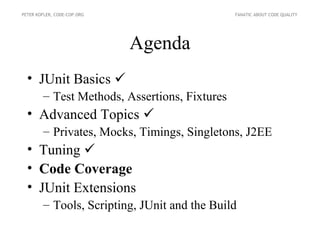
                             Agenda
  • JUnit Basics 
        – Test Methods, Assertions, Fixtures
  • Advanced Topics 
        – Privates, Mocks, Timings, Singletons, J2EE
  • Tuning 
  • Code Coverage
  • JUnit Extensions
        – Tools, Scripting, JUnit and the Build
PETER KOFLER, CODE-COP.ORG                      FANATIC ABOUT CODE QUALITY


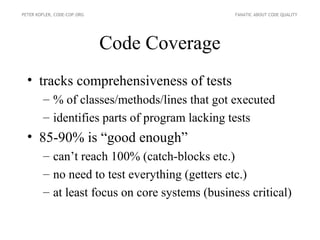
                             Code Coverage
  • tracks comprehensiveness of tests
        – % of classes/methods/lines that got executed
        – identifies parts of program lacking tests
  • 85-90% is “good enough”
        – can’t reach 100% (catch-blocks etc.)
        – no need to test everything (getters etc.)
        – at least focus on core systems (business critical)
PETER KOFLER, CODE-COP.ORG                           FANATIC ABOUT CODE QUALITY


                      Code Coverage Tools
  • EMMA
        –    instrument classes offline or on the fly
        –    detects partial coverage (if/short circuit)
        –    Ant, Maven, Eclipse (EclEmma)
        –    even able to track Eclipse plugins
        –    also used in test staging to test the testers
  • Cobertura
  • etc.
PETER KOFLER, CODE-COP.ORG                             FANATIC ABOUT CODE QUALITY


                             “Don’t Be Fooled”
  • comprehensiveness  quality!
        – high coverage does not mean anything
        – tools like AgitarOne create it
  • see http://www.ibm.com/developerworks/java/library/j-cq01316/

  • “Test state coverage, not code coverage.”
       (Pragmatic Tip 65)
        – difficult to measure
  • Crap4J “metric”
PETER KOFLER, CODE-COP.ORG                            FANATIC ABOUT CODE QUALITY


                      Development Process
  • code test & class (or class & test)
  • run tests with EclEmma (or on build)
        –    all important methods executed?
        –    all relevant if-branches executed?
        –    most common error cases executed?
        –    just browse the report line by line...
PETER KOFLER, CODE-COP.ORG              FANATIC ABOUT CODE QUALITY


                     How to Get Coverage
  • difficult to add tests to an existing program
  • wasn’t written with testing in mind
  • better to write tests before
      Test Driven Development (TDD)
                Red/Green/Refactor

  • Design to Test (Pragmatic Tip 48)
But How To Test This?
PETER KOFLER, CODE-COP.ORG                                     FANATIC ABOUT CODE QUALITY


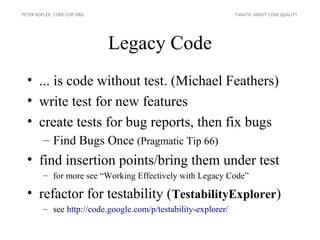
                             Legacy Code
  • ... is code without test. (Michael Feathers)
  • write test for new features
  • create tests for bug reports, then fix bugs
        – Find Bugs Once (Pragmatic Tip 66)
  • find insertion points/bring them under test
        – for more see “Working Effectively with Legacy Code”

  • refactor for testability (TestabilityExplorer)
        – see http://code.google.com/p/testability-explorer/
PETER KOFLER, CODE-COP.ORG                                FANATIC ABOUT CODE QUALITY


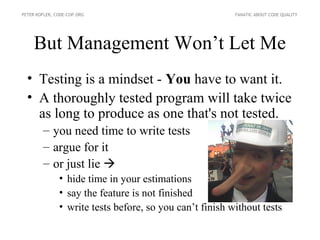
     But Management Won’t Let Me
  • Testing is a mindset - You have to want it.
  • A thoroughly tested program will take twice
    as long to produce as one that's not tested.
        – you need time to write tests
        – argue for it
        – or just lie 
               • hide time in your estimations
               • say the feature is not finished
               • write tests before, so you can’t finish without tests
PETER KOFLER, CODE-COP.ORG                     FANATIC ABOUT CODE QUALITY


                             Agenda
  • JUnit Basics 
        – Test Methods, Assertions, Fixtures
  • Advanced Topics 
        – Privates, Mocks, Timings, Singletons, J2EE
  • Tuning 
  • Code Coverage 
  • JUnit Extensions
        – Tools, Scripting, JUnit and the Build
PETER KOFLER, CODE-COP.ORG                      FANATIC ABOUT CODE QUALITY


                    JUnit Extensions (e.g.)
  • DbUnit - database fixtures
  • HtmlUnit/HttpUnit - GUI-less browser
        – typical for functional/integration tests
  • JUnitPerf - measure performance
        – no ordinary unit test  different package
  • SWTBot - UI testing SWT/Eclipse
  • XMLUnit - XML asserts
PETER KOFLER, CODE-COP.ORG                               FANATIC ABOUT CODE QUALITY


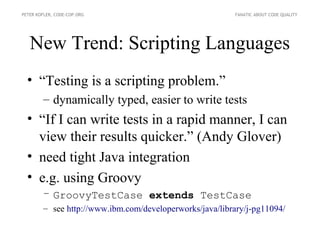
   New Trend: Scripting Languages
  • “Testing is a scripting problem.”
        – dynamically typed, easier to write tests
  • “If I can write tests in a rapid manner, I can
    view their results quicker.” (Andy Glover)
  • need tight Java integration
  • e.g. using Groovy
        – GroovyTestCase extends TestCase
        – see http://www.ibm.com/developerworks/java/library/j-pg11094/
PETER KOFLER, CODE-COP.ORG                    FANATIC ABOUT CODE QUALITY


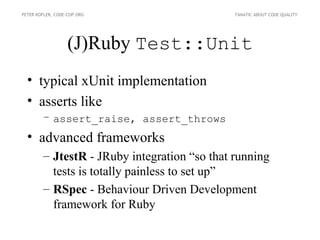
                   (J)Ruby Test::Unit
  • typical xUnit implementation
  • asserts like
        – assert_raise, assert_throws
  • advanced frameworks
        – JtestR - JRuby integration “so that running
          tests is totally painless to set up”
        – RSpec - Behaviour Driven Development
          framework for Ruby
PETER KOFLER, CODE-COP.ORG                 FANATIC ABOUT CODE QUALITY


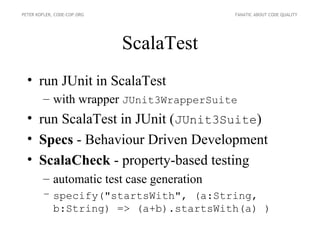
                             ScalaTest
  • run JUnit in ScalaTest
        – with wrapper JUnit3WrapperSuite
  • run ScalaTest in JUnit (JUnit3Suite)
  • Specs - Behaviour Driven Development
  • ScalaCheck - property-based testing
        – automatic test case generation
        – specify("startsWith", (a:String,
          b:String) => (a+b).startsWith(a) )
PETER KOFLER, CODE-COP.ORG                      FANATIC ABOUT CODE QUALITY


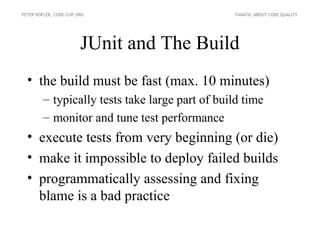
                        JUnit and The Build
  • the build must be fast (max. 10 minutes)
        – typically tests take large part of build time
        – monitor and tune test performance
  • execute tests from very beginning (or die)
  • make it impossible to deploy failed builds
  • programmatically assessing and fixing
    blame is a bad practice
PETER KOFLER, CODE-COP.ORG                    FANATIC ABOUT CODE QUALITY


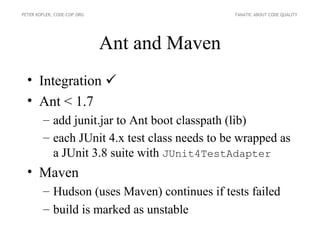
                             Ant and Maven
  • Integration 
  • Ant < 1.7
        – add junit.jar to Ant boot classpath (lib)
        – each JUnit 4.x test class needs to be wrapped as
          a JUnit 3.8 suite with JUnit4TestAdapter
  • Maven
        – Hudson (uses Maven) continues if tests failed
        – build is marked as unstable
PETER KOFLER, CODE-COP.ORG                     FANATIC ABOUT CODE QUALITY


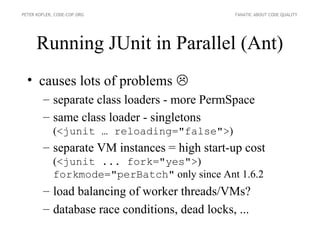
      Running JUnit in Parallel (Ant)
  • causes lots of problems 
        – separate class loaders - more PermSpace
        – same class loader - singletons
             (<junit … reloading="false">)
        – separate VM instances = high start-up cost
             (<junit ... fork="yes">)
             forkmode="perBatch" only since Ant 1.6.2
        – load balancing of worker threads/VMs?
        – database race conditions, dead locks, ...
PETER KOFLER, CODE-COP.ORG                       FANATIC ABOUT CODE QUALITY


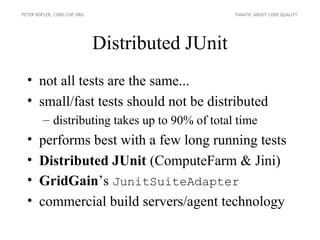
                             Distributed JUnit
  • not all tests are the same...
  • small/fast tests should not be distributed
        – distributing takes up to 90% of total time
  •    performs best with a few long running tests
  •    Distributed JUnit (ComputeFarm & Jini)
  •    GridGain’s JunitSuiteAdapter
  •    commercial build servers/agent technology
PETER KOFLER, CODE-COP.ORG                      FANATIC ABOUT CODE QUALITY


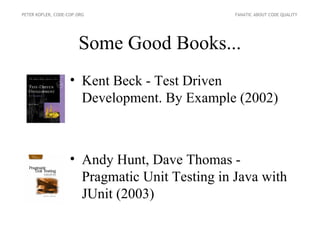
                       Some Good Books...
                    • Kent Beck - Test Driven
                      Development. By Example (2002)


                    • Andy Hunt, Dave Thomas -
                      Pragmatic Unit Testing in Java with
                      JUnit (2003)
PETER KOFLER, CODE-COP.ORG                      FANATIC ABOUT CODE QUALITY


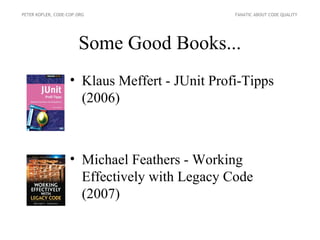
                       Some Good Books...
                    • Klaus Meffert - JUnit Profi-Tipps
                      (2006)


                    • Michael Feathers - Working
                      Effectively with Legacy Code
                      (2007)
Now go and write some tests!
PETER KOFLER, CODE-COP.ORG         FANATIC ABOUT CODE QUALITY


                             Q&A
  • Thank you for listening.
PETER KOFLER, CODE-COP.ORG             FANATIC ABOUT CODE QUALITY


                                Peter Kofler

                             @codecopkofler

             www.code-cop.org
PETER KOFLER, CODE-COP.ORG                                    FANATIC ABOUT CODE QUALITY


                             Image Sources
             •    http://rubystammtisch.at/


             •    http://www.flickr.com/photos/43442082@N00/296362882/


             •    http://www.flickr.com/photos/eszter/144393616/


             •    http://www.flickr.com/photos/sneddon/2413980712/
PETER KOFLER, CODE-COP.ORG                                    FANATIC ABOUT CODE QUALITY


                             Image Sources
             •    http://www.flickr.com/photos/paopix/184238679/


             •    http://www.flickr.com/photos/teotwawki/164966631/


             •    http://www.flickr.com/photos/paulk/3166328163/


             •    http://www.flickr.com/photos/otolithe/1831281833/
PETER KOFLER, CODE-COP.ORG                                    FANATIC ABOUT CODE QUALITY


                             Image Sources
             •    http://www.flickr.com/photos/rainforestactionnetwork/420117729/


             •    http://www.flickr.com/photos/ppdigital/2054989998/


             •    http://www.flickr.com/photos/good_day/48642035/

             •    http://www.flickr.com/photos/shelley13/2653029303/

Practical (J)Unit Testing (2009)

  • 1.
    Practical Unit Testing: “Goodprogrammers write code, great programmers write tests.” Java Student User Group 2009 Peter Kofler, ‘Code Cop’ @codecopkofler www.code-cop.org Copyright Peter Kofler, licensed under CC-BY.
  • 2.
    PETER KOFLER, CODE-COP.ORG FANATIC ABOUT CODE QUALITY Peter Kofler • Ph.D. in Applied Math • Java developer since 1999 • fanatic about code quality • appointed ‘Code Cop’ in 2006 • Senior Software Engineer at s-IT Solutions
  • 3.
    PETER KOFLER, CODE-COP.ORG FANATIC ABOUT CODE QUALITY Agenda • JUnit Basics – Test Methods, Assertions, Fixtures • Advanced Topics – Privates, Mocks, Timings, Singletons, J2EE • Tuning • Code Coverage • JUnit Extensions – Tools, Scripting, JUnit and the Build
  • 4.
    PETER KOFLER, CODE-COP.ORG FANATIC ABOUT CODE QUALITY A Little Survey... • Who knows xUnit? • Who knows JUnit 4? • Who ever wrote a unit test? • Who writes tests and tries to write them first? • Who checks the coverage? • Who ever produced a bug?
  • 5.
    PETER KOFLER, CODE-COP.ORG FANATIC ABOUT CODE QUALITY We Make Mistakes • at least I do...  • number of bugs proportional loc – 2 bugs per 1.000 loc (7 or even more...) – 1 bug per 10.000 loc in critical software • be paranoid when you write software – Assume you have lots of bugs. – Try to find these bugs aggressively.
  • 6.
    I find yourlack of tests disturbing.
  • 7.
    PETER KOFLER, CODE-COP.ORG FANATIC ABOUT CODE QUALITY Wait - We Have Tests • almost every project has some “tests” • almost all of them are useless  – experiments how to use some library – main methods, waiting for user input, ... – tests that initialise the whole application and check nothing – tests that fail since long, etc. No You Don’t!
  • 8.
    PETER KOFLER, CODE-COP.ORG FANATIC ABOUT CODE QUALITY JUnit • a unit testing framework • active, dynamic black-box tests – some call it white-box tests (tbd) • works best with a number of small tests • You should know it (no excuses!) – You should use it (no excuses!) – I will not explain it here  www.junit.org
  • 9.
    “Keep the bargreen to keep the code clean”
  • 10.
    PETER KOFLER, CODE-COP.ORG FANATIC ABOUT CODE QUALITY Test Methods • unit test tests the methods of a single class • test case tests the response of a single method to a particular set of inputs – multiple test cases for a single method – public void testMethod() or @Test – test methods should be short, simple – tests without test methods are pointless  Findbugs and PMD
  • 11.
    PETER KOFLER, CODE-COP.ORG FANATIC ABOUT CODE QUALITY Assertions • Don’t do any output from your unit tests! • check expectations programmatically – assertEquals,assertNull,assertTrue,... – test method without assert is pointless (PMD) – one test method - one assertion (tbd) • some work around PMD with assertTrue(true)  PMD: UnnecessaryBooleanAssertion • test runner reports failure on each test
  • 12.
    PETER KOFLER, CODE-COP.ORG FANATIC ABOUT CODE QUALITY Proper Assertions • add messages to asserts (tbd) ( PMD) • assertTrue(a.equals(b)) no message, better use assertEquals(a,b) ( PMD) • assert in Thread.run() not noticed ( Findbugs: IJU_...) • assert float in ranges of precision: assertEquals(expected, actual, 5*Math.ulp(expected))
  • 13.
    PETER KOFLER, CODE-COP.ORG FANATIC ABOUT CODE QUALITY Assertions (JUnit 4) • assertArrayEquals(.) for atom arrays and Object • but assertEquals(int,int) removed – not needed any more (auto boxing) – problems with mixed params, e.g. (int,byte) – JUnit 3: promoted to (int,int), succeeds – JUnit 4: boxed to (Integer,Byte), fails
  • 14.
    PETER KOFLER, CODE-COP.ORG FANATIC ABOUT CODE QUALITY Asserting Exceptions • JUnit 3 try-catch code: try { // code that should cause an exception fail("no exception occurred"); } catch (SomeException success) { // check exception type/parameters • JUnit 4: @Test(expected)annotation: @Test(expected=SomeException.class) public void testThrows() { // code that should cause an exception
  • 15.
    PETER KOFLER, CODE-COP.ORG FANATIC ABOUT CODE QUALITY Fixtures (JUnit 3) • sets up data needed to run tests • JUnit 3: setUp(), tearDown() – don’t forget to call super.setUp() first – don’t forget to call super.tearDown() last – don’t forget it (!) – Findbugs: IJU_SETUP_NO_SUPER,IJU_... • for fixture in JUnit 3.x that runs only once, use the TestSetup decorator
  • 16.
    PETER KOFLER, CODE-COP.ORG FANATIC ABOUT CODE QUALITY JUnit 3 TestSetup Decorator public class TheTest extends TestCase { // test methods ... public static Test suite() { return new TestSetup(new TestSuite(TheTest.class)) { protected void setUp() throws Exception { super.setUp(); // set-up code called only once } protected void tearDown() throws Exception { // tear-down code called only once super.tearDown(); } };
  • 17.
    PETER KOFLER, CODE-COP.ORG FANATIC ABOUT CODE QUALITY Fixtures • JUnit 4: @Before, @After – run methods of super classes – only once: @BeforeClass, @AfterClass • test data in database is problematic – test has to insert its own preconditions – large data sets  DbUnit • Remember: Test data is more likely to be wrong than the tested code!
  • 18.
    PETER KOFLER, CODE-COP.ORG FANATIC ABOUT CODE QUALITY Test Code Organisation • test code loc ~ functional code loc • same quality as production code – always built with test code – execute tests as soon/often as possible • parallel package hierarchy – no *.test sub-packages! (tbd) – folder test (simple), src/test/java (Maven) – package-access!
  • 19.
    PETER KOFLER, CODE-COP.ORG FANATIC ABOUT CODE QUALITY Test Class Organisation • create your own base test case(s) – named *TestCase or *TC (not *Test) – common methods, initialisation code – custom asserts, named assert* (PMD) • name test classes <tested class>Test
  • 21.
    PETER KOFLER, CODE-COP.ORG FANATIC ABOUT CODE QUALITY Agenda • JUnit Basics  – Test Methods, Assertions, Fixtures • Advanced Topics – Privates, Mocks, Timings, Singletons, J2EE • Tuning • Code Coverage • JUnit Extensions – Tools, Scripting, JUnit and the Build
  • 22.
    PETER KOFLER, CODE-COP.ORG FANATIC ABOUT CODE QUALITY Testing Private Data • “Wishing for White Box Testing (i.e. check a private field) is not a testing problem, it is a design problem.” – If you want to check internals - improve design. • if you have to: – Reflection: member.setAccessible(true)
  • 23.
  • 24.
    PETER KOFLER, CODE-COP.ORG FANATIC ABOUT CODE QUALITY When to Use Mocks • To have a “real” unit test (cut dependencies) • “It is much simpler to simulate behaviour than it is to recreate that behaviour.” • use a mock when the real object is – non-deterministic (e.g. current time) – problematic during execution (e.g. user input) – difficult to trigger (e.g. network error) – not existing yet (team collaboration)
  • 25.
    PETER KOFLER, CODE-COP.ORG FANATIC ABOUT CODE QUALITY How to Mock an Object • by hand – implement its interface (Eclipse Ctrl-1) – subclass it (beware complex constructors) • java.lang.reflect.Proxy – since 1.3 – only for interfaces – nasty for more than 1 method
  • 26.
    PETER KOFLER, CODE-COP.ORG FANATIC ABOUT CODE QUALITY Dynamic Mock Frameworks • EasyMock, jMock, ... (in fact since 1.5) • mock interfaces (Proxy) • mock non final classes (cglib) import static org.easymock.EasyMock.*; SomeInt mock = createMock(SomeInt.class); expect(mock.someMethod("param")).andReturn(42); replay(mock); // run the test which calls someMethod once verify(mock);
  • 27.
    PETER KOFLER, CODE-COP.ORG FANATIC ABOUT CODE QUALITY Mocks in Spring • IoC make it easy, just set the mock • combination of context/mocks – needs mocks inside Spring: <bean id="someMock" class="org.easymock.EasyMock" factory-method="createMock"> <constructor-arg index="0" value="...SomeBean" /> </bean> see http://satukubik.com/2007/12/21/spring-tips-initializing-bean-using-easymock-for-unit-test/
  • 28.
    PETER KOFLER, CODE-COP.ORG FANATIC ABOUT CODE QUALITY Enabling Mocking • Program to interfaces, not implementations. – interfaces are easier to mock • Law of Demeter – style guideline – “Only talk to your immediate friends.” – calling methods on objects you get from other collaborators is trouble - your mocks must expose internal state through these methods
  • 29.
    PETER KOFLER, CODE-COP.ORG FANATIC ABOUT CODE QUALITY Limits of Mocking • behave accordingly to your expectations – Do you know the mocked class good enough? • complex mocks are error prone – e.g. state machines – refactor using Law of Demeter • replace the right classes – not the tested ones! – focus on what goes inside than what comes out
  • 30.
    PETER KOFLER, CODE-COP.ORG FANATIC ABOUT CODE QUALITY Testing Timings • timings (e.g. timeouts) are difficult – timing/scheduling is not guaranteed – short timings almost always fail – long timings slow down the execution • You will never get it right! – esp. not for Windows and Unix at same time  mock the timer
  • 32.
    PETER KOFLER, CODE-COP.ORG FANATIC ABOUT CODE QUALITY Singletons are evil! • most overused design pattern – typical: public static Instance getInstance() – static methods (“mingletons”), e.g. System.currentTimeMillis() – static fields (“fingletons”) – ThreadLocal • most likely you have too many of them see http://c2.com/cgi/wiki?SingletonsAreEvil
  • 33.
    PETER KOFLER, CODE-COP.ORG FANATIC ABOUT CODE QUALITY Testing Singletons • problems for testing – evil – unknown dependencies – initialisation often expensive (fixture) – side effects in same class loader – concurrency issues when testing in parallel – can’t mock
  • 34.
    PETER KOFLER, CODE-COP.ORG FANATIC ABOUT CODE QUALITY Testing Singletons “Brute Force” • straight forward – (fake) initialise singleton in fixture (setUp) – use Ant’s forkmode=“perTest” – slow2 • if singletons can be reset – cleanup singleton in shutDown – make sure double initialisation fails – still slow, still no mock
  • 35.
    PETER KOFLER, CODE-COP.ORG FANATIC ABOUT CODE QUALITY Testing Singletons “AOP” • context-sensitive modification with AspectJ • returning a mock instead of proceeding (around advice) • per-test-case basis (using various pointcuts) – execution(public void SomeTest.test*()) – cflow(inTest()) && //other conditions • see http://www.ibm.com/developerworks/java/library/j-aspectj2/ • mock , but .aj files get nasty
  • 36.
    PETER KOFLER, CODE-COP.ORG FANATIC ABOUT CODE QUALITY Refactor Singletons • for new code - avoid singletons • refactor – pass singleton instance from outside to certain methods as argument, mock it – create a global registry for all singletons, which is the only singleton then, register mocks there – make whole singleton a Spring bean with singleton scope, mock it
  • 37.
    PETER KOFLER, CODE-COP.ORG FANATIC ABOUT CODE QUALITY Testing J2EE - JNDI • use mocks like Simple-JNDI or MockEJB protected void setUp() throws Exception { super.setUp(); MockContextFactory.setAsInitial(); new InitialContext().bind("name", stuff); } protected void tearDown() throws Exception { MockContextFactory.revertSetAsInitial(); super.tearDown(); }
  • 38.
    PETER KOFLER, CODE-COP.ORG FANATIC ABOUT CODE QUALITY Testing J2EE - JMS • use mock implementation like MockEJB • use in memory JMS like ApacheActiveMQ <bean id="factory" class="..ActiveMQConnectionFactory"> <property name="brokerURL” value="vm://broker? broker.persistent=false&amp; broker.useJmx=false" /> </bean> <bean id="queue" class="...command.ActiveMQQueue"> <constructor-arg value="SomeQueue" /> </bean>
  • 39.
    PETER KOFLER, CODE-COP.ORG FANATIC ABOUT CODE QUALITY Testing J2EE - Servlet • call them (HttpClient, HttpUnit) – needs deployment and running server  – integration test – beware GUI changes • run them in container (Cactus) • embedded server (Jetty ServletTester) • mock container (ServletUnit of HttpUnit) • mock/implement interfaces yourself
  • 40.
    PETER KOFLER, CODE-COP.ORG FANATIC ABOUT CODE QUALITY Testing J2EE - EJB • embedded server (Glassfish) ? – all since EJB 3.1 • run them in container (Cactus) • mock container (MockEJB) • using an aspect to replace EJB lookups • EJB 3.x are just POJOs 
  • 42.
    PETER KOFLER, CODE-COP.ORG FANATIC ABOUT CODE QUALITY Agenda • JUnit Basics  – Test Methods, Assertions, Fixtures • Advanced Topics  – Privates, Mocks, Timings, Singletons, J2EE • Tuning • Code Coverage • JUnit Extensions – Tools, Scripting, JUnit and the Build
  • 43.
    PETER KOFLER, CODE-COP.ORG FANATIC ABOUT CODE QUALITY Tune Test Performance • profile test suite - it’s run very often! • Ant/JUnit report contains execution times • target longest running tests – tune as any Java program (CPU, heap) – mock expensive/slow objects – avoid expensive set-up (e.g. Spring Context) – move expensive set-up to @BeforeClass
  • 44.
    PETER KOFLER, CODE-COP.ORG FANATIC ABOUT CODE QUALITY Test Performance - Database • database access is slow • mock out database – difficult for complex queries • use embedded memory database – e.g. HyperSQL DataBase (HSQLDB), H2 – beware of duplicating schema info – Hibernate’s import.sql
  • 45.
    PETER KOFLER, CODE-COP.ORG FANATIC ABOUT CODE QUALITY DB/Integration Test Performance • with database more an integration test – no problem - we want to test this too • don't use fixtures • do not commit • connection pool • tune database access (as usual)
  • 47.
    PETER KOFLER, CODE-COP.ORG FANATIC ABOUT CODE QUALITY Agenda • JUnit Basics  – Test Methods, Assertions, Fixtures • Advanced Topics  – Privates, Mocks, Timings, Singletons, J2EE • Tuning  • Code Coverage • JUnit Extensions – Tools, Scripting, JUnit and the Build
  • 48.
    PETER KOFLER, CODE-COP.ORG FANATIC ABOUT CODE QUALITY Code Coverage • tracks comprehensiveness of tests – % of classes/methods/lines that got executed – identifies parts of program lacking tests • 85-90% is “good enough” – can’t reach 100% (catch-blocks etc.) – no need to test everything (getters etc.) – at least focus on core systems (business critical)
  • 49.
    PETER KOFLER, CODE-COP.ORG FANATIC ABOUT CODE QUALITY Code Coverage Tools • EMMA – instrument classes offline or on the fly – detects partial coverage (if/short circuit) – Ant, Maven, Eclipse (EclEmma) – even able to track Eclipse plugins – also used in test staging to test the testers • Cobertura • etc.
  • 50.
    PETER KOFLER, CODE-COP.ORG FANATIC ABOUT CODE QUALITY “Don’t Be Fooled” • comprehensiveness  quality! – high coverage does not mean anything – tools like AgitarOne create it • see http://www.ibm.com/developerworks/java/library/j-cq01316/ • “Test state coverage, not code coverage.” (Pragmatic Tip 65) – difficult to measure • Crap4J “metric”
  • 51.
    PETER KOFLER, CODE-COP.ORG FANATIC ABOUT CODE QUALITY Development Process • code test & class (or class & test) • run tests with EclEmma (or on build) – all important methods executed? – all relevant if-branches executed? – most common error cases executed? – just browse the report line by line...
  • 52.
    PETER KOFLER, CODE-COP.ORG FANATIC ABOUT CODE QUALITY How to Get Coverage • difficult to add tests to an existing program • wasn’t written with testing in mind • better to write tests before  Test Driven Development (TDD) Red/Green/Refactor • Design to Test (Pragmatic Tip 48)
  • 53.
    But How ToTest This?
  • 54.
    PETER KOFLER, CODE-COP.ORG FANATIC ABOUT CODE QUALITY Legacy Code • ... is code without test. (Michael Feathers) • write test for new features • create tests for bug reports, then fix bugs – Find Bugs Once (Pragmatic Tip 66) • find insertion points/bring them under test – for more see “Working Effectively with Legacy Code” • refactor for testability (TestabilityExplorer) – see http://code.google.com/p/testability-explorer/
  • 55.
    PETER KOFLER, CODE-COP.ORG FANATIC ABOUT CODE QUALITY But Management Won’t Let Me • Testing is a mindset - You have to want it. • A thoroughly tested program will take twice as long to produce as one that's not tested. – you need time to write tests – argue for it – or just lie  • hide time in your estimations • say the feature is not finished • write tests before, so you can’t finish without tests
  • 57.
    PETER KOFLER, CODE-COP.ORG FANATIC ABOUT CODE QUALITY Agenda • JUnit Basics  – Test Methods, Assertions, Fixtures • Advanced Topics  – Privates, Mocks, Timings, Singletons, J2EE • Tuning  • Code Coverage  • JUnit Extensions – Tools, Scripting, JUnit and the Build
  • 58.
    PETER KOFLER, CODE-COP.ORG FANATIC ABOUT CODE QUALITY JUnit Extensions (e.g.) • DbUnit - database fixtures • HtmlUnit/HttpUnit - GUI-less browser – typical for functional/integration tests • JUnitPerf - measure performance – no ordinary unit test  different package • SWTBot - UI testing SWT/Eclipse • XMLUnit - XML asserts
  • 59.
    PETER KOFLER, CODE-COP.ORG FANATIC ABOUT CODE QUALITY New Trend: Scripting Languages • “Testing is a scripting problem.” – dynamically typed, easier to write tests • “If I can write tests in a rapid manner, I can view their results quicker.” (Andy Glover) • need tight Java integration • e.g. using Groovy – GroovyTestCase extends TestCase – see http://www.ibm.com/developerworks/java/library/j-pg11094/
  • 60.
    PETER KOFLER, CODE-COP.ORG FANATIC ABOUT CODE QUALITY (J)Ruby Test::Unit • typical xUnit implementation • asserts like – assert_raise, assert_throws • advanced frameworks – JtestR - JRuby integration “so that running tests is totally painless to set up” – RSpec - Behaviour Driven Development framework for Ruby
  • 61.
    PETER KOFLER, CODE-COP.ORG FANATIC ABOUT CODE QUALITY ScalaTest • run JUnit in ScalaTest – with wrapper JUnit3WrapperSuite • run ScalaTest in JUnit (JUnit3Suite) • Specs - Behaviour Driven Development • ScalaCheck - property-based testing – automatic test case generation – specify("startsWith", (a:String, b:String) => (a+b).startsWith(a) )
  • 62.
    PETER KOFLER, CODE-COP.ORG FANATIC ABOUT CODE QUALITY JUnit and The Build • the build must be fast (max. 10 minutes) – typically tests take large part of build time – monitor and tune test performance • execute tests from very beginning (or die) • make it impossible to deploy failed builds • programmatically assessing and fixing blame is a bad practice
  • 63.
    PETER KOFLER, CODE-COP.ORG FANATIC ABOUT CODE QUALITY Ant and Maven • Integration  • Ant < 1.7 – add junit.jar to Ant boot classpath (lib) – each JUnit 4.x test class needs to be wrapped as a JUnit 3.8 suite with JUnit4TestAdapter • Maven – Hudson (uses Maven) continues if tests failed – build is marked as unstable
  • 64.
    PETER KOFLER, CODE-COP.ORG FANATIC ABOUT CODE QUALITY Running JUnit in Parallel (Ant) • causes lots of problems  – separate class loaders - more PermSpace – same class loader - singletons (<junit … reloading="false">) – separate VM instances = high start-up cost (<junit ... fork="yes">) forkmode="perBatch" only since Ant 1.6.2 – load balancing of worker threads/VMs? – database race conditions, dead locks, ...
  • 65.
    PETER KOFLER, CODE-COP.ORG FANATIC ABOUT CODE QUALITY Distributed JUnit • not all tests are the same... • small/fast tests should not be distributed – distributing takes up to 90% of total time • performs best with a few long running tests • Distributed JUnit (ComputeFarm & Jini) • GridGain’s JunitSuiteAdapter • commercial build servers/agent technology
  • 67.
    PETER KOFLER, CODE-COP.ORG FANATIC ABOUT CODE QUALITY Some Good Books... • Kent Beck - Test Driven Development. By Example (2002) • Andy Hunt, Dave Thomas - Pragmatic Unit Testing in Java with JUnit (2003)
  • 68.
    PETER KOFLER, CODE-COP.ORG FANATIC ABOUT CODE QUALITY Some Good Books... • Klaus Meffert - JUnit Profi-Tipps (2006) • Michael Feathers - Working Effectively with Legacy Code (2007)
  • 69.
    Now go andwrite some tests!
  • 70.
    PETER KOFLER, CODE-COP.ORG FANATIC ABOUT CODE QUALITY Q&A • Thank you for listening.
  • 71.
    PETER KOFLER, CODE-COP.ORG FANATIC ABOUT CODE QUALITY Peter Kofler @codecopkofler www.code-cop.org
  • 72.
    PETER KOFLER, CODE-COP.ORG FANATIC ABOUT CODE QUALITY Image Sources • http://rubystammtisch.at/ • http://www.flickr.com/photos/43442082@N00/296362882/ • http://www.flickr.com/photos/eszter/144393616/ • http://www.flickr.com/photos/sneddon/2413980712/
  • 73.
    PETER KOFLER, CODE-COP.ORG FANATIC ABOUT CODE QUALITY Image Sources • http://www.flickr.com/photos/paopix/184238679/ • http://www.flickr.com/photos/teotwawki/164966631/ • http://www.flickr.com/photos/paulk/3166328163/ • http://www.flickr.com/photos/otolithe/1831281833/
  • 74.
    PETER KOFLER, CODE-COP.ORG FANATIC ABOUT CODE QUALITY Image Sources • http://www.flickr.com/photos/rainforestactionnetwork/420117729/ • http://www.flickr.com/photos/ppdigital/2054989998/ • http://www.flickr.com/photos/good_day/48642035/ • http://www.flickr.com/photos/shelley13/2653029303/