PR9:
REGULATION
Lauren Allard
Ofcom regulate TV, radio and many other
services. They make sure that the people of
the UK get the best from their
communications services and to make sure
that they are protected from scams and
sharp practises. They make sure that
television and radio services are provided
by a range of different organisations.
They make sure that people who watch TV
and listen to the Radio do not listen or
view any offensive or inappropriate
content.
WHO ARE
OFCOM?
Ofcom has the same job with radio as it
does with television. Their job is to make
sure that no offensive content or abusive
content is aired on any radio station, they
set out rules that radio stations have to
follow. If any complaints about that radio
station/show are sent to Ofcom, they can
either ban the show or remove the
presenter from that show and get them
easily replaced.
They make sure that radio services are
provided by a range of different
organisations. They make sure that none of
the public’s privacy is invaded during a
radio show and they also protect people
from being treated unfairly in a radio
programme.
HOW DOES
OFCOM
REGULATE
RADIO?
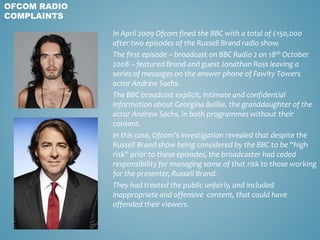
In April 2009 Ofcom fined the BBC with a total of £150,000
after two episodes of the Russell Brand radio show.
The first episode – broadcast on BBC Radio 2 on 18th October
2008 – featured Brand and guest Jonathan Ross leaving a
series of messages on the answer phone of Fawlty Towers
actor Andrew Sachs.
The BBC broadcast explicit, intimate and confidential
information about Georgina Baillie, the granddaughter of the
actor Andrew Sachs, in both programmes without their
consent.
In this case, Ofcom’s investigation revealed that despite the
Russell Brand show being considered by the BBC to be “high
risk” prior to these episodes, the broadcaster had ceded
responsibility for managing some of that risk to those working
for the presenter, Russell Brand.
They had treated the public unfairly, and included
inappropriate and offensive content, that could have
offended their viewers.
OFCOM RADIO
COMPLAINTS
The Commercial Radio Companies
Association is the trade body for UK
commercial Radio. It represents
commercial radio to Government, the
radio authority , copyright and other
organisations concerned with radio.
It manages the Radio Advertising Clearance
Centre which clears national and special
category advertisements prior to
broadcast.
CRCA members include national radio
stations, as well as most local and regional
stations.
COMMERCIAL
RADIO
COMPANIES
ASSOCIATION
(CRCA)
The Advertising Standards Authority makes sure that no
inappropriate content is included in advertisements. They
have a list of rules that all advertising companies have to
follow. These rules include:
 No offense to Religion
 No nudity
 No offensive language
 No one should be seen drinking alcohol alone
 No smoking
 No sexual content
Many more follow these rules, if these rules are not met
then the advert can be banned from television or radio, it
can be set to a later time of day when younger viewers are
less likely to see the advert. (After 9pm). It doesn’t take
just many complaints to the ASA for an advert to get
banned it can take only one, if the ASA agree with the
complaint then the advert can easily be banned or set to
be aired at a later time of day.
ADVERTISING
STANDARDS
AUTHORITY
(ASA)
PRS – PRS for Music represents members’ performing
rights, whenever a piece of music is performed or played in
any public space or place outside of the home. Performing
rights royalties are paid to a songwriter, composer or
publisher whenever their music is played or performed in
any public space or place.
This includes TV, radio, online, in a shop, an office, pub or
restaurant, at a concert, a sporting event and thousands of
other places.
MCPS – represents members’ mechanical rights, whenever
a piece of music is reproduced as a physical product.
Mechanical rights royalties are different to performing
rights as they are paid to the songwriter, composer or
publisher when music is reproduced as a physical product
or for broadcast or online.
MECHANICAL
COPYRIGHT
PROTECTION
SOCIETY-
PERFORMING
RIGHT
SOCIETY
ALLIANCE
(MCPS-PRS)

Pr9: Regulation

  • 1.
  • 2.
    Ofcom regulate TV,radio and many other services. They make sure that the people of the UK get the best from their communications services and to make sure that they are protected from scams and sharp practises. They make sure that television and radio services are provided by a range of different organisations. They make sure that people who watch TV and listen to the Radio do not listen or view any offensive or inappropriate content. WHO ARE OFCOM?
  • 3.
    Ofcom has thesame job with radio as it does with television. Their job is to make sure that no offensive content or abusive content is aired on any radio station, they set out rules that radio stations have to follow. If any complaints about that radio station/show are sent to Ofcom, they can either ban the show or remove the presenter from that show and get them easily replaced. They make sure that radio services are provided by a range of different organisations. They make sure that none of the public’s privacy is invaded during a radio show and they also protect people from being treated unfairly in a radio programme. HOW DOES OFCOM REGULATE RADIO?
  • 4.
    In April 2009Ofcom fined the BBC with a total of £150,000 after two episodes of the Russell Brand radio show. The first episode – broadcast on BBC Radio 2 on 18th October 2008 – featured Brand and guest Jonathan Ross leaving a series of messages on the answer phone of Fawlty Towers actor Andrew Sachs. The BBC broadcast explicit, intimate and confidential information about Georgina Baillie, the granddaughter of the actor Andrew Sachs, in both programmes without their consent. In this case, Ofcom’s investigation revealed that despite the Russell Brand show being considered by the BBC to be “high risk” prior to these episodes, the broadcaster had ceded responsibility for managing some of that risk to those working for the presenter, Russell Brand. They had treated the public unfairly, and included inappropriate and offensive content, that could have offended their viewers. OFCOM RADIO COMPLAINTS
  • 5.
    The Commercial RadioCompanies Association is the trade body for UK commercial Radio. It represents commercial radio to Government, the radio authority , copyright and other organisations concerned with radio. It manages the Radio Advertising Clearance Centre which clears national and special category advertisements prior to broadcast. CRCA members include national radio stations, as well as most local and regional stations. COMMERCIAL RADIO COMPANIES ASSOCIATION (CRCA)
  • 6.
    The Advertising StandardsAuthority makes sure that no inappropriate content is included in advertisements. They have a list of rules that all advertising companies have to follow. These rules include:  No offense to Religion  No nudity  No offensive language  No one should be seen drinking alcohol alone  No smoking  No sexual content Many more follow these rules, if these rules are not met then the advert can be banned from television or radio, it can be set to a later time of day when younger viewers are less likely to see the advert. (After 9pm). It doesn’t take just many complaints to the ASA for an advert to get banned it can take only one, if the ASA agree with the complaint then the advert can easily be banned or set to be aired at a later time of day. ADVERTISING STANDARDS AUTHORITY (ASA)
  • 7.
    PRS – PRSfor Music represents members’ performing rights, whenever a piece of music is performed or played in any public space or place outside of the home. Performing rights royalties are paid to a songwriter, composer or publisher whenever their music is played or performed in any public space or place. This includes TV, radio, online, in a shop, an office, pub or restaurant, at a concert, a sporting event and thousands of other places. MCPS – represents members’ mechanical rights, whenever a piece of music is reproduced as a physical product. Mechanical rights royalties are different to performing rights as they are paid to the songwriter, composer or publisher when music is reproduced as a physical product or for broadcast or online. MECHANICAL COPYRIGHT PROTECTION SOCIETY- PERFORMING RIGHT SOCIETY ALLIANCE (MCPS-PRS)