PR & the charity sector Ian Green, GREEN Communications
what we will cover What’s the environment and pressures? What is news? How do we stay current and how can we help? What can we do to help? How do you sell in?
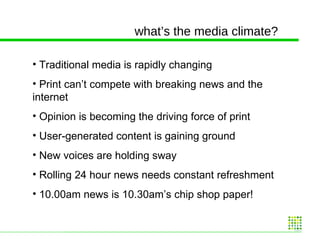
what’s the media climate? Traditional media is rapidly changing Print can’t compete with breaking news and the internet Opinion is becoming the driving force of print User-generated content is gaining ground New voices are holding sway Rolling 24 hour news needs constant refreshment 10.00am news is 10.30am’s chip shop paper!
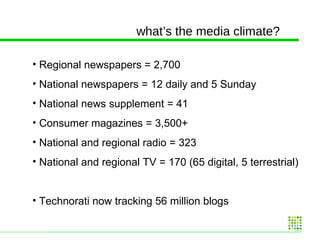
what’s the media climate? Regional newspapers = 2,700 National newspapers = 12 daily and 5 Sunday National news supplement = 41 Consumer magazines = 3,500+ National and regional radio = 323 National and regional TV = 170 (65 digital, 5 terrestrial) Technorati now tracking 56 million blogs
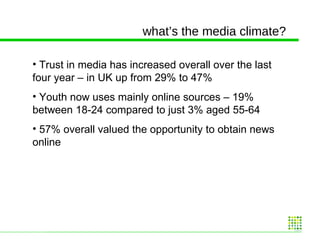
what’s the media climate? Trust in media has increased overall over the last four year – in UK up from 29% to 47% Youth now uses mainly online sources – 19% between 18-24 compared to just 3% aged 55-64 57% overall valued the opportunity to obtain news online
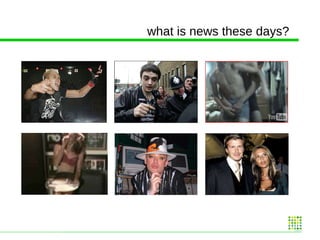
what is news these days?
it’s not all celebs though… is it? “ We have repeatedly confounded doom mongers who argue that, in the age of new media and dumbed-down celebrity culture, there is no place for intelligent, original, independent minded journalism.” David Green, Marketing Director, The Independent
Time pressures Information overload Competition of stories for limited space Deadline driven Drive for differentiation Uniqueness Job on the line!  the ‘newsroom’ environment
so what are the media looking for? News Exclusives and uniqueness Cultural relevance Current relevance A different angle A story! And stories are about people?
what makes a good news story? Timing Significance Proximity Prominence Human Interest Context
where do journalists go for stories? Survey: 1999 “ Overall, 60% of journalists throughout the world ranked fax as the preferred choice for receiving information. One third preferred email, while post was the least favourite” Survey: 2002 “ Three quarters of UK press surveyed used the web as a preferential source of information ahead of e-mail, personal contacts and other media”
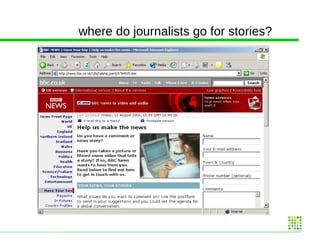
where do journalists go for stories?
Research first – understand the target Think differently Be helpful Stay current Pitch it right Place it right how to sell in
Build relationships and networks with your media Understand the media’s audience Research your journalist (or blogger) Read previous copy Research potential clashes Search online for similar stories Understand who might commentate Pre-brief potential talking heads Develop all possible requests for material research first
think differently Step into their shoes – what would you want? Be creative with angles Seed with one or two people online to generate momentum Rehearse with a friend or the team Test it with a trusted contact
be helpful Do the research for them Provide sources, angles and resources Create the story Prime the spokespeople Package the pitch Support the scheduling Know the timescales for turnaround Understand the broader opportunities Have a fall back
pitch it right What type of story is it? If it’s not new, it’s not news – target features  Who is it designed for? Does it fit in with current trends? Push back with your clients – test with a journalist  What’s the evidence? Is there ammunition? Is there an exclusive element to it? Are there supporting materials?
place it right What’s your release strategy? Who’s first? Do you know your audience well? How should it be released? Who should position it? How are you going to keep it alive? Who’s in reserve? What’s your back up strategy? Have you got your Q&A?
hints and tips Read it before before you send it! Create and rehearse the elevator pitch Call before you send it Don’t rush your pitch and keep it short Smile! Stand up when you’re on the phone Get away from your desk Pitch to a freelance – they will sell it for you If it’s not working ask for feedback
Research first  Think differently Be helpful Stay current Pitch it right Place it right how to sell in
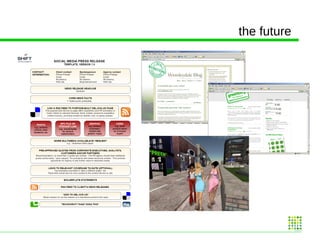
the future
selling in ends

PR for Charities

  • 1.
  • 2.
    PR & thecharity sector Ian Green, GREEN Communications
  • 3.
    what we willcover What’s the environment and pressures? What is news? How do we stay current and how can we help? What can we do to help? How do you sell in?
  • 4.
    what’s the mediaclimate? Traditional media is rapidly changing Print can’t compete with breaking news and the internet Opinion is becoming the driving force of print User-generated content is gaining ground New voices are holding sway Rolling 24 hour news needs constant refreshment 10.00am news is 10.30am’s chip shop paper!
  • 5.
    what’s the mediaclimate? Regional newspapers = 2,700 National newspapers = 12 daily and 5 Sunday National news supplement = 41 Consumer magazines = 3,500+ National and regional radio = 323 National and regional TV = 170 (65 digital, 5 terrestrial) Technorati now tracking 56 million blogs
  • 6.
    what’s the mediaclimate? Trust in media has increased overall over the last four year – in UK up from 29% to 47% Youth now uses mainly online sources – 19% between 18-24 compared to just 3% aged 55-64 57% overall valued the opportunity to obtain news online
  • 7.
    what is newsthese days?
  • 8.
    it’s not allcelebs though… is it? “ We have repeatedly confounded doom mongers who argue that, in the age of new media and dumbed-down celebrity culture, there is no place for intelligent, original, independent minded journalism.” David Green, Marketing Director, The Independent
  • 9.
    Time pressures Informationoverload Competition of stories for limited space Deadline driven Drive for differentiation Uniqueness Job on the line! the ‘newsroom’ environment
  • 10.
    so what arethe media looking for? News Exclusives and uniqueness Cultural relevance Current relevance A different angle A story! And stories are about people?
  • 11.
    what makes agood news story? Timing Significance Proximity Prominence Human Interest Context
  • 12.
    where do journalistsgo for stories? Survey: 1999 “ Overall, 60% of journalists throughout the world ranked fax as the preferred choice for receiving information. One third preferred email, while post was the least favourite” Survey: 2002 “ Three quarters of UK press surveyed used the web as a preferential source of information ahead of e-mail, personal contacts and other media”
  • 13.
    where do journalistsgo for stories?
  • 14.
    Research first –understand the target Think differently Be helpful Stay current Pitch it right Place it right how to sell in
  • 15.
    Build relationships andnetworks with your media Understand the media’s audience Research your journalist (or blogger) Read previous copy Research potential clashes Search online for similar stories Understand who might commentate Pre-brief potential talking heads Develop all possible requests for material research first
  • 16.
    think differently Stepinto their shoes – what would you want? Be creative with angles Seed with one or two people online to generate momentum Rehearse with a friend or the team Test it with a trusted contact
  • 17.
    be helpful Dothe research for them Provide sources, angles and resources Create the story Prime the spokespeople Package the pitch Support the scheduling Know the timescales for turnaround Understand the broader opportunities Have a fall back
  • 18.
    pitch it rightWhat type of story is it? If it’s not new, it’s not news – target features Who is it designed for? Does it fit in with current trends? Push back with your clients – test with a journalist What’s the evidence? Is there ammunition? Is there an exclusive element to it? Are there supporting materials?
  • 19.
    place it rightWhat’s your release strategy? Who’s first? Do you know your audience well? How should it be released? Who should position it? How are you going to keep it alive? Who’s in reserve? What’s your back up strategy? Have you got your Q&A?
  • 20.
    hints and tipsRead it before before you send it! Create and rehearse the elevator pitch Call before you send it Don’t rush your pitch and keep it short Smile! Stand up when you’re on the phone Get away from your desk Pitch to a freelance – they will sell it for you If it’s not working ask for feedback
  • 21.
    Research first Think differently Be helpful Stay current Pitch it right Place it right how to sell in
  • 22.
  • 23.