(Leishmania parasites)
Under Supervision
Dr. Raad Ajam
Students
Esraa jamel
Nawras mossa
Zahraa Thabt
Rusl Nouri
What is Leishmaniasis?
• Leishmaniasis is a disease caused
by protozoan parasites that belong to
the genus Leishmania.
• Disease is transmitted by the bite of
certain species of sand fly.
Systematic position of Leishmania
spp.
• Phylum: Euglenozoa
• Class: Kinetoplastidea
• Genus: Leishmania (L.)
From genus Leishmania about 21 species
infect human. 3species are the most
important:
1- L. donovani (Visceral Leishmaniasis
“Kala azar”).
2- L. Tropica (Cutaneous Leishmaniasis
“oriental sore”).
3- L. braziliensis (Muco-cutaneous
Leishmaniasis “Espundia”)
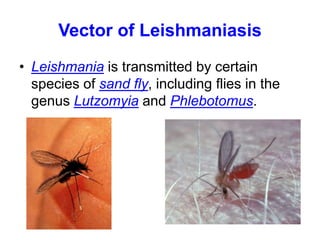
Vector of Leishmaniasis
• Leishmania is transmitted by certain
species of sand fly, including flies in the
genus Lutzomyia and Phlebotomus.
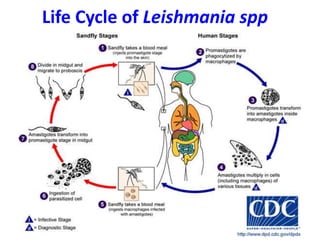
Life Cycle of Leishmania spp
Disease Transmission
1- Through the bite of infected sand
fly.
2- By direct contact with infected
material from the lesion of an
infected person.
Clinical Features
• Human leishmanial infections can result in 3
main forms of disease:
– cutaneous leishmaniasis (oriental sore),
– visceral leishmaniasis (kala-azar),
– Mucocutaneous Leishmaniasis (Espundia).
• The factors determining the form of disease
include:
– leishmanial species,
– geographic location,
– immune response of the host.
Cutaneous leishmaniasis
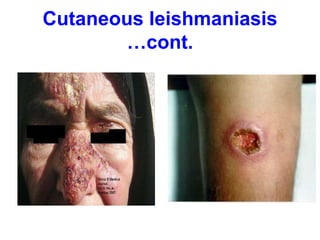
• Cutaneous leishmaniasis is characterized
by:
1- one or more cutaneous lesions on areas where
sandflies have fed.
2- Persons who have cutaneous leishmaniasis
have one or more sores on their skin.
3- The sores can change in size and appearance
over time.
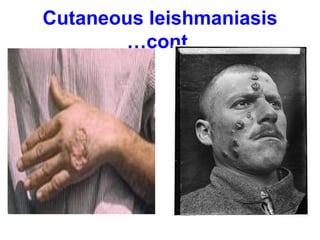
4- They often end up looking somewhat like a
volcano, with a raised edge and central crater.
5- A scab covers some sores.
6- The sores can be painless or painful.
Cutaneous leishmaniasis
…cont.
Cutaneous leishmaniasis
…cont.
Visceral Leishmaniasis
• Persons who have visceral
leishmaniasis usually have:
1- Fever.
2- Weight loss.
3- Enlarged spleen and liver (usually the spleen
is bigger than the liver).
4- Low blood counts, including a low red blood
cell count (anemia), low white blood cell count
(leukopenia), and low platelet count.
Visceral Leishmaniasis …..
Cont.
Diagnosis of Leishmaniasis
• Clinically :
1- Fever
2- Enlargement of liver and spleen.
3- Anaemia & leukopenia.
4- By the picture of sore.
• - Clinical signs and symptoms
• - Scrapings from the side or edge of the lesion in case of cutaneous
leishmaniasis and material aspirated from the spleen, bone marrow or
enlarged lymph glands and peripheral blood monocytes in case of
visceral leishmaniasis for demonstration of amastigotes by light
microscopy with Wright or Giemsa stain
• - Isolation, visualization, and culturing of the parasite from infected
tissue - Serologic detection of antibodies to Leishmania that may be
present in patient’s serum - Polymerase chain reaction (PCR) assay for
sensitive and rapid diagnosis of Leishmania species
• - Leishmanin (Montenegro) skin testing (LST) 5
• - It is an intradermal test for delayed hypersensitivity.
• - Most reliable for cutaneous leishmaniasis. A suspension of 107/ml
promastigotes in 0.5% phenol/saline given intradermally. Test is read
after 2~3 days.
• Positive test included erythema and induration occur within 48 hours
THANK YOU

3863912.ppt

  • 1.
    (Leishmania parasites) Under Supervision Dr.Raad Ajam Students Esraa jamel Nawras mossa Zahraa Thabt Rusl Nouri
  • 2.
    What is Leishmaniasis? •Leishmaniasis is a disease caused by protozoan parasites that belong to the genus Leishmania. • Disease is transmitted by the bite of certain species of sand fly.
  • 3.
    Systematic position ofLeishmania spp. • Phylum: Euglenozoa • Class: Kinetoplastidea • Genus: Leishmania (L.) From genus Leishmania about 21 species infect human. 3species are the most important: 1- L. donovani (Visceral Leishmaniasis “Kala azar”). 2- L. Tropica (Cutaneous Leishmaniasis “oriental sore”). 3- L. braziliensis (Muco-cutaneous Leishmaniasis “Espundia”)
  • 4.
    Vector of Leishmaniasis •Leishmania is transmitted by certain species of sand fly, including flies in the genus Lutzomyia and Phlebotomus.
  • 5.
    Life Cycle ofLeishmania spp
  • 6.
    Disease Transmission 1- Throughthe bite of infected sand fly. 2- By direct contact with infected material from the lesion of an infected person.
  • 7.
    Clinical Features • Humanleishmanial infections can result in 3 main forms of disease: – cutaneous leishmaniasis (oriental sore), – visceral leishmaniasis (kala-azar), – Mucocutaneous Leishmaniasis (Espundia). • The factors determining the form of disease include: – leishmanial species, – geographic location, – immune response of the host.
  • 8.
    Cutaneous leishmaniasis • Cutaneousleishmaniasis is characterized by: 1- one or more cutaneous lesions on areas where sandflies have fed. 2- Persons who have cutaneous leishmaniasis have one or more sores on their skin. 3- The sores can change in size and appearance over time. 4- They often end up looking somewhat like a volcano, with a raised edge and central crater. 5- A scab covers some sores. 6- The sores can be painless or painful.
  • 9.
  • 10.
  • 11.
    Visceral Leishmaniasis • Personswho have visceral leishmaniasis usually have: 1- Fever. 2- Weight loss. 3- Enlarged spleen and liver (usually the spleen is bigger than the liver). 4- Low blood counts, including a low red blood cell count (anemia), low white blood cell count (leukopenia), and low platelet count.
  • 12.
  • 13.
    Diagnosis of Leishmaniasis •Clinically : 1- Fever 2- Enlargement of liver and spleen. 3- Anaemia & leukopenia. 4- By the picture of sore.
  • 14.
    • - Clinicalsigns and symptoms • - Scrapings from the side or edge of the lesion in case of cutaneous leishmaniasis and material aspirated from the spleen, bone marrow or enlarged lymph glands and peripheral blood monocytes in case of visceral leishmaniasis for demonstration of amastigotes by light microscopy with Wright or Giemsa stain • - Isolation, visualization, and culturing of the parasite from infected tissue - Serologic detection of antibodies to Leishmania that may be present in patient’s serum - Polymerase chain reaction (PCR) assay for sensitive and rapid diagnosis of Leishmania species • - Leishmanin (Montenegro) skin testing (LST) 5 • - It is an intradermal test for delayed hypersensitivity. • - Most reliable for cutaneous leishmaniasis. A suspension of 107/ml promastigotes in 0.5% phenol/saline given intradermally. Test is read after 2~3 days. • Positive test included erythema and induration occur within 48 hours
  • 15.